
A rattling saddle or a slipping tuning peg can destroy the feel of a session. When your guitar isn’t holding its intonation or is snapping strings at the bridge, the instrument becomes a distraction rather than an extension of your hands. The parts you choose to fix these issues determine whether you get a stable, resonant partner or a constant source of frustration.
I’m Mohammad Maruf — the founder and writer behind Drink4Good. I spend my time analyzing hardware specifications across the guitar accessory market, comparing bridge geometries, gear ratios, and post spacing to find the components that actually deliver measurable improvements.
My focus here is on upgrades that solve real-world problems like string breakage and tuning drift. After examining customer feedback and technical data, I’ve narrowed the field to five components that define a reliable selection of guitar parts for players who want performance without guesswork.
How To Choose The Best Guitar Parts
Selecting the right component starts with identifying the specific problem you are solving. A bridge that rattles on a Bigsby-equipped guitar is a different beast than tuners that slip on a vintage Strat clone. You need to match the part’s geometry and material to your guitar’s dimensions and your playing style.
Post Spacing and Hole Diameter
Every bridge and tuning peg is built around a specific set of measurements. For a bridge, the center-to-center post spacing and the diameter of the post holes determine whether the part drops in or requires drilling. A Tune-O-Matic style bridge with a 73.5mm post spacing and 6mm post holes fits many Epiphone and import guitars. Tuners typically require either a vintage-style 8.5mm hole or a modern 9mm or 10mm hole. Always measure your existing holes before ordering.
Material and Finish
Zinc alloy is the standard for budget and mid-range bridges because it balances weight with castability. However, not all zinc alloys are equal. Better-quality zinc castings resist corrosion and hold threads longer than cheaper “pot metal” variants. For tuners, a nickel or chrome plating that resists tarnishing protects the internal gearbox from moisture. The finish is not just aesthetic — it is a shield.
Lubrication and Maintenance
New parts, especially roller saddles and tuning peg threads, often come with residual manufacturing oils that can bind. Applying a light lubricant to the saddle screws and roller pins before installation prevents binding and allows smooth intonation travel. This step is cheap and takes two minutes, but customers who skip it often return functional parts.
Quick Comparison
On smaller screens, swipe sideways to see the full table.
| Model | Category | Best For | Key Spec | Amazon |
|---|---|---|---|---|
| Guyker Locking Tuners | Tuning Pegs | Smooth tuning retention | 1:15 gear ratio, locking design | Amazon |
| KAISH Roller Bridge | Bridge | Bigsby tuning stability | 73.5mm post spacing, 14-inch radius | Amazon |
| Wilkinson E-Z LOK Tuners | Tuning Pegs | High precision tuning | 19:1 gear ratio, 10mm hole fit | Amazon |
| Guyker Bridge/Tailpiece Combo | Bridge Combo | Full bridge upgrade | 73.9mm post spacing, zinc alloy | Amazon |
| JLD Bridge Doctor | Structural Fix | Acoustic top bulge repair | Adjustable spruce pressure post | Amazon |
In‑Depth Reviews
1. Guyker 6 Inline Locking Tuners
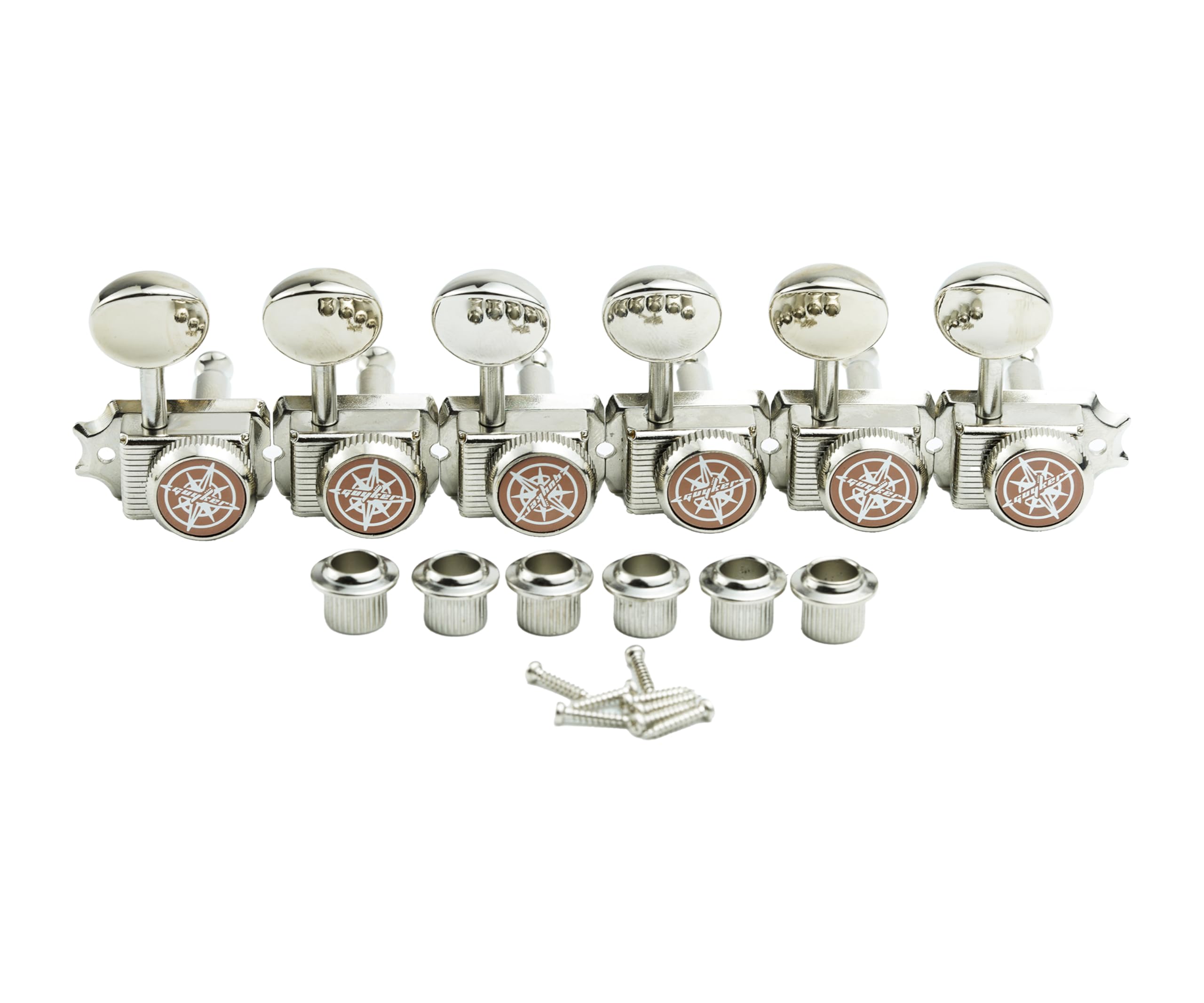
The Guyker locking tuners deliver a 1:15 gear ratio that feels smoother than many boutique sets at four times the price. The sealed housing protects the gears from dust, and the locking mechanism simplifies string changes by eliminating the need for multiple wraps around the post. Customers report gear smoothness that rivals sets costing over , with minimal backlash and a positive stop at pitch. The nickel plating resists corrosion and the oval button provides a comfortable, controlled grip for micro-adjustments.
Installation is straightforward on guitars with modern 9mm headstock holes, and the included screws and bushings cover most standard configurations. Multiple users verified a drop-in fit on Squier Classic Vibe Jaguars and Squier Affinity series guitars. The tuners add a slight weight to the headstock, which some players feel balances the neck. The upgraded logo design remains unchanged in quality between old and new inventory.
Right-hand orientation is the only configurable version, and the 1:15 ratio provides fine enough resolution for precise pitch bending. The locking mechanism is reliable across all six strings, though one unit reported a faulty Low E tuner that was replaced by the manufacturer without hassle. For players seeking the biggest tuning stability upgrade per dollar, this set outperforms the vast majority of aftermarket options.
Why it’s great
- Gear smoothness rivals premium tuners at a fraction of the cost
- Locking mechanism simplifies string changes and locks pitch firmly
- Drop-in fit on most modern 9mm headstock holes
Good to know
- Adds noticeable weight to the headstock
- One reported quality control issue with the Low E tuner
2. KAISH Chrome Roller Saddle Bridge

The KAISH roller saddle bridge solves the specific tuning instability problem that plagues Tune-O-Matic-equipped guitars with Bigsby vibrato tailpieces. Each saddle rolls freely on its pin, allowing the string to move linearly across the saddle without catching or binding. This eliminates the friction point that causes strings to go sharp or flat after vibrato use. The bridge features a 73.5mm center-to-center post spacing and a 14-inch radius, making it compatible with most Epiphone, Gretsch, and import LP-style guitars.
Zinc alloy construction gives the bridge a solid feel without being overly heavy. Users report that the bridge drops directly onto existing 6mm posts without modification on Gretsch G5230t and IYV 300 models. The retention rings prevent saddle rattle, a common annoyance with inexpensive roller bridges. The independent intonation adjustment for each saddle allows you to dial in compensation for string gauges from .009 to .052.
Pre-lubrication of the saddle screws and roller pins is essential before installation. Several customers noted that the screws arrive tight and may bind if torqued without oil. Once lubricated, the saddles move freely and the bridge dramatically improves tuning stability. The chrome plating is durable and matches standard factory hardware. For players running a Bigsby, this is the single most effective mechanical upgrade available at this tier.
Why it’s great
- Roller saddles eliminate binding for smooth Bigsby operation
- Drop-in fit on many import and mid-range guitars
- Retention rings prevent saddle rattle at high volumes
Good to know
- Requires pre-lubrication to avoid binding
- Heavier than some stock zinc bridges
3. Wilkinson E-Z LOK Post Tuners

The Wilkinson E-Z LOK Post tuners are not locking tuners; they are a specialized design that uses a split post to clamp the string end securely without wraps. The key feature is the 19:1 gear ratio, which gives you 19 turns of the tuning button for every single rotation of the string post. This provides incredibly fine tuning resolution, making micro-adjustments feel precise and deliberate. These tuners fit modern 25/64-inch (10mm) headstock holes with a 45-degree fixing tag, so they are not universal.
The flat-sided mini buttons are comfortable and provide good leverage for the high-ratio gears. The non-staggered post height means you will need to retain your string tree to maintain proper break angle across the nut. Installation is simple if your headstock holes already match the 10mm spec, but the package does not include installation instructions. Users report that these tuners hold tune perfectly after string stretching, with no pitch warble or slippage.
While they do not offer the convenience of a locking mechanism, the clamping post design grips the string effectively without requiring wraps. The sealed housing protects the 19:1 gearbox from debris. Customers upgrading cheap Telecaster tuners describe the improvement as immediate and significant. The chrome finish matches standard hardware. These are best for players who prioritize tuning precision and do not want the weight of locking tuners.
Why it’s great
- 19:1 gear ratio provides unmatched tuning precision
- Split post grips string without wraps or locking mechanism
- Sealed housing protects the gearbox from dust
Good to know
- Not a locking tuner — string tree required
- Only fits 10mm holes with 45-degree tag
4. Guyker Bridge and Stop Bar Tailpiece Combo
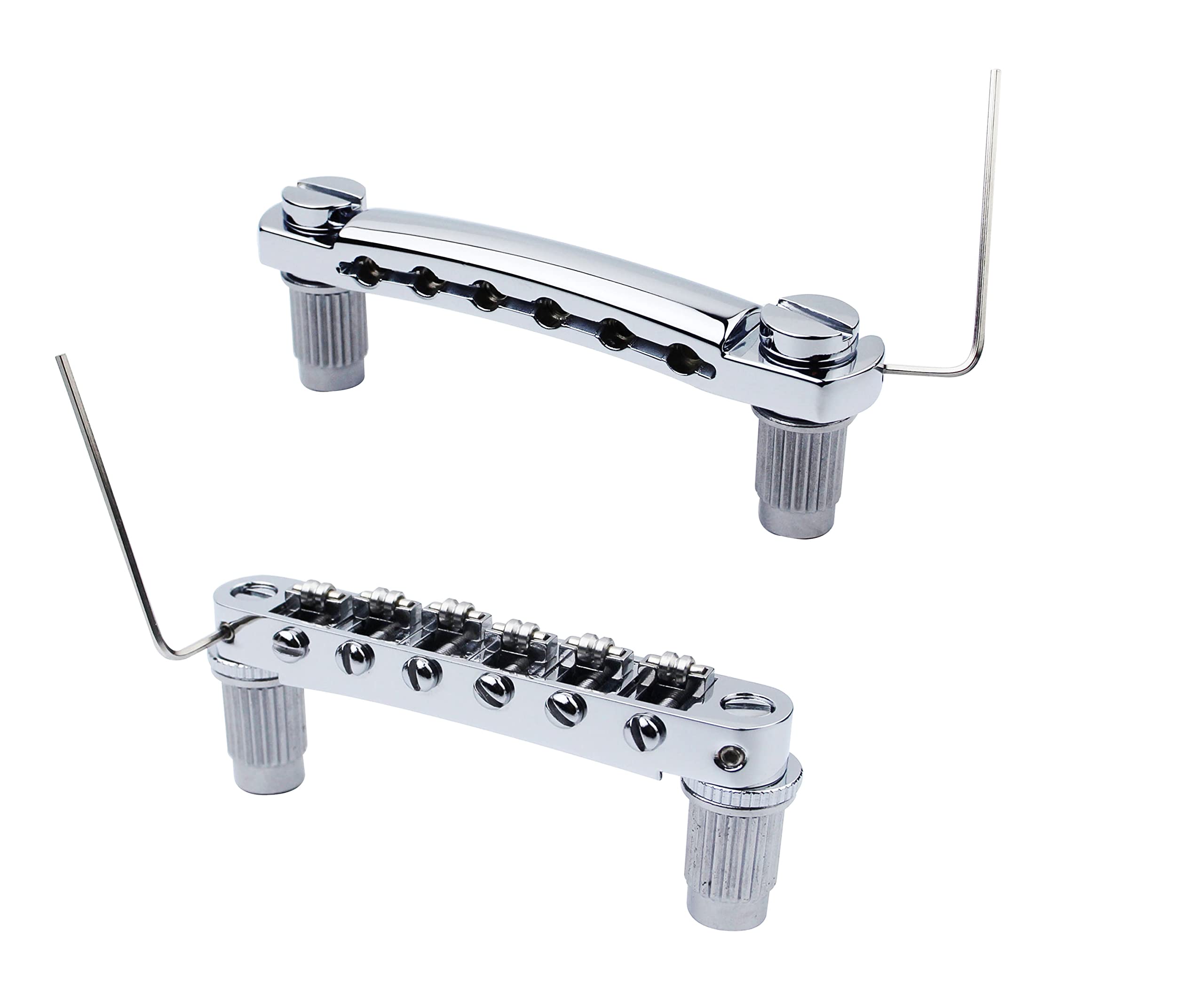
The Guyker bridge and stop bar tailpiece combo is a complete replacement system for LP, SG, and similar six-string electric guitars with Tune-O-Matic geometry. The bridge has a post spacing of 73.9mm, and the tailpiece studs are spaced at 81.9mm. The entire system is made from zinc alloy with a bronze-plated surface that gives it a vintage look and excellent durability. The roller saddle design on the bridge reduces string binding for improved tuning stability.
Installation is straightforward for a drop-in replacement, but the bridge studs may require slightly larger holes if your existing posts are narrower than the Guyker studs. Several users with Chinese-made Les Paul style guitars reported that the tailpiece studs fit perfectly but the bridge studs needed hole enlargement. The bridge dimensions are 88.9mm by 13.7mm, and the string spacing is 10.5mm, which matches standard Tune-O-Matic specifications.
Customers who installed this combo on an Epiphone LP Special 2 described it as a huge upgrade that locked the guitar in place and improved sustain. The finish is flawless and the action remained low after installation. The included tailpiece has a clean, smooth surface that improves string break angle over the bridge. For the price, this is the most complete bridge upgrade available, giving you both the bridge and tailpiece in one package.
Why it’s great
- Includes both bridge and tailpiece for a complete upgrade
- Bronze-plated zinc alloy offers good durability and vintage look
- Roller saddles improve tuning stability
Good to know
- Bridge studs may require hole enlargement on some guitars
- Avoid over-torquing the saddle screws
5. JLD Bridge Doctor

The JLD Bridge Doctor is a structural repair device designed to correct a common problem on older acoustic guitars: a belly bulge behind the bridge that lifts the bridge and raises the action. It consists of an adjustable spruce pressure post that mounts beneath the bridge and presses against the tailblock. By tightening the post, you apply downward pressure on the soundboard, flattening the bulge and lowering the action. This screw-mount version requires drilling a hole through the bridge behind the pin holes.
Installation is moderate — it requires careful drilling and measurement, but several verified purchasers with 50-year-old Martin 12-strings and 1963 Guild F-30s reported positive results. The device reduced top bow by up to 5mm in some cases, saved hundreds of dollars in professional repairs, and improved playability. The instructions are included, but a handy person with basic tools can complete the job in under 30 minutes. The spruce material matches the wood of many vintage acoustic tops.
The device includes a small black plastic dot to cover the screw hole, though some users wished for an abalone dot for better cosmetic matching. One user noted that the device slightly reduced brightness in the guitar’s tone, but found that loosening it partially restored the original voice. It is not a miracle cure for a cracked soundboard, but for a guitar with a belly bulge and a lifting bridge, it is a proven, cost-effective alternative to a luthier repair.
Why it’s great
- Corrects belly bulge and lowers action without expensive repair
- Spruce construction matches vintage acoustic materials
- Simple installation for a handy person
Good to know
- Requires drilling a hole through the bridge
- May slightly reduce brightness; can be loosened to restore tone
FAQ
How do I know if a roller saddle bridge will fit my guitar?
What is the difference between locking and non-locking tuners?
Final Thoughts: The Verdict
For most users, the guitar parts winner is the Guyker 6 Inline Locking Tuners because they deliver premium-level gear smoothness and locking functionality at a fraction of the price of name-brand alternatives. If you want a rock-solid tuning solution for your Bigsby-equipped guitar, grab the KAISH Chrome Roller Saddle Bridge. And for correcting an acoustic belly bulge without a costly luthier visit, nothing beats the JLD Bridge Doctor.