
A leggy seedling and a thriving Monstera both start with the same thing: the right light delivered at the right intensity. Standard household bulbs lack the specific red and blue wavelengths that drive photosynthesis, which is why indoor plants stretch toward a window or simply stop growing. Dedicated grow light bulbs solve this by emitting a targeted spectrum that mimics the sun, but not all bulbs deliver the same photosynthetic photon flux (PPF) or coverage pattern.
I’m Mohammad Maruf — the founder and writer behind Drink4Good. I’ve spent years analyzing the spectral output curves, lumen maintenance data, and real-world customer durability reports for the indoor gardening accessory market to separate bulbs that actually drive growth from those that just look bright to the human eye.
Whether you are germinating seeds, nurturing succulents, or coaxing a lemon tree through a dark winter, choosing the right bulb comes down to understanding beam angle, color temperature, and PPF values. After evaluating dozens of options, I’ve built a focused guide to the best grow light bulbs for indoor plants so you can match the exact light recipe to your specific setup.
How To Choose The Best Grow Light Bulbs For Indoor Plants
A grow light bulb that works perfectly for a low-light pothos can scorch a succulent or fail to trigger flowering in a pepper plant. Three specs define whether a bulb is right for your indoor garden: photosynthetic photon flux (PPF), beam angle, and the specific red-blue-amber chip mix inside the LED array.
Match the PPF to Your Plant Stage
PPF measures the total micromoles of photosynthetically active photons emitted per second. Seedlings and leafy greens thrive with a PPF around 20 to 30 µmol/s, while fruiting plants like tomatoes or peppers need 40 to 50 µmol/s. Bulbs that list only lumen output or wattage without PPF are hiding the metric that actually determines growth rate.
Beam Angle Determines Coverage Depth
Narrow-beam bulbs (around 50 degrees) concentrate light into a tight cone, making them ideal for tall plants or deep pots where photons need to reach lower leaves. Wide-beam bulbs (230 degrees) spread light across a broad area but lose intensity quickly beyond 12 inches, so they work best for propagation trays or shallow shelves of succulents.
Full Spectrum vs Red-Blue-Only
Bulbs that emit a balanced white light at 5000K combined with targeted red (660nm) and blue (450nm) peaks deliver good visual clarity and solid photosynthesis. Bluish-purple bulbs that lack any white chips save energy but make it hard to spot pests or assess leaf health. For living spaces, a full spectrum bulb with a CRI above 85 is the practical middle ground.
Quick Comparison
On smaller screens, swipe sideways to see the full table.
| Model | Category | Best For | Key Spec | Amazon |
|---|---|---|---|---|
| GE Grow LED PAR38 | Flood Light | Fruiting plants & tall pots | PPF of 50 µmol/s | Amazon |
| Philips LED PAR38 | Flood Light | Medium to large plants | Beam angle 50 degrees | Amazon |
| ALIDE A19 6-Pack | A19 Screw-In | Multi-shelf propagation | 230° beam angle | Amazon |
| ALIDE A19 3-Pack | A19 Screw-In | Single shelf or desk setup | 10W draw / 100W equiv. | Amazon |
| Hydrofarm Agrobrite CFL | Spiral CFL | Seedling germination | 6400K / 1600 lumens | Amazon |
In‑Depth Reviews
1. GE Grow LED Light Bulb, PAR38 Flood Light

The GE PAR38 delivers the highest PPF in this roundup at 50 µmol/s, which puts it in the same performance class as small panel fixtures but in a standard E26 flood format. That photon output translates directly to measurable growth in flowering houseplants, citrus trees, and fruiting vegetables. The advanced red spectrum peaks at the 660nm range that plants use most efficiently during bloom and fruit set, while the white light output stays visually neutral enough for a living room bookshelf.
A properly finned aluminum heat sink keeps the LED junction cool during 18-hour daily runs, and the 25,000-hour lifespan means this bulb will survive several years of continuous use before needing replacement. The 40-watt incandescent equivalent rating understates the actual usable light — the PAR38 reflector concentrates intensity into a cone that reaches the lower leaves of a 30-inch tall plant without scorching the top canopy.
User reports note the bulb runs warmer to the touch than smaller A19 designs, which is a direct consequence of the higher drive current, but the heat sink keeps the surface below burn risk. The bulb is noticeably heavier than a standard flood, so a plastic clip-on fixture may sag — a metal lamp stand with a ceramic socket is the safer pairing.
Why it’s great
- Highest PPF of the group at 50 µmol/s supports flowering and fruiting stages.
- Full spectrum white light with targeted red peaks avoids the harsh purple glow.
- 25,000-hour rated lifespan reduces long-term replacement cost.
Good to know
- Heavier than standard A19 bulbs; needs a sturdy fixture.
- Runs warm to the touch due to higher output — keep at recommended 24-30 inch distance.
2. Philips LED Plant Grow Light Bulb PAR38

Philips brings its horticultural lighting expertise to the PAR38 form factor with a 15.5-watt bulb that hits 1325 lumens at a daylight 5000K color temperature. The 50-degree beam angle is narrower than the wide-dispersion A19 bulbs, which gives the Philips an edge when lighting a single large plant in a pot — it concentrates the photons rather than scattering them across a whole tabletop. The CRI of 92 means the light renders leaf textures and soil moisture accurately, which helps with early pest detection.
The Title 20 certification confirms the bulb meets California’s strict efficiency standards, and the mercury-free construction aligns with the brand’s environmental commitments. Users consistently report that the bulb runs cooler than competing PAR38s, partly because the 15.5W draw is lower than the GE’s drive current while still delivering useful intensity for medium-sized foliage plants like peace lilies and orchids within a 12 to 18 inch radius.
One practical limitation is the single-bulb packaging — covering a multi-tier shelf requires buying multiple units, which pushes the total investment higher than multi-pack A19 alternatives. The bulb does not connect to Philips Hue, so it functions as a straightforward on/off fixture light without dimming or scheduling built in.
Why it’s great
- Very high CRI of 92 for accurate color rendering and early pest spotting.
- Narrow 50-degree beam angle delivers concentrated light to deep pots.
- Title 20 certified and runs cooler than many high-output PAR38 models.
Good to know
- Single-bulb packaging increases cost for multi-plant setups.
- Not compatible with Philips Hue smart lighting system.
3. ALIDE E26 A19 LED 6-Pack Full Spectrum
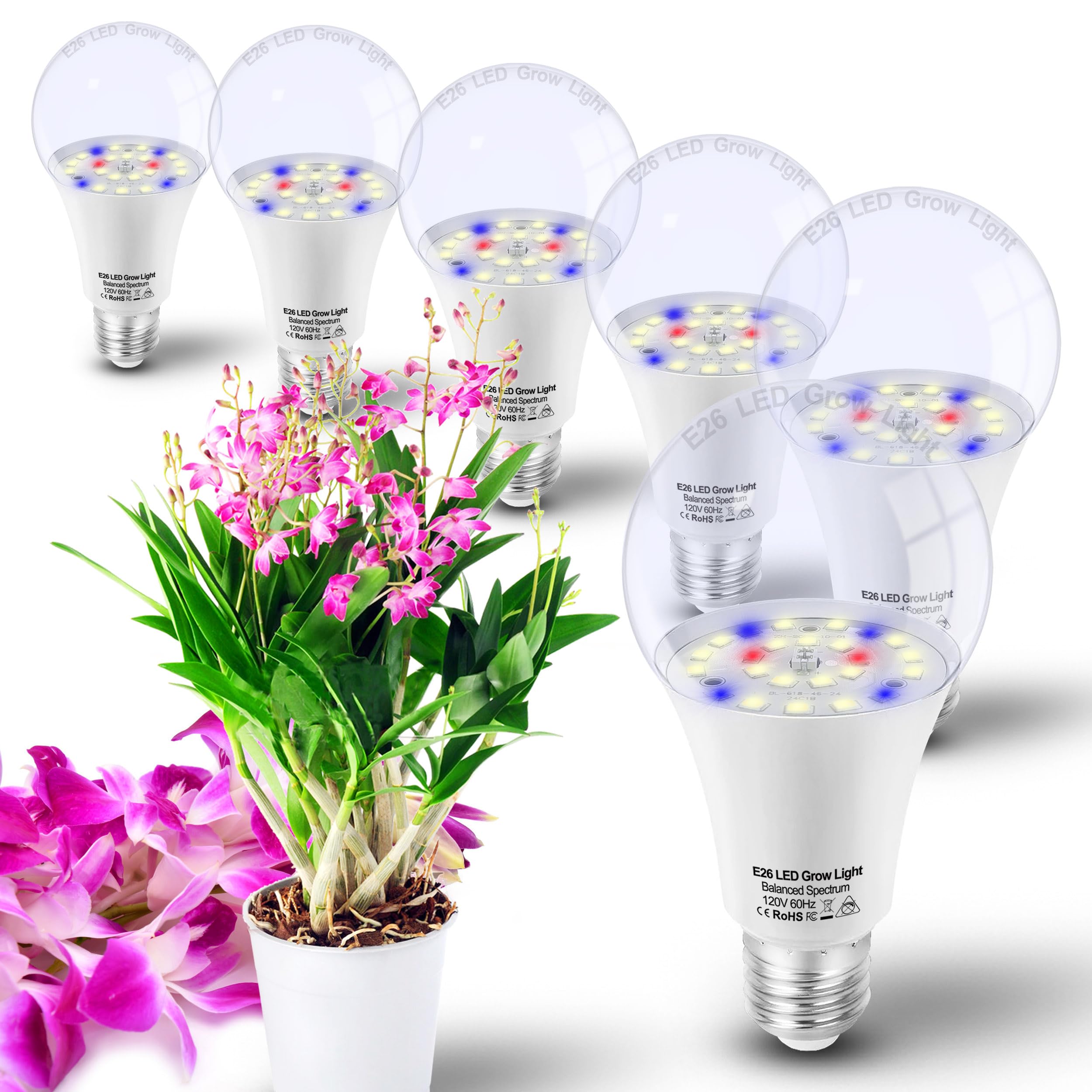
The ALIDE 6-pack offers the most economical way to light a multi-shelf greenhouse or a propagation station without buying individual bulbs. Each A19 bulb draws only 10 watts while delivering 1000 lumens at a 5000K color temperature, and the 230-degree beam angle spreads light across a wide, shallow area — ideal for seedling trays and low-growing succulents spaced within 12 inches of the bulb. The proprietary chip mix includes red (600-699nm), blue (400-499nm), and yellow (570-599nm) LEDs that cover the full germination-to-flowering spectrum.
The measured PPF of 23 µmol/s per bulb is modest compared to the PAR38 floodlights, but the advantage here is density: six bulbs spaced across a shelf system can deliver cumulative PPF that matches a single high-output flood. The standard E26 base screws into any existing lamp or ceiling fixture, so there is no need for specialized drivers or wiring.
Because the bulbs are not waterproof, they require a covered fixture if used in a greenhouse or humidity-prone area. The color temperature leans toward a cool white with a faint pinkish tint from the red chips — acceptable for a grow room but slightly off-putting in a living room lamp.
Why it’s great
- Six bulbs in one box cover multiple shelves at the lowest per-unit cost.
- Broad 230-degree beam angle ideal for shallow trays and low plants.
- Red, blue, and yellow chip mix supports all growth stages.
Good to know
- PPF of 23 µmol/s is low for tall or fruiting plants.
- Not waterproof — needs a covered fixture in humid spaces.
4. ALIDE E26 A19 LED 3-Pack Full Spectrum

This three-pack version of the ALIDE A19 delivers the same 5000K full spectrum and 230-degree beam angle as the six-pack, but in a smaller quantity that suits a single desk setup, a single-tier shelf, or a kitchen counter herb garden. The 10-watt draw per bulb keeps the electricity cost negligible even during 16-hour photoperiods, and the 1000 lumen output provides enough intensity for low to medium-light plants like pothos, snake plants, and leafy greens within a 12-inch distance.
The balanced chip ratio (red, blue, and 5000K white) produces a neutral white light that does not wash a room in purple, making these bulbs suitable for open shelving where aesthetics matter. Owners of succulents and cacti report that the bulbs prevent etiolation — the leggy stretching that happens when plants strain toward insufficient light — as long as the bulb is positioned no more than 10 inches above the canopy.
Several user accounts mention receiving a replacement pack promptly when a single bulb arrived non-functional, which suggests the brand supports its warranty well. The main trade-off versus the six-pack is simply the total coverage area; if you plan to expand your indoor garden, buying two three-packs costs slightly more than one six-pack.
Why it’s great
- Three bulbs cover a single shelf or desk setup at low upfront cost.
- Neutral white light with no purple cast blends into home decor.
- 10W per bulb runs very cool and keeps energy bills low.
Good to know
- PPF of 23 µmol/s per bulb is insufficient for tall or fruiting plants.
- Cannot daisy-chain; each bulb needs its own socket.
5. Hydrofarm Agrobrite FLC26D 26W CFL

The Agrobrite FLC26D is a 26-watt compact fluorescent spiral that has been a staple in the indoor gardening community for years. At 6400K (daylight) it outputs 1600 lumens, and the 130-watt incandescent equivalent rating gives a sense of the usable light for seedling germination and vegetative growth. The CFL technology generates less intensity per watt than modern LED designs, but the broad spiral shape disperses light in all directions, making it forgiving for beginners who place bulbs at uneven distances.
The rated 10,000-hour lifespan is shorter than an LED’s 25,000 hours, and the CRI of 64 is noticeably lower than the LED options — leaf color appears washed out under this bulb. However, users consistently report strong germination rates and vigorous early growth in seedlings, and the low surface temperature means the bulb can be placed within 3 to 4 inches of a seed tray without burning delicate stems. The E26 medium base fits any standard household fixture.
Some units have been reported to fail earlier than the rated lifespan, particularly when used in high-humidity environments. The bulb also contains a small amount of mercury, so it requires proper disposal at end of life rather than tossing it in the household trash.
Why it’s great
- Proven track record for rapid seedling germination and early vegetative growth.
- Very low surface temperature allows placement within 3-4 inches of plants.
- Broad spiral dispersion covers a wide area without hot spots.
Good to know
- Lower efficiency than LED; more wattage needed for the same PPF.
- CRI of 64 makes leaf colors look washed out compared to LED options.
FAQ
Can I use a regular LED bulb as a grow light for indoor plants?
What is the ideal distance to hang a PAR38 grow light bulb above a plant?
How many hours per day should I run an indoor grow light bulb?
Does a higher CRI number mean better plant growth from a grow light bulb?
Final Thoughts: The Verdict
For most users, the best grow light bulbs for indoor plants winner is the GE Grow LED PAR38 because its 50 µmol/s PPF and full spectrum output support everything from leafy greens to fruiting citrus in a single flood format. If you want wide coverage for a multi-shelf propagation setup, grab the ALIDE A19 6-Pack. And for budget-friendly seedling germination without scorching delicate stems, nothing beats the Hydrofarm Agrobrite CFL.