
The average 18-hole round involves over six miles of walking on uneven terrain, punctuated by explosive rotational forces during every swing. Most golfers overlook the foundation of their game: the interface between their foot and the shoe. The right insole transforms this dynamic, anchoring your foot securely and absorbing the repetitive shock that leads to mid-round fatigue and post-game soreness.
I’m Mohammad Maruf — the founder and writer behind Drink4Good. I’ve spent years analyzing biomechanical hardware, from orthotic shell rigidity to foam density gradients, specifically within the narrow category of performance insoles for rotational sports like golf.
After weeks of filtering customer feedback and manufacturer specs, I’ve narrowed the market to five products that genuinely change your experience on the course. These are the best golf shoe insoles I found after reading through hundreds of verified reviews from players who logged real rounds.
How To Choose The Best Golf Shoe Insoles
Golf imposes unique demands on your feet: prolonged standing, lateral weight transfer, and high-impact rotation. A standard foam insole designed for running will collapse under these conditions. You need to evaluate arch profile, heel cup depth, and foam density specifically for the torque and duration of a round of golf.
Evaluate the Arch Profile
Your arch type dictates the insole shape you need. Neutral or high arches benefit from a full-contact contour that cradles the foot’s natural curve. Flat feet require a firmer, more aggressive arch bridge that prevents over-pronation during the backswing and follow-through. A medium arch profile is the most common and versatile, offering a balance between lift and flexibility.
Check for a Deep Heel Cup
A shallow heel cup allows your foot to slide slightly inside the shoe during a fast hip rotation. A deep, U-shaped heel cup locks the calcaneus in place, providing a stable platform for the entire kinetic chain. This reduces the likelihood of blisters and improves power transfer from the ground up through the club head.
Assess Material Rigidity and Foam Density
Golf insoles need a semi-rigid internal structure — usually a polypropylene shell or a dense TPU plate — to resist deformation under rotational load. The top layer should use Poron or a closed-cell foam that absorbs vertical shock without bottoming out over 18 holes. Avoid insoles made entirely of soft memory foam, as they provide no torsional stability.
Verify Trim-to-Fit Compatibility
Golf shoes from brands like FootJoy, Adidas, and Nike vary in width and toe-box volume. A trim-to-fit insole lets you cut along sizing lines to match your specific shoe model. This ensures the insole sits flat against the footbed without curling at the edges, which can cause pressure points during lateral movement.
Quick Comparison
On smaller screens, swipe sideways to see the full table.
| Model | Category | Best For | Key Spec | Amazon |
|---|---|---|---|---|
| GED Golf Shoe Insoles | Premium | Golf-specific stability | 8.6% lighter with 20% improved rebound | Amazon |
| Linear Foot Motion | Mid-Range | Prescription-grade support | Firm polypropylene shell (40% thinner) | Amazon |
| VALSOLE Heavy Duty | Mid-Range | High arch support | Designed for 220+ lbs frames | Amazon |
| Professional Heavy Duty | Budget-Friendly | Medium arch, all-day wear | Double PORON cushioning layers | Amazon |
| Fit Geno Orthotics | Budget-Friendly | Heavy-duty work shifts | Removable TPU arch plate | Amazon |
In‑Depth Reviews
1. GED Golf Shoe Insoles for Men
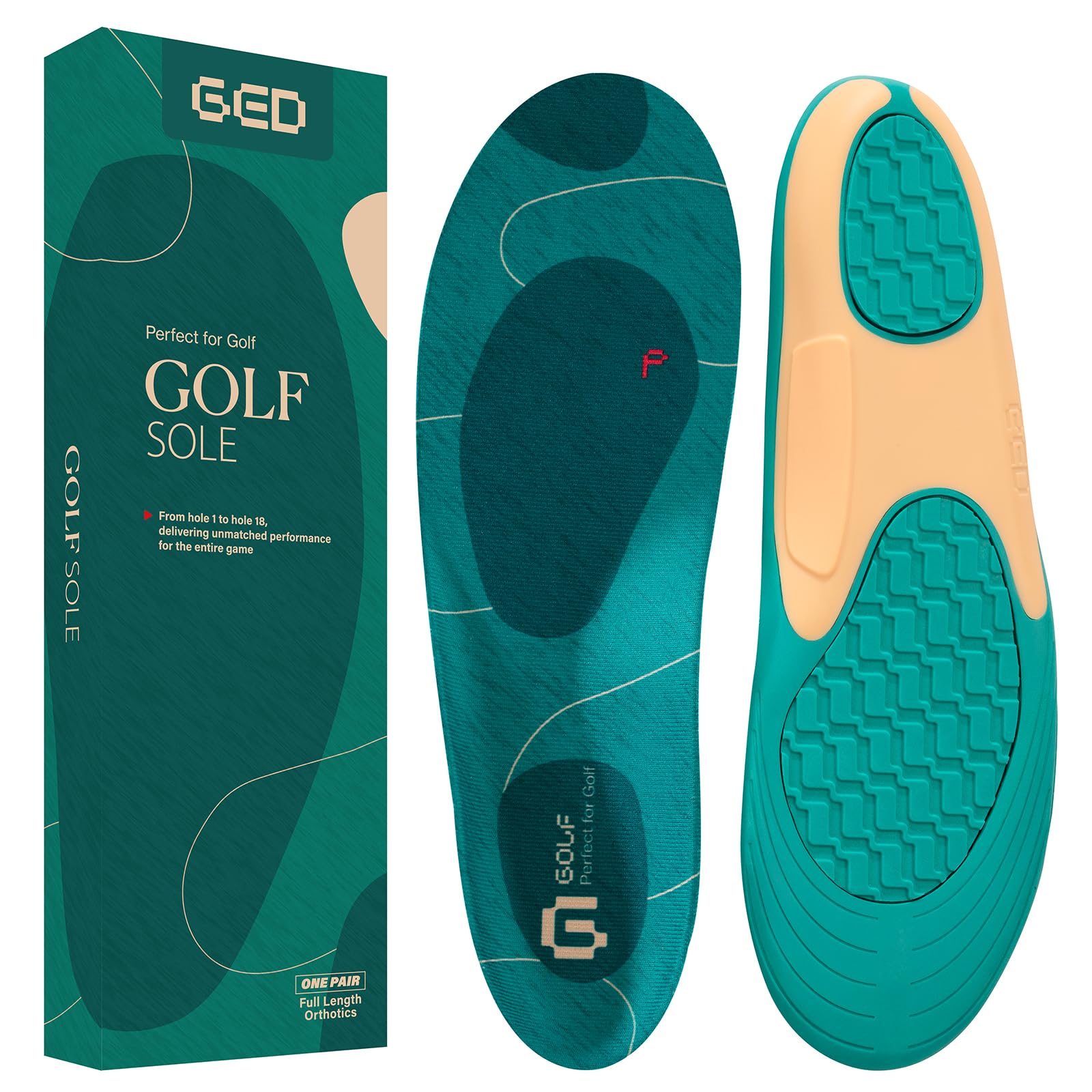
These insoles are the only product in this roundup designed from the ground up for golf, not adapted from a general orthotic. The architecture includes a deep heel cup that locks your calcaneus during the rotational torque of a driver swing, reducing heel lift inside the shoe. At 8.6% lighter than the previous generation, they eliminate the heavy, dead feeling some orthotics create inside a golf shoe.
The rebound material is the standout spec: after being compressed by a 440-pound load for 24 hours, the insole returns to 95% of its original height within 30 minutes. In practical terms, this means the insoles will not flatten out by the 15th hole on a hot day. The gentle arch profile works well for neutral arches, and the trim-to-fit lines let you drop them into most FootJoy and Adidas models without puckering at the toe box.
Customer reviews consistently mention reduced foot fatigue after walking 18 holes, with one player noting they felt less tired in their feet and legs compared to the stock insole. The breathable top layer also resists moisture buildup during humid summer rounds. If you want one pair that handles both the walk and the swing, this is it.
Why it’s great
- Engineered specifically for golf swing dynamics, not generalized walking
- Exceptional rebound recovery after sustained compression
- Lightweight build preserves shoe feel without adding bulk
Good to know
- Gentle arch profile may not satisfy golfers with very flat feet or high arches
- Less rigid than prescription-grade orthotics for severe pronation
2. Linear Foot Motion Orthotic Insoles
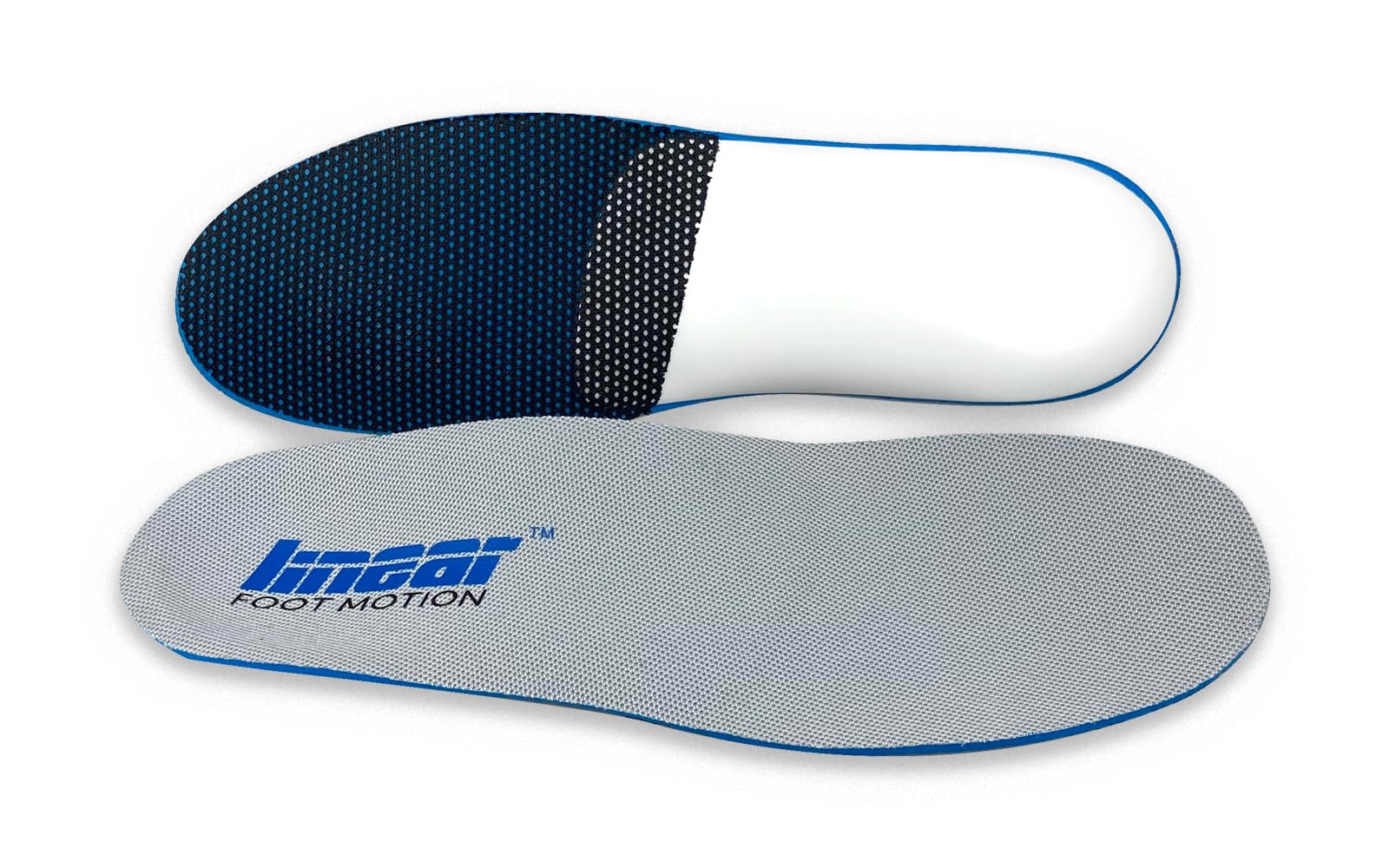
Linear Foot Motion is built around a rigid polypropylene shell that mimics the material used in custom podiatric orthotics costing ten times as much. The shell does not flex or collapse under rotational load, making this an ideal choice for golfers who over-pronate during their backswing or supinate on the follow-through. The full-contact arch design distributes weight across the entire footbed rather than concentrating pressure at the arch apex.
The key dimensional spec is thickness: at 40% thinner than typical heavy-duty orthotics, these slide into spiked golf shoes without crowding the toe box or requiring you to loosen the laces two extra notches. The top cover is a breathable moisture-wicking fabric that resists odor after repeated use. Multiple verified reviews mention the shell eliminated knee and hip pain that had persisted through years of custom orthotics.
One reviewer with chronic shin splints reported full resolution after switching from gel inserts to this rigid platform. The downsides are real: the plastic shell has a break-in period of several hours, and players accustomed to plush cushioning may find the firmness jarring at first. But for golfers with diagnosed pronation issues, the structural control is unmatched in this price tier.
Why it’s great
- Medical-grade polypropylene shell resists collapse under rotational torque
- Thin enough to fit dress golf shoes and cleats without trimming
- Broad weight distribution reduces pressure points throughout the round
Good to know
- Rigid feel requires a break-in period of a few days
- Too firm for golfers seeking a plush, cushioned footbed
3. VALSOLE Heavy Duty Support Orthotics

VALSOLE positions its Heavy Duty insoles for bodies over 220 pounds, and the engineering backs up that claim. The arch bridge is built with a pronounced medial rise that supports high arches aggressively, preventing the arch from collapsing during the explosive pivot of a drive. The deep heel cup extends upward at the rear to cradle the heel, which minimizes slippage inside a golf shoe during the lateral shift of a power swing.
The foam layer uses a dense EVA formulation that does not bottom out quickly. One 6-foot-5, 235-pound reviewer who is a former athlete reported zero foot pain after the first day of use, noting that the insoles outperformed 20 years of previous inserts. The shock absorption translates directly to reduced knee and lower-back strain on hard fairways and cart paths.
On the downside, the overall thickness can crowd the inside of narrow-profile golf shoes. Some players with size 10 or smaller feet reported needing to loosen laces to accommodate the volume. The insoles also have a brief adaptation period where the high arch feels overly aggressive. For taller, heavier golfers with high arches, however, this is a performance upgrade that changes how your body feels after the 18th green.
Why it’s great
- Aggressive high arch support prevents collapse during heavy rotational loads
- Deep heel cup eliminates slippage inside the shoe during weight shift
- Dense EVA foam absorbs shock on hard surfaces without flattening
Good to know
- Thick build may fit tightly in narrow or low-volume golf shoes
- High arch profile can feel intrusive if you have neutral or low arches
4. Professional Heavy Duty Support Pain Relief Orthotics

This is the most budget-friendly option in the lineup, but it avoids the trap of using cheap memory foam that flattens after two rounds. The insole integrates double PORON cushioning layers, a material commonly specified in clinical-grade orthotics because of its ability to absorb high-impact forces without losing density. The “Golden Triangle” three-point support design distributes pressure across the forefoot, arch, and heel rather than concentrating it in the arch alone.
The medium arch profile works for a wide spectrum of foot types. Multiple customer reviews from warehouse workers and retail employees confirm that the insoles held up through nine- to ten-hour shifts on concrete floors without noticeable flattening. In golf terms, that durability translates to consistent support through a full morning round followed by nine more holes in the afternoon.
The primary trade-off is thickness. At nearly half an inch at the heel, these insoles take up significant interior volume. Golfers with snug-fitting spiked shoes reported needing to loosen laces to avoid pressure on the top of the foot. For players with wide feet or generous room in their golf shoes, this is a strong entry-level pick that delivers structural support at a fraction of the cost of premium alternatives.
Why it’s great
- Double PORON foam layers absorb shock effectively without rapid compression
- Three-point pressure distribution reduces localized fatigue
- Excellent durability for the price point
Good to know
- Thick heel stack may cause tightness in low-volume golf shoes
- Medium arch lacks aggressive support for pronation correction
5. Fit Geno Arch Support Plantar Fasciitis Insoles
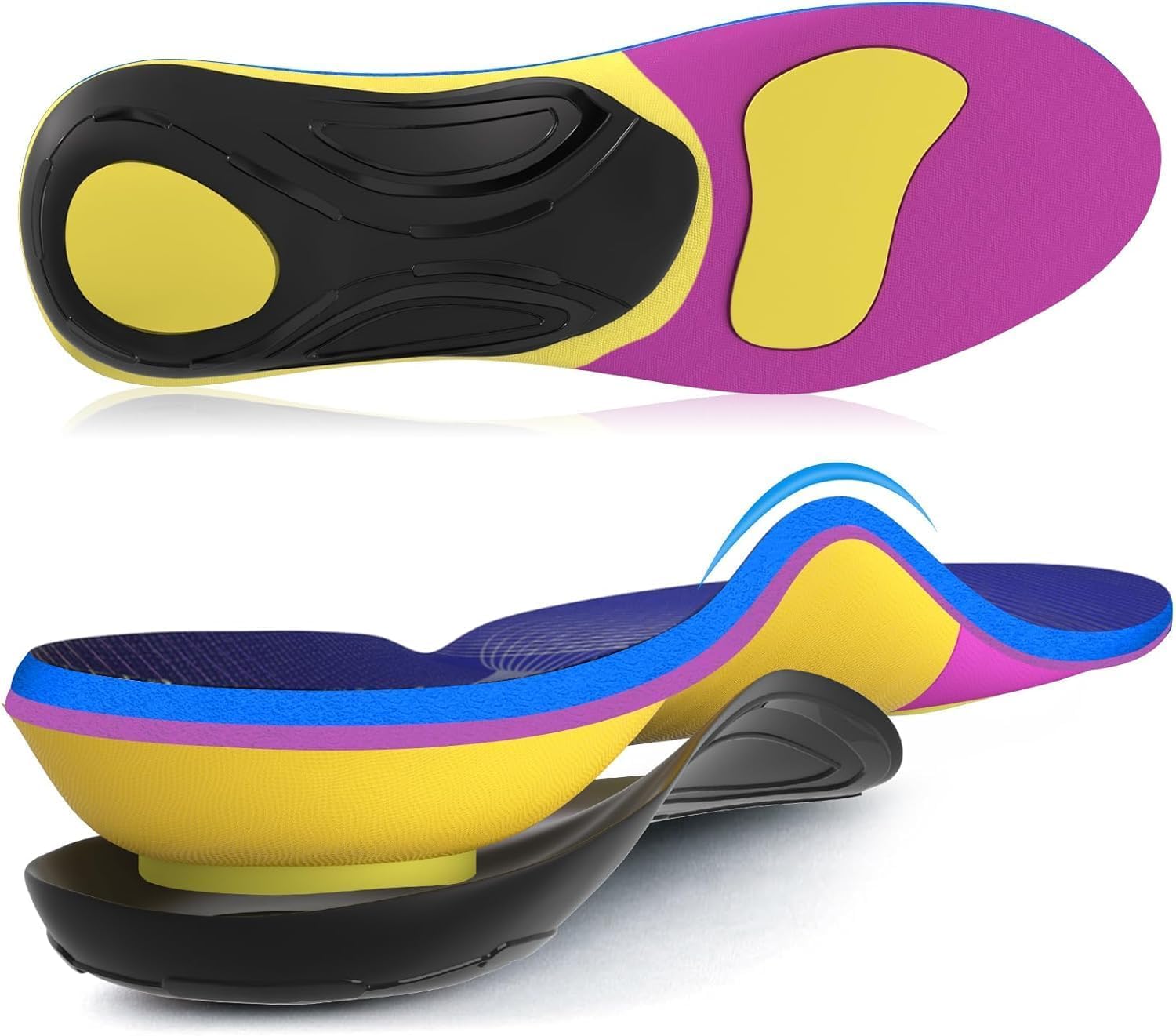
Fit Geno takes a different approach by offering a modular design: the rigid TPU arch plate is removable, giving you two levels of support in one insole. With the plate inserted, the insole provides firm resistance against over-pronation, making it suitable for flat-footed golfers who need a structural bridge. With the plate removed, the remaining Poron foam bed delivers a softer, more forgiving platform for casual rounds or recovery days.
The foam used at the heel and ball of the foot is Poron, a micro-cellular urethane that retains 95% of its shock-absorbing capacity after repeated compression. This matters on the course because the heel strike during walking and the forefoot pressure during a finish stance are the two high-impact zones. The deep heel cup is paired with a slight medial post to guide the foot into neutral alignment through the swing arc.
Customer feedback highlights the dual-layer design as a key differentiator. One reviewer noted that after removing the hard plastic brace during a long walking day, the remaining comfort layer still outperformed gel inserts. The breathable fabric cover also resists moisture well. The primary drawback for golf-specific use is that the insole is designed primarily for work boots and athletic shoes, so the shape may not contour perfectly to the narrower last of a golf shoe.
Why it’s great
- Removable TPU plate lets you switch between rigid support and soft cushioning
- Poron foam retains shock absorption capacity after sustained load
- Deep heel cup and medial post reduce pronation during the swing
Good to know
- Shape is optimized for wide footwear, may not fit narrow golf shoes perfectly
- Full rigid setup requires a break-in period for flat-footed users
FAQ
Will thick insoles fit inside my FootJoy spiked shoes?
Can I use running insoles for golf instead of dedicated golf insoles?
How often should I replace golf shoe insoles?
Do golf insoles help with plantar fasciitis?
How do I trim an insole to fit my golf shoes?
Final Thoughts: The Verdict
For most golfers, the best golf shoe insoles winner is the GED Golf Shoe Insoles for Men because they are the only pair designed specifically for the biomechanics of a golf swing, combining a deep heel cup, 20% improved rebound recovery, and a lightweight profile that fits seamlessly into spiked shoes. If you need prescription-grade pronation control, grab the Linear Foot Motion Orthotic Insoles with their firm polypropylene shell. And for the budget-conscious golfer with medium arches who wants durable double-layer cushioning, the Professional Heavy Duty Support Orthotics offer the best value without sacrificing structural support.