
Oregon’s unique climate—from the wet, mild valleys west of the Cascades to the drier, high-desert east—demands a grass seed that can handle both cool-season rain and summer dry spells. Pick the wrong blend and you will watch bare patches spread by mid-August.
I’m Mohammad Maruf — the founder and writer behind Drink4Good. I have spent years analyzing regional grass seed performance, studying germination rates, weed-content labels, and soil adaptability for Oregon landscapes.
This guide compares five regionally relevant grass seed options to help you choose the right mix for your yard. If you are looking for the best grass seed for oregon, the following reviews break down germination speed, shade tolerance, and weed-free purity so you can buy with confidence.
How To Choose The Best Grass Seed For Oregon
Oregon’s growing zones range from 6a to 9a, so a single “one-size-fits-all” seed mix rarely performs across the entire state. The key is matching your grass type to your region’s rainfall, your lawn’s sun exposure, and the kind of foot traffic your yard endures.
Match the Grass Type to Your Region
Western Oregon (Willamette Valley, Portland, Eugene) stays damp for much of the year, making cool-season grasses like fine fescue and perennial ryegrass the natural choice. Eastern Oregon, which sees colder winters and hotter, drier summers, often benefits from tall fescue blends that develop deeper root systems to survive prolonged dry spells.
Check the Weed and Filler Content
Oregon has strict noxious weed laws, but bagged seed from national brands can still contain annual bluegrass or bentgrass seeds that ruin a uniform lawn. Look for a label that states “99.9% weed-free” or “no filler” — and verify that the seed was grown in the Willamette Valley, where local producers test for region-specific contaminants.
Consider Shade vs. Sun Exposure
Many Oregon properties sit under mature Douglas fir or maple canopies, which create dense shade for most of the day. Fine fescues (especially creeping red fescue) have the highest shade tolerance among cool-season grasses. Tall fescue blends marketed as “sun and shade” can handle partial shade but may thin out in full darkness under a conifer canopy.
Quick Comparison
On smaller screens, swipe sideways to see the full table.
| Model | Category | Best For | Key Spec | Amazon |
|---|---|---|---|---|
| GreenView Perennial Ryegrass | Premium Perennial | Quick green-up & high-traffic overseeding | 99.9% weed-free; covers 3,500 sq ft | Amazon |
| GreenView Tall Fescue Blend | Premium Turf-Type | Drought resistance & sun/shade versatility | 99.9% weed-free; germinates in 10-14 days | Amazon |
| Eretz Creeping Red Fescue | Premium Fine Fescue | Deep shade under trees & low-maintenance slopes | 99.6% pure seed; 0.4% inert matter | Amazon |
| Eretz Annual RyeGrass | Budget Annual | Erosion control & temporary winter green | Willamette Valley grown; no fillers | Amazon |
| Pennington Annual Ryegrass | Budget Annual | Fast winter color for warm-season lawn overseeding | 10 lb bag; visible results in 3-7 days | Amazon |
In‑Depth Reviews
1. GreenView Pure Grass Seed Perennial Ryegrass Blend

This 7-pound perennial ryegrass blend from GreenView positions itself as a workhorse for Oregon lawns, and the 99.9% weed-free guarantee backs that up. With a 7- to 12-day germination window, this mix fits the typical spring and fall windows in the Willamette Valley, where consistent rain helps establish new turf without constant sprinkler intervention. The medium-to-fine blade texture gives a manicured look that holds up well under moderate foot traffic.
User reports note that this blend outperformed competitors in both sun and partial shade germinations, with one reviewer seeing visible growth within 24 hours in late April when soil temperatures stayed above 60°F. The coverage range (1,750 sq ft for new lawns, 3,500 sq ft for overseeding) provides excellent value for a mid-sized yard, especially when compared to big-box store options that often carry bentgrass fillers.
The drought and heat resistance claims rely on deep root establishment, which requires consistent soil moisture during the first four weeks. Over-seeding into an existing fescue or bluegrass lawn produces the fastest visual results, but starting bare soil from scratch may need additional top dressing and peat moss to hold moisture through those first critical weeks.
Why it’s great
- Pure seed with no filler — what you sow is what grows
- Fast germination even in partial shade
- Excellent coverage per pound for overseeding
Good to know
- Dry spring weather may stretch germination beyond the advertised 7 days
- Perennial ryegrass can thin in deep shade over time
2. GreenView Pure Grass Seed Turf Type Tall Fescue Sun & Shade

Turf-type tall fescue is the standard choice for Oregon homeowners who face hot, dry summers and want a lawn that stays green without marathon watering sessions. This 7-pound blend from GreenView delivers deep-rooted tall fescue varieties that push roots down 2 to 3 feet in the first year — a critical advantage in Oregon’s summer dry spells, especially east of the Cascades. The 10- to 14-day germination range is slightly slower than ryegrass, but the payoff is a denser, more wear-resistant turf.
Real-world reviews from zone 8b users describe a dark green color that rivals premium golf-course fairways, with near-complete germination by day 10 when paired with a thin layer of compost or peat moss. The blend’s ability to handle both full sun and partial shade makes it versatile for yards with mixed exposure. One reviewer specifically highlighted the absence of weed mix-ins — a critical detail for Oregon lawns where invasive bentgrass can quickly overtake a fescue stand.
The biggest consideration is patience. This seed demands consistent moisture for two full weeks, and skipping irrigation during a dry spring lag will reduce the germination rate noticeably. It also produces a medium-to-coarse blade texture, which looks more robust than fine fescue but feels less soft underfoot.
Why it’s great
- Deep root system for Oregon’s dry summer months
- Virtually no weed seeds in the bag
- Adaptable to sandy clay and typical PNW loam soils
Good to know
- Coarser texture than fine fescue — less “carpet-like” finish
- Needs consistent watering for 10-14 days to germinate fully
3. Eretz Creeping Red Fescue Seed
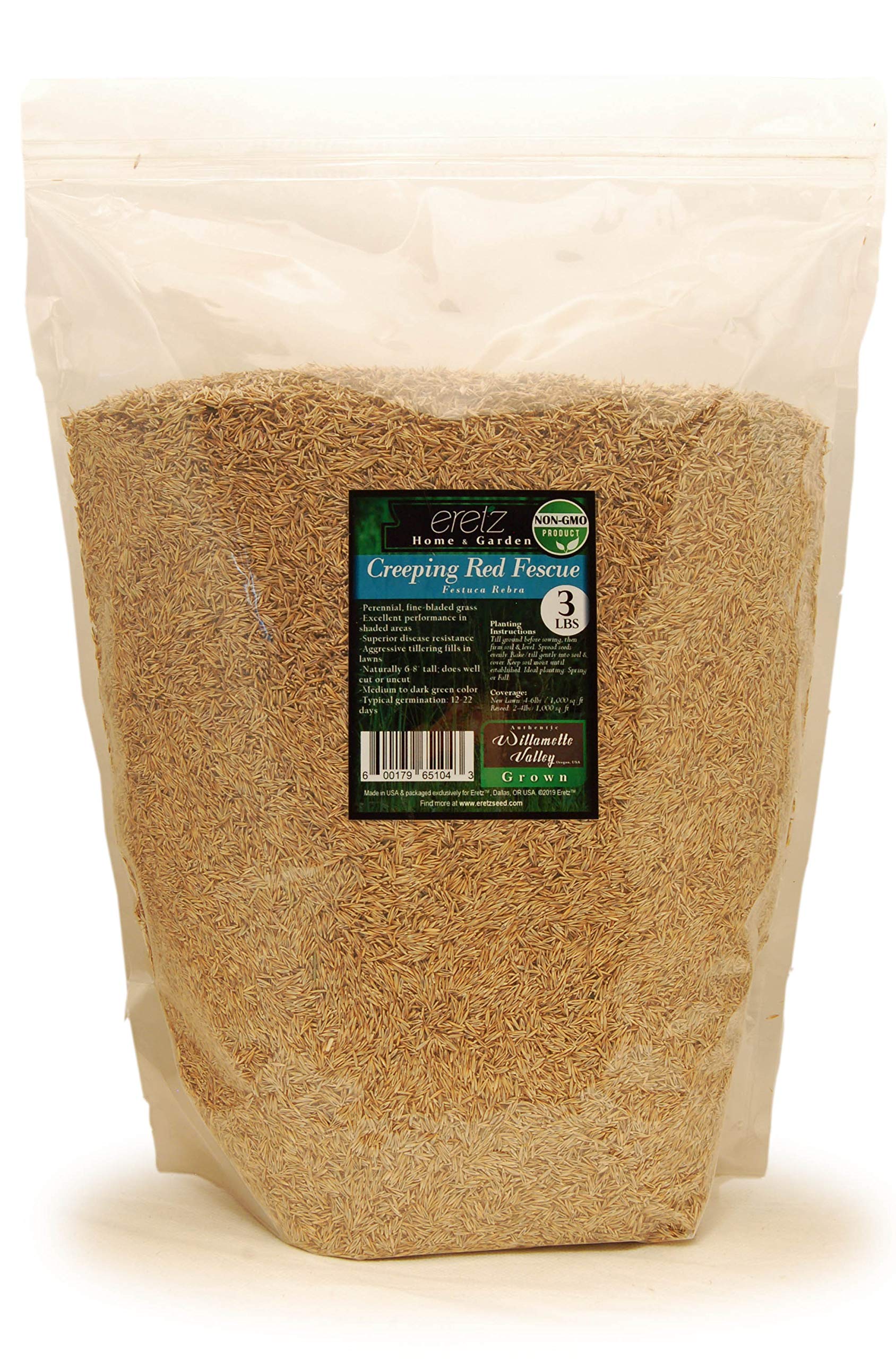
Creeping red fescue is the gold standard for Oregon lawns that exist under the shade of mature trees. Grown in the Willamette Valley by Eretz, this fine-bladed perennial fescue germinates slowly (around 2 to 3 weeks in cooler spring soil) but once established it forms a thick, self-repairing mat that competes well with moss — a constant battle in Portland’s damp, shady yards. The 99.6% pure seed content with 0.4% inert matter means you are buying actual seed, not filler.
Customer reviews from the Pacific Northwest confirm that this fescue holds its green color through winter and stays low-growing even when left unmowed, which makes it a strong candidate for steep banks or tree-rooted areas where mowing is difficult. Performance in clay-heavy Oregon soil improves significantly when you mix in a thin layer of topsoil before seeding. The fine blades produce a soft, carpet-like feel that is gentle on bare feet.
The trade-off is speed. Expect patience — this grass fills in over several months rather than weeks. It also does not tolerate heavy foot traffic as well as tall fescue. If you have kids or dogs tearing across the lawn daily, consider mixing this with a ryegrass for added durability.
Why it’s great
- Exceptional shade tolerance — perfect under Oregon’s conifers
- Low maintenance; natural height stays between 6-8 inches
- Grown and tested in Oregon for regional purity
Good to know
- Slow germination in cold spring weather (around 21 days)
- Not suited for high-traffic play areas
4. Eretz Annual RyeGrass Seed

Annual ryegrass serves a very specific purpose in Oregon: fast temporary ground cover, erosion control on bare slopes, or winter green color when permanent warm-season grasses go dormant. This 5-pound bag from Eretz is grown right in the Willamette Valley, which means it is already adapted to Oregon’s soil microbiome and seasonal rain patterns. Germination happens within 5 to 7 days under typical Oregon spring conditions, making it one of the fastest options available.
Reviewers note that this seed performs well even in poor soil — one customer reported strong growth through drought followed by snow, which mirrors the erratic weather cycles of Oregon’s transitional seasons. The ability to mix this with clovers and vetches also makes it a practical choice for pasture or cover-crop applications, not just decorative lawns. The no-filler claim holds up in side-by-side comparisons — what you dump out of the bag is uniform, small, dark seeds with no chaff.
The downside is obvious: this grass lives for one growing season. It dies back in the heat of summer or the cold of winter depending on your region, so do not use it as a permanent lawn solution. Plan it as a “nurse crop” or a quick fix while slower perennial grasses fill in.
Why it’s great
- Ultra-fast germination — green in under a week
- Locally grown in Oregon with no weed seed contamination
- Versatile for lawns, erosion control, and animal forage
Good to know
- Annual life cycle — must be replanted each season
- Blade texture is coarser and less attractive than perennial varieties
5. Pennington Annual Ryegrass Seed

Pennington’s annual ryegrass is the economical choice for Oregon homeowners who want a quick winter green-up over dormant Bermuda or Zoysia grass — a common scenario in southern Oregon where warm-season lawns are popular. The 10-pound bag offers generous coverage for the price, and the visible germination within 3 to 7 days provides almost instant gratification. This seed performs best in full sun (6 to 8 hours), which limits its use in heavily shaded Oregon yards.
Customer feedback from zone 8 confirms that grass seeded in December still looked good by mid-May, indicating decent cold tolerance during Oregon’s mild coastal winters. The seed spreads easily and establishes on bare soil with consistent watering. Multiple reviewers praised the fast establishment and dense coverage, noting that the thin blades fill in quickly to cover bald patches from summer wear.
However, this is strictly a temporary solution. The annual life cycle means it will die off when true summer heat arrives, and if you are looking for a permanent lawn, you will need to overseed with a perennial mix in the spring. Additionally, the blade quality is noticeably lower than perennial ryegrass or fescue — the color is a lighter green and the texture is less refined.
Why it’s great
- Germinates in 3-7 days for near-instant results
- Large 10 lb bag provides broad coverage at an accessible price
- Excellent for overseeding warm-season lawns in southern Oregon
Good to know
- Annual grass — does not survive into the next season
- Requires full sun; struggles in Oregon’s common shaded lawns
FAQ
When is the best time to plant grass seed in Oregon?
Can I use annual ryegrass for a permanent Oregon lawn?
Final Thoughts: The Verdict
For most users, the best grass seed for oregon winner is the GreenView Pure Grass Seed Perennial Ryegrass Blend because of its 99.9% weed-free purity, fast germination window, and versatile sun and shade performance. If you want deep drought resistance for eastern Oregon summers, grab the GreenView Turf Type Tall Fescue. And for deep shade under mature trees, nothing beats the Eretz Creeping Red Fescue Seed.