
A freshwater aquarium light is not a single-purpose bulb. The difference between a tank that looks murky and one that reveals every scale and leaf texture comes down to spectral band selection, PAR (Photosynthetically Active Radiation) intensity, and programmable sunrise cycles. Buying a fixture based on wattage alone is the single most common misstep — the real metric is how many micromoles of light hit the substrate at 18 inches of depth.
I’m Mohammad Maruf — the founder and writer behind Drink4Good. My research focuses on comparing spectral output graphs, timer logic durability, and real-world PAR readings across budget, mid-range, and premium freshwater fixtures to find the units that deliver consistent plant growth without triggering nuisance algae.
If you are shopping for a new fixture, this guide breaks down seven top-rated models across three performance tiers to help you identify the best freshwater aquarium light for your tank’s depth, plant load, and desired control complexity.
How To Choose The Best Freshwater Aquarium Light
Selecting a freshwater light means moving past basic on/off switches. The best fixtures today offer multiple spectral channels, programmable 24-hour cycles, and extendable brackets that match both rimmed and rimless tanks. You need to evaluate PAR at substrate depth, color rendering index (CRI), and whether the control interface matches your daily routine.
PAR Intensity and Spectral Composition
PAR measures the light available for photosynthesis in the 400–700 nm range. A light that delivers 30–50 µmol/m²/s at the substrate supports low-light plants like Java fern; medium-light stem plants require 50–100 µmol/m²/s. High-output fixtures with dedicated 660nm red and 455nm blue channels boost red plant coloration and root development. Check whether the manufacturer publishes PAR readings at a specific depth — this is more reliable than wattage.
Programmable Timing and Gradient Transitions
Fish and plants respond poorly to abrupt light changes. A quality fixture includes at least a sunrise and sunset ramp — a gradual 15- to 30-minute transition that mimics natural photoperiods. Look for a power-off memory function that retains your schedule after a blackout. Some units offer 24/7 natural mode that shifts color temperature throughout the day, from cool midday to warm sunset and blue moonlight.
Build Quality and Mounting Versatility
Aluminum alloy housings dissipate heat more efficiently than plastic, extending LED lifespan. Check whether the mounting brackets are extendable — the bracket should span the full width of your tank rim or include adjustable legs for rimless tanks. For tanks with plastic lids, verify whether the fixture can sit on the lid without overheating the housing. Gooseneck or clip-on designs work best for nano tanks under 10 gallons.
Quick Comparison
On smaller screens, swipe sideways to see the full table.
| Model | Category | Best For | Key Spec | Amazon |
|---|---|---|---|---|
| SEAOURA 48-54in | Premium Programmable | Planted tanks 50–120 gal | WRGB 4-channel / 4082 lumens | Amazon |
| FZONE Light 120 | Smart App Control | Large planted tanks | 72W / 6-row RGB+W+UV | Amazon |
| Fluval Plant 3.0 15-24in | High-End Spectrum | High-tech planted tanks | 6-band wave / 22W | Amazon |
| hygger 30-36in | Mid-Range Programmable | Custom sunrise/diy modes | 48W / 8-stage DIY / LCD | Amazon |
| GLOWRIUM 48-53in | Entry-Level Full Spectrum | Budget planted setups | 5000K + 460/660nm / CRI 90 | Amazon |
| Lominie A20 Freshwater | Nano / Clip-On | Small & nano tanks | 16W / 4-channel / gooseneck | Amazon |
| Fluval Aquasky 2.0 15-24in | App Weather Effects | Freshwater & fish-only | RGB+6500K / 12W / app | Amazon |
In‑Depth Reviews
1. SEAOURA LED Aquarium Light 48-54in
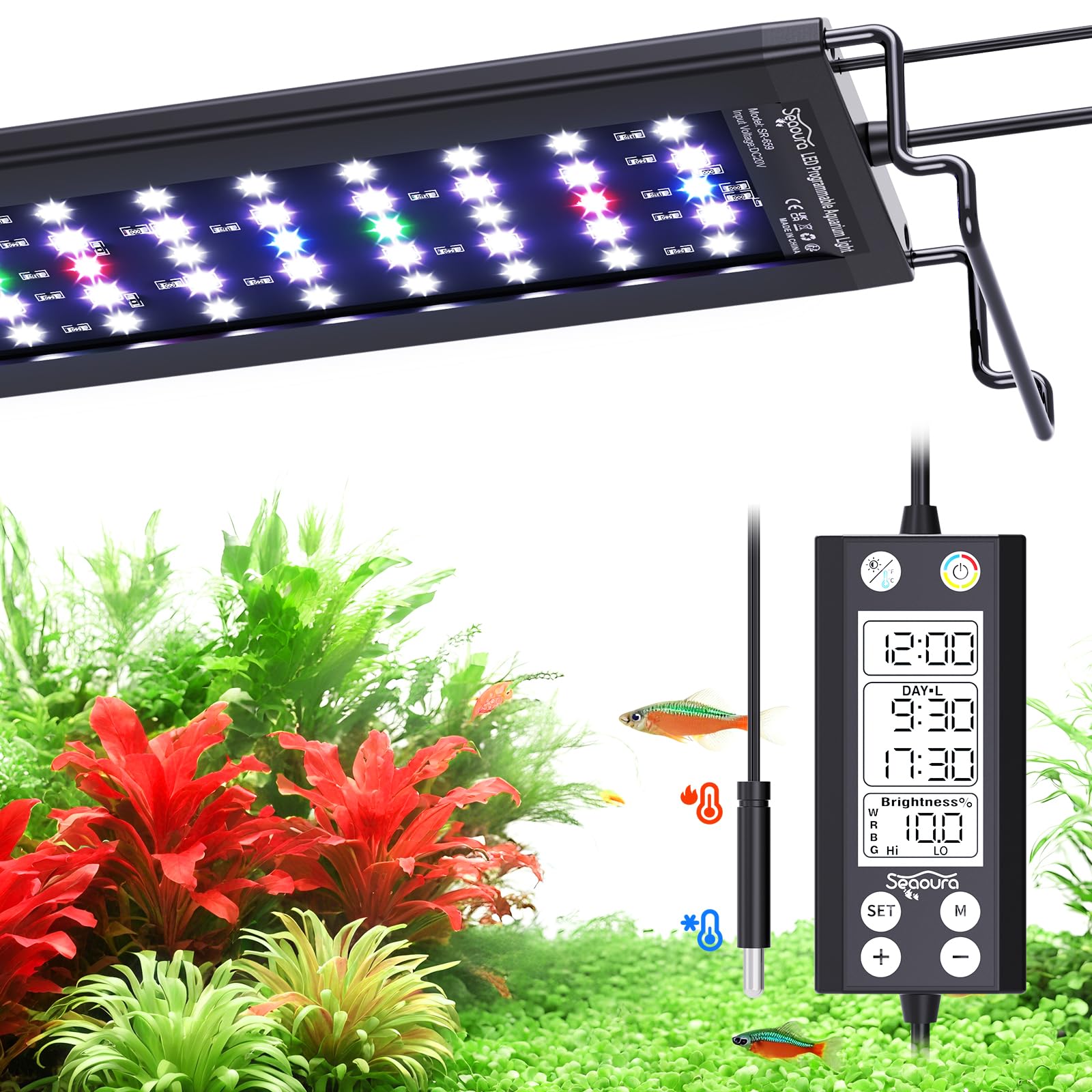
This fixture delivers the most complete feature set in the mid-to-premium tier. The WRGB system lets you dial in four independent channels — white, red, green, and blue — with 20 brightness levels each, so you can fine-tune the spectrum for both low-light crypts and high-light stem plants. PAR hits 159 µmol/m²/s at the substrate in a standard 24-inch deep tank, enough for demanding species like Rotala wallichii without needing CO2 injection.
The built-in temperature probe sets this model apart. It monitors water temperature in real time and triggers a beep alarm if the tank strays outside your set range — a safeguard that standalone digital thermometers rarely offer. Three timer modes (S1 for day/moon, S2 for 24/7 natural cycling, S3 for full DIY with eight stages) give you flexibility without overwhelming complexity. The 15-minute gradient between transitions prevents fish from startling.
Mounting is straightforward for tanks from 48 to 54 inches. The aluminum housing with silicone-coated IP68 beads means you can wipe down the light bar without worrying about moisture ingress. Some users report that the initial programming requires a couple of read-throughs of the manual, but once set, the power-off memory (backed by a CR1220 battery) keeps the schedule running through outages.
Why it’s great
- WRGB 4-channel with 20-level dimming for precise spectrum tuning
- Built-in temperature probe with high/low alarm
- Three timer modes including 24/7 natural and 8-stage DIY
Good to know
- Controller programming has a moderate learning curve
- Silicone coating may feel soft during cleaning
2. FZONE Aquarium Light Light 120
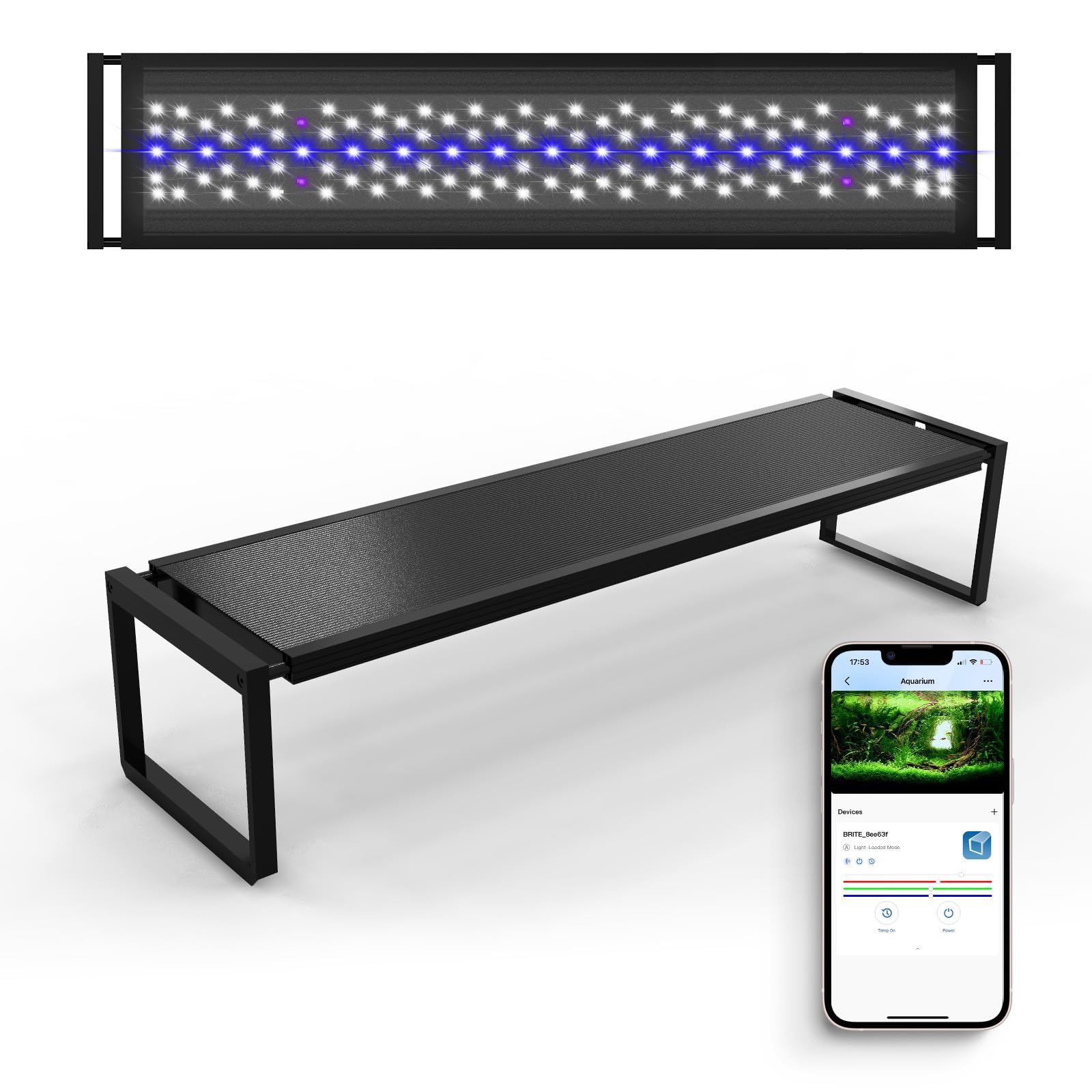
The FZONE Light 120 is built for tanks in the 47–55 inch range and puts out serious PAR with 294 individual LEDs split across white, RGB, and UV channels. The 4-inch-wide light emission panel spreads the beam evenly from edge to edge, eliminating the dark corners that plague narrower fixtures. At full power, the 72-watt output reaches 4900 lumens, which translates to strong growth for stem plants even in a 120-gallon setup.
Bluetooth app control is the standout feature here. You can set up to 24 time points in Custom mode, which means you can replicate a natural summer photoperiod with gradual intensity shifts from dawn to dusk. The app also includes simulated weather — cloudy, rainy, sunny — that adds visual variety without stressing fish. Pairing multiple lights for a single large tank is seamless through the app.
The aluminum alloy housing keeps operating temperature below 120°F even after 12-hour cycles, which reduces LED degradation over time. One trade-off: there is no physical on/off switch, so you must rely on the app or a smart plug for manual control. The extendable brackets accommodate both rimmed and rimless tanks, though the fit is snug on thicker glass panels over 12mm.
Why it’s great
- High 72W output with 294 LEDs (RGB+W+UV) for demanding plants
- Bluetooth app with 24-point custom schedule
- 4-inch wide emission panel for even edge-to-edge coverage
Good to know
- No physical on/off switch — app or smart plug required
- Learning curve for full spectrum customization
3. Fluval Plant 3.0 LED 15-24in

The Fluval Plant 3.0 uses six distinct wave bands — cool white, warm white, red, green, blue, and violet — to target chlorophyll absorption peaks at 430nm and 660nm. This spectral precision drives significantly faster growth in high-light species like rotala and ludwigia compared to standard RGB fixtures. The 120-degree light dispersion ensures uniform coverage across 15- to 24-inch tanks without hotspots near the center.
Programming is done through the FluvalSmart app, which includes preset habitat configurations — Tropical, Planted, Lake Malawi, and more — that adjust spectrum and intensity throughout a 24-hour cycle. The gradual sunrise/midday/sunset/night ramps are fully adjustable in 30-minute increments. Users report visible oxygen bubbles on leaves within 24 to 48 hours after installing this light on a CO2-injected tank.
One consistent criticism is that the light loses its internal clock after a power outage, requiring a phone resync to restore the schedule. The aluminum housing stays warm to the touch during operation but does not transfer heat to the water. The extendable brackets are well-suited for both Fluval-brand tanks and standard rimmed aquariums, though the fixture sits best on rimless or low-profile glass.
Why it’s great
- Six-band spectral targeting for optimal plant photosynthesis
- App preset habitats (Tropical, Planted) with 24-hour cycling
- 120-degree beam angle for even light spread
Good to know
- Loses time after power outage — requires app resync
- Expensive for the small 15-24 inch size range
4. hygger Programmable LED 30-36in

The hygger 30-36 inch fixture packs 144 LEDs with a CRI of 89 and adjustable color temperature from 6500K to 10000K, making it one of the most customizable lights in the mid-range bracket. The LCD display shows real time and program stages, and the eight-stage DIY mode lets you assign separate start/end times and brightness levels for each stage. This is ideal for aquarists who want a morning ramp, high-intensity afternoon, gradual evening dim, and a moonlit night phase — all without a phone app.
Four operating modes cover most use cases: Default Mode (all-optical with blue accent), DIY Mode (eight fully programmable stages), Gradient Mode (cycled colors for visual display), and All-Day All-optical Mode (constant full spectrum with RGB fine-tune). The IP68 lamp beads are waterproof and easy to wipe clean, and the separable adapter means you can replace the power brick without tossing the entire fixture.
Owners note that the default preset runs at 100% white intensity, which can trigger algae in tanks without CO2. Dropping brightness to 60–70% usually balances plant growth and algae control. A few users report driver failures after 12–15 months, so a 2-year warranty is worth confirming at purchase.
Why it’s great
- Eight-stage DIY programming with LCD display interface
- IP68 waterproof beads and separable adapter
- Excellent spectrum range (6500-10000K) for plant versatility
Good to know
- Default 100% intensity may cause algae in low-tech tanks
- Some reliability concerns reported after 12+ months
5. GLOWRIUM LED Full Spectrum 48-53in
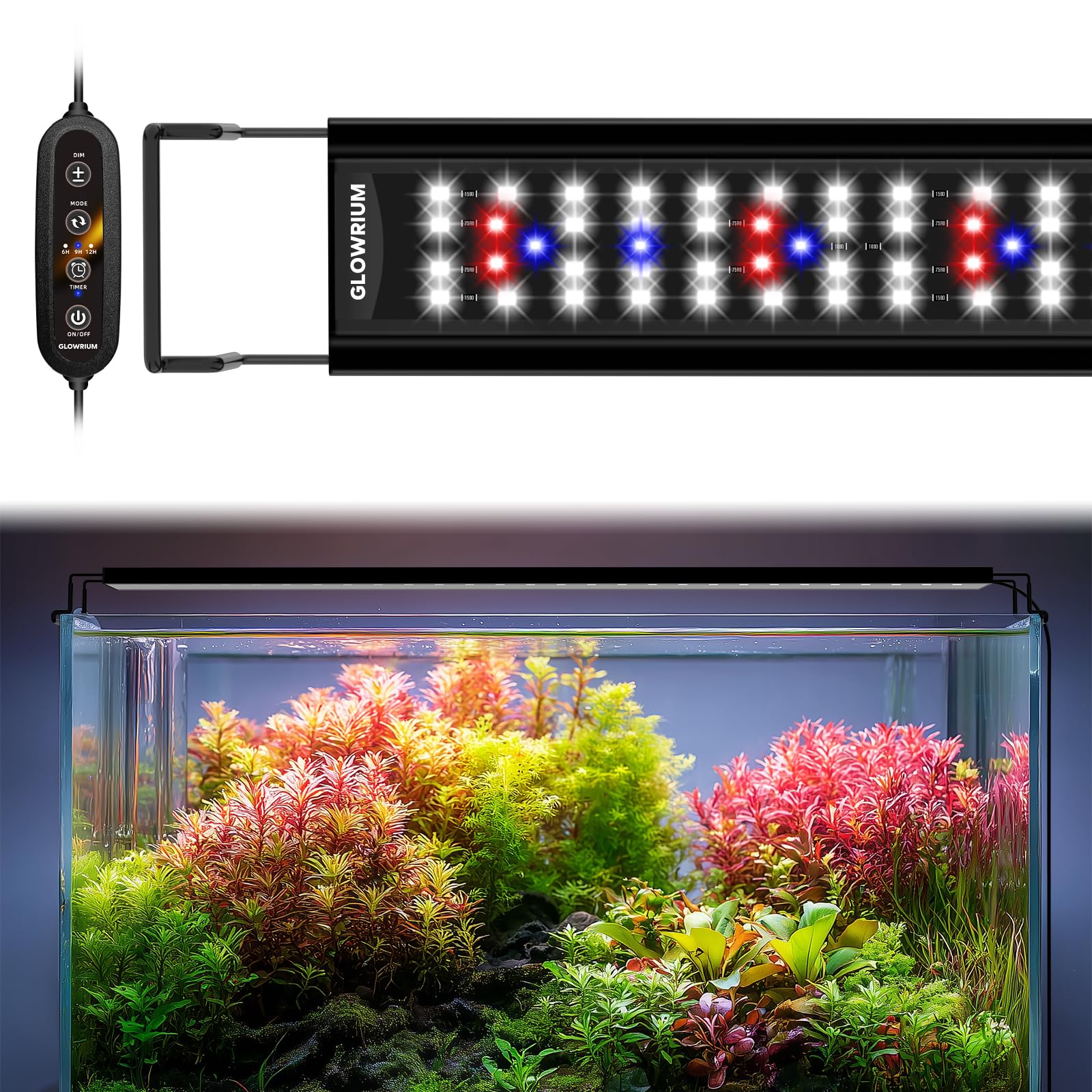
The GLOWRIUM fixture is one of the most cost-effective ways to add full-spectrum lighting to a 48- to 53-inch tank without sacrificing essential features. It uses five rows of LEDs at 5000K white, 460nm blue, and 660nm red, achieving a CRI above 90. The color rendering is noticeably better than budget strip lights — fish scales and plant greens look more saturated rather than washed out.
Day and Night modes are controlled via an included remote. Day mode fires all three color channels, while Night mode drops to blue-only moonlight, which is gentle enough for nocturnal fish like corydoras. The three timer options (6, 9, or 12 hours) include a sunrise/sunset simulation that transitions gradually rather than snapping on/off. The power-off memory retains your timer settings after a blackout, saving you from reprogramming.
The aluminum body doubles as a heat sink and stays cool enough to rest directly on a glass lid. The extendable bracket fits tanks from 36 to 41 inches natively, though the listing claims compatibility with 48- to 53-inch tanks with the brackets fully extended. Some owners note the bracket grip could be more secure on thicker glass. At this price point, the lack of a smartphone app is a fair trade-off for the simplicity of the physical remote.
Why it’s great
- CRI above 90 with 5000K white + 460/660nm red/blue
- Infinitely dimmable with three timer options and memory
- Cool-running aluminum body suitable for glass lids
Good to know
- Extendable bracket may not lock firmly on thicker rims
- No smartphone app or Wi-Fi connectivity
6. Lominie LED A20 Freshwater

The Lominie A20 is a focused solution for nano tanks from 5 to 18 inches. Its 16-watt output through 16 high-output LEDs — including RGBW and purple channels — creates a full spectrum that rivals much larger fixtures. The 360-degree adjustable gooseneck lets you position the light precisely over a rimless cube or a shelf-mounted specimen tank, directing light exactly where the plants need it.
Four independent channels (red, green, blue, white) are controlled individually via the included remote, so you can dial in a cool daylight look for a shrimp tank or a warmer tone for a Betta setup. The 92 CRI rating ensures natural color rendition. Two interchangeable lenses (60° and 120°) let you focus the beam for deeper penetration or spread it for shallow tanks. Owners report that the 60° lens produces a warmer, more dramatic light gradient.
Heat management uses a cold-forging aluminum heat sink with a smart fan that runs quietly — the fan is audible only in a very silent room. The plastic clip is designed for glass up to 0.95 inch thick, but it can slip on rimmed tanks; rimless or low-profile glass holds much better. The freshwater version does not include a remote (the saltwater version does), so plan to use the inline dimmer or buy the optional Wi-Fi controller for phone-based scheduling.
Why it’s great
- 4-channel RGBW+purple with 92 CRI for vivid color
- Interchangeable 60°/120° lenses for beam control
- 360-degree gooseneck for precise positioning
Good to know
- Clip may slip on rimmed tanks; best with rimless glass
- Freshwater version lacks remote — inline dimmer only
7. Fluval Aquasky 2.0 15-24in

The Aquasky 2.0 focuses more on aesthetic control than raw photosynthetic output, making it a strong choice for community freshwater tanks where plant growth is secondary to visual impact. The 6500K white LEDs paired with tri-colored RGB LEDs let you create infinite color blends — from crisp daylight to deep ocean blue — with 11 preset sky modes including storm, cloud cover, and lightning.
The FluvalSmart app handles all scheduling and color mixing. You can design a 24-hour light cycle that shifts from sunrise pink to midday white to sunset amber and finally to moonlight blue. The SkyPad remote gives you quick access to color presets and weather effects without pulling out your phone. The 120-degree beam angle provides even coverage across tanks up to 24 inches wide.
A significant limitation for planted tank enthusiasts is the lack of dedicated red/depth-penetration channels — this light is not designed for high-PAR plant growth. Multiple users note that there is no physical on/off switch, so after a power outage you must open the app to restart the schedule. The plastic housing is lightweight and moisture-resistant but feels less premium than aluminum competition. For a low-tech tank with easy plants like Anubias and Java moss, the Aquasky delivers pleasing aesthetics and effortless control.
Why it’s great
- App-controlled weather effects (storm, clouds, lightning)
- 11 preset sky modes with 24-hour gradual cycling
- 120-degree beam for even coverage
Good to know
- No dedicated red channel — limited PAR for demanding plants
- No physical on/off switch; app required after power loss
FAQ
How many hours per day should I run my freshwater aquarium light?
What PAR level do I need for a low-tech vs. high-tech planted tank?
Can I use a freshwater light on a saltwater tank or vice versa?
How do I prevent algae when upgrading to a brighter light?
Final Thoughts: The Verdict
For most users, the best freshwater aquarium light winner is the SEAOURA 48-54in because it packages WRGB four-channel tuning, a built-in temperature alarm, and three flexible timer modes into a single fixture that works across low-tech and high-tech planted tanks. If you want powerful Bluetooth-controlled output for a large planted setup, grab the FZONE Light 120. And for a small nano tank where precise gooseneck positioning matters, nothing beats the Lominie A20.