
Punching the throttle and seeing the world blur past through a grainy, 800×600 feed is the defining experience of FPV racing drone flying. The gap between the drone that keeps you in the air for three laps and the one that falls apart after one hard landing comes down to a handful of critical hardware choices.
I’m Mohammad Maruf — the founder and writer behind Drink4Good. I spend most of my research time analyzing flight controller firmware maturity, VTX power output consistency, and frame flex characteristics across the mid-range and premium FPV racing drone market.
Whether you are pushing gates on a competitive track or learning proximity flight in your backyard, finding the right fpv racing drone means matching the drone’s component ecosystem to your skill level and budget without overpaying for features your reflexes cannot yet use.
How To Choose The Best FPV Racing Drone
Every FPV racing drone buyer faces a fork in the road: choose a ready-to-fly (RTF) kit that works out of the box but locks you into a specific radio protocol, or build a custom setup that demands soldering and Betaflight tuning but offers limitless upgrade paths. Understanding the trade-offs between flight controller firmware, video transmission power, battery chemistry, and frame durability is what separates a functional purchase from a frustrating one.
Flight Controller and Firmware Ecosystem
The flight controller is the brain. Drones running Betaflight (open-source) give you full PID tuning, rate profiles, and receiver protocol flexibility. Proprietary controllers are simpler but often lack the adjustment range serious pilots need. If you plan to race or freestyle, a Betaflight-compatible board with an STM32F405 or F7 processor is the baseline.
Video Transmitter (VTX) Power and Antenna
A VTX rated for at least 200mW output on 5.8GHz ensures you can fly behind a tree line or around a building without your goggles going to static. Combined with a quality dipole or patch antenna (like the Foxeer SMA included on some kits), the difference between 100mW and 400mW is the difference between flying confidently and flying blind.
Battery Connector and Cell Count
1S (3.7V) whoops with JST PH2.0 connectors are fine for gentle cruising but voltage sag under hard throttle. BT2.0 connectors on 1S or 2S packs handle higher continuous current, giving you punchier acceleration and longer consistent flight times. For outdoor racing, 2S is the minimum sweet spot.
Quick Comparison
On smaller screens, swipe sideways to see the full table.
| Model | Category | Best For | Key Spec | Amazon |
|---|---|---|---|---|
| DJI Avata 2 Fly Smart Combo | Premium | Immersive cinematic FPV with acro tricks | 4K/60fps, 155° FOV, 3-axis gimbal | Amazon |
| DJI Avata 2 Fly More Combo (1 Battery) | Premium | Serious beginners wanting full DJI ecosystem | 4K/60fps, Goggles 3, RC Motion 3 | Amazon |
| Potensic ATOM 2 Fly More Combo | Mid-Range | Photo-focused pilots wanting gimbal stability | 48MP photo, 3-axis gimbal, 10km range | Amazon |
| Tinyhawk 3 RTF Kit | Mid-Range | Indoor whoop racing with Betaflight tuning | 1S, FrSky, 5.8G, Betaflight FC | Amazon |
| BETAFPV ELRS V3 Cetus X FPV Kit | Mid-Range | Entry-level 2S with ExpressLRS protocol | Betaflight FC, BT2.0 450mAh, DVR | Amazon |
| EMAX EZ Pilot Pro FPV Drone Set | Budget-Friendly | Absolute beginners needing a durable trainer | Real 5.8G, detachable goggle screen | Amazon |
| Tiny Hawk Micro Drone Free Style 2 | Budget-Friendly | Outdoor micro freestyle with carbon frame | Carbon fiber frame, 450mAh 1S | Amazon |
| CADDXFPV Walksnail Avatar HD Goggles L | Accessory | HD digital goggle upgrade for Walksnail Vtx | 1080p 4.5″, head tracking, 4km range | Amazon |
| APEX FPV Drone Kit | Budget-Friendly | First-ever FPV flight with 3-battery kit | 400mAh 1S, 5.8G, altitude hold | Amazon |
In‑Depth Reviews
1. DJI Avata 2 Fly Smart Combo (Three Batteries)
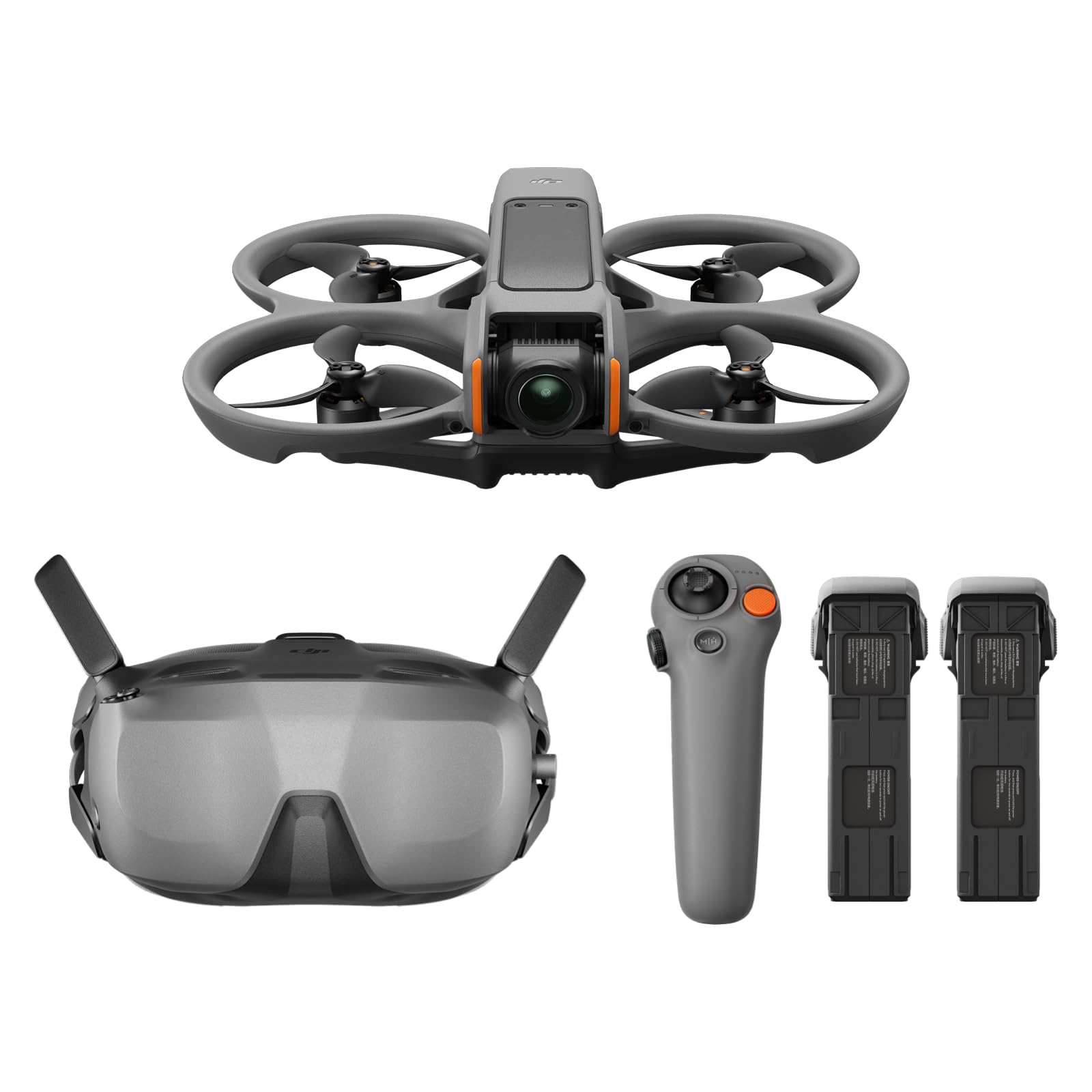
The DJI Avata 2 sets the premium benchmark for an FPV racing drone that doubles as a cinematic tool. Its 1/1.3-inch sensor captures 4K/60fps footage with a 155° field of view, while integrated propeller guards let you fly confidently in tighter spaces without shredding props. The combo includes three Intelligent Flight Batteries, the Goggles N3, and the RC Motion 3 controller, so you are airborne immediately with a full ecosystem that requires zero soldering or Betaflight tuning.
Manual mode unlocks flips, rolls, and 180° drifts with a single push, yet beginner mode keeps things docile enough for indoor learning. Real-world flight times average 17–20 minutes per battery, and the motion controller translates hand gestures into directional movement so intuitively that even first-time pilots can navigate gaps. The built-in propeller guard is not a gimmick — it absorbs contact with tree branches and walls without stopping the motors.
Rated for teens and youth, the Avata 2 is FAA Remote ID compliant and weighs 1.56 kg fully loaded. The LightCut app simplifies POV content creation with ready-made templates. This is the drone that makes you feel like you are inside the cockpit from the moment you power up.
Why it’s great
- Outstanding 4K image quality with wide FOV
- Motion controller eliminates the radio stick learning curve
- Three batteries provide over 50 minutes of cumulative flight
Good to know
- Proprietary ecosystem limits component swapping
- Heavier than typical race quads at 1.56 kg
2. DJI Avata 2 Fly More Combo (1 Battery)

This Fly More Combo pairs the Avata 2 airframe with the premium Goggles 3 and RC Motion 3, giving you the full immersive cockpit experience without the three-battery pack. The Goggles 3 feature a sleek form factor with diopter adjustment and foam padding for long sessions. The 1/1.3-inch sensor delivers the same 4K/60fps clarity as the Smart Combo, and the 155° FOV ensures you catch every obstacle in your peripheral vision.
The propeller guard design is identical to the Smart Combo, meaning the same crash resilience. Flight time per battery is about 23 minutes under gentle flying, dropping to 17 minutes with aggressive acro maneuvers. The RC Motion 3 controller pairs instantly and requires zero configuration — beginners can fly within five minutes of unboxing. Compatibility extends to DJI Goggles 2, Goggles Integra, and the FPV Remote Controller 3, so you can mix hardware from previous generations.
Reviewers consistently praise the stability improvement over the original Avata. The drone handles wind well at altitude and feels planted even during sharp yaw spins. Internal storage captures footage without an SD card, though you will want one for extended sessions. One battery is enough for learning, but competitive racers will want the three-battery Smart Combo for longer track time.
Why it’s great
- Best-in-class video transmission with Goggles 3
- Beginner-friendly motion controls with instant pairing
- Propeller guards make indoor flying safe
Good to know
- Only one battery included — add more for extended flying
- Simulator support is less polished than standalone sims
3. Potensic ATOM 2 Fly More Combo with RC PTD 1
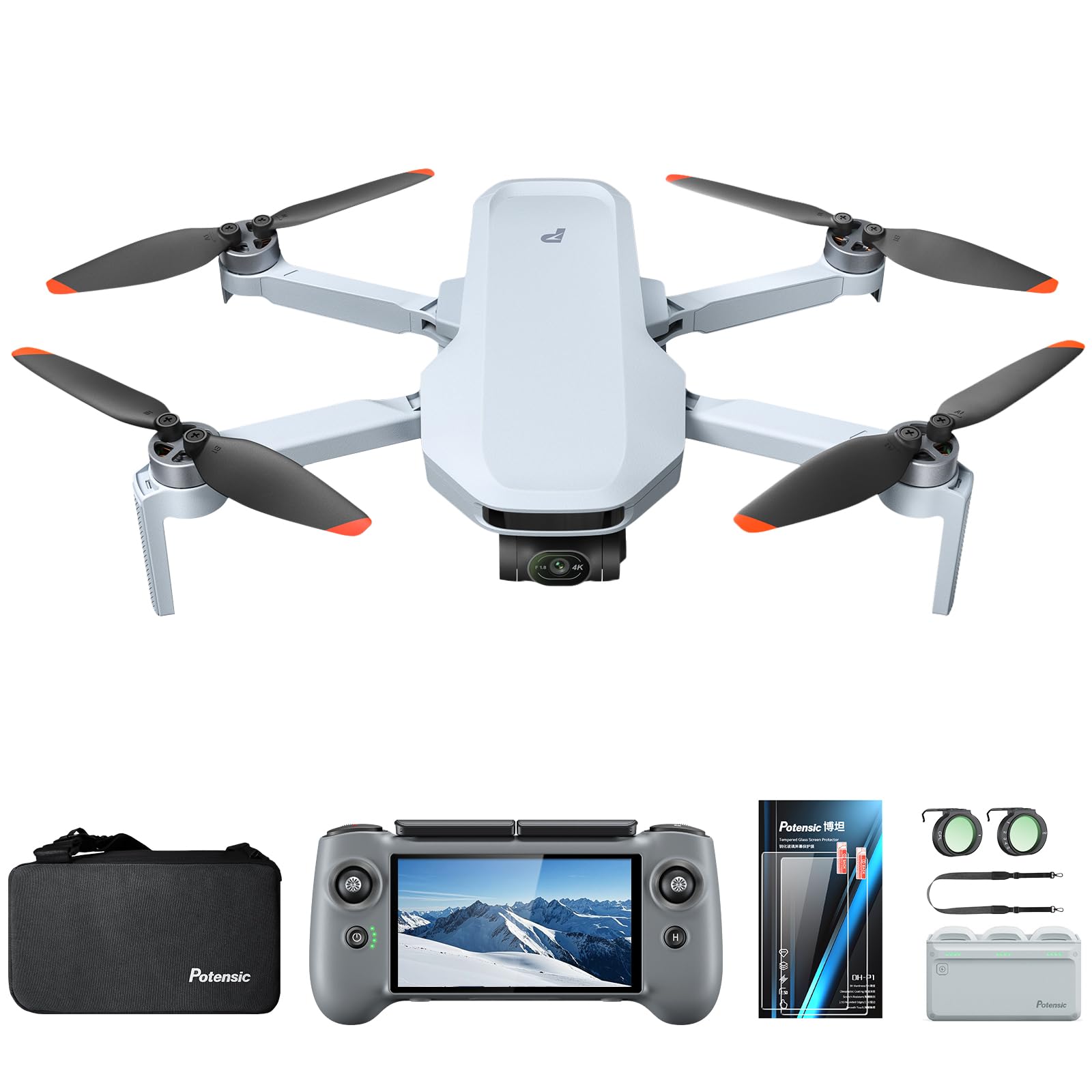
The Potensic ATOM 2 is a mid-range FPV racing drone that prioritizes camera quality over raw racing speed. Its 1/2-inch Sony CMOS sensor captures 48MP stills and 4K/30fps HDR video through a 3-axis mechanical gimbal — a setup usually found on much more expensive camera drones. The included ND and CPL filters let you control exposure and cut reflections, giving your footage a polished look straight out of the box.
The RC PTD 1 controller features a built-in 5.5-inch 1920×1080 FHD touchscreen with 700 nits brightness, eliminating the need for a phone mount or external screen. PixSync 4.0 technology delivers 10km transmission range with 1080p/30fps live feed. AI tracking modes — Spotlight, Follow, and Parallel — work well for keeping subjects framed during auto-flight. The entire Fly More Combo weighs under 249 grams, exempting it from FAA registration.
Three batteries charge simultaneously in 1.3 hours via the parallel hub, giving you 96 minutes of total flight time. Dolly Zoom, Slow Motion, and QuickShots modes expand creative options. This is not a pure racing quad — the 4x digital zoom and gimbal stabilization prioritize smooth footage over split-second lap times. If your goal is cinematic POV with racing-capable flight characteristics, the ATOM 2 hits a rare balance.
Why it’s great
- Professional-grade 3-axis gimbal for smooth 4K footage
- Built-in FHD controller screen removes phone dependency
- Under 249g with no FAA registration required
Good to know
- Not a pure racing platform — slower yaw rates
- 4x digital zoom reduces image quality
4. Tinyhawk 3 RTF Kit 1s FRSKY FPV Drone

The Tinyhawk 3 is the definitive indoor whoop for pilots serious about learning acro flight. Powered by a Betaflight flight controller and a 1S LiPo, this 1.47 kg kit includes a controller and 5.8G goggles out of the box — no extra purchases required. The flexible polycarbonate frame is famously tough; reviewers report surviving falls from two stories onto tile floors with only minor scuffs.
True acro mode with no auto-leveling means beginners will crash — a lot. But the durability and the ability to tune PIDs, rates, and power limits through Betaflight Configurator turn those crashes into learning opportunities. The 5.8G VTX delivers acceptable range through a single-story home, though concrete walls cut signal around 100 feet. Adjusting VTX power in Betaflight helps extend penetration.
The 1S battery platform limits raw punch compared to 2S builds, but for indoor racing around furniture, the Tinyhawk 3 is agile enough. The included goggles are basic and the camera scratches easily, but the drone itself is a proven training tool. Experienced pilots recommend upgrading to a higher-quality headset while keeping the Tinyhawk 3 as the fleet beater quad for risky proximity practice.
Why it’s great
- Extremely durable polycarbonate frame
- Full Betaflight tuning capability for advanced pilots
- RTF kit includes everything for indoor flight
Good to know
- 1S power limits outdoor performance in wind
- Goggle and camera quality are entry-level
5. BETAFPV ELRS V3 Cetus X FPV Kit

The BETAFPV Cetus X is the bridge between entry-level whoops and serious 2S racing. It runs a Betaflight flight controller with the ExpressLRS (ELRS V3) radio protocol, giving you sub-100ms response times and kilometer-range control links — a massive upgrade over FrSky or FlySky systems on budget kits. The LiteRadio 3 transmitter is compact but functional, and the VR03 goggles include a DVR recording function for reviewing your laps.
Powered by 2S 450mAh BT2.0 batteries, the Cetus X delivers punchy acceleration and around five minutes of aggressive flight per pack. The kit includes four batteries and a charger, so you can rotate packs for extended sessions. The C04 camera with M04 VTX provides a clean analog feed, though the camera cable is prone to loosening after hard crashes — re-seating it usually restores signal. Betaflight Configurator access lets you tweak rates and filters as your skills grow.
The three flight modes — Angle, Horizon, and Air — let beginners start with self-leveling and transition to full acro. Durability is strong for a whoop-class drone, though the VTX antenna range is limited to about 150 feet in obstructed environments. Reviewers consistently recommend adding 550mAh batteries and a WhoopStor 3 charger to get the most out of this platform.
Why it’s great
- ExpressLRS protocol offers superior range and response
- 2S power provides real racing acceleration
- Betaflight FC allows full PID and rate tuning
Good to know
- Camera cable may loosen during crashes
- VTX range is short in dense environments
6. EMAX EZ Pilot Pro FPV Drone Set

The EMAX EZ Pilot Pro is designed as a low-stress entry point for younger or first-time pilots who want to learn FPV without the steep acro-mode learning curve. Its flexible plastic frame absorbs crashes that would shatter rigid carbon fiber, and the detachable goggle screen doubles as a monitor that clips onto the controller — a clever workaround for kids who find goggles uncomfortable or blurry.
The 5.8G real-time feed is clear enough for proximity flying, though the VTX is not the most powerful, so keep flights within 50–100 meters. Three flight modes (Angle, Horizon, Air) let beginners graduate from assisted hover to manual control. The included six-battery charger and 450mAh packs give you about 3.5 minutes of flight per battery, with quick turnaround for back-to-back sessions. Betaflight compatibility means you can adjust rates and expo as your reflexes sharpen.
EMAX uses the FrSky D8/D16 protocol, which is widely supported but less modern than ExpressLRS. Some reviewers found the goggle optics blurry for older users who wear glasses. The screen-on-controller alternative solves this neatly. The EZ Pilot Pro will not win any speed records, but it will survive the learning process intact — and that is exactly what a trainer should do.
Why it’s great
- Detachable goggle screen works as a monitor
- Extremely durable frame for crash-heavy learning
- Kit includes six batteries and a charger
Good to know
- Goggle optics may be blurry for eyeglass wearers
- FrSky protocol is older than modern ExpressLRS
7. Tiny Hawk Micro Drone Free Style 2 FPV Racing Outdoor Quad

The Tiny Hawk Free Style 2 is a pure manual-mode micro drone built for outdoor freestyle. Its carbon fiber frame is significantly stiffer than polycarbonate whoops, offering crisper control response during flips and rolls. The 5.8G video feed is real-time, and the 450mAh 1S battery provides about three to four minutes of aggressive flying. This RTF kit includes goggles and a controller, so you can unbox and fly immediately — provided you already understand acro mode.
There is no altitude hold, no beginner mode, and no angle mode. This drone expects you to know how to fly or be willing to learn the hard way. The full manual control is a steep curve, but the durability is remarkable — one reviewer reported over 75 crashes with only a broken antenna that required a solder repair. The controller and goggles differ slightly from the promotional images, but the core flight experience remains authentic FPV.
The integrated camera is serviceable for line-of-sight proximity flying but lacks the clarity of a premium setup. Video quality is described as “good” but not sharp. For pilots who want to practice outdoor freestyle moves on a micro budget, the Free Style 2 delivers the raw flight feel of a 5-inch quad in a pocket-sized package. Just be prepared for the learning curve.
Why it’s great
- Carbon fiber frame for precise control feel
- Extremely durable for a micro quad
- Real 5.8G FPV feed with low latency
Good to know
- No beginner modes — full manual only
- Video quality is basic analog
8. CADDXFPV Walksnail Avatar HD FPV Goggles L
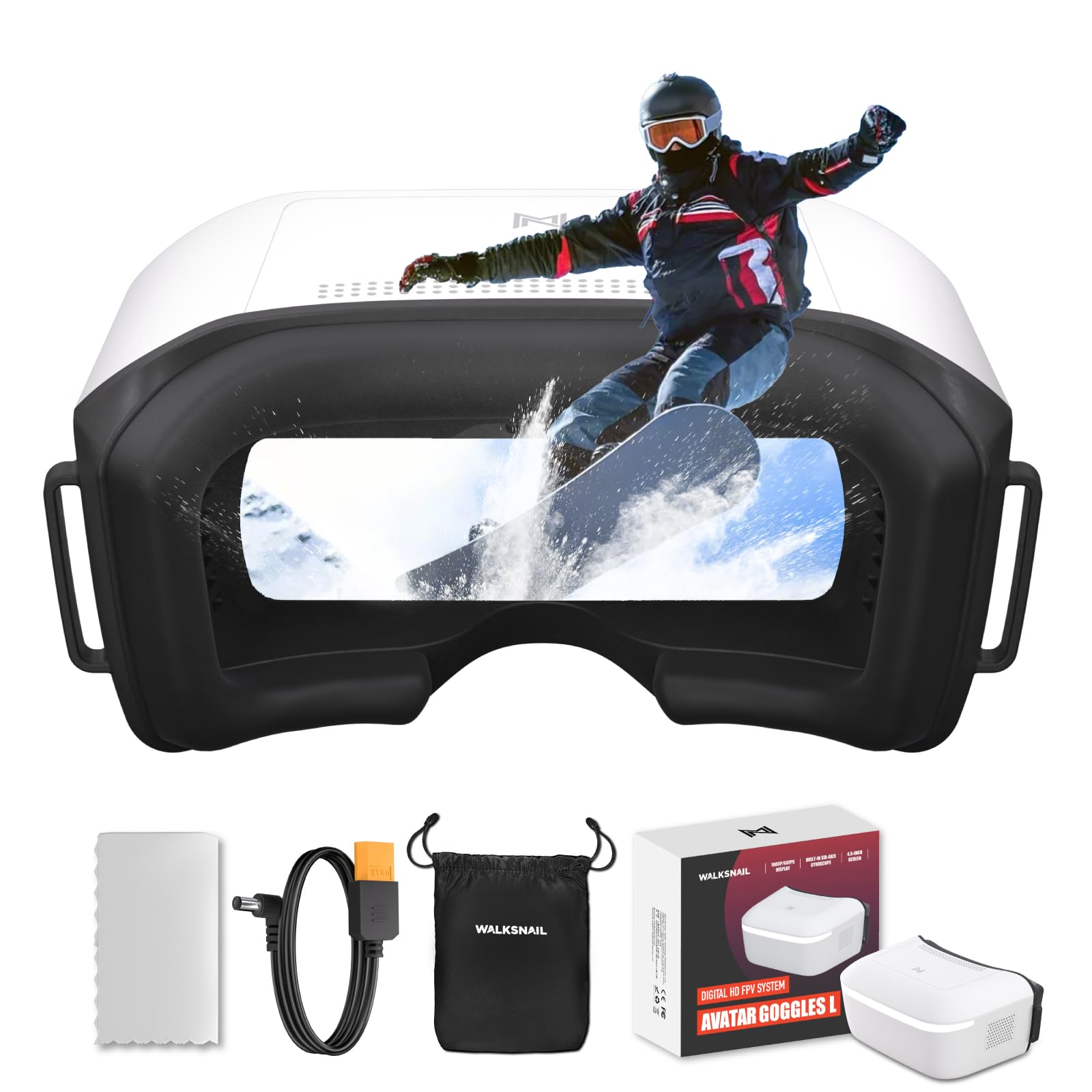
The Walksnail Avatar HD Goggles L is a standalone accessory that transforms any drone with a Walksnail VTX into an HD digital FPV machine. The 4.5-inch 1080p screen is crisp and immersive, with a wide enough field of view to feel present in the cockpit. A built-in DVR records flight footage directly to a micro SD card, and the 4.9dBi directional antenna maintains a solid link up to 4 kilometers in open air.
The head tracking feature lets you pan the camera by turning your head — a natural control method that works seamlessly with compatible Walksnail VTX systems. The polyurethane faceplate blocks ambient light and stays comfortable during longer sessions. Swappable lenses accommodate vision correction, so eyeglass wearers can adjust focus without wearing glasses under the goggles. Input power flexibility (6–25.2V) means you can run it off a 2S to 6S LiPo.
Compatibility is limited to the Walksnail Avatar system — these goggles will not work with analog VTX or other HD systems like DJI. There is no HDMI input. The goggles are compact and lightweight at 1.32 pounds, making them ideal for travel or as a secondary pair for ride-along passengers. For pilots invested in the Walksnail ecosystem, this is the best HD goggle value on the market.
Why it’s great
- Stunning 1080p clarity with DVR recording
- Head tracking adds immersive camera control
- Swappable lenses accommodate vision needs
Good to know
- Only works with Walksnail VTX — no analog support
- No HDMI input for external devices
9. APEX FPV Drone Kit, FPV Goggles, First-Person View Drone

The APEX FPV Drone Kit is the most affordable RTF bundle in this guide, aiming at absolute beginners who have never flown an FPV quad. It includes a fully calibrated drone, FPV goggles, a transmitter, and three 400mAh 1S batteries that deliver 15–18 minutes of total flight time. The altitude hold mode keeps the drone stable at a fixed height, letting new pilots focus on directional control before attempting manual flight.
The 120° FPV view through the included goggles provides a real-time 5.8G feed. The left throttle stick has no spring-back, so manual mode freestyle is possible once the pilot outgrows beginner mode. The transmitter is compatible with the S.BUS protocol and works with simulators like Uncrashed, TRYPFPV, and Phoenix RC — a crucial feature for practicing without risking a crash. The drone body is drop-resistant but not indestructible; some units arrive with loose propeller attachments or charging port defects.
Battery installation is tight — reviewers note that the 400mAh packs are hard to insert and remove, though they stay secure during flight. The camera quality is VHS-grade, and the goggles are basic. This is not a drone for competitive racing or freestyle. But as a cheap introduction to FPV where you can confirm the hobby suits you before spending hundreds more, the APEX kit serves its purpose.
Why it’s great
- Altitude hold makes first flights manageable
- Three batteries included for extended practice
- Compatible with popular FPV simulators
Good to know
- Camera quality is VHS-level
- Some units arrive with minor defects
FAQ
Is a ready-to-fly kit better than building my own FPV racing drone?
How important is ExpressLRS compared to FrSky for racing?
Can I use DJI FPV goggles with non-DJI racing drones?
Final Thoughts: The Verdict
For most users, the fpv racing drone winner is the DJI Avata 2 Fly Smart Combo because it combines polished 4K video with intuitive motion controls and proven durability in a single ready-to-fly ecosystem. If you want a budget-friendly trainer to learn acro mode without fear of expensive repairs, grab the EMAX EZ Pilot Pro. And for the indoor racer who wants full Betaflight tuning and 1S whoop agility, nothing beats the Tinyhawk 3 RTF Kit.