
Chasing high refresh rates at 2560×1440 resolution demands a graphics card that can push past the 100 FPS mark without thermal throttling or sacrificing visual fidelity. The difference between a smooth 1440p experience and a stuttery mess often comes down to VRAM capacity, core clock stability, and how effectively the cooling system handles sustained gaming loads.
I’m Mohammad Maruf — the founder and writer behind Drink4Good. My deep market research focuses on analyzing hardware specifications, real-world benchmark data, and thermal performance under load to find cards that deliver reliable high-FPS 1440p gaming without hidden compromises.
After evaluating the latest GPU architectures, VRAM configurations, and cooling solutions available today, I have curated the best gpu for 1440p gaming options that balance raw performance with long-term reliability for immersive gaming sessions.
How To Choose The Best GPU For 1440p Gaming
Selecting a 1440p GPU isn’t just about picking the highest core clock you can afford. You need to consider VRAM headroom for texture-heavy modern titles, the cooling solution’s ability to maintain boost clocks under sustained load, and the architecture’s efficiency with ray tracing and upscaling technologies. A card that runs hot or runs out of memory mid-session will ruin the experience regardless of its raw specs.
VRAM Capacity and Memory Bandwidth
Modern 1440p games at high to ultra settings frequently exceed 8GB of VRAM usage, especially when texture packs are loaded. Cards with 12GB or 16GB provide comfortable headroom for current titles and future releases. Memory bandwidth, determined by the interface width (128-bit vs 192-bit vs 256-bit) and memory type (GDDR6 or GDDR7), directly impacts how quickly textures stream from VRAM to the GPU cores — higher bandwidth reduces texture pop-in and frame drops in open-world environments.
Cooling Solution and Form Factor
The cooling system determines whether a card can sustain its advertised boost clock during long sessions. Triple-fan designs with larger heatsinks generally offer superior thermal dissipation and quieter operation compared to dual-fan or blower-style coolers. Pay attention to card length and slot width — some premium coolers exceed 12 inches and require spacious cases with good airflow. Zero-RPM fan modes are a plus for silent operation during less demanding tasks.
Upscaling and Ray Tracing Ecosystem
NVIDIA’s DLSS 4 and AMD’s FSR 4 technologies can significantly boost frame rates at 1440p while maintaining image quality. If ray tracing matters for your gaming library, NVIDIA cards generally offer stronger RT performance per dollar, while AMD cards provide better raw rasterization value. Consider which ecosystem aligns with the games you play most — some titles support both technologies, others are optimized for one over the other.
Quick Comparison
On smaller screens, swipe sideways to see the full table.
| Model | Category | Best For | Key Spec | Amazon |
|---|---|---|---|---|
| PNY RTX 5070 Epic-X | Premium | High-FPS 1440p with DLSS 4 | 12GB GDDR7, 2685 MHz boost | Amazon |
| MSI RTX 5070 Gaming Trio OC | Premium | Silent triple-fan 1440p gaming | 12GB GDDR7, 2625 MHz boost | Amazon |
| ASUS Prime RX 9070 XT | Premium | Ultra 1440p with future-proof VRAM | 16GB GDDR6, 4000 MHz boost | Amazon |
| GIGABYTE RX 9060 XT Gaming OC | Mid-Range | Value 1440p with 16GB VRAM | 16GB GDDR6, 2700 MHz game clock | Amazon |
| Sapphire Pulse RX 9060 XT | Mid-Range | Compact 1440p with excellent Linux support | 16GB GDDR6, 3290 MHz boost | Amazon |
| ASRock RX 9060 XT Challenger | Mid-Range | Budget 1440p with silent operation | 16GB GDDR6, 3290 MHz boost | Amazon |
| PowerColor Reaper RX 9060 XT | Mid-Range | SFF 1440p build | 16GB GDDR6, 2620 MHz game clock | Amazon |
| XFX Swift RX 9060 XT | Mid-Range | Budget-friendly 1440p gaming | 16GB GDDR6, 3320 MHz boost | Amazon |
| GIGABYTE RTX 5060 Ti Gaming OC | Mid-Range | Efficient 1440p with DLSS 4 | 8GB GDDR7, 2647 MHz boost | Amazon |
| ASUS Dual RTX 5060 | Entry | Entry-level 1440p with GDDR7 | 8GB GDDR7, 2565 MHz OC mode | Amazon |
| EVGA RTX 3070 XC3 Ultra | Mid-Range | Reliable 1440p with proven build | 8GB GDDR6, 1770 MHz boost | Amazon |
In‑Depth Reviews
1. PNY NVIDIA GeForce RTX 5070 Epic-X ARGB OC Triple Fan
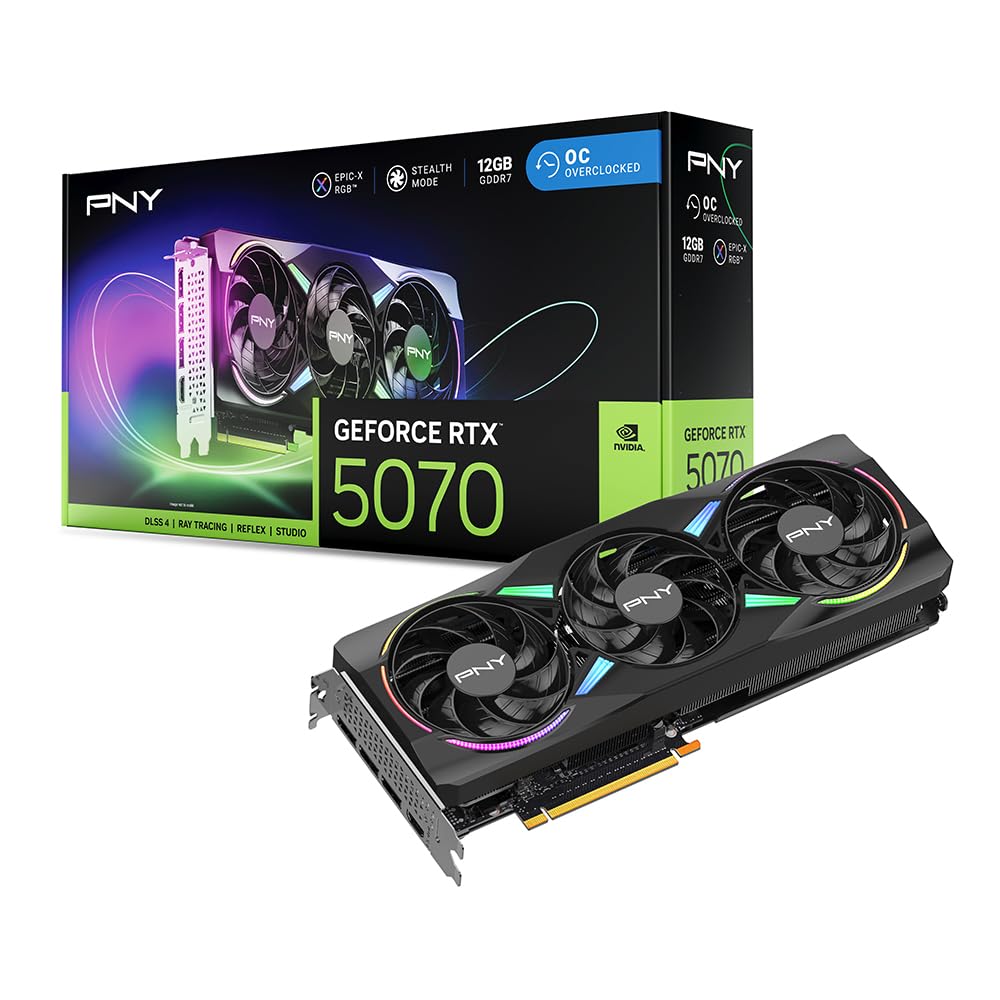
The PNY RTX 5070 Epic-X hits the sweet spot for 1440p gaming with its Blackwell architecture, 12GB of GDDR7 memory on a 192-bit bus, and a boost clock of 2685 MHz. The triple-fan cooling solution keeps temperatures in check even during sustained gaming sessions, and the card runs notably quieter than many competitors in this class. With 6,144 CUDA cores and support for DLSS 4, this card handles ray-traced titles at 1440p with impressive frame rates.
Real-world benchmarks show this card outperforming the previous-generation 4070 Super by a noticeable margin, especially in titles that leverage frame generation. The 12GB VRAM buffer is sufficient for current 1440p titles at ultra settings, though future-proofing enthusiasts may want more headroom. The factory overclock provides extra performance out of the box without requiring manual tuning.
The card’s SFF-ready 2.4-slot design and relatively compact footprint make it compatible with a wide range of cases. The included dual 8-pin to 12-pin adapter works with standard power supplies, though a 750W unit is recommended for stable operation. Overclockers will appreciate the extra headroom beyond the factory OC settings.
Why it’s great
- Excellent 1440p performance with DLSS 4 support
- Very quiet triple-fan cooling under load
- Compact size fits most cases comfortably
Good to know
- 12GB VRAM may feel tight for future ultra-texture 1440p titles
- Requires 750W PSU for stable operation
2. MSI RTX 5070 12G Gaming Trio OC

MSI’s Gaming Trio OC leverages the TRI FROZR 4 thermal design with STORMFORCE fans that use claw texturing and circular arc blades to push air quietly. The nickel-plated copper baseplate captures heat from the GPU and memory swiftly, while square-shaped core pipes maximize contact area for optimal thermal transfer. This card maintains boost clocks even during extended sessions without the fan noise becoming intrusive.
With 12GB of GDDR7 memory and a 2625 MHz boost clock, the Gaming Trio OC handles modern 1440p titles at high to ultra settings with ease. The card supports 8K output and features three DisplayPort 2.1a outputs plus HDMI 2.1b, giving users flexibility for multi-monitor setups. Build quality feels premium, and the heft of the cooler inspires confidence in its longevity.
Installation is straightforward, and the card works well with standard power supplies using the included adapters. The extra OC headroom beyond factory settings allows enthusiasts to push performance further. MSI’s Afterburner software provides granular control over fan curves and voltage settings for those who want to fine-tune their 1440p experience.
Why it’s great
- Exceptional TRI FROZR 4 cooling keeps noise low
- Premium build quality with sturdy backplate
- Strong 1440p performance with OC headroom
Good to know
- 12GB VRAM is adequate but not future-proof at 1440p
- Large cooler may not fit compact cases
3. ASUS Prime AMD Radeon RX 9070 XT 16GB GDDR6 OC Edition

The ASUS Prime RX 9070 XT brings 16GB of GDDR6 memory and a staggering 4000 MHz boost clock to the 1440p arena. This card uses axial-tech fans with a smaller hub for longer blades and a barrier ring that increases downward air pressure. A phase-change GPU thermal pad ensures optimal heat transfer, keeping temperatures lower for sustained performance. The 2.5-slot design balances cooling capability with case compatibility.
In real-world testing, this card delivers over 100 FPS at 1440p ultra settings in titles like Red Dead Redemption 2. The 16GB VRAM buffer provides ample headroom for texture-heavy mods and future games, making it a strong choice for users who plan to keep their card for several years. The dual BIOS feature lets users switch between performance and quiet modes without software.
The card runs cool and quiet, with dual-ball fan bearings rated for longer lifespan than conventional sleeve-bearing designs. Zero RPM technology keeps fans off during light workloads. Linux compatibility is excellent, with users reporting plug-and-play functionality on modern distributions. The card does require three PCIe power connectors and measures 12.3 inches, so case check is essential.
Why it’s great
- 16GB VRAM offers excellent future-proofing for 1440p
- Very efficient cooling with low noise levels
- Dual BIOS and zero RPM modes add flexibility
Good to know
- Large card requires spacious case with good airflow
- Ray tracing performance trails equivalent NVIDIA cards
4. GIGABYTE Radeon RX 9060 XT Gaming OC 16G

GIGABYTE’s RX 9060 XT Gaming OC packs 16GB of GDDR6 memory with a 2700 MHz game clock into a mid-range price bracket that makes 1440p gaming accessible. The WINDFORCE cooling system uses Hawk fans and server-grade thermal conductive gel to keep temperatures low under load. RGB lighting adds visual flair without detracting from the card’s primary mission of delivering smooth frame rates.
This card handles 1440p ultra settings comfortably in most modern titles, with users reporting 240 FPS in Fortnite and strong performance in demanding simulations like DCS World. The 16GB VRAM buffer is the standout feature at this price point, allowing for high-resolution texture packs and mods without hitting memory limits. FSR 4 support provides an additional performance boost when needed.
The card is physically large, measuring over 11 inches, and requires adequate case clearance. The dual-slot design with a solid backplate feels robustly built. AV1 encoding support is a bonus for content creators who stream or record gameplay. The zero RPM fan mode keeps the system silent during desktop use and lighter games.
Why it’s great
- 16GB VRAM at a competitive price point
- WINDFORCE cooling runs quiet and effective
- FSR 4 and AV1 encoding support added versatility
Good to know
- Large size may not fit smaller cases
- Ray tracing performance is decent but not class-leading
5. Sapphire 11350-03-20G Pulse AMD Radeon RX 9060 XT Gaming OC

The Sapphire Pulse RX 9060 XT delivers 16GB of GDDR6 memory on a 128-bit bus with a 3290 MHz boost clock in a compact form factor that suits smaller builds. Sapphire’s reputation for quality AMD cards shines here, with excellent thermal performance — edge temps sit in the mid-high 50s°C under load, and the card remains whisper quiet. Full PCIe 5.0 x16 support ensures maximum bandwidth with compatible motherboards.
This card punches above its weight for 1440p gaming, running all modern titles at max settings smoothly. The 16GB VRAM buffer makes it a strong choice for users who also run local LLMs or use ComfyUI for AI workflows. Linux support is outstanding, with plug-and-play functionality on distributions like Devuan and Fedora. The card draws low power and uses a single 6+2 pin connector.
A firmware update allows for a 200W power cap, and undervolting can boost clock speeds further while reducing temperatures. The compact footprint means it fits in most cases without issue. Users upgrading from older cards like the RX 570 report massive performance gains and silent operation. The thick back bracket can make for a tight fit in some systems, so measure carefully.
Why it’s great
- Excellent Linux support for dual-boot setups
- Runs cool and silent even under sustained load
- 16GB VRAM at a compact size
Good to know
- Back bracket may cause tight fit in some cases
- Only two HDMI outputs, one DisplayPort
6. ASRock Radeon RX 9060 XT Challenger 16GB OC
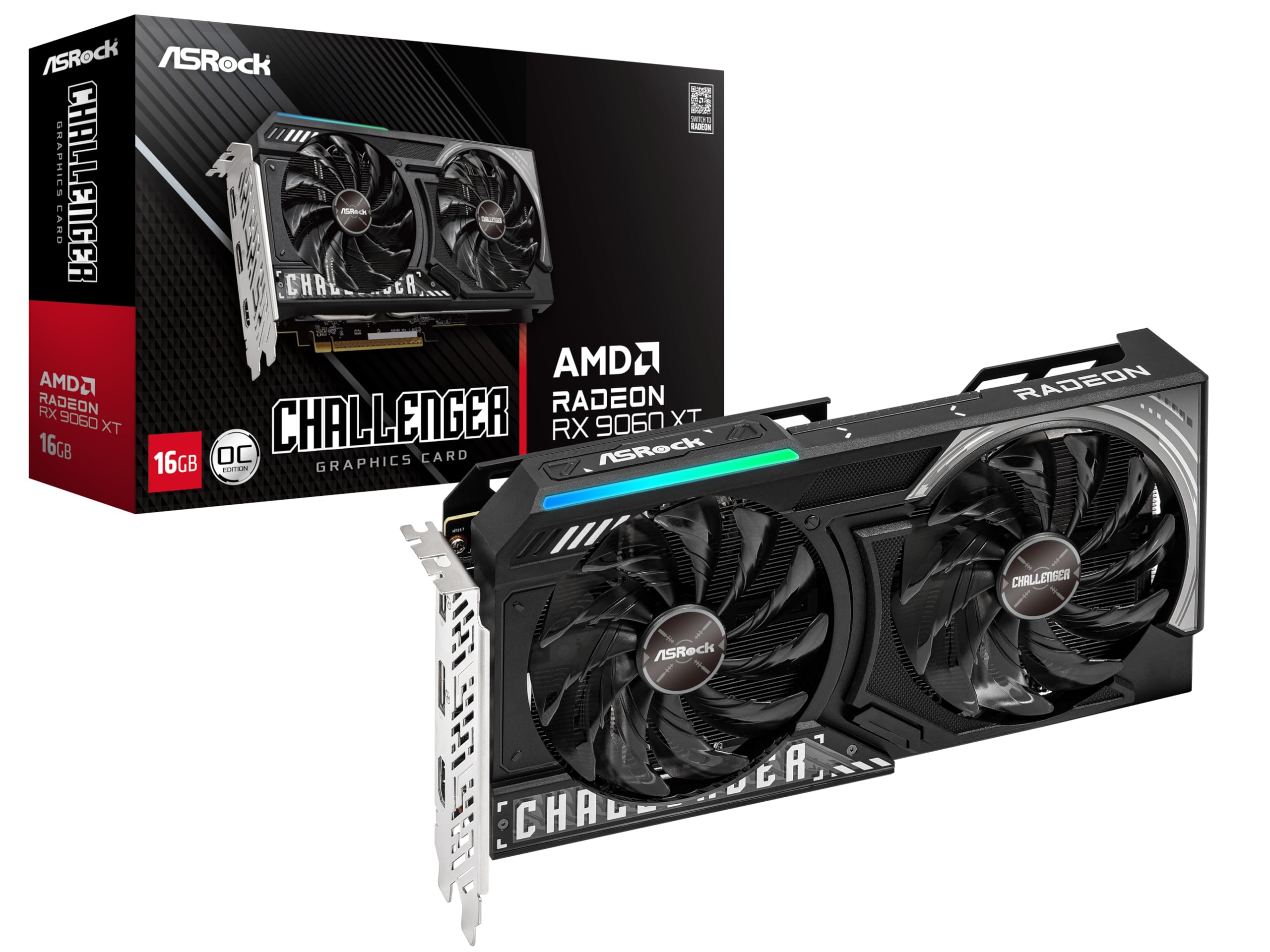
The ASRock Challenger RX 9060 XT offers 16GB of GDDR6 memory and a 3290 MHz boost clock at a budget-friendly price point. The dual-fan design with striped axial fans and 0dB Silent Cooling stops fans completely at low temperatures, making the card inaudible during desktop use and lighter games. At 0.98 kilograms, it is one of the lighter 16GB cards, making it easy to handle during installation.
This card excels at 1440p gaming, pushing high frame rates in modern titles with FSR 4 support enhancing performance further. Users upgrading from older cards like the 3060 report significant gains, with smooth 165 FPS at high settings. The 16GB VRAM buffer also makes this card capable for AI inference tasks, running models like Qwen 3.6-35b-a3b at reasonable speeds with ROCm support.
The card’s compact size fits easily in mid-tower cases, and the hardware switch to disable RGB is a thoughtful touch for users who prefer a clean aesthetic. Thermals are manageable with good case airflow, and the card never approaches 90°C even under load. For users prioritizing pure performance per dollar without extras like RGB or premium backplates, this card delivers solid value.
Why it’s great
- Lowest cost entry to 16GB VRAM for 1440p
- Very quiet operation with 0dB fan stop
- Compact dual-fan design fits most cases
Good to know
- Dual-fan heatsink has less heat dissipation than triple-fan
- No included extras like RGB controller or support bracket
7. PowerColor Reaper AMD Radeon RX 9060 XT 16GB GDDR6

The PowerColor Reaper RX 9060 XT is purpose-built for small form factor builds, measuring just 200mm in length while still packing 16GB of GDDR6 memory. The single 8-pin power connector and 500W minimum system power requirement make it compatible with smaller power supplies commonly found in SFF cases. Despite its compact size, the card delivers strong 1440p performance.
Users report excellent results at 1440p with high refresh rates, and the card handles 4K at 60 FPS in many titles when settings are adjusted. The 16GB VRAM buffer provides headroom for texture-heavy games and AI workloads. The card runs silently under load, making it suitable for living room PC builds where noise matters. Upgrading from older cards like the RX 580 yields dramatic performance improvements.
The dual-fan cooling solution with one HDMI 2.1b and two DisplayPort 2.1a outputs covers modern monitor setups. The card is lightweight at just 658 grams, reducing strain on the PCIe slot. While the Reaper line focuses on no-frills performance, the build quality feels solid and reliable. Some users note the card is not compatible with very old legacy titles, but for modern 1440p gaming it delivers.
Why it’s great
- Ultra-compact 200mm length perfect for SFF builds
- Single 8-pin power connector simplifies cable management
- 16GB VRAM in a small footprint
Good to know
- Dual-fan cooling less effective than larger designs in hot cases
- Not compatible with some very old legacy game titles
8. XFX Swift AMD Radeon RX 9060 XT OC Gaming Edition 16GB
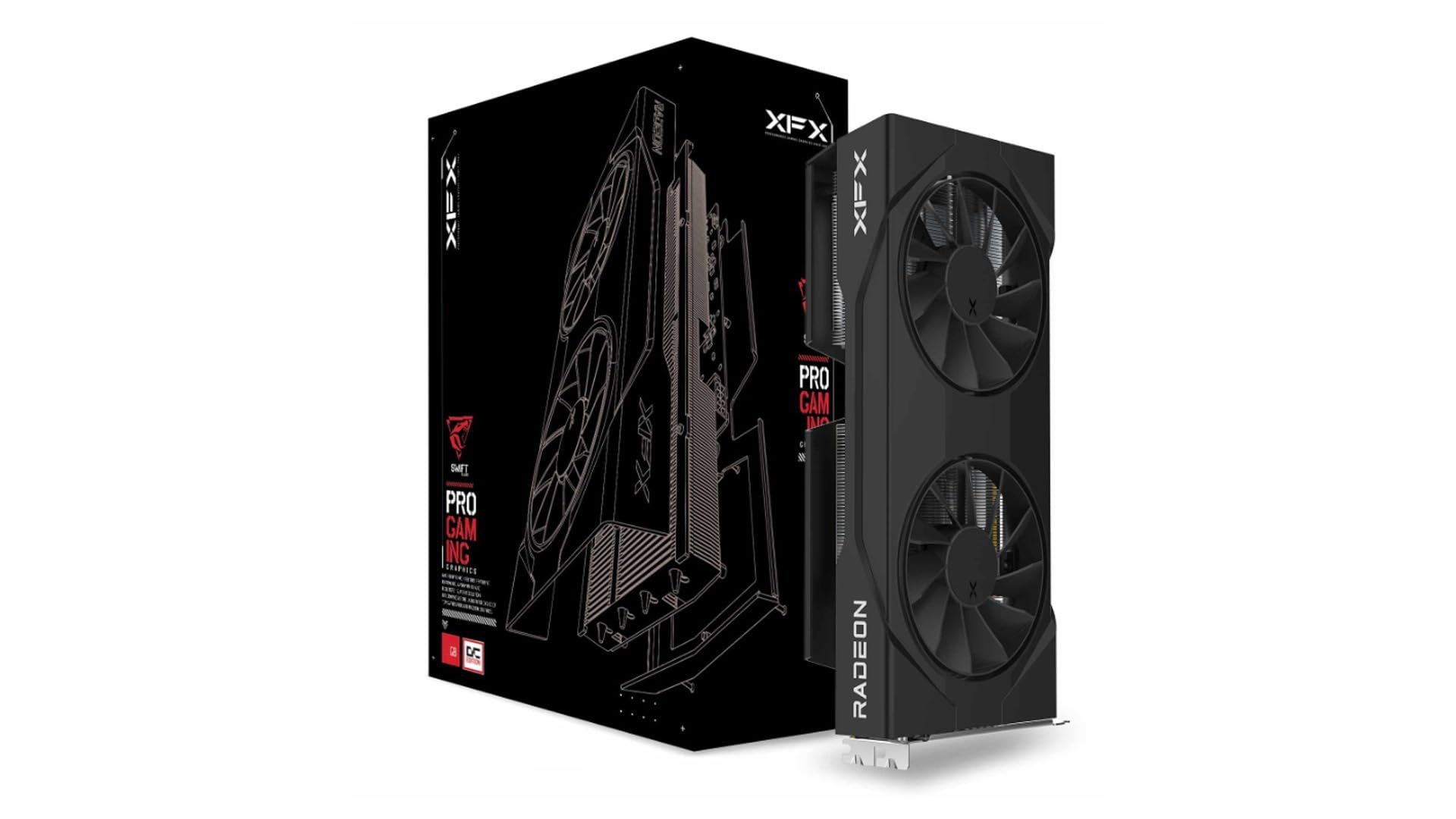
The XFX Swift RX 9060 XT offers the highest boost clock among the 9060 XT cards at 3320 MHz, paired with 16GB of GDDR6 memory. The SWFT Dual Fan cooling solution keeps temperatures around 60°C under load according to user reports, with a Time Spy score of approximately 17000. This card handles 1080p max settings on 95% of modern AAA games with ease while being fully capable at 1440p.
Users upgrading from older cards like the 6650 XT report significant performance improvements with easy installation and stable operation. The card runs super quiet, and the build quality feels solid for its price tier. The 16GB VRAM buffer provides headroom for high-resolution textures and future games, and FSR 4 support adds upscaling capabilities for extra performance.
The card features two DisplayPort outputs and one HDMI output, which may limit multi-monitor configurations for some users. The dual-fan design is effective but not as thermally robust as triple-fan solutions in constrained airflow cases. For gamers on a budget who want access to 16GB of VRAM and strong 1440p performance, this card represents excellent value.
Why it’s great
- Highest 3320 MHz boost clock in 9060 XT class
- Runs cool at ~60°C under gaming load
- 16GB VRAM at an entry-level price point
Good to know
- Only 3 video outputs limit multi-monitor setups
- Dual-fan cooling less robust than triple-fan designs
9. GIGABYTE GeForce RTX 5060 Ti Gaming OC 8G

The GIGABYTE RTX 5060 Ti Gaming OC brings NVIDIA’s Blackwell architecture and DLSS 4 to the entry-level 1440p market with 8GB of GDDR7 memory on a 128-bit bus. The WINDFORCE cooling system with Hawk fans keeps the card running efficiently, and the 8-pin power connector means no PSU upgrade is needed for most users who already have a decent unit. The 2647 MHz boost clock provides solid out-of-box performance.
Users upgrading from cards like the 3060 Ti report noticeable improvements in COD, Battlefield, and other popular titles at 1440p. The card draws less power than the 3060 Ti while delivering better performance, making it an efficient upgrade path. The 8GB VRAM is the limiting factor here — current titles at 1440p can push past this limit with ultra textures, so users may need to adjust settings in the most demanding games.
The card performs well at 1080p with ultra settings and handles 1440p with high settings in most titles. The 128-bit memory interface is narrower than higher-tier cards, but GDDR7’s higher bandwidth compensates somewhat. For casual gamers who want DLSS 4 access and don’t plan to run maxed-out textures at 1440p, this card offers a strong value proposition with NVIDIA’s feature set.
Why it’s great
- Access to DLSS 4 at an entry-level price
- Lower power draw than previous-gen 3060 Ti
- Standard 8-pin power connector simplifies upgrades
Good to know
- 8GB VRAM may limit texture quality at 1440p
- 128-bit memory interface narrower than premium options
10. ASUS Dual NVIDIA GeForce RTX 5060 8GB GDDR7 OC Edition

The ASUS Dual RTX 5060 is the most budget-conscious entry point to the RTX 50 series and 1440p gaming, featuring 8GB of GDDR7 memory with PCIe 5.0 support. The axial-tech fan design with a smaller hub facilitates longer blades and a barrier ring that increases downward air pressure, improving cooling efficiency. The 150W TDP means this card runs efficiently and typically pulls around 100W during gaming.
This card delivers strong 1080p and solid 1440p performance, with users reporting near 2080 Ti / 3070 level rasterization in about 80% of titles. DLSS 4 helps extend its lifespan at higher resolutions by using AI-powered upscaling. The SFF-ready dual-fan design makes it compatible with compact cases, and the lack of RGB appeals to users who prefer a clean aesthetic.
The 8GB VRAM is the most significant limitation for 1440p gaming — modern titles with high-resolution texture packs may require lowering settings. Users upgrading from older systems report excellent compatibility with 8-year-old computers, and the price is competitive for those wanting to enter the RTX 50 series ecosystem. For users who primarily play competitive titles or are willing to adjust settings, this card delivers good value.
Why it’s great
- Most affordable way to access RTX 50 series and GDDR7
- Very efficient at ~100W gaming power draw
- SFF-compatible dual-fan design
Good to know
- 8GB VRAM limits texture detail at 1440p
- GDDR7 bandwidth partially offset by 128-bit interface
11. EVGA 08G-P5-3755-KR GeForce RTX 3070 XC3 Ultra Gaming 8GB

The EVGA RTX 3070 XC3 Ultra remains a relevant 1440p contender thanks to its proven build quality and iCX3 cooling technology with triple HDB fans. The 1770 MHz boost clock on paper looks modest compared to newer cards, but in practice this card delivers excellent 1440p performance with ray tracing and DLSS support. The all-metal backplate and adjustable ARGB lighting give it a premium aesthetic that still looks great in modern builds.
In benchmarks, this card scores over 8000 in Port Royal and pushes 150+ FPS in many competitive titles at 1440p. Cyberpunk 2077 runs well on ray tracing medium at 2K resolution. The card runs cool with max temperatures of 62-65°C at 35-45% fan speeds in well-ventilated cases. The EVGA PX1 software provides full control over fan curves and overclocking — though note that Afterburner may only control two of the three fans.
The 8GB GDDR6 memory is the limiting factor for the most demanding modern titles at 1440p, and users may need to reduce texture quality in newer releases. The card requires a PCIe power cable adapter and benefits from a support bracket to prevent sag. While the card is older technology, its reliability and thermal performance make it a solid choice for users who find a good deal on this proven platform.
Why it’s great
- Proven EVGA build quality and iCX3 cooling performance
- Excellent 1440p ray tracing capability for its class
- Runs cool and quiet with triple HDB fans
Good to know
- 8GB VRAM is below modern 1440p standards
- May require sag bracket and PX1 software for full fan control
FAQ
Is 8GB of VRAM enough for 1440p gaming in 2025?
What power supply wattage do I need for a 1440p GPU?
Should I choose NVIDIA or AMD for 1440p gaming?
Will PCIe 5.0 improve my 1440p gaming performance?
Final Thoughts: The Verdict
For most users, the best gpu for 1440p gaming winner is the PNY RTX 5070 Epic-X because it delivers excellent 1440p performance with DLSS 4 support, quiet triple-fan cooling, and a balanced feature set that hits the sweet spot between price and capability. If you want maximum future-proofing with 16GB VRAM, grab the ASUS Prime RX 9070 XT. And for budget-conscious builders who still want 16GB VRAM and solid 1440p performance, nothing beats the ASRock RX 9060 XT Challenger.