
Your cool-season lawn’s real battle starts when soil temperatures dip below 55°F. That’s when root growth peaks underground while the top goes dormant — and the wrong fertilizer (too much fast-release nitrogen, not enough potassium) will waste nutrients and leave you with weak, snow-mold-prone turf in March. The same granular bag you grab in April won’t cut it for autumn application.
I’m Mohammad Maruf — the founder and writer behind Drink4Good. I’ve spent the last three seasons analyzing soil test data and granular NPK release profiles to identify which fall-specific blends actually deliver deep rooting and spring green-up without burning your lawn budget.
Whether you’re overseeding a bare patch or prepping a mature Kentucky bluegrass stand for winter dormancy, the right best grass fertilizer for fall hinges on potassium levels (K above 10), slow-release nitrogen percentages, and iron content for that dark green carryover into the cold months.
How To Choose The Best Grass Fertilizer For Fall
Fall feeding is the most important lawn application of the year for cool-season grasses. The goal isn’t top-growth green-up — it’s root carbohydrate storage and crown hardiness that determine how fast your lawn recovers in the spring. You need a distinct NPK profile and a specific nitrogen release pattern to get that right.
Prioritize Potassium (K) Over Everything
A fall fertilizer’s third number (potassium) should be at least 10, and ideally between 12 and 20. Potassium strengthens cell walls, improves drought and cold tolerance, and helps the plant metabolize stored energy through winter dormancy. The classic fall ratio is a high-K formula like 10-0-20 or 24-0-12 — low phosphorus because most established lawns have enough P already, and high K for root resilience.
Check the Nitrogen Release Mechanism
You want a mix of quick-release (for a short color boost before dormancy) and slow-release nitrogen (for sustained feeding over 6 to 8 weeks as roots continue growing in cool soil). Labels listing “slow-release nitrogen” or “polymer-coated sulfur-coated urea” indicate feeding that lasts into the late fall without forcing a dangerous flush of top growth that invites snow mold.
Look for Supplementary Iron
Fall fertilizers that include chelated iron (often listed as “3% Iron” or “Fe”) give you that deep green look without adding more nitrogen. Iron produces a dark, rich color even as the grass slows its top growth, which is exactly what you want heading into winter. It also doesn’t contribute to thatch buildup the way excess nitrogen can.
Quick Comparison
On smaller screens, swipe sideways to see the full table.
| Model | Category | Best For | Key Spec | Amazon |
|---|---|---|---|---|
| GreenView Fairway Formula | Premium | Deep color with minimal surge growth | 30-0-12, 58% slow-release N | Amazon |
| Yard Mastery 24-0-6 Flagship | Premium | Bermuda thickening and dark greening | 24-0-6 with 3% Iron, Bio-Nite | Amazon |
| Jonathan Green Winter Survival | Premium | Deep rooting and early spring green-up | 10-0-20, high potassium blend | Amazon |
| The Andersons Professional PGF 16-0-8 | Mid-Range | Soil with high phosphorus levels | 16-0-8, Humic DG particles | Amazon |
| The Andersons Premium Fall Lawn Food | Mid-Range | General fall prep for all turf types | 24-0-14, triple-source N | Amazon |
| Scotts Turf Builder WinterGuard Fall Weed & Feed5 | Budget | Weed control plus fall feeding | Kills 50+ weeds, 4000 sq. ft. | Amazon |
| Scotts Turf Builder WinterGuard Fall Lawn Food | Budget | Large-area fall recovery feeding | 32-0-10, covers 12,000 sq. ft. | Amazon |
In‑Depth Reviews
1. GreenView Fairway Formula Fall Lawn Fertilizer

This 30-0-12 formula sits at the intersection of high potassium and smart-nitrogen delivery — nearly 60% of its nitrogen is slow-release polymer-coated, which means roots get fed for weeks without pushing a risky flush of top growth before frost. The zero-phosphate composition also makes it environmentally responsible for properties near waterways or those with already-sufficient soil P levels.
Moisture-proof bag construction solves a major annoyance with fall fertilizers: clumping. Traditional paper bags absorb humidity and turn granular products into concrete blocks by mid-October, but GreenView’s sealed packaging pours freely even after storage. The 15,000 sq. ft. coverage per 45-pound bag works out to an efficient application rate for medium-to-large lots.
Customer reports consistently describe a deep kelly-green color that holds through winter into late spring, with dramatically fewer clippings than comparable high-N formulas. One Northern Virginia user noted their GreenView-fed lawn outperformed a neighbor’s spray-on service after a single fall treatment.
Why it’s great
- Gives nearly 60% slow-release nitrogen that lasts through late fall
- Moisture-proof bag prevents granule clumping and waste
- Zero phosphate — safe near waterways and on phosphate-rich soil
Good to know
- Slightly higher cost per bag than generic big-box fall fertilizers
- Not widely available in local hardware stores — mostly online
2. Yard Mastery 24-0-6 Flagship Granular Lawn Fertilizer

Yard Mastery’s Flagship formula brings 3% chelated iron to the fall application — a detail that makes a visible difference in color retention as temperatures drop. With 24% slow-release nitrogen and 6% potassium, it’s best suited for warm-season grasses like Bermuda that need a strong pre-dormancy root boost, though it works across all grass types.
The Bio-Nite additive enhances microbial activity in the soil, helping break down thatch and improving nutrient uptake during the cooler soil temperatures of October and November. Each 45-pound bag covers 15,000 sq. ft., matching the coverage of premium competitors while delivering a heavier iron punch that customers describe as “asking which lawn service” they use.
One caveat: the high nitrogen content (24%) can stimulate aggressive growth if applied too early in fall. Users report needing to mow twice a week during the flush period, which is a sign you should time this application for early to mid-October rather than September.
Why it’s great
- 3% iron provides deep, dark green color without additional nitrogen
- Bio-Nite additive improves soil biology in cooler autumn soil
- High coverage — one bag handles a standard quarter-acre lot
Good to know
- May cause a strong growth surge if applied too early in September
- Potassium level (6) is lower than ideal for pure cold-hardiness focus
3. Jonathan Green Winter Survival Fall Lawn Food 10-0-20

If cold-hardiness is your primary concern, this 10-0-20 blend delivers the highest potassium-to-nitrogen ratio in its class. The 20% potassium is specifically formulated to thicken cell walls and support root carbohydrate storage through deep winter freezes. Jonathan Green recommends a first application in early fall followed by a second in early November for maximum spring carryover.
The slow-release nitrogen source maintains a steady feeding cadence without pushing tender new growth that would be vulnerable to snow mold. The granular formulation is larger than typical Anderson’s or GreenView particles, which some users found challenging to spread evenly with a rotary broadcast spreader — a slightly wider overlap pattern compensates.
Northeast customers who applied in early November reported their lawn looked “significantly healthier by mid-December” compared to untreated areas, with noticeable green-up when snow melted in early spring. The 45-pound bag covers the same 15,000 sq. ft. as other full-size bags, but the higher K content means you’re getting more cold-stress protection per pound.
Why it’s great
- Highest potassium ratio (20) for maximum winter root storage
- Dual-application strategy works well for cold northern climates
- Slow-release N prevents snow mold risk from late-season growth
Good to know
- Large granules require careful spreader calibration to avoid streaks
- No weed control — pure fertilizer, not a weed-and-feed combo
4. The Andersons Professional PGF 16-0-8 with Humic DG
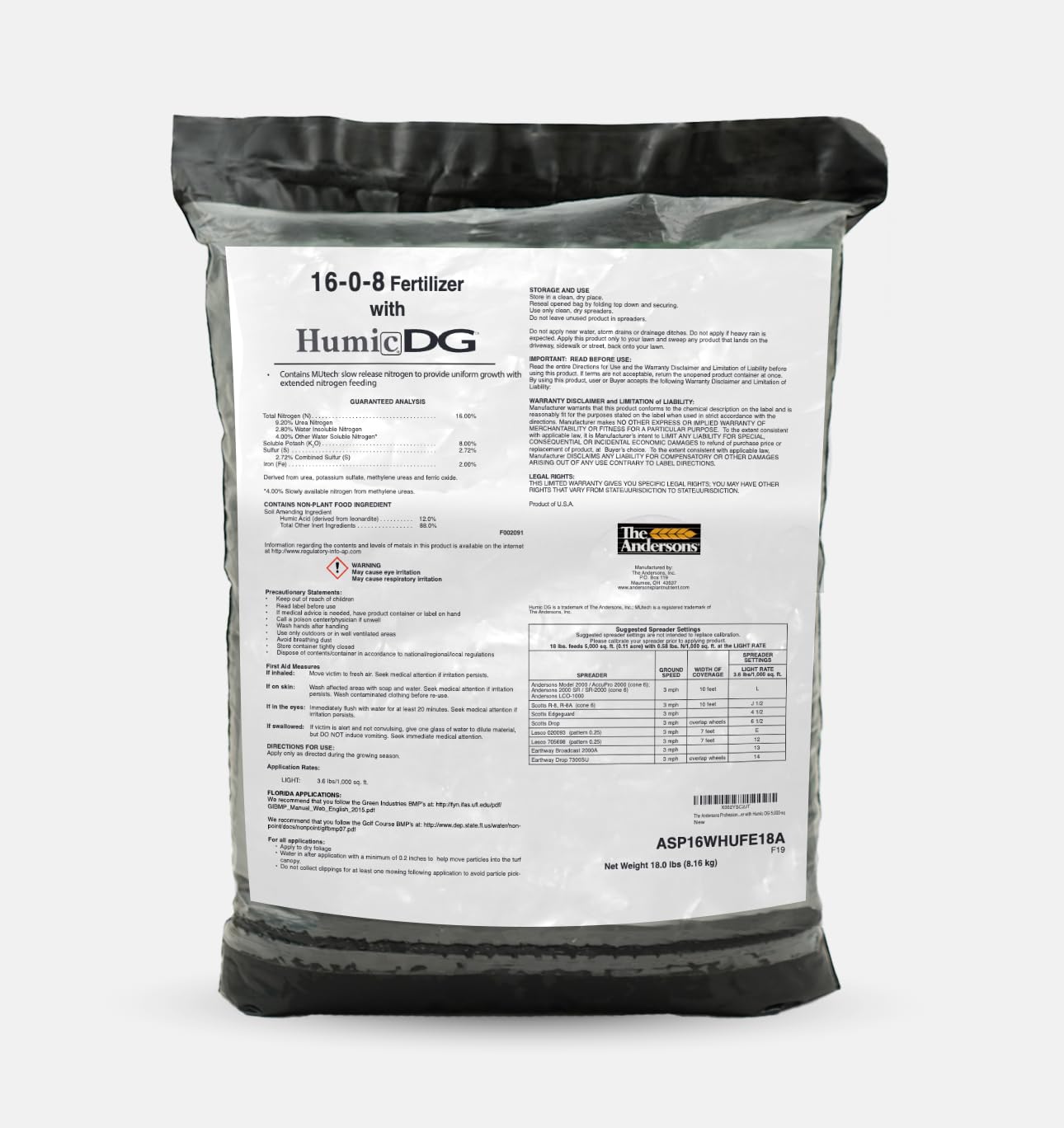
This is the go-to fall option for anyone whose soil test shows high phosphorus levels — the 16-0-8 analysis skips P entirely while still delivering balanced fall nutrition. The Humic DG particles (distinctive dark granules that disperse easily) improve nutrient uptake in cool fall soils and enhance root mass development even as top growth slows.
The ultra-fine particle size provides double the particles per square foot compared to standard granular fertilizers, which makes the 18-pound bag feel deceptively small but actually delivers excellent distribution. Quick-release and slow-release nitrogen are blended so you see a two-week color response while roots continue feeding for eight weeks.
Multiple customers on the “How to with Doc” program specifically use this product for soil with elevated P levels, and one long-time user reported switching to this after a soil test showed his backyard was phosphorus-loaded from years of standard fertilizer. The smaller bag is easier to handle for homeowners with sub-acre lawns, making it a practical mid-range choice.
Why it’s great
- Phosphorus-free — perfect for high-P soils and eco-conscious lawns
- Humic DG enhances root nutrient uptake in colder fall soil
- Fine particle size means exceptional coverage uniformity
Good to know
- Only 8% potassium — lower than pure winterizer blends
- 18 lb bag covers smaller area; not ideal for large properties
5. The Andersons Premium Fall Lawn Food 24-0-14
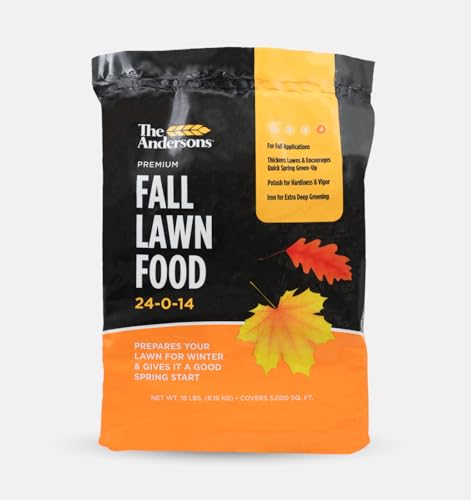
With 14% potassium and a triple-source nitrogen system (quick-release, intermediate, and slow-release urea), this Andersons blend hits the sweet spot for homeowners who want visible fall color plus measurable root protection. The 24-0-14 ratio provides more nitrogen than a pure winterizer, making it a strong transitional option for early-to-mid fall when top-growth greening still matters.
The inclusion of iron adds an extra dimension: customers report a “deep, dark green” that rivals premium iron-heavy products, but the 14% K ensures the lawn also builds cold tolerance. The 18-pound bag covers approximately 5,000 sq. ft., which is smaller than the 15,000 sq. ft. bags mentioned above, so adjust your purchase quantity for your lawn size.
User reviews consistently mention this is “the best fertilizer I have ever used,” with particularly dramatic results on lawns transitioning from summer stress into fall recovery. One customer noted their lawn “outperformed a well-known landscape company” after switching to this product for their fall application schedule.
Why it’s great
- Triple-source nitrogen provides immediate green plus extended feeding
- 14% K combined with iron for both cold tolerance and color
- Safe for all turf types — no phosphorus addition
Good to know
- 5,000 sq. ft. coverage means larger lawns need multiple bags
- Not a weed-and-feed formulation — no herbicide included
6. Scotts Turf Builder WinterGuard Fall Weed & Feed5
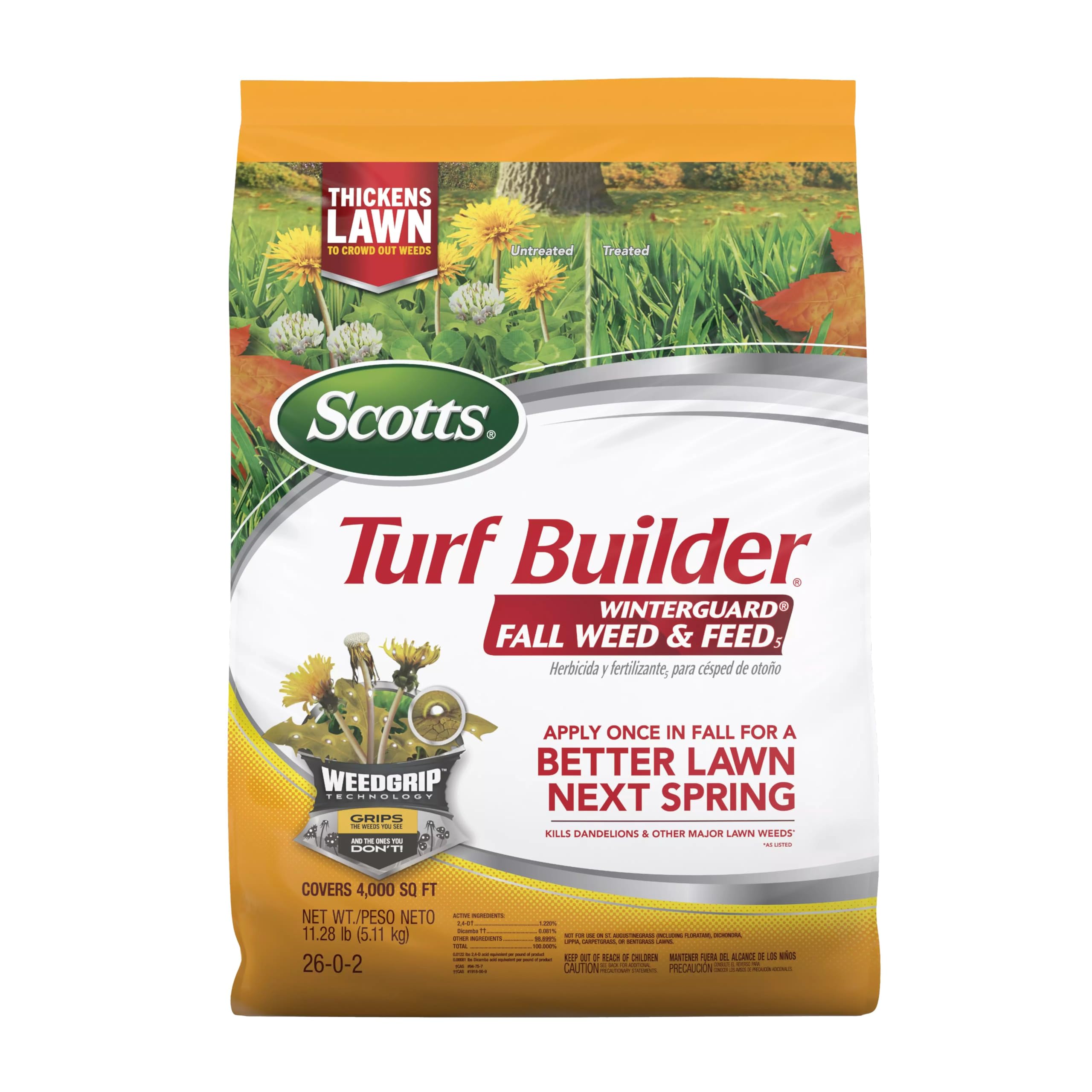
If your fall lawn is overrun with clover, dandelion, or plantain, this Scotts weed-and-feed targets over 50 listed broadleaf weeds while delivering a potassium-based fall fertilizer. The herbicide component (active ingredient known as 2,4-D and related compounds) works best when temperatures are between 60°F and 90°F and weeds are actively growing — which means early fall timing is critical.
The 11.28-pound bag covers 4,000 sq. ft., making it a smaller-area option best suited for suburban front yards or zone-specific spot treatment. Application requires a wet lawn (dew or light watering) and no rain within 24 hours for optimal herbicide absorption. Users consistently report that dandelions requiring “days of weeding last year” were eliminated after one application.
The biggest trade-off: you cannot combine this with overseeding. The herbicide that kills broadleaf weeds will also kill germinating grass seedlings. If you plan to overseed this fall, apply the fertilizer-only product and do weed control separately. Also, the 4,000 sq. ft. coverage means it’s cost-inefficient for large properties.
Why it’s great
- Kills 50+ broadleaf weed types including clover and dandelion
- Combines weed control with fall-specific NPK in one pass
- Compatible with all common cool-season and warm-season grasses
Good to know
- Cannot be used with overseeding — herbicide kills new grass seed
- Small bag covers only 4,000 sq. ft., not economical for large lawns
7. Scotts Turf Builder WinterGuard Fall Lawn Food 32-0-10

This straightforward fall food focuses on root recovery from summer stress with a 32-0-10 ratio — heavily nitrogen-loaded to repair damage from heat, drought, and foot traffic. The 10% potassium provides moderate winter protection, but the star feature is coverage: a single 32.3-pound bag treats 12,000 sq. ft., making it the most area-efficient option in this lineup.
Scotts recommends applying this to wet OR dry lawns, which adds application flexibility. The granular formula works through any broadcast or drop spreader, and because it’s a pure fertilizer (no herbicide), you can freely overseed immediately after application. The nitrogen content is higher than most fall specialists recommend, so timing is important — apply too late and the grass may stay green into early winter instead of going dormant.
Users report that grass “became bright green even as winter started” when applied in late October. One customer with a freshly grown lawn noted this “stabilized my fresh lawn over the cold months” in a yard with minimal sunlight exposure. For large properties needing fast recovery and visible color through late fall, this entry-level bag offers the best cost-per-square-foot value.
Why it’s great
- One bag covers 12,000 sq. ft. — best coverage-to-price ratio
- Can be applied to wet or dry lawn without compromising performance
- No herbicide, so overseeding can happen immediately
Good to know
- High 32% nitrogen may delay natural winter dormancy if applied late
- Only 10% potassium — lower winter-hardiness protection than high-K blends
FAQ
Can I apply a spring fertilizer in the fall instead of a specific winterizer blend?
What is the ideal soil temperature window for applying fall fertilizer?
Should I use a weed-and-feed product if I plan to overseed this fall?
Final Thoughts: The Verdict
For most users, the best grass fertilizer for fall winner is the GreenView Fairway Formula because the 30-0-12 ratio with nearly 60% slow-release nitrogen and zero phosphate delivers the ideal balance of winter root protection and environmental responsibility. If you want maximum cold-hardiness for a northern frost zone, grab the Jonathan Green Winter Survival with its 10-0-20 high-K formulation. And for large-area recovery after a tough summer, nothing beats the coverage-to-value ratio of the Scott’s Turf Builder WinterGuard 32-0-10.