
You land in a new country, pull out your phone, and the hotel’s “complimentary WiFi” offers a generous 2 Mbps. You are stuck buffering a map while roaming charges loom. A dedicated global WiFi hotspot eliminates this bottleneck—it taps local cellular networks, builds your own private LAN, and often covers dozens of countries without a single physical SIM swap. The right device keeps you productive on a video call in a Tokyo coffee shop, streaming in a Marrakech riad, or working remotely from an RV in rural Montana.
I’m Mohammad Maruf — the founder and writer behind Drink4Good. I have spent hundreds of hours analyzing mobile hotspot hardware, cross-referencing carrier bands, battery benchmarks, and real-world throughput data so you avoid the common pitfall of buying a device that only works well in one region.
The decision comes down to how you travel and how many devices you need online simultaneously. This guide breaks down the top contenders for the best global wifi hotspot to help you match a device to your actual trip itinerary rather than a flashy spec sheet.
How To Choose The Best Global WiFi Hotspot
Not every hotspot is built for multi-country roaming. A device that shines on a cross-country road trip in the US may lock you out of local 4G bands in Southeast Asia. Here are the three filters that separate a versatile travel companion from a one-trip wonder.
Coverage vs. Carrier Partnerships
A hotspot sold as “global” often has partnerships with dozens (or hundreds) of mobile carriers in specific regions. Check whether the device uses CloudSIM technology, which automatically selects the strongest local network, or relies on a pre-loaded eSIM that limits you to a single roam-like-home partner in each country. Devices that support a physical SIM slot give you the flexibility to buy a cheap local data plan for extended stays.
Battery Life and Real-World Throughput
Manufacturers often quote battery life under ideal lab conditions — low screen brightness, a single device connected, and a weak signal. In practice, a hotspot running 4–5 devices with active video calls drains faster. Look for a battery capacity above 5000 mAh if you need a full workday away from an outlet. Also, note that the advertised “up to 150 Mbps” speed rarely materializes in crowded urban areas where many users share the same tower.
Device Capacity and Security Layer
A hotspot that supports 32+ simultaneous devices sounds like overkill, but it matters when you are traveling with a group or using gadgets that lack cellular modems (laptops, tablets, smart TVs). Equally important is the security stack — at minimum look for WPA3 encryption. If you handle sensitive data, choose a device that can run a VPN client (OpenVPN or WireGuard) so all traffic is encrypted before it ever leaves the hotspot.
Quick Comparison
On smaller screens, swipe sideways to see the full table.
| Model | Category | Best For | Key Spec | Amazon |
|---|---|---|---|---|
| GlocalMe UPP | CloudSIM | Budget global roaming | 3000 mAh battery | Amazon |
| TP-Link Roam 7 | Travel Router | Hotel/Cruise WiFi security | 2.5 Gbps WAN port | Amazon |
| GL.iNet Beryl 7 | Travel Router | VPN-first travelers | 1100 Mbps WireGuard | Amazon |
| TravlFi JourneyGo | LTE Hotspot | US RV/camper internet | 16-hour battery | Amazon |
| Netgear Nighthawk M6 Pro (Renewed) | 5G Hotspot | High-speed US + global | 2.8-inch touchscreen | Amazon |
| Solis Edge 5G | CloudSIM | Lifetime data bundle | 12 GB/year free data | Amazon |
| Netgear Nighthawk M7 Pro (Renewed) | 5G mmWave | Ultra-fast group travel | 10 Gbps data rate | Amazon |
| GlocalMe Numen Air 5G | CloudSIM | Speed + power bank | 2.5 Gbps downlink | Amazon |
| GL.iNet GL-X3000 (Spitz AX) | Cellular Gateway | RV / rural base station | Dual-SIM failover | Amazon |
In‑Depth Reviews
1. GlocalMe UPP 4G Portable WiFi Hotspot
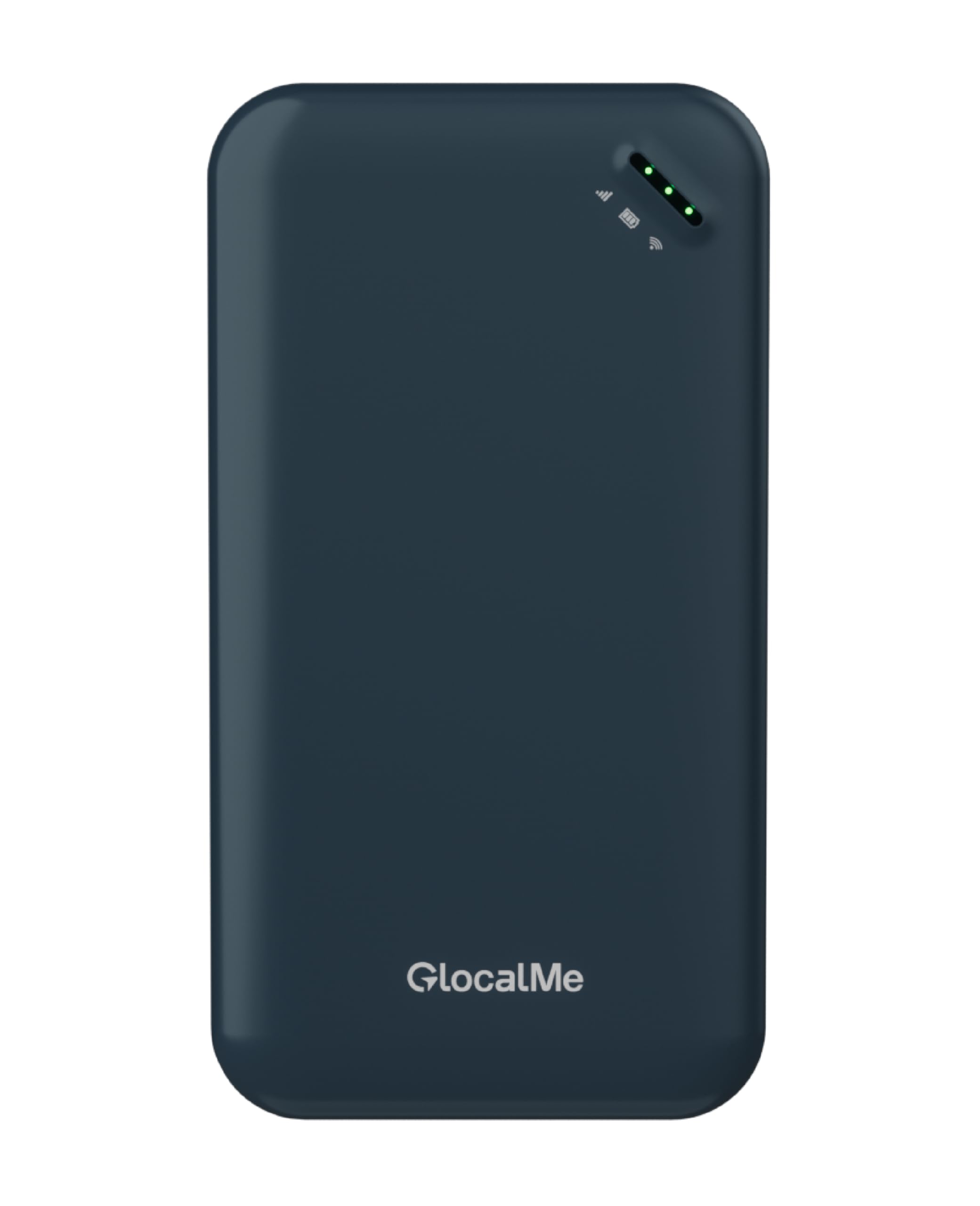
The GlocalMe UPP strikes a rare balance between cost and global utility. It ships with 1.1 GB of preloaded data (valid 90 days) and its CloudSIM engine hooks into 390+ carriers across 200 countries — you literally pull it out of the box, turn it on, and connect. There is no physical SIM to hunt down at an airport kiosk. The 3000 mAh battery delivers a solid 13 hours of mixed use, enough for a full day of light browsing, navigation, and messaging. Pair it with eight devices and the whole family stays online without anyone needing to buy a roaming add-on.
Speeds average 35–40 Mbps in real-world tests (not the 150 Mbps ceiling), which covers 1080p streaming and Zoom calls comfortably. A single-band radio keeps things simple but means you get the same performance in both congested and open environments. The touchscreen interface is small but usable for checking data balance and connected devices.
Where the UPP earns its “Best Overall” tag is the pay-as-you-go data model — you buy top-ups by the day, month, region, or GB, and there is zero contract. For travelers who move between continents and want one device that always works without fiddling, this is the pick.
Why it’s great
- Works out of the box with no SIM or contract
- Covers 200+ countries with automatic carrier selection
- Supports up to eight devices simultaneously
Good to know
- Real-world speeds top out around 40 Mbps
- Battery requires a daily charge with heavy use
2. TP-Link Roam 7 BE3600

The TP-Link Roam 7 is not a cellular hotspot — it is a travel router that connects to existing public WiFi (hotel, airport, cruise ship) and rebroadcasts a private, encrypted network. This distinction matters when you already have internet access but distrust the security. It supports up to 90 devices and pumps out 2.4 Gbps on the 5 GHz band, making it the strongest choice for large groups who need to share a single public login.
The captive portal authentication is a standout feature: log in once on the Tether App, and every device behind the Roam 7 stays authenticated. No more re-entering hotel WiFi passwords on every phone and laptop. The 2.5 Gbps WAN port also lets you plug directly into an ethernet jack in a business hotel for wired-backup speeds.
Note that this device uses WiFi 7 but does not support the 6 GHz band — it is a dual-band router, not tri-band. If you need a cellular modem built in, this is not the device. But for anyone whose main pain point is insecure public WiFi and device limits at hotels, the Roam 7 is a precise fix.
Why it’s great
- Creates a secure VPN-encrypted network from any public WiFi
- One-time captive portal login works for all connected devices
- Supports up to 90 devices simultaneously
Good to know
- No cellular modem — requires existing WiFi or ethernet
- Does not support the 6 GHz band
3. GL.iNet GL-MT3600BE (Beryl 7)
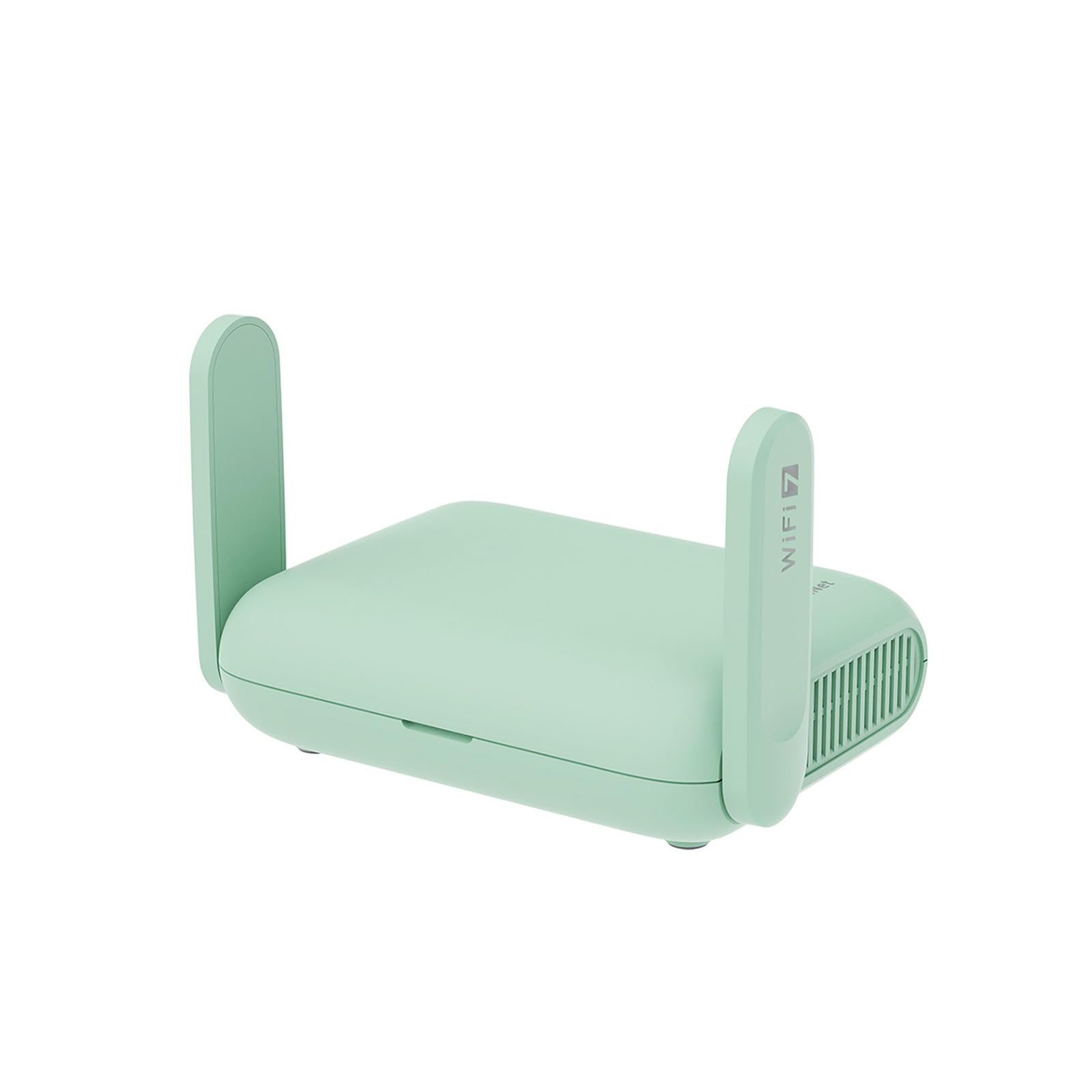
The Beryl 7 is the premium travel router for the privacy-conscious nomad. It runs OpenWrt 21.02 under the hood, which means you can install custom plugins, configure VLANs, and run a VPN server and client at the same time (called VPN cascading). The dual 2.5 Gbps ethernet ports are rare in a device this compact — it even handles up to 120 connected clients without choking.
WireGuard throughput hits 1100 Mbps on a local network, so even if the upstream public WiFi is slow, the Beryl 7 does not introduce any routing bottleneck. The physical toggle switch is a clever touch: it lets you instantly enable or disable AdGuard Home or a VPN client without diving into the admin panel. The mint green chassis is polarizing, but the build quality is clearly a step above budget travel routers.
Like the TP-Link Roam 7, the Beryl 7 is a travel router without cellular — it needs an upstream WiFi or ethernet source. For remote workers who need a hardened OpenWrt environment with VPN-first architecture, this is the gold standard.
Why it’s great
- OpenWrt firmware offers unlimited customization
- VPN cascading supports server and client simultaneously
- Physical toggle for quick VPN/AdGuard activation
Good to know
- No cellular modem — tethered to public WiFi
- Requires some networking knowledge for advanced setups
4. TravlFi JourneyGo LTE RV Hotspot
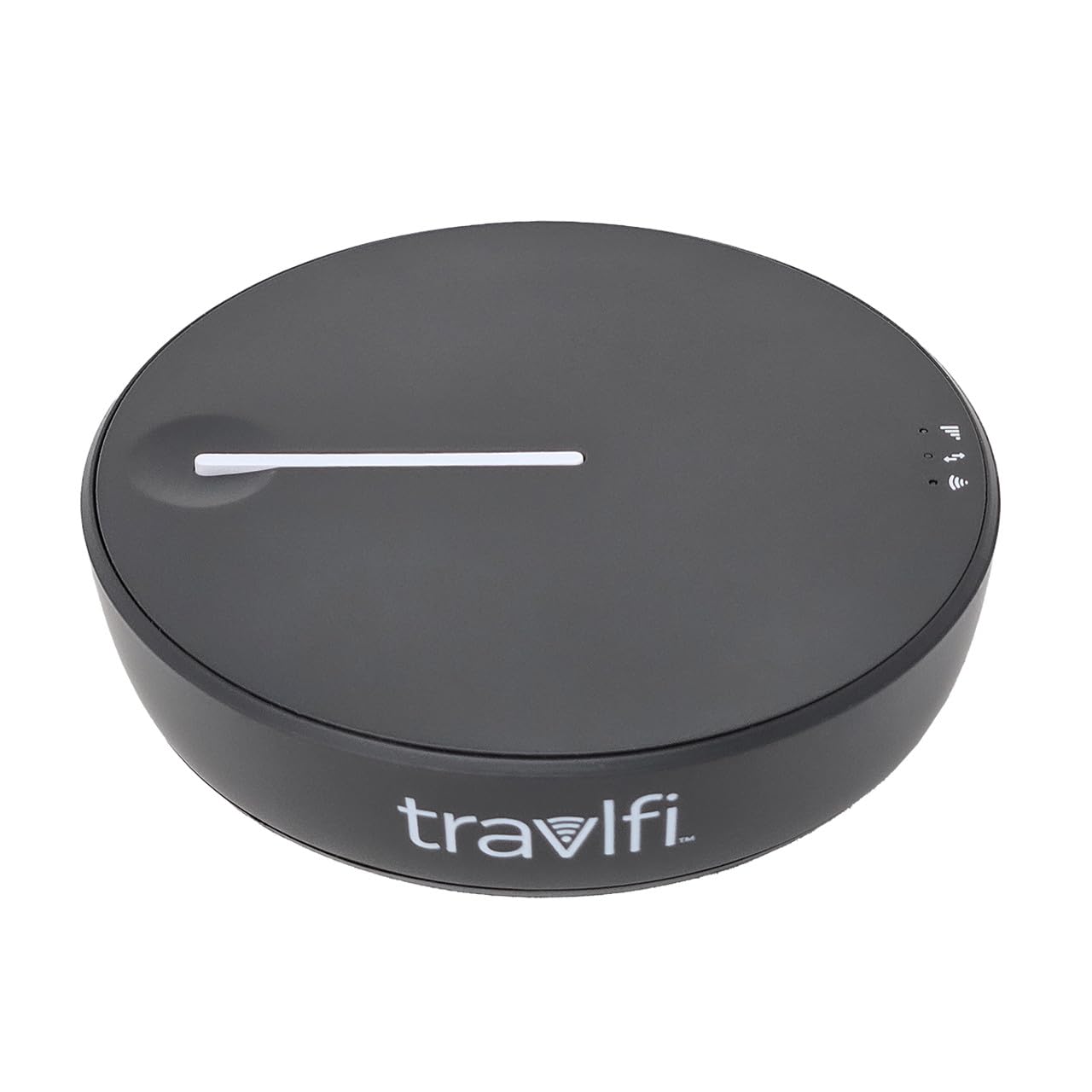
The TravlFi JourneyGo is built specifically for the US-based nomad. It uses eSIM technology to tap into multiple national carriers (including AT&T and T-Mobile) and switches to the strongest signal automatically. There is no SIM slot — you manage everything through the TravlFi app, choosing prepaid plans as small as 2 GB or as large as unlimited. The 16-hour battery life is the best in this roundup, so it can run a full day of RV driving and campsite streaming without hunting for a USB port.
Real-world user reports say it streams TV smoothly on two screens simultaneously, even in areas where phone signal showed as “low.” The single-band 2.4 GHz radio is a limitation in urban environments where 5 GHz offers less congestion, but for rural campsites and highway stops it is rarely an issue. The compact grey body fits in a cup holder.
The catch is that the JourneyGo is strictly a US device. If your travel extends to Canada or Mexico, check the data plan coverage before buying. For the full-time US RVer who wants contract-free data with a battery that lasts from sunrise to sundown, this is the right tool.
Why it’s great
- 16-hour battery life supports all-day operation
- Automatic carrier switching via eSIM
- No contract – pay by the month or pause service
Good to know
- US coverage only – not a global device
- Single-band 2.4 GHz WiFi only
5. Netgear Nighthawk M6 Pro (Renewed)

Netgear’s Nighthawk M6 Pro brings 5G mmWave and WiFi 6E into a mobile hotspot that also includes a 2.8-inch color touchscreen for real-time network monitoring. It is unlocked and supports AT&T, Verizon, and T-Mobile bands, plus global roaming with a local SIM. The Snapdragon X65 modem inside can theoretically hit 8 Gbps on 5G, though real-world speeds around 30–100 Mbps are more typical depending on the carrier and signal strength.
The 2.5 Gig ethernet port is a rare find on a hotspot — useful for plugging in a laptop for a stable wired connection or connecting to a home router as a WAN failover. Battery life is quoted at 13 hours, but users report 4–5 hours under heavy use with multiple devices streaming. The device also supports external antenna ports, which helps in fringe-coverage RV scenarios.
The “Renewed” status is the main variable here — units may show cosmetic wear and you should test the battery immediately. For travelers who need a premium modem with a touchscreen dashboard and the flexibility of a physical SIM slot, the M6 Pro delivers a pro-grade experience, but you will likely want to budget for a high-capacity power bank alongside it.
Why it’s great
- 5G mmWave + WiFi 6E for cutting-edge speeds
- 2.5 Gig ethernet port for wired connections
- Intuitive 2.8-inch touchscreen interface
Good to know
- Renewed product may have wear or degraded battery
- Battery drains fast under multi-device load
6. Solis Edge 5G Hotspot
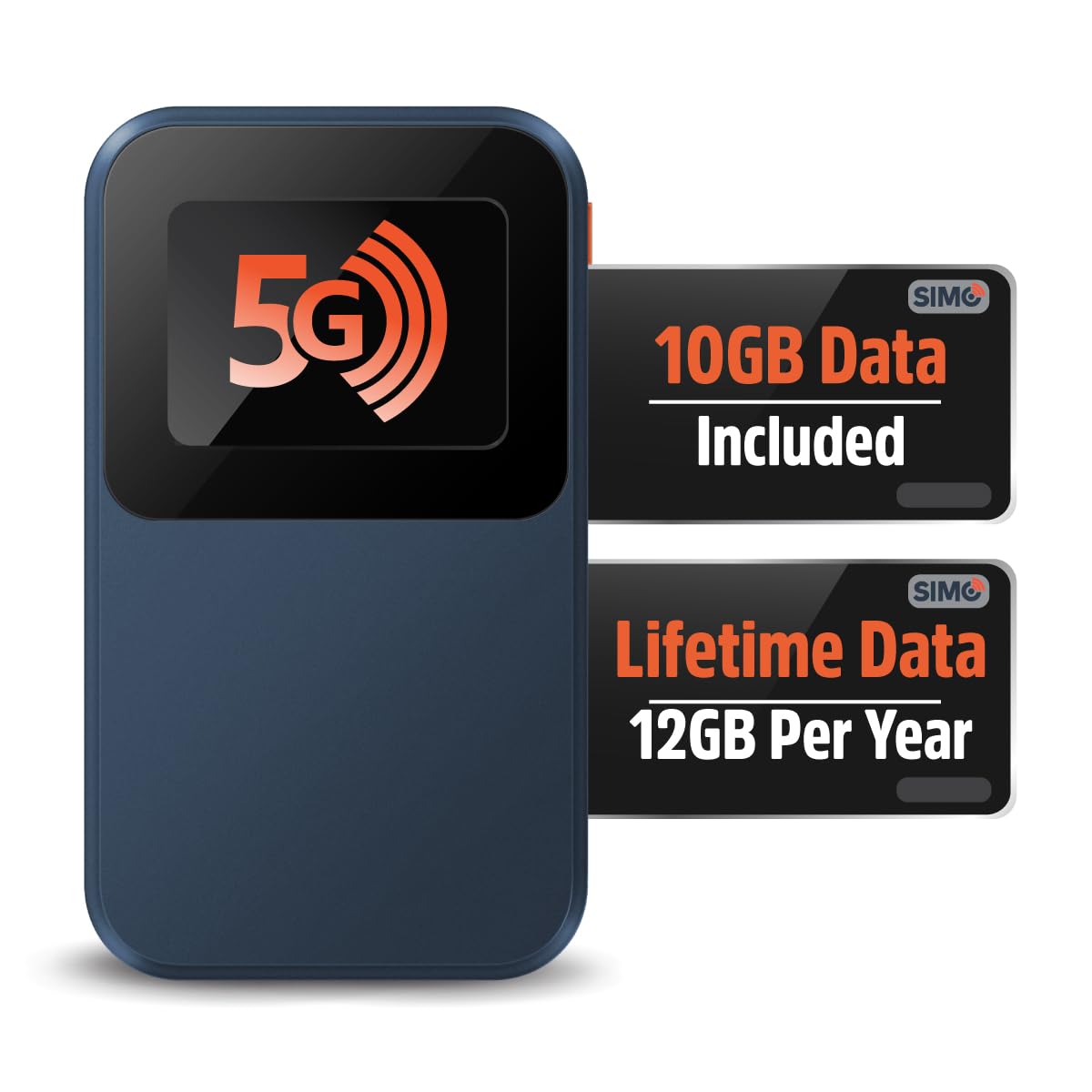
The Solis Edge 5G bundle includes a lifetime data plan (12 GB per year) and an extra 10 GB of global data right out of the box. For a light traveler who only needs basic connectivity — email, maps, messaging — this could cover years of trips without a single data top-up. It connects to 300+ carriers across 140 countries using the same CloudSIM approach as GlocalMe, but adds SignalScan for automatic strongest-signal selection.
At just 2.8 ounces, it is the lightest 5G hotspot in this comparison. The battery lasts a full workday (roughly 8–10 hours of mixed use), and the dual-band WiFi handles 5 GHz for faster local throughput. Users praise the quick setup: no SIM, no contract, no configuration — you activate in the app and you are online.
The “Explorer Bundle” pricing is mid-range, but the included data is worth roughly 3–4 GB of pay-as-you-go data on most other brands. If your annual travel is limited to a couple of weeks and your data needs are moderate, the Solis Edge pays for itself in data savings alone.
Why it’s great
- Includes lifetime 12 GB/year data plan
- Ultra-lightweight at 2.8 ounces
- SignalScan picks the strongest local carrier automatically
Good to know
- Not ideal for heavy streaming or group travel in one session
- VPN compatibility is hit-or-miss depending on region
7. Netgear Nighthawk M7 Pro (Renewed)

The Nighthawk M7 Pro is Netgear’s most advanced mobile hotspot — supporting 5G mmWave, sub-6 GHz, and WiFi 7. It is designed for a group of up to 64 devices, with a theoretical ceiling of 10 Gbps from the modem and 2,000 square feet of WiFi coverage. The 6 GHz band is unlocked here, giving you access to the least congested WiFi spectrum currently available.
This device includes URL filtering and an LCD passcode lock, which are useful for families who want to control what the kids access on road trips. The “Renewed” pricing is deeply discounted, but the product list explicitly warns that some units arrive locked to AT&T and may not be truly unlocked for global use. You should verify carrier compatibility immediately after purchase.
Battery life is adequate (around 6–8 hours), and the device runs hot under load. For a large family crossing the US with multiple tablets, laptops, and gaming consoles, the M7 Pro offers the raw throughput to keep everyone satisfied — just confirm the unlock status before relying on it internationally.
Why it’s great
- WiFi 7 + mmWave delivers multi-gigabit speeds
- Supports 64 devices with 2,000 sq. ft. coverage
- URL filtering and LCD passcode for parental control
Good to know
- Renewed units may arrive carrier-locked
- Runs hot under sustained load
8. GlocalMe Numen Air 5G
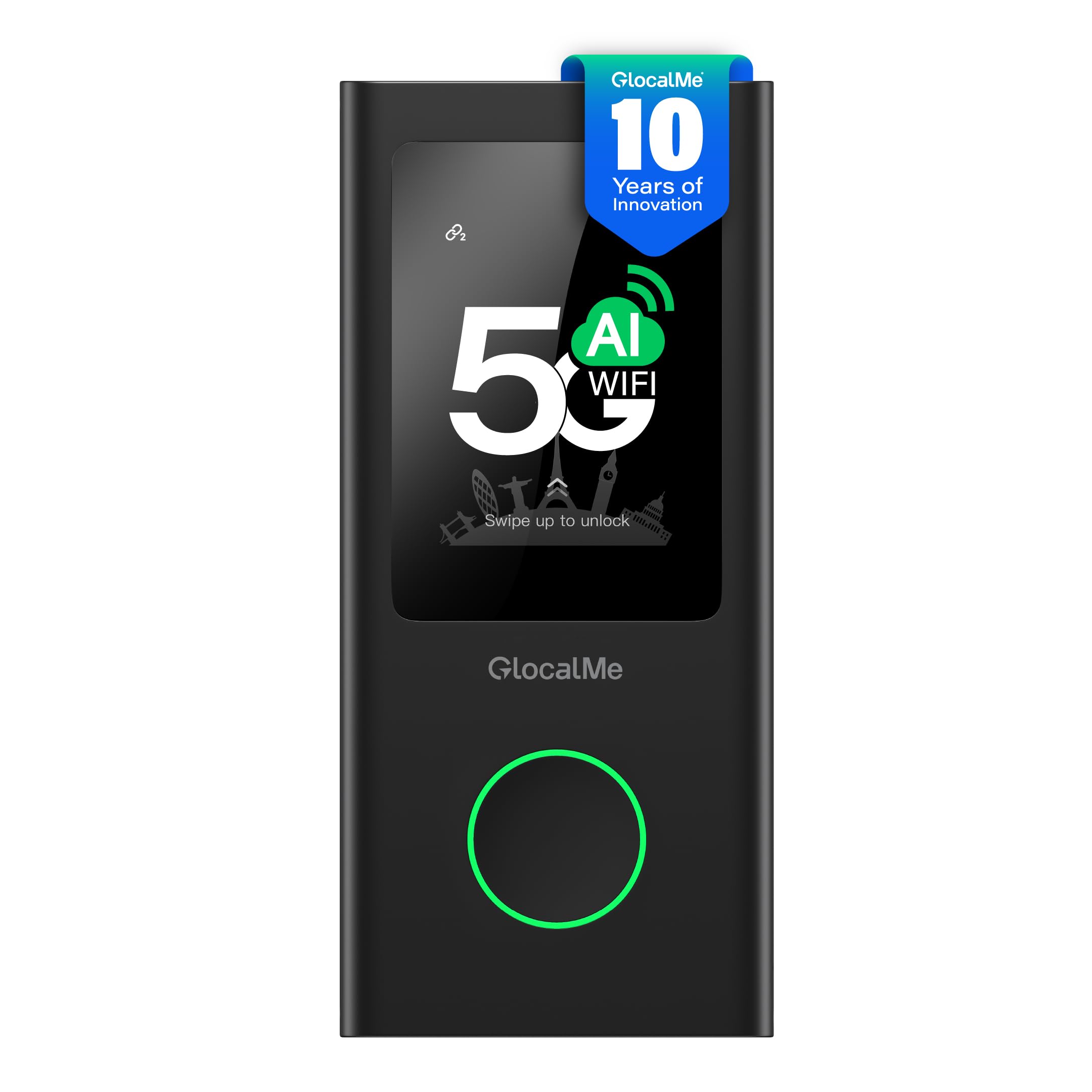
The GlocalMe Numen Air 5G pushes the upper boundary of mobile hotspot performance with a theoretical 2.5 Gbps downlink and support for 16 simultaneous devices. It uses the same CloudSIM technology as the UPP, so no SIM card is required to get online in 200+ countries. The device has a bonus feature: it doubles as a power bank, so you can charge your phone while the hotspot runs.
The 2.4-inch LCD touchscreen is responsive and offers quick access to data usage, signal strength, and network settings. Users report real-world speeds of 80–110 Mbps outdoors on 5G, which is excellent for team meetings and 4K streaming. The dual-band WiFi (2.4 GHz and 5 GHz) reduces interference in crowded environments like airports and convention centers.
The main concern is reliability: some units have experienced battery failure within the first year, and customer support responsiveness has been inconsistent. If you buy the Numen Air, run a full charge cycle test immediately and keep the receipt handy. For the traveler who demands the fastest 5G speed without swapping SIMs and wants a backup battery for their phone, the Numen Air delivers — but there is a durability risk.
Why it’s great
- 2.5 Gbps 5G with CloudSIM for true plug-and-play
- Works as a power bank for phone charging
- Large 2.4-inch LCD touchscreen interface
Good to know
- Battery life is around 6 hours in practice
- Some reports of premature battery failure
9. GL.iNet GL-X3000 (Spitz AX) Cellular Gateway

The GL.iNet Spitz AX is the most powerful device on this list — a full 5G cellular gateway with dual-SIM redundancy, six detachable antennas, and WiFi 6. It is not a pocket hotspot; it is a permanent or semi-permanent internet solution for an RV, rural home, or remote worksite. The X3000 supports carrier aggregation and can reach 200 Mbps down under good conditions (users in Florida reported consistent 200 Mbps on Verizon).
The dual-SIM slots with automatic failover mean you can load an AT&T SIM and a T-Mobile SIM, and the router will switch to the stronger connection without a drop. OpenWrt runs the show, so you can load custom VPN profiles, set up load balancing with an ethernet WAN, or run network failover with cellular as the primary. The 5 detachable antennas can be upgraded or replaced for even better range in fringe areas.
The Spitz AX is heavy, expensive, and draws power via USB-C — meaning you can run it off a power station or RV battery without an inverter. It is overkill for a quick weekend in a hotel. But for anyone living or traveling in a vehicle full-time and needing enterprise-grade 5G routing with backup SIM failover, the Spitz AX is the benchmark.
Why it’s great
- Dual-SIM with automatic failover for continuous uptime
- Six detachable antennas for maximum signal optimization
- OpenWrt firmware with deep customization options
Good to know
- Too large and expensive for casual travel
- Requires networking knowledge to unlock full potential
FAQ
Do I need a separate SIM card for each country with a global WiFi hotspot?
Can I use a global WiFi hotspot on a cruise ship?
How many devices can realistically share a portable hotspot without slowdowns?
What does “unlocked” mean for a mobile hotspot?
Final Thoughts: The Verdict
For most users, the best global wifi hotspot winner is the GlocalMe UPP because it balances wide 200-country coverage, no-SIM convenience, and affordability without locking you into a contract. If you need enterprise-level VPN security while using hotel or cruise WiFi, grab the GL.iNet Beryl 7. And for a full-time RV or remote home setup that demands dual-SIM failover and powerful antennas, nothing beats the GL.iNet GL-X3000 (Spitz AX).