
Finding a game that holds a five-year-old’s attention while actually building reading or math skills can feel like a tug-of-war between fun and learning. Most tablets apps last one car ride before being forgotten, and craft projects end up as glitter all over the floor. The sweet spot is a physical, hands-on toy that makes early literacy or number sense feel like play—something that survives a bent corner or a dropped piece without ending in tears.
I’m Mohammad Maruf — the founder and writer behind Drink4Good. I spend my time analyzing how specific product design choices—like laminated card thickness, wooden block smoothness, and game mechanics—directly impact how long a preschooler stays engaged and how much they actually retain.
After spending hours comparing card stock quality, letter block sizes, wipe-clean durability, and pattern progression in the most popular options, I’ve curated a tight list of the best games for kindergarteners that actually deliver on their educational promises without boring kids on day two.
How To Choose The Best Games For Kindergarteners
Not all “educational” toys are created equal. A flashcard deck that doesn’t survive a single marker swipe, or a game box with too many tiny pieces, can turn a promising afternoon into a frustrating 15 minutes. Here’s what separates the keepers from the clutter in this specific age group.
Material Durability and Safety
Look for laminated card stock that resists bending and tearing, or wooden pieces that are sanded smooth without rough edges. Thicker card stock (similar to 400gsm or higher) holds up to scribbling, erasing, and being tossed back into a drawstring bag. Hardwood letter blocks should be chunkier than standard Scrabble tiles—ideally around 1 inch thick—so small hands can grip them easily and they pose no choking risk. Avoid cheap cardboard that will start peeling after the second use.
Multi-Level Gameplay Versus One-Trick Pony
A single matching activity will lose its appeal after a week. The strongest options build in progression—for example, a sight-word game with five color-coded difficulty levels that take a child from pre-K through third-grade vocabulary, or a board game that includes both an introductory deck and a challenge deck. This lets the game grow with the child and keeps older siblings or classmates playing at their own pace.
Hands-On Interaction and Fine Motor Engagement
Kindergarteners need to move. Games that incorporate writing with a dry-erase marker, placing wooden blocks into spelling boards, or using a magnetic fishing pole to “catch” sight words engage fine motor skills far better than simply pointing at a screen. The physical act of forming letters, fitting blocks into slots, or balancing a magnetic fish strengthens hand-eye coordination and makes the learning tangible.
Quick Comparison
On smaller screens, swipe sideways to see the full table.
| Model | Category | Best For | Key Spec | Amazon |
|---|---|---|---|---|
| hand2mind Numberblocks Race to Pattern Palace | Board Game | Pattern Recognition & Counting | 40 Pattern Cards (2 Levels) | Amazon |
| Coogam Magnetic Fishing Sight Words | Magnetic Game | Sight Word Mastery | 220 Wooden Fish (5 Levels) | Amazon |
| Preschool Learning Activities Workbook | Wipe-Clean Workbook | Comprehensive Pre-Writing Practice | 62 Reusable Pages, 16 Activities | Amazon |
| Gojmzo Wooden CVC Word Spelling Game | Wooden Block Game | Phonics & Word Building | 50 Double-Sided Cards + 53 Wooden Blocks | Amazon |
| Gojmzo CVC Flash Cards Set | Flash Cards | Budget-Friendly Spelling Practice | 100 Double-Sided CVC Cards | Amazon |
In‑Depth Reviews
1. hand2mind Numberblocks Race to Pattern Palace! Board Game

This is the rare board game that kindergarteners actually beg to play again. Inspired by the “Pattern Palace” episode from the hit Numberblocks TV series, it transforms pattern recognition into a simple race around a vibrant game board. Players move Numberblocks One through Four over bridges and twists, using colored tiles to copy, extend, and create patterns shown on the included pattern cards. The 10-by-10-inch board is sturdy, and the chunky Numberblocks pawns are sized perfectly for small fingers to grip and slide across the board without toppling.
The two-level gameplay keeps it from getting stale. The introductory deck covers basic AB and AAB patterns, while the challenge deck introduces more complex sequences, making it suitable for both a 3-year-old and a first-grader. The dice popper—a dome-shaped plastic device that holds the die inside—adds a satisfying physical click that kids find way more exciting than rolling a standard cube. The 16 “Six’s Tricks” cards also throw in surprise moves (like swapping places) that keep the game from being purely linear.
A key advantage here is the structured turn-taking mechanic. Unlike a solitary flashcard session, this naturally teaches social skills like waiting your turn and coping with not winning every round. The pieces are all high-quality, thick card stock for the pattern tiles and bridges, with no sharp edges. Recommended for ages 3-5, but the pattern complexity means it holds attention up to 6 or 7 without feeling babyish.
Why it’s great
- Two difficulty levels keep the game challenging as kids grow.
- Dice popper adds a fun, tactile element that kids love.
- Officially licensed Numberblocks characters boost immediate engagement.
Good to know
- Players need to be familiar with Numberblocks to get the most out of the theme.
- The pattern tiles are small enough that they could be lost if not stored carefully after play.
2. Coogam Wooden Magnetic Fishing Sight Words Game

Turning sight word drills into a fishing derby is a stroke of genius. This set includes 220 small wooden fish, each printed with a Dolch sight word, and four wooden fishing poles with a magnetic tip. The fish come in five distinct colors and shapes, corresponding to different reading levels: red for Pre-K, yellow for Kindergarten, green for Grade 1, blue for Grade 2, and purple for Grade 3. This means a single toy carries a child from their first early readers through primary school without needing an upgrade.
The magnetic action is surprisingly solid—the magnets are strong enough to lift the fish cleanly off the floor or a table, giving a satisfying “click” each time a fish is caught. The poles are about 6 inches long, which is a perfect size for a 4–5-year-old’s hand, and the string length is enough to encourage a bit of aiming but not so long that it tangles every time. The fish themselves are well-sanded with rounded edges and non-toxic paint, passing the “mouth test” that any wooden toy for this age inevitably faces.
Beyond reading, the game inherently practices hand-eye coordination and fine motor control—the child must aim the magnet and gently lift without dropping the fish. Parents report that kids who are reluctant to read flashcards will happily “fish” for words, then read the word aloud before placing it in their pile. The included drawstring bag makes cleanup quick, though with 220 fish, a small parts warning is worth noting—you’ll want to supervise the first few plays to ensure no fish get scattered into the mouth of a younger sibling.
Why it’s great
- Five color-coded levels span Pre-K through Grade 3 for long-term use.
- Play is self-correcting—kids can swap fish and self-test.
- Durable wooden construction with smooth edges and strong magnets.
Good to know
- Fishing poles are short (~6″)—some parents prefer longer DIY replacements.
- 220 pieces can be messy to store; the drawstring bag helps but requires discipline.
3. Preschool Learning Activities Educational Workbook
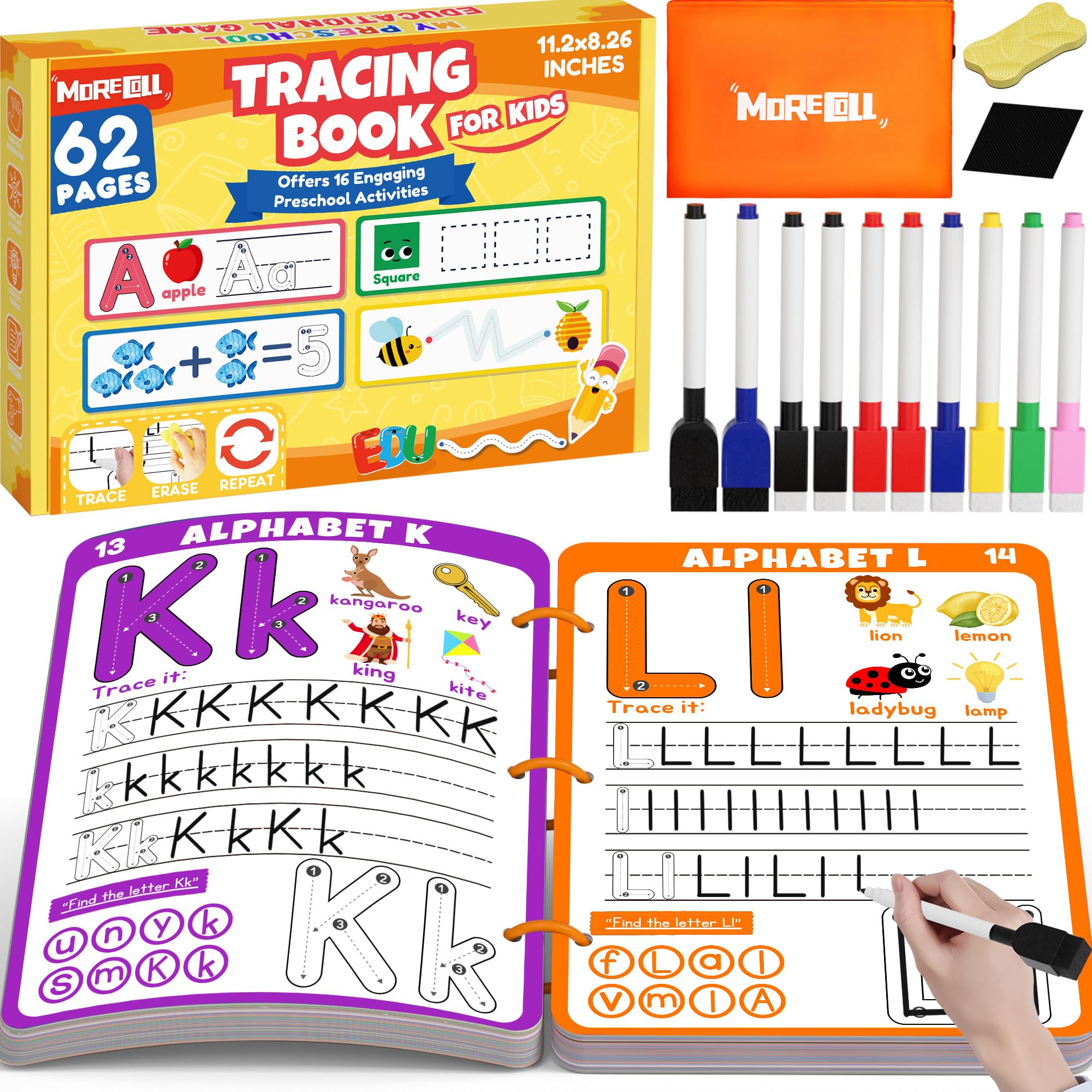
If you want one product that covers nearly every pre-K to kindergarten skill without a screen, this wipe-clean workbook is the most comprehensive option on the list. It comes in a nice gift box and includes 62 double-sided, laminated pages, ten dry-erase markers in assorted colors, a cloth eraser, and a drawstring storage bag. The removable rings let you pull out just the pages you need—a detail that matters when you’re trying to keep a squirmy kid focused on letter formation without the bulk of a full binder.
The 16 included activities span traceable uppercase and lowercase letters, number practice from 1 to 10, shape tracing, simple addition and subtraction, body parts labeling, emotions identification, spot-the-difference puzzles, and even a weekly planner. The last page includes tips on proper sitting posture and pencil grip, which is a thoughtful touch for parents or teachers focusing on handwriting readiness. The pages are waterproof, tear-resistant, and odorless—important when a dry-erase marker accidentally gets left uncapped overnight.
The real test, though, is how the wipe-clean surface holds up. The laminated coating is smooth enough that markers wipe away cleanly with the included eraser or even a dry cloth, with no staining left behind, as long as you wipe within a few hours. Leaving marks for days can cause ghosting. This is an excellent choice for circle time, car rides, or waiting rooms, as each activity can be repeated endlessly. The variety also means a child can switch from math to writing to drawing within seconds, reducing frustration when one skill feels too hard.
Why it’s great
- Massive variety—16 different activities in one lightweight, portable book.
- Tear-resistant, waterproof pages hold up to repeated erasing.
- Removable rings let you customize the activity order or isolate specific skills.
Good to know
- Marker stains can set if left on the page for more than a day.
- The box takes up significant shelf space; the book is better stored in the bag alone.
4. Gojmzo Wooden CVC Word Spelling Game

For a child who needs to touch and manipulate letters to learn, this wooden block set is a tactile powerhouse. The set includes 50 double-sided phonics flash cards (with a word on one side and a matching picture on the other), 53 wooden lowercase letter blocks—12 red vowels and 41 blue consonants—plus 5 wooden spelling boards. The division of consonants in blue and vowels in red is a deliberate visual cue that helps kids internalize the vowel-consonant pattern in CVC words like “cat,” “dog,” and “hen.”
The cards are thickly laminated and roughly 3.5 x 5 inches, which is large enough to read at a glance. The letter blocks are about 1 inch square and weighty enough to feel substantial, but not so large that they’re hard to sort. Children place the card on the spelling board, read the word, then find the correct wooden blocks and arrange them in the correct order. The self-checking aspect—the picture on the back confirms whether they spelled the word correctly—encourages independent play without adult hovering.
The biggest caution from users involves occasional picture confusion. For example, “bag” shows a designer purse rather than a simple school bag, and “hut” shows a garden shed instead of a simple hut. For a beginning reader, this ambiguity can be confusing when they’re trying to map a concrete object to a word. However, the wood quality is excellent, the storage box is sturdy with a sliding lid, and the blocks have held up through dozens of plays without any splintering. This is an ideal tool for a classroom literacy center or a structured homeschool phonics lesson.
Why it’s great
- Tactile wooden blocks engage fine motor skills and letter recognition simultaneously.
- Color-coded vowels (red) and consonants (blue) aid pattern learning.
- Cards are thick, laminated, and wipe-clean—good for extended classroom use.
Good to know
- Some card pictures can be misleading for a child’s real-world vocabulary.
- Blocks do not include all letters (missing q, y, z) to match the card set.
5. Gojmzo CVC Word Writing & Spelling Flash Cards Set

This is the entry-level workhorse of CVC practice—simple, effective, and intensely portable. The set contains 100 double-sided flash cards (each roughly 4.3 x 3.3 inches) and four dry-erase markers with eraser caps. One side of the card shows a word, while the reverse side shows the same word with a picture and a fill-in-the-blank version. Some cards have only the vowel missing, some have the beginning and ending letters missing, which adds variety without needing a separate game system.
What sets this apart from basic flash cards is the write-and-wipe functionality. A child can trace the word, then erase it and try again. The laminated card stock is noticeably thick—you won’t see corners curling after a week—and the cards slide into the included drawstring bag easily, making this a restaurant or travel companion. Markers have a small eraser on the cap, which is convenient but not as effective as a dedicated cloth; the instructions suggest wiping marks away right away to avoid staining.
The 100-card count gives you solid coverage of the most common CVC word families, which is a lot of material for a budget-friendly price. Literacy tutors specifically mention using these for students who struggle with short vowel mastery—the consistent “consonant-vowel-consonant” structure allows targeted practice. The main limitation is that there’s no game “board” or block component, so it requires a parent or teacher to introduce creative play (like “Find the card with the vowel ‘a’ and spell it”) to prevent it from feeling like rote repetition.
Why it’s great
- 100 cards cover a wide range of common CVC word families.
- Thick, laminated stock withstands repeated writing and erasing.
- Drawstring bag makes it the most portable option on the list.
Good to know
- Markers can stain cards if not wiped promptly—use a cloth for best results.
- No built-in game mechanic means adult-led creativity is needed to maximize engagement.
FAQ
Is a board game or a flashcard set better for teaching phonics to a kindergartener?
How many sight words should a kindergartener know before starting a sight word game?
Can these games be used in a classroom with multiple children?
Final Thoughts: The Verdict
For most users, the best games for kindergarteners winner is the hand2mind Numberblocks Race to Pattern Palace because it combines pattern recognition instruction with genuine family board game fun, and the two-level gameplay keeps it relevant for years. If you want a high-energy, hands-on way to drill sight words, grab the Coogam Wooden Magnetic Fishing Sight Words Game. And for a comprehensive, all-in-one workbook that covers phonics, math, and fine motor skills on the go, nothing beats the Preschool Learning Activities Educational Workbook.