
The difference between a clutch win and a respawn screen in a competitive shooter often comes down to how fast you react and how precisely you aim. A standard controller can hold you back with mushy triggers, noticeable stick drift, and limited button mapping that forces you to take your thumbs off the sticks. Upgrading to a controller built specifically for FPS titles addresses these pain points head-on.
I’m Mohammad Maruf — the founder and writer behind Drink4Good. I spend hundreds of hours analyzing gaming peripheral markets, comparing trigger actuation technologies, and tracking the durability of Hall-effect sensor implementations across premium and mid-range controller lines.
After combing through specifications, user feedback, and feature sets, I’ve curated the controllers that deliver the fastest response times, most reliable analog inputs, and best ergonomic layouts for twitch-based shooters. This guide covers the top contenders in the fps controller for ps5 category, from Sony’s first-party Edge to third-party heavyweights like Razer and Nacon.
How To Choose The Best FPS Controller For PS5
Not every pro-grade controller is optimized for first-person shooters. You need to focus on four key pillars: stick technology, trigger response, rear input options, and overall ergonomics. Choosing blindly based on brand reputation often leads to buyers ending up with a controller designed for fighting games or RPGs, which has different requirements for the analog sticks and button layout.
Stick Technology: Hall-Effect vs. Standard Potentiometers
Standard analog sticks use physical potentiometers that wear down over time, leading to the dreaded stick drift that ruins aim precision in games like Call of Duty or Apex Legends. Hall-effect sensors use magnetic fields to detect stick position without physical contact. This completely eliminates drift and provides smoother, more accurate input. For FPS play, where micro-adjustments to your aim are constant, Hall-effect sticks are a massive long-term advantage.
Trigger Stops and Hair-Trigger Modes
In an FPS, the time it takes to pull a trigger from its resting position to the actuation point translates directly to in-game shot delay. Many premium controllers offer physical trigger stops or digital switch modes that reduce trigger travel to nearly zero. This allows for much faster semi-automatic fire and a distinct tactile click that tells you exactly when the shot is registered.
Rear Paddles and Back Buttons
To maintain thumb-on-stick contact at all times, you need mappable controls on the back of the controller. Four rear buttons or paddles are the sweet spot for mapping actions like jump, crouch/slide, reload, and weapon swap. This eliminates the need for a claw grip and gives you a significant reaction time advantage in close-quarters gunfights.
Quick Comparison
On smaller screens, swipe sideways to see the full table.
| Model | Category | Best For | Key Spec | Amazon |
|---|---|---|---|---|
| NACON Revolution 5 Pro | Premium | Zero-drift precision | Hall-effect joysticks & triggers | Amazon |
| HEXGAMING ULTIMATE | Premium | Customizable stick feel | 8 swappable thumbsticks | Amazon |
| PlayStation DualSense Edge | First-Party | Native PS5 integration | Replaceable stick modules | Amazon |
| Razer Wolverine V2 Pro | Pro | Ultra-fast trigger clicks | Mecha-Tactile action buttons | Amazon |
| PDP Victrix Pro BFG | Modular | Fighting game & FPS hybrid | Modular faceplate & modules | Amazon |
| HEXGAMING PHANTOM | Elite | Tournament-ready customization | 6 swappable control profiles | Amazon |
| PlayStation DualSense Marathon | Standard | Budget entry with haptics | Haptic feedback & adaptive triggers | Amazon |
In‑Depth Reviews
1. NACON Revolution 5 Pro

NACON has delivered a controller that directly addresses the two biggest frustrations for FPS players: stick drift and trigger lag. The Revolution 5 Pro is equipped with Hall-effect sensors on both the joysticks and the triggers, meaning zero physical wear on the contact points and consistent, precise analog input over years of use. The trigger blockers let you switch between long and short pulls instantly, adapting to both semi-automatic rifles and vehicles in games like Battlefield.
The four Omron micro-switch back paddles are positioned for natural finger rest and offer a crisp, decisive click with every press. The rubberized grip texture on the handles ensures the controller stays planted in your hands during intense firefights. Battery life is rated at up to 10 hours, which comfortably covers extended sessions without needing to stay tethered.
One compromise is the lack of native PS5 haptic feedback and adaptive trigger support — the controller connects via a USB-A wireless dongle. This is a common trade-off for third-party controllers focused on competitive latency. Also, the recessed USB-C port forces use of the included proprietary cable for wired play. For a pure FPS setup, the precision and durability here are hard to beat.
Why it’s great
- Hall-effect sticks and triggers eliminate drift completely
- Four responsive Omron back paddles improve reaction times
- Rubberized grip provides secure handling during long sessions
Good to know
- No native PS5 haptics or adaptive triggers
- Recessed USB-C port limits cable options
- PC software required for full customization
2. HEXGAMING ULTIMATE

HEXGAMING designed the ULTIMATE around the simple idea that your thumbstick feel is personal. The controller ships with eight swappable thumbsticks in two heights and three styles — domed, concave, and concave widened — letting you dial in the exact resistance and surface texture you need for snap aiming. The Hall-effect joysticks deliver the same drift-free longevity found in the Nacon, with smooth rotational movement that tracks minute stick deflections.
The mouse-click hair triggers are a standout feature for FPS players. They actuate with a short, crisp click that shaves milliseconds off your trigger pull compared to standard analog triggers. Four remappable back buttons support instant assignment of up to 15 different inputs, covering all the essentials without needing to dive into a software suite mid-game. The controller is recognized natively on PS5 for most button functions.
Build quality is solid, though some users report that the back buttons have a slight rattle during normal handling. The controller also has a noticeable weight to it, which some players find reassuring while others may prefer a lighter feel. Note that it does not include a charging cable, so you will need a USB-C cable to get started.
Why it’s great
- Eight thumbsticks let you fine-tune grip and height
- Mouse-click triggers reduce shot delay
- Four back buttons map to 15 different inputs
Good to know
- Back buttons can feel loose with a rattle
- Heavier than a standard DualSense
- No cable or charging dock included
3. PlayStation DualSense Edge

Sony’s own DualSense Edge is the safest choice for players who want professional features without leaving the official PlayStation ecosystem. It retains the full suite of haptic feedback, adaptive triggers, and 3D audio support that standard DualSense controllers offer — a key advantage over almost every third-party competitor. The adjustable trigger lengths allow you to set shorter travel distances for faster shots in FPS games while keeping the full range for racing titles.
The controller comes with two swappable sets of back buttons and three types of stick caps (domed, high-domed, and concave). The stick modules themselves are replaceable, meaning when they do eventually wear out after thousands of hours, you can swap in a fresh module rather than buying a whole new controller. This modular approach is a major long-term value for heavy FPS players who grind daily.
The single most common criticism is the battery life. With haptic feedback active, you can expect around 3-4 hours of gameplay before needing to charge. This is significantly shorter than most third-party alternatives and forces most competitive players to use it wired. Despite this, the combination of native features, first-party build quality, and replaceable sticks makes it a strong contender.
Why it’s great
- Full native PS5 haptics and adaptive trigger support
- Replaceable stick modules prevent total controller loss
- Adjustable trigger travel for FPS fast-fire
Good to know
- Battery life is very short at 3-4 hours
- Only two back buttons compared to four on rivals
- Premium price for a controller with no Hall-effect sticks
4. Razer Wolverine V2 Pro

Razer brings its PC gaming pedigree to the PS5 with the Wolverine V2 Pro, a controller built around speed. The Mecha-Tactile action buttons combine the short actuation distance of a membrane button with the tactile feedback of a mechanical switch, giving you a distinct bump with every press. The 8-way microswitch D-pad provides the same mechanical sensation for directional inputs — a real benefit for precise movement and weapon switching in FPS games.
The HyperTrigger mode is the headline feature for shooter fans. A physical switch on the back of the controller lets you toggle the triggers from a standard full-range pull into a hair-trigger click mode. This reduces travel distance to nearly zero, allowing for rapid semi-automatic fire. The six remappable buttons (four triggers and two bumpers) give you ample control mapping without needing to resort to a claw grip.
Two notable trade-offs: the Wolverine V2 Pro does not support PS5 haptic feedback or the built-in speaker, functions commonly used in first-party games. The battery life is also a weak point, often requiring a charge after a few hours of play. If you prioritize raw input speed and are willing to play wired for extended sessions, the Wolverine V2 Pro delivers the fastest stock trigger response on this list.
Why it’s great
- HyperTrigger mode provides near-instant shot response
- Mecha-Tactile buttons offer satisfying feedback
- Six remappable buttons give extensive control customization
Good to know
- No PS5 haptic feedback or speaker support
- Battery life is shorter than average
- High price point for a non-Hall-effect controller
5. PDP Victrix Pro BFG
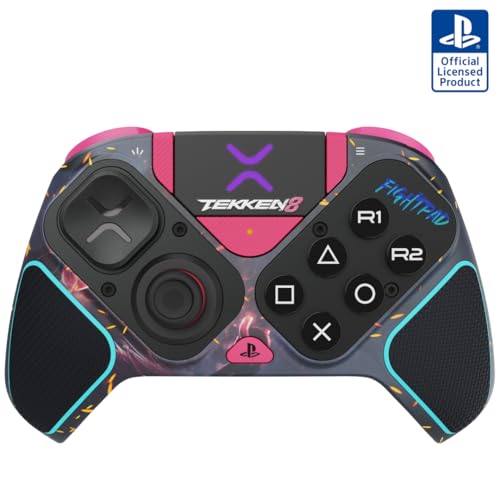
The PDP Victrix Pro BFG stands out for its modular design philosophy. The faceplate and module system allows you to swap between a standard asymmetrical stick layout, a symmetrical PlayStation layout, and a six-button fight-pad configuration. This makes it uniquely versatile for players who jump between FPS titles and fighting games like Tekken or Street Fighter. The four mappable back buttons are positioned intuitively and respond with a solid click.
For FPS use specifically, the interchangeable thumbstick gates and trigger stops are the key features. You can switch from a circular gate to a square or octagonal gate to change how the stick registers directional movement, which can improve your aim consistency. The trigger locks reduce travel for faster shooting. The controller also supports Sony 3D audio on PS5, a rarity among third-party controllers, and connects via a 2.4GHz wireless dongle for low-latency play.
There are some compromises. The Victrix Pro BFG does not feature Hall-effect sticks, so drift is still a potential issue over time. Some users have reported connectivity quirks on Windows 11, and the lack of rumble or haptic feedback may be a dealbreaker for players who rely on those sensory cues. It also requires a PC for initial firmware updates and customization.
Why it’s great
- Modular design adapts to FPS and fighting games equally
- Interchangeable thumbstick gates improve aim precision
- Supports Sony 3D audio for immersive gameplay
Good to know
- No Hall-effect sticks — drift can develop over time
- Lacks haptic feedback and rumble motors
- Firmware updates require a Windows PC
6. HEXGAMING PHANTOM
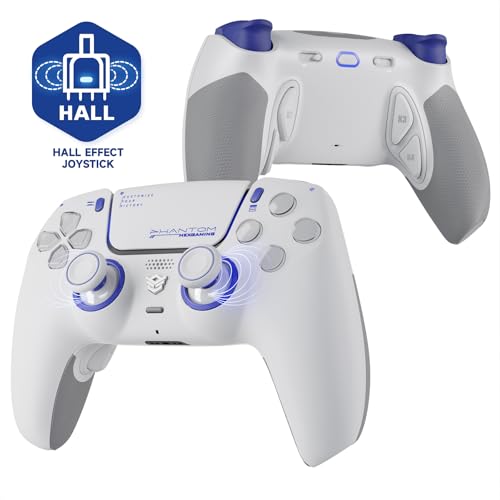
The HEXGAMING PHANTOM is the company’s flagship controller, pushing the feature set further than the ULTIMATE model. It still uses Hall-effect joysticks for drift-free aiming and mouse-click digital triggers with a 1.5-2mm travel range, but it adds six swappable control profiles that can be cycled on the fly. This means you can have one profile tuned for fast ADS sensitivity in Call of Duty and another for slower, more precise aiming in tactical shooters like Rainbow Six Siege.
The controller also introduces adjustable centering points and outer range calibration for the joysticks. You can tweak the dead zone and maximum output range without opening a software tool — the adjustment tool is included in the box. For competitive FPS players who obsess over stick response curves, this is a massive advantage. The four back buttons are positioned ergonomically under the grips, and the rubber coating reduces hand fatigue during marathon sessions.
The biggest downside is the price, which sits at the high end of the controller market. Additionally, some units have had quality control issues, with reports of creaky sticks or sticky trigger switches out of the box. The battery life is also shorter than the Nacon, requiring more frequent charges. If you value deep hardware-level customization over everything else, the PHANTOM is worth the premium.
Why it’s great
- Hardware-level stick calibration and centering adjustment
- Six on-the-fly profiles for different game sensitivity needs
- Hall-effect sticks and mouse-click triggers for speed
Good to know
- High price point relative to feature set of competitors
- Battery life is shorter than mid-range options
- Some units have quality control inconsistencies
7. PlayStation DualSense Wireless Controller (Marathon Limited Edition)
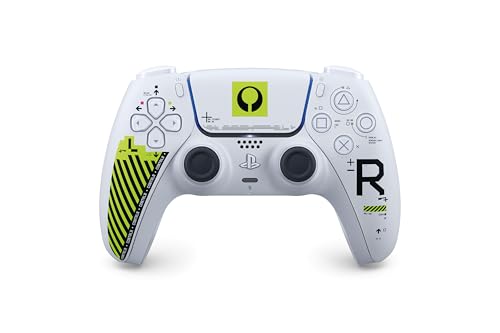
The standard DualSense, here in a Marathon Limited Edition colorway, is the baseline for PS5 FPS gaming. It offers the full suite of native features — haptic feedback, adaptive triggers, built-in microphone, and 3D audio support. For players who are just getting into competitive FPS titles and are not ready to invest in a premium controller, this is the most accessible starting point. The adaptive triggers, while not as fast as mechanical trigger stops, still provide immersive resistance during weapon use.
What you trade off is any form of competitive advantage. There are no back paddles or rear buttons, meaning you are forced into claw grip or reWASD-style button mapping on PC for advanced inputs. The standard potentiometer sticks are prone to drift over time, especially if you play FPS titles aggressively. There is also no customization software for tweaking stick curves or dead zones.
The Marathon Edition specifically features a unique lime green accent and off-white color scheme that stands out from the standard white model. Functionally, it is identical to any other standard DualSense controller. It works perfectly for causal FPS play, but competitive players will quickly hit its limitations in terms of input speed and ergonomic options.
Why it’s great
- Full native PS5 haptics and adaptive trigger support
- Best entry-level price for PS5 FPS play
- Unique Marathon colorway is visually striking
Good to know
- No back paddles — limits advanced control schemes
- Standard sticks prone to drift over time
- No software-based customization for stick response
FAQ
Will a third-party FPS controller work on PS5 without an adapter?
Does the DualSense Edge support Hall-effect joysticks?
Can I use PS5 haptic feedback with a third-party controller?
How many back buttons do I need for competitive shooters?
Final Thoughts: The Verdict
For most users, the fps controller for ps5 winner is the NACON Revolution 5 Pro because it combines Hall-effect joysticks and triggers with four responsive back paddles and a comfortable rubberized grip, all at a price that undercuts many rivals. If you want native PS5 features like haptic feedback and adaptive triggers, grab the PlayStation DualSense Edge. And for deep hardware-level stick customization with six on-the-fly profiles, nothing beats the HEXGAMING PHANTOM.