
When the grid goes dark, the silence isn’t peace—it’s the sound of a freezer full of food defrosting, a sump pump failing, or a CPAP machine losing breath support. That moment demands a machine you trust to roar to life on the first pull or push of a button, delivering stable, usable wattage without the flicker or frequency drop that can fry a refrigerator control board. Whether you’re outfitting a seasonal cabin, preparing for hurricane season, or simply need juice for a job site, the difference between a generator that works and one that frustrates comes down to real-world specs: surge vs. running wattage, total harmonic distortion, run time per tank, and how easily you can move the thing.
I’m Mohammad Maruf — the founder and writer behind Drink4Good. My market analysis focuses on cross-referencing verified owner data with manufacturer spec sheets to identify the portable power solutions that actually deliver on their promises under load.
After digging through hundreds of hours of real-world usage reports and technical documentation, I’ve separated the contenders from the pretenders to bring you a practical breakdown of the best gas generator options that earn their place in a garage, RV bay, or job site today.
How To Choose The Best Gas Generator
Shopping for a portable generator means navigating a minefield of peak wattage claims, confusing outlet types, and conflicting advice about “clean power.” Before you decide between a lightweight inverter and a brute-force open-frame unit, you need to pin down three things: the total starting wattage of everything you plan to run simultaneously, your tolerance for noise, and how you intend to move the machine from storage to use. The right choice balances those factors without overspending on wattage you’ll never need or undershooting on surge capacity your AC demands.
Surge Watts vs. Running Watts: The Real Number
The single most common mistake buyers make is comparing peak wattage numbers as if they were continuous output. A refrigerator’s compressor motor can draw 2–3 times its running wattage for a split second during startup. If your generator’s surge rating doesn’t cover that spike, the fridge won’t start—or worse, the generator stalls under load. Always total the running watts of everything you plan to power, then add the highest single surge number from a motor-driven appliance (well pump, AC compressor, refrigerator). That sum is your absolute minimum for the generator’s surge rating.
Inverter vs. Conventional: Noise and Power Quality
Inverter generators use an electronic module to convert raw AC into DC and back to a clean AC sine wave, producing less than 3% total harmonic distortion. That matters for charging laptops, running CPAP machines, or powering modern refrigerators with digital control boards. Inverters also throttle their engine speed to match load, which cuts fuel consumption and noise dramatically at partial load. Conventional open-frame generators run at a fixed 3600 RPM, producing more noise (70–80+ dB) and rougher power best suited for power tools and resistive heaters. If you’re camping or need quiet nighttime operation, an inverter is the only practical choice.
Fuel Flexibility: Dual-Fuel and Tri-Fuel Benefits
Gasoline is energy-dense and widely available, but it degrades in storage after a few months. Propane (LPG) lasts indefinitely, burns cleaner, and typically extends oil-change intervals, but delivers slightly lower peak wattage. Natural gas offers unlimited run time if you have a permanent connection but limits portability. Dual-fuel generators let you switch between gasoline and propane at the turn of a valve or quick-connect fitting. Tri-fuel models add natural gas, making them ideal for whole-home standby setups where a buried gas line is available. The fuel choice also affects cold-weather starting: propane and natural gas can struggle below freezing without a heated regulator.
Weight, Wheels, and Portability
A 50-pound inverter generator can be lifted into a truck bed without strain. A 220-pound open-frame unit with a 500cc engine is a two-person job at best. Check the included mobility kit: some generators ship with never-flat tires and a folding handle (like the WEN DF680iX), while others arrive as a bare engine block requiring you to buy a wheel kit separately. If you plan to move the generator between home, RV, and tailgate events, prioritize models under 80 pounds with integrated handles. For stationary home backup, weight becomes irrelevant—invest in a heavy-duty cart and a transfer switch instead.
Safety Features: CO Shutdown and Low-Oil Protection
Modern generators must meet ANSI/PGMA G300-2018 standards, which mandate automatic shutdown when carbon monoxide accumulates to dangerous levels. This CO sensor is a literal lifesaver if you ever run the generator too close to a window, door, or garage opening—even with the door partially open. Low-oil shutdown prevents the engine from seizing when oil levels drop, extending the life of the power plant. These aren’t optional extras anymore; they’re industry requirements on any reputable model manufactured for sale in the United States after 2021.
Quick Comparison
On smaller screens, swipe sideways to see the full table.
| Model | Category | Best For | Key Spec | Amazon |
|---|---|---|---|---|
| WEN DF680iX | Inverter / Dual-Fuel | Large RV / Home Backup | 5100W running (gas) | Amazon |
| Westinghouse iGen8200TFc | Inverter / Tri-Fuel | Quiet Whole-Home Backup | 6600W running (gas) | Amazon |
| Westinghouse 12500W | Open Frame / Dual-Fuel | Heavy-Duty Whole-Home Backup | 9500W running (gas) | Amazon |
| DuroStar DS13000MX | Open Frame / Dual-Fuel | Whole Home + Welder | 13000W surge (gas) | Amazon |
| WEN DF480iX | Inverter / Dual-Fuel | RV / Essentials Backup | 4000W running (gas/propane) | Amazon |
| Champion 4000W | Inverter | Lightweight RV / Camping | 3000W running | Amazon |
| ERAYAK 4500W | Inverter | Camping / Sensitive Electronics | 3500W running | Amazon |
| AIVOLT 4300W | Inverter | RV / Tailgating | 3450W running | Amazon |
| PowerSmart 3600W | Inverter | Budget-Friendly RV Power | 3200W running | Amazon |
| Generac GP3300i | Inverter | Light Home Backup / Camping | 3300W surge | Amazon |
| AMERISUN 2500W | Inverter | Ultraportable / Camping | 1900W running | Amazon |
In‑Depth Reviews
1. WEN DF680iX 6800W Dual-Fuel Inverter

The WEN DF680iX earns the top spot because it solves two problems simultaneously: it delivers enough surge wattage (6800W on gasoline) to handle a 15,000 BTU RV air conditioner plus refrigerator, while also offering a bonded-neutral 240V configuration that enables low-power Level 2 charging for electric vehicles. That 224cc dual-fuel engine sips from either gasoline or propane—owners report roughly 30 hours of runtime on a single 40-pound propane tank when running two AC units in a fifth wheel. At 99.2 pounds it’s not light, but the telescoping handle and never-flat wheels make rolling it across a driveway or campsite manageable for one person.
Total harmonic distortion stays low enough (under 3%) that you can plug laptops, phone chargers, and modern refrigerator control boards directly into the 120V receptacles without worrying about voltage spikes. The WEN Watchdog CO sensor automatically shuts the engine down if carbon monoxide reaches dangerous levels. The fuel shutoff switch is a smart touch that lets the carburetor run dry before shutdown, preventing gummed-up jets during long-term storage.
A handful of owners reported a faulty fuel solenoid that prevented gasoline operation, though the unit ran fine on propane. WEN’s customer service replaced the regulator and entire unit when the issue persisted. The magnetic dipstick catches metal shards during break-in—a small but telling detail that shows attention to maintenance. For the owner who needs both RV power and the ability to trickle-charge a plug-in hybrid, this is the most versatile inverter in the class.
Why it’s great
- Bonded-neutral 240V output for Level 2 EV charging
- Dual-fuel flexibility with excellent propane run time
- Good mobility with telescoping handle and flat-free tires
Good to know
- Weight near 100 pounds requires careful lifting
- Occasional fuel solenoid issues on gasoline circuit
- Oil drain plug location not intuitive; check manual
2. Westinghouse iGen8200TFc Tri-Fuel Inverter
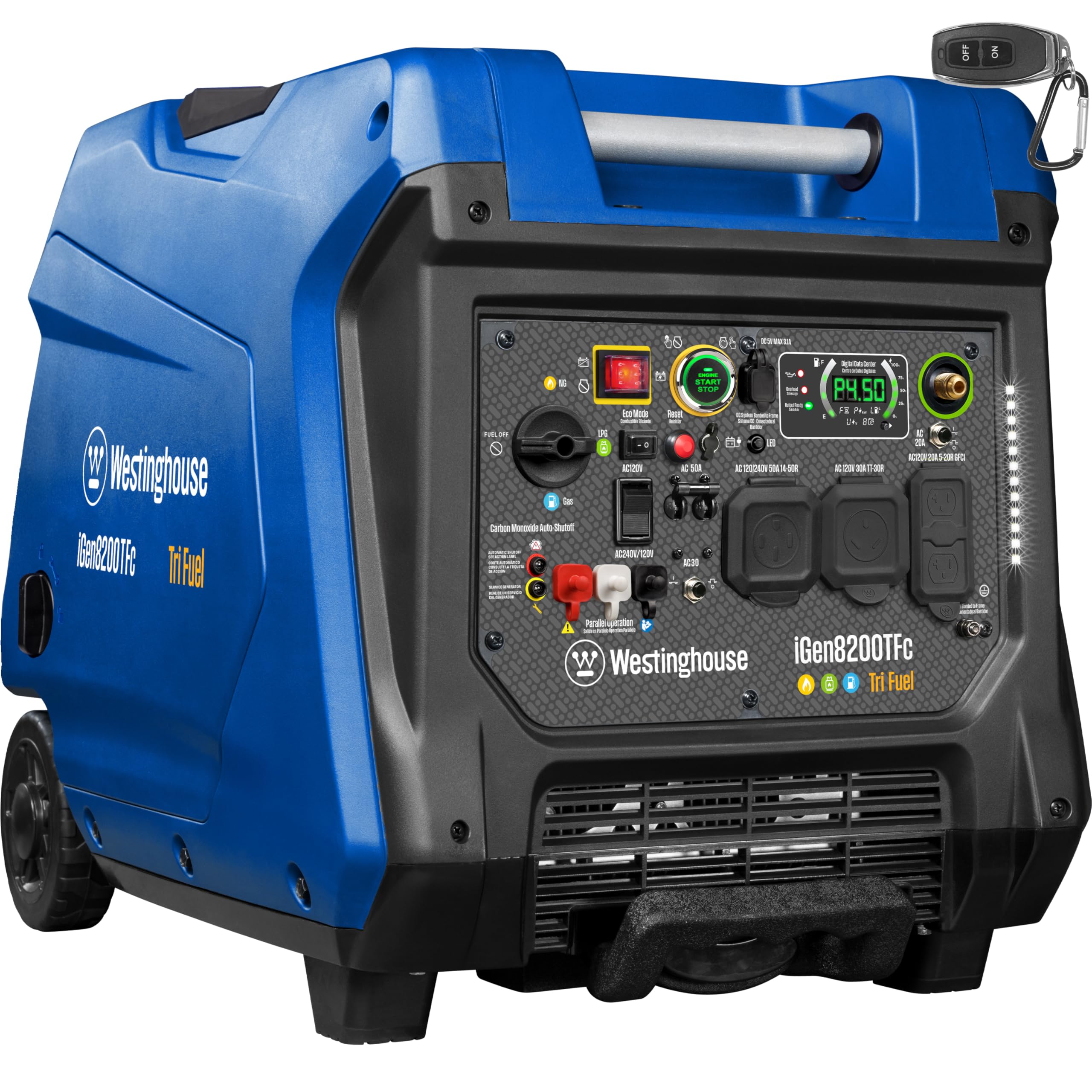
The Westinghouse iGen8200TFc is the inverter that blurs the line between portable generator and home standby system. It runs on gasoline, propane, or natural gas—switching between them at the turn of a selector dial—and puts out 6600 continuous watts on gasoline (5940 on propane, 5280 on natural gas). That’s enough to power a refrigerator, sump pump, furnace blower, lights, and a window AC simultaneously without dropping below 60 dBA at 25% load. The inverter technology keeps THD under 3%, making it safe for modern electronics.
The 298cc engine with a cast-iron sleeve is built for longevity, and the 3.9-gallon fuel tank delivers up to 17 hours of runtime at quarter load. Remote start via key fob is a convenience you’ll appreciate during a midnight outage, and the 120/240V 50A outlet means you can feed a transfer switch or interlock kit without adapters. The unit weighs 134.5 pounds, but the folding handle and flat-free tires make it rollable across grass or pavement.
Owners consistently praise the quiet operation—conversation-level noise that doesn’t disturb neighbors in a residential setting. The built-in battery maintainer keeps the starter battery topped off during storage. A few users noted that the serial number is printed on a barcode sticker (not obvious) and that the manual could be better organized, but reliability complaints are rare. For anyone with access to a natural gas line, the iGen8200TFc eliminates fuel storage concerns entirely while delivering inverter-quality power.
Why it’s great
- Tri-fuel operation with tool-free switching
- Very quiet at 60 dBA under partial load
- 240V 50A outlet for transfer switch connection
Good to know
- Heavy at 134 pounds despite good wheels
- Battery may need initial charge before first start
- High-altitude performance may require kit
3. Westinghouse 12500W Dual-Fuel Open Frame

When you need to run a whole house—well pump, water heater, refrigerator, furnace, and a 1.5-ton AC simultaneously—the Westinghouse 12500W dual-fuel generator delivers the brute force required. Its 457cc cast-iron-sleeve engine produces 9500 running watts on gasoline (8500 on propane) with a surge capacity of 12500 watts. The 6.6-gallon fuel tank provides up to 12 hours of runtime at half load, which translates to an overnight stretch without refueling during a storm.
The control panel is transfer-switch ready with a 50A 120/240V outlet, a 30A L14-30R, and two GFCI 20A household receptacles. Remote start via key fob means you can fire it up from inside the garage or house without walking out in the rain. Assembly is minimal—attach the wheel kit and add oil—and the included tool kit and battery charger get you running quickly. At 212 pounds this is a stationary backup unit, not a tailgate companion; the never-flat tires and folding handle make rolling it into position manageable on hard surfaces.
Owners report that it starts reliably even after sitting for months, and the CO sensor adds a layer of safety for placement near the house. A few buyers noted the manual’s confusing mention of an Eco switch that doesn’t functionally apply to this open-frame model, and the documentation density is a minor complaint. But Consumer Reports and Popular Mechanics both rate this generator at the top of its class for a reason—it’s a proven workhorse that powers an entire home without breaking a sweat.
Why it’s great
- Massive 12500W surge handles AC + well pump
- Remote start key fob for convenient operation
- Dual-fuel with propane backup for indefinite storage
Good to know
- Open-frame design is louder than inverters
- Very heavy at 212 pounds; two-person setup
- High-altitude kit required above 2,000 feet
4. DuroStar DS13000MX 13,000W Dual-Fuel

The DuroStar DS13000MX is the budget-minded home backup option that doesn’t cut corners on power. Its 500cc 4-stroke engine delivers 13,000 surge watts and 10,500 running watts on gasoline (10,500 surge and 8,500 running on propane). That’s enough to power a 1.5-ton AC, well pump, electric water heater, fridge, lights, and a microwave simultaneously—verified by owners running a full house including a titanium 225 stick welder on its 240V outlet.
The push-button electric start works reliably, and the included remote control gives you the same convenience as the Westinghouse at a lower price point. The control panel features a 50A 120/240V outlet for transfer switch connection, plus twist-lock and household outlets. The all-metal frame and reinforced power panel are built to survive rough handling and weather exposure. Assembly involves mounting the wheel kit and connecting the battery; the included tool set and propane regulator get you operational quickly.
Owners note that it’s remarkably fuel-efficient for its size, and the CO automatic shutdown adds safety. The biggest drawback is weight: 220 pounds makes this a strictly stationary unit once positioned. A few users missed the step of turning the gas valve on before pressing start, leading to frustration that was resolved once they learned the procedure. For the price, you’re getting whole-home power with dual-fuel flexibility and a CO sensor—an unbeatable value proposition.
Why it’s great
- Highest surge wattage in the class for the price
- Dual-fuel with included propane regulator
- Remote electric start makes operation effortless
Good to know
- 220 pounds requires strategic placement
- Open-frame noise level higher than inverters
- Assembly needed for wheels and battery
5. WEN DF480iX 4800W Dual-Fuel Inverter
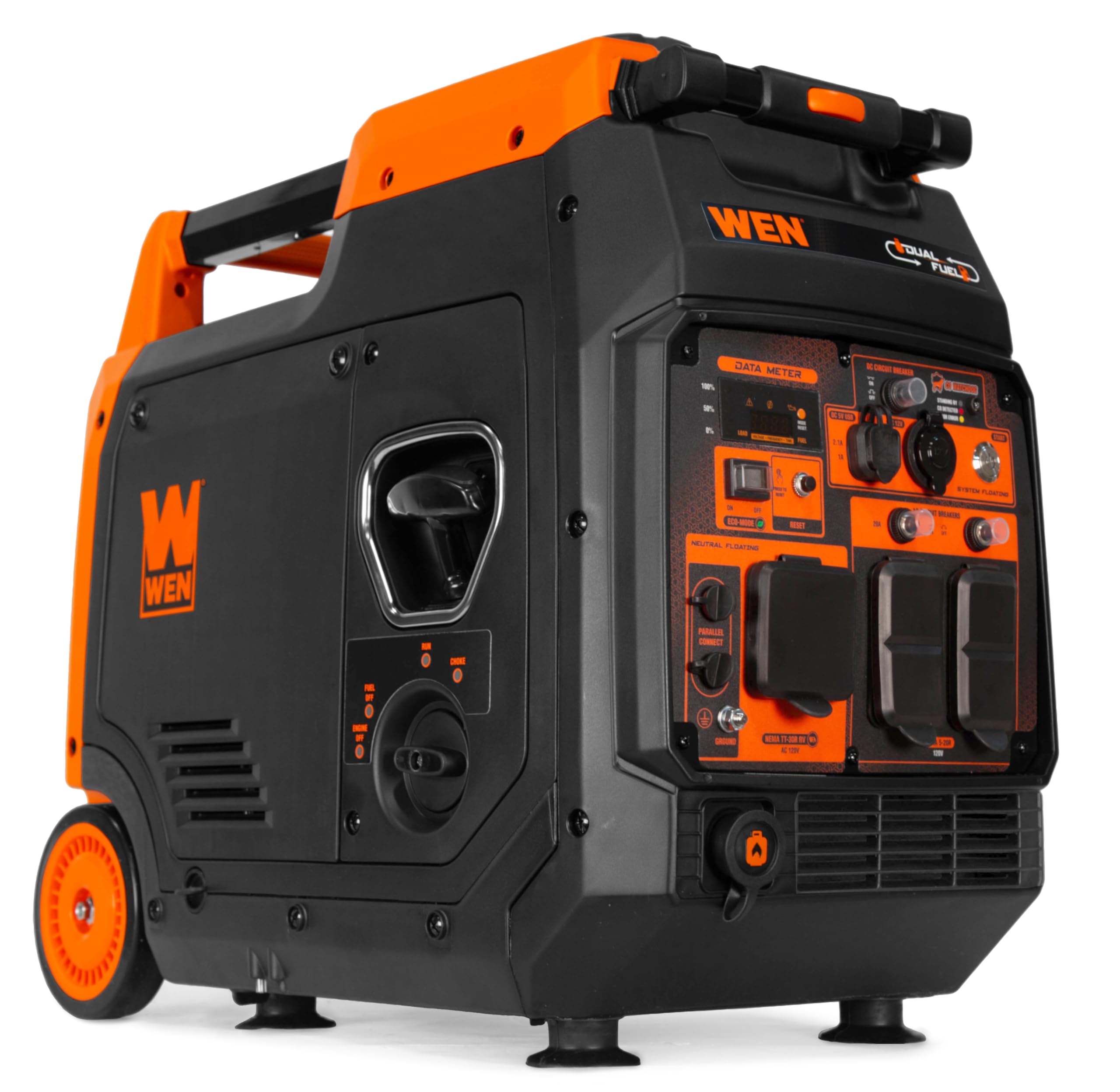
The WEN DF480iX is the sweet spot for RV owners who want dual-fuel flexibility without the weight of a 100-pound machine. Its 224cc engine produces 4800 surge watts and 4000 running watts on gasoline (4320 surge and 3600 running on propane). That’s enough to run a 15,000 BTU RV air conditioner plus lights and refrigerator, or a small home’s essential circuits during an outage. The inverter technology produces clean sine wave power with less than 3% THD, safe for CPAP machines, laptops, and TV equipment.
At 78.5 pounds with a telescoping pull handle and onboard wheels, it’s manageable for one person to load into an SUV or roll across a campsite. The tool-free LPG quick-connector makes switching to propane a 10-second job. Owners running on propane report starting effortlessly even in cold weather (38°F) after a few start cycles. The CO Watchdog sensor and fuel shutoff are standard, and the three-year warranty adds peace of mind.
A minor quibble: the battery connection access panel is tight and the included magnetic dip stick is shorter than the standard plastic one, but these are setup issues not reliability concerns. One early owner noted the battery polarity was reversed on his unit, requiring a simple swap of the charger leads. For the RV owner who wants to avoid gas degradation during long storage periods, the DF480iX delivers quiet, clean propane power without the sticker shock of premium competitors.
Why it’s great
- Dual-fuel with easy tool-free LPG connection
- Clean inverter power safe for electronics
- Good portability with handle and wheels
Good to know
- Propane output lower than gasoline max
- Battery connection area can be tight
- Some units delivered with reversed battery leads
6. Champion 4000W RV-Ready Inverter

At just 48.1 pounds, the Champion 4000-watt inverter is the lightest generator in its power class—a meaningful advantage for anyone who needs to lift it into a truck bed, carry it up stairs, or store it on a high shelf. The 149cc 4-stroke engine delivers 4000 surge watts and 3000 running watts, which is sufficient for a 13,500 BTU RV air conditioner (many owners report running a 15,000 BTU unit with lights and fridge, though the AC plus microwave together trips the overload reset). Noise output is rated at 64 dBA from 23 feet, quiet enough for campgrounds and residential areas.
Champion includes a 120V 25A TT-30R outlet for direct RV hookup, a 120V duplex household outlet, and a 12V automotive port. The optional parallel kit lets you link two units to double output. The CO Shield automatic shutoff is standard, and the 3-year limited warranty with lifetime technical support is one of the best in the industry. Owners consistently report first-pull starts after proper break-in, and the low weight makes transport effortless.
One notable detail: the overload reset button may trip if you try to run a high-draw microwave alongside the AC, but that’s a realistic limitation of its 3000-watt continuous capacity. A few owners received units with cosmetic defects (cracked cases from shipping), but Champion’s customer service and Amazon’s return policy resolved those issues quickly. For the camper or tailgater who prioritizes weight savings over maximum wattage, this is the lightest practical option available.
Why it’s great
- Extremely light at 48 pounds for easy portability
- First-pull start after proper break-in period
- Excellent warranty and US-based customer support
Good to know
- 3000W running watts limits simultaneous high-draw loads
- Overload reset button may trip with AC + microwave
- Some reports of cosmetic damage in shipping
7. ERAYAK 4500W Portable Inverter

The ERAYAK 4500W inverter stands out for its exceptionally low total harmonic distortion—between 0.2% and 1.2% depending on load. That’s cleaner than most competitors, making it arguably the safest portable generator for charging expensive laptops, running CPAP machines, or powering medical devices without the risk of voltage ripple. The 208cc 4-stroke engine produces 4500 peak watts and 3500 running watts, enough for a small RV AC, a refrigerator, lights, and electronics simultaneously.
Noise output is rated at 60.5 dBA, which is genuinely conversation-level quiet. The Eco Mode automatically adjusts engine speed to match load, dramatically reducing fuel consumption—owners report using just 0.21 gallons per hour at 25% load. The unit weighs 54 pounds and measures a compact 20 x 12.2 x 19.3 inches, fitting easily into tight storage spaces. The 30A L5-30R outlet is RV-ready, and the USB-A and USB-C ports provide modern device charging without adapters.
Parallel capability lets you link two units for 7000W continuous output, a useful scalability trick for growing power needs. However, a notable minority of owners experienced engine failure after just a few uses—the pull cord broke and the unit refused to restart under load. Those buyers found ERAYAK’s customer service unresponsive, and the unit is not returnable through Amazon once used. For the risk-tolerant buyer who wants the cleanest power available at this price point, the ERAYAK delivers, but the reliability inconsistency is a real concern.
Why it’s great
- Ultra-low THD (0.2-1.2%) for sensitive electronics
- Very quiet at 60.5 dBA with Eco Mode
- Compact and light at 54 pounds
Good to know
- Mixed reliability reports after a few months
- Customer service responsiveness is inconsistent
- Not returnable through Amazon after use
8. AIVOLT 4300W Inverter Generator
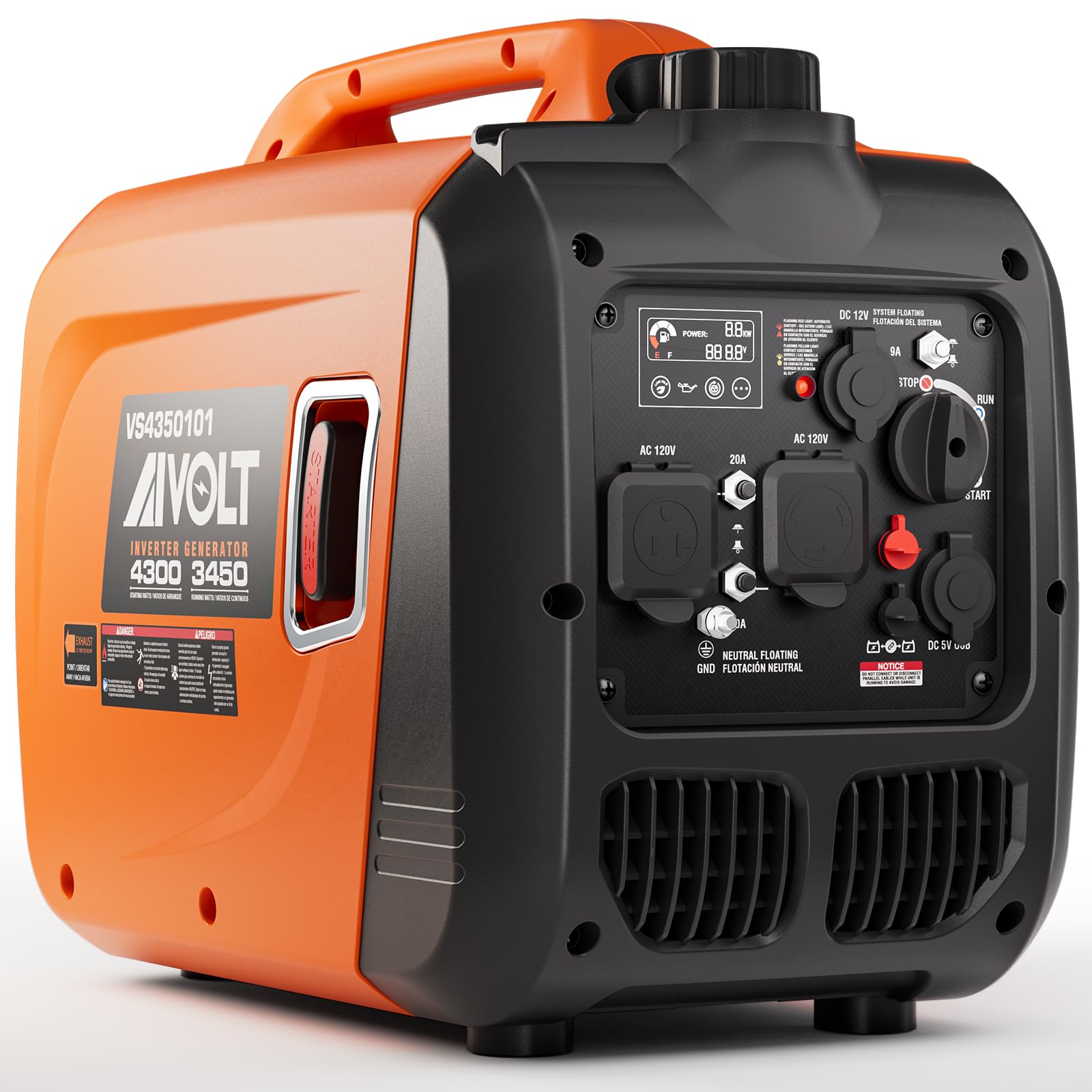
The AIVOLT 4300W inverter packs an impressive feature set into a 50.7-pound package, including a 5-in-1 LCD display that shows oil warnings, fuel level, overload alerts, and operating status at a glance. The 149cc copper-winding engine produces 4300 surge watts and 3450 running watts with less than 3% THD, making it safe for laptops, gaming consoles, and phone charging. The CO Alert technology automatically shuts the generator down if unsafe carbon monoxide levels accumulate.
The control panel is the most comprehensive in its weight class: a 30A locking outlet, a 20A household outlet, a 12V DC charging port, and USB-A/USB-C ports. The electric start works reliably, and the included RV adapter and battery charging cable mean you can connect directly to a camper or trickle-charge a vehicle battery without extra purchases. Owners running 400W portable AC units report 8+ hours of runtime on a single tank, and the quiet operation (60 dBA at no load) is suitable for campgrounds.
A known quirk: if you shut the unit off while it’s hot, the safety mode prevents restart for up to an hour until the engine cools. That’s a deliberate protection feature, but it can catch users off guard during a power outage when they want to refuel and restart quickly. A small number of owners experienced complete failure within the first hour of operation, though AIVOLT’s support team (based in China) was less responsive than domestic competitors. For the feature-conscious buyer who values the LCD display and CO safety, this is competitive.
Why it’s great
- Informative 5-in-1 LCD display shows all key statuses
- Electric start with included RV adapter and battery cable
- CO Alert auto-shutdown for safety
Good to know
- Safety mode prevents hot restart for up to an hour
- Customer service is China-based with mixed reviews
- Early failures reported in a minority of units
9. PowerSmart 3600W Inverter Generator

The PowerSmart 3600W inverter is the strongest argument for going budget in the 3000-watt class without sacrificing inverter quality. Its 149cc 4-stroke engine delivers 3600 surge watts and 3200 running watts—enough for a 15,000 BTU RV air conditioner according to multiple owner reports—and the inverter technology keeps THD under 3%. At 50.7 pounds with an integrated carry handle, it’s one of the most portable options in the 3.5kW class.
The 1.3-gallon fuel tank provides up to 8 hours of runtime at 25% load, enough for overnight camping or a work shift. The parallel connection capability (kit sold separately) lets you link two units for double output, a useful scaling option. The control panel includes a 30A RV-ready outlet, two 120V household outlets, and USB ports. Owners consistently report first-pull starts and quiet operation that allows conversation nearby.
The two-year warranty is shorter than competitors offering three years, but the price reflects that trade-off. A few owners noted that the included wrench and basic tool kit are minimal, so you’ll want your own socket set for maintenance. For the budget-conscious buyer who needs clean inverter power for RV use or emergency backup without paying for premium branding, the PowerSmart delivers solid performance at a price that’s hard to beat.
Why it’s great
- Excellent value for inverter-quality power
- Lightweight at 50.7 pounds with carry handle
- RV-ready 30A outlet included
Good to know
- Two-year warranty is shorter than competitors
- Minimal included tool kit
- Parallel kit sold separately
10. Generac GP3300i Inverter Generator

Generac brings its reputation for residential standby generators to the portable market with the GP3300i inverter. This 59.5-pound unit produces 3300 surge watts and a continuous output around 2500 watts at higher elevations—verified by owners who found the unit bogs down when two high-draw tools are used simultaneously. The TruePower Technology delivers consistent output with less than 3% THD, and PowerRush Advance Technology provides over 50% extra starting capacity for motor-driven appliances.
The closed-frame design is much quieter than open-frame Generac models, making it suitable for camping and residential use. Owners report running TV, WiFi, refrigerator, fans, and phone chargers for 9 hours on less than 1 gallon of gas. The Eco Mode automatically adjusts engine speed to match the load, reducing fuel consumption and noise. The COsense Technology and low-oil shutdown add essential safety features.
The biggest concern is long-term reliability: one owner reported failure at 1100 hours on a first unit and before 500 hours on a replacement, with poor parts availability and few authorized servicers. That’s a significant red flag for anyone planning to use this as a primary backup source rather than occasional camping power. For the buyer who wants the Generac name and the convenience of local dealer support, this unit delivers in the short term, but extended reliability data suggests caution.
Why it’s great
- Generac brand with wide dealer network
- PowerRush technology for extra starting surge
- Very quiet operation for its power class
Good to know
- Some reports of failure before 500 hours
- Parts and service availability is limited
- Continuous output drops at higher altitudes
11. AMERISUN 2500W Portable Inverter
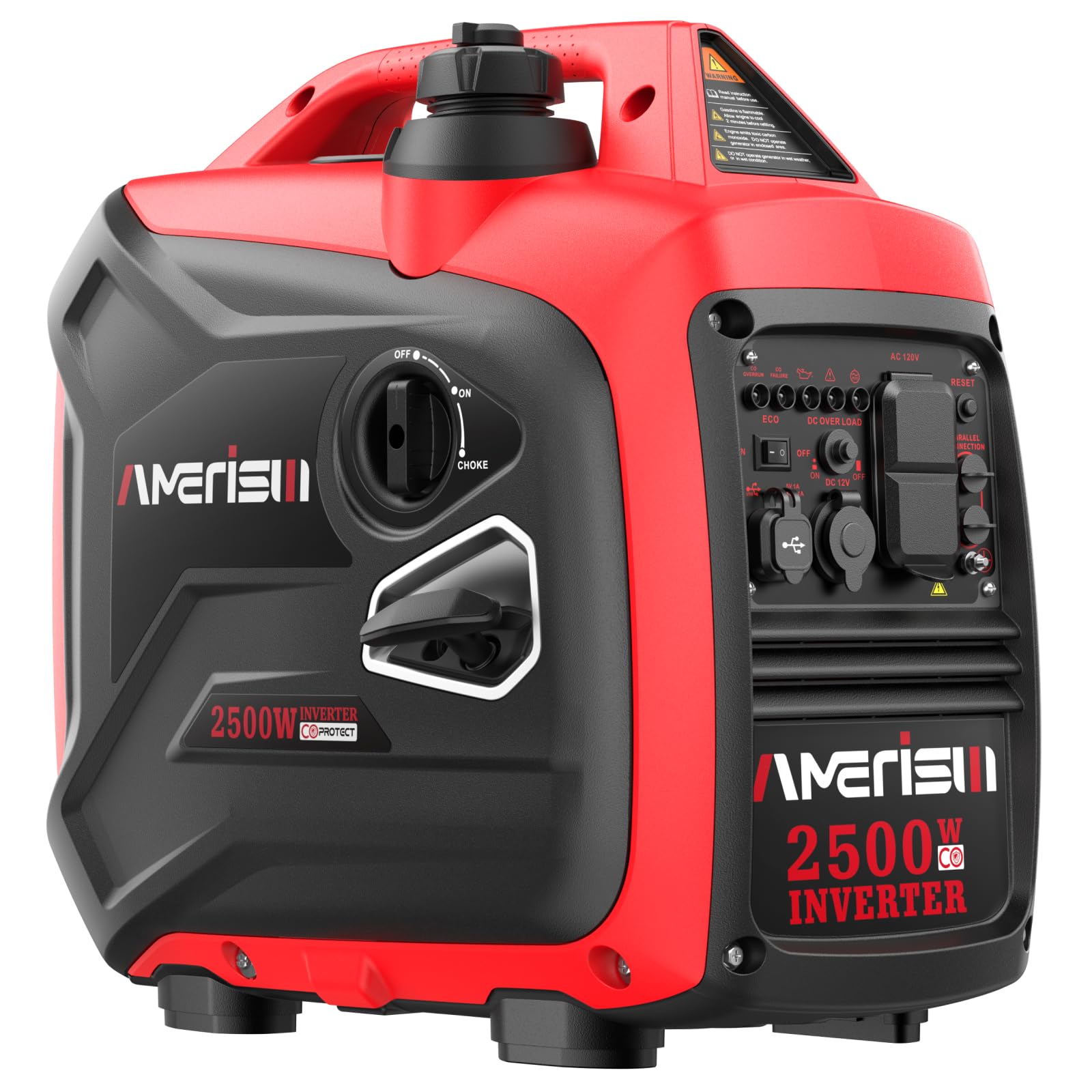
The AMERISUN 2500W inverter is the entry-level champion for good reason: it weighs only 39.7 pounds, starts on one pull after break-in, and delivers enough clean power (2500 surge, 1900 running watts) to run a small RV mini-split, refrigerator, TV, CPAP machine, and lights simultaneously. The 1.05-gallon fuel tank provides up to 11 hours of runtime at 25% load, which translates to a full night of sleep without refueling. Noise output at 69 dB from 23 feet is quiet enough for campgrounds.
The control panel includes two 120V AC outlets, one 12V DC outlet, and two USB ports, providing enough flexibility for typical camping loads. Owners report that performance measurably improves after the break-in period (5 tanks of gas), with smoother idle and better fuel efficiency. The carrying handle makes one-handed transport possible, and the compact 12 x 20 x 20-inch footprint fits in the smallest storage spaces.
The main limitation is the 1900 running watts, which cannot handle a 15,000 BTU RV air conditioner or a large well pump. A minority of owners note that while it starts on the first pull after break-in, the initial start can take many pulls until the engine is properly lubricated. The unit is manufactured in China despite some listings suggesting domestic assembly. For the buyer on a tight budget who needs lightweight, quiet power for lights, fridge, and electronics, this is the most affordable reliable option available.
Why it’s great
- Ultra-light at 39.7 pounds with one-hand carry
- Excellent runtime at 11 hours on 1 gallon of gas
- Clean inverter power safe for CPAP and electronics
Good to know
- 1900 running watts won’t power large AC units
- First start may require many pulls initially
- Manufactured in China despite listing ambiguities
FAQ
Can I run a 15000 BTU RV air conditioner on a 3000-watt generator?
What is the practical difference between gasoline, propane, and natural gas for a portable generator?
How do I calculate the generator size I need for my home?
How often should I change the oil in a portable generator?
Is it safe to run a generator in my garage with the door partially open?
What does “dual-fuel” mean and is it worth paying extra for?
Final Thoughts: The Verdict
For most users, the best gas generator winner is the WEN DF680iX because it balances dual-fuel flexibility, inverter-grade clean power, 240V bonding for EV charging, and excellent runtime per tank in a package that rolls easily. If you want the quietest inverter with tri-fuel capability for whole-home backup, grab the Westinghouse iGen8200TFc. And for pure whole-home brute force where noise isn’t a problem, nothing beats the Westinghouse 12500W dual-fuel.