
Ditching your phone and relying on a dedicated watch with built-in satellite tracking is the single most effective way to get serious about pacing, route accuracy, and post-run analysis. Whether you’re training for a marathon, grinding through a Hyrox session, or exploring a new trail, the right wrist companion pulls in data from GPS, GLONASS, and Galileo constellations to give you distance, elevation, and real-time pace that your phone’s arm-band guesswork can’t match. The difference between a watch that drops a signal in a city canyon and one that locks onto dual-frequency bands is the difference between a reliable training log and a frustrating blank spot on your miles.
I’m Mohammad Maruf — the founder and writer behind Drink4Good. Over years of analyzing wearables and talking with runners, triathletes, and outdoor adventurers, I’ve learned that GPS accuracy, battery life, and ecosystem compatibility define whether a watch earns its spot on your wrist or ends up in a drawer.
After testing and researching the market’s most capable models, I’ve built this guide to help you find the best gps workout watch for your training style, budget, and daily wear needs.
How To Choose The Best GPS Workout Watch
Not every watch that shows you a moving dot on a map is good at it. The gap between a budget fitness band and a purpose-built GPS smartwatch is measured in satellite lock speed, frequency bands, and the quality of onboard processing that turns raw coordinates into actionable pace data. Before you look at any specific model, you need to understand what matters for your workouts.
GPS Chipset: Single-Band vs. Multi-Band (Dual-Frequency)
The single most important hardware decision is whether the watch uses one satellite frequency (L1) or two frequencies (L1 + L5). Multi-band receivers compensate for atmospheric distortion and signal reflection off buildings or tree canopies, which means your track won’t wander into the wrong lane during a city run or drift off the trail in dense forest. If you run or ride in urban environments or under heavy tree cover, dual-frequency GPS is a must — the few dollars extra in the bill saves you from corrupted mileage data.
Battery Life: Smartwatch Mode vs. GPS Mode
Manufacturers quote battery life in two very different scenarios. A watch that “lasts 14 days” in smartwatch mode might only hold 20 hours of continuous GPS tracking. For long training sessions, ultra-marathon attempts, or multi-day backpacking trips, you need the GPS mode number — ideally 30 hours or more with dual-frequency enabled. Models with solar charging lenses can extend this further, but only if you get consistent sun exposure during daylight hours.
Display Type: AMOLED vs. MIP (Memory-in-Pixel)
AMOLED screens deliver vibrant colors, deep blacks, and high brightness for indoor and low-light visibility, but they drain more battery when always-on and can wash out in direct sunlight if not bright enough. MIP displays use reflected ambient light and sip power, making them ideal for all-day wear and multi-day excursions — but they lack the visual pop of an AMOLED panel. Runners who want maps and rich data fields indoors tend toward AMOLED; backpackers and trail runners who need readability under direct sun lean toward MIP.
Quick Comparison
On smaller screens, swipe sideways to see the full table.
| Model | Category | Best For | Key Spec | Amazon |
|---|---|---|---|---|
| Garmin Forerunner 970 | Premium | Triathletes & serious runners | 26 hrs GPS, AMOLED, flashlight | Amazon |
| COROS PACE Pro | Mid-Range | Runners wanting AMOLED & maps | 31 hrs GPS (dual-freq), 20 days | Amazon |
| Amazfit Balance 2 | Mid-Range | Fitness generalists & Hyrox athletes | 170+ sport modes, 21 days battery | Amazon |
| Garmin Instinct 3 Solar | Premium | Backpackers & outdoor adventurers | Unlimited solar smartwatch mode | Amazon |
| Samsung Galaxy Watch Ultra | Premium | Android users wanting LTE & deep health | Titanium, dual-freq GPS, sleep coaching | Amazon |
| Amazfit T-Rex 3 Pro | Premium | Rugged outdoor explorers | Sapphire AMOLED, 25-day battery, flashlight | Amazon |
| POLAR Grit X2 Pro Titan | Premium | Adventure racers & navigation-focused users | Aerospace titanium, dual-freq GPS, offline topo maps | Amazon |
| Apple Watch Ultra 3 | Premium | iPhone users wanting full ecosystem & safety | Precision dual-freq GPS, 42 hrs normal, satellite SOS | Amazon |
| COROS PACE 3 | Budget-Friendly | Lightweight comfort & long battery | 38 hrs GPS, 30g with nylon band | Amazon |
In‑Depth Reviews
1. Garmin Forerunner 970

The Forerunner 970 represents the current peak of Garmin’s running and triathlon lineup, packing their brightest AMOLED touchscreen, a lightweight titanium bezel, and a sapphire lens into a package that weighs less than its premium price suggests. With 26 hours of continuous GPS tracking and up to 15 days of smartwatch use, you can train through a full Ironman block without looking for a charger mid-week. The built-in LED flashlight is a genuine safety upgrade for early-morning or late-night runs — it’s bright enough to see potholes and dark enough not to blind oncoming traffic.
Garmin’s training metrics go deeper here than on any other watch in this guide. Running economy, step speed loss, and running tolerance give you granular feedback on form and fatigue, while the Training Readiness score combines sleep quality, recovery, HRV, and training load into one number that tells you whether today is a hard-day or a recovery jog. The ECG app and wrist-based running dynamics (cadence, stride length, ground contact time) further close the gap between a wrist watch and a chest-strap lab setup.
Auto-transition between swim, bike, and run in multisport mode means you can race a triathlon without touching a button. Multi-band GPS with SatIQ dynamically switches between frequency modes to balance accuracy and battery consumption. The color onboard maps with round-trip routing let you explore new routes and still hit your target mileage. It’s expensive, but for serious multisport athletes, the Forerunner 970 earns every dollar of its premium positioning.
Why it’s great
- Best-in-class training metrics and running dynamics
- Sapphire AMOLED with bright flashlight is ideal for low-light runs
- Multi-band GPS with SatIQ for optimal battery/accuracy balance
Good to know
- Steep learning curve with Garmin’s menu system
- Premium pricing limits this to dedicated athletes
2. COROS PACE Pro

The COROS PACE Pro takes everything the brand’s fans loved about the PACE 3 — lightweight design, exceptional value, clean software — and wraps it in a 1.3-inch always-on AMOLED display with 1500 nits of brightness. The 2x processor improvement over the PACE 3 makes the interface feel much snappier, especially when panning and zooming on the newly included topographical and landscape maps. GPS accuracy is class-leading thanks to a redesigned satellite chipset that holds tracks tight even through downtown core streets.
Battery performance is genuinely impressive for an AMOLED watch: 38 hours of continuous outdoor activity tracking, 31 hours with dual-frequency GPS enabled, and up to 20 days of daily use or 6 days with always-on display active. The USB-C charging port and included keychain adapter mean you can charge your watch with the same cable you use for your laptop and phone — a practical win for travelers and minimalists. The silicone band is standard 22mm, so swapping straps is easy.
Navigation is where the PACE Pro separates from cheaper COROS models. You can build custom routes in the COROS app, send them to the watch, and get turn-by-turn breadcrumb guidance with offline maps visible right on the bright AMOLED screen. Activity modes cover run, trail run, bike, swim, strength, and winter sports. The trade-off is a less mature app ecosystem than Garmin’s Connect IQ, but the core fitness data — pace, distance, heart rate, sleep, recovery — is rock-solid and free of paywalls.
Why it’s great
- Bright 1500-nit AMOLED with offline topo maps
- Excellent GPS battery life (31 hrs dual-freq)
- USB-C charging and fast processor
Good to know
- Wrist strap quality feels less premium than the watch itself
- Lacks the breadth of third-party apps found on Garmin/Apple watches
3. Amazfit Balance 2

The Amazfit Balance 2 bridges the gap between a premium smartwatch and a dedicated fitness device with a 1.5-inch sapphire crystal AMOLED display, aluminum body, and dual speakers that provide clear audio cues during workouts. What sets it apart in the mid-range is the sheer breadth of sport modes — over 170 — including official HYROX training and competition modes, downloadable maps for 40,000 golf courses, and professional-grade SCUBA diving support with 10 ATM water resistance. The dual-band GPS with six satellite systems delivers fast lock-on and reliable tracks even under heavy tree cover or in urban canyons.
Battery life stays competitive at up to 21 days of typical use, and the 658 mAh cell charges fully in about two hours. The Zepp Flow AI voice assistant lets you start or pause activities, check stats, and respond to messages hands-free during workouts — a feature athletes with messy hands appreciate. Sleep tracking and HRV recovery metrics are well-calibrated, and the 24/7 health monitoring tracks heart rate, SpO2, stress, and energy levels throughout the day.
The biggest differentiator for the Balance 2 is its ability to silence notifications when Workout Mode is on, combined with sapphire glass durability. Some users report that GPS lock-on can be slightly slower than Garmin or COROS equivalents, and the band may feel too short for wrists over 8 inches. But for a watch that costs roughly a third of a Garmin Fenix 8 while offering 90% of the same features for most workouts, the Balance 2 is a strong argument against overspending.
Why it’s great
- Premium sapphire glass and aluminum build for the price
- Massive sport library with HYROX and diving modes
- Long 21-day battery with fast 2-hour recharge
Good to know
- GPS lock is slightly slower than premium competitors
- Band may be too short for larger wrists
4. Garmin Instinct 3 Solar 50mm

The Instinct 3 Solar is the watch you buy when battery anxiety and durability matter more than shiny screens. Its 1.1-inch MIP display is sunlight-readable and uses almost no power, while the solar charging lens can extend battery life indefinitely in smartwatch mode if you spend at least three hours per day in 50,000 lux conditions. The fiber-reinforced polymer case with metal-reinforced bezel, MIL-STD-810 thermal and shock resistance, and 10 ATM water rating mean this watch survives things that would destroy an AMOLED-equipped competitor.
Navigation gets multi-band GPS with SatIQ, a 3-axis compass, and barometric altimeter — plenty of tools for backcountry route-finding without needing a separate GPS unit. The built-in LED flashlight with variable intensities and strobe modes is surprisingly bright for such a small aperture and is one of those features you don’t appreciate until you need to find a tent zipper at 3 a.m. Health monitoring covers wrist-based heart rate, Pulse Ox, advanced sleep tracking, and stress tracking, though Garmin’s usual disclaimer applies: this is not a medical device.
Garmin Pay contactless payments and smart notifications add urban convenience, but the Instinct 3 deliberately omits music storage, offline maps with turn-by-turn navigation, and voice assistant integration. That’s fine — this is a tool for people who spend more time looking at the horizon than at their wrist. The button-based interface works perfectly with gloves, and the 26mm QuickFit band system makes swapping bands easy. For backpackers, climbers, and anyone who needs a watch that lasts between town resupplies, the Instinct 3 Solar is the most capable workhorse in this lineup.
Why it’s great
- Unlimited battery life with solar in smartwatch mode
- MIL-STD-810 toughness with 10 ATM water resistance
- Useful built-in flashlight with multiple modes
Good to know
- Mono-LCD display lacks the vibrancy of AMOLED
- No offline maps or music storage
5. Samsung Galaxy Watch Ultra (2025)
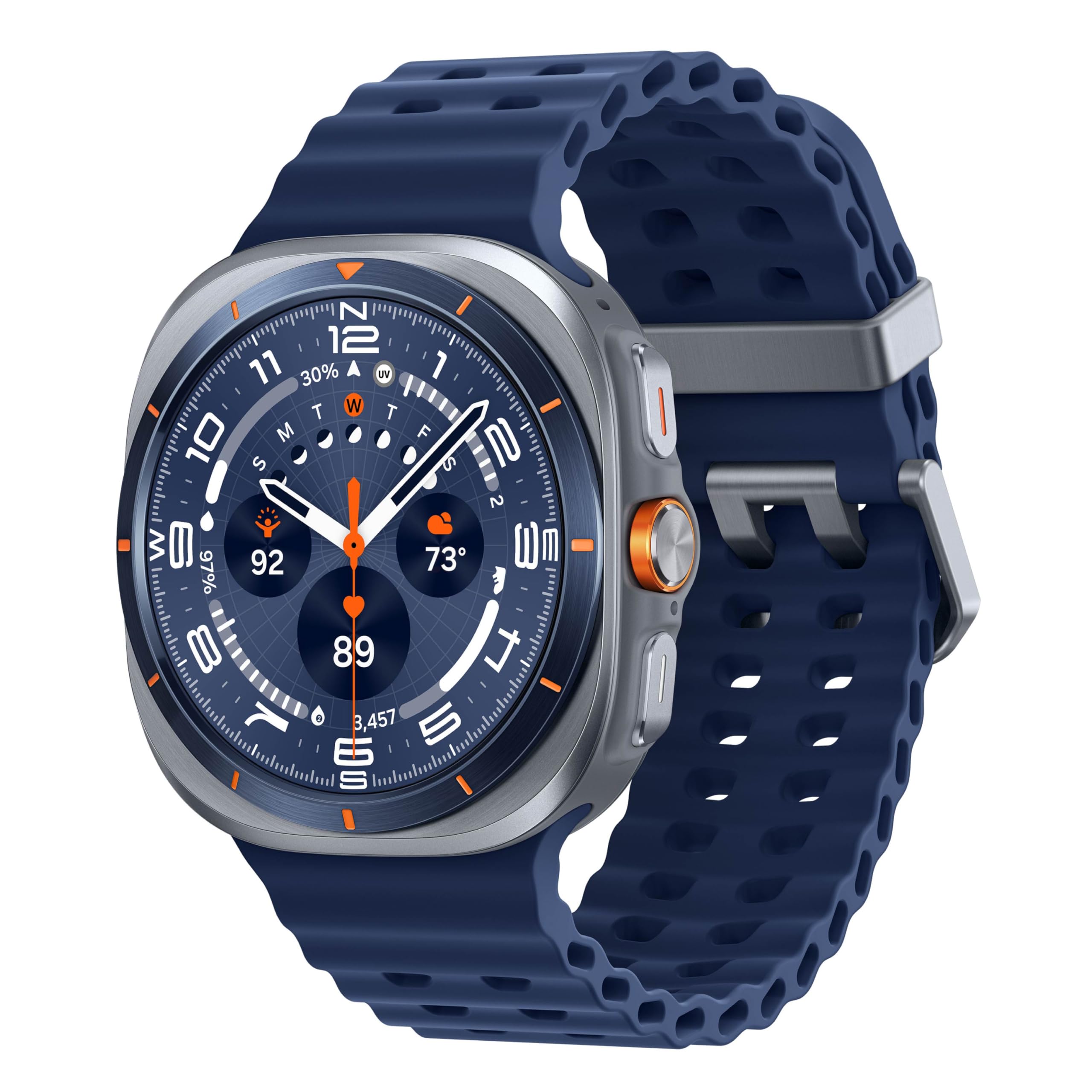
The Galaxy Watch Ultra is Samsung’s answer to the Apple Watch Ultra — a premium, LTE-capable smartwatch with a titanium casing, dual-frequency GPS, and a deep ecosystem of health and fitness features that tie into Samsung Health and your Galaxy smartphone. The 1.5-inch AMOLED display is sharp and bright, and the 3nm Exynos processor with 64GB of storage makes it one of the fastest watches for data-intensive apps like offline music streaming. The Running Coach feature uses your age, weight, oxygen levels, and heart rate to build personalized run plans and pace strategies.
Battery life is a real-world 1.5 to 2.5 days depending on whether you use always-on display and LTE, which is short compared to dedicated fitness watches but class-leading for a full-featured smartwatch. The 10 ATM water resistance and military-grade toughness allow you to swim, run in rain, or hike in dust without worry, and the Energy Score feature with Galaxy AI gives you a quick daily wellness summary. Stress tracking through Vascular Load monitoring and Advanced Sleep Coaching with sleep apnea detection add health depth that GPS-only watches don’t offer.
This is a renewed model so condition varies, but the core hardware — titanium, dual-frequency GPS, LTE — is unchanged. The biggest limitation is that it’s optimized for Samsung phones; features like ECG and blood pressure monitoring require a Samsung Galaxy phone, and the full Running Coach experience works best inside Samsung Health. For Android users who want a stylish, LTE-connected watch that doubles as a serious fitness tracker, the Galaxy Watch Ultra is a strong contender, but its battery life means you’ll charge it every night.
Why it’s great
- Premium titanium build with LTE connectivity
- Deep health tracking with sleep coaching and stress monitoring
- Fast 3nm processor and 64GB storage
Good to know
- Battery lasts 1.5-2.5 days, far behind dedicated fitness watches
- Best features locked to Samsung phone ecosystem
6. Amazfit T-Rex 3 Pro
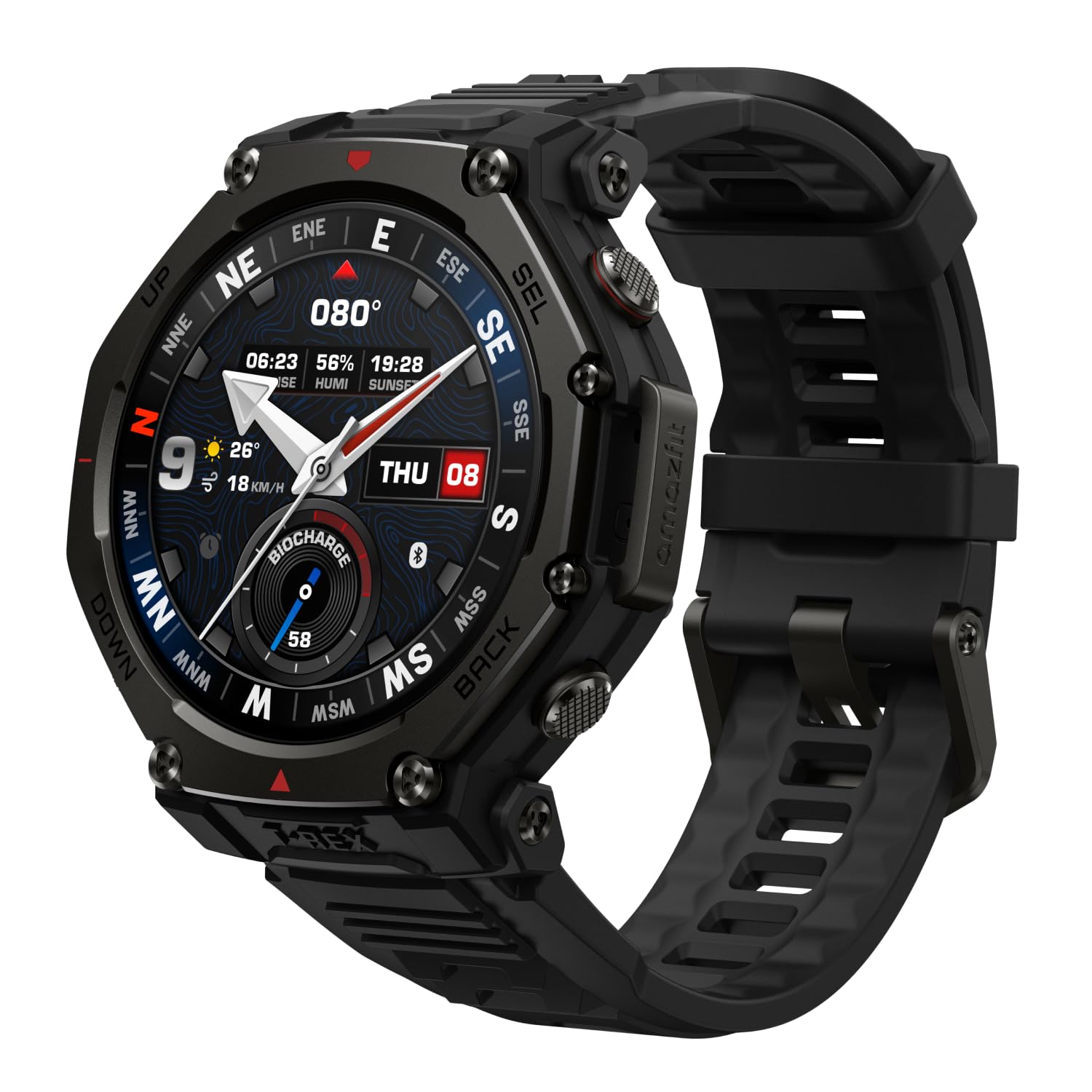
The Amazfit T-Rex 3 Pro is a direct shot at the Garmin Fenix line, delivering a sapphire glass AMOLED display with 3000 nits peak brightness, a titanium alloy bezel and buttons, and a 700 mAh battery that lasts up to 27 days in smartwatch mode and over 3 weeks with typical use. The 180+ sport modes include HYROX training, 45-meter SCUBA diving certification, and 10 ATM water resistance — the same rugged credentials as watches costing more than double. Offline maps support point-of-interest search, auto-rerouting, and round-trip route creation, and the dual-band GPS with six satellite systems locks quickly even under dense canopy.
The built-in two-color flashlight (white for clarity, red for night vision) plus an SOS signal mode is a practical safety addition for night hikes or emergency situations. The BioTracker heart rate sensor can pair with the optional Helio Strap for 24/7 recovery tracking. The watch also supports Bluetooth calls and Zepp Flow voice assistant for hands-free replies when paired to an Android phone. Build quality is genuinely impressive at this price point — the sapphire crystal, titanium accents, and smooth OS navigation make it feel like a watch.
Software limitations separate the T-Rex 3 Pro from true premium competitors. The route recalculation feature rarely works as intended in real-world testing, and the screen can be difficult to unlock when wet or cold. The Zepp ecosystem, while improving, lacks the depth and third-party app support of Garmin Connect or Apple Health. But for the athlete who wants Garmin Fenix-level hardware at a fraction of the cost — and doesn’t need the full third-party app library — the T-Rex 3 Pro delivers exceptional value.
Why it’s great
- Sapphire AMOLED with 3000 nits and titanium bezel
- 27-day battery life with offline maps and dual-band GPS
- Built-in two-color flashlight with SOS mode
Good to know
- Route recalculation is unreliable in real-world use
- Screen unlocking can be difficult when wet or cold
7. POLAR Grit X2 Pro Titan

The Grit X2 Pro Titan is POLAR’s most advanced outdoor GPS watch ever, built around an aerospace-grade titanium front casing, sapphire crystal glass, and a 1.39-inch AMOLED display that’s 15% brighter than its predecessor. The dual-frequency GPS with downloadable topographic maps makes it an exceptional navigation tool for backcountry adventures — Komoot turn-by-turn guidance is supported natively, routes transfer seamlessly, and the map rendering is crisp and responsive. The watch weighs only 64 grams with the included leather band, which is remarkably light for a titanium-cased adventure watch.
Training metrics are where POLAR has always excelled, and the Grit X2 Pro doesn’t disappoint. Vertical speed, running power, training load, and recovery status are all tracked with the same algorithms used in POLAR’s professional-grade wearables. The battery delivers around 40 hours of GPS training mode and multi-day life in power-save mode. The sleep reporting has been significantly improved in this generation, with temperature and weather summaries integrated into the morning report. The standard 22mm band lug means you can swap to any strap without proprietary connections.
The Grit X2 Pro Titan is not for everyone. The Polar ecosystem is insular — smart notifications are basic, there’s no music storage, and the App Store equivalents from Garmin and Apple are absent. Some users have reported heart rate inaccuracy compared to a Polar H10 chest strap, which is a concern if you rely on wrist-based HR for zone training. And at this price point, it sits squarely against Garmin’s Fenix 8 and Apple Watch Ultra 3, both of which offer deeper ecosystems. For athletes already invested in Polar Flow and for navigators who want a premium, lightweight titanium tool, though, the Grit X2 Pro is a serious contender.
Why it’s great
- Aerospace titanium and sapphire glass in a lightweight 64g package
- Excellent navigation with dual-frequency GPS and topo maps
- Improved AMOLED display and sleep reporting
Good to know
- Heart rate accuracy can be inconsistent compared to chest strap
- Limited smartwatch features and app ecosystem
8. Apple Watch Ultra 3
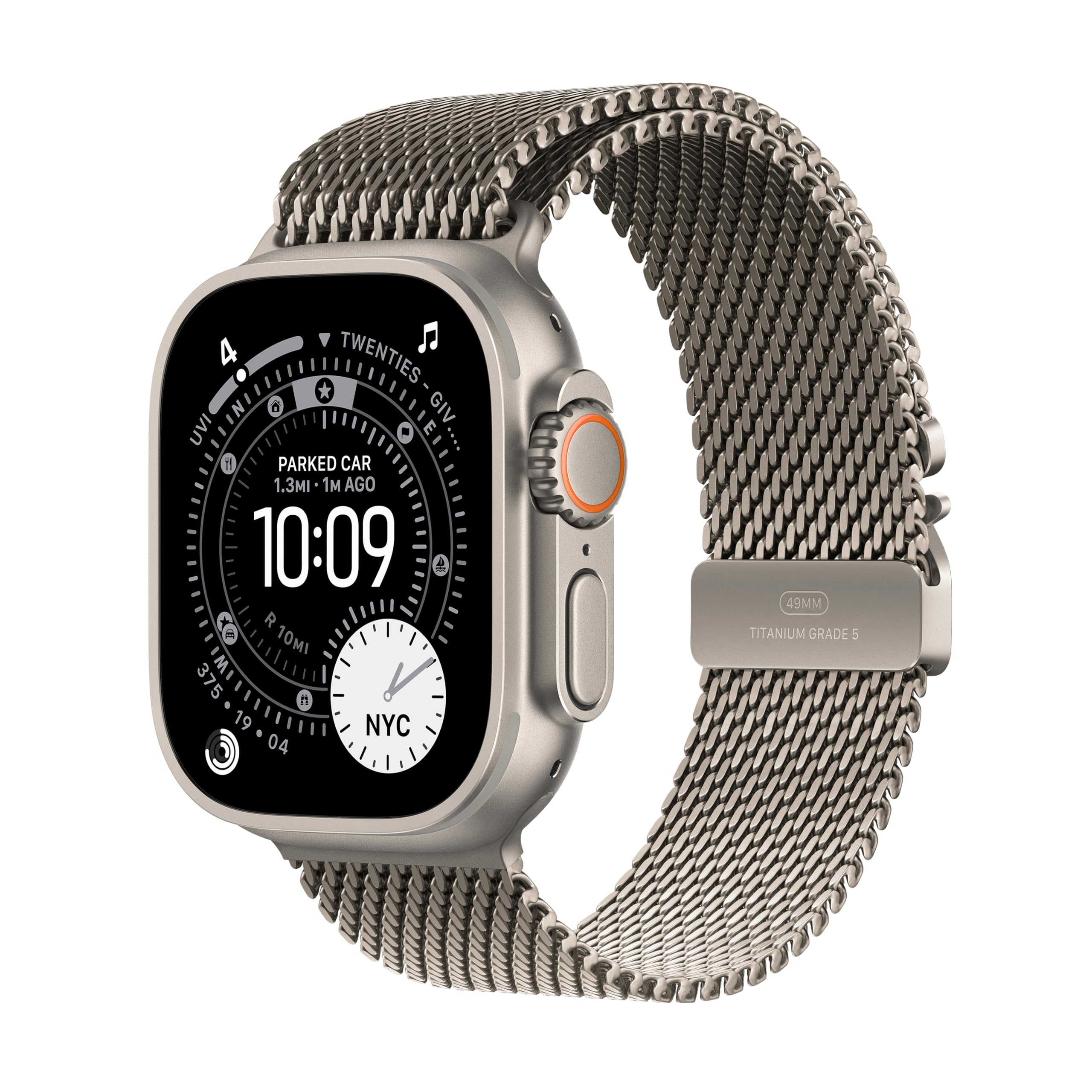
The Apple Watch Ultra 3 is the most feature-dense GPS workout watch in this lineup, combining precision dual-frequency GPS (L1+L5), a rugged titanium case with sapphire crystal display, and the full Apple health ecosystem. Satellite communications let you text emergency services when you’re off-grid with no cell service — a genuine safety net for backcountry runners and hikers. The 49mm display is bright enough to read in direct sunlight and can double as a flashlight, and the customizable Action Button gives you physical control to start a workout, mark a lap, or turn on the flashlight with one press.
Fitness tracking is comprehensive: Pacer, Heart Rate Zones, Custom Workouts, running power, Training Load, and even Workout Buddy powered by Apple Intelligence from your nearby iPhone. The dual-frequency GPS tracks accurately through urban canyons and dense forests, and the 20-hour GPS tracking in Low Power Mode covers full-day adventures. Health features include notifications for possible hypertension, irregular heart rhythm, sleep apnea, and blood oxygen readings. The Vitals app gives you a daily health status summary based on overnight metrics.
The catch is battery life. Apple claims up to 42 hours of normal use and 72 hours in Low Power Mode, but real-world use with GPS tracking, notifications, and cellular connectivity means daily charging if you’re a heavy user. The renewed model in this listing offers some savings, but the full retail price is the highest in this guide. It also requires an iPhone to unlock the full feature set — Android users need not apply. For iPhone loyalists who want the deepest health-tracking integration and best app ecosystem, the Ultra 3 is unmatched.
Why it’s great
- Best-in-class health tracking with ECG, SpO2, sleep apnea detection
- Satellite SOS and precise dual-frequency GPS for safety
- Fast 3nm processor and vibrant 49mm display
Good to know
- Requires daily charging for heavy GPS users
- Full features require an iPhone
9. COROS PACE 3

The COROS PACE 3 is the benchmark for budget-friendly dedicated GPS workout watches, offering dual-frequency satellite tracking in a package that weighs just 30 grams with the nylon band and measures 11.7mm thick. It’s barely noticeable on the wrist during sleep, which is a key advantage for athletes who want 24/7 HRV and sleep tracking. The always-on 1.2-inch transflective touchscreen is readable in direct sunlight and sips power, enabling 38 hours of continuous GPS recording and up to 24 days of daily use on a single charge.
Navigation is functional but not flashy — breadcrumb routing via the COROS App with elevation data and barometric altimeter. Activity modes cover running, trail running, cycling, swimming, strength, and winter sports like XC skiing and snowboarding. The training load and recovery insights are impressively deep for the price, with COROS’ Evolab system providing daily training recommendations based on your performance history. The app syncs detailed stats including HRV, sleep stages, and training effect.
The PACE 3 makes deliberate trade-offs to hit its price point. You get a transflective display instead of AMOLED, no offline maps, no music storage, and a smaller 1.2-inch screen compared to premium models. The proprietary charging cable is also a minor annoyance. But for runners who want accurate dual-frequency GPS, week-plus battery life, and a lightweight form factor that disappears on the wrist, the PACE 3 offers 90% of the performance of a watch at a budget-friendly price. It’s the gateway watch that serious runners buy while saving up for a Forerunner 970 — and many never feel the need to upgrade.
Why it’s great
- Ultra-light (30g) and slim (11.7mm) for 24/7 comfort
- Dual-frequency GPS at a budget-friendly price
- 38-hour GPS battery and 24-day daily battery
Good to know
- Transflective display lacks the visual punch of AMOLED
- No offline maps or music storage
FAQ
Do I need multi-band GPS on a workout watch?
How long should a GPS workout watch battery last for marathon training?
Final Thoughts: The Verdict
For most users, the best gps workout watch winner is the Garmin Forerunner 970 because it delivers the deepest training metrics, brightest AMOLED display, and longest battery of any running-specific watch on the market. If you want the best balance of price and features with an AMOLED display and offline maps, grab the COROS PACE Pro. And for the absolute budget-friendly entry point with dual-frequency GPS and exceptional comfort, nothing beats the COROS PACE 3.