
Standing on the fairway, the flag looks close, but a bad club choice turns a potential birdie into a scramble for par. The difference between a good round and a great one often comes down to knowing the exact yardage, not just estimating by eye. A reliable laser or GPS unit removes that uncertainty, giving you the data to commit to every shot with confidence.
I’m Mohammad Maruf — the founder and writer behind Drink4Good. I’ve spent years deep in market research, analyzing the specific optics, slope algorithms, and battery systems that separate a weekend gimmick from a true scoring tool for this category.
Whether you prefer the instant lock of a laser or the hands-free convenience of a wearable GPS, the best golf yardage device is the one that matches your playing style and the specific conditions of your home course.
How To Choose The Best Golf Yardage Device
Choosing between a laser rangefinder and a GPS device comes down to how you play. Laser units offer pin-point accuracy to a specific target like a flagstick, while GPS devices provide quick distances to the front, center, and back of the green along with hazard information. Consider your typical course conditions, whether you need slope compensation, and how much weight you want to carry in your pocket or on your wrist.
Laser vs GPS: The Core Difference
A laser rangefinder requires you to aim and press a button to get a distance to a reflective target, often within a yard. A GPS device, whether handheld or a watch, uses satellite data to automatically show distances to pre-mapped points on the green. Lasers are better for precise pin hunting on blind shots or undulating greens, while GPS is faster for general club selection and offers features like hazard layup distances without needing a direct line of sight.
Slope Compensation and Tournament Legality
Slope technology adjusts yardage based on elevation changes, giving you a “plays like” distance for uphill or downhill shots. This is extremely helpful for course management. However, most tournament rules require you to disable the slope function. Look for a device with a physical switch or a dedicated tournament mode that clearly indicates when slope is turned off, ensuring you remain compliant during competitive rounds.
Quick Comparison
On smaller screens, swipe sideways to see the full table.
| Model | Category | Best For | Key Spec | Amazon |
|---|---|---|---|---|
| Nikon COOLSHOT PROIII | Laser | Stabilized pin hunting | 1200-yard range with stabilization | Amazon |
| Garmin Approach Z30 | Laser | Garmin ecosystem users | 400-yard range with range relay | Amazon |
| Bushnell Tour V5 | Laser | PGA Tour trusted accuracy | 1300-yard distance; JOLT vibration | Amazon |
| Bushnell Phantom 3 Slope | GPS | Quick green distances | Touchscreen; 38,000+ courses | Amazon |
| Precision Pro NX9 | Laser | Premium value with slope switch | 999-yard range; IP54 water resistant | Amazon |
| GOLFBUDDY 2S PRO | Laser | Triangulation from cart | 1093-yard range; Buddy Mode | Amazon |
| Garmin Approach S44 | GPS Watch | All-in-one wrist data | 1.2″ AMOLED; 43,000 courses | Amazon |
| ACEGMET PFS5 | Laser | Budget-friendly dual power | 1300-yard range; USB-C + CR2 | Amazon |
| Swami KISS 2.0 | GPS | Simple, affordable GPS | 38,000 courses; i-Caddie tech | Amazon |
In‑Depth Reviews
1. Nikon COOLSHOT PROIII STABILIZED

The defining feature here is Vibration Reduction built into the optical path. Unlike standard rangefinders that amplify hand shake at long distances, the COOLSHOT PROIII keeps the reticle steady and the laser on target, which translates to faster, more confident pin locks even beyond 200 yards. The 6x multilayer-coated optics deliver bright, high-contrast images in low light or high glare.
It offers Dual LOCKED ON QUAKE, providing both a red ring visual cue and a tactile vibration when you hit the flag, which eliminates the confusion of ranging background trees. The HYPER READ system clocks a reading in 0.1 seconds. Slope compensation is handled by ID Technology, and a dedicated Actual Distance Mode with an ADI LED indicator keeps you tournament legal without fumbling through menus.
The trade-off is battery choice: it uses a standard CR2 rather than a rechargeable lithium pack, which some golfers see as a minor inconvenience given the premium price point. Also, the included carry case has a weak magnetic closure that may not survive a full season in your bag. For pure optical performance and target stability at distance, this is the class leader.
Why it’s great
- Image stabilization dramatically reduces hand shake for steady pin locks.
- Fast 0.1-second HYPER READ measurement with vibration confirmation.
- Rainproof construction handles unexpected showers without worry.
Good to know
- No built-in magnetic cart mount; must use a separate holder.
- Uses a standard CR2 battery instead of a rechargeable internal cell.
2. Garmin Approach Z30

The Z30 is engineered to feel like a natural extension of your wrist when paired with a compatible Garmin watch like the Approach S44 or Fenix series. Its Range Relay feature automatically sends the lasered distance directly to your watch display and the Garmin Golf app, eliminating the need to memorize numbers between shots. This integration is seamless enough to change your pre-shot routine.
The viewfinder shows not just the pin distance but also the front and back of the green, all with 6x magnification. PlaysLike Distance accounts for elevation changes using barometric data from your paired watch. An external indicator light lets playing partners know when the device is in tournament-legal mode. The magnetic cart mount is strong, and the IPX7 waterproof rating gives it a significant durability edge over many competitors.
Its maximum range is capped at 400 yards, which is fine for nearly every approach shot but feels limited compared to the 1200-yard class leaders for ranging fairway bunkers or distant hazards. If you are not already invested in the Garmin ecosystem, the integration advantage is lost and the premium price becomes harder to justify. For Garmin users, it is a near-perfect data hub.
Why it’s great
- Seamless range relay to Garmin watches and app for hands-free data logging.
- IPX7 waterproof rating for reliable use in heavy rain.
- “Find My Garmin” feature helps locate a misplaced unit on the course.
Good to know
- Optimal functionality requires a compatible Garmin watch or app.
- Maximum ranging distance of 400 yards is lower than many pure laser units.
3. Bushnell Golf Tour V5

Bushnell’s Tour V5 is the most-used laser on the PGA Tour for a reason. The 6x optics are bright and the Pinseeker technology with Visual JOLT delivers a vibrating ring and flashing red indicator that confirms you have locked the flag, not a tree behind it. The ranging speed is under one second in most conditions, and the maximum 1300-yard capacity covers every shot you will face.
The integrated BITE magnetic cart mount is strong and low-profile, holding the device securely on steel cart bars even over rough terrain. The Slope-Switch feature lets you toggle between compensated and actual distances with a physical button on the side, and a dedicated indicator confirms the mode. The IPX4 water resistance protects against light rain, fitting the typical “play through” attitude of serious golfers.
Customer reports note that the V5 can struggle to lock onto non-reflective pins or in high-contrast blue-sky conditions, sometimes requiring reflective tape for reliable acquisition. While the build quality is high, the 12-month warranty is shorter than some competitors offer, so registering the product immediately after purchase is recommended. It is a time-tested, no-surprises rangefinder.
Why it’s great
- Used by the vast majority of PGA Tour pros for a reason — it’s trusted.
- Visual JOLT provides clear, unmistakable flag lock confirmation.
- Strong BITE magnetic mount stays put on bumpy cart paths.
Good to know
- Can struggle to lock onto pins without reflective tape in certain light.
- Standard 12-month warranty is thinner than some mid-range models.
4. Bushnell Golf Phantom 3 Slope
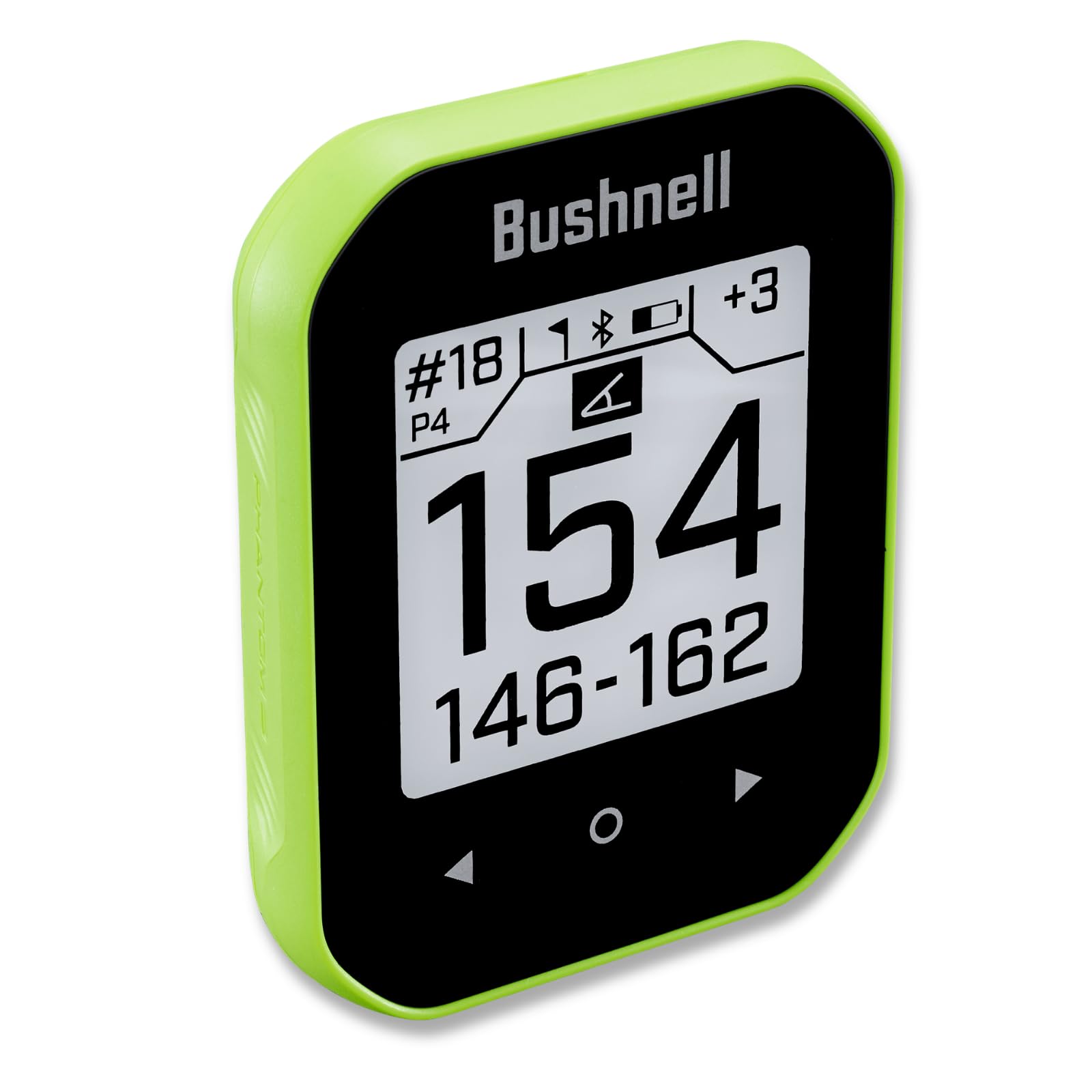
This is the GPS-only alternative for golfers who want instant distances without raising a device to their eye. The Phantom 3 Slope uses a responsive touchscreen to display front, center, and back green yardages, as well as hazard carry distances. It comes preloaded with over 38,000 courses and automatically recognizes the hole you are playing, updating distances as you walk or ride.
The patented Bushnell Slope Technology adjusts yardages based on elevation changes, giving you a “plays like” number that compensates for uphill or downhill terrain. The built-in BITE magnetic mount secures it to the cart bar, and the 14+ hour battery life holds up for about four full rounds. A Bluetooth connection to the Bushnell app provides detailed hole layouts and stat tracking.
The touchscreen can be less responsive in wet conditions or with gloves on, which slows down operation during a round. Some users find the hazard codes and menu navigation less intuitive without regular reference to the manual. It also requires periodic course updates via the app. If you prefer a watch-style GPS, this is bulkier, but the larger screen is easier to read at a glance from the cart.
Why it’s great
- Large touchscreen displays front, center, and back distances instantly.
- Bluetooth sync with Bushnell app provides full hole layout images.
- Excellent battery life covering up to four rounds on a single charge.
Good to know
- Touchscreen can be sluggish in rain or when wearing golf gloves.
- Requires manual app updates to keep course data current.
5. Precision Pro NX9
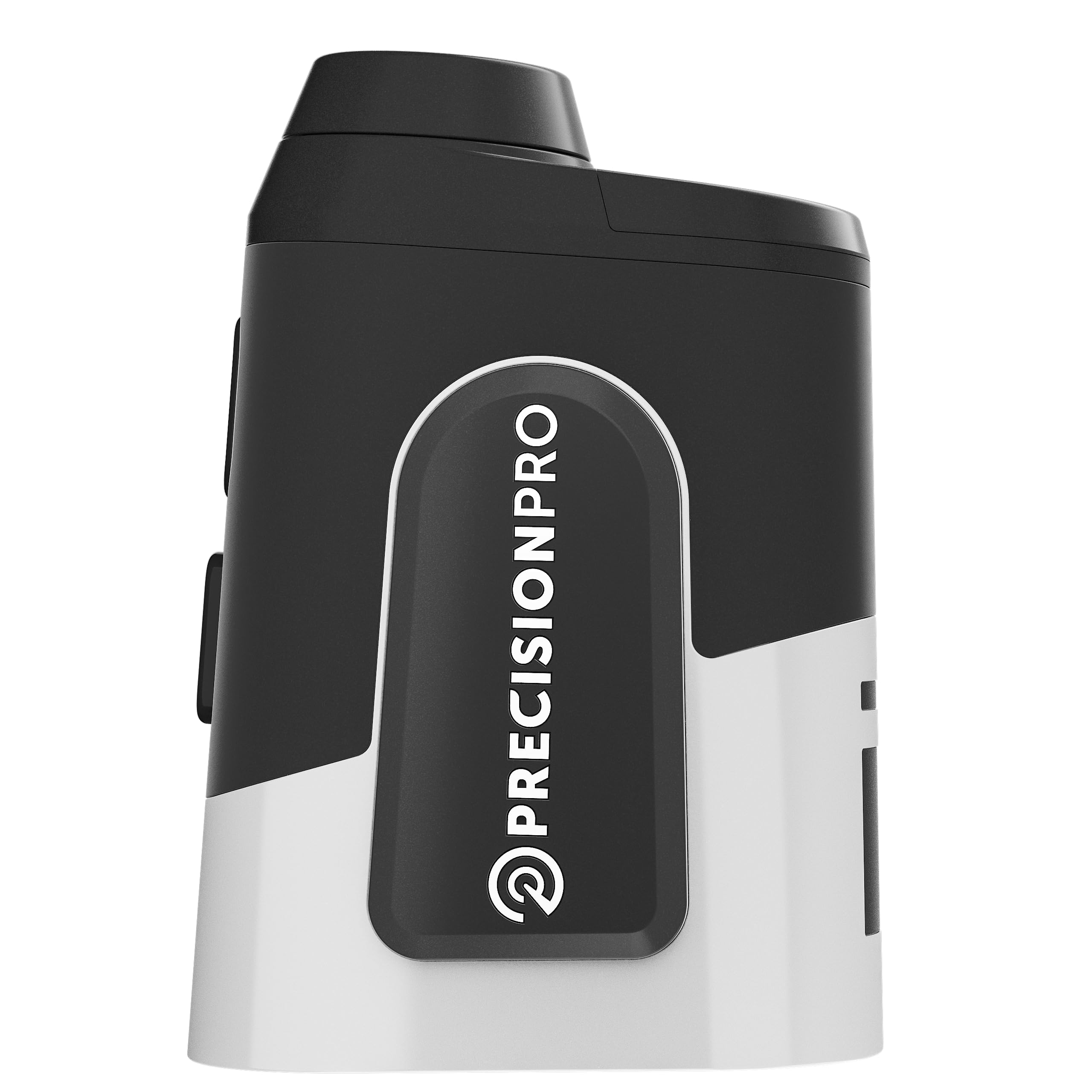
The NX9 hits a sweet spot where premium features meet a sensible investment. The Adaptive Slope Technology adjusts for elevation changes just like the big names, and a dedicated physical switch on the side makes toggling slope on and off simple. The 6x HD optics provide a crisp image, and the Flag Lock Vibration confirms pin acquisition with a buzz you can feel through the grip.
It ranges up to 999 yards with ±1 yard accuracy, which is more than enough for approach play. The IP54 water resistance means it can handle light rain and morning dew. The magnetic cart mount is built into the body, so you do not need an accessory. Users consistently report that the NX9 matches yardages from Bushnell units costing significantly more, which speaks to its engineering.
One quirk is the yard-to-meter toggle, which can accidentally switch during use if you hold the power button too long. The included case is a basic sleeve rather than a hard shell, so you may want to invest in a sturdier pouch for storage. It does not have a rechargeable battery, using a standard CR2, but a single battery lasts several months of regular play.
Why it’s great
- Physical slope switch for instant tournament-legal compliance.
- Fast flag lock with vibration and strong magnetic cart mount.
- Accuracy rivals premium brands at a significantly lower investment.
Good to know
- Yard-meter setting can accidentally toggle if button is held too long.
- Included storage case is a soft sleeve, not a hard protective shell.
6. GOLFBUDDY 2S PRO

The headline feature here is Buddy Mode, a triangulation tool that measures the distance from your cart to the pin without you walking to your ball. This is transformative on “cart path only” days or when you want to pre-select a club while still rolling. The ZST+ technology delivers readings in just 0.15 seconds, making it one of the fastest rangefinders for scanning multiple targets.
It has a 1093-yard max range with ±1 yard accuracy and a slope function that can be switched off for tournaments. The Pin Finder Mode uses Flag Pole Locking Vibration to confirm you have the pin. A built-in magnet and a separate magnetic belt clip keep it accessible from cart or hip. At only 5.9 ounces, it is light enough to forget you are carrying it.
Some users find the zoom wheel stiff, which can slow down focusing. The Buddy Mode has a learning curve; it takes a few rounds to master the two-point measurement process. The plastic body feels durable but not as premium as an aluminum-clad Bushnell. For the price, the feature set is generous, especially if you routinely play on courses with restricted cart access.
Why it’s great
- Buddy Mode triangulates distance from the cart to the pin without walking.
- Ultra-fast 0.15-second readings with ZST+ technology.
- Lightweight at 5.9 oz with both magnet and belt clip included.
Good to know
- Zoom wheel can be stiff and requires effort to adjust.
- Buddy Mode has a learning curve that takes practice to master.
7. Garmin Approach S44

The S44 brings a vibrant 1.2-inch AMOLED display to the course, making yardages and hazard layouts easy to read even in direct sunlight. It preloads 43,000 courses and auto-recognizes the hole you are on, showing distances to the front, middle, and back of the green. The slim profile is comfortable enough to wear all day without feeling bulky, and the silicone band is secure during the swing.
It offers smart notifications from your phone, step counting, and the ability to pair with Approach CT1 or CT10 club trackers for shot tracking. The battery life is around 15 hours in GPS mode, which covers about three rounds. With a Garmin Golf membership, you unlock full-color CourseView maps, green contour data, and PlaysLike Distance adjusted for elevation.
Early software versions had autoshot tracking and GPS dropout issues, but firmware updates have largely resolved these. The included band is known to be short and difficult to fasten for larger wrists. The Garmin Golf subscription fee for premium features is an ongoing cost that not all users anticipate. For a no-phone, one-button golf experience on your wrist, this is a focused tool.
Why it’s great
- Stunning AMOLED display that is bright and readable in sunlight.
- Lightweight, comfortable design that does not interfere with the swing.
- Seamless shot tracking and scoring with optional club sensors.
Good to know
- Premium CourseView maps and slope data require a subscription fee.
- Stock silicone band may be too short for larger wrists.
8. ACEGMET PFS5
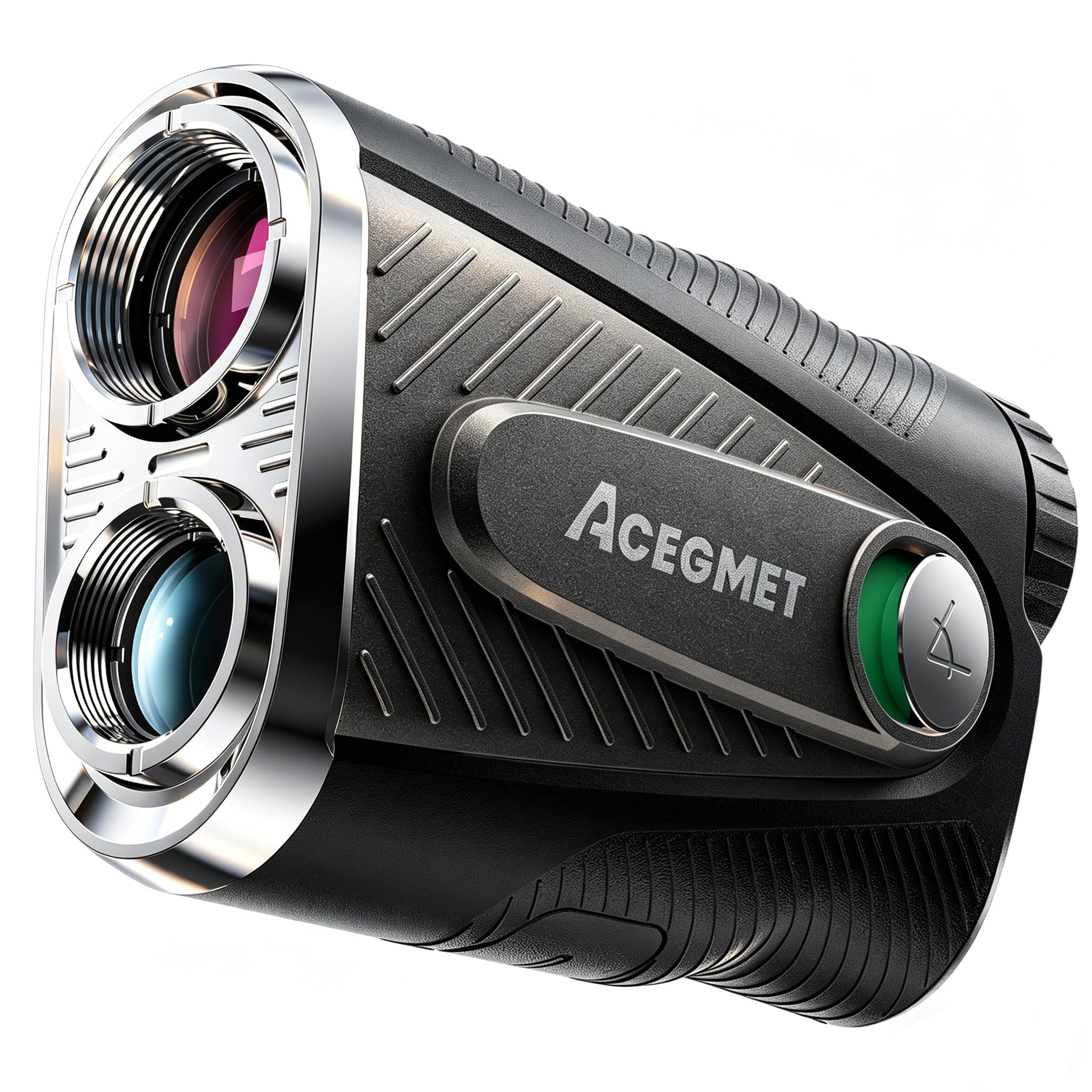
The PFS5 stands out with a dual power system: a 450mAh USB-C rechargeable battery for daily use and a CR2 backup in case you forget to charge. This eliminates the single-point-of-failure anxiety that comes with most laser rangefinders. A full charge is rated for 40,000+ measurements, so you will not need the backup often, but it is a comforting safety net when it appears.
It introduces Coach Mode, a triangulation feature similar to the GOLFBUDDY Buddy Mode, that measures distance from the cart to the pin without walking. The patented EnviroSlope Tech adjusts yardage based on temperature, humidity, and air pressure, going beyond simple elevation compensation. The flag lock is fast, claiming 0.1 seconds, with vibration and a red flash confirmation.
The 7x magnification is slightly higher than the standard 6x, giving you a closer view of the pin. The pin lock can be inconsistent at times, occasionally locking onto background objects when the hand is unsteady. Some users note that the optical clarity, while good for the price, does not match the brightness of a Bushnell or Nikon. For the feature set, it is an aggressive value proposition.
Why it’s great
- Dual power (USB-C and CR2 backup) ensures the battery never dies mid-round.
- Coach Mode uses triangulation to measure distances from the cart.
- 7x magnification offers a tighter view of the flag than standard 6x models.
Good to know
- Pin lock can occasionally latch onto background objects instead of the flag.
- Optical brightness and clarity lag behind premium-tier brands.
9. Swami KISS 2.0

The Swami KISS 2.0 is a pure GPS unit that strips away the complexity of a laser. It connects to over 38,000 course maps and automatically recognizes the hole you are on, displaying distances to the front, center, and back of the green. The i-Caddie technology offers club suggestions based on your distance, which is a handy guide for newer players learning their ranges.
The display offers two views: a full front-center-back readout, or a simplified mode that shows only the center distance with front and back on the next screen. A powerful integrated magnet on the back attaches securely to cart frames. It includes a scorecard tracker and uses a universal micro USB port for charging. The water-resistant body handles morning dew and light mist without issue.
A limitation shared by some users is that the device only recognizes nine holes at a time and requires a power cycle to start the back nine. The plastic build feels basic, and the display is not as sharp as a modern touchscreen. It works well as a compact, no-frills distance companion for the casual golfer or as a backup unit.
Why it’s great
- Simple, automatic GPS with quick course recognition and large numbers.
- Strong magnetic attachment keeps it accessible on the cart bar.
- i-Caddie technology offers basic club suggestions for new players.
Good to know
- Only recognizes nine holes at a time; requires a reset for the back nine.
- Micro USB charging is a dated connector compared to modern USB-C.
FAQ
Is a laser rangefinder more accurate than a GPS watch on the golf course?
Do I need a golf rangefinder with slope compensation?
Why does my laser rangefinder struggle to lock onto the pin in bright sunlight?
Final Thoughts: The Verdict
For most users, the best golf yardage device winner is the Nikon COOLSHOT PROIII STABILIZED because its image stabilization directly solves the most common error in long-distance ranging — hand shake — while delivering fast, accurate pin locks with slope compensation. If you want deep integration with a smartwatch for automatic data logging, grab the Garmin Approach Z30. And for a premium-feeling laser with a flexible budget, nothing beats the Precision Pro NX9.