
A lawn full of weeds is a sign of soil that’s starving for the right nutrients—and the wrong approach will just feed the problem. A precise combination of nitrogen, potassium, and selective herbicides changes that dynamic, pushing grass to thicken while broadleaf invaders wither. The difference between a patchy mess and a uniform green carpet is knowing the timing of your application and the particle size of your product.
I’m Mohammad Maruf — the founder and writer behind Drink4Good. After hundreds of hours analyzing nitrogen-to-herbicide ratios, particle dispersion patterns, and the specific temperature windows where post-emergent formulas actually activate, I built this guide to cut through the marketing noise and focus on what actually works on fescue, Bermuda, zoysia, and bluegrass.
You need a formula that feeds the grass without triggering a weed bloom—and the best grass weed and feed products balance those two actions so precisely that your lawn gets greener, thicker, and less hospitable to dandelions, clover, and plantain by the third week after application.
How To Choose The Best Grass Weed And Feed
The wrong weed and feed can turn a lawn into a patchwork of dead grass streaks and surviving weeds. Most beginners make one critical error: they grab the cheapest bag without checking whether the herbicide matches their grass type. Here is what you actually need to look at.
Nitrogen-to-Herbicide Ratio
The first number on the bag tells you the nitrogen percentage. A 20-0-0 formula delivers a heavy nitrogen punch that greens up grass fast but can push weed growth if applied too early. A 16-0-9 or 21-0-3 provides a slower, more balanced release that builds root mass without overwhelming the lawn with top-growth. Match the ratio to your season: high nitrogen in spring, balanced in fall.
Granular vs. Liquid Formulation
Granular weed and feed products like those from Scotts and The Andersons rely on small particles that stick to weed leaves through moisture. Liquids like Spectracide require a hose-end sprayer and give you lighter control over where the herbicide lands. Granules are better for large, even lawns. Liquids suit spot-treatment or irregular-shaped yards where you need precise coverage.
Coverage Area and Particle Size
Fine particles pack more active ingredient per square inch and reduce the chance of missed spots. A 40-pound bag covering 16,000 sq ft like The Andersons Professional Surge gives you a lower application rate per pass, which means less product waste. Larger granules spread farther but can bounce off thick grass and miss weed leaves entirely.
Grass Type Compatibility
Not every weed and feed works on every grass. St. Augustine grass, Floratam varieties, dichondra, and creeping bentgrass can be damaged by broadleaf herbicides found in standard formulas. Always check the product label: cool-season grasses like fescue, ryegrass, and bluegrass tolerate most products, while warm-season grasses require a careful match to avoid burning the turf.
Quick Comparison
On smaller screens, swipe sideways to see the full table.
| Model | Category | Best For | Key Spec | Amazon |
|---|---|---|---|---|
| The Andersons Professional Surge | Granular | Large lawns, thick coverage | 16-0-9, 40 lb, 16,000 sq ft | Amazon |
| Jonathan Green Green-Up | Granular | Fed-up weed control, 250+ weeds | 21-0-3, 15 lb, 5,000 sq ft | Amazon |
| Scotts WinterGuard Fall Weed & Feed3 | Granular | Fall root-building, clover control | 11.43 lb, 4,000 sq ft | Amazon |
| Scotts WinterGuard Fall Weed & Feed5 | Granular | Spring pre-emergent, 50+ weeds | 11.28 lb, 4,000 sq ft | Amazon |
| Spectracide Weed & Feed | Liquid | Quick weed kill, small yards | 20-0-0, 96 oz, 7,500 sq ft | Amazon |
| PBI/Gordon Trimec | Liquid | Stubborn weeds, cool-season grass | Trimec, 1 gal, 32,000 sq ft | Amazon |
| Turf Titan Lawn Commander | Liquid | Safe formula, quick green-up | 32 oz, 8,000 sq ft, hose-end sprayer | Amazon |
In‑Depth Reviews
1. The Andersons Professional Surge Weed and Feed
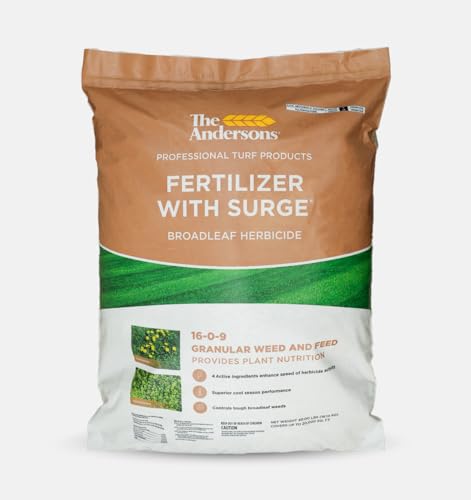
The Andersons Professional Surge delivers the most coverage per bag of any product in this lineup—a 40-pound granular formula that blankets up to 16,000 square feet with a 16-0-9 ratio. That balance of nitrogen and potassium supports deep root growth without forcing a rapid top-growth flush that can attract fungal issues. The fine particle size means you get more active ingredient per square inch, reducing the chance of herbicide skips that leave dandelions standing.
User reports confirm this eliminates over 250 broadleaf weeds, including creeping Charlie and plantain, while thickening zoysia and fescue noticeably within two weeks. The four-way herbicide mix targets weed species that single-ingredient formulas miss, making it effective even when temperatures dip into cooler spring and fall windows.
The one constraint is grass-type restriction: Floratam St. Augustine, dichondra, and carpetgrass cannot tolerate this herbicide blend. Homeowners with mixed cool-season lawns will see the strongest results, and the 40-pound bag eliminates the need for multiple seasonal purchases.
Why it’s great
- Covers 16,000 sq ft, so large yards get full treatment in one pass
- Fine particles stick to weed leaves better than coarse granules
- Balanced 16-0-9 formula builds roots without excessive top growth
Good to know
- Not compatible with Floratam St. Augustine or carpetgrass
- Price per bag is higher upfront, but cost per sq ft is lower than most
2. Turf Titan Lawn Commander
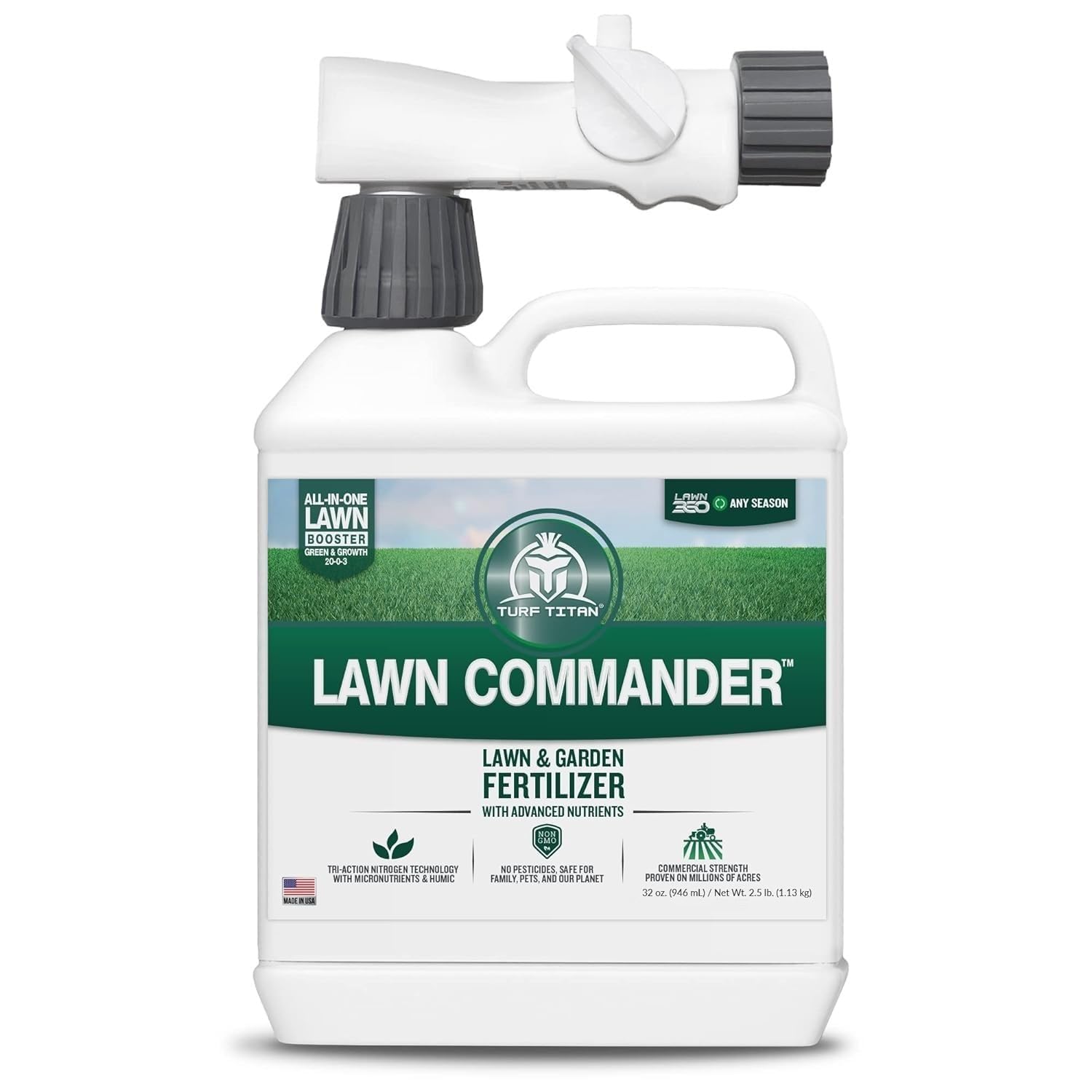
Turf Titan Lawn Commander is a liquid formula with a built-in hose-end sprayer that skips traditional herbicides in favor of humic acid, sulfur, iron, and zinc. This approach feeds the soil biology directly, improving root uptake of water and existing nutrients rather than blanketing the lawn with broadleaf killers. The tri-action nitrogen tech delivers an immediate green pop within about a week on St. Augustine, dichondra, and fescue.
The 32-ounce bottle covers 5,000 to 8,000 square feet depending on walking speed, and the no-mix sprayer eliminates the guesswork of dilution ratios—just screw onto a garden hose and go. Users on drought-stressed lawns reported visible improvement in color and density after four applications, though results depend heavily on consistent watering.
The absence of synthetic herbicides means you cannot expect dandelion or clover reduction within days. Lawn Commander is a fertilizer and soil conditioner first, so it works best as a restorative treatment for pale, weak grass rather than a quick weed fix. Pair it with a separate post-emergent spray if weed pressure is high.
Why it’s great
- Non-GMO and pesticide-free, safe for families and pets when dry
- Hose-end sprayer simplifies application on irregular lawn shapes
- Humic acid and micronutrients improve long-term soil resilience
Good to know
- No active weed-killing ingredients, so weeds require separate treatment
- Consistent watering is essential for the humic acid to activate
3. Scotts Turf Builder WinterGuard Fall Weed & Feed5
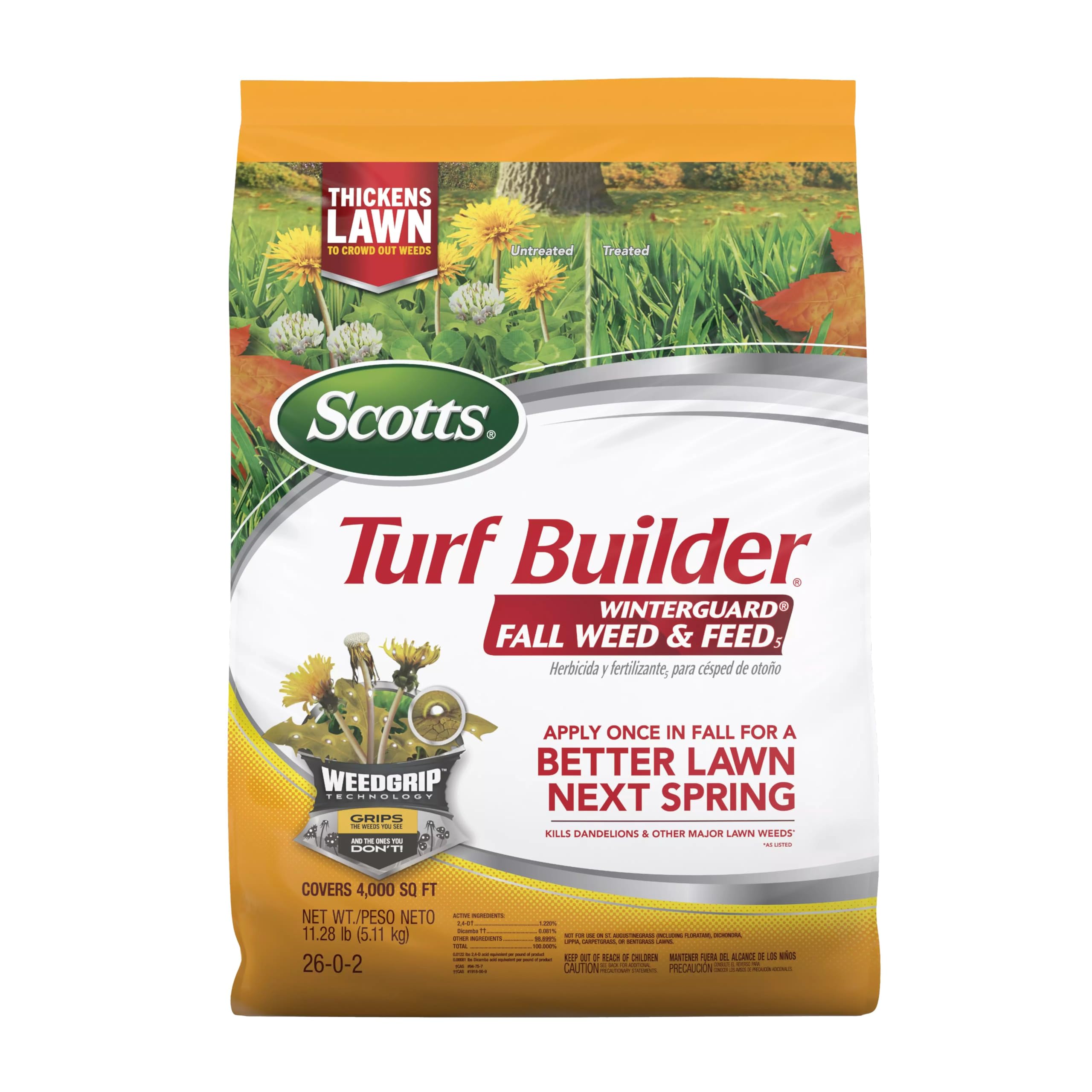
Scotts WinterGuard Fall Weed & Feed5 is calibrated specifically for autumn application when soil temperatures drop below 60°F but grass roots are still active. The granular formula targets over 50 broadleaf weeds including clover, morningglory, chickweed, and plantain while delivering a slow-release nitrogen blend that builds root reserves for spring green-up.
Users consistently report visible weed browning by week three when applied to a wet lawn between 60°F and 90°F. The 11.28-pound bag covers 4,000 square feet, and the fine granules adhere to weed leaves without needing a heavy pre-wetting. Scotts recommends using a drop spreader for even distribution; a rotary spreader can cause streak patterns if you overlap unevenly.
The formula works on bahiagrass, Bermuda, bluegrass, centipedegrass, fescue, ryegrass, and zoysia. It does not work on St. Augustine, and the post-emergent action requires that weeds are actively growing—dormant weeds will not absorb the herbicide. Apply before the first hard frost for maximum root uptake.
Why it’s great
- Targeted fall formula builds root density for winter survival
- Kills dandelions, clover, and morningglory reliably by week three
- Compatible with seven cool- and warm-season grass types
Good to know
- Not for use on St. Augustine grass
- Requires wet lawn and frost-free temperatures for activation
4. Jonathan Green Green-Up Weed & Feed

Jonathan Green Green-Up packs a 21-0-3 analysis with a slow-release nitrogen that feeds grass for up to three months after a single application. The granular formula uses ultra-fine particles that adhere to weed leaves for herbicide uptake while providing a consistent nutrient drip to the soil. This dual-release mechanism reduces the nitrogen surge that pushes weed seeds to germinate.
The herbicide blend controls over 250 broadleaf weeds including poison ivy, wild onions, and this is one of the few consumer-grade products that targets thistle at the root. Coverage is 5,000 square feet per 15-pound bag, and the best application window is late spring or early fall when weeds are actively growing. Users with persistent clover and chickweed issues report visible reduction within 10 to 14 days.
Some users noted that the bag can arrive with clumps that are difficult to break down if exposed to moisture during shipping. The product also cannot be used at the same time as seeding, since the herbicide will damage new grass seedlings. A drop spreader provides the most even distribution for this fine particle size.
Why it’s great
- Extended-release nitrogen feeds for up to three months
- Controls over 250 weed species including tough thistle and poison ivy
- Fine particles give even coverage and fewer missed spots
Good to know
- Cannot be used during seeding or sodding
- Bag may arrive with clumps if exposed to humidity
5. PBI/Gordon Trimec Lawn Weed Killer

PBI/Gordon Trimec is a concentrated liquid that requires mixing with water and a sprayer—no pre-diluted convenience here, but the trade-off is exceptional coverage range. One gallon treats between 32,000 and 64,000 square feet depending on your dilution ratio, making it the most cost-effective weed killer per square foot on this list. The Trimec active ingredient penetrates weed leaves quickly and moves to the root system.
Users report rapid results on creeping Charlie (2-3 days) and tougher weeds like Virginia buttonweed within two weeks. The formula is designed specifically for cool-season grasses like fescue and ryegrass, and it does not harm the turf when applied at the correct rate. Multiple users noted that for heavy weed infestations, doubling the Trimec portion beyond the label recommendation yields better results on stubborn species.
The main catch is that this is a weed killer only—there is no nitrogen or potassium content, so you need a separate fertilizer program. The gallon container is heavy and the concentrated liquid can be messy to measure. You will also need a separate hose-end or pump sprayer since none is included.
Why it’s great
- Covers up to 64,000 sq ft per gallon, the biggest coverage in this guide
- Trimec penetrates leaf cuticle fast for deep root kill
- Does not damage cool-season turf when mixed correctly
Good to know
- No fertilizer included—must supplement with a separate feeding product
- Requires measuring and mixing; pump or hose-end sprayer sold separately
6. Spectracide Weed & Feed 20-0-0
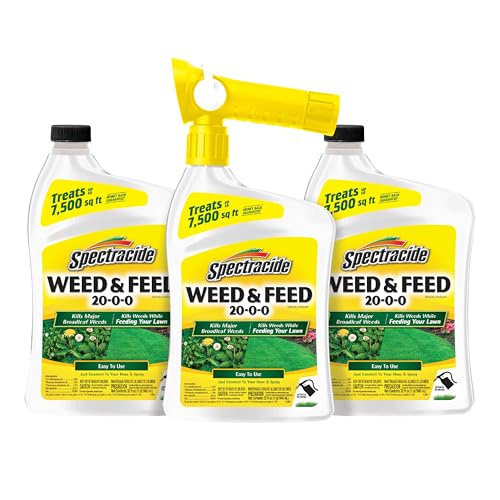
Spectracide Weed & Feed uses a high-nitrogen 20-0-0 formulation in a liquid that connects directly to a garden hose via the included QuickFlip sprayer. The three-pack provides 96 total ounces, treating up to 7,500 square feet when used as directed, and targets major broadleaf weeds such as dandelion, chickweed, knotweed, plantain, and clover. The nitrogen component greens up grass within two weeks while the herbicide works on weed leaves.
Users noted that the sprayer works best when you maintain steady pressure—stop-and-go spraying leads to uneven coverage and residual salt smell that can linger for a few days after application. The product is labeled safe for St. Augustine grass under normal conditions, which sets it apart from many granular formulas that exclude warm-season grass types. Temperatures above 85°F can reduce herbicide effectiveness and risk leaf burn.
The weed kill is effective on most annual broadleaf species, but perennial weeds like lawn violets may require three or more applications spread across the season. Some users reported that the sprayer nozzle clogged after the first bottle, though a quick rinse with warm water usually clears the internal tube. The three-bottle pack gives you enough reserve for a second treatment without buying an extra set.
Why it’s great
- Safe for St. Augustine grass when applied at label rates
- QuickFlip sprayer simplifies application on small to medium lawns
- High 20% nitrogen delivers rapid greening in two weeks
Good to know
- Sprayer timing is tricky—stop-and-go use leads to uneven coverage
- Perennial weeds like violets may need three or more applications
7. Scotts Turf Builder WinterGuard Fall Weed & Feed3

Scotts WinterGuard Fall Weed & Feed3 is the lower-cost sibling of the Weed & Feed5, with an identical 4,000-square-foot coverage but a slightly different nitrogen release profile. The granular formula kills over 50 listed broadleaf weeds including dandelion, clover, plantain, and morningglory while feeding grass through fall for stronger spring regrowth. Users consistently report that it is an effective clover killer within two weeks when applied to a moist lawn.
One common user observation: the smaller particle size means a drop spreader produces far more even results than a broadcast spreader, which can throw the granules too wide and leave streaks in the turf. The product works best on bahiagrass, Bermuda, bluegrass, centipedegrass, fescue, ryegrass, and zoysia—but again, not on St. Augustine. Apply before November for the winter moisture to fully activate the herbicide.
Some early spring applications reported less effective weed control because the weeds were not yet actively growing. The product label specifically requires temperatures between 60 °F and 90 °F, so a late frost can stall the herbicide action. For the price per bag, it is a reliable fall treatment for homeowners with cool-season lawns who want to prevent crabgrass and dandelions from overwintering.
Why it’s great
- Cost-effective fall treatment for cool-season grass varieties
- Kills clover, dandelions, and plantain within two weeks
- Easy to find and widely compatible with common grass blends
Good to know
- Not for use on St. Augustine or warm-season grasses
- Drop spreader recommended—broadcast spreader can cause streak patterns
FAQ
Can I apply weed and feed to a newly seeded lawn?
How long after applying can I water my lawn?
What causes white streaks in the lawn after applying granular weed and feed?
Is weed and feed safe for pets after it dries?
Can I use weed and feed on St. Augustine grass?
Final Thoughts: The Verdict
For most users, the best grass weed and feed winner is the The Andersons Professional Surge because it balances wide coverage, precise 16-0-9 nutrient delivery, and professional-grade weed control at a cost per square foot that beats every other granular product on this list. If you need a pet-safe, pesticide-free option for spot-treating a small lawn, grab the Turf Titan Lawn Commander. And for a targeted fall application that builds deep roots and prevents spring weeds, nothing beats the Scotts WinterGuard Fall Weed & Feed5.