
A sim racing GPU has one job: push three screens at high frame rates without dropping a single frame mid-corner. Most gaming cards can handle a single monitor at 1080p, but the moment you add triple displays or a VR headset, you’ll feel every millisecond of latency. This guide compares 11 GPUs built for that exact pressure.
I’m Mohammad Maruf — the founder and writer behind Drink4Good. I’ve spent weeks analyzing hardware specifications, thermal performance across repeated laps, and the real-world frame time consistency each card delivers for sim titles like iRacing, Assetto Corsa Competizione, and rFactor 2.
Whether you drive a 1440p triple monitor rig or a single 4K screen, the right gpu for sim racing must maintain minimum frame rates under sustained load, support low-latency VR, and scale across three displays without choking the bus.
How To Choose The Best GPU For Sim Racing
Sim racing is a unique workload —‑ the GPU doesn’t just render one frame; it must project a cohesive world across three screens (or a single wide 4K panel) while maintaining rock-solid frame pacing. A card that shines in synthetic benchmarks can fall apart under the sustained 20‑minute thermal load of a GT3 endurance race. Here are the factors that guarantee you cross the finish line at full speed.
Frame Pacing Over Peak FPS
Synthetic benchmarks show peak frames per second, but sim racing punishes inconsistent frame delivery. A 1% low that dips to 40 FPS on a 120 FPS average will feel like a stutter in the middle of Eau Rouge. Look for GPUs with proven low frame time variance —‑ measured through real-world logs from iRacing and ACC. Cards with larger VRAM pools (12 GB and up) generally keep frame times flatter on triple 1440p displays because they don’t need to swap textures mid-race.
VRAM for Triple Screen Textures
Three 1440p monitors push roughly 8.3 megapixels per frame —‑ 40 percent more than a single 4K screen. That loads the VRAM buffer with car liveries, track detail, and weather conditions that layer on top of each other. An 8 GB card will work for 1080p triples or single‑screen 4K, but 12 GB or more gives you headroom for full field grids, rain effects, and high‑resolution cockpit textures. The 16 GB options are the safe bet for future sim titles with ray‑traced rain reflections.
Display Outputs and Bandwidth
A single HDMI port won’t drive three monitors in surround view. You need at least three independent outputs —‑ ideally DisplayPort 1.4a or 2.1 —‑ to run native refresh rates on each screen. DisplayPort 2.1 provides up to 80 Gbps of bandwidth, enough for three 4K displays at 144 Hz without compression. HDMI 2.1 is useful for a fourth monitor or a large TV rig, but DisplayPort remains the standard for multi‑monitor sim rigs.
Sustained Thermal Headroom
Sim racing sessions often run 40 minutes or longer without a pause. The GPU sits at 90‑100 percent load the entire time. A card with a triple‑fan cooler and a robust thermal solution —‑ like phase‑change pads or vapor chambers —‑ will hold its boost clock longer than a compact dual‑fan design that thermal‑throttles after 15 minutes. Check real user reports about temp deltas under long load, not just idle noise levels.
PCIe Generation and Platform Fit
PCIe 5.0 offers 64 GB/s per lane, but most sim racing workloads today don’t saturate even PCIe 4.0 x16. The critical factor is CPU overhead —‑ sims like iRacing are heavily CPU‑bound in physics calculations. Pair a fast GPU with a modern processor that has high single‑thread performance (AMD X3D chips or Intel 13th/14th gen) to avoid a CPU bottleneck. Also confirm your power supply can handle the transient spikes from cards like the RX 9070 XT or RTX 5070 Ti.
Quick Comparison
On smaller screens, swipe sideways to see the full table.
| Model | Category | Best For | Key Spec (VRAM / Memory) | Amazon |
|---|---|---|---|---|
| MSI Ventus 3X RTX 5070 Ti | Premium | 4K triples, future‑proof | 16 GB GDDR7 | Amazon |
| ASUS Prime RX 9070 XT | Premium | 1440p triples, cool running | 16 GB GDDR6 | Amazon |
| GIGABYTE RX 9070 XT Gaming OC | Premium | High FPS 1440p triples | 16 GB GDDR6 | Amazon |
| PNY RTX 5070 Epic-X | Premium | 1440p single, quiet operation | 12 GB GDDR7 | Amazon |
| ASUS Prime RTX 5070 | Mid-Range | SFF triple monitor builds | 12 GB GDDR7 | Amazon |
| GIGABYTE RTX 5060 Windforce | Mid-Range | 1080p single screen | 8 GB GDDR7 | Amazon |
| PowerColor RX 9060 XT | Mid-Range | 1440p single, 16GB value | 16 GB GDDR6 | Amazon |
| ASRock Arc B580 Challenger | Entry/Mid | Budget 1440p single, XeSS | 12 GB GDDR6 | Amazon |
| XFX Speedster RX 7600 | Entry | 1080p single, VR capable | 8 GB GDDR6 | Amazon |
| MAXSUN RTX 3050 | Entry | SFF single monitor, low power | 6 GB GDDR6 | Amazon |
| ARES WING Sim Rig | Chassis | Rigid cockpit, adjustable | Supports 50″ monitor | Amazon |
In‑Depth Reviews
1. MSI Ventus 3X RTX 5070 Ti

The MSI Ventus 3X RTX 5070 Ti sits at the sweet spot for sim racing because it delivers 16 GB of GDDR7 memory on a 256‑bit bus — enough bandwidth to keep triple 1440p displays fed at 120 Hz with room for rain effects and full grid liveries. Real owners report hitting 120‑140 FPS on 4K OLED screens in demanding titles like Tarkov and DayZ, while BF6 runs over 200 FPS with DLSS Frame Gen 4 enabled. That margin means you’ll never choke on a 20‑car multiclass start in ACC.
The TORX Fan 5.0 design and nickel‑plated copper baseplate keep thermals under 65°C during long sessions, according to multiple verified reviews. The card is also SFF‑Ready, so it fits in compact rig chassis without sacrificing cooling. The nickel‑plated baseplate rapidly pulls heat from both the GPU die and memory modules, which directly helps maintain consistent boost clocks when you’re running hot laps for 45 minutes straight.
On the downside, the card is large (15.2″ x 9.3″) and requires a spacious case. Some owners noted it needs a support bracket to prevent sag in vertical mount scenarios. The Ventus 3X has no RGB, which is a plus for many sim racers who want a clean cockpit look, but you lose the bling factor. Overall, this card rivals the previous generation RTX 4080 Super in raw rasterization performance while costing significantly less.
Why it’s great
- 16 GB GDDR7 handles triple 1440p VRAM loads effortlessly
- Stays under 65°C under sustained load
- Outperforms last‑gen 4080 Super without overclocking
Good to know
- Large footprint requires a wide case and support bracket
- No RGB lighting for those who want aesthetic flair
2. ASUS Prime AMD Radeon RX 9070 XT OC

The ASUS Prime RX 9070 XT OC edition is built for the sim racer who values silence alongside performance. Its axial‑tech fans with dual‑ball bearings stop completely during light loads thanks to 0dB technology, meaning no fan noise when you’re just browsing setups or watching replays. Under load, verified owners report idle temperatures of 28‑32°C and stressed temps of just 55‑59°C, with fans remaining quiet at moderate speeds — crucial for immersion with high‑end headsets or open‑ear speakers.
With 16 GB of GDDR6 memory and a 2.5‑slot design, this card is a direct fit for most mid‑tower rig cases. Real reviews mention it replaced an RX 6800 and saw RDR2 jump from 80‑90 FPS on medium 1440p to 170‑190 FPS on high settings. In sim context, that headroom means you can max out track detail and crowd density in iRacing without worrying about VRAM limits. The phase‑change GPU thermal pad ensures heat transfers efficiently, keeping boost clocks stable across long race stints.
The card runs on three PCIe power connectors, so ensure your power supply has enough 8‑pin headers. Some owners caution that ASUS warranty support can be slow, so factor that into your purchase decision. The cooler is plasticky at touch points, though internal build quality is solid. For sim racers running 1440p triple screens or a single 4K display, this card delivers excellent value and whisper‑quiet operation.
Why it’s great
- 0dB fan stop for silent idle and low‑load scenarios
- 16 GB VRAM handles triple monitor textures without swap stutters
- Excellent thermals in the 55‑59°C range under full load
Good to know
- Requires three 8‑pin PCIe power connectors
- ASUS warranty support has mixed feedback
3. GIGABYTE Radeon RX 9070 XT Gaming OC

The GIGABYTE RX 9070 XT Gaming OC is a pure performance play for sim racers who want maximum frame rates at 1440p multi‑monitor. Owner reports mention hitting 500+ FPS in lighter titles with FSR 4.1 and a 9800X3D processor, while heavier sims like Hogwarts Legacy push 240 FPS at 1440p max settings and Cyberpunk 2077 runs at 150 FPS. Those numbers translate to butter‑smooth triple‑screen rendering with zero perceptible lag.
The WINDFORCE cooling system uses Hawk Fans and server‑grade thermal conductive gel to keep temps under 65°C during full load, even in a closed rig. One verified reviewer downgraded from an RTX 5090 and reported the same or better gaming experience in Call of Duty thanks to lower latency with Fidelity CAS. For sim purposes, the 16 GB VRAM buffer means you can load full circuits like Nürburgring Nordschleife with all details cranked across three monitors without hitting VRAM limits.
On the minor side, this card runs slightly hotter than other RX 9070 XT models, with a higher edge‑to‑junction temperature delta according to one review. The card is also large at 11.34″ x 5.2″ so triple‑check your case dimensions before buying. Some users noted that undervolting helps bring temps down significantly, but the card performs perfectly out of the box for most setups. The subtle RGB lighting is a nice touch without being distracting.
Why it’s great
- 500+ FPS potential with FSR 4.1 for lighter sims
- 16 GB VRAM handles Nordschleife at max details across triples
- WINDFORCE cooling keeps GPU under 65°C sustained
Good to know
- Runs slightly hotter junction temps than competing 9070 XT models
- Large dimensions require a roomy chassis
4. PNY NVIDIA GeForce RTX 5070 Epic-X ARGB OC
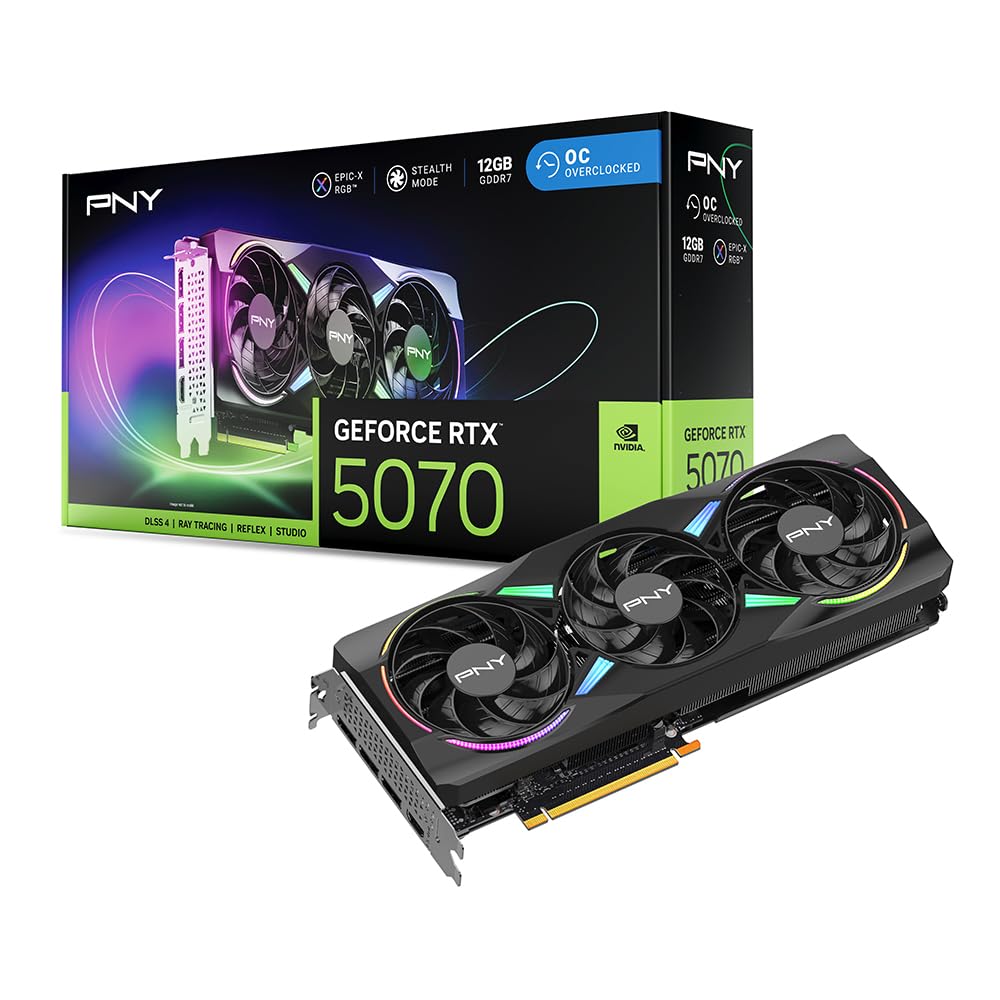
The PNY RTX 5070 Epic-X hits the 1440p sweet spot for sim racers who prioritize quiet operation and steady frame pacing. Built on the Blackwell architecture with 6,144 CUDA cores and a 192‑bit memory interface (672 GB/s bandwidth), it handles single‑screen 1440p at max settings with DLSS 4. Verified owners report excellent 1440p performance with fans staying very quiet even under load, and temps running cool enough to fit in a compact mini tower (HP Z4‑G4) without thermal issues.
The triple‑fan ARGB cooler includes a 16‑pin adapter (dual 8‑pin) and eight percent factory overclock out of the box, confirmed by users who saw extra headroom for manual tuning. For sim racing, the DLSS 4 neural rendering suite boosts frame rates in supported titles like ACC and F1 23, providing up to double the FPS with minimal latency. The Reflex 2.0 pipeline also reduces input lag, which is critical when you’re trail‑braking into a hairpin on a direct‑drive wheel.
The 12 GB GDDR7 memory is sufficient for single 1440p or 1080p triple screens, but VRAM can hit limits on triple 1440p with high‑resolution texture packs modded into Assetto Corsa. Some reviewers mentioned that the card only catches up to a 4070 Super in raw rasterization, so if you want a pure raster leap the Radeon alternatives may edge ahead. Still, for DLSS‑compatible sims this card offers the best value in the ‑700 bracket.
Why it’s great
- Very quiet operation even under sustained load
- Efficient 250W TDP keeps power bills low
- DLSS 4 boosts FPS significantly in supported sims
Good to know
- 12 GB VRAM may be tight for modded triple 1440p
- Raster performance trails RX 9070 XT competitors
5. ASUS SFF-Ready Prime NVIDIA GeForce RTX 5070

The ASUS Prime RTX 5070 is built for sim racers who want full Blackwell power in a small‑form‑factor chassis. At 2.5 slots and 12 inches long, it fits in most compact ITX cases while still packing axial‑tech fans, a phase‑change GPU thermal pad, and dual‑ball bearing fans. One verified reviewer paired it with a 7800X3D and saw Steel Nomad score of 5839, Kombustor 6587, and FurMark 13153 — all while staying at 67°C under load.
The 12 GB GDDR7 memory clocked at 2542 MHz boost is enough for smooth 1440p triple monitor performance in iRacing and ACC, with room to enable ray tracing in Cyberpunk 2077 (Path Tracing at ~60 FPS). The SFF‑Ready label means it fits in enthusiast small‑form‑factor builds, which is ideal for racers who want a compact rig that tucks next to a desk. The 2.5‑slot design leaves room for additional capture cards or sound cards.
This card runs hot under load — owners noted it requires a well‑ventilated case with good airflow to avoid thermal throttle. The 16‑pin connector means you may need a new PSU if your existing unit only has older 8‑pin headers. Additionally, some users reported micro‑stutter on older motherboards that was resolved after a BIOS update, so factor in a motherboard refresh if you’re running an older platform.
Why it’s great
- Fits SFF cases without sacrificing performance
- Dual‑ball bearings last twice as long as sleeve designs
- Path Tracing in Cyberpunk at 60 FPS achievable
Good to know
- Requires excellent case ventilation to stay cool
- 16‑pin power connector may force a PSU upgrade
6. GIGABYTE GeForce RTX 5060 Windforce OC

The GIGABYTE RTX 5060 Windforce OC is the entry point for sim racers on a budget who still want Blackwell architecture and DLSS 4. With 8 GB of GDDR7 on a 128‑bit bus, this card delivers over 250 FPS in lighter games and handles Cyberpunk 2077 with ease, according to verified owners. For sim racing at 1080p single‑screen, this card is more than capable — you’ll max out iRacing and ACC without any frame drops.
The WINDFORCE dual‑fan cooling system keeps thermals in check, with a 2512 MHz boost clock and PCIe 5.0 support for compatibility with the latest motherboards. The 7.83″ length fits comfortably in most mid‑tower cases. One reviewer upgraded from a GTX 1660 and saw roughly double the capability, running medium to high settings in most games. For a starter sim rig, this card offers an incredible performance‑per‑dollar ratio.
The 8 GB VRAM is the limiting factor — on triple 1080p monitors or modded Assetto Corsa with high‑res texture packs, you may need to dial down texture quality. The card also uses a single 8‑pin power connector, so you don’t need a new PSU. Some users reported installation issues resolved by running DDU (Display Driver Uninstaller) in Safe Mode to fully remove old drivers. Ensure you do a clean driver install for best stability.
Why it’s great
- Incredible value for 1080p single‑screen sim racing
- Compact 7.83″ length fits almost any case
- PCIe 5.0 ensures future motherboard compatibility
Good to know
- 8 GB VRAM may be constraining for triple monitors
- Clean driver installation essential to avoid stability issues
7. PowerColor Reaper AMD Radeon RX 9060 XT

The PowerColor Reaper RX 9060 XT stands out for one critical reason: 16 GB of VRAM at an entry‑level price point. This makes it a prime candidate for sim racers who want to load full grids on triple monitors without worrying about VRAM swapping. One verified owner reported using 14 GB of VRAM in WoW at 1440p ultrawide, and in sim racing titles like ACC or iRacing, that capacity ensures smooth texture streaming even with full weather effects and car sets.
The card is extremely compact at just 200 mm long and 2 slots thick, making it ideal for small‑form‑factor builds. The single 8‑pin PCIe power connector draws only 500W system minimum power, so you don’t need a massive PSU. Real reviews mention it runs very quiet and stays cool (72‑76°C GPU, 88‑91°C hotspot) with negligible fan noise. For a 1440p single‑screen setup, it crushes anything at that resolution and even handles 4K at 53 FPS average in lighter titles.
The card does have some minor downsides. The memory clock is 2620 MHz, which is slightly conservative compared to competitors. Additionally, the 8‑pin power connector limits overclocking headroom, so this isn’t the card for pushing extreme benchmarks. Some owners reported driver frame pacing issues that required disabling upscaling in Adrenaline, but a quick fix is available. For pure VRAM capacity at this price tier, nothing else comes close.
Why it’s great
- 16 GB VRAM is class‑leading for texture‑heavy sims
- Compact 200 mm length fits in tiny SFF cases
- Very quiet and cool running under sustained load
Good to know
- Conservative clock speeds limit overclocking
- Driver frame pacing may require optimisation
8. ASRock Intel Arc B580 Challenger 12GB

The ASRock Intel Arc B580 Challenger is the dark horse of the sim racing GPU world. With 12 GB of GDDR6 on a 192‑bit bus and an engine clock of 2740 MHz, it delivers impressive 1440p performance at a budget price. Verified owners report smooth 1440p gaming with zero crashes or stuttering, consistent frame rates, and very quiet operation. For sim racers, the 12 GB VRAM provides enough headroom for modded Assetto Corsa or RFactor 2 with full grids.
The dual‑fan cooling system uses striped axial fans and 0dB Silent Technology, meaning the fans stop completely during light loads — perfect for when you’re just browsing or adjusting your rig. The card supports Intel XeSS 2 for AI‑enhanced upscaling, which can boost frame rates in compatible sims. The PCIe 4.0 x8 interface and single 8‑pin power connector keep the build simple and cable management clean.
The biggest catch is that the Arc B580 requires Resizable BAR (REBAR) support from your CPU — if you have a 10th gen Intel or older, performance will be poor. Some users noted that driver installation was complex, and while drivers have improved significantly, they still lag behind AMD and NVIDIA in polish. The card also has no HDMI 2.1, just 1x HDMI 2.1a and 3x DP 2.1, so older TV monitors may need an adapter. For a budget 1440p single‑screen sim rig, this is a fantastic option.
Why it’s great
- 12 GB VRAM at budget price for 1440p sims
- 0dB Silent Cooling for silent idle operation
- XeSS 2 upscaling boosts FPS in supported titles
Good to know
- Requires REBAR support to perform optimally
- Driver polish still trails AMD/NVIDIA
9. XFX Speedster SWFT210 Radeon RX 7600

The XFX Speedster SWFT210 RX 7600 is a compact, value‑focused GPU that punches above its weight for sim racing at 1080p and even entry‑level VR. One verified owner tested it with Assetto Corsa, Project Cars 2, Half‑Life Alyx, and Kayak VR Mirage at highest settings — all running perfectly except for some minor stuttering in Kayak VR. That’s impressive for a card at this price tier. The single 8‑pin power connector and 9.49″ length make it simple to install.
The 8 GB GDDR6 memory and boost clock up to 2655 MHz deliver 80+ FPS in most sim racing titles at high settings. The SWFT dual‑fan cooling keeps temps reasonable (upper 70s°C after driver updates according to one review). The RDNA 3 architecture also provides stable drivers on Linux for sim racers using that platform — one reviewer swapped from a GTX 1070 on Arch Linux and all three displays worked immediately.
Where this card falls short is high‑resolution gaming. On 1440p triples you’ll be limited to medium settings, and 4K gaming is a stretch. Some owners noted that driver updates were needed to fix initial system crashes and high temps. For a first sim rig running a single 1080p monitor, this is a great cost‑effective starting point that can also handle VR training laps.
Why it’s great
- Plays Assetto Corsa and PC2 at highest settings on 1080p
- Linux‑friendly with stable AMD drivers
- VR capable for entry‑level headsets
Good to know
- Struggles with 1440p triple monitors
- Initial driver updates needed for stability
10. MAXSUN GeForce RTX 3050 6GB

The MAXSUN GeForce RTX 3050 6GB is the most compact option here, designed for ultra‑small form factor builds like Dell Optiplex 3060 SFF. With a slim profile measuring 6.65″ x 2.71″ and a weight of just 240 grams, it fits in cases where a full‑size GPU simply won’t go. Verified owners report successfully using it in Optiplex builds for 1080p gaming, running games like Warzone and Fortnite at 80+ FPS on 1080p.
The card runs entirely on PCIe slot power — no extra power cables needed — making it a drop‑in upgrade for office PCs. The 6 GB GDDR6 memory suffices for 1080p single‑screen sim racing titles at medium settings. The DLSS support (Deep Learning Super Sampling) helps boost frame rates in supported sims. The low‑profile bracket is included for installation in SFF cases.
The major downsides are loud fan noise under load and limited VRAM. At 6 GB, you’ll need to reduce texture quality in modern sims like ACC. The 77W power limit means it won’t maintain high boost clocks under sustained load. This is strictly an entry‑level card for budget sim rigs or upgrading an old office PC. If your case can fit a larger card, the RX 7600 or Arc B580 offer better performance for a modest price uplift.
Why it’s great
- Drops into Optiplex/SFF cases without PSU upgrade
- No extra power cables required
- Runs Fortnite, Warzone at 80+ FPS on 1080p
Good to know
- Loud fan noise under sustained load
- 6 GB VRAM limits modern sim texture quality
11. ARES WING Racing Simulator Cockpit
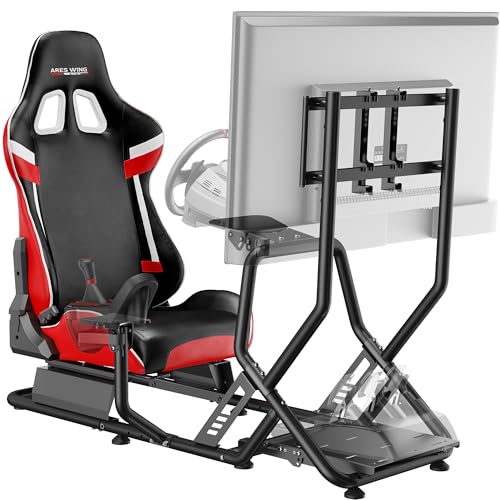
The ARES WING Racing Simulator Cockpit is the chassis that holds your entire setup together. While not a GPU, it’s included here because a solid cockpit is as important as the graphics card for sim immersion. Made from powder‑coated steel with a rigid frame, it supports direct‑drive wheels like Fanatec Pro without flexing. The 8 non‑slip support feet keep everything planted during hard braking and steering movements.
The cockpit includes a detachable monitor mount that holds screens up to 50″ and 77 lbs with VESA patterns up to 400×200. The seat slides 7.1″ front‑to‑back and reclines 90‑150°, fitting drivers of different heights. The wheel, pedals, shifter, and monitor positions are all fully adjustable. Owners report easy 1.5‑hour solo assembly and excellent comfort for long races.
One important note: while the rig is very sturdy for its price, it may not be ideal for extremely high‑torque direct‑drive wheelbases — one owner cautioned that 20+ Nm wheels could flex the pedal plate. The PU leather seat lacks lower back padding, similar to real bucket seats. For the price, however, this is one of the most adjustable and well‑built mid‑range cockpits available. The red color scheme also looks great in a gaming setup.
Why it’s great
- Rigid steel frame supports direct‑drive wheels
- Highly adjustable wheel, pedals, shifter, and seat
- Detachable monitor mount saves space in tight rooms
Good to know
- Seat lacks firm lower back padding
- Very high‑torque wheels may cause flex
FAQ
Do I need 16 GB VRAM for triple monitor sim racing?
Which is better for sim racing, NVIDIA or AMD?
Can an entry‑level GPU handle triple 1080p monitors?
Does PCIe 5.0 matter for sim racing GPUs?
Is 8 GB VRAM enough for VR sim racing?
Final Thoughts: The Verdict
For most users, the gpu for sim racing winner is the MSI Ventus 3X RTX 5070 Ti because it delivers 16 GB of GDDR7 VRAM, a 256‑bit bus, and quiet triple‑fan cooling that stays under 65°C during long race stints. If you want a cool and silent runner with excellent 1440p triple performance, grab the ASUS Prime RX 9070 XT. And for a budget 1440p build with the best VRAM‑to‑dollar ratio, nothing beats the PowerColor Reaper RX 9060 XT 16GB.