
Framing a wall, deck, or roof sheathing demands a tool that sinks nails flush every time, cycle after cycle, without jamming or leaving proud fasteners. A pneumatic framing nailer is the backbone of any serious carpentry toolkit, but choosing the wrong degree angle, magazine type, or power delivery can turn a fast-paced job into a frustrating battle with misfires and constant reloads. The right one balances weight, power, and magazine capacity so you can work a full day without fatigue slowing you down.
I’m Mohammad Maruf — the founder and writer behind Drink4Good. I’ve spent hundreds of hours analyzing industry specs, customer long-term reliability reports, and real-world use patterns across job sites to build this guide around the hardware that actually holds up under serious use.
After comparing weight distribution, drive power, jam-clearing mechanisms, and magazine loading systems across nine models, I’ve assembled the definitive breakdown of the best framing nailer for every type of builder from the weekend shed builder to the full-time framing crew.
How To Choose The Best Framing Nailer
Selecting a framing nailer goes beyond just picking a brand you recognize. The wrong nail angle can lock you out of whole categories of fasteners, and a poorly balanced gun will punish your wrist after just a few hours of overhead nailing. Focus on these four decisions before you click buy.
Degree Angle: Your Nail Compatibility Locks In Here
21-degree and 28-degree nailers use plastic-collated or wire-weld stick nails. 21-degree full round head nails offer the strongest connection for engineered lumber and shear walls, while 28-degree nails use clipped or offset heads for tighter spacing. Coil nailers (15-degree) hold up to 300 nails but use different wire-collated nails. Pick your nail type first — your framing nailer must match the fasteners your local lumberyard stocks for your trusses, joists, and hangers.
Weight and Balance: The Fatigue Equation
A gun that weighs 8.5 pounds may not sound heavy, but lift it overhead to nail rafters for two hours and that weight multiplies into real arm fatigue. Lightweight designs under 8 pounds like the Paslode F325R (5.9 lbs) reduce fatigue dramatically but sometimes sacrifice raw driving power into dense engineered lumber. Good balance — where the weight sits over the magazine — matters more than total weight for controlled nailing all day.
Magazine Type: Stick vs. Coil Loading
Stick magazines (typically 30 to 45 nails) force frequent reloads but make the gun narrower, allowing it to fit between 16-inch on-center studs for interior wall work. Coil magazines (300 nails) minimize downtime on large deck and roof jobs but add bulk at the nose that makes toe-nailing and tight corner work harder. If you frame walls in tight bays all day, a stick nailer is faster. If you do open decking or sheathing runs, a coil nailer keeps you pulling the trigger longer between reloads.
Sequential vs. Contact (Bump) Firing: Speed vs. Control
Sequential mode requires you to depress the safety tip and pull the trigger for each nail — precision mode for framing corners and joist hangers. Contact (bump) fire lets you hold the trigger and bounce the nose across the work surface to drive nails as fast as you can move. Pro crews often use bump fire for sheathing but prefer sequential for walls and blocking. A nailer with a selectable trigger switch gives you both in one tool.
Quick Comparison
On smaller screens, swipe sideways to see the full table.
| Model | Category | Best For | Key Spec | Amazon |
|---|---|---|---|---|
| Paslode F325R | Pneumatic Stick | Overhead work & tight spots | 5.9 lbs — lightest in class | Amazon |
| Makita AN924 | Pneumatic Stick | High-volume framing | 8.3 lbs, topload aluminum mag | Amazon |
| Metabo HPT NR83A5(S) | Pneumatic Stick | Pro framing & roof decking | 8.8 lbs, selective trigger | Amazon |
| MAX SuperFramer SN883RH3 | Pneumatic Stick | All-day bump fire work | 7.9 lbs, nose magnet | Amazon |
| Bostitch Coil N89C-1 | Pneumatic Coil | Open deck & large sheathing | 300-nail coil capacity | Amazon |
| Metabo HPT Coil NV90AG(S) | Pneumatic Coil | Professional coil siding | 7.7 lbs, 15° wire coil | Amazon |
| Bostitch BTF83WW | Pneumatic Stick | Engineered lumber driving | 28° wire weld stick nails | Amazon |
| Freeman PFR2190 | Pneumatic Stick | DIY shed & fence building | hardened steel drive blade | Amazon |
| Makita XNB03Z | Cordless Stick | Jobsite without air hose | 1000 nails per charge | Amazon |
In‑Depth Reviews
1. Paslode F325R Pneumatic Framing Nailer

The Paslode F325R weighs only 5.9 pounds, making it the lightest pneumatic framing nailer in this comparison. That weight advantage transforms overhead sheathing and rafter work — your arm stays fresh longer when you are not wrestling a heavy tool above shoulder height. The 30-degree paper-collated nail system uses a narrower clip that fits easily between 16-inch on-center studs, giving you room to maneuver where bulkier guns get stuck.
Despite its featherweight build, the F325R drives nails flush into bone-dry pressure-treated lumber without excessive recoil. The bypass follower lets you reload in two quick steps, and the compact air chamber uses less compressed air per cycle so your compressor runs less frequently. One common trade-off is the smaller nail capacity — it holds only one sleeve, so expect more frequent trips to reload during large framing sessions.
The minimal recoil is surprising for such a light tool, and it runs quietly enough outdoors that hearing protection is less burdensome. No case or bag is included, and the belt clip requires modification to hang securely on framing lumber. For remodelers who move walls and sheath with speed, this is the most maneuverable pneumatic framer available.
Why it’s great
- Unmatched 5.9-pound weight reduces overhead fatigue
- Minimal recoil and low noise for comfortable all-day use
- Fits into tight 16-inch stud bays easily
Good to know
- One-sleeve magazine demands frequent reload adjustments
- No storage case or bag included
- Paper-collated nails may not be stocked at all lumberyards
2. MAX SuperFramer SN883RH3

The MAX SuperFramer SN883RH3 weighs just 7.9 pounds and balances like a much lighter tool, with the center of gravity positioned over the magazine for stable one-handed nailing. The dial-adjustable depth control is tool-less and responds precisely, letting you dial in flush or counter-sink settings without reaching for an Allen wrench. It uses 21-degree plastic collated nails up to 3-1/4 inches, and the nose magnet holds the last nail in place so it does not drop out during final loading.
The bump fire action is smooth and predictable — experienced framers can move across sheathing panels at a rapid pace without skipping fasteners. The open nose design clears jams quickly with just a fingertip pull. A heavy-duty steel rafter hook folds out when you need to hang the tool on a joist, and the tangle-free swivel plug keeps the air hose out of your way as you pivot around the work surface.
Some users report that the plastic depth adjustment knob feels less durable than the all-metal construction of the rest of the tool, and the stationary top vent directs exhaust only in one fixed direction. The 3-1/4-inch max nail length means you cannot sink a full 3-1/2-inch nail into laminated beams, but for standard framing lumber this is rarely a limitation. The 5-year warranty backs the tool confidently.
Why it’s great
- Excellent balance and low 7.9-pound weight for all-day framing
- Tool-less dial depth adjustment and swivel air inlet
- Smooth bump fire with minimal recoil even in cold weather
Good to know
- Plastic depth knob less rugged than metal alternatives
- Max nail length 3-1/4 inches, not 3-1/2 inches
- Top exhaust vent is not adjustable
3. Freeman PFR2190 Pneumatic Framing Nailer

The Freeman PFR2190 delivers framing-grade performance at an entry-level investment, making it the gateway nailer for DIY barn builds, fence runs, and shed construction. It drives 21-degree plastic collated nails from 2 to 3-1/2 inches, and the one-piece hardened steel drive blade withstands repeated cycles into dense lumber without mushrooming. The anodized aluminum magazine and cylinder add durability while keeping the tool weight at a manageable 8.5 pounds.
The dual-mode trigger switches between single sequential fire for precise work like joist hangers and bump fire for speed on sheathing runs. Tool-free depth adjustment via a textured wheel lets you tweak drive depth without stopping, and the 360-degree adjustable exhaust nozzle points air away from your face regardless of your working angle. A blow-molded case is included for storage and transport.
Some users note that the trigger must be swapped physically rather than flipped with a switch, which adds a step when changing modes. The anti-dry-fire mechanism stops the gun automatically when four nails remain, which can catch you off guard mid-run. At 8.5 pounds, it is heavier than premium magnesium-bodied nailers, but the 7-year warranty and included case make it a compelling choice for intermittent use.
Why it’s great
- Hardened steel drive blade and anodized aluminum magazine for longevity
- Includes blow-molded case and 7-year warranty
- 360-degree adjustable exhaust and dual-mode trigger
Good to know
- Heavier than premium magnesium-body competitors
- Trigger must be physically swapped for mode change
- Anti-dry fire stops with several nails still in the strip
4. Makita AN924 Framing Nailer

The Makita AN924 combines a large-capacity air chamber with a fast cycle rate to drive 21-degree plastic collated nails up to 3-1/2 inches into engineered lumber without hesitation. The top-loading aluminum magazine drops nails in from the top rather than sliding them in from the rear, which speeds up reloading on the job site. Weighing 8.3 pounds, it is middleweight among pneumatic stick nailers, but the balance is excellent thanks to the offset air chuck that keeps the hose away from the work surface.
Users report driving thousands of nails without a single jam, and the keyless depth adjustment allows quick flush-to-countersink changes without tools. A reversible belt clip gives left and right-handed users mounting flexibility, and the included hex wrench, safety glasses, and pneumatic oil mean you are ready to work out of the box. The 3-year limited warranty is shorter than some competitors but reflects Makita’s confidence in the internal sealing design.
One minor frustration is that the safety mechanism stops the driver when roughly five nails remain on the strip, wasting the last portion of the nail load. The packaging is a basic cardboard box rather than a blow-molded case, so dedicated storage requires a separate bag. For production framing crews who value reliable driving power and fast reloading, the AN924 earns its reputation.
Why it’s great
- Large air chamber drives 3-1/2-inch nails into dense lumber with ease
- Top-loading aluminum magazine speeds up reloading
- Offset air chuck keeps the hose out of the way
Good to know
- No blow-molded case included — ships in cardboard box
- Dry-fire safety stops with nails still in the strip
- 3-year warranty shorter than some competitors
5. Makita XNB03Z Cordless Framing Nailer
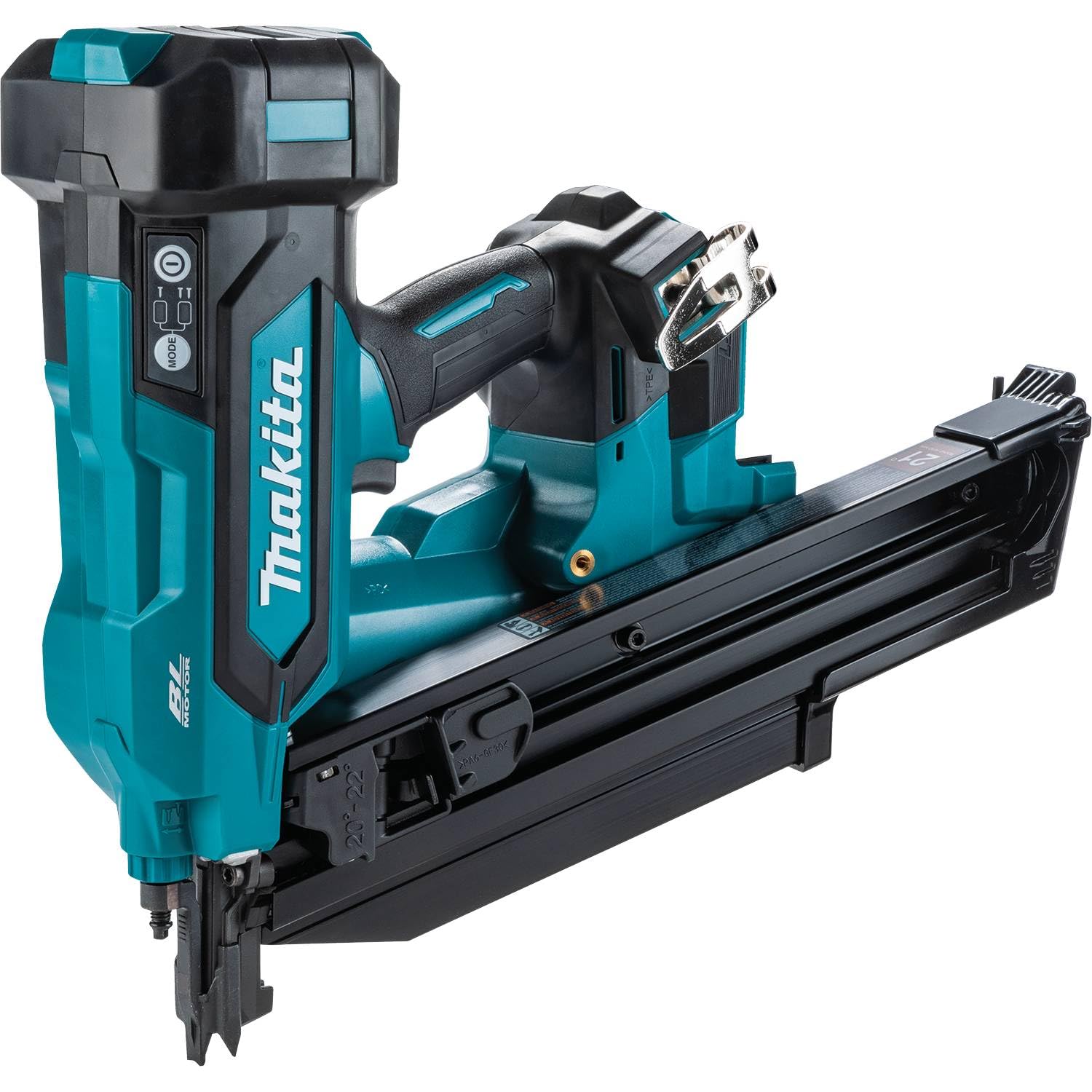
The Makita XNB03Z is a cordless 18-volt framing nailer that drives up to 1,000 full-round head nails on a single 5.0Ah battery charge, freeing you from compressor hoses on remote job sites. It fires into dense engineered lumber with authority — testers have driven 3-1/4-inch ring shanks into treated southern yellow pine without skipping a fastening. The two-mode selector switch lets you toggle between sequential nailing for precision work and bump fire for rapid sheathing attachment.
The anti-slip nose provides controlled nailing when driving at an angle, a feature that matters when toe-nailing studs or working into tight corners. The tool-less depth adjustment delivers flush to countersink results across varying material densities, and the built-in LED light illuminates dark framing cavities. The rear lock-and-load magazine holds 41 nails, balancing capacity with a slim profile that fits between studs.
At 11.9 pounds with an 18V battery installed, this is the heaviest nailer in the guide, and the weight is noticeable during extended overhead work. The battery and charger are not included, which adds to the total upfront cost if you are not already on the Makita LXT platform. Still, the freedom of zero hoses and consistent driving power make it the top cordless choice for framers who move across multiple levels without dragging an air line.
Why it’s great
- Up to 1,000 nails per charge with a 5.0Ah battery
- Drives into dense engineered lumber without hesitation
- Tool-less depth adjustment and anti-slip nose for angled nailing
Good to know
- Heaviest option at 11.9 lbs with battery installed
- Battery and charger sold separately
- Single-sleeve magazine requires frequent reloads
6. Bostitch Coil N89C-1 Framing Nailer
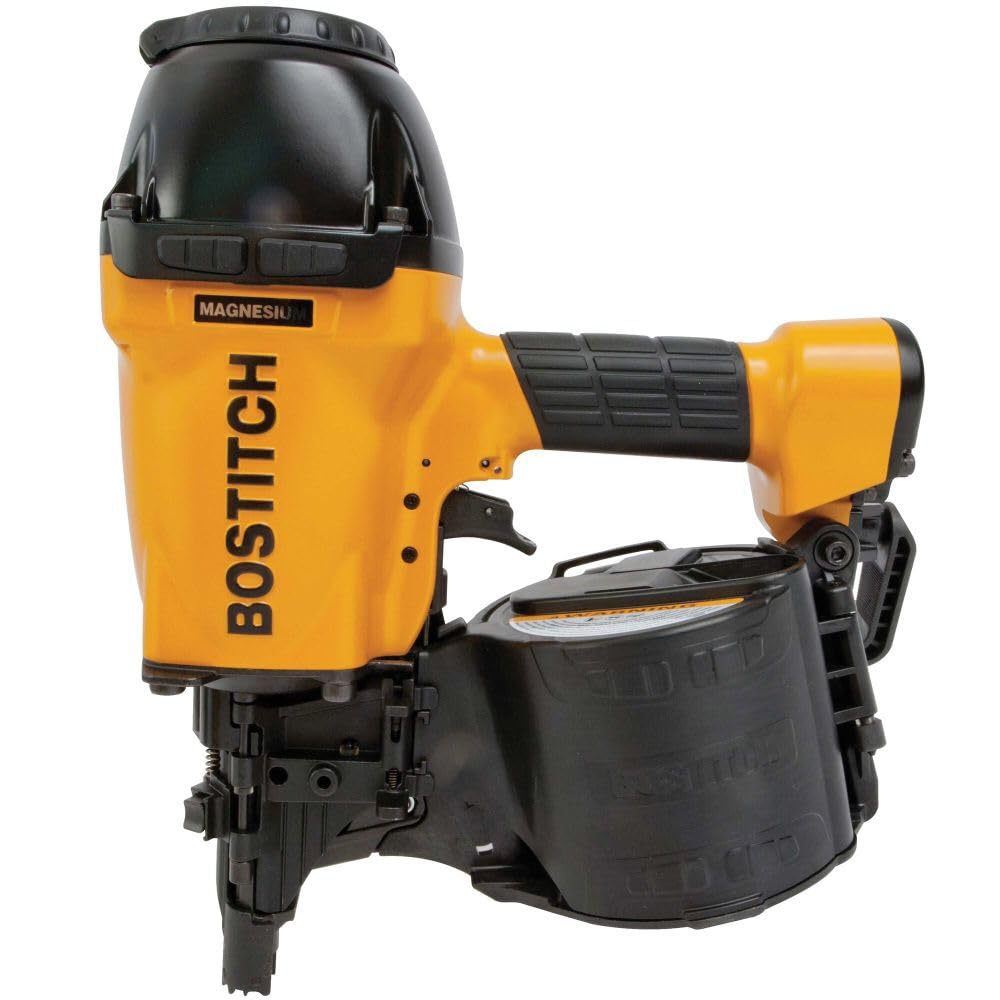
The Bostitch 89C-1 coil framing nailer holds an impressive 300 nails in a single coil, dramatically cutting down reloading interruptions on large deck, floor, and roof sheathing projects. It runs on 90 PSI and drives nails with the kind of raw power that sinks fasteners into even the toughest LVL beams. The adjustable rafter hook can be positioned on either side, and the quick depth adjuster lets you dial in flush driving without stopping your work flow.
The tool ships with both a smart trigger (for sequential fire) and a standard trigger you can swap in, giving you control over safety mode preferences. Users consistently report that the gun drives nails flawlessly roll after roll once properly oiled. The 7-year warranty provides strong backup for the investment, and the tool’s reputation for reliability on professional framing crews is well documented.
The massive nailing tip and side flanges make toe-nailing and driving into tight corners more difficult compared to stick nailers. The coil wire nails are prone to damage during shipping if the box is crushed, and the bulk at the nose can make maneuvering in confined spaces frustrating. For open-area decking and sheathing runs where speed and capacity matter most, this coil framer is a workhorse.
Why it’s great
- 300-nail coil capacity minimizes reloading downtime
- Powerful driving at 90 PSI into engineered lumber
- 7-year warranty and adjustable rafter hook included
Good to know
- Bulk at the nose limits toe-nailing ability
- Coil nails are easily damaged during shipping
- Large and heavy — not ideal for tight stud bays
7. Bostitch BTF83WW Framing Nailer

The Bostitch BTF83WW uses 28-degree wire weld stick nails in a low-profile, ergonomic body that offers exceptional balance for a 9.88-pound nailer. The industrial-grade design powers through engineered lumber and OSB sheathing without leaving proud fasteners — in one documented job, this gun outperformed two cordless models by consistently sinking every nail while the batteries left dozens sticking up. The tool-free depth adjustment, selectable trigger, and adjustable rafter hook give you three productivity features without requiring wrenches or disassembly.
The low profile and enhanced ergonomics make this a comfortable tool for high-volume framing and sheathing applications where you need to keep moving. Users report only one jam over several months of daily professional use, and that jam was attributed to a store-brand nail strip. The wire weld nail collation is less common than plastic collation, but it provides stiff strips that feed reliably in the magazine.
The firing mode selector can be stiff to operate when wearing gloves in cold weather, and the tool does not include a storage case. Replacing the trigger mechanism requires some familiarity with the tool layout. For framers who prefer the 28-degree wire weld nail gauge for its rigidity and flush-driving consistency, this Bostitch delivers reliable power.
Why it’s great
- Outperforms many cordless guns on flush driving consistency
- Tool-free depth adjustment and selectable trigger modes
- Balanced, low-profile design reduces fatigue
Good to know
- Mode selector stiff in cold weather with gloves
- No storage case included
- 28-degree wire weld nails less widely available
8. Metabo HPT NR83A5(S) Framing Nailer

The Metabo HPT NR83A5(S) was voted the Pro Preferred Nailer for seven consecutive years by Builder and Developer Magazine, a testament to its reliability on production framing crews. It uses a Rapid Response cylinder valve that increases cycle speed, allowing faster nailing without sacrificing driving depth into engineered lumber. The rear-loading 21-degree magazine reloads quickly, and the two-piece magazine design means you can replace a damaged section without buying a whole new assembly.
The selectable trigger switches between contact and single sequential actuation with a simple flip switch — no trigger swaps or tear-down required. The hardened claw tip resists wear when toe-nailing at angles, and the open nose design pops open instantly to clear a jam. The rubber grip provides secure handling even when your palms are sweaty on a hot roofing day, and the rafter hook mounts on either side for left or right-handed use.
One notable omission is the lack of a tool-free depth adjustment wheel — depth changes require a hex wrench or manual adjustment that is less convenient than the dial systems on some competitors. The 8.8-pound weight is neither the lightest nor heaviest but is well balanced. The 5-year professional tool warranty covers the investment for daily use.
Why it’s great
- Seven-time Pro Preferred award winner for reliability
- Selectable trigger with flip switch — no trigger swap needed
- Hardened claw tip for durable toe-nailing
Good to know
- No tool-less depth adjustment — requires hex wrench
- 8.8 pounds is mid-weight, not the lightest available
- No storage case included
9. Metabo HPT Coil NV90AG(S) Framing Nailer

The Metabo HPT NV90AG(S) is a 15-degree wire coil framing nailer that earned the Pro Preferred title for 12 consecutive years. At just 7.7 pounds, it is remarkably light for a coil nailer, making extended overhead nailing far less punishing than heavier coil guns. It accepts wire collated nails from 1-3/4 to 3-1/2 inches, and the tool-less depth adjustment dial provides instant flush or countersink control across varying sheathing thicknesses.
The selective actuation switch allows you to run in contact mode for speed or sequential mode for precision without changing parts. The steel head plate and plastic body keep weight down while maintaining structural rigidity. The open nose design clears jams in seconds without tools, and the 5-year professional warranty reflects Metabo HPT’s durability expectations.
This nailer is noticeably heavier than a stick nailer during tight overhead work despite the low 7.7-pound claim (the coil magazine and wider body add bulk). The case is sold separately, and the 15-degree wire collated nails are less common at general hardware stores compared to plastic collated 21-degree nails. For pros who prefer the reduced reload frequency of coil nails and want the lightest coil body available, this is the premier choice.
Why it’s great
- Lightest coil nailer at 7.7 pounds for reduced fatigue
- 12-year Pro Preferred award winner for professional reliability
- Tool-less depth adjustment and selective actuation trigger
Good to know
- Storage case sold separately
- 15-degree wire coil nails less available at retail
- Coil magazine bulk limits tight-space maneuverability
FAQ
Can I use 21-degree nails in a 28-degree framing nailer?
Does a framing nailer need an oiled air supply?
Why do some nailers stop with nails still in the magazine?
Can a framing nailer drive nails into steel studs?
What PSI should I set my compressor to for a framing nailer?
Final Thoughts: The Verdict
For most users, the best framing nailer winner is the Paslode F325R because its unmatched 5.9-pound weight and minimal recoil make every framing task less fatiguing while still delivering flush-driving power into standard lumber. If you want a lightweight coil nailer for open deck runs with minimal reloads, grab the Metabo HPT NV90AG(S). And for cordless freedom without compromising on nail-driving consistency into dense wood, nothing beats the Makita XNB03Z.