
That spreading ring of brown or yellow in your turf isn’t a watering issue—it’s a fungal invasion that requires a targeted chemical response. Choosing the wrong treatment can waste weeks of effort, while the proper active ingredient stops the disease cycle at the root.
I’m Mohammad Maruf — the founder and writer behind Drink4Good. I’ve spent countless hours poring over EPA labels, active ingredient concentration data, and real-world user reports to bring you a focused comparison of the top-performing products in this narrow category.
After reviewing seven leading formulas, this guide cuts through the marketing to help you select the ideal grass fungicide for your specific lawn disease, grass type, and application preference.
How To Choose The Best Grass Fungicide
Selecting the right fungicide requires matching the active ingredient to the specific disease, your grass type, and the season. A product that stops dollar spot in Bermuda may be ineffective against large patch in Zoysia.
Identify Your Lawn Disease First
Fungicides are often disease-specific. Brown patch appears as large, circular tan patches in cool-season grasses during summer heat. Dollar spot creates small, silver-dollar-sized lesions. Powdery mildew looks like a white dusting on blades. Knowing the visual signature ensures you choose a product labeled for your exact issue, not a general “cure-all.”
Quick Comparison
On smaller screens, swipe sideways to see the full table.
| Model | Category | Best For | Key Spec | Amazon |
|---|---|---|---|---|
| Quali-Pro Propiconazole 14.3 | Concentrate | Broad-spectrum curative control | Propiconazole 14.3% | Amazon |
| Atticus Gunner 14.3 MEC | Concentrate | Large lawns, 28-day prevention | 14.3% Propiconazole MEC | Amazon |
| Dow AgroSciences Eagle 20EW | Concentrate | Stubborn diseases (Rose Blackspot) | Myclobutanil 19.7% | Amazon |
| The Andersons Prophesy 25lb | Granular | Large area preventative/curative | 0.42% Propiconazole | Amazon |
| Select Source Propiconazole 14.3 | Concentrate | Budget rotation with Azoxystrobin | Propiconazole 14.3% | Amazon |
| Ferti-lome Liquid Systemic II | RTU Spray | Small lawns, no-mix convenience | Propiconazole 1.55% | Amazon |
| Ferti-lome Triple Action | RTU Spray | Insect + fungus control on ornamentals | Neem Oil 70% | Amazon |
In‑Depth Reviews
1. Quali-Pro Propiconazole 14.3 Fungicide (32oz)

Quali-Pro delivers a professional-grade propiconazole concentrate that turfs managers rely on for its broad-spectrum label covering brown patch, dollar spot, summer patch, and snow molds. The 14.3% active concentration means a little goes a long way—users report treating a 1/3-acre Bermuda lawn with visible recovery in just one week after application. The microemulsion formulation mixes cleanly and stays stable in the tank, reducing nozzle clogging compared to emulsifiable concentrates.
User reports confirm it stopped fungal spread immediately on Bermuda grass and eliminated orange rust on blackberries. The systemic action moves through the plant tissue, protecting new growth from reinfection. One reviewer alternated it with a granular product every two weeks for 8 weeks to fix St. Augustine sod. The 32oz bottle provides excellent value for those maintaining larger lawns or managing multiple disease cycles.
Some users note that St. Augustine grass may require a different active ingredient for optimal results. The product label is dense, so careful measurement is essential. Expect the bottle to last 4-5 seasons for moderate annual applications, making it a long-term investment in turf health.
Why it’s great
- Powerful 14.3% propiconazole concentrate stops brown patch fast
- Microemulsion formulation mixes easily and resists separation
- Excellent value per application; one bottle lasts multiple seasons
Good to know
- Requires precise measuring and a sprayer; not for casual users
- May not be as effective on St. Augustine grass as some competing actives
- Label instructions are small and dense; careful reading required
2. Atticus Gunner 14.3 MEC Propiconazole (32oz)
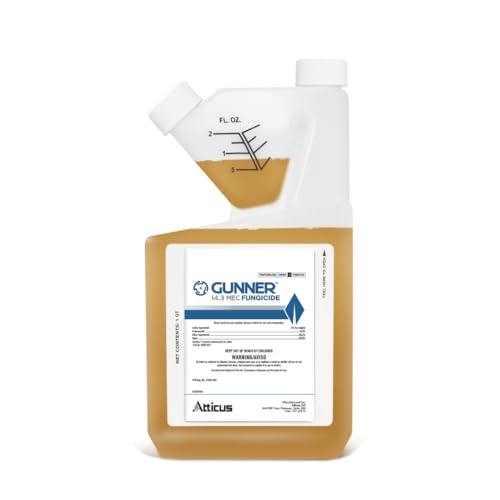
Atticus Gunner uses a microemulsion concentrate (MEC) formulation where extremely small particles create a stable suspension that won’t separate in the sprayer. This means you don’t need to re-mix mid-application, saving time on large lawns. It is resistant to rainfastness once dry, so unpredictable weather won’t wash away the treatment. The product delivers fast-acting, systemic protection that lasts up to 28 days against common turf diseases like brown patch, dollar spot, and powdery mildew.
Users report excellent results on powdery mildew and find the 32oz size sufficient for lawns up to 12,000 square feet when used at preventative rates. The low-odor formula is a welcome feature for residential applications. A dedicated reviewer who purchased a second bottle confirms the product’s reliability. One user noted the instruction text is small, so online label access is recommended for accurate dosing.
While the MEC technology provides superior stability, it requires a compatible sprayer for best results. Some regional restrictions apply (not sold in Alaska, Hawaii, or Vermont). Overall, it’s a refined option for homeowners who want professional-grade mixing ease and predictable disease suppression.
Why it’s great
- MEC formulation stays mixed in the tank—no constant re-agitation
- Rainfast once dry, offering reliable control in wet weather
- Long 28-day residual protection for busy schedules
Good to know
- Label print is small; downloading a digital copy is recommended
- Some state shipping restrictions apply
- Premium concentrate pricing reflects the advanced formulation
3. Dow AgroSciences Eagle 20EW Fungicide (16oz)

Eagle 20EW uses myclobutanil, a demethylation inhibitor (DMI) fungicide that works differently from propiconazole. It is effective against stubborn diseases like black spot on roses, shot-hole disease, and powdery mildew where copper fungicides failed. The systemic action protects new growth from the inside out. Users in zone 7 consider it their go-to for powdery mildew, and one Connecticut user eliminated clover on Zoysia grass with just two applications 30 days apart.
The concentrated formula (19.7% myclobutanil) requires careful mixing and full PPE. One user saved a mature red oak tree using a root-drench application (note: this off-label use highlights the product’s potency). Its efficacy on fruit trees and grapes makes it versatile for orchard owners who also manage turf. The 16oz bottle covers a substantial area despite its compact size.
Because it is a strong agricultural-grade fungicide, it demands respect during handling. Mixing errors can harm desirable plants. Its primary strength is its ability to tackle diseases that resist other actives, making it a valuable rotation partner for preventing resistance in your lawn’s fungal population.
Why it’s great
- Myclobutanil provides a different mode of action for resistance management
- Excellent for tough diseases like black spot and shot-hole that shrug off copper
- Systemic protection moves into new growth
Good to know
- Agricultural grade; requires strict PPE and precise mixing
- Smaller 16oz bottle size compared to propiconazole competitors
- Off-label uses (e.g., root drench) show efficacy but stray from label
4. The Andersons Prophesy Propiconazole 25lb
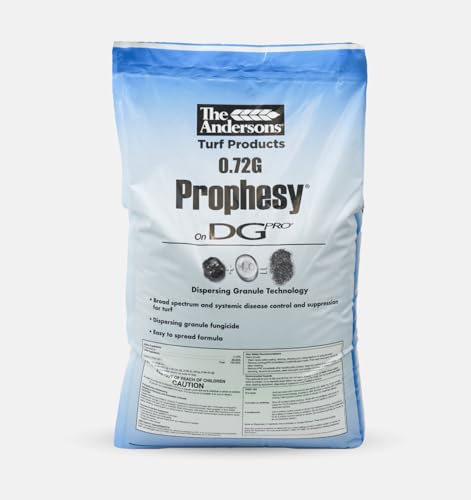
The Andersons delivers its propiconazole in a patented DG Pro granule technology, which provides more particles per square foot for even distribution. This granular format is ideal for homeowners who prefer a spreader over a sprayer. It is labeled for both preventative and curative applications against brown patch, dollar spot, snow mold, and more. One user successfully cured necrotic ring spot that had resisted all other treatments by combining the granules with lawn topsoil.
Users with Kentucky bluegrass and tall fescue report greener, healthier lawns after application. A professional reviewer noted it knocked out red thread that had developed tolerance to a competing brand (Scotts Disease Ex). At 25lbs covering up to 10,000 sq ft, it offers one-stop coverage for medium to large lawns without the hassle of mixing liquids. Some users find the granular action slower than liquids, but the convenience factor is high for those with spreaders.
The price point has risen due to inflation, leading some long-time users to question the value compared to liquid concentrates. However, for those without spray equipment or who want a simple “spread and water-in” approach, this remains a high-quality option. Proper spreader calibration is essential to avoid waste or under-application.
Why it’s great
- Granular application bypasses the need for sprayers and mixing
- Patented DG Pro technology for consistent particle coverage
- Proven effective against resistant diseases like necrotic ring spot
Good to know
- Higher upfront cost compared to liquid concentrates
- Slower action than spray-applied systemic fungicides
- Requires careful spreader calibration for even coverage
5. Select Source Propiconazole 14.3 (16oz)

Select Source offers the same 14.3% propiconazole found in premium brands, but at a more accessible price point. The low-odor formulation is pleasant to work with and has high tank-mix compatibility. Users frequently pair it with azoxystrobin in a two-week rotation to manage resistance on Bermuda and centipede lawns. One long-time user combined it with neem oil and alternative fungicides over two seasons to virtually eliminate chronic fungal outbreaks.
The 16oz bottle is a good starting size for smaller yards or targeted spot treatments. A customer with a centipede lawn used it to successfully control circular brown patches. The product is EPA-registered and comes ready to mix with water. Its low use rates mean even the small bottle treats a respectable area, but heavy users will likely want the larger 32oz option.
Some beginners may be confused by the multi-step mixing process. The instructions are clear but assume familiarity with hose-end sprayer calibration. Overall, it’s a smart buy for budget-conscious homeowners who want the efficacy of a professional active ingredient without the premium price tag.
Why it’s great
- Same 14.3% propiconazole as name brands at a lower cost
- Low-odor and easy to mix with other fungicides
- Effective on centipede, Bermuda, and fescue lawns
Good to know
- 16oz size may require frequent repurchasing for larger lawns
- Mixing instructions assume basic sprayer knowledge
- Some users pair it with azoxystrobin for optimal coverage
6. Fertilome Liquid Systemic Fungicide II RTS (32oz)
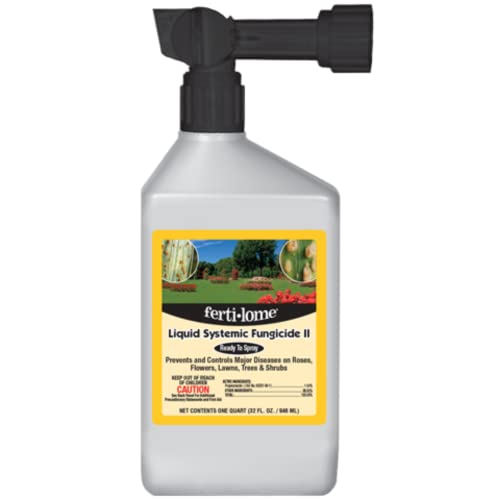
Fertilome’s ready-to-use (RTS) spray is the ultimate entry point for small lawns and targeted plant treatments. There is no mixing, measuring, or sprayer calibration required. Simply attach the bottle to your garden hose and spray to runoff. It is labeled for roses, flowers, lawns, and trees, controlling take-all patch, brown patch, dollar spot, and leaf spot. One user eliminated fire blight on a Crimson Maple tree with three biweekly hose-end sprays.
Mature live oak trees stopped yellowing leaves after a single treatment. The 32oz concentrate dilutes through the hose to cover a reasonable area, though not as large as a backpack sprayer with a concentrate. It is ideal for homeowners who want a quick fix without investing in application equipment. The active ingredient is propiconazole at a lower concentration (1.55%), making it gentler but requiring more frequent reapplication.
The cost per square foot is higher than concentrates, making it less economical for large lawns. One user noted it worked as a dandelion spot treatment, which suggests some off-target herbicidal activity. Overall, it excels in convenience for small-scale or targeted fungus problems.
Why it’s great
- Zero setup: just attach the bottle and spray
- Effective on a wide range of plants including trees and flowers
- Users report success on fire blight and take-all patch
Good to know
- Lower active concentration means more frequent reapplication
- Higher per-application cost than mixing concentrates
- Not cost-effective for treating entire large lawns
7. Fertilome Triple Action (32oz)
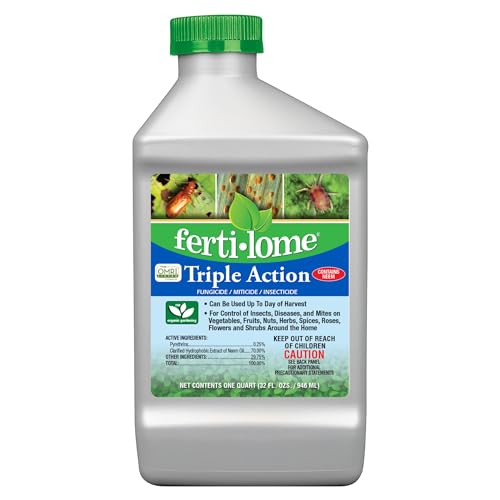
Fertilome Triple Action combines neem oil (70%) with insecticidal and fungicidal properties, making it a three-in-one solution for gardens and small lawns. It prevents and controls powdery mildew, rust, and leaf spot while also managing aphids, spider mites, and leafminers. The neem oil base is considered organic and is safe for use on edibles like fruits, herbs, vegetables, and nuts. Long-time users rely on it for apple trees, spraying on a 7-14 day schedule.
It works best as a preventative or early curative treatment; heavy fungal infections may require a stronger systemic product. One user noted it warns against harming pollinators, so application timing matters (avoid bloom). The 32oz RTU bottle offers convenience for garden spraying. However, some users find it expensive for the coverage area compared to concentrated alternatives.
Neem oil requires thorough coverage of all plant surfaces, including underside of leaves, for best results. This product is not designed for large turf areas—its primary strength is in mixed-use gardens where insect and fungal pressures coexist. For a dedicated grass fungicide, it is a secondary option for spot treatments or integrated pest management.
Why it’s great
- Triple action: fungicide, insecticide, and miticide in one spray
- Neem oil base is organic and safe for edible crops
- Proven on apple trees and garden ornamentals
Good to know
- Higher cost per use compared to concentrates
- Requires careful timing to protect pollinators
- Less effective for advanced turf diseases on large lawns
FAQ
What is the difference between preventative and curative fungicide applications on grass?
Can I use a propiconazole fungicide on all grass types?
Final Thoughts: The Verdict
For most users, the grass fungicide winner is the Quali-Pro Propiconazole 14.3 (32oz) because its concentrated systemic action covers the widest range of common turf diseases at the best per-application value. If you want the convenience of no-mix granular application, grab the The Andersons Prophesy 25lb for effortless spreader coverage. And for stubborn diseases like rose black spot that resist standard treatments, nothing beats the targeted myclobutanil power of the Dow AgroSciences Eagle 20EW.