
Walk through any farm equipment lot and you’ll see it: the telltale sign of grease that couldn’t hold up — dried-out lumps around zerk fittings, water-washed residue on pivot pins, and the grinding sound of metal-on-metal that means a rebuild is coming. Farm equipment doesn’t work in a lab; it works in dust, mud, freezing cold, and blistering summer heat, and the grease you pump into those bearings and joints has to do far more than just lubricate. It must cling to vertical surfaces, resist water washout when you pressure-wash the tractor, handle shock loads from a disc harrow hitting rocks, and stay put even when the temperature swings forty degrees in an afternoon. The wrong grease will drip out of a loader pin in a week, or worse, harden into a carbonized crust that chews through seals. What you need is a grease formulated specifically for the heavy loads, moisture exposure, and wide temperature ranges that define agricultural equipment. That means looking at NLGI grade, lithium complex or moly-rich bases, extreme pressure (EP) additive packages, and a dropping point well above the ambient heat your equipment generates. After cross-referencing hundreds of real-world user reports, ASTM specs, and equipment manufacturer recommendations, I’ve settled on the five contenders that actually survive a season in the field.
I’m Mohammad Maruf — the founder and writer behind Drink4Good. I’ve spent countless hours analyzing grease formulations, comparing dropping points and EP additive loads, and sifting through field reports from mechanics who maintain fleets of combines, tractors, and loaders to find which lubricants genuinely prevent wear instead of just masking it.
This guide draws on those findings to deliver a clear, practical breakdown of the best options available right now, helping you match the right lubricant to your specific equipment and operating conditions. Whether you are topping off a zero-turn mower, repacking a combine’s wheel bearings, or greasing the bucket pins on a compact loader, the right grease for farm equipment will extend component life and reduce your downtime across a full working season.
How To Choose The Best Grease For Farm Equipment
Farm equipment exposes grease to a combination of contaminants and mechanical stresses that few other applications can match. You aren’t just lubricating a bearing in a climate-controlled factory — you are trying to keep a thin film of oil between two metal surfaces while mud, dust, livestock waste, and pressure-washer spray all try to wash it away. The wrong choice leads to accelerated wear, seized pins, and bearings that fail in the middle of harvest. Here are the four critical factors to evaluate before buying.
NLGI Grade: The Thickness That Determines Adhesion and Feedability
The National Lubricating Grease Institute grading scale runs from 000 (semi-fluid) to 6 (nearly solid brick). For virtually all farm equipment, NLGI 2 is the benchmark — it offers the right balance of adhesion to vertical surfaces (pins, bushings, universal joints) and pumpability through a standard grease gun in cold weather. NLGI 1 is sometimes used for central lubrication systems or very cold climates where a softer grease is needed, but it tends to wash out faster. NLGI 3 offers better water resistance but can be too stiff for some grease guns and won’t flow into tight clearances as easily. Stick with NLGI 2 unless your machinery manual explicitly specifies otherwise.
Thickener Type: Lithium Complex vs. Moly vs. Graphite Blends
The thickener is the sponge that holds the oil in the grease. Lithium complex is the most common and versatile — it delivers a dropping point around 350-380°F (177-193°C), resists water washout well, and handles moderate shock loads. Moly (molybdenum disulfide) additives step up the extreme pressure protection significantly; they plate the metal surfaces with a sacrificial layer that prevents galling even when the grease film breaks down under severe load. A moly-graphite blend takes this further by adding graphite’s lubricating properties, which excel under heavy sliding loads like you find in fifth-wheel hitches or track undercarriages. For general farm use with a premium pick, a lithium complex grease fortified with moly gives the best combination of wide-temperature range and high-load protection.
Dropping Point: The Thermal Ceiling
The dropping point is the temperature at which the thickener structure fails and the grease turns into a liquid and flows away. For wheel bearings on a tractor traveling down the road at transport speed, or for the spindles on a rotary cutter running deep summer hay, the grease needs a dropping point well above 300°F (149°C). A grease with a dropping point of 350°F or higher gives you a safety margin — even when the bearing runs hotter than ideal, the grease stays in place and continues to lubricate. Greases with dropping points under 300°F are best reserved for low-heat applications like pivot pins and drawbar hitches where temperatures stay moderate.
Water Washout Resistance: Surviving Pressure Washers and Rain
Farm equipment inevitably gets pressure-washed to remove caked-on mud and manure. Low-quality greases can wash out of bearings and joints in minutes under direct spray, leaving the component dry and vulnerable. Look for greases that explicitly list water washout test results or are formulated with water-resistant thickeners like lithium complex or calcium sulfonate. If you operate in wet conditions — irrigated fields, dairy operations, or frequent rain — prioritizing water resistance is just as important as load protection.
Quick Comparison
On smaller screens, swipe sideways to see the full table.
| Model | Category | Best For | Key Spec | Amazon |
|---|---|---|---|---|
| Sta-Lube CRC SL3330 | Moly-Graphite | High-shock-load pins and U-joints | Drop point 380°F | Amazon |
| John Deere TY6341 | OEM Multi-Purpose | General maintenance on JD equipment | Max temp 193°C (379°F) | Amazon |
| John Deere TY24416 | Lithium Complex | Wheel bearings and suspension joints | Range -15 to 350°F | Amazon |
| Kubota 70000-01041 | Moly-Lithium | Kubota tractors and implements | Max temp 350°F | Amazon |
| GREASECO HVDY-200-00016 | Lithium Multi-Purpose | Entry-level general chassis lube | ISO 460 base oil | Amazon |
In‑Depth Reviews
1. Sta-Lube CRC SL3330 Moly-Graphite Extreme Pressure Multi-Purpose Lithium Grease

The Sta-Lube SL3330 is exactly what its name suggests — a lithium 12-hydroxy base grease fortified with molybdenum disulfide and graphite, two solid-film lubricants that establish a fine micron plating on metal surfaces. This dual-additive approach gives it an edge over standard moly-only greases because the graphite handles sliding friction (think fifth-wheel hitches, track rollers, and mower deck spindles) while the moly absorbs the brunt of shock loads on U-joints and bucket pins. The dropping point of 380°F is excellent, and the mechanical shear stability ensures the grease won’t thin out and run off after a few hours of heavy use.
Real-world reports from operators running Kubota, Case IH, and Deere equipment confirm that this grease holds up under pressure-washer spray and resists separating even when stored through temperature swings in an unheated barn. It stays tacky on vertical elevator bearings and does not cake up into hard deposits inside the cartridge — a common frustration with cheaper options. The thick NLGI 2 consistency feeds well through most standard grease guns without requiring the user to warm the cartridge on a heater.
One practical limitation: the moly content can leave a dark stain on porous concrete or painted surfaces, so wiping down zerks after greasing is wise if you care about cleanup. The lack of California VOC compliance means it may not be available for retail sale in that state, but for most buyers across the agricultural belt, this is the best balance of load capacity, water resistance, and thermal range you will find in a standard 14-ounce cartridge. For the operator who needs one grease that works across a fleet of mixed equipment, this is the pick.
Why it’s great
- Moly-graphite dual-additive system provides superior protection under both shock and sliding loads
- High 380°F dropping point gives ample thermal safety margin for wheel bearings and brake components
- Excellent shear stability and water washout resistance for pressure-washer environments
Good to know
- Not VOC-compliant for sale in California
- Dark residue may stain concrete or painted surfaces around fittings
- Some users report the moly can be slightly more difficult to fully purge from grease guns between changes
2. John Deere Original Equipment Grease TY6341
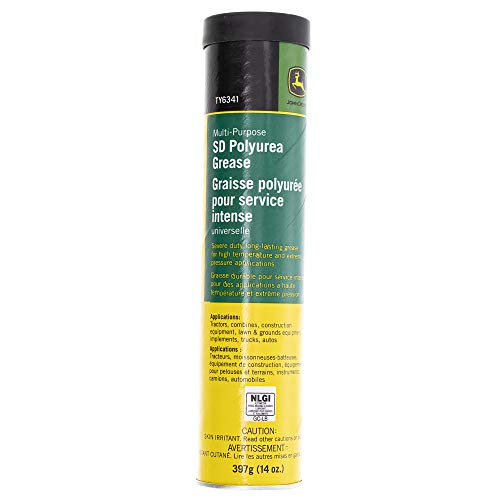
The John Deere TY6341 is the original equipment lubricant that Deere engineers designed to last across the full temperature range their machines experience — from a frigid Minnesota January to a Kansas August harvest running at full load. Real-world tests from operators operating 1025R subcompact tractors up through larger 6-series machines confirm the grease does not bleed or harden in extreme 100°F to -20°F conditions. That thermal stability is the direct result of a carefully balanced lithium complex thickener and additive package that prioritizes staying power over maximum load capacity.
Where this grease distinguishes itself from aftermarket options is in its predictable behavior across a standardized maintenance schedule. It does not thin out and drip from loader arm pivot pins during heavy work, yet it remains soft enough to flow through extended grease gun lines without needing the operator to switch to a lighter NLGI grade. Several fleet owners note they have standardized using TY6341 across all their power equipment — tractors, mowers, loaders, and U-joints — because it eliminates the guesswork of matching different greases to different applications.
The notable limitation is that this is not a high-moly grease, so for applications involving extreme shock loading — bucket pins on a large excavator, heavily loaded U-joints on a PTO shaft — the Sta-Lube with moly-graphite additive offers a higher safety margin. Deere explicitly does not recommend TY6341 for mower blade spindles, where a dedicated high-temperature spindle grease is preferable. For the fleet operator looking for a single grease that covers 90% of the applications with OEM confidence, the TY6341 is an excellent choice.
Why it’s great
- Excellent thermal stability from -20°F to 379°F without bleeding or hardening
- OEM formulation eliminates guesswork for John Deere equipment owners
- Feeds well through standard grease guns even in cold weather
Good to know
- Not explicitly formulated with moly additives for extreme shock-load protection
- Not recommended for mower blade spindles — use a high-temperature spindle grease instead
- Premium tier cost per ounce compared to general-purpose lithium greases
3. John Deere Multi-Purpose HD Lithium Complex Grease TY24416

The TY24416 is John Deere’s standard multi-purpose HD lithium complex grease sold in a squeeze tube — a format that is useful for smaller jobs where you do not want to load a grease gun. The formulation is the same heavy-duty grease Deere recommends for wheel bearings, universal joints, suspension systems, ball joints, and anti-friction plain bearings across their equipment line. The operating temperature range of -15°F to 350°F (-26°C to 177°C) covers the practical needs of most seasonal farm work, and the lithium complex thickener provides good mechanical stability under the moderate loads typical of tractor chassis and implement pivot points.
Operators running zero-turn mowers, compact tractors, and hay equipment report that this grease matches the requirements specified in their owner’s manuals and that a single tube covers multiple greasing sessions on smaller equipment. The 15W-40 viscosity grade of the base oil is a common sight across diesel engine oils, which suggests the base oil is formulated for the thermal and oxidative demands of modern engines and heavy equipment. The consistency is noticeably dense — it stays in position on vertical zerks and does not soften and run out even when the equipment is parked in direct summer sun.
The primary trade-off is format: the squeeze tube is convenient for spot applications but impractical if you are working through a fleet of equipment that all uses standard grease gun cartridges. For the operator with one or two tractors and a handful of implements, the tube is fine, but if you are greasing multiple machines weekly, you will want to move up to the TY6341 cartridge format or another cartridge-compatible option. This is a solid entry-level pick for the owner-operator who wants OEM-spec performance without paying for additives they may never need.
Why it’s great
- Lithium complex formulation offers reliable performance across -15°F to 350°F range
- Convenient squeeze tube format for quick greasing without loading a gun
- Matches OEM dealer-specified grease for John Deere wheel bearings and chassis
Good to know
- Squeeze tube format is less cost-effective per ounce compared to cartridge or tub
- Not intended for extreme shock-load or high-speed bearing applications
- Some users report the tube can split if squeezed too aggressively in cold weather
4. Kubota High Performance Moly Lithium All Purpose Heavy Duty Grease 70000-01041

The Kubota 70000-01041 is the manufacturer’s own grease, engineered specifically for the demands of their compact and utility tractors, loaders, and backhoes. Where many general-purpose greases use a straight lithium complex thickener, Kubota adds molybdenum disulfide — an EP additive that plates the metal surfaces of pins, bushings, and bearings and prevents galling under the repeated shock loads typical of loader work and ground-engaging implements. The 350°F upper temperature rating covers the thermal load from wheel bearings during transport and from the bushings on a rotary cutter spindle that runs for hours in tall stubble.
Field feedback from operators using Kubota B-series and L-series tractors is consistent: the grease stays dense and does not leak from the tractor’s zerks or separate in the grease gun between uses. A common observation is that the grease feels noticeably “stickier” than generic multi-purpose greases — it clings to the pins and bushings even when the equipment is parked on a hot concrete floor and does not drip onto the floor overnight. The 14.5-ounce can format is a tub rather than a cartridge, so you will need to pack it into a grease gun manually or use it for hand-packing bearings and open joints.
The can format is the main practical drawback. If you prefer the convenience of swapping cartridges, the can requires a grease gun loader or careful packing, which is messier and introduces the risk of contamination. Additionally, the grease is explicitly labeled for construction and agricultural equipment, and some users have reported it is overkill for lighter applications like lawn tractor spindles where a cheaper lithium grease would suffice. For a Kubota owner who wants factory-spec protection and is willing to deal with the tub format, this is the correct grease for the machine.
Why it’s great
- Factory-spec formulation with moly additives for Kubota tractors and implements
- Tacky consistency prevents drip leakage from zerks and vertical pins
- Excellent staying power between maintenance intervals under heavy loader work
Good to know
- Tub format requires manual packing into grease guns — no cartridge convenience
- May be over-specified for light-duty equipment like push mowers or small implements
- Limited application range compared to a universal multi-purpose lithium complex grease
5. GREASECO HVDY-200-00016 Wheel Bearing Grease Red And Tacky

The GREASECO HVDY-200-00016 is a budget-friendly entry into the farm grease category, offering a thick lithium-based NLGI 2 grease with a red tacky consistency and an ISO 460 base oil that is heavier than many entry-level competitors. The formulation uses an advanced EP additive package designed to safeguard metal surfaces against heavy shock loads, high pressure, and water washout — all of which are relevant to farm equipment operating in exposed conditions. The 1-pound tub is a practical size for the operator with one or two machines who does not want to invest in a larger pail.
User reports confirm the grease works well for caliper slide pins, bushings, wheel bearings, and chassis points on older vehicles and compact equipment. Several users note its strong chemical fragrance — one reviewer described the odor as “from hell” if you have chemical sensitivities or allergies — which suggests the additive package includes aromatic compounds that may be off-putting in enclosed workshop environments. The red color makes it easy to track which joints have been recently greased, a useful visual cue during routine lubrication rounds.
The main limitation is the 14-ounce (1-pound) quantity, which is small relative to the volume needed for a full-season greasing schedule on larger equipment. A single tub will handle a few rounds on a compact tractor but disappears quickly if you are doing a full service on a combine or large loader. The ISO 460 base oil is heavy enough for moderate applications, but the formulation lacks the high dropping point and moly additives that premium greases offer for extreme shock loading. For the cost-conscious operator with smaller Kubota, Ford, or lawn tractor equipment, this is a functional stopgap that will get the job done for a season.
Why it’s great
- Thick red tacky consistency makes visual verification of greased joints easy
- ISO 460 base oil is heavier than many entry-level greases for better load support
- Budget-friendly entry price for the operator with a single compact tractor
Good to know
- Small 1-pound tub quantity is insufficient for larger equipment fleets
- Strong chemical fragrance may be problematic for users with sensitivities
- Lacks the high dropping point and moly load of premium farm-grade greases
FAQ
Can I use the same grease for wheel bearings and loader pins on my tractor?
Is OEM grease from John Deere or Kubota worth the premium over generic brands?
Why does some farm grease smell strongly and should I be concerned?
How often should I regrease the pivot pins and U-joints on a compact tractor?
Can mixing different types of grease cause problems in farm equipment?
Final Thoughts: The Verdict
For most users, the grease for farm equipment winner is the Sta-Lube CRC SL3330 because its moly-graphite blend provides the broadest protection across wheel bearings, loader pins, U-joints, and fifth-wheel hitches while maintaining a high 380°F dropping point and strong water washout resistance. If you want the confidence of OEM engineering and plan to standardize across a John Deere fleet, grab the John Deere TY6341. And for a cost-effective option that handles light to moderate duty on compact tractors without breaking the budget, the GREASECO HVDY-200-00016 will keep your pins wet and your bearings protected through a full season.