
Choosing a gas chainsaw for home use means balancing raw cutting power with the weight you are willing to carry through a weekend of limbing and bucking. The wrong choice leaves you fighting a saw that either stalls on a 12-inch oak limb or fatigues your arms after ten minutes of work.
I’m Mohammad Maruf — the founder and writer behind Drink4Good. I have analyzed over a hundred gas chainsaw spec sheets and customer reports to isolate the exact trade-offs between displacement, bar length, vibration control, and starting reliability that matter most for home and property maintenance.
This guide ranks nine of the most practical options available, filtering out marketing noise to help you find the right gas chainsaw for home use that matches the specific workload on your property.
How To Choose The Best Gas Chainsaw For Home Use
Home-use chainsaw buyers often overestimate the engine size they need and underestimate the importance of a clean-starting carburetor and effective anti-vibration. The key is matching displacement and bar length to the typical diameter of wood on your land — not the biggest log you can find.
Engine Displacement and Bar Length
A 38cc to 45cc engine paired with a 16-inch bar handles most pruning, limbing, and small tree felling on an average suburban lot. Move up to 55cc–62cc with an 18- or 20-inch bar if you cut firewood regularly or deal with 12-inch-plus trunks. Larger displacement delivers more torque at lower RPM, meaning the saw pulls through the cut rather than bogging when the chain bites hardwood.
Starting System and Carburetion
Homeowners value hassle-free starting above almost every other feature. Look for a primer bulb, a combined choke/stop control, and a spring-assisted or decompression-valve starter. These features reduce the pull-force needed and prevent flooding, which is the most common complaint among occasional users.
Vibration Reduction and Handle Ergonomics
Dual-spring or rubber-buffer anti-vibration systems reduce hand fatigue significantly when cutting for more than 30 minutes. A wrap-around handle adds control during angled cuts, while a standard rear-handle design keeps the saw compact for limbing. Home-use saws with LowVib or equivalent tech allow longer work sessions with less numbness.
Quick Comparison
On smaller screens, swipe sideways to see the full table.
| Model | Category | Best For | Key Spec | Amazon |
|---|---|---|---|---|
| Echo CS-590-20AA | Rear Handle | Heavy firewood cutting | 59.8cc / 20″ bar | Amazon |
| PRORUN PCS560C | Rear Handle | Commercial-grade for home | 55.5cc / 20″ bar / 14.7 lbs | Amazon |
| Echo CS-3510 | Rear Handle | Light limbing & pruning | 34.4cc / 16″ bar / 8.2 lbs | Amazon |
| Husqvarna 130 | Rear Handle | General yard maintenance | 38cc / 16″ bar / X-Torq | Amazon |
| PROYAMA 68cc | Top Handle | Heavy limbing & small felling | 68cc (62 actual) / 24″ bar | Amazon |
| Baotree 62cc | Rear Handle | Dual-bar versatility | 62cc / 20″ & 24″ bars / 14 lbs | Amazon |
| NEO-TEC 62cc | Rear Handle | Budget-friendly heavy cutting | 62cc / 20″ bar / 3.5 HP | Amazon |
| WTHW 58cc | Dual Bar | Quick bar swap tasks | 58cc / 18″ & 20″ bars / 17 lbs | Amazon |
| KKXXDBD 58cc | Rear Handle | Entry-level price point | 58cc / 20″ bar / 3.48 HP | Amazon |
In‑Depth Reviews
1. Echo CS-590-20AA

The Echo CS-590 sits at the top of this list because it delivers professional-grade displacement and torque at a price that undercuts most pro-saw competitors. The 59.8cc engine spins a 20-inch bar with authority, pulling through 16-inch oak rounds without bogging down, and the commercial air filtration system keeps debris out of the carburetor during extended cuts.
Owners consistently report starting it on the first or second pull using the standard primer-and-choke sequence, and the fuel economy is noticeably better than older Husqvarna equivalents. The saw tips the scales at roughly 13.5 pounds dry, which is manageable for a full day of firewood processing but heavier than a 16-inch limbing saw.
Several long-term users mention running multiple cords of wood per season with nothing beyond normal chain sharpening and bar oil refills. One verified buyer called it “the best chainsaw money can buy for homeowner firewood tree felling,” and the consensus across dozens of reviews is that this saw outlasts cheaper options by years.
Why it’s great
- Near-pro displacement (59.8cc) handles 20-inch hardwood cuts without strain
- Easy 1-2 pull starting with primer bulb and choke
- Better fuel efficiency than many older 60cc saws from premium brands
Good to know
- Heavier than 16-inch limbing saws at ~13.5 lbs dry
- Some buyers report a lemon; dealer support is essential
- Bar oil consumption can be high during aggressive cutting
2. PRORUN PCS560C

The PRORUN PCS560C bridges the gap between a home-use saw and a commercial-grade tool with a full magnesium crankcase and a 55.5cc full-crank engine. The magnesium chassis absorbs more vibration than plastic composite housings, and the spring-assisted starter reduces pull effort noticeably — though over-priming can flood the carb if you push the bulb beyond visible fuel.
At 14.7 pounds with a 20-inch Oregon bar, it balances weight and reach well for property owners who need to fell medium trees and buck firewood. The decompression valve makes cold starts predictable, and the automatic oiler keeps the K095 mount bar lubricated even with chisel-skip chains. Owners who have run four or five tanks through it praise the smooth anti-vibe and consistent cut speed through oak and locust.
PRORUN backs this saw with a 3-year residential warranty, which is stronger than most mid-range brands offer. A few buyers experienced carburetor issues within the first tank, but the majority report reliable performance after the break-in period at 40:1 ratio.
Why it’s great
- Full magnesium crankcase reduces vibration and adds durability
- Decompression valve and spring assist make starting reliable
- 3-year residential warranty exceeds typical mid-range coverage
Good to know
- Over-priming the fuel bulb is easy and prevents starting
- Carburetor adjustment may be needed out of the box
- Heavier than some 50cc saws by about a pound
3. Echo CS-3510
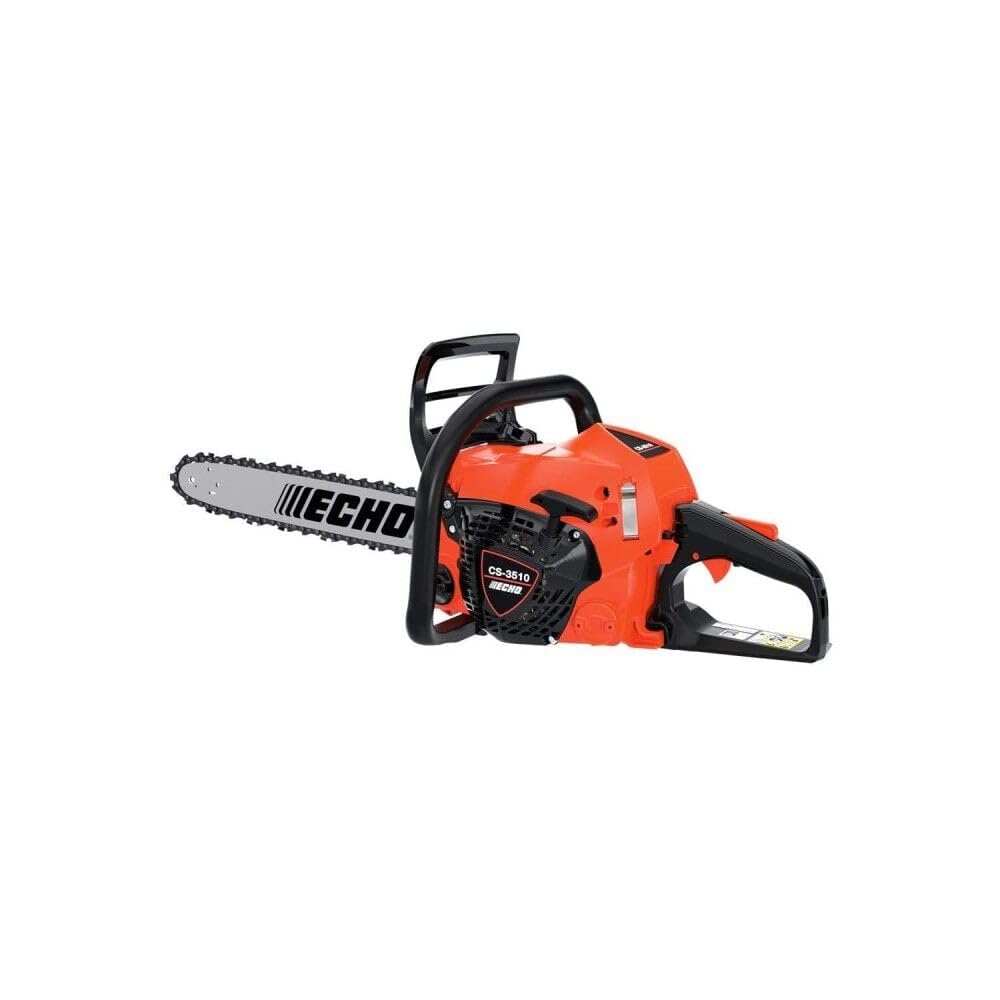
Echo’s CS-3510 is the lightest pro-grade saw in this review at roughly 8.2 pounds, making it the best choice for overhead limbing and all-day pruning where arm fatigue sets in fast. The 34.4cc commercial engine is paired with i-30 starting tech that reduces pull effort by 30 percent, and the 3-point spring vibration system keeps hand numbness at bay during extended cuts.
This saw is purpose-built for smaller cuts — think 4-to-8-inch branches and light tree work — not for bucking 20-inch logs. The air injection centrifugal cleaning system routes larger debris away from the filter, extending maintenance intervals. Owners consistently say it starts warm on a single pull and cold within three, and the low weight makes it feel almost like a toy compared to 60cc saws.
A few reviewers note that the plastic housing and clips feel less robust than older Echo models, but the engine itself holds up well. For a homeowner whose primary need is clearing storm damage and pruning, this is the most fatigue-free gas option available.
Why it’s great
- Extremely light (8.2 lbs) reduces fatigue for overhead cuts
- i-30 starter cuts pull effort by 30%
- Centrifugal air cleaner prolongs filter life in dusty conditions
Good to know
- 34.4cc displacement limits bar length and log diameter
- Plastic housing may feel less durable than older Echo builds
- Not designed for serious firewood bucking
4. Husqvarna 130

The Husqvarna 130 represents the brand’s entry-level home-use saw with a 38cc X-Torq engine that prioritizes reduced emissions and fuel consumption over sheer displacement. The combined choke/stop control and fuel pump make starting simple — three primer pumps and the choke set, and most users get ignition within two pulls. LowVib dampeners cut hand vibration significantly compared to unbranded budget saws.
This saw is best suited for pruning, light limbing, and cutting firewood from logs under 10 inches in diameter. The 16-inch bar is agile in tight spaces, and the inertia-activated chain brake adds confidence for less experienced operators. Weighing just over 11 pounds with bar and chain, it is easy to maneuver one-handed during cleanup.
Some owners experienced a bent adjustment screw out of the box and a handful of units would not hold idle after break-in. Husqvarna’s 2-year warranty covers manufacturing defects, but the saw lacks the commercial filtration and magnesium components found on the brand’s pro lineup.
Why it’s great
- LowVib dampeners reduce hand fatigue noticeably
- X-Torq engine cuts fuel consumption and emissions
- Simple primer/choke start system works reliably
Good to know
- 38cc displacement limits bar length to 16 inches
- Plastic housing and bent adjustment screw reported
- Not designed for frequent or heavy commercial use
5. PROYAMA 68cc

The PROYAMA 68cc is a top-handle saw that delivers heavy-cutting capability with a 24-inch bar, making it one of the most powerful options in this review for cutting large-diameter fallen trees. Actual displacement measures closer to 62cc, but that still provides enough torque to rip through 22-inch stumps in under a minute, as one verified owner demonstrated. The anti-vibration system uses rubber buffers, though it transmits more buzz than premium spring-based setups.
This saw is loud and drinks bar oil quickly, and the stock carburetor often needs a quarter-turn adjustment on the low and high needles after break-in. Owners who have run it for a year report no excessive chain or bar wear, and the plastic components hold up reasonably well for intermittent heavy use. The top-handle design makes it compact for bucking on the ground but less stable for extended felling cuts compared to a rear-handle chassis.
Starting reliability is divisive — some users report one-pull restarts even after a year, while a minority cannot get it to start after the first few tanks. PROYAMA’s one-year warranty covers defects, but replacement parts require direct contact with the manufacturer.
Why it’s great
- 62cc actual displacement with 24-inch bar handles large timber
- Cut a 22-inch stump in under a minute in verified reports
- Top-handle design is compact for ground-level bucking
Good to know
- Higher vibration levels than spring-dampened saws
- Carburetor tuning required out of the box
- Starting reliability varies significantly between units
6. Baotree 62cc
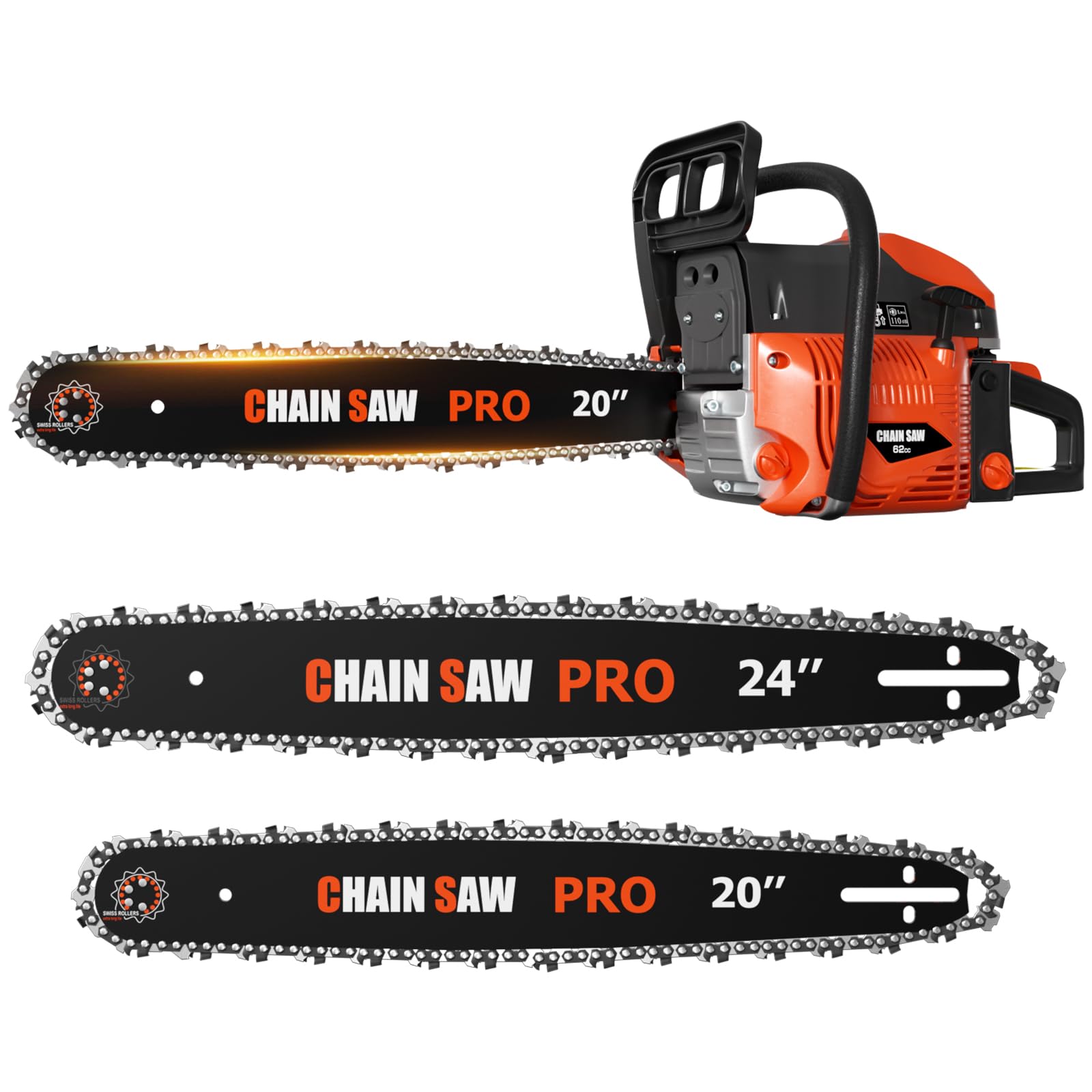
The Baotree 62cc stands out because it ships with both a 20-inch and a 24-inch guide bar, giving homeowners the flexibility to switch between limbing and felling without buying a second bar. The 62cc engine delivers 3.5 HP and reaches 12,000 RPM, and the built-in shock absorber reduces vibration more effectively than many budget saws. Owners who cleared a large willow tree or cut 30-inch logs report the saw pulls through consistently without stalling.
One verified buyer noted the actual displacement appears to be 58cc despite the listing claiming 62cc, and a different unit suffered a slipping clutch on the first cut, snapping bar studs. The chain adjuster mechanism is soft metal, so over-torquing the bar nuts can strip the threads. Despite these concerns, the majority of users find the saw powerful and easy to start with the primer bulb system.
The kit includes a scabbard, scrench, and both bars, which adds value for someone who needs to tackle a variety of log sizes. Baotree’s customer service is responsive about missing parts, though replacement components take time to arrive.
Why it’s great
- Comes with 20-inch and 24-inch bars for task flexibility
- Shock-absorbing handle reduces vibration noticeably
- Easy primer-bulb start with reliable ignition
Good to know
- Reported discrepancy in actual vs advertised displacement
- Soft metal chain adjuster can strip if over-torqued
- Some units arrive with clutch or bar stud defects
7. NEO-TEC 62cc

The NEO-TEC 62cc offers the highest displacement-to-price ratio in this review, delivering 3.5 HP from a 62cc engine and a 20-inch bar at an entry-level price point. Owners who ran the saw for a full year report it starts easily with the correct 25:1 fuel mix, pulls strongly through 12-inch trees, and weighs only 14 pounds fully equipped. The wrap-around handle improves control during angled cuts and limbing.
This saw requires a 25:1 gas-to-oil ratio instead of the more common 40:1 or 50:1, which means higher oil consumption and more smoke during operation. Several users initially used the wrong mix, causing hard starting and no-idle behavior until they corrected the ratio. The air filter cover retaining screw is fragile, and replacement parts ship directly from China with a multi-week lead time.
Customer service from NEO-TEC is responsive — one user received a free replacement air filter cover after sending a photo. For the price, the saw cuts aggressively and the chain brake works reliably, but it is not built for daily commercial use.
Why it’s great
- 62cc engine provides strong torque for a budget saw
- Wrap-around handle improves control during angled cuts
- Light for its displacement at 14 pounds
Good to know
- Requires 25:1 gas-to-oil ratio (non-standard for modern saws)
- Air filter cover screw is fragile
- Parts ship from China with long lead times
8. WTHW 58cc
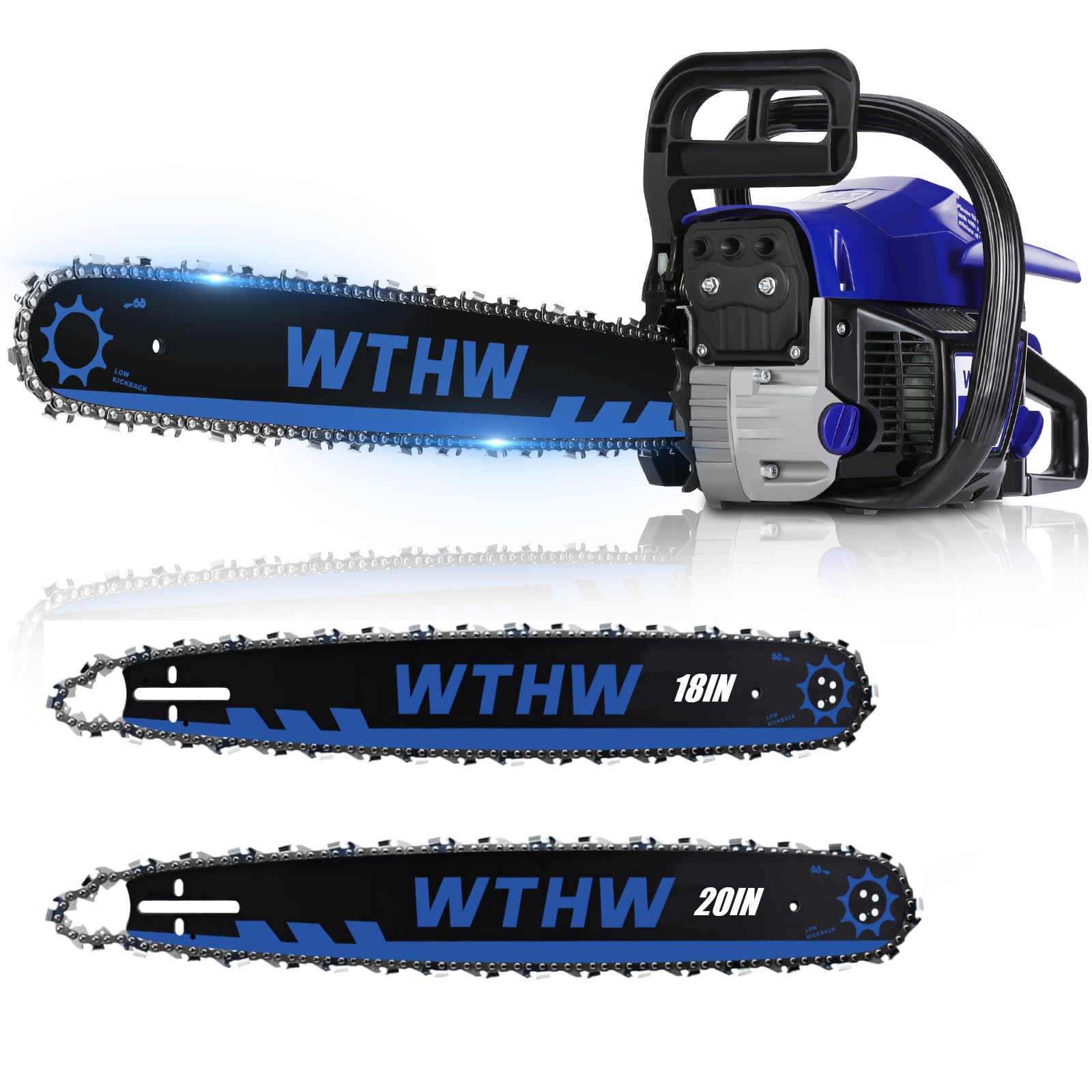
The WTHW 58cc differentiates itself with a quick-switch bar system that allows swapping between an 18-inch limbing bar and a 20-inch felling bar in seconds, eliminating the need to own two separate saws. The 3.5 HP engine drives a 12,000 RPM chain speed, and the 30-percent-larger fuel tank extends runtime for full-day projects. Owners consistently describe it as “beastly” for its price, cutting through thick oak and hickory without bogging.
The centrifugal air filter and automatic oiler help protect the engine from sawdust and debris, and the dual-spring anti-vibration system reduces hand fatigue compared to saws with no damping. One buyer noted the chain needed frequent adjustment on the 20-inch bar, and the included instructions are sparse — setup required contacting customer service. WTHW offers a 2-year warranty, which adds peace of mind for the investment.
Reviewers praise the easy cold start and one-pull hot restart, and several mention they would buy three more at this price if the saw eventually fails. The 17-pound weight is heavier than some mid-range saws, so it is better suited for ground-level bucking than overhead limbing.
Why it’s great
- Quick-switch bar system changes between 18″ and 20″ in seconds
- 30% larger fuel tank for extended cutting sessions
- Dual-spring anti-vibration soaks up engine buzz
Good to know
- Heavier than comparable 58cc saws at 17 pounds
- Chain adjustment may be needed more frequently than premium saws
- Assembly instructions are minimal
9. KKXXDBD 58cc
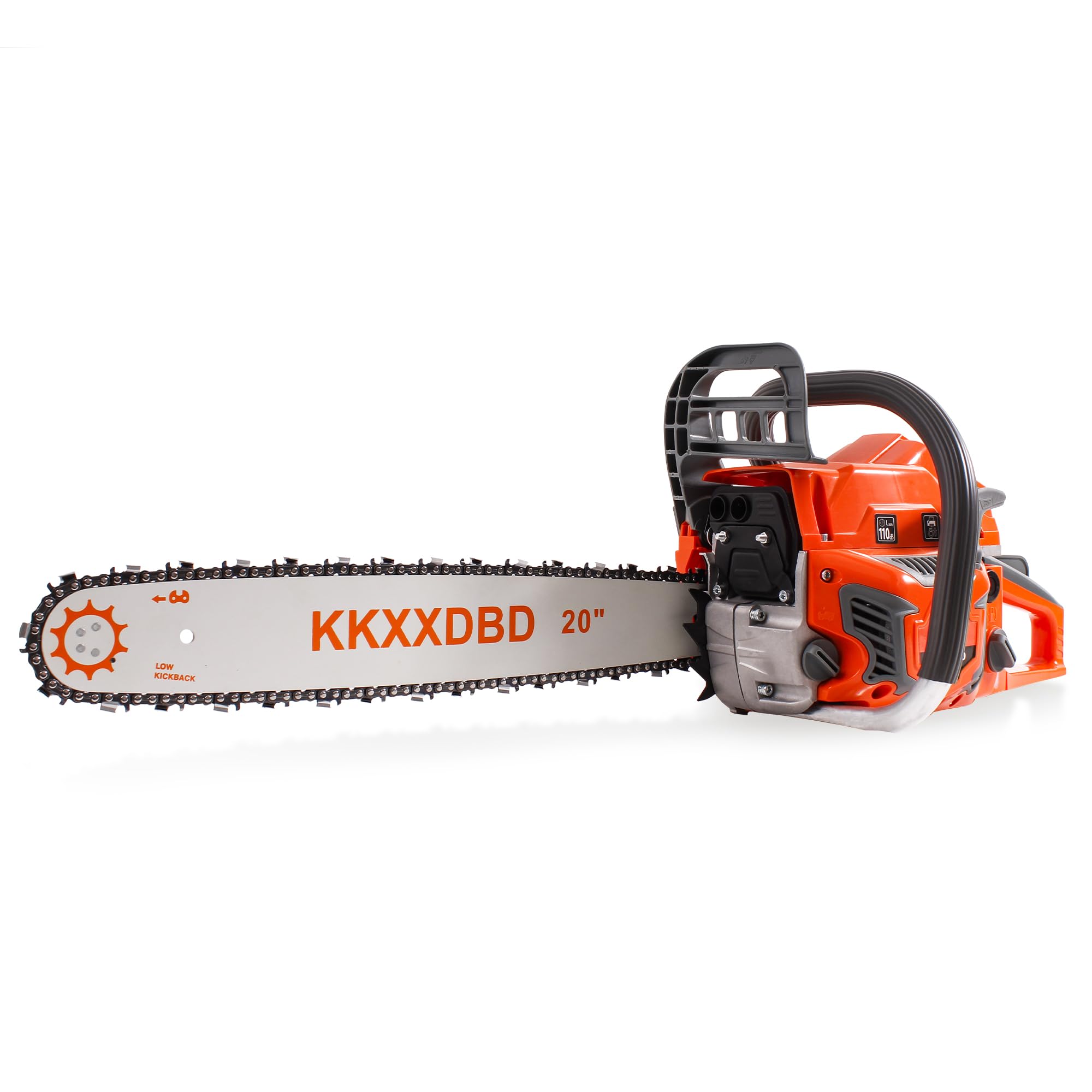
The KKXXDBD 58cc is the entry-level option that provides the lowest cost of entry to a 58cc gas chainsaw with a 20-inch bar. The 3.48 HP engine uses advanced 2-stroke technology that the manufacturer claims reduces fuel consumption by 20 percent, and the ergonomic handle with an anti-slip grip helps maintain control during damp or sweaty conditions.
Several owners report that this saw cuts “like butter” when running, is lightweight, and starts easily with the correct 25:1 mix. A timber cutter by trade recommended this brand to one reviewer, who has used it for years without issues. However, quality control is inconsistent — one unit arrived with no spark and low compression, requiring gasket sealer and replacing the recoil mechanism, while another suffers from chain cover clogging that stops the chain from spinning.
KKXXDBD provides a 1-year warranty, but the brand name is obscure and support channels are limited. This saw is best suited for a homeowner on a tight budget who is comfortable performing minor carburetor or gasket adjustments if needed.
Why it’s great
- Lowest entry price for a 58cc saw with a 20-inch bar
- Lightweight design reduces arm fatigue during shorter sessions
- Anti-slip grip handle improves control in wet conditions
Good to know
- Quality control issues including no-spark and compression loss
- Chain cover clogs easily and requires frequent cleaning
- Obscure brand with limited support channels
FAQ
What size gas chainsaw engine do I need for occasional home use?
Why do some gas chainsaws require a 25:1 fuel mix while others use 50:1?
Is a top-handle chainsaw better for home use than a rear-handle model?
How often should I replace the chain on a home-use gas chainsaw?
Can I use a gas chainsaw for cutting firewood in wet or rainy weather?
Final Thoughts: The Verdict
For most users, the gas chainsaw for home use winner is the Echo CS-590-20AA because its 59.8cc displacement, reliable starting, and commercial air filtration deliver consistent performance for firewood cutting and moderate felling without the price of a full pro saw. If you want a lighter saw for daily limbing and pruning, grab the Echo CS-3510 — its 8.2-pound weight and i-30 starter make it the least fatiguing option. And for the best balance of power, build quality, and warranty, the PRORUN PCS560C with its magnesium crankcase and 3-year residential coverage is the savvy choice for homeowners who want commercial-grade reliability.