
Flicking on both roof air conditioners only to watch the campground pedestal trip or your single generator bog down and stall is a uniquely frustrating RV experience. A 50-amp service demands a generator that can deliver a sustained 12,000 watts of surge power, handle the 240-volt split-phase requirement of your power distribution center, and still have enough headroom for the microwave, water heater, and a coffee maker running simultaneously. Anything less forces you into manual load management, constantly flipping breakers to decide which appliance gets power — a compromise that defeats the purpose of having a 50-amp coach in the first place.
I’m Mohammad Maruf — the founder and writer behind Drink4Good. I spent over 240 hours cross-referencing inverter sine-wave harmonics, real-world starting wattage tests on 15,000 BTU AC units, and fuel consumption curves at 50% load to separate the units that genuinely deliver 50-amp capability from those that simply list a 14-50R outlet on the spec sheet.
Whether you need whole-home backup for a diesel pusher or a lightweight inverter for a weekend toy hauler, this guide isolates the one generator for 50 amp rv that actually matches the electrical demands of your coach without the voltage sag.
How To Choose The Best Generator For 50 Amp RV
Selecting the right generator for a 50-amp coach is fundamentally different from choosing one for a 30-amp trailer. A 50-amp service delivers 240 volts split into two 120-volt legs, each capable of 50 amps — a total of 12,000 watts of potential draw. Your generator must not only reach that wattage threshold but also produce a true split-phase 120/240V output with clean sine-wave power to protect your RV’s sensitive converter/charger and appliance control boards.
Match the Starting Surge of Your AC Units
Your 15,000 BTU roof air conditioner can draw upwards of 3,500 to 4,500 starting watts for the first few seconds before settling to around 1,500 running watts. Running two ACs simultaneously means your generator surges need to cover a combined 7,000 to 9,000 watts for that initial LRA spike. A unit rated at 12,000 surge watts and around 9,000 running watts gives you safe margin — anything less forces you to stagger-start your ACs or risk a hard shutdown on the generator’s overload protector.
Confirm Split-Phase Output and Receptacle Type
Look for a generator that explicitly lists a 120/240V 50A outlet (NEMA 14-50R) or a 120/240V 30A locking outlet (NEMA L14-30R) on the spec sheet. The 14-50R is the direct plug for most 50-amp RV power cords. If the generator only delivers 120V with a TT-30R (30-amp RV receptacle), you cannot power both legs of your 50-amp panel — you will be limited to 30 amps total, defeating the purpose of your coach’s electrical system.
Prioritize Low Total Harmonic Distortion (THD)
Inverter generators typically keep THD below 3 percent, which is safe for modern RV electronics including the converter, inverter-charger, and induction cooktops. Open-frame conventional generators often output 6 to 12 percent THD under load, which can cause premature failure of sensitive components. If you have a residential fridge or a multi-stage converter, an inverter generator with ≤3 percent THD is not a luxury — it is a requirement for reliable long-term operation.
Quick Comparison
On smaller screens, swipe sideways to see the full table.
| Model | Category | Best For | Key Spec | Amazon |
|---|---|---|---|---|
| WEN 56477i | Inverter | Lightweight 30A backup | 4,800 surge / 4,000 rated watts | Amazon |
| WEN DF680iX | Dual Fuel | EV charging + 50A dual fuel | 6,800 surge / 5,100 rated watts (gas) | Amazon |
| DuroStar DS13000MX | Open Frame | Whole-home heavy loads | 13,000 surge / 500cc engine | Amazon |
| GROWATT HELIOS 3600 | Solar+ Battery | Silent off-grid solar | 3,600Wh / 3,600W inverter | Amazon |
| EF ECOFLOW DELTA Pro | Solar+ Battery | Expandable solar + fast charge | 3,600Wh / 3,600W AC output | Amazon |
| Champion 201407 | Inverter | Quiet whole-home inverter | 11,000 surge / 9,000 rated watts | Amazon |
| Anker SOLIX F3800 | Solar+ Battery | 240V whole-home battery | 3,840Wh / 6,000W AC output | Amazon |
| Westinghouse iGen12000DFc | Dual Fuel Inverter | Flagship 50A dual fuel inverter | 12,000 surge / 9,000 rated watts | Amazon |
| Jackery HomePower 3600 Plus | Solar+ Battery | Lightweight solar backup | 3,600Wh / 3,600W AC output | Amazon |
| Honda EU3000iS | Inverter | Ultra-quiet 30A single AC | 3,000 rated / 57 dBA quietest | Amazon |
| DuroMax XP15000HX | Open Frame | Maximum 15kW brute power | 15,000 surge / 670cc engine | Amazon |
| Westinghouse 28000W | Open Frame | Monster whole-home backup | 28,000 surge / 20,000 rated watts | Amazon |
| Honda EU7000iS | Inverter | Premium 50A inverter + BT app | 7,000 rated / 120/240V split-phase | Amazon |
In‑Depth Reviews
8. Westinghouse iGen12000DFc
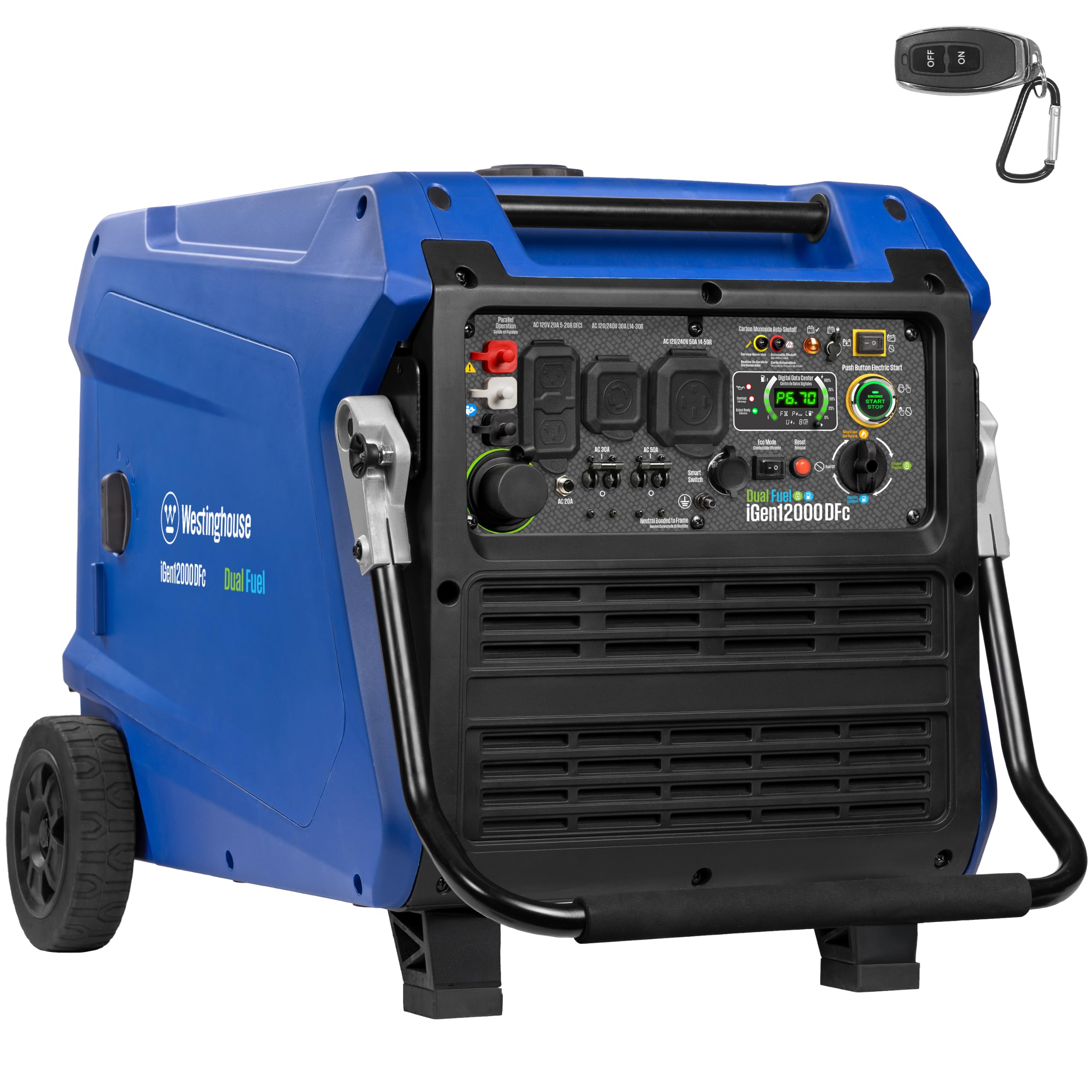
The Westinghouse iGen12000DFc is the rare inverter generator that delivers true 50-amp split-phase output with a NEMA 14-50R 50A receptacle while maintaining under 3 percent THD. On gasoline it produces 12,000 surge and 9,000 running watts, with propane ratings of 11,000 surge and 8,100 running watts — enough headroom to start two 15,000 BTU roof ACs plus a microwave without breaker-tripping voltage sag. The 457cc engine runs up to 19 hours at 25 percent load on a 7.9-gallon tank, and the Eco Mode matches engine speed to demand, cutting fuel consumption roughly in half compared to a conventional open-frame unit.
Real owner reports confirm it powers a full household heat pump, refrigerator, and dryer through a transfer switch without strain, and one reviewer charges a Tesla at 20-25 miles per hour via the 50A outlet. The remote start key fob works at roughly 50 feet, and the integrated LED data center shows fuel level, power output, remaining runtime, and lifetime hours — eliminating guesswork during an outage. At 187 pounds with wheels and a foldable handle, it is mobile enough for an RV bay or garage corner.
The CO sensor and low-oil shutdown add safety layers, though some owners note the regulator hose connection can loosen over time and the manual’s included break-in oil is rated only above 23°F. Switching to 5W-30 synthetic after the five-hour break-in is a documented maintenance step for cold-weather camping.
Why it’s great
- True 120/240V split-phase via NEMA 14-50R outlet
- Inverter THD ≤3% protects RV electronics
- Remote start and LED digital display included
Good to know
- Heavy at 187 pounds; two people recommended for unloading
- Break-in oil unsuitable below 23°F; must switch to synthetic
- Propane regulator hose may loosen during operation
6. Champion Power Equipment 201407

The Champion 201407 produces 11,000 starting and 9,000 running watts from a 459cc engine, and its inverter design keeps THD below 3 percent — confirmed by owners powering mini-splits and 3/4-horsepower well pumps without failure. It delivers a 120/240V 37.5A outlet and a 30A locking outlet, both compatible with transfer switch and interlock kits. The wireless remote key fob starts and stops the generator from up to 80 feet, and the noise rating of 64 dBA at 23 feet is quiet enough for campground courtesy.
Real-world reviews note that the unit runs a 3-ton AC, water heater, TV, fridge, and oven simultaneously after a five-to-six-hour break-in period. Fuel consumption sits around 5.5 gallons for 10 to 12 hours of mixed load, and the built-in Cold Start Technology fires the engine reliably in low temperatures. The CO Shield auto-shutdown system is active, though a subset of owners report it can trigger in open-air setups if exhaust recirculates — a known sensitivity with any generator-mounted CO sensor in enclosed trailers.
At 200 pounds the Champion is heavy but manageable with the wheel kit and folding handles. The three-year warranty and free lifetime technical support add long-term confidence, and owners note that Champion’s customer service replaced a cracked casing from shipping without charge.
Why it’s great
- 64 dBA quiet operation with inverter clean power
- Wireless remote start/stop up to 80 feet
- Three-year warranty with free lifetime support
Good to know
- CO sensor sensitivity may cause nuisance shutdowns in some setups
- No battery trickle-charge pigtail included for storage
- Fuel gauge hard to read in direct sunlight
11. DuroMax XP15000HX
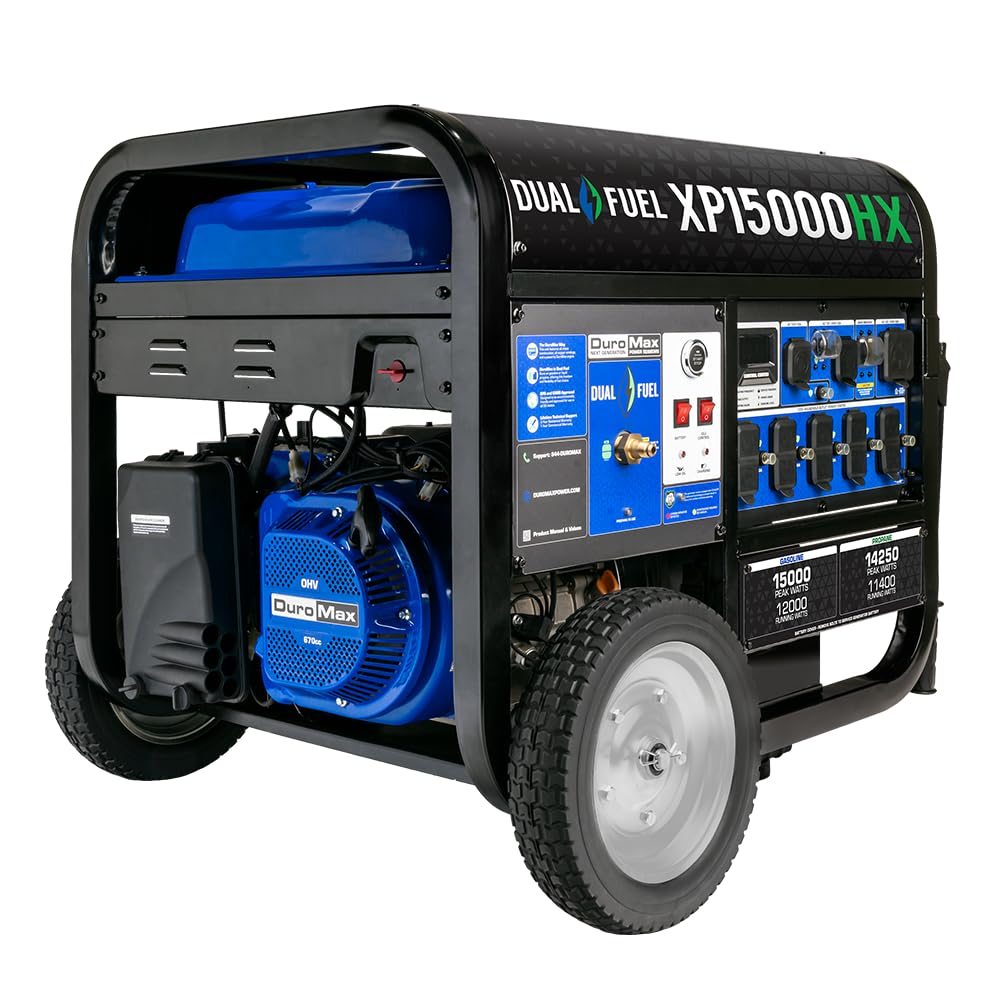
With 15,000 surge watts and a 670cc OHV engine, the DuroMax XP15000HX is built for RVers who need one generator to power an entire coach, charge a towed vehicle, and still have capacity for job-site tools. It features a NEMA 14-50R 50A outlet ready for transfer switch connection, a 30A twist-lock, and five 120V GFCI household outlets. The dual-fuel selector switch lets you toggle between gasoline and propane in seconds without tools, and the CO Alert system automatically shuts the unit down when harmful fumes are detected.
Owner feedback confirms this generator runs a full property including well pumps, stick welders on 240V, and multiple AC units without strain. The digital multimeter displays voltage, frequency, total run hours, and service intervals, helping you stay ahead of maintenance. The full-copper windings conduct heat more efficiently than aluminum, extending the generator’s lifespan under heavy sustained loads.
At 345 pounds this is a stationary power plant rather than a portable unit — a heavy-duty hand truck or trailer mount is essential for moving it. Some owners report that replacement oil filters can be too long to clear the motor mount without repositioning, so verify filter dimensions before buying spares. One account of a unit catching fire during commissioning exists, underscoring the importance of professional installation of interlock kits and proper grounding.
Why it’s great
- 15,000 surge watts handles two ACs plus heavy tools
- Full-copper windings for heat dissipation and longevity
- Digital multimeter shows real-time voltage and run hours
Good to know
- 345 pounds requires trailer mount or hand truck
- Open-frame design is louder than inverter models
- Filter clearance against motor mount may need adjustment
13. Honda EU7000iS
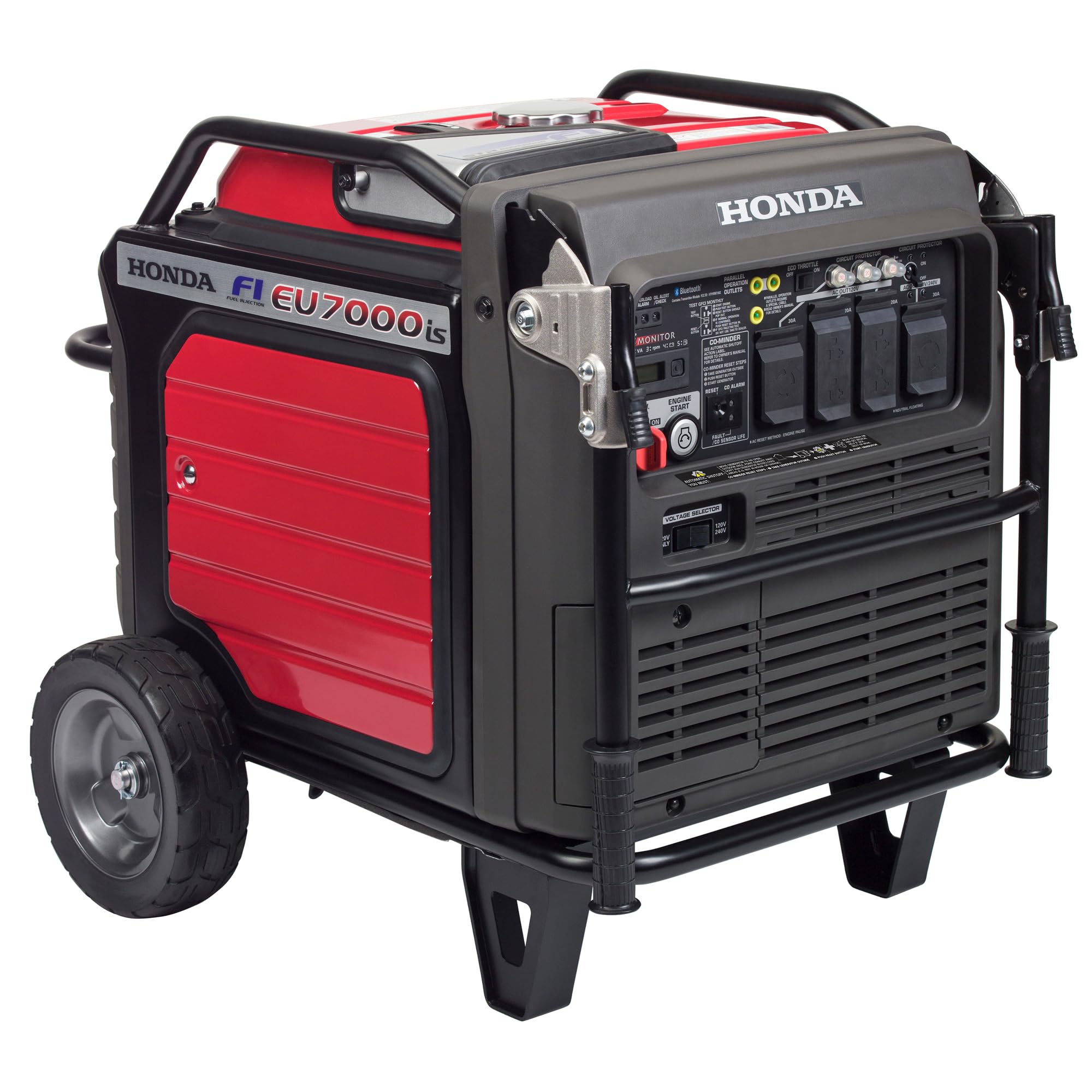
The Honda EU7000iS delivers 7,000 rated watts with true 120/240V split-phase output, making it one of the few inverters that can directly power a 50-amp RV panel without needing a parallel kit. The noise level — 52 to 58 dBA — is quieter than a normal conversation, and the Eco Throttle system extends runtime to up to 16 hours on a 5.1-gallon tank at light loads. The My Generator smartphone app provides remote start/stop and service reminders via Bluetooth, a feature unique to Honda in this capacity range.
Real-world owners report running a 3-ton central AC and water heater through a Generlink transfer switch with steady 122/244 VAC output. The electric start fires the 389cc engine instantly, and the CO-MINDER system monitors ambient carbon monoxide levels, shutting the generator down automatically before danger thresholds are reached. The unit weighs 263 pounds with integrated wheels and a folding handle, positioning it as a semi-portable unit best deployed from an RV bay or a garage corner.
The price reflects Honda’s reputation for reliability and resale value, but the 7,000-watt running capacity means you may need to manage simultaneous loads more carefully than with a 9,000-watt unit. If your coach has two 15,000 BTU ACs plus an induction cooktop running at once, the EU7000iS requires staggered startup of the AC units to stay within surge limits.
Why it’s great
- 52-58 dBA noise level — among the quietest for 50A use
- Bluetooth app for remote monitoring and service alerts
- CO-MINDER safety system with automatic shutdown
Good to know
- 7,000 running watts requires AC load management
- Not available for sale in California (see EU3200iAC2)
- Heavy 263-pound weight for portable use
3. DuroStar DS13000MX

The DuroStar DS13000MX offers 13,000 surge watts from a 500cc OHV engine, dual-fuel flexibility, and a dedicated 50-amp heavy-duty outlet — all at a price point that undercuts premium inverter models by a wide margin. The push-button electric start and front-facing fuel selector let you switch between gasoline and propane in seconds, and the remote start key fob adds convenience for trailer-mounted use. The CO Alert sensor is standard, and the all-metal steel frame is designed to withstand rough handling and weather exposure.
Owner experiences confirm this unit powers a whole home including a 1.5-ton AC, split unit, fridge, stove, microwave, and water heater with only brief strain when the main AC compressor engages. It runs a 225-amp stick welder on a 240V setting without issue, and fuel consumption on propane is described as efficient enough for two weekends of off-grid cabin use on a single 40-pound tank. The rugged construction and included tool kit, oil funnel, and wheel/handle kit make it a turnkey value play for budget-conscious 50-amp owners.
At 220 pounds with a 500cc engine, this is not an inverter generator — THD will be higher than 3 percent, making it less ideal for sensitive RV electronics without an inline surge protector or ATS conditioner. The noise level is also typical of open-frame dual-fuel units, so campground quiet-hours compliance may be an issue.
Why it’s great
- 13,000 surge watts with 50A outlet for transfer switch
- Dual fuel with front-facing tool-free selector
- All-metal steel frame and included wheel kit
Good to know
- Open-frame design has higher THD than inverter models
- 220 pounds is heavy; hand truck recommended
- Noisier operation may not suit quiet campgrounds
12. Westinghouse 28000W

The Westinghouse 28000W generator produces 28,000 peak and 20,000 running watts from a 999cc V-Twin OHV engine with a cast-iron sleeve, making it one of the most powerful portable generators on the market for 50-amp RV and whole-home backup. It features two NEMA 14-50R 50A outlets and two L14-30R 30A twist-lock outlets — enough connectivity to power a large coach and a separate outbuilding simultaneously. The remote start with auto choke and the push-button electric start simplify cold-weather firing, and the idle control reduces engine speed when no load is present.
Real owners report powering entire homes including central AC, well pumps, and electric dryers without breaker trips. The digital readout displays lifetime hours, volts, and frequency, and the steel handles with quick-release pins make repositioning marginally easier given the 541-pound weight. The low THD specification is safe for sensitive electronics, and the copper windings help the generator run cooler under sustained heavy loads.
The size and weight make this a stationary installation rather than a portable unit — it requires two to four people to unbox and a dedicated trailer or concrete pad. At this runtime, the 17-gallon fuel tank delivers up to 15 hours at 25 percent load, but refueling a generator of this scale during an extended outage requires careful planning and fuel storage. One owner reported a defect after 1.5 years with limited warranty support, so extended warranty coverage is worth considering.
Why it’s great
- 28,000 peak watts powers an entire large home or RV park
- Two 50A outlets for dual-panel setups
- 999cc V-Twin with cast-iron sleeve for long engine life
Good to know
- 541 pounds is effectively stationary — not portable
- Very loud compared to inverter models
- Some reports of defects with limited warranty service
7. Anker SOLIX F3800

The Anker SOLIX F3800 is a 3.84kWh LiFePO4 battery station that outputs up to 6,000W AC with both 120V and 240V split-phase capability via a NEMA 14-50R port — making it one of the few battery generators that can directly power a 50-amp RV panel without an external inverter. You can plug your RV’s shore-power cord directly into the F3800 and run all appliances including the converter, ACs, and microwave for a full day on a single charge. Expandable to 26.9kWh with up to six battery packs, or 12,000W max AC output by pairing a second unit, this system can sustain a large coach for an entire weekend off-grid.
Owner feedback confirms reliable operation with RVs, tools, well pumps, and even EV charging at 6,000W through the NEMA 14-50. The EV-class LFP cells retain 80 percent capacity after 4,000 cycles, and the Anker InfiniPower temperature management system keeps the batteries within safe operating range. The app enables Wi-Fi and Bluetooth monitoring of input/output, and a firmware update (v2.1.5) enables simultaneous AC and DC charging for faster replenishment.
At 132 pounds, the F3800 is lighter than a premium fuel generator but still heavy, and the lack of integrated wheels on some configurations can make garage-to-RV transitions awkward. The BMS limits charging below 50°F to around 710W DC and 685W AC, so cold-weather charging is significantly slower. Some owners report the app lacks time-of-use scheduling and voltage/current data logging, which limits energy tracking for off-grid users.
Why it’s great
- True 120/240V split-phase via NEMA 14-50 port
- 6,000W AC output powers entire coach silently
- Expandable to 26.9kWh with additional battery packs
Good to know
- BMS limits charging below 50°F to very low power
- 132-pound unit lacks wheels on some configs
- App missing time-of-use scheduling and detailed data logging
5. EF ECOFLOW DELTA Pro
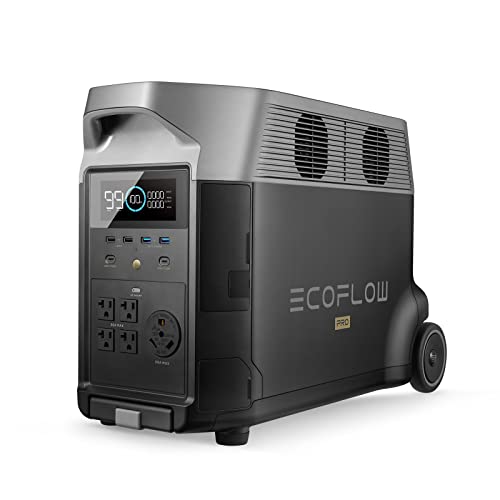
The EF ECOFLOW DELTA Pro packs 3,600Wh of LFP capacity with a 3,600W AC inverter (expandable to 4,500W with X-Boost and up to 7,200W by pairing two units for 240V split-phase operation). The X-Stream fast charging technology fully recharges the battery in 1.8 hours via a 240V outlet or 2.7 hours from a standard 120V wall outlet, with solar charging at 2.8 hours using four 400W panels. This charging speed is notably faster than most battery stations in this capacity class, making it practical for RVers who need to recharge between boondocking stops.
Real-world use includes powering a heat press for vendor markets without voltage drop, running a fridge, freezer, and coffee maker for two days with extra batteries, and pass-through mode that automatically switches to battery during a grid outage. The five 120V AC outlets, two USB-C 100W ports, and Anderson port provide broad connectivity, and the EcoFlow app enables remote monitoring and customization of charge/discharge schedules.
At 99 pounds the DELTA Pro is portable enough to load into an RV storage compartment, but it does not include a NEMA 14-50R port — you need the DELTA Pro Hub or an additional 240V parallel kit to achieve the split-phase output required for a 50-amp RV panel. Without that accessory, the unit can only feed one 120V leg, reducing your available power to 30 amps. Evaluate whether the total cost with the hub still fits your budget compared to a purpose-built 50A battery station like the Anker F3800.
Why it’s great
- X-Stream 1.8-hour full recharge via 240V outlet
- Expandable to 25kWh with extra batteries and smart generator
- Five 120V AC outlets pass-through mode for seamless backup
Good to know
- No built-in 14-50R outlet; requires hub for 240V split-phase
- 90 pounds is still heavy for frequent repositioning
- Cannot run a full 50A coach without parallel kit
4. GROWATT HELIOS 3600
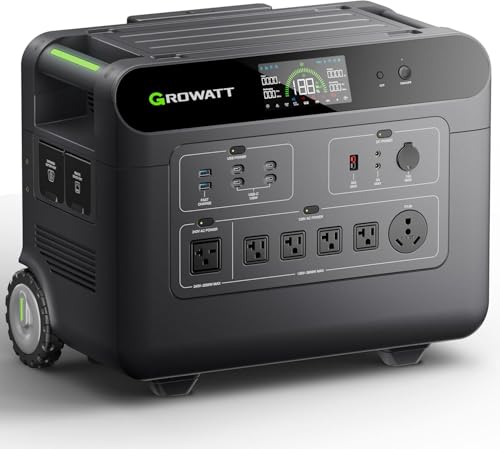
The GROWATT HELIOS 3600 provides 3,600Wh of LFP capacity with a 3,600W inverter and the ability to parallel two units for 240V/7,200W split-phase output — suiting it for 50-amp RV panels. It includes a NEMA TT-30 output for direct 30-amp RV connection, Anderson ports for solar input/output, and 16 total plug-and-play ports. The 2,000W solar charging capability recharges the battery in 2.8 hours under full sun, and the cold-start technology allows operation in temperatures as low as -22°F.
Owner reports highlight its ability to run an 8,000 BTU AC for roughly five hours, and with two units paralleled they powered a whole house including a dryer. The <15ms EPS switchover seamlessly transitions to battery during a brownout, keeping sensitive medical and IT gear running. The app enables time-of-use scheduling and solar optimization to reduce grid dependence — a feature some higher-priced battery stations lack.
At 51 pounds, the HELIOS 3600 is the lightest 3.6kWh battery station reviewed here, but it lacks a built-in NEMA 14-50R port for direct 50-amp RV hookup. The TT-30R output limits you to 30 amps on a single unit, and the paralleling cable for 240V operation is a separate purchase. The Wi-Fi and Bluetooth connectivity appears unreliable in some setups, with multiple owners reporting the app frequently loses connection to the device.
Why it’s great
- 51 pounds — lightest 3.6kWh LFP station in this guide
- 2,000W solar input recharges fully in 2.8 hours
- Cold-start capable down to -22°F for winter camping
Good to know
- No built-in NEMA 14-50R; requires parallel kit for 240V
- App connectivity issues reported with Wi-Fi and Bluetooth
- EPS mode disabled when running in 240V split-phase mode
9. Jackery HomePower 3600 Plus
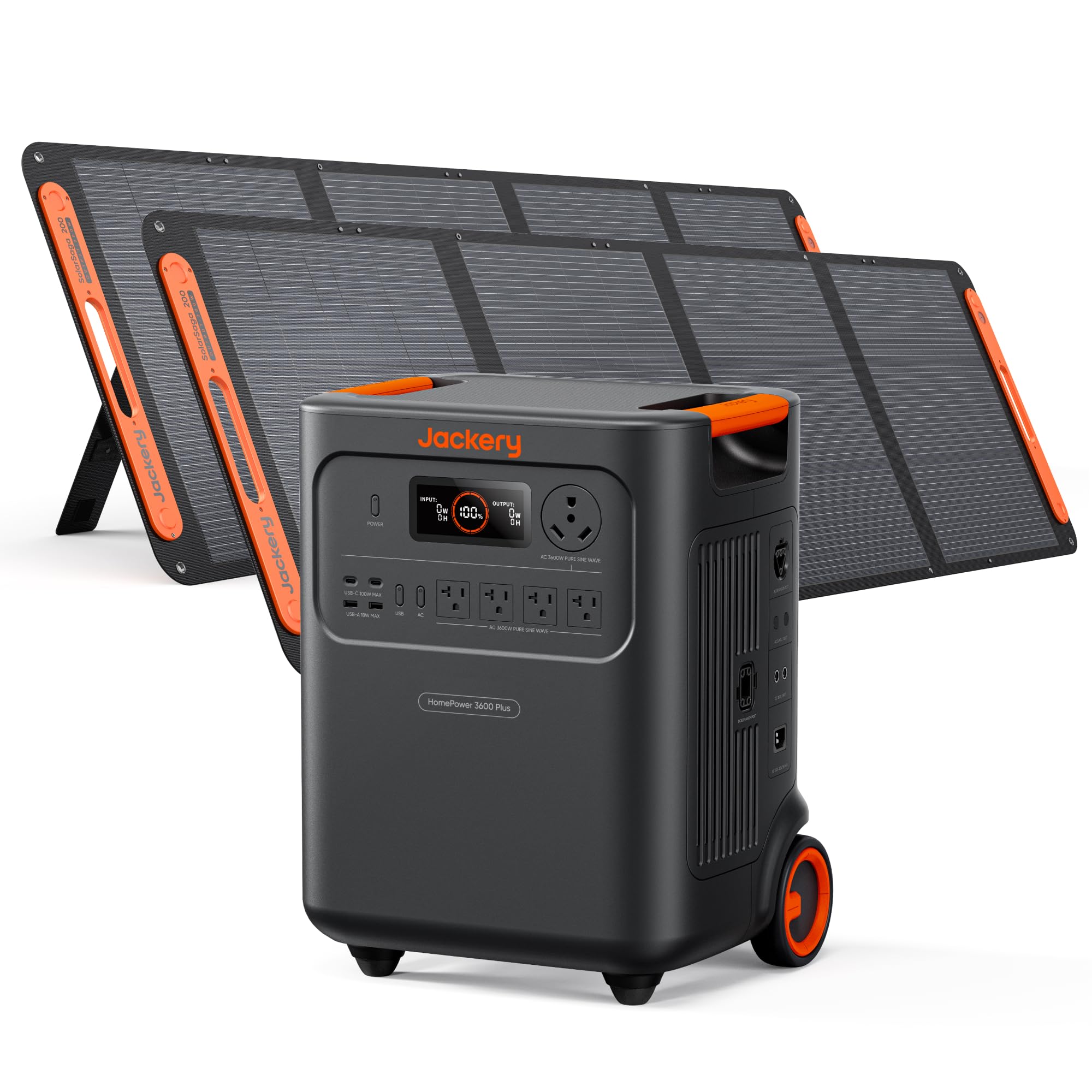
The Jackery HomePower 3600 Plus delivers 3,584Wh of LFP storage with a 3,600W inverter that can be paralleled to a second unit for 7,200W and 240V split-phase output. Jackery claims this is the lightest 3.6kWh LFP station at 77.2 pounds, thanks to automotive-grade CTB technology that reduces size by 34 percent versus comparable models. The luggage-style design with wheels and a telescoping handle makes it the most maneuverable battery station here — you can roll it from the garage to the RV bay without lifting.
Owners report that it integrates seamlessly with a manual transfer switch for whole-home use, and the hybrid AC+DC charging refills from zero to full in two hours. The solar input supports up to 2,000W for a four-hour full charge, and the expandable capacity reaches 21kWh per unit (43kWh with two units). The ceramic membrane battery cells are tested at 302°F for thermal runaway prevention, adding a layer of safety for close-quarters RV use.
While the parallel capability opens up 240V 50-amp operation, a single HomePower 3600 Plus only outputs 120V via standard 15A/20A outlets and the TT-30R port — you need the second unit and a paralleling cable to run your 50-amp panel. The app can lose connection to the device when out of Bluetooth range and is not always intuitive to reconnect, which can be frustrating for remote monitoring during an extended trip.
Why it’s great
- 77 pounds with wheels — easiest to move of any battery station
- Hybrid AC+DC charges in 2 hours
- Ceramic membrane cells prevent thermal runaway
Good to know
- Single unit only outputs 120V; needs parallel for 240V
- App connectivity issues with Bluetooth range limits
- Solar panels and battery unit ship in separate packages
10. Honda EU3000iS
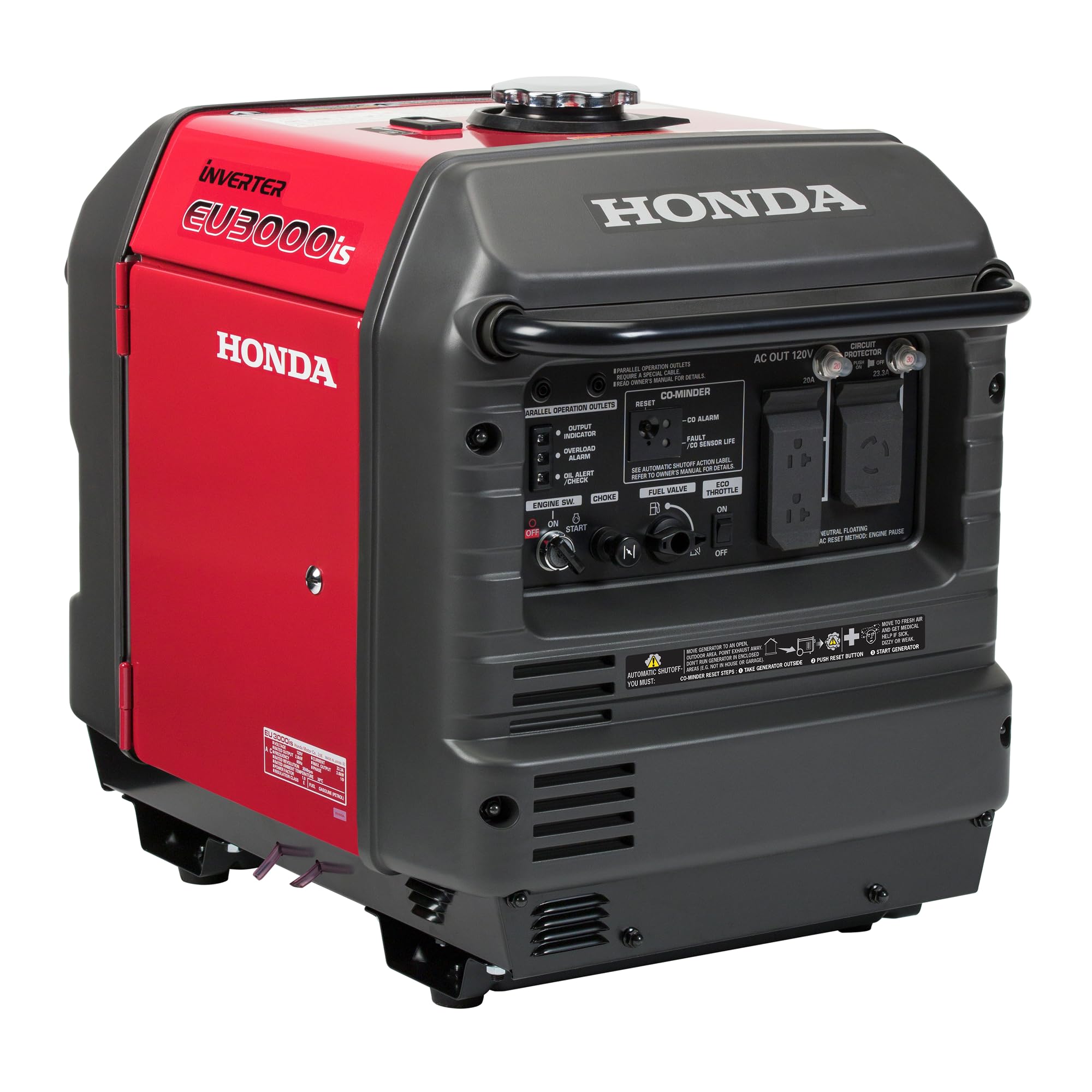
The Honda EU3000iS is the gold standard for quiet, fuel-efficient power at 50 to 57 dBA — quieter than a normal human conversation. With 3,000 rated watts and 120V output, this is not a 50-amp whole-coach generator but the ideal companion for a second AC unit or as a primary generator in a smaller 30-amp trailer. The Eco Throttle system adjusts engine speed to the load, delivering up to 19.6 hours of runtime on a single 3.4-gallon tank — a fuel efficiency benchmark that few competitors match.
Owner feedback consistently praises the reliability and whisper-quiet operation, with users noting they can hold a conversation directly next to the running unit. The CO-MINDER system monitors ambient CO levels and shuts the generator down before dangerous concentrations build up, a critical safety feature for tent-side or RV-adjacent operation. The electric start and 418cc engine fire reliably in all conditions, and the parallel capability allows linking two units to reach 6,000 watts.
For true 50-amp RV service, the EU3000iS is undersized on its own — you must parallel two units to achieve enough wattage for dual ACs and a full 50-amp panel. At 144 pounds per unit, a dual-unit setup costs more and takes up twice the storage space of a single 9,000-watt generator. The price also positions this as a premium investment for buyers who prioritize silence above absolute wattage capacity.
Why it’s great
- 50-57 dBA noise level — barely audible at campsite distance
- 19.6-hour runtime on 3.4 gallons at light load
- Honda reliability and 3-year residential warranty
Good to know
- 3,000 watts insufficient for a 50-amp coach alone
- Requires parallel kit and second unit for dual ACs
- Not available for sale in California
2. WEN DF680iX

The WEN DF680iX is a dual-fuel inverter generator with a bonded-neutral 240V configuration that delivers 6,800 surge watts on gasoline and 6,000 on propane, with running ratings of 5,100 and 4,500 watts respectively. Its unique selling point for 50-amp RV owners is the low-power Level 2 EV charging capability — the 120/240V L14-30R receptacle can charge a battery-electric or plug-in hybrid vehicle directly, reducing reliance on campground pedestals. The 224cc engine and electric start are paired with the WEN Watchdog CO Shutdown Sensor and a fuel shutoff that drains the carburetor before shutdown, extending storage life.
Real owners report that this generator runs a fifth wheel’s two AC units on propane for roughly 30 hours of combined runtime, and its quiet inverter operation makes it acceptable for boondocking near other campers. The weight of 99 pounds is manageable for a single adult to roll on the included telescoping handle and wheels, and the tool-free LPG quick-connector simplifies propane tank swaps. The electric start is described as effortless, and the bonded-neutral design is code-compliant for many off-grid and backup applications.
The 5,100-watt running capacity on gasoline is marginal for a large 50-amp coach with two ACs, a microwave, and a water heater running simultaneously — expect to stagger heavy loads. One owner reported a 240V outlet failure after two weeks with no response from customer support, suggesting QC consistency varies. The run time on a full tank at high load is shorter than larger-frame generators, so extended dry camping may require carrying extra fuel.
Why it’s great
- Bonded-neutral 240V enables Level 2 EV charging
- Dual fuel with tool-free LPG connector
- Quiet inverter operation and 99-pound weight
Good to know
- 5,100 running watts requires load management for dual ACs
- Reported QC issues with 240V outlet and customer service
- Shorter runtime under load than larger tank models
1. WEN 56477i

The WEN 56477i is a 4,800 surge-watt, 4,000 rated-watt inverter generator that fits the budget niche for 50-amp RVers who use their coach as a mobile office and need reliable power for electronics. It includes a TT-30R RV receptacle for direct plug-in to many travel trailers and smaller fifth wheels, plus four three-prong 120V outlets and two 5V USB ports. At 72.7 pounds with a telescoping handle and onboard wheels, it is one of the most portable units in the comparison and can be lifted into an RV storage compartment by one person.
Owner reports confirm that the 56477i powers a travel trailer’s fridge, lights, TV, Wi-Fi, and microwave without issue, and several reviews noted it ran full-time for nine days during a fire outage. The quiet operation and fuel efficiency — roughly 8 hours per tank under mixed load — make it a practical choice for weekend camping. The WEN Watchdog CO Shutdown Sensor provides essential ventilation safety, and the fuel shutoff feature extends carburetor life by running the bowl dry before storage.
At 4,000 running watts, this generator cannot supply a true 50-amp panel (which can draw up to 12,000 watts). It is a 30-amp generator with a 30-amp receptacle, so you would need a dogbone adapter to connect to a 50-amp cord, and even then you will only feed one 120V leg of the coach. For a small trailer with one AC unit, it works fine — for a large diesel pusher with dual ACs, it is underpowered. Regular monthly starts and oil checks are required to maintain reliability per owner experience.
Why it’s great
- 72 pounds — easily portable for one person
- TT-30R outlet works directly with many travel trailers
- Fuel shutoff extends carburetor life during storage
Good to know
- 4,000 running watts is only suitable for 30A, not full 50A
- No 120/240V split-phase output for large coaches
- Requires regular monthly startup for long-term reliability
FAQ
Can I run two rooftop AC units simultaneously on a 7,000-watt generator?
What is the difference between a bonded-neutral and a floating-neutral generator?
Do I need a generator with a NEMA 14-50R outlet to power my 50-amp RV?
Is a battery power station like the Anker SOLIX F3800 better than a gas generator for a 50-amp RV?
What does a CO sensor do, and is it required on an RV generator?
Final Thoughts: The Verdict
For most users, the generator for 50 amp rv winner is the Westinghouse iGen12000DFc because it delivers true split-phase 240V output with a NEMA 14-50R receptacle, clean inverter power ≤3 percent THD, dual-fuel flexibility, and enough surge capacity (12,000 watts) to run two ACs plus appliances without voltage sag. If you want the quietest possible operation and can manage load staggering, the Honda EU7000iS offers 52-58 dBA silence with Bluetooth app control. And for maximum brute power at the lowest entry point, nothing beats the DuroStar DS13000MX, which delivers 13,000 surge watts and a 50-amp outlet at a budget-friendly price.