
Keeping a small house lit, fed, and connected during an outage doesn’t require a monster generator that drowns out conversation and guzzles gasoline. You need a machine that delivers stable, clean electricity without waking the neighbors or destroying your fuel budget.
I’m Mohammad Maruf — the founder and writer behind Drink4Good. I’ve spent hundreds of hours analyzing inverter technology, fuel consumption curves, starting wattage requirements, and real customer durability reports to separate the workhorses from the white elephants.
Whether you are prepping for hurricane season, outfitting a tiny home, or just want peace of mind during winter storms, this guide will help you find the right generator for small house that balances output, noise, portability, and upfront cost.
How To Choose The Best Generator For Small House
Small houses present a unique energy challenge: you need enough surge power to start a fridge, a well pump, or a window AC, but you don’t want to lug around a 200-pound beast that burns through five gallons of gas in a few hours. The key is matching your peak load to the right inverter platform.
Inverter vs. Conventional — Clean and quiet matters
A conventional open-frame generator produces raw power with high total harmonic distortion (THD), which can damage sensitive electronics like modems, laptops, and modern fridge control boards. An inverter generator converts raw AC to DC and then back to stable AC, yielding THD under 3%. It also automatically adjusts engine speed to match load, which cuts noise and fuel consumption dramatically. For a small house where you are likely running electronics alongside appliances, an inverter unit is the smarter buy.
Sizing your starting and running watts
Make a list: refrigerator (600-800 running watts, 2200 surge), a few lights (300W total), a furnace fan (800W), and maybe a 5000 BTU window AC (500 running, 1500 surge). Most small houses run fine on 3000-4000 rated watts with a 4500-5000 surge capacity. Overshooting by buying a 7000-watt conventional unit wastes fuel, space, and your hearing. The sweet spot for most small homes is a 3000-5000 watt inverter generator.
Fuel type and runtime — Don’t get stranded
Gasoline is the most accessible fuel, but it degrades in months. Propane (dual-fuel) stores indefinitely and burns cleaner, reducing carburetor maintenance. A 3.5-gallon tank on a mid-range inverter generator should give you 8-12 hours at half load. Also check if the unit has a fuel shut-off valve — this lets you run the carburetor dry before storage, preventing gummed-up jets.
Noise, portability, and safety features
Look for a noise rating under 70 dBA from 23 feet — that’s quieter than a vacuum cleaner. Most inverter generators in this class weigh 50-90 lbs, so built-in wheels and a telescoping handle are almost essential if you plan to move it between the garage and patio. A CO shutdown sensor is now standard on quality units and should be non-negotiable for any indoor-adjacent placement.
Quick Comparison
On smaller screens, swipe sideways to see the full table.
| Model | Category | Best For | Key Spec | Amazon |
|---|---|---|---|---|
| Westinghouse iGen5000c | Inverter | Remote electric start & quiet operation | 52 dBA at 23 feet | Amazon |
| Champion 4000W Dual Fuel | Inverter | Propane flexibility & compact size | 64 dBA at 23 feet | Amazon |
| Cummins Onan P4500I | Inverter | Premium build & remote start | 224cc OHV Engine | Amazon |
| Jackery Explorer 2000 v2 | Power Station | Silent indoor backup & solar charging | 2042Wh LiFePO4 | Amazon |
| Anker SOLIX C2000 Gen 2 | Power Station | Fast recharging & expandable capacity | 2400W rated output | Amazon |
| WEN DF480iX | Inverter | Dual fuel with electric start | 4800W surge / 4000W rated | Amazon |
| WEN DF360iX | Inverter | Ultra lightweight dual fuel | 49 pounds | Amazon |
| AMERISUN AM5046C | Inverter | High power at a competitive price | 5000W surge / 4000W rated | Amazon |
| PowerSmart PS5046CE | Inverter | Lightweight & parallel ready | 67 dBA at 23 feet | Amazon |
| Pulsar PGD40ISCO | Inverter | Super lightweight portable | 47.3 pounds | Amazon |
| A-iPower GXS5000 | Conventional | High surge power on a budget | 5000W surge / 4000W rated | Amazon |
In‑Depth Reviews
1. Westinghouse iGen5000c
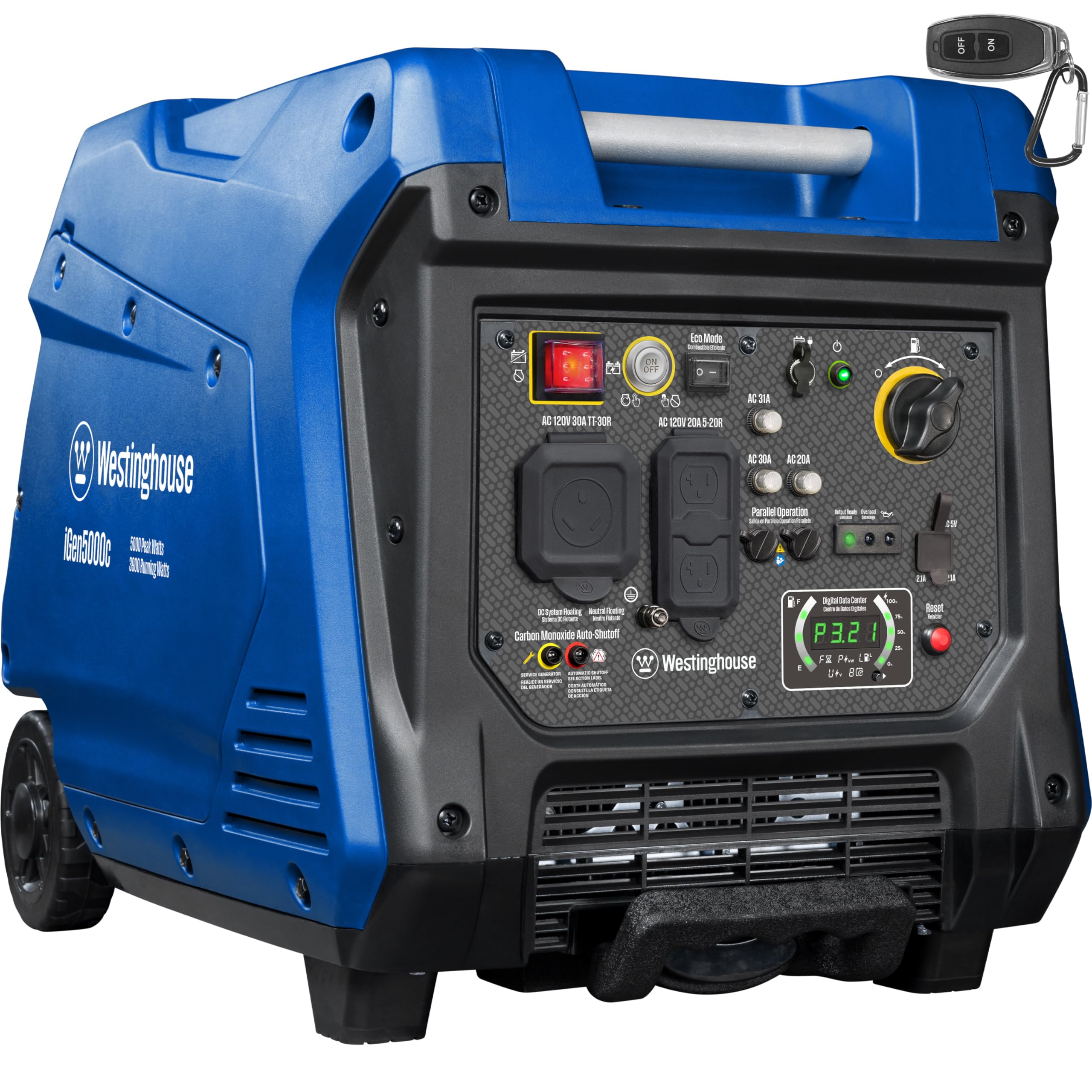
The Westinghouse iGen5000c hits the trifecta for small-house use: it is quiet enough (52 dBA) to run at night without disturbing the household, produces a clean 5000 peak watts with under 3% THD, and includes a remote-start key fob so you can fire it up from your living room during a storm. The telescoping handle and wheel kit make repositioning around a tight patio or garage easy despite its 105-pound heft.
The rotating digital display shows fuel level, runtime remaining, and voltage output, giving you real-time awareness of your load. The Economy Mode adjusts engine speed to match demand, extending the 3.4-gallon tank to an 18-hour runtime at light loads — enough to keep a fridge and a few lights going through an entire night without refueling.
Customer reports confirm it runs an entire 28-foot fifth wheel RV AC and appliances concurrently, meaning it will laugh at a small house’s refrigerator, furnace fan, and entertainment load. The CO shutdown and low-oil shutdown add safety layers. It is the most well-rounded pick for the typical small homeowner who values convenience and quiet above all.
Why it’s great
- Ultra-low 52 dBA noise rating, the quietest in its class.
- Remote electric start with key fob is genuinely useful in bad weather.
- Economy mode delivers up to 18 hours runtime on a single tank.
Good to know
- Gasoline-only — no dual-fuel option for propane users.
- Weighs 105 lbs, so the wheels and handle are essential for moving it.
2. Champion Power Equipment 4000W Dual Fuel

The Champion 4000-watt dual-fuel inverter generator is a compact powerhouse for homeowners who want the flexibility to run on propane. With 4000 starting watts on gas and 3000 running watts, it comfortably powers two fridges, a freezer, and lights simultaneously — one verified owner ran that exact load for 6-12 hours on a single 20-pound propane tank without exhausting it.
At 53 pounds and 64 dBA, this is a genuinely portable and neighbor-friendly unit. The CO Shield auto-shutdown system adds critical safety, and the included propane hose and oil funnel mean you can be running within minutes of unboxing. Dual-fuel operation extends the lifespan of the engine because propane burns much cleaner than gasoline, reducing carbon buildup.
Some users reported intermittent quality control issues, with two units failing within months, though Champion’s warranty and Amazon’s replacement policy typically resolve these quickly. For the small-house owner who wants fuel-choice security and a compact footprint, this remains one of the best values in the mid-range inverter category.
Why it’s great
- Dual-fuel (gasoline and propane) with included LPG hose.
- Lightweight at 53 lbs, easy to carry or wheel to the job site.
- Ultra-quiet 64 dBA operation is campground and neighborhood friendly.
Good to know
- Quality control inconsistency reported by a minority of buyers.
- Running watts drop to 2700W on propane, so calculate your peak load carefully.
3. Cummins Onan P4500I
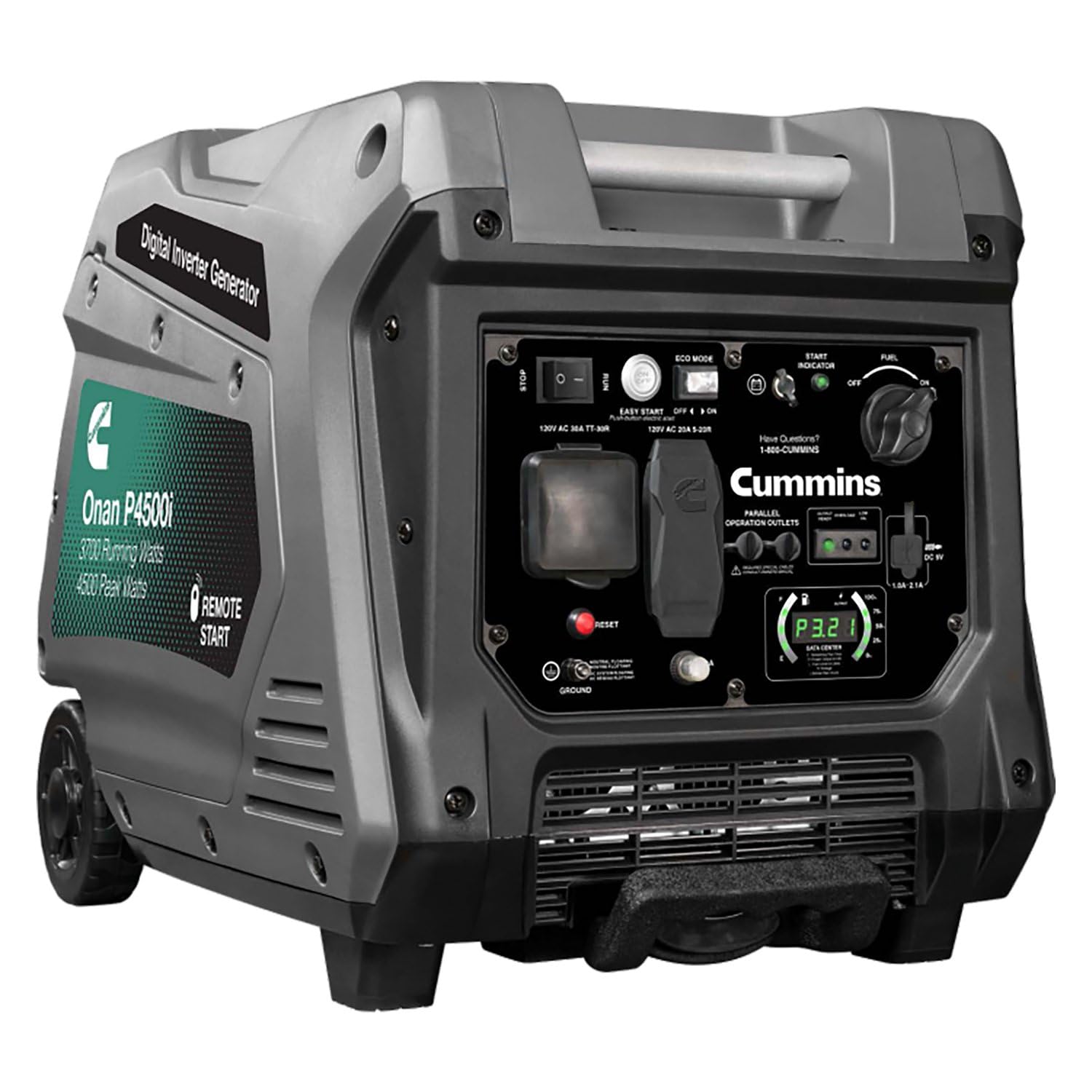
The Cummins Onan P4500I is the premium pick for the small-house owner who expects industrial reliability in a portable package. Its 224cc OHV engine delivers 4500 peak watts and 3700 running watts, and the remote electric start with key fob makes dead-of-night starts effortless. Verified owners report it runs a 50-amp fifth wheel RV at under 50% load, and the voltage stays rock-steady at 120V.
The 98-pound weight is manageable thanks to a luggage-style telescoping handle, and the noise level is low enough that campers report it does not disturb neighboring sites. Dual 5V USB ports and a TT-30R RV outlet cover all the typical small-house outlets. The parallel capability lets you pair two units for 50-amp service if you ever need to scale up.
The main trade-off is the price — this is the most expensive traditional generator on the list. Also, the oil drain access is tight and requires removing a panel. But for buyers who plan to keep a generator for a decade and want Cummins’ reputation for support, the Onan P4500I is a long-term investment that holds its value.
Why it’s great
- Premium build quality from a trusted industrial brand.
- Remote start with fob is a major convenience in cold or wet weather.
- Quiet enough for campgrounds and residential neighborhoods.
Good to know
- Gasoline-only — no dual-fuel or propane option.
- Oil drain access is awkward, requiring removal of a side panel.
4. Jackery Explorer 2000 v2

The Jackery Explorer 2000 v2 is not a generator in the traditional sense — it is a 2042Wh LiFePO4 battery power station that provides silent, zero-emission backup for a small house. At just 39.5 pounds, it is the lightest 2kWh unit on the market, thanks to CTB case technology borrowed from EV battery packs. It powers a full-size refrigerator for over 21 hours, as confirmed by a verified owner, and does so at less than 30 dB — completely inaudible in the next room.
The 2200W AC output handles most small-house essentials: fridge, lights, modem, TV, and a few device charges. The UPS mode switches in under 20 milliseconds during an outage, so your electronics never hiccup. The companion app provides real-time monitoring and remote control. Recharging from 0-80% takes just 66 minutes via AC, making it ready for the next outage before you are.
The obvious limitation is capacity — 2042Wh will not run a well pump or a window AC for long. It is best paired with a gas inverter generator for extended outages or used alone for shorter blackouts. For the small-house dweller who prioritizes silent, fume-free operation and wants the option of solar recharging, this is the cleanest solution available.
Why it’s great
- Silent operation at under 30 dB, ideal for indoor placement.
- Ultra-fast 66-minute AC recharge from 0-80%.
- UPS mode with sub-20ms transfer time protects sensitive equipment.
Good to know
- Limited 2042Wh capacity won’t run high-draw appliances for long.
- Recharging with a 200W solar panel is slow; 400W panels recommended.
5. Anker SOLIX C2000 Gen 2
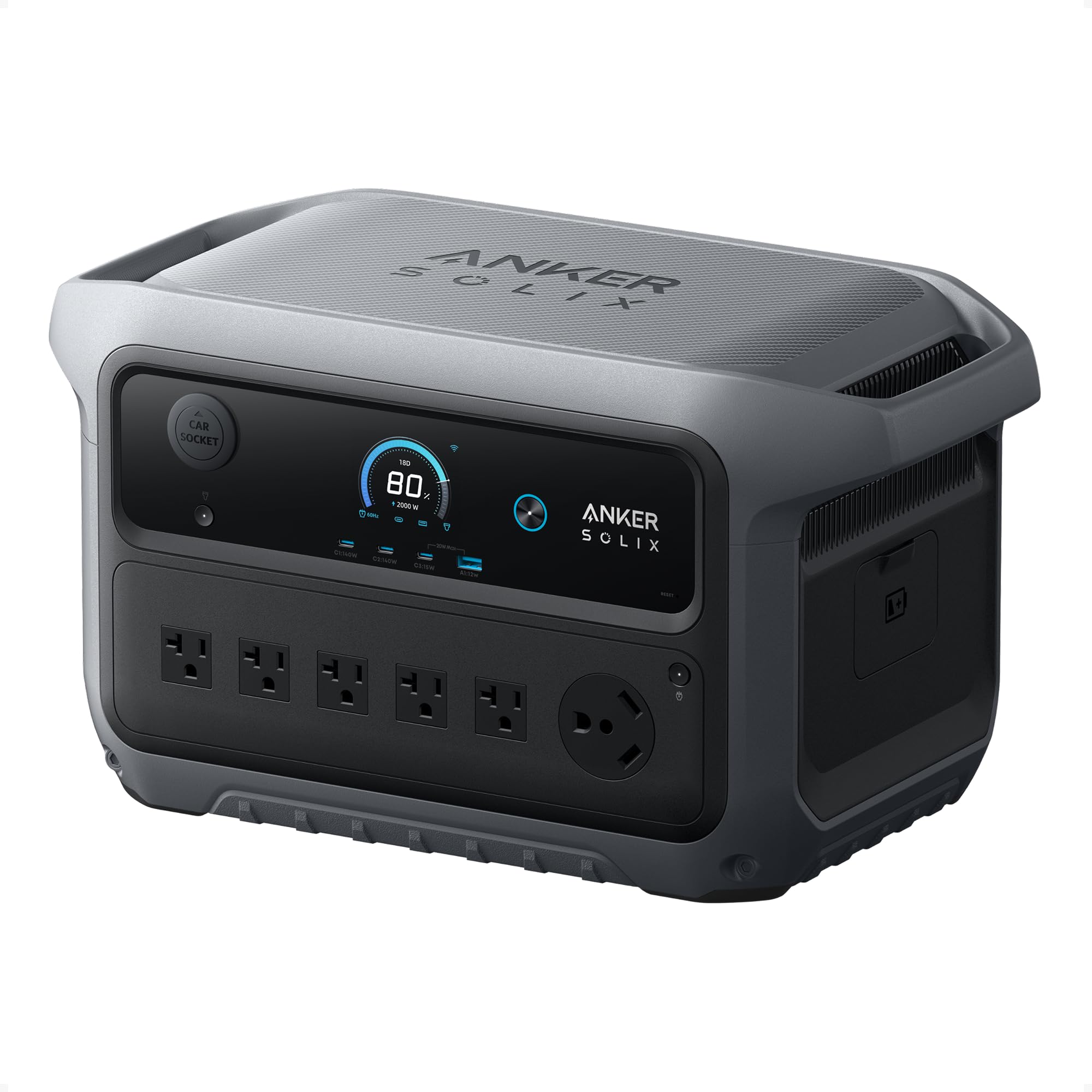
The Anker SOLIX C2000 Gen 2 is a direct competitor to the Jackery 2000 v2, but it differentiates itself with a higher 2400W continuous output (4000W peak) and the ability to fully recharge from zero in just 58 minutes. Its 2048Wh LiFePO4 battery can be expanded to 4kWh with an optional external battery pack, giving it the longest potential runtime of any portable power station in this lineup.
Owners report it powers a 30-quart car fridge for 5-7 days on a single charge, and a full-size fridge, freezer, fan, modem, TV, and lighting for over 10 hours during an outage. The standby power draw is only 9W, meaning it loses very little charge while waiting for the next outage. The companion app gives you granular control and usage predictions.
At 41.7 pounds, it is slightly heavier than the Jackery but still very manageable. The lack of a hardcopy manual is a minor inconvenience — the app serves as the manual. For the small-house buyer who wants the fastest recharge and the option to double the capacity later, the SOLIX C2000 Gen 2 is a future-proof choice in the battery backup category.
Why it’s great
- Full recharge in 58 minutes, the fastest in its class.
- Expandable to 4096Wh with an additional battery for extended outages.
- Very low 9W standby power consumption preserves stored charge.
Good to know
- Slightly heavier than the Jackery at 41.7 lbs.
- No printed manual included, relying on the app for instructions.
6. WEN DF480iX
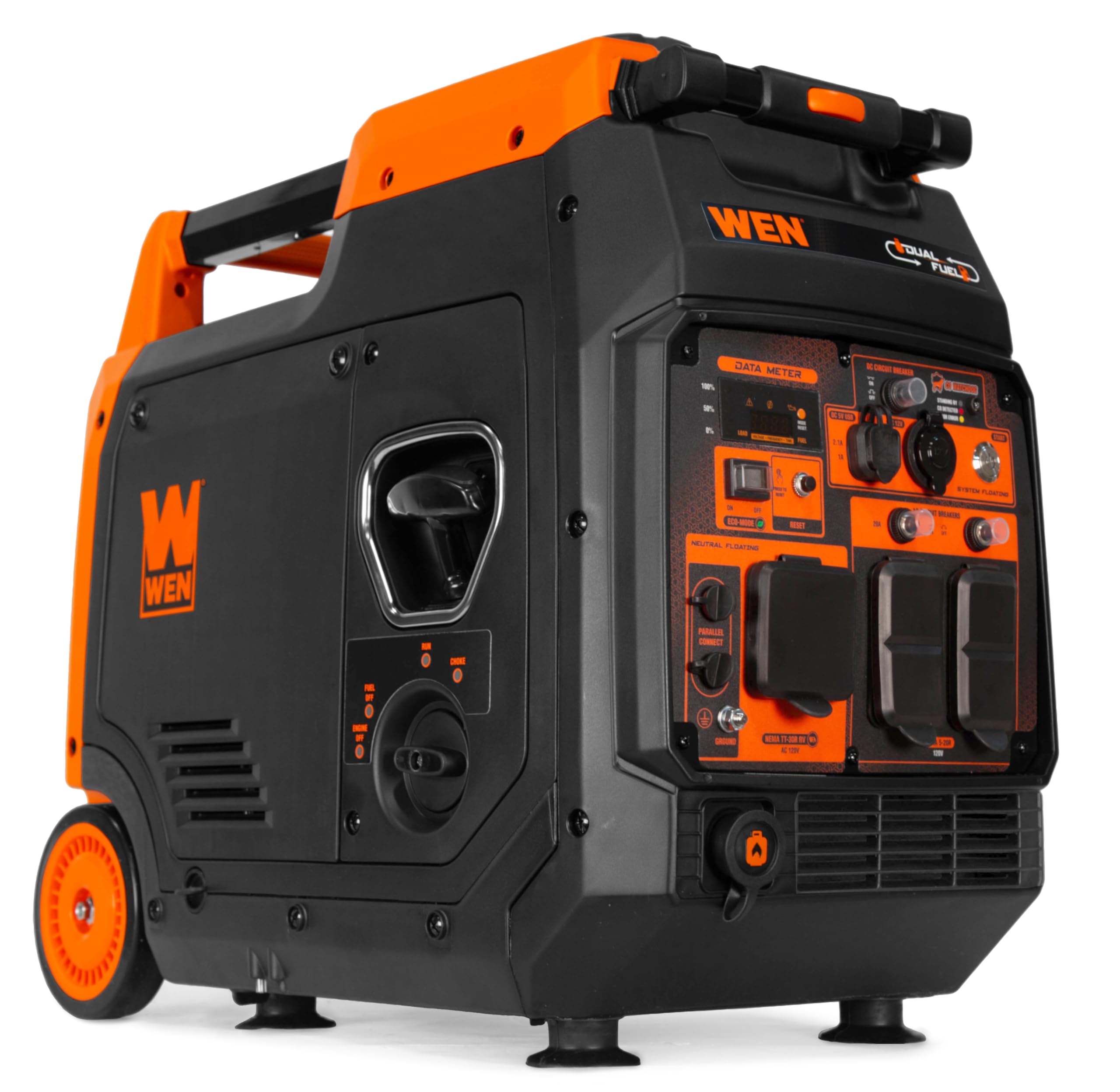
The WEN DF480iX is a 4800-watt surge (4000W rated) dual-fuel inverter generator that offers electric start, a CO Watchdog shutdown sensor, and onboard wheels with a telescoping handle. Its 224cc engine runs on either gasoline or propane, giving you fuel flexibility during extended outages. Verified owners report it reliably powered a fridge, portable AC, lights, TV, and modem for an entire week.
At 78.5 pounds, it is heavier than the Champion 4000W but still manageable with the wheel kit. Operators praise the quiet inverter operation and the fact that propane use eliminates the strong gasoline smell. The hidden oil drain plug is easier to access after you locate it — the manual doesn’t flag it, but it sits below the fill hole.
The main downsides are the lack of an automatic fuel switchover (you must manually switch hoses between gas and propane) and some frustration with the battery connection panel being fiddly to reattach. For the price, however, this unit packs more power and features than most competitors in the mid-range dual-fuel space.
Why it’s great
- Dual-fuel (gasoline/propane) for fuel storage flexibility.
- Electric start with recoil backup for reliability.
- Quiet inverter operation with under 3% THD for sensitive electronics.
Good to know
- No automatic fuel switchover — must manually switch hoses.
- Battery connection access panel is tricky to reattach.
7. WEN DF360iX

The WEN DF360iX is the baby brother of the DF480iX and the lightest dual-fuel inverter generator on this list at just 49 pounds. That 49-pound weight makes it genuinely portable — one person can lift it into the trunk of an SUV without straining. It delivers 3600 surge watts and 2900 rated watts on gasoline (3500/2600 on propane), which is right in the sweet spot for a small house.
Owners report it starts on the first or second pull on both gas and propane, and the digital display shows voltage, frequency, runtime, load percentage, and fuel level. The CO Watchdog auto-shutdown system adds safety. A 20-pound propane tank ran the unit for hours without depleting, and the carburetor drain valve simplifies storage maintenance.
The only consistent complaint is that the 20-amp household outlets hold plugs loosely, which could be an issue with heavier-gauge extension cords. For the small-house owner who prioritizes portability and dual-fuel capability above raw wattage, the DF360iX is an excellent lightweight companion that covers the essentials.
Why it’s great
- Ultra-lightweight at 49 pounds, easy for one person to load.
- Dual-fuel operation on gasoline or propane.
- CO Watchdog sensor and fuel shut-off for safe storage.
Good to know
- 20A outlets hold plugs loosely — use twist-lock adapters for heavy loads.
- Some units arrived with a broken propane regulator, though WEN replaced it quickly.
8. AMERISUN AM5046C
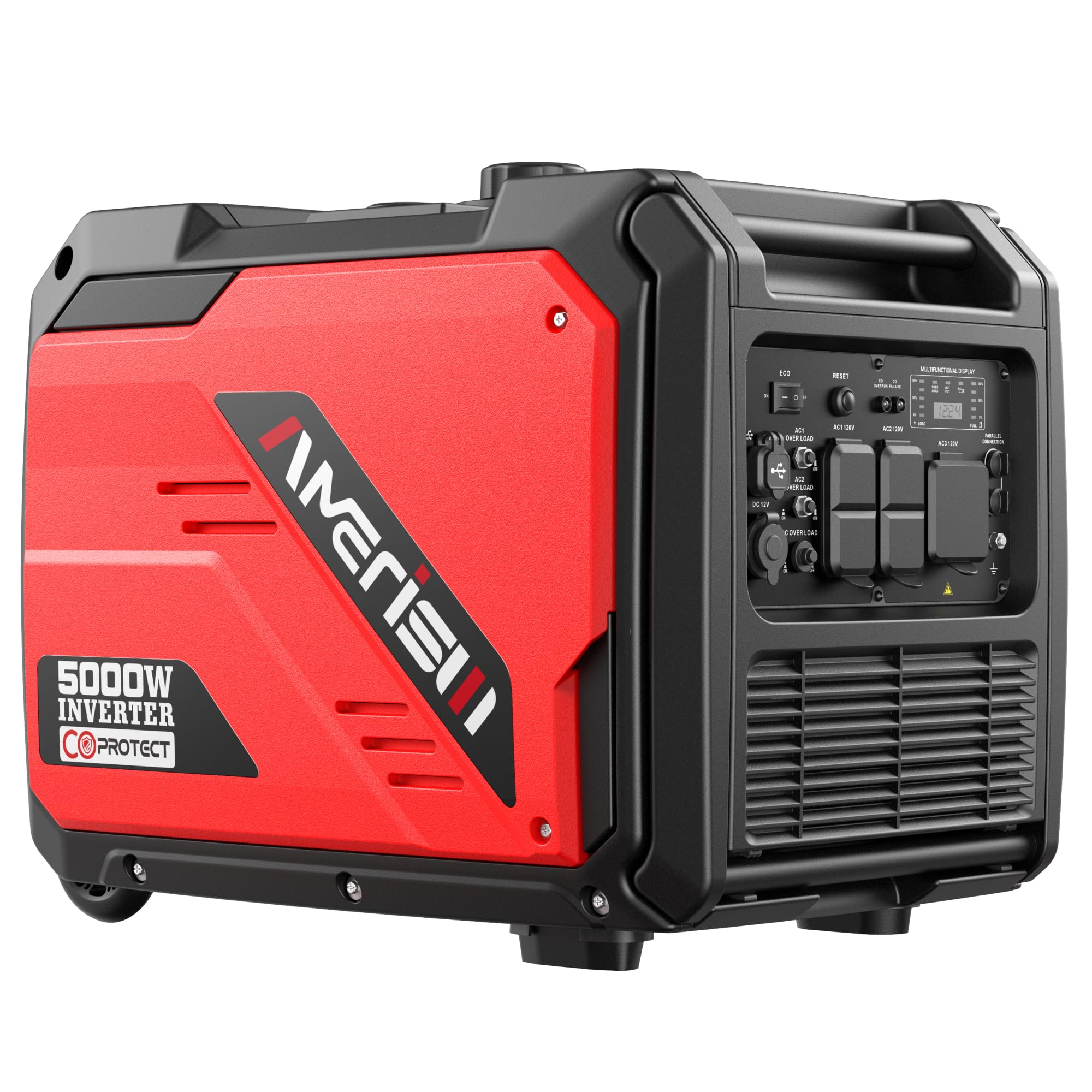
The AMERISUN AM5046C is a 5000-watt surge (4000W rated) inverter generator that punches above its price point with features usually found on more expensive units. The 223cc OHV engine produces clean power at 70 dBA — not the quietest on the list, but well within acceptable range for a generator this size. It runs for up to 10 hours on a 3.43-gallon tank at half load.
Owners praise its ability to start on the first pull and run a fridge, TV, PS5, CPAP machine, and washing machine simultaneously without any power fluctuation. The CO sensor light adds a real-time safety alert, and the built-in wheels and handle make moving it around the yard straightforward. One verified owner reported 11+ hours of runtime on just one gallon of gas.
The main drawback is the false advertising claim on the Amazon listing stating “made in USA” — the unit is made in China, which disappointed one buyer. Performance-wise, it delivers, but the 70 dBA noise level means it is not the best choice for close-quarters neighborhoods. For the budget-conscious small-house buyer who needs 5000 watts on tap, this is hard to beat.
Why it’s great
- High 5000W surge power at a competitive price point.
- CO sensor light for real-time carbon monoxide detection.
- 10-hour runtime at half load, enough for an overnight outage.
Good to know
- Noise level of 70 dBA is louder than premium inverter competitors.
- Listed as “made in USA” but actually manufactured in China.
9. PowerSmart PS5046CE
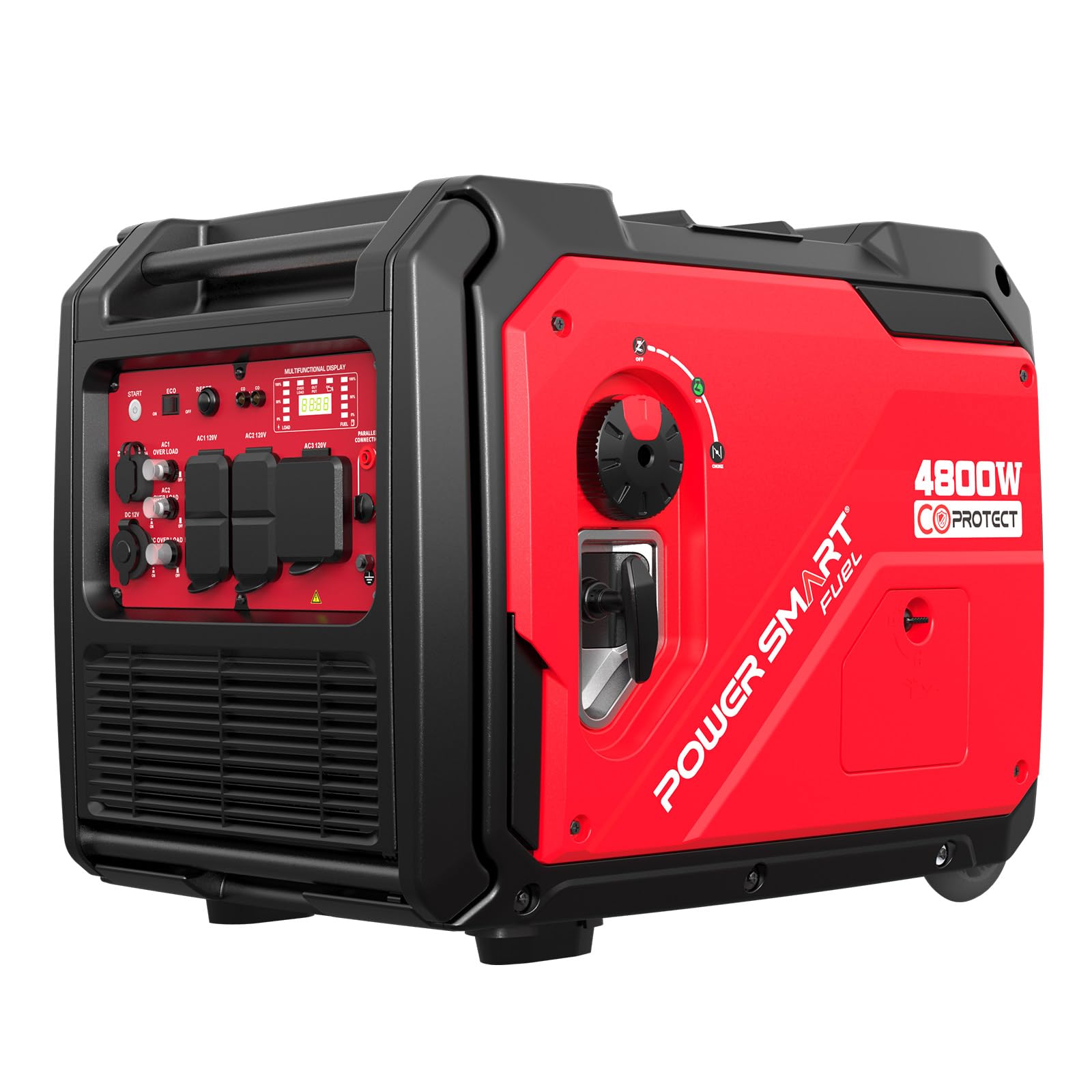
The PowerSmart PS5046CE is a 4800-watt surge inverter generator that is surprisingly light at 68 pounds and compact (16x16x19 inches) for the power it offers. The 223cc OHV engine includes one-touch electric start with a manual recoil backup, and the built-in parallel terminals let you connect a second unit to double your output for larger loads. The CO alarm automatically shuts the engine down if dangerous CO levels are detected.
Verified owners report it runs a window AC, fridge, lights, and an RV on 30-amp service without issue, and the 3.43-gallon tank provides up to 10 hours of runtime at 50% load. The clean sine wave output from the 5V USB ports safely charges laptops and medical equipment. The noise is rated at 67 dBA, which is quieter than the AMERISUN but still audible in a quiet neighborhood.
The biggest risk is reliability — one owner reported a complete failure after limited use that a repair shop could not fix. Others have had excellent experiences, so this unit may have some quality variance. For the buyer who wants a lightweight, parallel-ready inverter with electric start and is comfortable rolling the dice on a budget-friendly unit, the PS5046CE is a capable performer.
Why it’s great
- Lightweight at 68 lbs and compact form factor.
- Electric start with recoil backup for easy ignition.
- Parallel ready for doubling power output with a second unit.
Good to know
- Reliability concerns — some units fail without warning.
- No oil included in the box, must buy separately before first use.
10. Pulsar PGD40ISCO

The Pulsar PGD40ISCO weighs just 47.3 pounds and runs at 59 dBA, making it the lightest and one of the quietest inverter generators on this list. It delivers 4000 peak watts and 3200 running watts — enough for a small house’s essentials plus an RV air conditioner up to 13,500 BTU when paired with a soft start. The 1-gallon fuel tank is small, giving only 4 hours of runtime at half load, so this is more of a short-duration backup or camping companion.
Owners report it starts on the first pull even at 8000 feet elevation, and it has accumulated over 300 hours of use with regular oil changes and spark plug replacements. The parallel-ready feature lets you combine it with another PGD40ISCO for double the output. The compact size (18.9 x 11.4 x 17.3 inches) means it stores easily in a shed or garage corner.
The absence of wheels is a notable omission — on rough terrain, you will need to carry it by the handle. The fuel tank is small, so you will be refilling frequently during extended outages. For the ultra-lightweight category, where portability and quiet operation matter most, the Pulsar is an excellent option for short-run backup power.
Why it’s great
- Incredibly light at 47.3 lbs, easiest to carry of any unit here.
- Very quiet at 59 dBA, comparable to normal conversation.
- Compact size fits in tight storage spaces.
Good to know
- No built-in wheels, must carry it manually.
- Small 1-gallon fuel tank provides only 4 hours of runtime.
11. A-iPower GXS5000
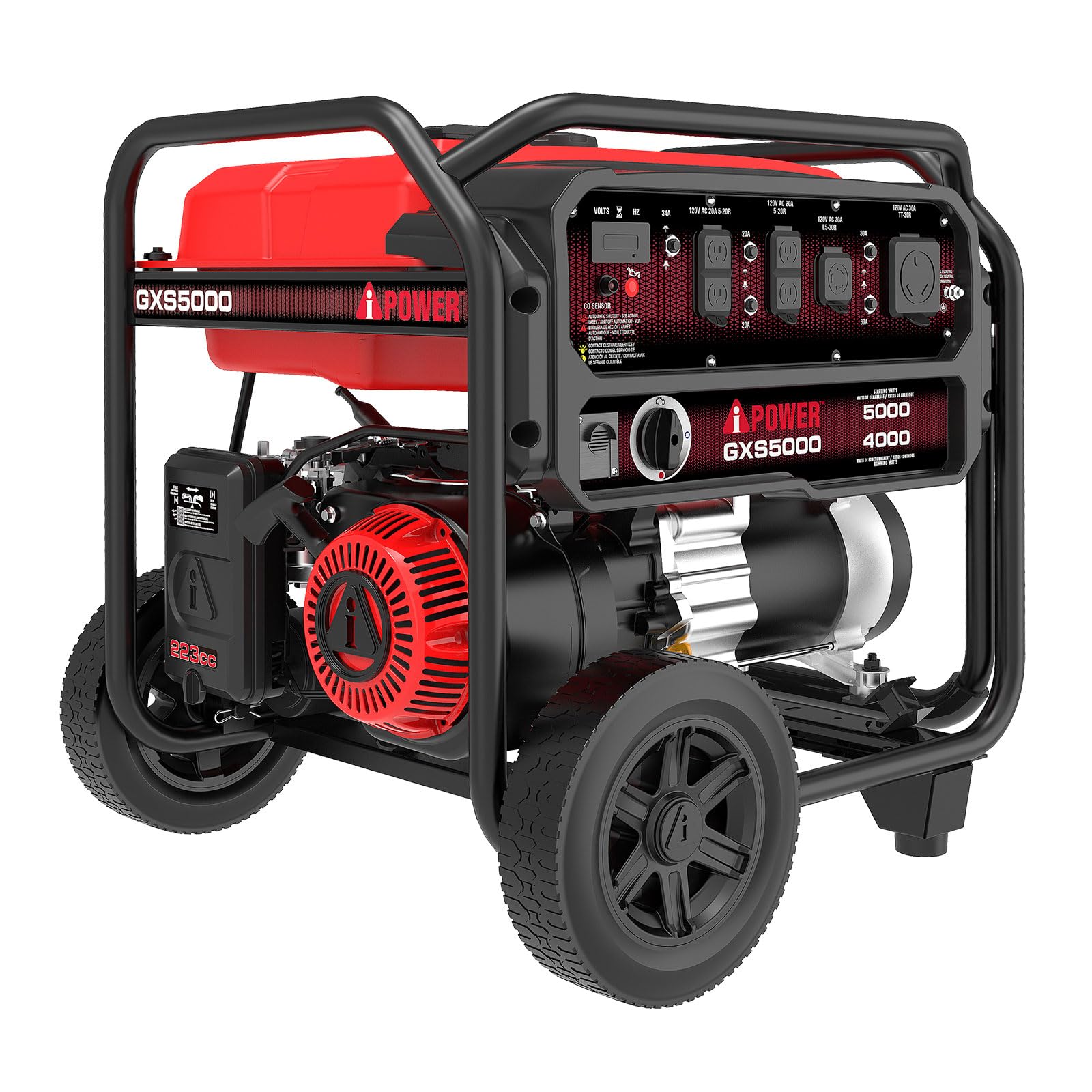
The A-iPower GXS5000 is the only conventional (non-inverter) generator on this list, and it earns its spot by offering the most raw power for the lowest upfront cost. Its 223cc OHV cast-iron sleeve engine produces 5000 starting watts and 4000 running watts, enough to handle a 3.5-ton AC and a 2HP well pump starting simultaneously — verified by a homeowner. The 6.3-gallon fuel tank delivers a class-leading 20-hour runtime at 25% load.
At 111.6 pounds, this is a heavy machine, but the noise level is a reasonable 68 dBA for a conventional frame. The control panel is well-equipped with a CO sensor, data center display, duplex 120V outlets, a TT-30R RV outlet, and an L5-30R twist-lock. Owners report running 80 hours straight during Hurricane Irma powering a fridge, 12k BTU AC, TV, and game consoles without a hiccup.
The lack of inverter technology means THD is higher than 3%, so you should avoid plugging sensitive electronics directly in without a line conditioner. The 20-hour runtime is impressive, but the conventional engine burns significantly more fuel than an inverter engine under partial load. For the budget-focused small-house owner who needs maximum surge power for appliances and tools and does not mind the extra weight and fuel consumption, the GXS5000 is a proven workhorse.
Why it’s great
- Best power-to-price ratio — 5000W surge for the lowest investment.
- 20-hour runtime at 25% load eliminates middle-of-the-night refueling.
- Cast-iron sleeve engine is built for longevity.
Good to know
- Conventional alternator produces higher THD — not ideal for sensitive electronics.
- Heavy at 111.6 lbs, requires two people or a dolly to move.
FAQ
Can a 3000-watt generator run a small house?
Is a dual-fuel generator worth it for a small house?
How many watts do I need for a refrigerator and a window AC?
Final Thoughts: The Verdict
For most users, the generator for small house winner is the Westinghouse iGen5000c because it delivers the best combination of remote-start convenience, class-leading quietness at 52 dBA, and reliable 5000-watt surge power in a single-fuel inverter package. If you want dual-fuel flexibility for fuel storage peace of mind, grab the Champion 4000W Dual Fuel. And for silent, fume-free indoor backup that can recharge in just over an hour, nothing beats the Jackery Explorer 2000 v2.