
Memory games sit on a strange shelf: they are sold as toys, but their real job is cognitive maintenance. Whether you are keeping a toddler’s developing brain sharp or slowing the fog that creeps in with age, the right set does not rely on flashy packaging — it relies on card stock weight, illustration logic, and how many milliseconds the brain needs to register a correct pair. After analyzing the physical build, print quality, and real-world feedback from speech therapists, occupational therapists, and families, one thing becomes clear: these five games represent the smartest options for every memory stage you are likely to face.
I’m Mohammad Maruf — the founder and writer behind Drink4Good. I have spent hundreds of hours cross-referencing customer reviews with technical specs, durability benchmarks, and therapeutic applications to separate memory games that actually work from those that just sit on a shelf.
Below, I have stacked, weighed, and scrutinized every deck and tile to deliver a no-nonsense breakdown of the best games for memory on the market right now.
How To Choose The Best Games For Memory
Not every memory game challenges the brain the same way. A toddler needs bright, identical pairs with high-contrast backgrounds to build basic object permanence. A senior with early dementia needs associative matches — items that belong together, like a toothbrush and toothpaste — to stimulate neural pathways without causing frustration. The common mistake is buying a game that looks fun rather than looking at the cognitive demand it actually places on the player.
Physical Durability
Paperboard cards with a thin laminate will peel at the corners within twenty rounds. The best memory games use thick card stock — think 400 gsm or higher — or solid wood tiles that can survive drops, spills, and the aggressive grip of small hands. A coating that is water-resistant not smudge-prone adds years of playable life. For therapy settings where the same deck gets used multiple times a day, this is the single most important spec.
Matching Logic and Cognitive Demand
There are two main designs: identical matching (find two of the same image) and associative matching (find items that go together). Identical matching is ideal for children under four and for early-stage cognitive exercises because it requires only visual recognition. Associative matching, seen in sets like the Go Together flash cards, demands higher-order reasoning and is far more effective for speech therapy, ESL learners, and adults recovering from neurological events. If you only check one thing before buying, check how the pairs are formed.
Target Age and Skill Range
Many sets claim a wide age range but functionally work best within a narrow band. A game with 150 cards and negative-number scoring, like Skyjo, will baffle a five-year-old but delight a group of teenagers or adults. A wooden set with 18 pairs and a color-coded background, like the Cottify Montessori game, is perfect for ages two to four but will bore an eight-year-old in ten minutes. Match the game to the player’s current cognitive stage, not the optimistic label on the box.
Quick Comparison
On smaller screens, swipe sideways to see the full table.
| Model | Category | Best For | Key Spec | Amazon |
|---|---|---|---|---|
| Ravensburger Great Outdoors | Matching | Family play, ages 3+ | 48 sturdy tiles, 15-min play | Amazon |
| CreateFun Go Together | Associative | Speech therapy & dementia care | 50 photo cards, water-resistant | Amazon |
| magilano SKYJO | Card Game | Family game nights, ages 8+ | 150 cards, 30-min play | Amazon |
| Cottify Wooden Matching | Matching | Toddlers 2-4 years | 36 wooden discs, carry bag | Amazon |
| Match a Pair of Birds | Matching | Bird lovers & educational play | Thick cards, male/female pairs | Amazon |
In‑Depth Reviews
1. Ravensburger Great Outdoors Memory Game

Ravensburger has a reputation for tile thickness that rivals premium board games, and this Great Outdoors set delivers exactly that. Each tile measures roughly the thickness of three stacked business cards, which means they survive being bent by small fingers and can be shuffled aggressively without fraying at the edges. The 48 tiles are all identical in shape and back-pattern, so there are no visual tells — your brain has to work purely off memory of the front-side illustration.
The artwork here is the star. Unlike many memory games that use generic clip art, Ravensburger commissioned original scenes — a tent, a campfire with s’mores, a canoe, various forest animals — that are distinct enough to avoid confusion but detailed enough to require real focus. Reviewers noted that the background colors vary between tiles, which actually makes the game slightly easier than some other Ravensburger sets, lowering the frustration floor for younger players. The 15-minute playtime is accurate and respects short attention spans.
For a family with mixed-age players — say a four-year-old and a ten-year-old — this is the safest buy on the list. The cognitive load is moderate: identical matching with strong visual anchors. No reading required, no scoring complexity. It just works, and it works for years. If your household needs one memory game that bridges toddler territory and adult patience, this is it.
Why it’s great
- Tiles are noticeably thick and won’t bend after repeated play
- Illustrations are charming without being confusing
- 15-minute playtime fits perfectly between meals or bedtime
Good to know
- Older kids and adults may find it too easy after a few rounds
- Only 24 pairs — advanced players might want more tiles
2. CreateFun Go Together Flash Cards
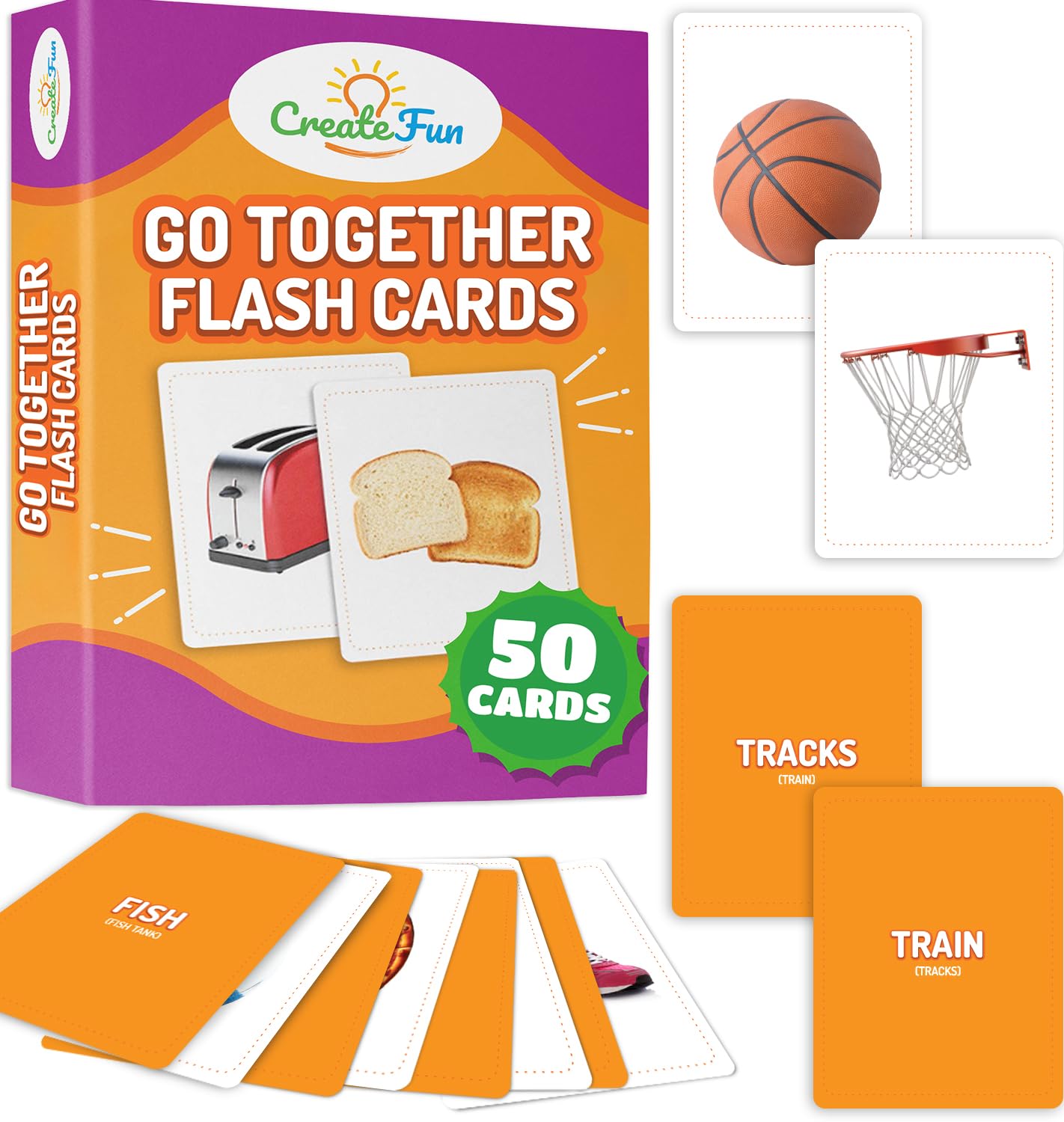
This is not a standard memory game. Instead of matching two identical pictures, you match items that belong together in real life — a lock with a key, a sock with a shoe, a toothbrush with toothpaste. That shift in logic changes the cognitive demand entirely. The player must understand functional relationships, not just visual symmetry. Speech-language pathologists use these cards precisely because of that difference: the associative matching prompts conversation, reasoning, and sequencing skills that identical matching cannot reach.
The physical quality is built for high-frequency handling. Each card has a smudge-proof, water-resistant coating that wipes clean after sticky fingers. The 50 cards (25 pairs) are printed on sturdy card stock with realistic photography rather than cartoons — a deliberate choice that helps elderly users and those with dementia connect the images to familiar real-world objects. The dimensions, roughly 3.5 by 4.5 inches, are large enough to read easily but small enough to lay out in a six-card grid on a table.
Reviewers consistently mention use cases that go far beyond the box label: occupational therapists use them in stroke recovery, caregivers deploy them for Alzheimer’s activities, and ESL teachers rely on them for vocabulary building. If your situation involves rehabilitation, language delay, or age-related cognitive decline, this set belongs at the top of your list. The only real limitation is that it does not follow a classic memory-game format — there is no Hidden Treasure reveal mechanic — so children expecting a timed matching race may need guidance.
Why it’s great
- Associative matching exercises higher-order thinking, not just visual recall
- Water-resistant coating holds up to daily use in therapy settings
- Realistic photos are clear and universally recognizable
Good to know
- Not a traditional memory game with a face-down reveal mechanic
- Young children may need help understanding the association concept
3. magilano SKYJO Card Game

SKYJO operates on a completely different memory principle than the matching games above. Each player has twelve cards arranged face-down in a grid, and over several rounds you flip, exchange, and discard cards to minimize your point total. The memory challenge here is not about matching images — it’s about tracking which cards have been discarded, which positions your opponents have revealed, and which columns are low-value. That tracking requirement makes working memory the primary cognitive muscle being trained.
The card quality matches the German-engineering reputation of the manufacturer. The stock is thick enough to stand up to frequent shuffling and the included scoring pad is a thoughtful touch for competitive groups. Negative-value cards in the deck add a scoring twist that forces players to recalibrate their strategy mid-game. At thirty minutes per round and supporting up to eight players, this is the most social game on the list — it works equally well for a couple on a quiet evening and a large family gathering.
This is not a game for young children. The age recommendation of 8+ is accurate; the scoring involves adding two-digit numbers, and the strategic layer of negative cards will frustrate anyone who is not comfortable with basic math. But for teens and adults, SKYJO delivers a memory workout that feels like a party game. The replayability is excellent because the initial deal is random and the discard decisions change every round. If your goal is to sharpen working memory in a low-stakes, high-fun environment, this is the strongest pick.
Why it’s great
- Working memory training disguised as a competitive card game
- High-quality cards and compact box are travel-friendly
- Huge player count range (2-8) with fast 30-minute rounds
Good to know
- Requires basic addition skills — not suitable for children under 8
- Negative-value cards add complexity that some casual players dislike
4. Cottify Montessori Wooden Matching Game

The moment you pick up one of these wooden discs, you understand why this game justifies its position among premium options. Each disc is cut from solid basswood with a silk-finish paint layer that resists chipping and feels pleasant in the hand. The 2.2-inch diameter is large enough that toddlers can grasp them easily but small enough that a full 36-disc set fits in the included drawstring pouch. For families with children between ages two and four, this is the tactile gold standard.
The educational design goes beyond simple matching. Every illustration sits on a different-colored background, which provides an additional visual cue — a child who cannot yet distinguish the lion from the monkey can still succeed by matching background colors. That scaffolding is intentional. As the child improves, you can introduce the full memory game: place all discs face-down, take turns flipping, and find identical pairs. The progression from simple color-matching to full memory play means this single product serves a child for two to three years of cognitive development.
Reviewers with eighteen-month-olds report using the discs for face-up matching and vocabulary building long before the formal memory rules come into play. The only consistent criticism involves the back-side design: the reverse shows three identical animal heads, which toddlers sometimes mistake as part of the matching criteria. A simpler abstract pattern on the back would have eliminated that confusion entirely. Still, for raw durability and developmental range per dollar, this wooden set outperforms every paper-card alternative in the toddler space.
Why it’s great
- Solid basswood discs are virtually indestructible under normal toddler use
- Color-coded backgrounds scaffold the learning process for very young children
- Carry pouch makes it easy to pack for restaurants or travel
Good to know
- Back-side pattern with three animal heads can confuse younger toddlers
- Only 18 pairs — older children may outgrow it quickly
5. Match a Pair of Birds: A Memory Game

This is a memory game that doubles as a coffee-table artifact. Published by Laurence King, the deck features scientifically accurate watercolor bird illustrations that are vivid enough to frame. The twist: you match male and female birds of the same species, not two identical birds. A male cardinal in brilliant red matches a female cardinal in muted brown. That design choice dramatically increases the difficulty because the brain has to first identify the species and then recall that the other color variant belongs to the same bird.
The card stock is genuinely impressive. At 2.31 pounds for the full package, each card feels dense and substantial, with a matte finish that resists glare and fingerprints. The accompanying booklet is thin on text, but the visual field-guide quality of the illustrations compensates — you can learn actual ornithology while playing. Bird enthusiasts across multiple reviews called this the perfect gift because it bridges a niche interest with a universally familiar game format.
The elevated difficulty is a double-edged sword. Multiple reviewers noted that elderly players with excellent memory still struggled because the male-female matching logic is unintuitive for a traditional memory game format. If the primary goal is relaxation or therapy for an older adult, this is not the right deck. But for a bird-loving family, a classroom studying biology, or an adult who wants a genuinely challenging visual memory workout, this set delivers an experience no other game on this list can match. The box is sturdy enough to survive thirty years of play.
Why it’s great
- Male-female matching logic creates a difficult, rewarding cognitive challenge
- Premium card stock and beautiful illustrations justify the higher cost
- Educational content doubles as a real bird identification tool
Good to know
- Too difficult for elderly players or beginners — frustration potential is high
- Small booklet provides minimal support for bird identification
FAQ
How many card pairs do I need for an effective memory workout?
Can memory games really help with dementia or Alzheimer’s?
Why do some memory games have different back designs on the cards?
Final Thoughts: The Verdict
For most users, the games for memory winner is the Ravensburger Great Outdoors Memory Game because it balances durable tiles, charming artwork, and a 15-minute play window that respects every age group. If you need associative reasoning for therapy or language development, grab the CreateFun Go Together Flash Cards. And for a competitive working-memory workout disguised as a party game, nothing beats the magilano SKYJO.