
The “toy graveyard” is real by age eight. Kids at this stage crave independence, real skills, and challenges that don’t feel like schoolwork. A gift that lands flat—too babyish or too complex—gets one play and then lives under the bed. The right pick, however, sparks a weeks-long obsession with building, experimenting, or mastering a new skill, all while feeling like pure fun.
I’m Mohammad Maruf — the founder and writer behind Drink4Good. I’ve spent hundreds of hours analyzing STEM toy specifications, reading through parent-verified reviews, and cross-referencing age-appropriateness metrics to find the gifts that actually hold an eight-year-old’s attention. This guide focuses on concrete specs like logic challenge quantity, piece counts, and instructional depth, not just marketing claims.
Whether you are shopping for a budding engineer, a nature explorer, or a future performer, this guide to the very best gifts for 8 year olds breaks down five top contenders across the key categories of hands-on learning and creative play.
How To Choose The Best Gifts For 8 Year Olds
Eight-year-olds are in a sweet spot: they have the fine motor skills for detailed builds, the reading comprehension for multi-step instructions, and the curiosity to ask “why.” The best gifts channel this energy into focused play. Avoid anything that requires no thought (purely passive) and anything with a steep barrier to entry that requires constant adult intervention. Look for a clear progression, from simple beginnings to more complex challenges.
Challenge Count and Replay Value
The number of unique challenges, experiments, or builds included in a kit directly predicts how long it will hold a child’s interest. A kit with 10 experiments might entertain an afternoon, while 60+ logic puzzles or 135 science activities can provide weeks of daily engagement. Check the “included components” list for specific numbers—this is the single most concrete measure of a gift’s staying power for an 8-year-old.
Skill Focus: Logic vs. Creativity vs. Performance
Consider the child’s natural inclination. Logic-driven kids will gravitate toward spatial reasoning challenges like marble mazes or building sets with specific end-goals (like a 3-in-1 animal model). Creative kids thrive with open-ended science kits where they can mix, observe, and hypothesize. Performance-oriented children need a stage-ready skill—magic tricks with video instruction are a perfect fit, as they combine learning with an audience payoff.
Quick Comparison
On smaller screens, swipe sideways to see the full table.
| Model | Category | Best For | Key Spec | Amazon |
|---|---|---|---|---|
| ThinkFun Gravity Maze | Logic Game | Problem-solving & spatial reasoning | 60 progressive challenges | Amazon |
| LEGO Creator 3in1 Hummingbird | Building Set | Creative construction & display | 312 pieces, 3 build options | Amazon |
| Doctor Jupiter Science Kit | Science Kit | Hands-on STEM exploration | 135+ experiments included | Amazon |
| BMDSAE Digital Microscope | Science Tool | High-magnification discovery | 1000X magnification, 2″ screen | Amazon |
| National Geographic Magic Set | Performance Kit | Learning & performing magic | 45 tricks with video lessons | Amazon |
In‑Depth Reviews
1. ThinkFun Gravity Maze

The ThinkFun Gravity Maze earns the top spot by bridging the gap between pure building and pure logic. It tasks kids with constructing a path using 9 towers so that a marble lands in a target zone—a simple premise that demands spatial reasoning and forward planning. The 60 challenge cards are graded from beginner to expert, which gives this game genuine longevity; a child who breezes through the first 20 cards will find the later ones stump adults.
What makes this a standout among gifts for 8 year olds is the instant feedback loop: if you built it wrong, the marble falls off the track. There is no waiting for a parent to check an answer key. The pieces are high-quality ABS plastic with a satisfying weight, and the game grid keeps everything contained. Customer reviews consistently mention that kids who love puzzles and building request this toy daily, while those who prefer more passive play might lose interest—so it is best for a child with a natural inclination toward problem-solving.
The one limitation is that the challenge set is fixed. Once a child solves all 60, there is no expansion pack. However, for most 8-year-olds, mastering the full set takes weeks, and the replay value for simple marble-run free play remains high. It is an award-winning STEM toy that delivers on its promise of cognitive development without feeling like homework.
Why it’s great
- 60 progressive challenges provide weeks of engagement
- Instant hands-on feedback; no screen needed
- High-quality, durable pieces and game grid
Good to know
- Later puzzles may feel repetitive to advanced solvers
- No expansion packs; fixed challenge set
2. LEGO Creator 3in1 Hummingbird
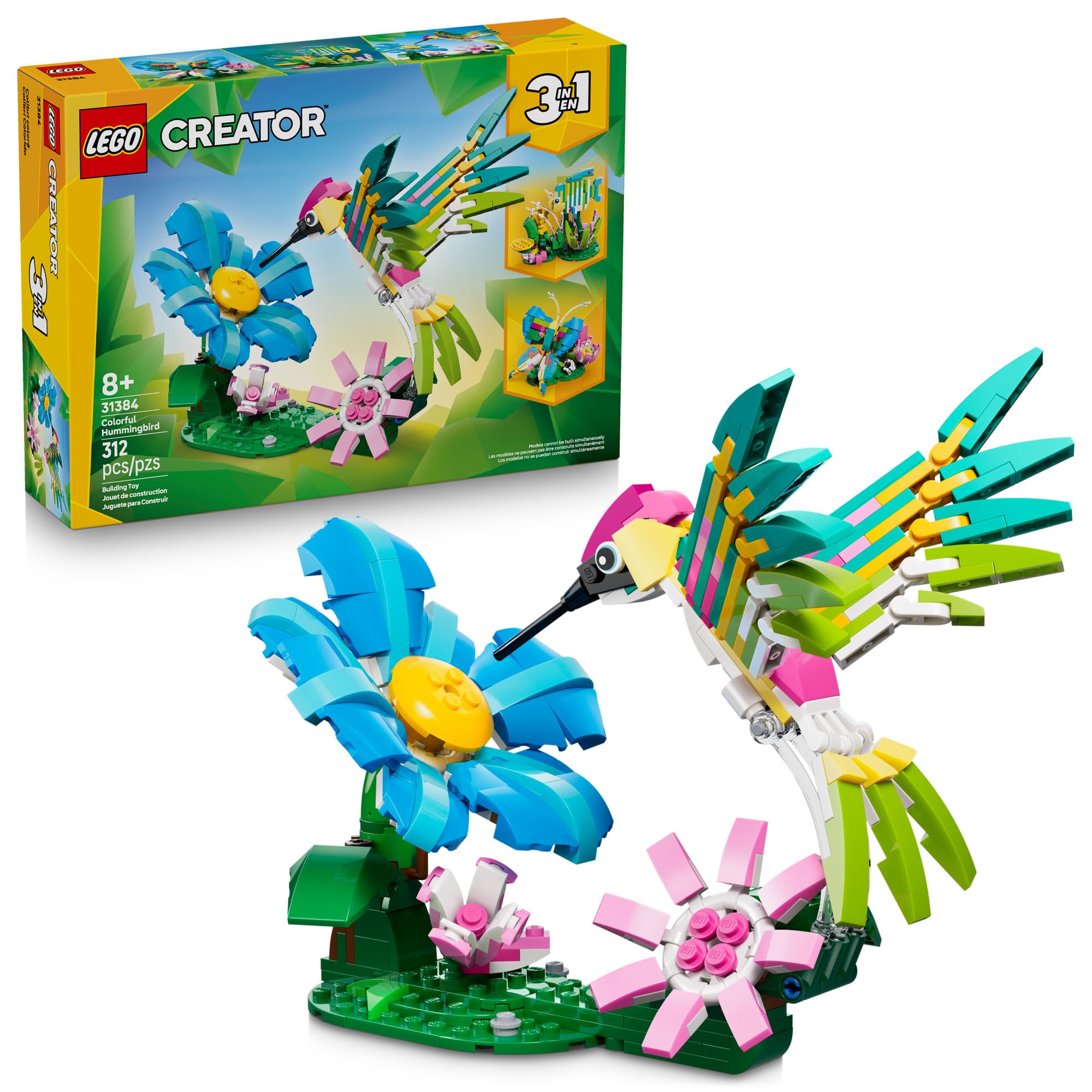
LEGO Creator sets are a reliable choice, but this Hummingbird model stands out for a specific reason: it is display-worthy. The finished bird, perched on a stand with flowers, measures over 6 inches tall and features vibrant pinks, blues, and greens that pop on a shelf. The 312-piece count hits the sweet spot for an 8-year-old—enough of a build to feel like an achievement without overwhelming a builder of average patience.
The 3-in-1 design is the core value proposition. After building the hummingbird, the kid can dismantle it and reconstruct it into a butterfly or a tropical fish. This effectively triples the play-to-cost ratio. The instruction manual is clear, and the LEGO Builder app adds a 3D zoom-and-rotate feature that visually-oriented kids find intuitive. The hummingbird’s wings and tail are posable, which adds a subtle kinetic element that makes the model feel alive.
One honest note: like all LEGO Creator sets, only one model can be built at a time. Some children are reluctant to take apart a finished build to start another. This is a minor behavioral hurdle, but the high-quality standard of LEGO bricks (consistent clutch power and color accuracy) ensures the set survives multiple rebuilds. It is a perfect gift for a child who enjoys calm, methodical work and wants something to show for it.
Why it’s great
- Three distinct animal builds from one set of bricks
- Excellent display quality with vibrant, unique colors
- Posable wings and tail add play value
Good to know
- Only one model can be built at a time
- Requires patience; not a quick ten-minute build
3. Doctor Jupiter Ultimate Science Kit

When evaluating a science kit, the critical metric is not just the number of experiments claimed, but whether the materials are included and organized. The Doctor Jupiter kit sets a high bar with 135+ experiments, all of which use the provided chemicals, food coloring, and lab tools (conical flask, measuring cylinder, test tube stand). The instruction manual is lay-flat and colo-coded, with a separate bonus booklet for experiments using household items—a smart way to stretch the kit further.
The experiments range from classic volcanoes and color-changing liquids to soap-making with included molds and food essences. This variety keeps the kit from feeling repetitive. Parents report that the materials come in separate, leak-proof bottles, which is a practical detail that prevents the entire kit from becoming a single, ruined mess. The “time to complete” estimates on each experiment help an 8-year-old plan their session, reducing frustration from abandoned half-finished projects.
The main trade-off is scale. Each experiment uses small quantities of materials, so a child who loves repeating an experiment six times might run out of baking soda or citric acid faster than expected. A few reviewers noted that the crystal powder supply was limited. Still, for the price point, the sheer density of included, organized activities makes this the strongest value proposition for a child who loves to mix, observe, and hypothesize.
Why it’s great
- Over 135 experiments with all core materials included
- Time estimates and clear instructions for each activity
- Separate leak-proof bottles prevent mess and waste
Good to know
- Material quantities are limited; may need refills for repeat experiments
- Requires adult supervision for some experiments
4. BMDSAE 1000X Digital Microscope
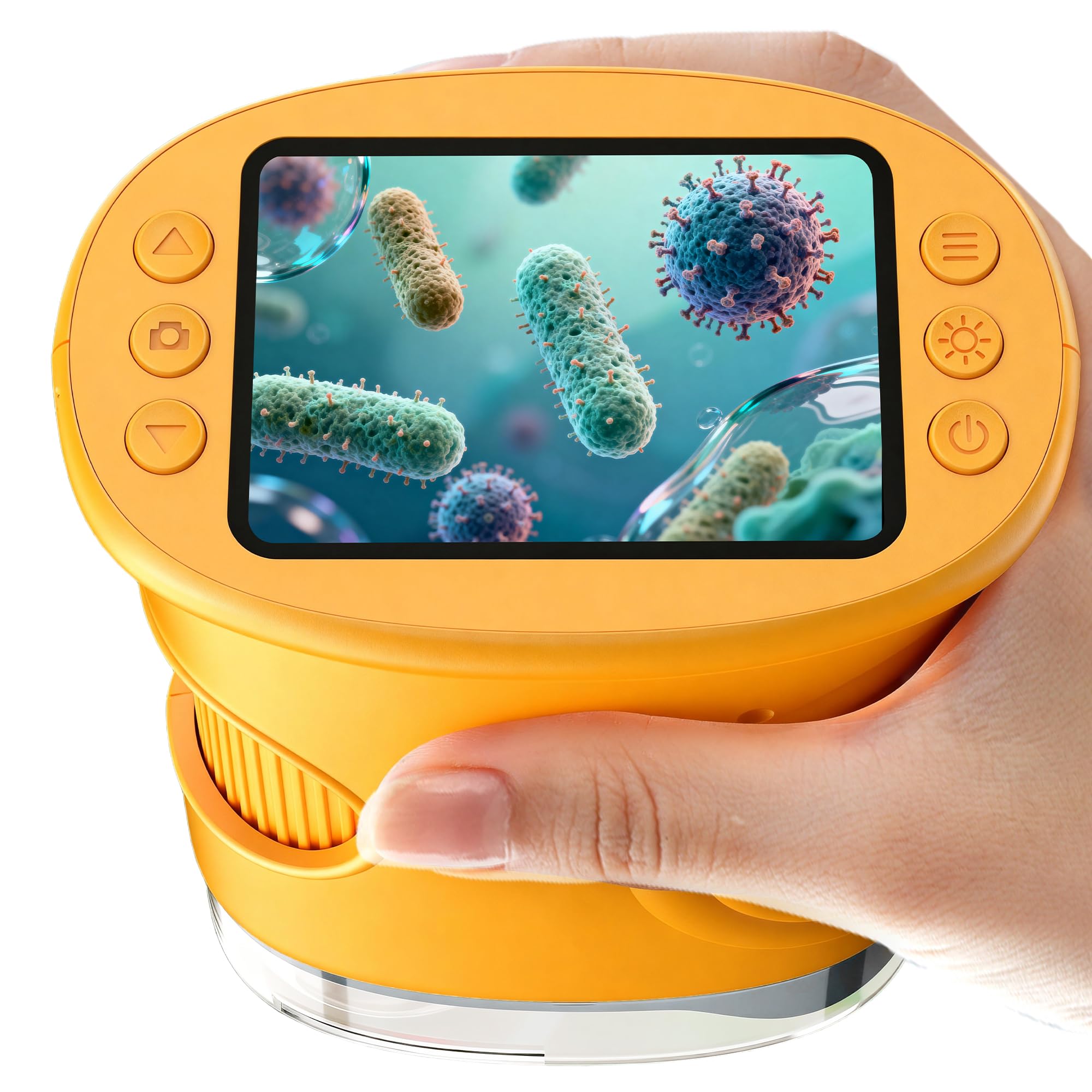
Traditional eyepiece microscopes are frustrating for this age group—it is hard to keep an eye aligned, and the depth of field is unforgiving. This handheld digital microscope eliminates that friction by replacing the eyepiece with a 2.0-inch IPS screen. An 8-year-old can simply point the device at a leaf, fabric, or insect wing and see a crisp, real-time magnified image. The 1000X combined optical and digital magnification is not a marketing exaggeration; it actually resolves plant cell structures and the fine hairs on a spider’s leg.
The 8-LED ring light with three brightness levels is surprisingly important. A single bright LED creates harsh shadows that obscure detail, but the diffused ring design here provides even illumination, making the discovery process far more satisfying. The 600mAh battery runs for about two hours of continuous use, which is enough for a backyard expedition or a focused lab session. The inclusion of a USB-C data cable, lanyard, and storage for 200+ photos means kids can document and share their findings—a feature that turns a toy into a genuine scientific tool.
The caveat is that the included instruction manual is basic, and the promised prepared slides were not in every package according to a few verified reviews. The yellow button icons are small and can be tough for young fingers to read. However, for a curious child who wants to examine the world at a new scale, this tool’s ease of use and immediate visual feedback outweigh these minor packaging inconsistencies. It is the rare gift that gets used daily for months, not just on Christmas morning.
Why it’s great
- Screen-based viewing eliminates traditional eyepiece frustration
- 1000X magnification with even, adjustable LED lighting
- Photo and video capture for documenting discoveries
Good to know
- Prepared slides not always included with every unit
- Small yellow button icons hard for some kids to read
5. National Geographic Kids Magic Set

Magic kits are a classic category, but many fail because printed instructions simply do not convey the sleight-of-hand required. The National Geographic set solves this with a link to step-by-step videos performed by a professional magician. This is a significant advantage for an 8-year-old: they can watch exactly how to palm a coin, how to position the false thumb tip, and how to time the reveal. The kit includes classic props like a cup-and-ball set, a magic wand, a specialized card deck, and a mysterious coin case.
The real educational value here is in the performance aspect. Unlike a solitary building or science kit, magic tricks require a child to practice, memorize a script, and then present to an audience. This builds confidence, public speaking skills, and resilience when a trick goes wrong. The kit covers 45 tricks, but more importantly, it teaches the fundamentals so kids can invent variations. A child who masters the included tricks can easily transition to more advanced magic resources.
The main risk is that the quality of the props is functional, not premium—the plastic components do the job but would not withstand intense abuse. Some tricks require fine motor precision that might be too challenging for an 8-year-old without significant practice, which can lead to frustration. The video instructions mitigate this, but parental encouragement is crucial during the first few sessions. For the child who loves to perform, put on a show, or simply enjoys the thrill of surprising others, this kit offers a structured path to a genuinely impressive skill.
Why it’s great
- Professional video instructions for every single trick
- Builds performance skills, confidence, and public speaking
- 45 tricks cover a wide range of classic illusions
Good to know
- Some tricks require significant fine motor practice
- Plastic props are functional, not heavy-duty
FAQ
Are logic games like Gravity Maze too difficult for the average 8-year-old?
How much adult help does the Doctor Jupiter Science Kit require?
Will a handheld microscope actually show bacteria to a child?
Final Thoughts: The Verdict
For most users, the gifts for 8 year olds winner is the ThinkFun Gravity Maze because it combines the instant tactile feedback of a marble run with the intellectual rigor of a logic puzzle, offering 60 challenges that grow with the child. If you want a creative, display-worthy build that can be rebuilt into new forms, grab the LEGO Creator 3in1 Hummingbird. And for science-obsessed kids who need hundreds of hands-on activities, nothing beats the comprehensive Doctor Jupiter Ultimate Science Kit.