
Wrestling with invasive weeds across a sprawling property is a battle of endurance, not just effort. The right chemistry applied at scale can turn weeks of manual labor into a single afternoon of targeted spraying, but choosing a formula that matches the sheer square footage of your land is the difference between a clean slate and a frustrating re-growth cycle.
I’m Mohammad Maruf — the founder and writer behind Drink4Good. I’ve spent hundreds of hours analyzing herbicide active ingredients, concentration ratios, and coverage claims to determine which large-area solutions deliver consistent results without breaking the bank.
Whether you are preparing a garden plot, clearing a fence line, or maintaining a commercial property, understanding the key specifications of a grass killer for large areas can save you time, money, and repeated applications.
How To Choose The Best Grass Killer For Large Areas
Selecting a herbicide for extensive terrain is less about brand loyalty and more about matching the chemistry to your specific vegetation targets and the equipment you already own. The most cost-effective option for a ten-acre field may be an overkill for a homeowner treating a half-acre fence line.
Active Ingredient and Concentration
Glyphosate at a 41% concentration is the industry standard for non-selective broad-spectrum control. Higher percentages mean fewer ounces of concentrate per gallon of water, which directly reduces the number of jugs you need to haul. For brushy or woody species, a 2,4-D based mix like the one found in Crossbow provides better translocation into the root system of vines and saplings.
Coverage Potential and Mix Ratios
Pay close attention to the square-footage claim on the label. A 2.5-gallon jug of professional concentrate can cover up to 435,600 square feet, which is roughly ten acres. Entry-level one-gallon concentrates typically treat 17,000 square feet. Calculate your property’s total area and then divide by the coverage per jug to determine how many units you need.
Surfactants and Rainfastness
A built-in surfactant reduces the surface tension of the spray droplets, allowing the herbicide to stick to oily or waxy weed leaves. Products marketed as rainproof within thirty minutes contain both a surfactant and a sticker agent. If you skip this feature, you will need to buy a separate non-ionic surfactant, adding an extra cost and a mixing step to your routine.
Quick Comparison
On smaller screens, swipe sideways to see the full table.
| Model | Category | Best For | Key Spec | Amazon |
|---|---|---|---|---|
| Roundup Pro Concentrate | Professional | Maximum acreage with a 2.5-gal mix | 435,600 sq. ft coverage | Amazon |
| Southern Ag Crossbow | Specialty | Brush, vines, and woody invaders | 2.23 acres from 1 gal | Amazon |
| Hi-Yield Killzall 365 | Balance | Bare-ground sterilant for driveways | 17,200 sq. ft per gallon | Amazon |
| Albaugh Gly Star Plus | Value | Commercial-scale, fast knock-down | 41% glyphosate + surfactant | Amazon |
| Hi-Yield Killzall II | Budget | General fence-line and ATV tank spraying | 2.5 gal for large tank mixes | Amazon |
| Roundup Weed & Grass Killer₄ | Consumer | Small-to-medium flower bed prep | Rainproof in 30 minutes | Amazon |
| Target 6 Plus (MSMA) | Specialty | Selective grassy weed control in turf | MSMA 48.2%, 2.5 gal jug | Amazon |
In‑Depth Reviews
1. Roundup Pro Concentrate Herbicide
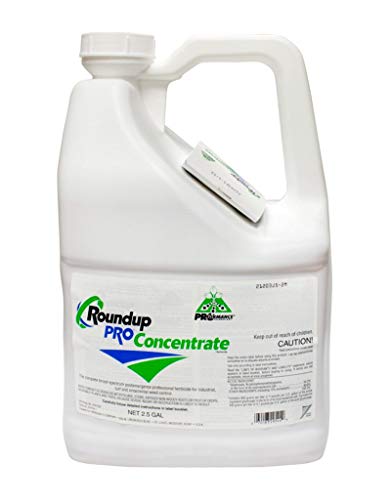
The Roundup Pro Concentrate delivers the highest square-foot coverage of any product on this list — one 2.5-gallon jug treats up to ten acres. The super-concentrate formula requires only 2.5 to 3 ounces per gallon of water, making it an extremely lean mixing ratio that stretches your supply across multiple tank fills.
Users report visible wilting within three to four days and complete die-off within a week, provided the spray is applied during warm, dry weather. The professional formulation is non-selective, so it annihilates everything from annual grasses to deep-rooted perennial weeds, but it does lack a built-in surfactant, so you will want to add a non-ionic surfactant for better leaf adhesion on glossy weed foliage.
This product carries a restriction against sale in Wisconsin and New Jersey, so verify local regulations before ordering. For anyone maintaining large acreage, pasture land, or commercial property, the cost-per-acre of this concentrate is unmatched by any consumer-grade option.
Why it’s great
- Highest coverage per dollar among all reviewed concentrates
- Super-concentrate ratio stretches supply across many tank loads
- Fast visible results in 3-4 days under optimal conditions
Good to know
- No surfactant included — requires separate purchase for best results
- Not for sale in Wisconsin or New Jersey
- Professional formulation demands careful protective gear use
2. Southern Ag Crossbow Specialty Herbicide

Crossbow is the go-to choice when your battlefield includes woody brush, thorny vines, and established saplings alongside broadleaf weeds. Its dual active ingredients — Garlon and 2,4-D — provide a systemic action that penetrates bark and translocates deep into root systems, causing complete collapse of hard-to-kill species like poison ivy, blackberry brambles, and multiflora rose.
A single gallon of concentrate makes up to 96 gallons of spray solution, covering 2.23 acres at the standard rate. The 2,4-D component gives Crossbow a short three-day half-life in the soil, making it a more environmentally friendly choice for areas where you plan to replant relatively soon. Users consistently note that results are visible within 48 hours on sensitive weeds, with complete die-off of heavy brush in roughly one week.
The product does carry a strong odor during application, so a respirator is recommended, and effectiveness can drop if rain occurs within two days after spraying. For properties overrun with English ivy, wild grapevines, or woody undergrowth, Crossbow outperforms standard glyphosate products by a wide margin.
Why it’s great
- Exceptional efficacy against woody brush and thick vines
- Short 3-day soil half-life for faster replanting
- Makes up to 96 gallons of spray from one gallon of concentrate
Good to know
- Strong chemical odor during application
- Rain within 48 hours significantly reduces effectiveness
- Less effective on grassy weeds — best for broadleaf and woody targets
3. Albaugh Gly Star Plus Herbicide

Gly Star Plus offers the same 41% glyphosate concentration as the leading professional brand but at a significant cost saving, and it comes with a fully loaded surfactant system already built into the formula. That surfactant inclusion eliminates an entire mixing step and saves you the roughly you would spend on a separate bottle of non-ionic surfactant.
The systemic action moves from leaf to root within hours, and users consistently report visible results within two to four days on annual weeds, with tougher perennials taking about seven to ten days. The 2.5-gallon jug provides a generous volume for large-scale spraying operations, and the product is labeled for professional and commercial applications, meaning it carries a higher active ingredient load per ounce than any consumer-grade alternative.
This product is not for sale in California, Montana, Nevada, Oregon, Washington, or Wyoming due to state regulations. Because it contains a surfactant, you must follow the label’s mixing directions carefully — overconcentrating can cause excessive leaf burn that reduces translocation to the roots. For budget-conscious operators covering multiple acres per season, Gly Star Plus delivers professional-level performance at a wholesale price point.
Why it’s great
- Pre-loaded surfactant saves time and money on additives
- Same 41% glyphosate concentration as premium professional brands
- Competitive per-gallon cost for high-volume users
Good to know
- Restricted sale in six western states
- Professional label requires strict adherence to protective gear
- Overmixing can cause rapid leaf burn before root translocation occurs
4. Hi-Yield Killzall 365
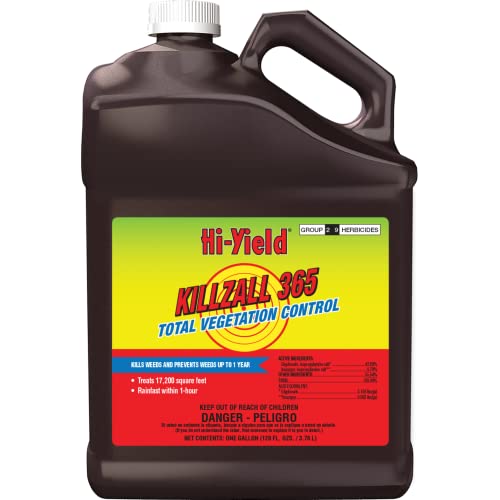
Hi-Yield’s Killzall 365 is formulated specifically for bare-ground sterilization — it creates a chemical barrier that prevents vegetation from re-sprouting for up to twelve months after a single application. This makes it the ideal solution for gravel driveways, parking lot edges, storage yards, and fence lines where you want zero growth for a full season.
The concentrate mixes at 7.4 ounces per gallon of water for bare-ground treatment, meaning a single gallon of concentrate yields roughly 17 gallons of finished spray, covering about 17,200 square feet. Users note that the product is rainproof within one to two hours of drying, making it more forgiving than quick-knockdown formulas that require longer dry times. However, the total vegetation control claim does not extend to moss — multiple users reported that moss survived treatment unscathed.
Because the goal is long-term sterility, this formula contains a higher load of residual active ingredient than standard glyphosate-only products. Do not use Killzall 365 on lawns, garden beds, or any area where you intend to plant within the next year. For permanent hardscape maintenance, this is the most labor-efficient option available.
Why it’s great
- Provides up to 12 months of bare-ground vegetation control
- Rainproof within 1-2 hours after drying
- Excellent for driveways, gravel paths, and fence lines
Good to know
- Ineffective against moss species
- Not safe for use in any area where planting is planned
- May require two applications on stubborn perennial weeds
5. Hi-Yield Killzall II Super Concentrate

The Killzall II Super Concentrate is positioned as a direct Roundup replacement at a significantly lower per-gallon price. It reaches the roots within one to two hours of application and begins showing visible results in as little as three hours, making it one of the fastest-acting formulas when conditions are warm and sunny.
The 2.5-gallon jug is ideal for users who mix large batches in an ATV-mounted or truck-bed spray tank. Coverage is non-selective, meaning it targets annual and perennial grasses, broadleaf weeds, and woody brush species. Users commonly mix it at 2 to 3 ounces per gallon for general weed control, and the concentrate easily dissolves in water without leaving sediment in the tank.
Be extremely mindful of drift — the absorption speed does not prevent the spray from killing ornamentals, flowers, and garden plants on contact. The product’s label explicitly prohibits use on lawns, and its fast-acting nature means that any overspray onto desirable plants will produce visible damage within hours. For users who need a cost-effective bulk concentrate for fence rows and field margins, this is a solid performer.
Why it’s great
- Fast absorption — visible results in as little as 3 hours
- Cost-effective alternative to brand-name Roundup
- Large 2.5-gallon jug suits ATV and tractor sprayer tanks
Good to know
- Non-selective — kills any plant it touches, including garden plants
- Not suitable for lawn or turf applications
- Requires calm weather to prevent drift damage
6. Roundup Weed & Grass Killer₄ Concentrate

The consumer-focused Roundup Weed & Grass Killer₄ Concentrate is built for the homeowner who wants fast, reliable results without the bulk of a 2.5-gallon jug. It is rainproof in just thirty minutes after application, which is the fastest rainfast window in this lineup, giving you more flexibility when unpredictable afternoon storms are a concern.
This formulation contains a proprietary blend of active ingredients — triclopyr, diquat dibromide, and fluazifop-P-butyl — that work together to kill tough weeds and grasses to the root. It is specifically labeled for use in and around flower beds, along fences, driveways, and for garden plot preparation. The label allows planting as soon as one day after application for some ornamentals, though heavy-feeding crops require a longer waiting period.
While the coverage per gallon is only about 300 square feet when mixed at the standard rate, the product is designed for precision spot-spraying rather than broad-acre treatment. For large-scale work, the price per square foot is higher than the professional concentrates, so budget accordingly. It will not prevent new weeds from germinating after the initial kill — expect to reapply for season-long control in high-traffic weed areas.
Why it’s great
- Fastest rainproof window at just 30 minutes
- Multi-active ingredient formula attacks weeds via different pathways
- Safe for use around established flower beds with proper precautions
Good to know
- Low coverage — only 300 sq. ft per mixed gallon
- Higher cost per square foot compared to bulk concentrates
- No pre-emergent activity — new weeds will pop up after treatment
7. Target 6 Plus (MSMA 48.2%) Turf Herbicide

Target 6 Plus is an entirely different tool in the herbicide arsenal — it is a selective post-emergent herbicide based on MSMA (monosodium methanearsonate) that targets grassy weeds while leaving established turfgrass relatively unharmed. This makes it the only product in this list suitable for use on lawns, golf courses, and sod farms where you want to kill dallisgrass, crabgrass, johnsongrass, and nutsedge without destroying the surrounding turf.
The concentration is impressive — at 48.2 percent MSMA active ingredient, a 2.5-gallon jug goes a very long way. The standard mixing rate is 2 ounces per gallon of water, and users report that a single jug has lasted them multiple seasons when used for spot treatments. The product is fast-acting, with visible yellowing of targeted grassy weeds within 24 to 48 hours under ideal conditions.
MSMA is a restricted-use pesticide in many states, so check your local regulations before ordering. The product is thick and requires thorough agitation to mix completely. Overapplication can cause severe browning of Bermuda grass and other warm-season turf species, so precision with the mixing ratio is critical. For the specific job of eliminating invasive grassy weeds from an established lawn, no other product on this list can match its selectivity.
Why it’s great
- Selective — kills grassy weeds without harming most turf species
- Extremely concentrated — very low mixing rate per gallon
- Fast-acting against tough species like dallisgrass and nutsedge
Good to know
- Restricted-use pesticide in many states — verify legality before purchase
- Requires thorough tank agitation for proper mixing
- Overapplication causes brown-out of desirable turf like Bermuda
FAQ
How many ounces of 41% glyphosate concentrate should I mix per gallon of water for general weed control?
Can I use a broad-acre grass killer concentrate in a small hand-pump sprayer for fence-line spot treatments?
What causes a grass killer to stop working or show reduced effectiveness on my property?
How long should I wait before replanting after applying a non-selective grass killer?
Is Crossbow herbicide safe to use around ponds or near water features?
Final Thoughts: The Verdict
For most users, the grass killer for large areas winner is the Roundup Pro Concentrate because its 435,600 square feet of coverage from a single jug delivers the lowest per-acre cost while maintaining fast, reliable knock-down on annual and perennial weeds. If you are battling woody brush and thick vines, grab the Southern Ag Crossbow for its superior translocation into root systems of trees and saplings. And for targeted control of grassy weeds like dallisgrass and crabgrass without destroying your lawn, nothing beats the Target 6 Plus MSMA.