
When you’re screaming through a gate at 100 km/h, the single thing separating you from a podium finish or a tangled mess of carbon fiber is how fast your goggles can paint the next frame. Every millisecond of latency feels like an eternity when you’re clipping a flag at full throttle, and a screen that blacks out or smears on a hard turn can cost you the race. This is where picking the right optical weapon — a set of goggles that balances image clarity, signal stability, and raw speed — becomes the most important decision in your quad build.
I’m Mohammad Maruf — the founder and writer behind Drink4Good. I’ve spent countless hours cross-referencing the cold technical data sheets and real world flight reports on dozens of FPV goggle models to build a guide that focuses on the measurable specs that actually matter for competitive drone racing.
Whether you’re just breaking into the hobby or you need a rugged backup set for race day, this deep dive into the best fpv goggles for drone racing will arm you with the knowledge to make a confident, fast decision.
How To Choose The Best FPV Goggles For Drone Racing
Buying goggles for racing is different from buying them for cinematic cruising. A racer cares about three things above all else: how fast the video hits your eyes, whether the signal holds through a maze of metal bleachers, and how comfortable the unit feels across a full day of back-to-back heats. Here’s what to lock onto when you read the spec sheets.
Latency — The Single Metric That Defines Race Readiness
Every goggle has a processing delay between receiving the radio signal and lighting up the pixels. Analog systems typically sit in the sub-30ms range, while modern digital systems like Walksnail and DJI have pushed well under 20ms. For racing, anything above 40ms is a real handicap — you’ll overcorrect turns and clip gates because your brain is reacting to what happened two frames ago. Look for goggles that quote end-to-end latency numbers (camera + VTX + goggles), not just the goggle’s internal processing figure.
Receiver Diversity — Staying Locked Through the Course
An FPV racer’s worst nightmare is a snowy white screen at the apex of a high-speed turn. True diversity receivers use two separate antenna inputs and constantly switch to whichever signal is cleaner. This is critical when your quad zips behind a concrete pillar or flies through a metal-framed gate. Some budget goggles claim “diversity” but only use a single receiver module with a second antenna port — that’s not the same thing. Demand real, independently-fed receiver diversity, and you’ll avoid many of the signal-drop horror stories found in entry-level reviews.
Field of View and Form Factor Fit
A narrow FOV (under 30 degrees) makes gates feel like you’re peeking through a straw. Race-oriented goggles typically sit at 35 to 50 degrees FOV, giving you that peripheral awareness to see the next gate while you’re still clearing the last one. Equally important is how the goggles sit on your face over hours of practice. A heavy front-loaded box style fatigues your neck. A compact, low-profile design with a center-of-gravity strap mount lets you keep your head in the game for longer. Also check if the goggles offer IPD (interpupillary distance) adjustment — if the lenses don’t match your eyes, you’ll get headaches and a blurry image within minutes.
Analog vs. Digital — The Race Day Reality
The analog-vs-digital debate still has teeth in the racing community. Analog systems offer the lowest possible raw latency (around 14-20ms on a good setup), are extremely lightweight, and are immune to the bitrate compression artifacts that can plague digital feeds in high-RF interference environments. Digital systems, however, give you an HD picture that makes it drastically easier to spot gates at distance and see branches, power lines, and other racers clearly. Many pro-level pilots now run digital for practice (to save the video for analysis) and analog on race day (for the pure speed). If you can only buy one system, consider a hybrid-ready goggle with an HDMI or AV input so you can switch between analog and digital receivers as your budget grows.
Quick Comparison
On smaller screens, swipe sideways to see the full table.
| Model | Category | Best For | Key Spec | Amazon |
|---|---|---|---|---|
| DJI Goggles 3 | Digital | Lowest latency HD racing & cinematic | 24ms latency, 1080p Micro-OLED, 100Hz | Amazon |
| Walksnail Avatar Goggles X | Digital | High-res digital with head tracking | 22ms latency, 1080p dual displays, 50° FOV | Amazon |
| DJI FPV Goggles V2 (Renewed) | Digital | Budget-friendly entry into DJI digital | 720p displays, O3/O4 Air Unit compatible | Amazon |
| Fat Shark Recon Echo DVR | Analog | Lightweight analog starter kit | Built-in DVR, fixed-focus lens, 0.5 kg | Amazon |
| SoloGood EV800D | Analog | Versatile box-style with detachable monitor | 5″ 800×480 LCD, DVR, 2-hour battery | Amazon |
| DroneMask 2 | Smartphone | GPS camera drone FPV via phone screen | Unibody lens, 4x VR resolution, glasses-compatible | Amazon |
| RunCam Spotter V2 Kit | Analog | Compact all-in-one camera + VTX + goggle | 700TVL camera, 5.8G 40CH 200mW VTX | Amazon |
| CADDXFPV Walksnail Moonlight Kit | Digital Air Unit | Night flying and 4K/60 recording | Starlight sensor, 4K/60, 22ms latency, 4km range | Amazon |
| GEPRC Vapor-X5 HD O4 Pro | BNF Drone | Ready-to-fly freestyle with O4 Pro | O4 Air Unit Pro, 5mm carbon arms, 1300mAh | Amazon |
In-Depth Reviews
1. DJI Goggles 3

The DJI Goggles 3 set the new benchmark for digital FPV racing with a 24ms end-to-end latency over the O4 transmission link and a pair of 1080p Micro-OLED screens that refresh at up to 100 Hz. That combination means you’re seeing the course with virtually zero smear even during the fastest split-S maneuvers, while the Real View PiP feature lets you glance at your surroundings without pulling the goggles off — a genuine safety and convenience advantage during race-day pit stops.
Comfort is the other standout: the integrated headband design shifts the battery weight to the back of your skull, eliminating the face-pressure fatigue that plagues front-heavy box goggles. Diopter adjustment covers -6.0 to +2.0 D, so you can ditch your glasses entirely, and the one-tap defogging system keeps the lenses clear when you’re sweating through back-to-back heats. The 3-hour battery life from the integrated pack means you won’t be hunting for a charge between practice sessions.
On the downside, the Goggles 3 are locked into the DJI ecosystem — they won’t work with Walksnail or analog VTXs without an external receiver module. The price point is firmly in the premium tier, and the 50-degree FOV, while excellent, is slightly narrower than some larger box-style goggles. If you’re all-in on DJI Air Units (O3/O4), this is the goggle that gives you the speed, clarity, and comfort to compete at any level.
Why it’s great
- Industry-leading 24ms latency with O4 transmission
- Unmatched comfort from battery-in-strap design
- Built-in diopter for glasses-free flying
Good to know
- Lacks native analog input without adapter
- Premium pricing
- Only compatible with DJI Air Units and drones
2. CADDXFPV Walksnail Avatar HD FPV Goggles X
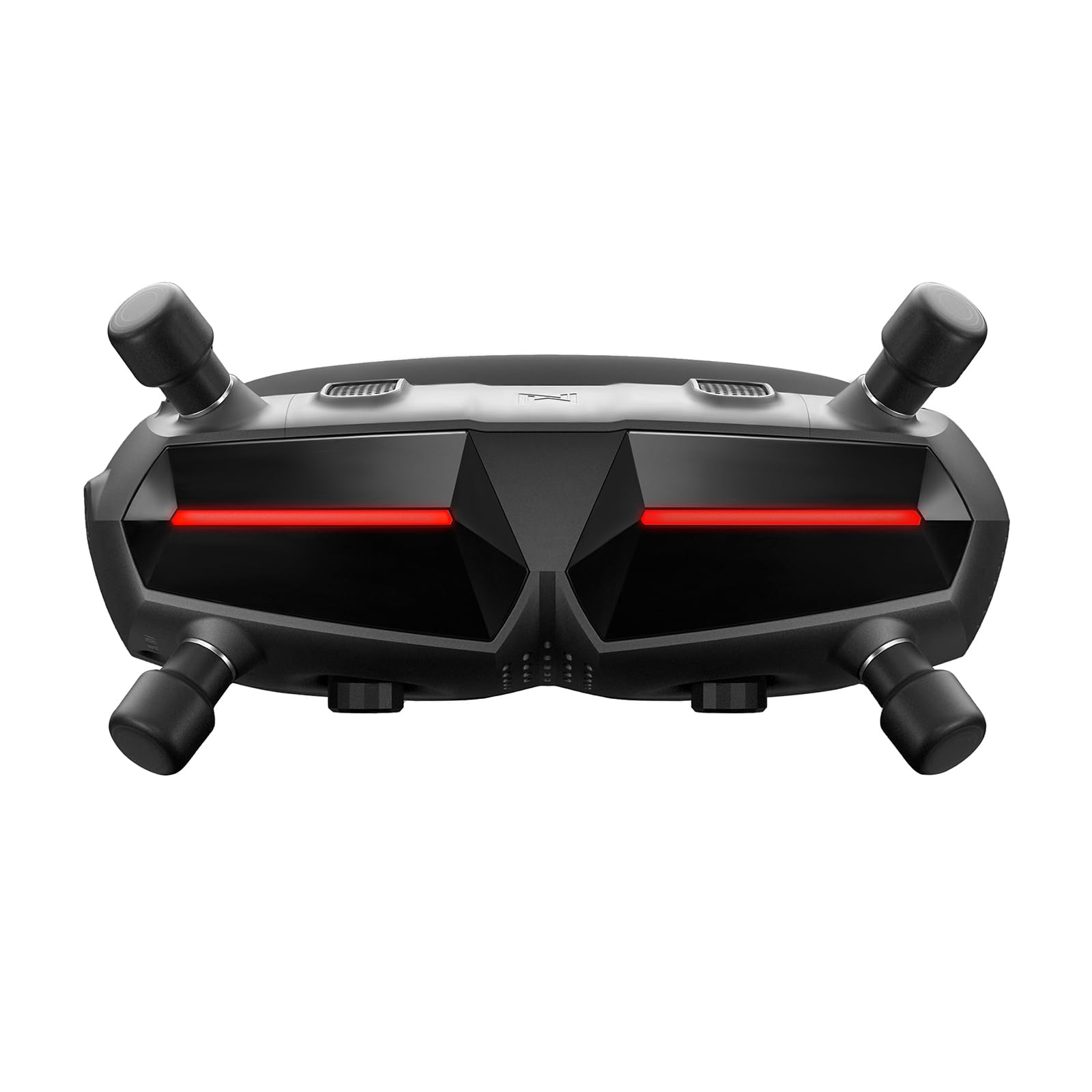
The Walksnail Avatar Goggles X deliver an impressive 22ms latency and dual 1920×1080 HD panels with a 50-degree FOV, giving you a crisp, wide view that rivals the DJI experience for a slightly lower entry price. The image is vivid and detailed, and the smart cooling fan keeps the optics from fogging during intense racing sessions. Built-in head tracking adds a layer of immersive control when paired with a compatible gimbal, which freestyle pilots will appreciate for cinematic shots.
Diopter adjustment spans +2.0 to -6.0 and the IPD adjustment covers 57–72mm, so nearly any pilot can achieve a sharp, comfortable view without corrective lenses. The modular design includes HDMI and AV inputs, making it possible to plug in an analog receiver module if you want to practice on digital but race on analog. At 0.84 kg, it’s relatively lightweight for a full digital system, and the XT60 power cable lets you run it off a 4S Li-ion pack for up to 7 hours of field time.
The catch is that the stock foam gasket tends to leak light for people with narrow faces — many users report needing an aftermarket foam pad for a proper seal. Also, firmware compatibility is critical: the goggles and all Walksnail VTXs must be running the same version, or pairing fails. For pilots who want a standalone digital system outside the DJI walled garden, the Goggles X are a serious competitor.
Why it’s great
- Excellent 22ms digital latency
- Built-in head tracking for immersive control
- Video inputs for analog module compatibility
Good to know
- Stock foam gasket needs replacement for a proper seal
- Firmware sync required across all Walksnail devices
- Not compatible with DJI Air Units
3. DJI FPV Goggles V2 (Renewed)

The DJI FPV Goggles V2 are a proven workhorse that remains relevant thanks to their compatibility with the O3 and O4 Air Units. Even though the displays are 720p rather than the 1080p of the Goggles 3, the image is still sharp enough for gate recognition at speed, and the 44ms latency (when paired with O3 units) is perfectly competitive for club-level racing. The renewed units often arrive in like-new condition with original packaging, offering a significant discount over the current flagship.
One of the V2’s enduring advantages is the modular receiver bay that accepts the BDI DigiAdapter for analog whoops and mini quads. This lets you train on a tiny whoop in analog and switch to a 5-inch digital racer using the same goggle — a flexibility the Goggles 3 currently lacks without an external HDMI receiver. The semi-integrated battery strap works well to balance the weight, and the foam light seal can be upgraded with third-party pads for a better fit.
The V2 is not without caveats: the foam gasket leaves light gaps on many face shapes, and the 1800mAh internal battery provides only about an hour of flight time before you need a top-up. Some users have reported reliability issues with refurbished units, though most reviews indicate they arrive in excellent working order. For a pilot on a budget who wants to enter the DJI digital ecosystem, the V2 remains the smartest gateway.
Why it’s great
- Affordable entry into DJI digital FPV
- Broad compatibility with O3/O4 Air Units
- Modular add-on support for analog reception
Good to know
- 720p resolution is outdated compared to current flagships
- Battery life is shorter than newer models
- Renewed units may have intermittent packaging/accessory issues
4. Fat Shark Recon Echo DVR FPV Goggles

The Fat Shark Recon Echo DVR is an all-analog starter kit that includes a headset, a micro FPV camera (FSV1225), and a video transmitter. At just 0.5 kg, it’s noticeably lighter than box-style goggles, which reduces neck fatigue during long race meets. The fixed-focus prime lens is simple and effective, and the built-in DVR lets you record flights onto a microSD card for post-race analysis of your lines and split times.
The kit is marketed as “ready to fly out of the box,” but the reality requires a few caveats: the camera and VTX need a separate battery to run (not included), and the polarities of the wiring harness (red/black/white vs. red/black) are not documented in the manual. Several users have reported range issues that persist even after upgrading antennas, which suggests the built-in receiver may lack the sensitivity of a standalone diversity module. The HDMI output is also missing, so you can’t share your view with a ground station monitor.
For a pilot looking to get started in analog racing without spending much, the Recon Echo provides a functional image and the convenience of an all-in-one bundle. However, the inconsistent wiring documentation, poor stock antennas, and reports of units failing after a few weeks make this a risky pick for anyone who needs dependable race-day gear. Plan on investing in a quality set of antennas and possibly a foam faceplate upgrade right away.
Why it’s great
- Very lightweight analog all-in-one system
- Built-in DVR for flight recording
- Includes camera and VTX for immediate setup
Good to know
- Missing critical documentation for wiring
- Poor range compared to dedicated diversity goggles
- Reliability concerns with units dying after limited use
5. SoloGood EV800D FPV Goggles with DVR

The SoloGood EV800D is the most popular entry-level box goggle for good reason: the 5-inch 800×480 LCD is bright and clear, the built-in DVR records at 720×576 resolution for reviewing your laps, and the entire goggle module detaches to function as a standalone field monitor. The 2000mAh battery delivers about two hours of flight time, and the auto-search feature on the 40-channel RaceBand receiver makes finding an open frequency at a busy race meet quick and painless.
Despite the “diversity” labeling, seasoned pilots have confirmed that this model uses a single receiver module with two antenna ports — it’s not true antenna diversity. The power connector uses a barrel-type DC jack that can experience intermittent contact, causing the goggles to shut off mid-flight if the cable gets jostled. The screen allows a small amount of light bleed around the edges, and the foam faceplate does not seal completely for glasses wearers.
For , the EV800D punches well above its weight class. The detachable screen is a huge plus for pit table convenience, and the image quality is good enough to learn gate-running fundamentals. The trade-offs in receiver design and build quality are manageable if you treat it as a learning tool rather than a permanent race-day solution. Add a magnetic USB-C adapter to fix the power issue and a foam light blocker, and you have a rugged budget goggle that will serve you well into the intermediate stage.
Why it’s great
- Bright 5-inch LCD with built-in DVR
- Detachable screen works as a standalone monitor
- Excellent channel auto-search for busy race frequencies
Good to know
- Power connector is prone to intermittent disconnection
- Single receiver despite dual antenna ports; not true diversity
- Light bleed around screen edges
6. DroneMask 2 FPV Goggles

The DroneMask 2 takes a completely different approach by turning your smartphone into the display. Instead of a built-in screen, it uses a patented unibody lens system that magnifies your phone’s display to deliver what the manufacturer claims is 4x the resolution of typical split-screen VR headsets. This design is a perfect match for GPS camera drones like the DJI Mini 4 or Air 3, where the FPV feed comes from the DJI Fly app on your phone rather than a dedicated VTX.
Build quality is solid: the soft face padding, breathable fabric, and adjustable headstraps keep the 1.3 kg unit tolerable for 20-minute sessions. The lightproof screen access holes let you tap your phone’s screen to change settings without removing the goggles, which is a thoughtful touch. It also works with HDMI input, so you can use it as a monitor for any HDMI-capable source. The included cable set covers USB-C and Lightning, ensuring broad phone compatibility.
The DroneMask 2 is not designed for true analog racing quads or digital VTX systems. If you race with a dedicated FPV quad (analog or Walksnail/DJI Air Unit), these goggles won’t work unless your VTX outputs to a phone via a capture card. The lenses also tend to fog within 5 minutes in humid conditions without an anti-fog treatment. This is a specialized accessory for DJI drone pilots who want an immersive FPV experience without buying a separate digital goggle system.
Why it’s great
- Leverages your phone’s high-resolution display
- Works with glasses and large phone sizes
- Excellent sunlight isolation for outdoor flying
Good to know
- Not compatible with analog or most digital racing VTXs
- Heavy at 1.3 kg; fatigue sets in during longer sessions
- Lenses fog easily in humid conditions
7. RunCam Spotter V2 FPV Goggles Kit

The RunCam Spotter V2 is an all-in-one analog FPV kit that bundles a micro AIO camera (170-degree FOV, 700TVL) with a 5.8G 40CH transmitter adjustable from 20mW to 200mW. The kit is designed for small RC cars, boats, and micro drones, making it a quick and cheap way to get a full analog setup without soldering a separate VTX and camera. The integrated mic picks up motor sounds for an immersive audio experience, and the on-screen display provides real-time battery and channel info.
Dual antennas offer slightly better reception than a single whip, and the auto-search feature scans all 40 RaceBand channels to find the cleanest frequency. The entire kit is lightweight and compact, easily fitting into a small gear bag. However, the included goggles are very basic and do not offer the same clarity or ergonomics as a purpose-built goggle like the EV800D. The heat sink on the VTX runs extremely hot — several reviews note it can melt the plastic case during extended bench testing.
This kit is best viewed as an entry-level experimentation bundle rather than a competitive racing setup. The camera resolution is adequate for learning line-of-sight-to-FPV transition, but the lack of any receiver diversity and the limited power output (200mW max) mean you’ll struggle to hold a clean signal beyond 200 meters in a noisy RF environment. For a racer, the Spotter V2 is a novelty toy, not a race tool.
Why it’s great
- Complete all-in-one kit with camera, VTX, and goggles
- Dual antennas and 40-channel auto-search
- Ultra-compact and portable for micro builds
Good to know
- VTX heat sink gets dangerously hot
- Very limited range compared to standard 800mW+ VTXs
- Goggle quality is entry-level; not for competitive racing
8. CADDXFPV Walksnail Moonlight Kit
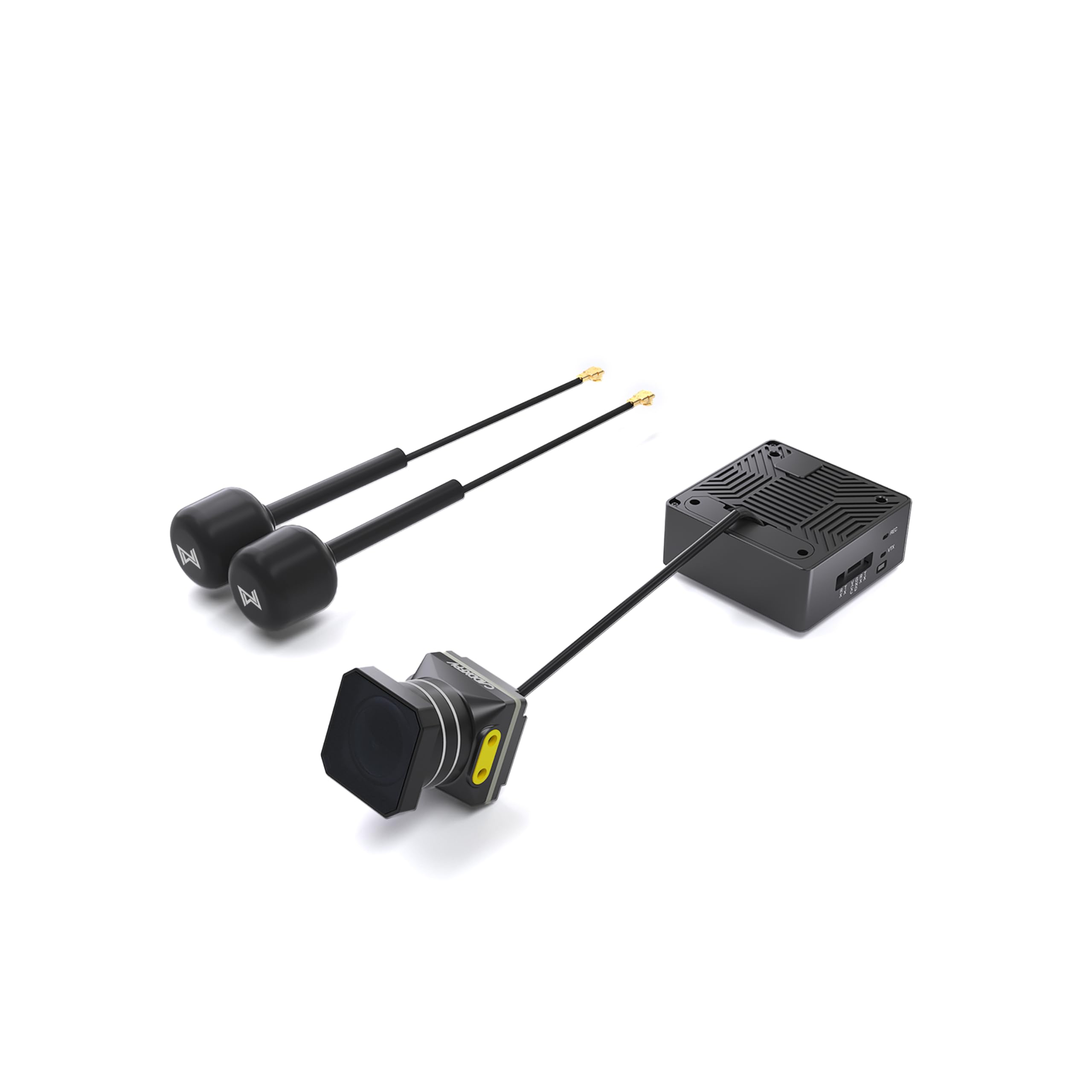
The Walksnail Moonlight Kit is not a goggle — it’s a digital air unit (VTX + camera) designed to pair with Walksnail Avatar Goggles X or L. What makes it special is the 1/1.8-inch starlight sensor that delivers exceptional low-light performance. You can fly at dusk with usable video quality that no analog camera can touch, and the 4K/60fps recording at 150 Mbps, combined with Gyroflow stabilization, means you can ditch your GoPro on a freestyle build and still walk away with cinematic footage.
The dual-antenna design and 1.2W power output give a solid 4km range in open air, and the 22ms latency keeps it competitive for racing. The included ND8 filter prevents overexposure in bright daylight, and the built-in EIS smooths out vibrations from aggressive flying. Installation is straightforward on 3.5-inch to 5-inch builds, and the unit has survived hundreds of crashes in user reports.
The Moonlight Kit runs hot — really hot. At full 4K recording power, the VTX requires active airflow to avoid overheating, and the MIPI cable connecting the camera to the VTX is fragile; several users reported receiving units with damaged cables out of the box. It’s also only compatible with Walksnail goggles, so you can’t use it with DJI or analog systems. For pilots who want to push the limits of low-light freestyle and keep HD recordings without an action cam, the Moonlight Kit is an incredible tool.
Why it’s great
- Outstanding low-light performance with starlight sensor
- Records 4K/60fps in-camera with Gyroflow support
- Dual antennas for reliable long-range transmission
Good to know
- Requires good airflow to prevent overheating
- MIPI cable is fragile; QC issues reported
- Locks you into the Walksnail goggle ecosystem
9. GEPRC Vapor-X5 HD O4 Pro FPV Drone

The GEPRC Vapor-X5 is a bind-and-fly (BNF) 5-inch freestyle drone that comes pre-loaded with the DJI O4 Air Unit Pro, making it a turnkey solution for pilots who already own DJI Goggles 3 or V2. The 5mm carbon fiber arms are significantly thicker than the industry-standard 4mm, giving the frame exceptional crash resistance, and the CNC aluminum lens housing protects the O4 camera from impacts that would shatter plastic housings.
The SPEEDX2 E-series motors are smooth and responsive, and the GPS module ensures quick satellite lock for return-to-home safety. The drone is tuned for freestyle rather than pure racing, with a weight of 692 grams that grips the air well during power loops and split-S moves. It’s compatible with 6S batteries, and the 1300mAh pack in the specs provides about 3-4 minutes of aggressive flying.
The Vapor-X5 is not a goggle, but it’s listed here because it represents the end-to-end solution for pilots who want to fly the O4 Pro system. The downsides: the motor shafts are brittle and can snap on hard impacts, the battery leads are long enough to risk prop strike, and the price has gone up due to tariffs. It also requires comfort with Betaflight tuning to really dial in the PID settings. For an experienced pilot who wants a durable O4 Pro freighter without building from scratch, this is a solid pick.
Why it’s great
- Pre-built with DJI O4 Air Unit Pro
- Thick 5mm carbon fiber arms for durability
- GPS module for return-to-home safety
Good to know
- Motor shafts are brittle and prone to snapping
- Requires PID tuning for optimal performance
- Battery leads need shortening to avoid prop strike
FAQ
What latency spec should a racing pilot aim for?
Can I use analog goggles with a digital VTX?
Final Thoughts: The Verdict
For most racers, the fpv goggles for drone racing winner is the DJI Goggles 3 because it combines the lowest real-world latency in its class (24ms) with a comfortable all-day fit and the best digital image clarity available. If you want a standalone digital system outside the DJI ecosystem, grab the Walksnail Avatar Goggles X — its 22ms latency and HDMI input flexibility make it a strong contender. And for a mid-range analog option that won’t break the bank, nothing beats the SoloGood EV800D as a learning tool and backup set.