
Nothing feels worse than watching a freshly glued plastic repair split apart because the bond could not handle a little flex. The wrong adhesive forms a brittle joint that snaps under normal use, leaving you back at square one with a dirty broken surface and a wasted afternoon. Finding a formula that actually grips the low surface energy of common plastics and stays flexible after curing is the real challenge in any plastic repair.
I’m Mohammad Maruf — the founder and writer behind Drink4Good. I have spent countless hours cross-referencing bond strength data, cure chemistry, and real-world application reports to produce this guide on the most reliable plastic adhesives available right now.
Whether you are fixing a cracked bumper, reassembling a broken toy, or sealing a fishing kayak leak, this article breaks down the top candidates for glue for plastic repair so you can pick a solution that actually lasts.
How To Choose The Best Glue For Plastic Repair
Plastic is not one material — it is a family of polymers with vastly different surface energies. A glue that works perfectly on ABS may bead up and refuse to bond on polyethylene. Understanding the plastic type and the stress the repair will face is the first step to choosing correctly.
Identify your plastic type
Look for a recycling symbol on your part. Plastics marked with a 2 (HDPE), 4 (LDPE), or 5 (PP) are low-energy polymers that resist standard glues. You need a specialty cyanoacrylate with a primer or a structural urethane adhesive to wet these surfaces properly. ABS (7-Other) and PVC (3) bond more easily with epoxies and cyanoacrylates.
Match the bond flexibility to the part
A rigid epoxy works well on hard shells and casings that do not bend. Flexible parts like kayak hulls, garden hose fittings, or car interior trim need an adhesive that can stretch slightly without delaminating. Scan the cured hardness rating — rubber-toughened formulas absorb vibration better than brittle fast-cure types.
Understand the cure time tradeoff
Fast-setting formulas (under five minutes) are convenient for small parts that you can hold in place. Slower-curing epoxies (thirty minutes to several hours) allow more repositioning time and generally develop higher ultimate bond strength because the polymer chains have more time to crosslink.
Quick Comparison
On smaller screens, swipe sideways to see the full table.
| Model | Category | Best For | Key Spec | Amazon |
|---|---|---|---|---|
| Loctite Super Glue Plastics Bonding System | Cyanoacrylate + Activator | Hard to bond polypropylene & polyethylene | Activator + cyanoacrylate pen | Amazon |
| J-B Weld Plastic Bonder | Structural Urethane | High-strength repairs on ABS & fiberglass | 30-minute set time | Amazon |
| Starbond 5 Minute Epoxy Pro Kit | Flexible Epoxy | Multi-material repairs needing vibration resistance | 2,600 lb psi shear strength | Amazon |
| Tamiya Epoxy Putty (Quick Type) | Epoxy Putty | Model making & gap filling on small parts | 6 hour full cure | Amazon |
| Loctite Vinyl, Plastic, and Fabric Adhesive | Flexible Contact Adhesive | Vinyl upholstery and fabric-to-plastic bonds | 24 hour full cure | Amazon |
In‑Depth Reviews
1. Loctite Super Glue Plastics Bonding System with Activator (2 Pack)
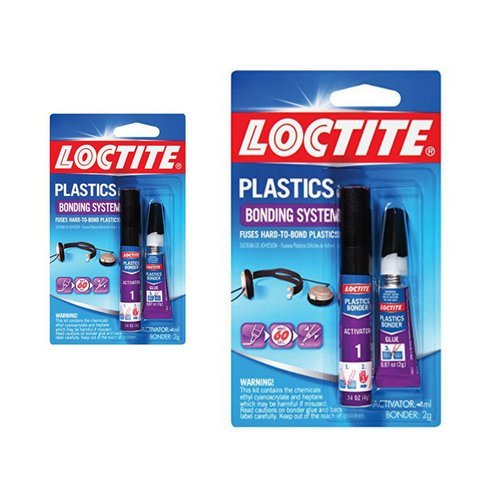
This two-part system pairs a brush-on activator with a cyanoacrylate pen designed specifically for low-energy plastics. The activator prepares the surface by raising the surface energy, allowing the adhesive to wet out polypropylene and polyethylene — two plastics that reject nearly every other glue. Users report successful repairs on airline cat carriers and split earpieces that had previously resisted multiple other adhesives including B-7000 and generic epoxy.
The activator dries in seconds, then the pen applies a controlled bead that cures in one minute. That speed is a double-edged sword: you have almost no repositioning time, so parts must be held firmly in place during setting. The bond is rigid and very strong — reviewers call it the only plastic glue that truly holds on high-temperature car interior repairs.
Full cure takes 24 hours despite the one-minute handling time. The pack includes two 2-gram pens and two activator bottles, which is enough for several small-to-medium repairs. For anyone who has struggled to glue polypropylene garden tools or polyethylene kayak fittings, this system solves the specific adhesion chemistry problem that standard super glues cannot overcome.
Why it’s great
- Activator primes polypropylene and polyethylene for bonding
- Sets in approximately one minute for fast repairs
- Bond remains strong even in high-heat environments
Good to know
- No repositioning time once the adhesive contacts the surface
- Each pen contains only a small amount of glue
- Requires separate activator application step
2. J-B Weld 50133 Plastic Bonder Structural Adhesive Syringe (3 Pack)

J-B Weld Plastic Bonder is a two-part urethane adhesive that mixes through a static mixing tip and cures to a tan color that blends with many common plastics. The urethane chemistry gives it a distinct advantage over standard epoxies: it remains slightly flexible after curing, making it suitable for parts that experience thermal expansion or light flexing.
The set time is 30 minutes, offering a comfortable window to clamp or position parts. Full cure is roughly 24 hours. The syringe applicator makes ratio mixing automatic, which eliminates the guesswork of hand-mixing epoxies. Each syringe contains 25 ml, and the three-pack provides enough adhesive for multiple projects or larger surface areas.
One user noted that while the bond is strong, it can pop out under sustained pressure from ice pack leaks. That limitation points to urethane’s good but not absolute gap-filling ability. For most repair scenarios — bumper cracks, appliance housings, outdoor gear — the flexibility and bond strength make this a reliable mid-range workhorse.
Why it’s great
- Cured bond remains flexible to handle vibration and expansion
- Syringe mixing tip ensures perfect 1:1 ratio every time
- Tan color blends well with many common plastic parts
Good to know
- Not ideal for continuous underwater pressure applications
- Static mixing tips waste a small amount of adhesive
- May require surface roughening for best adhesion
3. Starbond 5 Minute Epoxy Pro Kit (8 oz.)

This kit uses a flexible-toughened epoxy formula that handles 2,600 psi shear strength while absorbing stress without cracking — a rare combination for a five-minute-setting adhesive. The kit includes screw-cap bottles, reusable mixing trays, and a spatula, making repeated use practical without the waste of foil packs or single-use syringes. Users report success sealing basement cracks and bonding crown molding joints, though some noted the epoxy failed one of two direct pull tests against a competitor.
The 1:1 mix ratio by volume is simple to eyeball, and the clear finish keeps repairs discreet. The five-minute working time forces a quick pace, but the kit’s instruction card recommends warming the bottles slightly in warm water to reduce viscosity for deeper penetration into cracks. Once cured, the bond is firm yet slightly flexible, which prevents brittle breakage on parts that see light bending or temperature shifts.
The 8-ounce total volume (4 ounces resin, 4 ounces hardener) represents the highest material quantity in this roundup, making it a strong choice for frequent users or larger repair projects. Just store the bottles upright with caps tightened, as uncured epoxy can crystallize if left exposed to air for long periods.
Why it’s great
- 2,600 psi shear strength with flexible cure
- Large 8-ounce total volume for multiple projects
- Kit includes reusable mixing trays and tools
Good to know
- Five-minute working time is tight for large areas
- Bond performance varies on some smooth plastics
- Bottles can crystallize if caps are not sealed properly
4. Tamiya Epoxy Putty (Quick Type)

Tamiya Epoxy Putty is a two-part stick that you knead together by hand to activate the curing process. Unlike liquid adhesives, this putty can be shaped, carved, and sanded after it cures, making it the top choice for repairing broken tabs, filling gaps, or building up missing geometry on scale models and small plastic parts. The beige and white colors mix to a neutral tone that takes paint well.
Users report that the Quick Type version cures fully in six hours, which is faster than Tamiya’s standard formula. Adding a few drops of water during kneading improves workability and prevents the putty from drying out too quickly. The cured material sands smoothly and does not shrink, so details stay crisp. Reviewers call it the best modeling putty they have ever used, citing easier handling than the popular “green stuff.”
This product is not designed for large structural repairs or high-stress load-bearing parts. Its strength is sculptability and fine-detail restoration. For anyone restoring a broken model car part, filling a seam, or rebuilding a cracked drone arm, the putty form allows precise control that liquid adhesives cannot match.
Why it’s great
- Sculptable putty form allows precise shaping before cure
- Sands smooth and accepts paint without issues
- No shrinkage during curing
Good to know
- Not suitable for high-stress load-bearing repairs
- Requires hand-kneading for thorough mixing
- Full six-hour cure time is slow for quick fixes
5. Loctite Vinyl, Plastic, and Fabric Adhesive (Pack of 2)

This adhesive is a flexible contact cement formulated for soft plastics, vinyl, and fabric. It dries clear and remains flexible, making it the right choice for reattaching vinyl upholstery, fixing fabric blinds bonded to plastic frames, or repairing lawn mower seat padding. Users report that with proper surface cleaning, the bond held through an entire mowing season without delamination.
The paste consistency applies cleanly from a tube, though it does string if the nozzle is pulled away too quickly — a thin layer spread evenly on both mating surfaces yields better results. Full cure takes 24 hours, and the bond forms through solvent evaporation rather than chemical polymerization, so ventilation during application matters. The two-pack provides good value for small household repairs.
This product is not intended for structural bonding on rigid plastics or load-bearing items. It excels where the repaired part will continue to flex or fold. Do not use it on polyethylene or polypropylene without testing first, as its grip on low-energy plastics is inconsistent compared to the activator-based cyanoacrylate system.
Why it’s great
- Dries flexible for vinyl and fabric repair applications
- Clear finish keeps repairs visually clean
- Two tubes included for multiple uses
Good to know
- Strings if applied too quickly
- 24-hour cure is slow
- Inconsistent grip on polypropylene without surface prep
FAQ
How do I prepare a plastic surface for gluing?
What is the difference between cyanoacrylate and epoxy for plastic repair?
Why does my glue keep failing on plastic?
Final Thoughts: The Verdict
For most users, the glue for plastic repair winner is the Loctite Super Glue Plastics Bonding System because it solves the core adhesion problem on polypropylene and polyethylene that plagues standard glues. If you want a flexible structural bond with generous working time, grab the J-B Weld Plastic Bonder. And for sculptable gap-filling repairs on models and hobby parts, nothing beats the Tamiya Epoxy Putty.