
The moment you grab a box of cheap, one-size-fits-all gloves for warehouse work, you have already lost — lost dexterity, lost grip in the first hour of a shift, and lost money when the fingertips tear open on a cardboard edge before lunch. The difference between a productive day and a frustrating one often comes down to what is wrapped around your hands: a glove that feels like a second skin versus one that fights you at every fold and pinch.
I’m Mohammad Maruf — the founder and writer behind Drink4Good. I have analyzed the technical specifications, real-world user reports, and abrasion certifications for over 40 glove models to find the handful that actually deliver on their promises for demanding warehouse environments.
The answer to finding the best pair is rarely about choosing the thickest leather or the highest price tag. After cross-referencing customer feedback with certified test data, the list of the very best warehouse work gloves narrows dramatically to models that balance breathability, tactile feedback, and certified abrasion resistance without forcing you to swap gloves every two weeks.
How To Choose The Best Warehouse Work Gloves
Warehouse gloves are a high-consumption tool, not a one-time investment. The choice comes down to three core factors: the coating material that determines grip and durability, the liner gauge that dictates breathability and feel, and the abrasion certification that tells you how many cycles of punishment the glove can survive before the coating flakes off.
Coating Material: Foam Nitrile vs. Crinkle Latex vs. PU
Foam nitrile is the current gold standard for warehouse work because the micro-cellular structure wicks oil and moisture away from the contact point, maintaining grip even on slightly greasy totes or wet cardboard. Crinkle latex offers excellent dry grip at a lower cost but degrades faster when exposed to oils. PU coatings are thin and provide high dexterity but lack the abrasion resistance needed for repeated contact with rough corrugated surfaces.
Liner Gauge and Knit Construction
The liner gauge (13-gauge vs. 15-gauge) directly impacts how much you can feel what you are handling. A 13-gauge liner is thicker and offers more padding but reduces tactile feedback. A 15-gauge liner is thinner, more breathable, and allows you to pick up small screws or handle delicate packaging without removing the glove. For warehouse picking and packing, 15-gauge nylon-spandex is the sweet spot.
ANSI / EN388 Abrasion Ratings
Do not buy gloves without checking the certified abrasion level. Level 3 (2000-7999 cycles) is acceptable for light sorting. Level 4 (8000+ cycles) is the benchmark for heavy warehouse use involving constant contact with cardboard, plastic totes, and metal shelving. Gloves without a published rating often fail within the first week of full-shift use.
Quick Comparison
On smaller screens, swipe sideways to see the full table.
| Model | Category | Best For | Key Spec | Amazon |
|---|---|---|---|---|
| Kebada W5 | Premium | High-volume warehouse & heavy abrasion | EN388 Level 4 / 8000+ cycles | Amazon |
| MidWest 94BLP03 | Mid-Range | All-day comfort & touchscreen use | Foam nitrile with dot grip | Amazon |
| LOCCEF MicroFoam | Premium | Long shifts & precision handling | 15-gauge nylon-spandex liner | Amazon |
| TitanFlex | Mid-Range | Automotive & oily environments | ANSI Level 4 abrasion | Amazon |
| toolant Crinkle Latex | Entry-Level | Budget bulk & light sorting | 12-pair value pack | Amazon |
In-Depth Reviews
1. Kebada W5 Safety Work Gloves
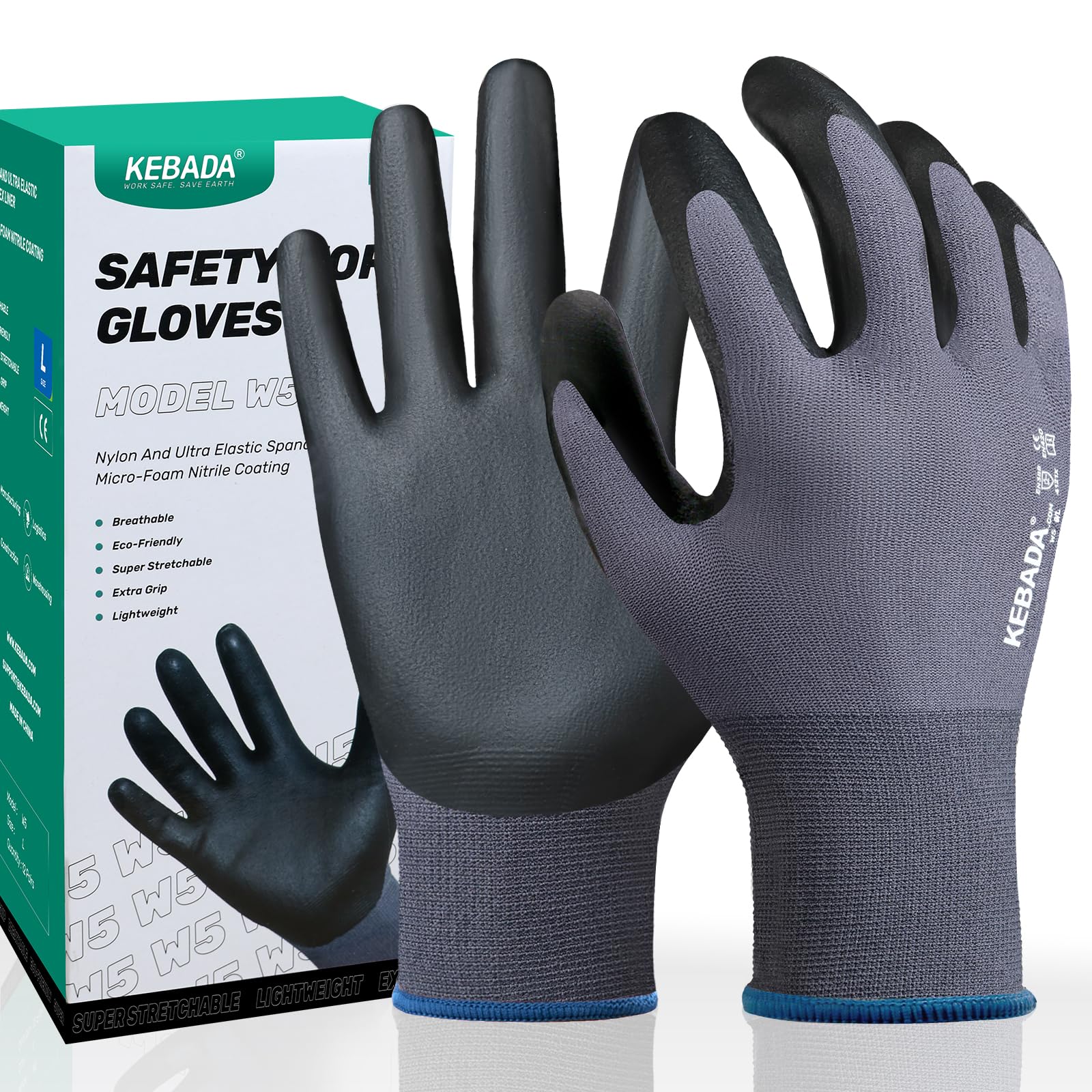
This is the pair that sets the benchmark for warehouse durability. The foam nitrile coating is micro-textured to channel away moisture, which means your grip stays reliable even when handling greasy totes or damp cardboard. The 15-gauge nylon-spandex liner is noticeably thinner than standard 13-gauge gloves, giving you the tactile feedback needed to pick up small parts or handle touchscreens without pulling the glove off every five minutes.
The EN388:2016 Level 4 abrasion rating (over 8000 cycles) is not just a sticker — users report getting two years out of a 12-pair pack while working tire changes and heavy loading. The slip-on elastic cuff keeps dirt and debris out, and the latex-free OEKO-TEX certification matters for anyone with sensitive skin. It is the most expensive option in this guide, but the cost-per-wear plummets when each pair survives weeks instead of days.
Some users note that the fingers run slightly short for very long digits, so consider sizing up if you are between sizes. The breathable back keeps hands cool up to 95°F, but the coating retains heat above that threshold. Wash them by hand with mild soap to preserve the foam structure — hot dryers will shorten the lifespan.
Why it’s great
- EN388 Level 4 certified for 8000+ abrasion cycles
- 15-gauge liner provides superior dexterity and breathability
- Foam nitrile coating grips well in oily and damp conditions
Good to know
- Fingertip coating can wear thin after 4 weeks of constant cardboard handling
- Hand-wash only to avoid damaging the foam layer
2. MidWest Gloves 94BLP03 Max Grip

The MidWest Max Grip gloves solve the most common complaint in warehouse work: sweaty, clammy hands. The spandex liner combined with a foam nitrile dip and additional nitrile dots on the palm creates a breathable barrier that keeps air moving while providing a tacky grip that locks onto box edges. At roughly half the cost of the premium tier options, this six-pair pack is the go-to choice for stockers and pickers who need a fresh pair every few days.
Users consistently report surviving three months of heavy retail stock work on the first pair before needing to rotate. The pull-on closure means no Velcro to snag on shelving, and the ambidextrous design simplifies ordering in bulk for a team. The touchscreen compatibility is genuinely functional — you can scan barcodes and check inventory without removing the glove.
The main trade-off is that these are not waterproof. In sustained wet conditions, the foam soaks through. The elastic wrist is snug but can feel restrictive during all-day wear for those with wider palms. Cleaning is simple: rinse under the sink while wearing them or toss them in the laundry on a gentle cycle.
Why it’s great
- Breathable spandex liner reduces hand fatigue and sweating
- Foam nitrile plus dot grip offers excellent traction on cardboard
- Ambidextrous and machine washable for easy rotation
Good to know
- Not waterproof — will soak through in wet environments
- Snug wrist may feel tight for users with larger palms
3. LOCCEF MicroFoam Nitrile Coated Gloves

The LOCCEF gloves occupy a narrow lane that many warehouse workers desperately need: thin, breathable, and capable of lasting an entire shift without feeling like a wet sock. The microfoam nitrile coating is applied only to the palm and fingers, leaving the knit nylon back completely exposed for maximum airflow. The tacky dot grip pattern on the palm provides a subtle stickiness that excels on smooth plastic totes and sealed cardboard.
Users who work constant cardboard handling report getting about a month before the fingertip coating begins to crack around the edges, which is competitive with gloves that cost significantly more. The touchscreen responsiveness is reliable enough for quick phone checks and scanner use. The 15-gauge liner allows you to feel the texture of what you are gripping — critical for jobs that require tactile discrimination between items.
Sizing runs slightly large, so order one size down from your usual measurement. The pack contains six pairs, which is less generous than the 12-pair bulk options, but the per-pair quality justifies the difference. Machine washing is not recommended — hand-wash in cold water to prevent the foam coating from delaminating.
Why it’s great
- Ultra-thin 15-gauge liner provides excellent fingertip feel
- Tacky dot grip pattern holds well on plastic and cardboard
- Breathable knit back keeps hands cool during long shifts
Good to know
- Fingertip coating may begin cracking after 4 weeks of heavy use
- Size down for a secure fit; runs slightly large
4. TitanFlex Microfoam Nitrile Work Gloves
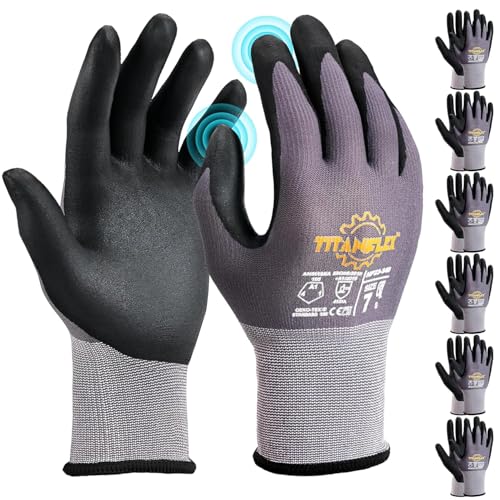
The TitanFlex gloves punch above their price tier with an ANSI Level 4 abrasion rating that matches gloves costing twice as much. The microfoam nitrile coating provides genuine oil and grease resistance, making this a strong choice for warehouse workers who rotate between dry sorting and automotive or machinery tasks. The seamless knit nylon liner stretches to fit like a second skin without bunching at the fingertips.
Users highlight the excellent fit and the ability to work on brakes and small parts without losing dexterity — a rare combination in a glove at this price point. The touchscreen compatibility works well enough for quick calls and navigation, though the coating thickness reduces sensitivity compared to the thinner LOCCEF or MidWest models. The 6-pair pack is machine washable below 40°C, which extends the lifespan significantly.
The main drawback is color inconsistency — some packs ship with rings in colors different from the listing photos. This does not affect performance but may matter for teams that color-code glove sizes. The lack of a Velcro closure means the elastic cuff must fit snugly on its own, so check the sizing chart carefully before ordering.
Why it’s great
- ANSI Level 4 abrasion rating at a mid-range price point
- Microfoam nitrile resists oil and grease effectively
- Machine washable below 40°C without losing shape
Good to know
- No Velcro closure — elastic cuff fit may vary
- Color of ring accents may differ from product photos
5. toolant Crinkle Latex Work Gloves
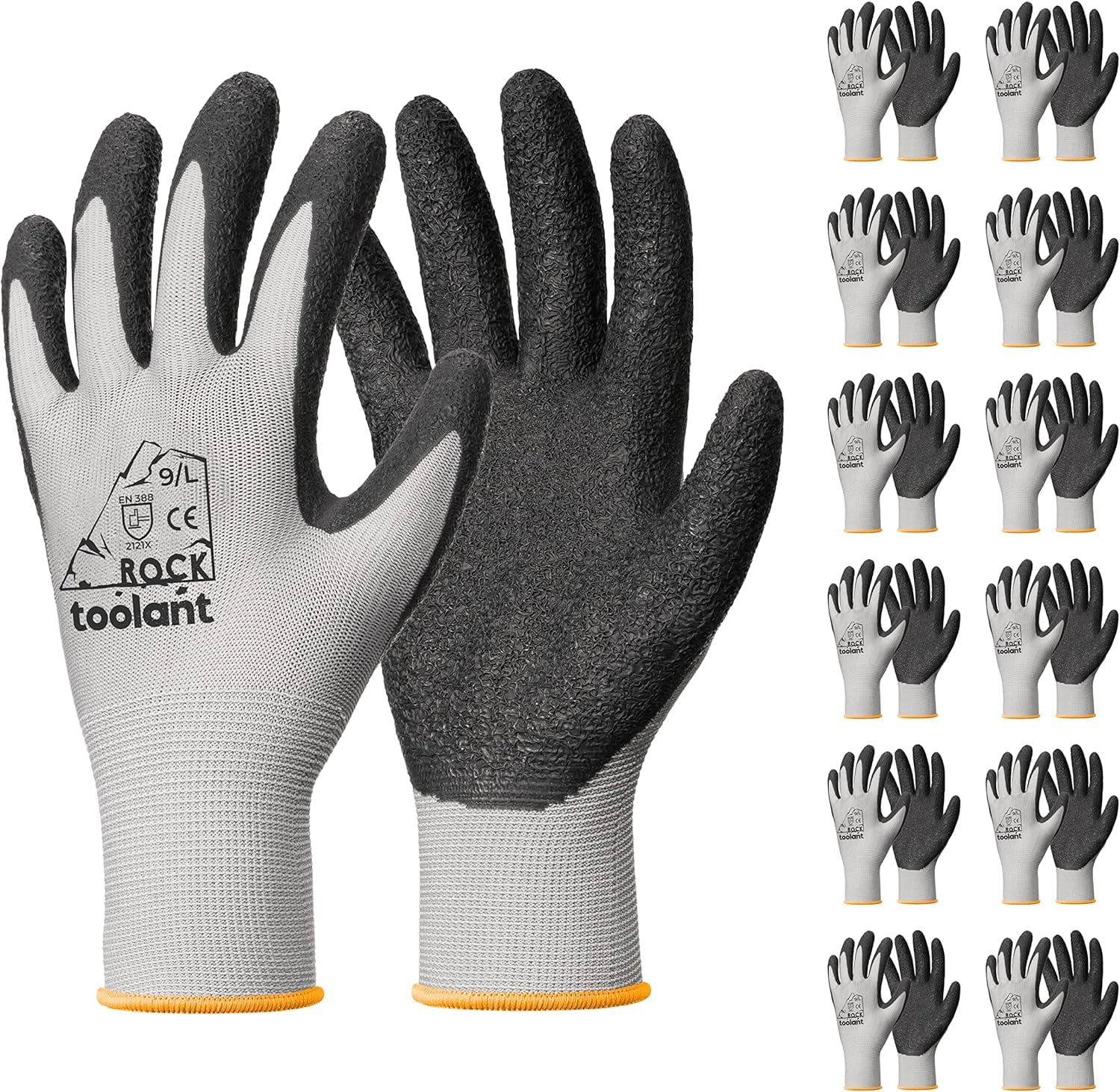
The toolant crinkle latex gloves are the budget-friendly workhorse for environments where gloves are treated as consumables. The crinkle latex coating provides a rough, high-friction surface that excels in dry conditions — it locks onto wooden pallets, drywall, and unpainted metal without slipping. The 13-gauge polyester liner is thick enough for basic protection but sacrifices some fingertip sensitivity compared to the 15-gauge options above.
Users working in pallet repair and construction report that a single pair lasts about a week of heavy abuse, which is respectable given the low per-pair cost of the 12-pack. The ambidextrous design and pull-on closure make it easy to distribute across a team without sorting left and right hands. The gray color hides dirt well, and the gloves can be tossed in the wash without worrying about coating degradation.
The crinkle latex does not handle oil or grease well — the coating becomes slippery when wet. The polyester liner also traps more heat than nylon blends, making these less comfortable for summer warehouse work in unconditioned spaces. If your work is strictly dry and you need volume, these are a solid option. For oily or damp conditions, spend more on a foam nitrile model.
Why it’s great
- 12-pair pack offers lowest per-pair cost in this guide
- Crinkle latex grip is excellent in dry conditions
- Ambidextrous pull-on design is easy for team distribution
Good to know
- Latex coating becomes slippery when wet or oily
- 13-gauge polyester liner runs warmer than nylon alternatives
FAQ
How often should I replace my warehouse work gloves?
Can I wash foam nitrile gloves in a washing machine?
What does EN388 Level 4 mean for cardboard handling?
Should I buy ambidextrous or hand-specific gloves?
Final Thoughts: The Verdict
For most users, the warehouse work gloves winner is the Kebada W5 because the EN388 Level 4 certification and 15-gauge liner deliver the best balance of durability, dexterity, and breathability for demanding shifts. If you prioritize all-day comfort and touchscreen functionality at a lower entry cost, grab the MidWest Max Grip. And for bulk purchasing on a tight budget where dry conditions are the norm, nothing beats the toolant crinkle latex 12-pack.