
Every home cook eventually hits the wall where a stamped blade no longer cuts it, and the search for real forged performance begins. The problem isn’t just dullness; it’s inconsistent geometry, poor balance, and steel that refuses to take a fine edge.
I’m Mohammad Maruf — the founder and writer behind Drink4Good. I’ve spent hundreds of hours cross-referencing steel chemistries, handle ergonomics, and forging techniques to separate the knives built for decades of daily use from the shiny boxes that disappoint after the first onion.
Whether you are upgrading from a starter block or filling your first serious knife roll, understanding Rockwell hardness, blade geometry, and handle construction makes the difference between a regret and a lifelong kitchen partner. This guide breaks down the seven best options on the market so you can actually pick the right forged chef knife for your kitchen style.
How To Choose The Best Forged Chef Knife
Forging a chef knife compresses and aligns the steel grain under extreme heat and pressure, producing a blade that holds an edge longer and resists chipping better than stamped alternatives. But not every forged knife performs the same. Three factors determine whether a knife earns its place in your daily rotation.
Steel Type and Rockwell Hardness
The steel determines how often you sharpen and how long the edge survives aggressive chopping. German 1.4116 stainless steel (around 57-58 HRC) resists rust and chips but dulls faster and requires more frequent honing. Japanese high-carbon steels like VG10 or 10Cr15CoMoV (60-62 HRC) hold a razor edge much longer but require immediate drying and occasional oiling to prevent oxidation. Softer steel suits low-maintenance cooks; harder steel rewards those willing to hand-wash and dry immediately.
Blade Profile and Edge Geometry
German-style blades feature a thicker spine and a belly curve that rocks easily for chopping herbs. Japanese Gyuto profiles are thinner behind the edge with a flatter profile that excels at push-cutting and precision slicing. Edge angle matters too: 15 degrees per side on Japanese knives delivers extreme sharpness, while 20 degrees per side on German knives gives more durability against hard ingredients like winter squash.
Handle Construction and Balance
A full-tang blade—steel extending through the entire handle—transfers force cleanly and prevents the handle from loosening over time. Handle materials range from ABS polymer (dishwasher-safe, almost indestructible) to natural rosewood or maple (warmer grip, better moisture absorption). Balance point should sit near the bolster or the first inch of the blade; a rear-heavy handle fatigues the wrist during long prep sessions.
Quick Comparison
On smaller screens, swipe sideways to see the full table.
| Model | Category | Best For | Key Spec | Amazon |
|---|---|---|---|---|
| Atumuryou JPCK VG10 Damascus | Damascus | Precision slicing & gifting | 62 HRC / 67-layer VG10 core | Amazon |
| ZWILLING Professional S | German | Rugged daily use | 57 HRC / FRIODUR ice-hardened | Amazon |
| COOLINA Promaja 6″ | Carbon Steel | BBQ & outdoor cooking | Hand-forged high-carbon / 0.89 lb | Amazon |
| SHAN ZU Damascus Chef Knife | Copper Damascus | Collectible & display | 62 HRC / 33-layer copper & steel | Amazon |
| HOSHANHO Japanese Gyuto | Japanese | Balanced all-purpose cutting | 12-15° edge / rosewood octagonal handle | Amazon |
| SYOKAMI 7-Piece Set | Knife Set | Family safety & storage | 56 HRC / foldable magnetic acacia block | Amazon |
| SCOLE 7-Piece Set | Set Entry | Budget starter set | 58 HRC / German 1.4116 steel | Amazon |
In‑Depth Reviews
1. Atumuryou JPCK VG10 Damascus 8″ Chef Knife
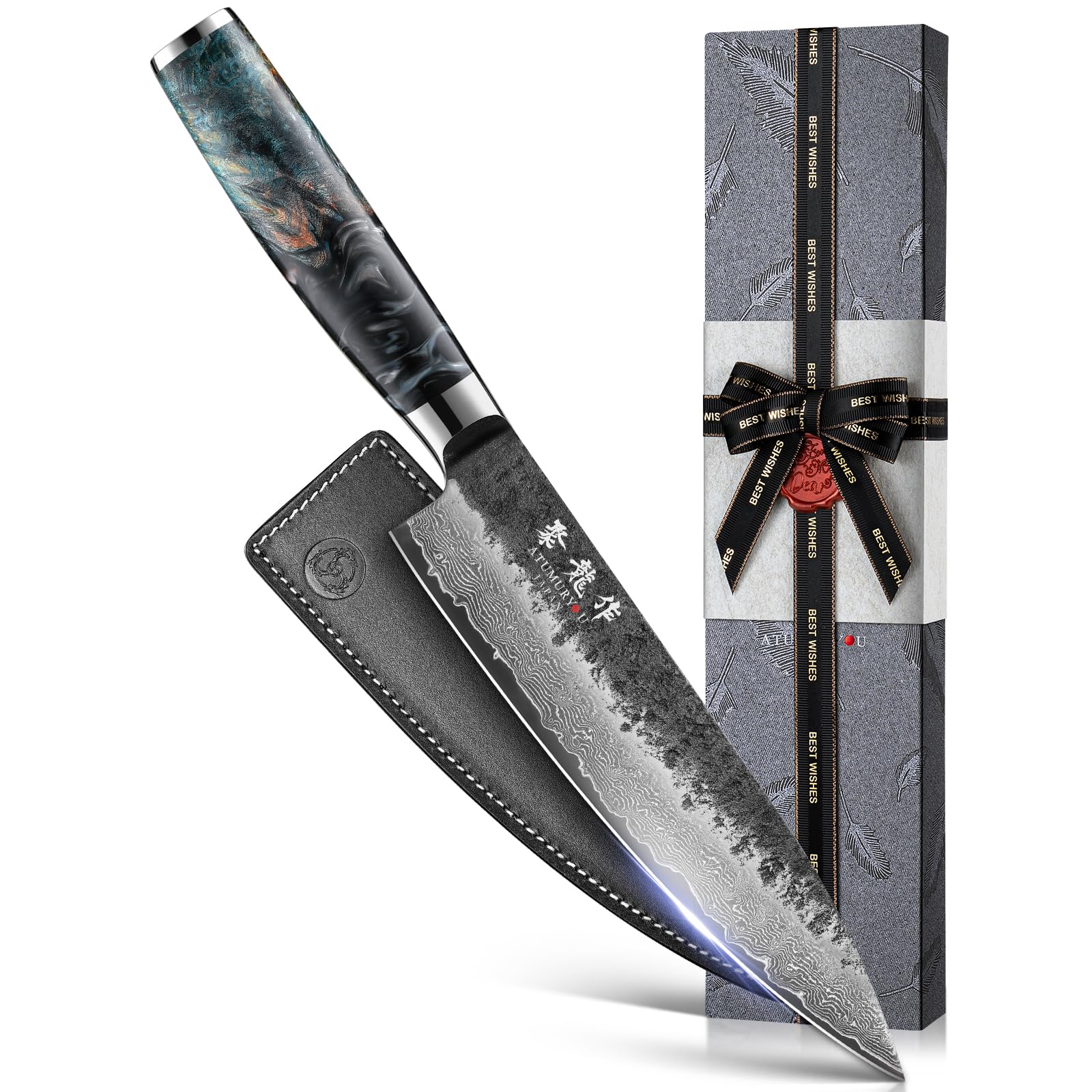
The Atumuryou JPCK brings a VG10 core wrapped in 67 layers of Damascus steel to a 62 HRC hardness—right in the sweet spot where edge retention peaks without becoming brittle. Career chefs in the reviews confirm the out-of-box sharpness handles fish filleting and vegetable prep with identical precision, which is rare for a knife at this tier. The full-tang construction and stabilized wood-and-resin handle keep the balance point directly over the pinch grip, reducing fatigue during hour-long prep sessions.
The genuine leather sheath included with every knife is a practical addition that most forged blades in this range skip. The packaging, a black gift box with feather patterns and a golden butterfly knot, makes it a strong candidate for a serious gift. The black-forged finish and unique multicolor resin handles mean no two knives look exactly alike, which matters for collectors who value individuality in their kit.
VG10 is a semi-stainless steel—it resists rust better than simple high-carbon steel but still demands hand-washing and immediate drying. Reviewers note that a small red authenticity dot verifies the Japanese origin, and the knife arrives with a certificate of authenticity. The 8-inch blade length and 13.3-inch overall length make it a versatile choice for both home cooks and professionals who need one knife for 90% of their cutting tasks.
Why it’s great
- 67-layer Damascus with genuine VG10 core hits an ideal 62 HRC balance of hardness and toughness.
- Stabilized wood and resin handle provides a secure grip that resists moisture absorption over years of use.
- Leather sheath and premium gift box packaging make it ready for gifting without extra cost.
Good to know
- VG10 steel requires immediate drying after each use to prevent surface oxidation.
- The unique resin handle pattern varies per knife—you cannot choose the exact color combination.
2. ZWILLING Professional S 8″ Chef Knife

The ZWILLING Professional S represents over 280 years of German blade-making compressed into one of the most balanced workhorse profiles available. Its special-formula high-carbon stainless steel is ice-hardened through the FRIODUR process, which aligns the molecular structure for a 57 HRC rating that delivers better edge retention than standard 55 HRC stamped blades. The Sigma Forge process forges the blade from a single piece of solid steel before the ergonomic polymer handle is bonded to the full tang—no welding, no weak points.
At 15 degrees per side, the edge angle is more acute than traditional German 20-degree edges, giving you precision that approaches Japanese geometry while retaining the chip resistance of German metallurgy. The reinforced bolster provides a safe finger guard and adds weight distribution that center-balances the knife just behind the heel. Multiple reviews from professional settings confirm the knife handles spatchcocking whole chickens and thin-slicing cherry tomatoes with equal confidence, a versatility not every German knife delivers.
The dishwasher-safe claim is technically accurate, but the edge will last significantly longer with hand-washing. The polymer handle resists cracking and shrinking better than natural wood, which is why commercial kitchens favor this line. At 277 grams, the knife is substantial enough to power through butternut squash without feeling heavy in the hand—a Goldilocks weight for cooks who want feedback without fatigue.
Why it’s great
- FRIODUR ice-hardening process delivers superior edge retention and corrosion resistance over standard German knives.
- 15-degree edge angle per side provides German durability with Japanese-like sharpness out of the box.
- Ergonomic polymer three-rivet handle is bonded to the full tang—no gaps, no loosening over time.
Good to know
- The 57 HRC steel will require honing more frequently than 60+ HRC Japanese steels.
- While dishwasher-safe, the edge will degrade faster with dishwasher heat and detergent cycles.
3. COOLINA Promaja 6″ Chef Knife
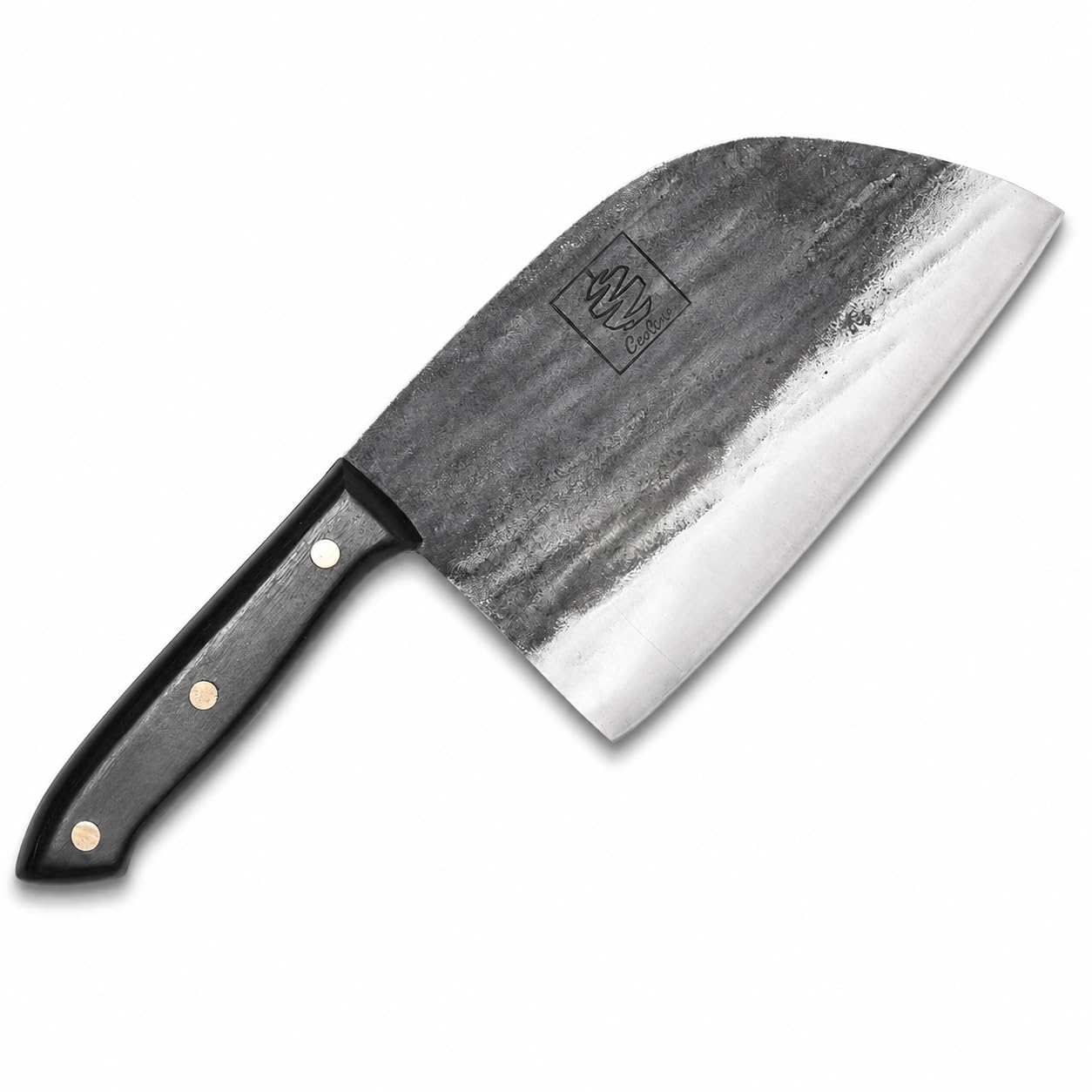
The COOLINA Promaja breaks the standard 8-inch length rule with a wide, tall 6.6-inch blade designed specifically for cooks who prefer one versatile knife over a drawer of specialized blades. The hand-forged high-carbon steel uses traditional Serbian forging techniques—repeated heating and hammering that aligns the grain for toughness—resulting in a blade that takes a finer edge than standard stainless and holds it longer through dense cutting tasks like splitting ribs or carving briskets. At 0.89 pounds, the Promaja has a deliberate heft that powers through meats and dense squash without needing downward force from the cook.
The wide profile doubles as a scoop for transferring chopped ingredients from board to pan, which reduces utensil swaps during high-tempo prep sessions. The full-tang design extends the steel through the entire 4.9-inch contoured wood handle, creating a forward-balanced feel that makes the knife feel lighter in the hand than its weight suggests. Reviewers note that the blade arrives sharp enough to slice brisket effortlessly straight from the box—a rare claim in the carbon steel segment where factory edges often need refining.
High-carbon steel requires maintenance discipline: hand-wash and dry immediately after use, then apply a light coat of food-safe oil periodically to maintain the finish. Some users report that the black coating rubs off the spine over time, though this is cosmetic and does not affect cutting performance. The Promaja is best suited for home cooks, grill masters, and outdoor enthusiasts who want a single blade that transitions from slicing raw proteins to chopping herbs without switching tools.
Why it’s great
- Wide 6.6-inch blade doubles as a food scoop, reducing utensil swaps during prep.
- Traditional Serbian hand-forging aligns the steel grain for superior edge retention over stamped carbon blades.
- Forward-balanced full-tang design makes the 0.89-lb knife feel lighter during extended use.
Good to know
- High-carbon steel requires immediate drying and periodic oiling to prevent surface rust.
- The 6-inch blade may feel short for cooks accustomed to standard 8-inch chef knives.
4. SHAN ZU Damascus Chef Knife 8″

The SHAN ZU 8-inch chef knife is one of the few production knives that combines copper and steel in a true 33-layer Damascus pattern—not a laser-etched imitation. The core is Japanese 10Cr15MoV steel rated at 62 HRC, which is twice as hard as budget stainless kitchen knives and takes an exceptionally fine edge. The copper layers are not purely decorative; they add a subtle thermal damping effect that can reduce micro-chatter during high-speed chopping, and the gold-color pattern is genuinely formed through heat treatment rather than acid etching.
The maple wood handle is ergonomically contoured to reduce fatigue by roughly 50 percent compared to straight-profile handles, according to the manufacturer’s testing. Users with larger hands specifically report that the handle fills the palm securely without slipping, even when wet. At 235 grams, the knife is lighter than the ZWILLING Professional S but still carries a solid feel thanks to the full-tang construction and the density of the laminated layers.
Customer reviews highlight the blistering out-of-box sharpness—one user notes it cuts tomatoes without any squishing on the first pass. However, a small percentage of units have had the blade separate from the handle after several months of use. SHAN ZU appears to handle replacements quickly, but this is a quality-control variance to be aware of. The included gift box presentation makes this a strong option for a collector or as a high-impact gift for someone who appreciates blade artistry.
Why it’s great
- True 33-layer copper and steel Damascus pattern—genuine forging, not laser-etching.
- 62 HRC 10Cr15MoV core delivers outstanding edge retention for a semi-production knife.
- Ergonomic maple handle reduces hand fatigue significantly during long prep sessions.
Good to know
- Occasional quality-control issues with blade-to-handle separation have been reported in online reviews.
- The copper layers require gentle cleaning—abrasive scrubbers can damage the pattern finish over time.
5. HOSHANHO Japanese Gyuto 8″ Chef Knife

The HOSHANHO Gyuto uses a Japanese 10Cr15CoMoV super-steel core wrapped in 9 layers of corrosion-resistant composite steel, creating a sandwich structure that provides the hardness of a high-carbon core with the rust protection of a stainless cladding. Each blade is hand-forged over an estimated 60-day process by a single craftsman, and the hand-polished wet-sharpening technique produces a 12-15 degree edge angle per side that delivers extreme sharpness straight from the box. Multiple reviewers confirm the knife glides through vegetables, fruits, and boneless meats with no resistance on the first cut.
The traditional Japanese octagonal rosewood handle is the defining ergonomic feature here. The eight-sided profile naturally indexes the blade angle in your hand without requiring you to look down, which is a meaningful advantage during fast prep work where visual attention is on the ingredient. The two copper accent wires add mechanical stability to the handle-to-tang bond and give the knife a distinct visual contrast against the dark gray hammered blade.
At 221 grams and 14.2 inches overall length, the HOSHANHO is noticeably lighter and longer than German counterparts, shifting the balance forward for a nimble feel ideal for push-cutting and slicing. A few users report that the unfinished transition area near the heel of the blade can feel sharp against the index finger—some have filed or ground it down for comfort. The hammered pattern (tsuchime) reduces food sticking, but the straight edge requires a push-cut motion rather than the rock-chop many Western cooks default to.
Why it’s great
- 9-layer sandwich construction combines a hard 10Cr15CoMoV core with a stainless outer cladding for durability.
- Octagonal rosewood handle provides natural blade-angle indexing for faster, more accurate cuts.
- Hammered tsuchime finish significantly reduces food sticking during slicing and dicing.
Good to know
- The straight-edge profile requires a push-cut technique rather than the traditional Western rock-chop motion.
- Some units have a sharp unfinished area at the heel that may need light grinding for comfort.
6. SYOKAMI 7-Piece Japanese Knife Set
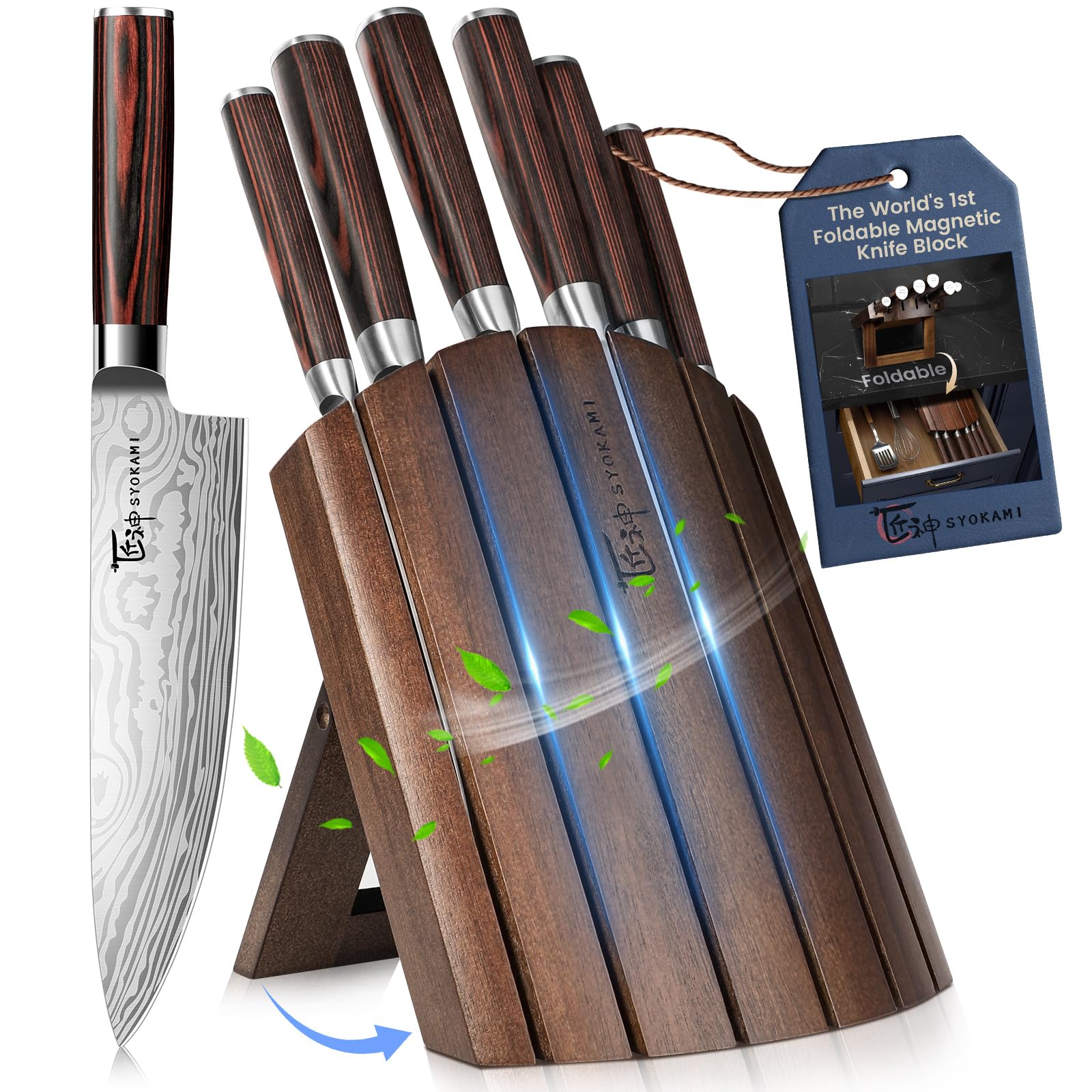
The SYOKAMI 7-Piece set solves a specific problem most knife blocks ignore: safe storage in households with children or pets. The acacia wood block folds flat for drawer storage, and each slot uses a magnetic strip to hold the knives firmly in place during movement. When you need the knives on the counter, the block opens into an easel stand, though some users note the countertop stability falters if the block is fully loaded and the surface is uneven. The FSC-certified wood construction adds environmental credibility that matters for sustainability-focused buyers.
The set covers the full spectrum: an 8-inch chef knife, a 7-inch Santoku, an 8-inch slicing knife, an 8-inch bread knife, a 6-inch utility knife, and a 3.8-inch paring knife. Each blade is forged from high-carbon stainless steel with a 56+ Rockwell hardness and a hand-sanded 15-degree edge. The 56 HRC rating means the steel is softer than the VG10 or 10Cr15CoMoV options in this guide, which translates to easier home sharpening but more frequent honing. For a family that wants one set for all tasks without breaking the budget, this is a practical compromise.
The slot design allows easy cleaning with a brush, which prevents the bacterial buildup common in solid wood blocks. The ergonomic wood handles are comfortable for medium-sized hands, but cooks with larger hands may find the handles slightly narrow for a secure pinch grip. The lifetime warranty adds peace of mind, and the packaging is gift-worthy for housewarming or wedding occasions. For households prioritizing child safety and drawer organization over single-blade performance, this set delivers where others compromise.
Why it’s great
- Foldable magnetic block stores flat in a drawer, preventing child and pet access to sharp blades.
- 7-piece set covers every common kitchen cutting task without needing additional purchases.
- Open-slot block design allows easy brush cleaning to prevent bacterial growth.
Good to know
- The 56 HRC steel requires more frequent honing than harder Japanese steels in the 60+ range.
- Countertop easel mode can be unstable on uneven surfaces when the block is fully loaded with knives.
7. SCOLE 7-Piece Chef Knife Set

The SCOLE 7-piece set offers a rare combination at this entry tier: German 1.4116 high-carbon stainless steel, 58±2 Rockwell hardness, and a full-tang ABS handle with classic triple-riveted construction—all for less than many single premium blades. The set includes an 8-inch chef knife, 8-inch slicing knife, 8-inch bread knife, 5-inch Santoku, 5.5-inch serrated utility knife, 5-inch utility knife, and 3.5-inch paring knife, covering every common kitchen task. The hand-polished 14-degree edge per side delivers sharpness that competes with knives costing two to three times as much.
The ABS handles are dishwasher-safe and engineered not to shrink, crack, or fall off over time, addressing the most common failure point in budget knife sets. The full-tang design gives the knives a solid feel and proper balance that belies the price point. Multiple verified reviews report the knives arrive sharp out of the box and maintain their edge through weeks of daily use with proper hand-washing. The 3-pound total set weight means each knife has a substantial feel that inspires confidence during prep work.
The trade-offs are predictable at this level: the 58 HRC steel will need sharpening more frequently than the premium Japanese options in this guide, and the ABS handles lack the warmth and grip of wood or resin alternatives. The set is dishwasher-safe, but edge degradation accelerates with heat cycling, so hand-washing remains recommended. For a new cook building their first knife kit or a household that needs a complete set without blowing the budget, the SCOLE set represents the highest-value entry point into forged construction available today.
Why it’s great
- 7-piece forged set with German 1.4116 steel at 58 HRC—exceptional value for a complete kitchen kit.
- Full-tang ABS handles with triple-riveted construction resist shrinking and cracking over time.
- Hand-polished 14-degree edge delivers sharpness that competes with knives in higher price brackets.
Good to know
- ABS handles lack the warmth, texture, and moisture absorption of natural wood or resin handles.
- 58 HRC steel will require more frequent sharpening than 60+ HRC Japanese alternatives.
FAQ
Is a higher Rockwell hardness always better in a forged chef knife?
How often should I sharpen a 58 HRC forged chef knife compared to a 62 HRC blade?
What is the practical advantage of a full-tang forged knife over a stamped blade?
Final Thoughts: The Verdict
For most users, the forged chef knife winner is the Atumuryou JPCK VG10 Damascus 8″ Chef Knife because it delivers 62 HRC edge retention, genuine 67-layer Damascus construction, and a stabilized wood handle at a price that undercuts comparable premium brands by a wide margin. If you want the bomb-proof reliability of German engineering that handles anything from herbs to butternut squash, grab the ZWILLING Professional S. And for outdoor cooks or BBQ enthusiasts who need a single blade that excels on proteins and vegetables alike, nothing beats the COOLINA Promaja 6″ Chef Knife.