
Rubber flexes and wood holds still — joining two materials with opposite personalities under stress is a recipe for peeling, cracking, and eventual failure. The wrong glue leaves you with a loose sole, a delaminated countertop edge, or a project that falls apart the moment it faces heat or moisture.
I’m Mohammad Maruf — the founder and writer behind Drink4Good. I’ve spent hundreds of hours analyzing construction chemistry, reading tear-down reports from marine and woodworking forums, and comparing cure cycles, temperature thresholds, and bond-flexibility data to find the glue that delivers a lasting bond between elastic rubber and rigid wood. This guide focuses exclusively on that specific material pairing — not general adhesives.
Based on real-world feedback and technical spec analysis, I’ve identified the five adhesives that solve the rubber-to-wood equation, covering contact cements, hybrid polymers, and neoprene formulas. Whether you’re repairing a boot sole, laminating a countertop, or building a custom jig, this buying guide to the best glue for rubber to wood gives you the exact chemistry and application data to pick the right tube, can, or bottle for your specific job.
How To Choose The Best Glue For Rubber To Wood
Matching rubber and wood isn’t like gluing two pieces of the same lumber. The bond must survive differential expansion, repeated flex, and the solvents that keep rubber alive without dissolving the wood fibers. Here are the three factors that separate a long-term hold from a weekend failure.
Flexibility vs. Rigidity
Wood is dimensionally stable within a narrow moisture range. Rubber can stretch, compress, and twist. A rigid glue like standard cyanoacrylate or brittle epoxy will crack the first time the rubber moves. You want a formula that cures to a resilient film — neoprene-based contact cements and hybrid polymers are the right chemical classes, because they retain elasticity after full cure.
Cure Chemistry and Working Time
Contact cements require coating both surfaces, letting the solvent flash off, then joining them at the precise moment of tack. This gives you zero sliding room — the bond grabs instantly. If you need repositioning time (for a large rubber sheet on a wood panel), look for a hybrid adhesive with a 5- to 30-minute open assembly window. Always factor in that heat accelerates solvent evaporation; a garage at 90°F will flash off a contact cement in half the label time.
Moisture and Temperature Resistance
Outdoor rubber-to-wood joints — a rubber bumper on a wooden gate, a sole glued to a leather boot — face rain, humidity, and thermal cycling. The adhesive must be waterproof and stable at temperatures from freezing to at least 150°F. Neoprene contact cements naturally resist water and oil, while some hybrid formulas can be applied even on damp wood. Check the technical spec for “water resistant” or “waterproof” labeling and the maximum service temperature.
Quick Comparison
On smaller screens, swipe sideways to see the full table.
| Model | Category | Best For | Key Spec | Amazon |
|---|---|---|---|---|
| DAP Weldwood Contact Cement | Premium Neoprene | Laminate & countertop bonding | 2.5‑hour full cure | Amazon |
| Gorilla Max Strength Construction Adhesive | Hybrid Polymer | Gap-filling & underwater repairs | Dries crystal clear | Amazon |
| Wonshine Contact Cement with Brush | Neoprene Contact | Precision brush-on repairs | Built‑in brush applicator | Amazon |
| RH Adhesives S-18 All-Purpose | Neoprene Solvent | Rubber-to-metal & leather repair | Excellent oil resistance | Amazon |
| RH Adhesives Clear-Tite Contact Cement | Fast-Set Contact | High-temperature laminates | Holds up to 250°F | Amazon |
In‑Depth Reviews
1. DAP Weldwood High Strength Rubber Contact Cement

DAP Weldwood is the household name in contact cement for a reason — its polychloroprene formula delivers the industry-standard balance of aggressive initial tack and long-term creep resistance. The 1-pint can is sized for laminating countertops, applying Formica to tabletops, or bonding rubber strips to wooden substrates in furniture assembly. The chemistry requires coating both surfaces, waiting for the solvent to evaporate until the film is touch-dry, then pressing together for an instant, permanent bond.
Users consistently report that Weldwood bonds strongly enough to hold edge banding and laminates through years of daily use, and the 2.5-hour full cure time is significantly faster than the 24-hour standard of most neoprene adhesives. One reviewer noted that while it’s excellent for Formica and similar materials, a single reapplication wasn’t enough to reattach shoe soles — a reminder that no single glue handles every rubber compound equally. For flat, large-area rubber-to-wood bonds where you can apply even pressure, this is the benchmark.
The can format is economical per ounce, but you’ll need a separate brush or roller for application. The solvent fumes are strong — work outdoors or with cross-ventilation. For high-production repairs or countertop fabrication, Weldwood remains the professional’s default.
Why it’s great
- Industry-standard bond strength for laminates and rubber sheet to wood
- Fast 2.5-hour full cure saves project time
- Water resistant for kitchen and bath applications
Good to know
- Requires separate brush — no built-in applicator
- Strong solvent odor demands ventilation
- May not bond flexible shoe soles on second application
2. Gorilla Max Strength Construction Adhesive
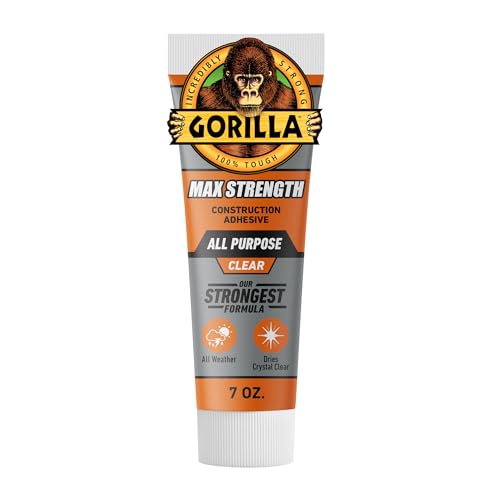
Gorilla’s Max Strength formula is a hybrid polymer that bridges the gap between a rigid construction adhesive and a flexible rubber cement. It cures to a clear, slightly rubbery consistency that absorbs movement without cracking — exactly what you want when rubber and wood expand and contract at different rates. The 7-ounce squeeze tube delivers a thick paste that fills gaps up to 1/4 inch, so you don’t need perfectly flush surfaces.
Users praise its ability to bond magnets to car armrests through interior heat cycles and to seal outdoor wood projects against water. The 30-minute working time is a major advantage over contact cements — you can reposition the rubber sheet or part after applying, a feature essential for large-format jobs. Reviewers note that it requires clamping and 24 hours to reach full strength, and the paste is extremely sticky — gloves are mandatory.
Because it’s 100% waterproof and can be applied underwater, this is the best pick for rubber bumpers on wooden gates, shower mat repairs, or any outdoor rubber-to-wood bond that faces rain and humidity. The clear finish also matters for visible edges where a tan contact cement line would look messy.
Why it’s great
- Gap-filling paste compensates for uneven rubber and wood surfaces
- 30-minute repositioning window for precise placement
- 100% waterproof and works on wet surfaces
Good to know
- Requires clamping during 24-hour cure
- Extremely sticky — difficult to remove from skin
- Not a contact cement — no instant grab
3. Wonshine Contact Cement with Brush
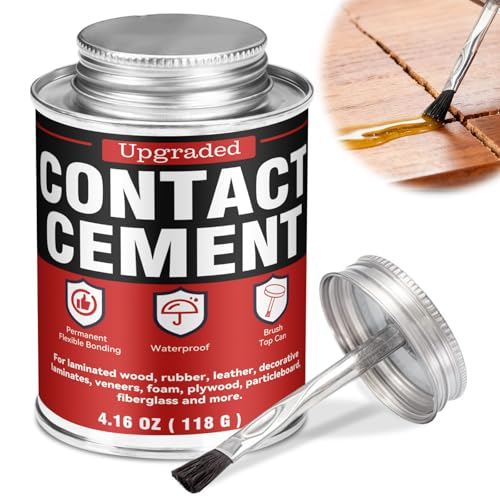
Wonshine’s contact cement is a specialized chloroprene formula that cures to a soft, rubbery film rather than a brittle shell — the right mechanical behavior for bonding rubber to wood. The 4.16-ounce bottle includes a precision brush tip, a small detail that makes a huge difference when you’re working on edge banding, shoe soles, or small craft pieces. You apply the glue to both surfaces, wait 10 to 15 minutes until the film is glossy and tacky, then press together for an instant bond.
Several users report that this glue finally solved their recurring laminate-countertop failure after other adhesives popped up. The brush keeps the application clean and controlled, which matters for narrow rubber strips and wood veneers where a drip would ruin the finish. One reviewer noted the bottle stiffens as volatiles evaporate over time, but a few drops of acetone restore the original consistency.
This is a mid-range option that punches above its price tier. It’s waterproof and heat-resistant, though the 24-hour full cure means you’ll need to keep the assembly undisturbed overnight. For anyone who does frequent small-scale rubber-to-wood repairs — shoe sole reattachment, furniture trim, DIY leathercraft — the built-in applicator alone justifies the buy.
Why it’s great
- Built-in brush applicator prevents mess and waste
- Cures to a flexible film that moves with rubber
- Waterproof and heat resistant for outdoor use
Good to know
- Small 4.16-ounce bottle limits coverage area
- Contents can thicken if bottle is left open
- 24-hour full cure requires overnight clamping
4. RH Adhesives S-18 All-Purpose Adhesive
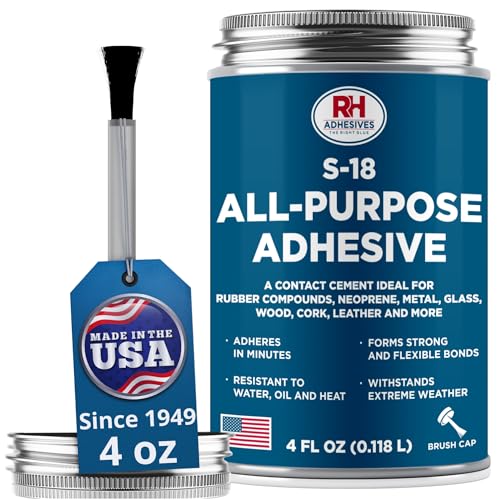
RH Adhesives S-18 is a classic neoprene solvent adhesive made in the USA since 1949. It’s designed to bond porous and non-porous surfaces alike — SBR rubber to metal, neoprene to wood, felt, leather, and ceramics. The 4-ounce can holds enough for several small repairs, and the water-resistant formula holds up in marine applications and difficult temperature conditions. Films made from S-18 deliver excellent peel strength and aging properties.
Users report success with leather boot repair, gluing neoprene yoga mats for hail protection, and affixing rubber to various substrates. One reviewer warns that the bond failed after exposure to heat and rain in an outdoor car-protection setup, suggesting this formula performs best in indoor or sheltered conditions. The adhesive sets faster in heat, but the can’s opening tends to gum up between uses. Ventilation is mandatory — reviewers consistently emphasize using this in a well-ventilated area.
S-18 is the right pick for workshop repairs where you need a tough, solvent-based bond between rubber and wood indoors. It’s not the best choice for outdoor installations that face direct rain and seasonal temperature swings. The small size is perfect for the occasional repair, but frequent users will want the larger can.
Why it’s great
- Proven neoprene formula with decades of field data
- Bonds both porous wood and non-porous rubber compounds
- Oil-resistant film ideal for workshop and automotive use
Good to know
- Not fully waterproof — can fail in sustained outdoor rain
- Strong solvent fumes require open-air ventilation
- Can opening gums up between uses
5. RH Adhesives Clear-Tite Contact Cement

Clear-Tite is a specialized neoprene contact cement formulated to maintain its bond at temperatures up to 250°F — significantly higher than standard contact cements, which typically soften above 180°F. This makes it the glue of choice for bonding rubber to wood near heat sources: countertops near stoves, rubber bumpers on industrial machinery, or laminate in direct sunlight. The light-beige liquid dries to a transparent yellow film, not water-clear, but the color blends acceptably on most wood substrates.
Users confirm it bonds quickly — the contact set takes about ten minutes — and holds laminated countertops through years of kitchen use. One reviewer compared it favorably to the classic Weldwood formula, noting the same performance. The 4-ounce can is small, so it’s best suited for discrete repairs rather than large-area laminating. Like all solvent-based contact cements, the fumes are present, though reviewers describe the smell as lighter than some alternatives.
The fast-drying, high-temperature tolerance makes Clear-Tite the specialty tool in this lineup. If your rubber-to-wood bond sits near a radiator, an oven, or under a dark roof in a hot climate, this is the formula that won’t creep or fail. For general indoor repairs without extreme heat, the standard neoprene options are more cost-effective per ounce.
Why it’s great
- Maintains bond integrity up to 250°F
- Fast 10-minute set time speeds project completion
- Effective on crepe rubber, wood veneers, and metal
Good to know
- Dries transparent yellow — not truly clear
- Small 4-ounce can limits coverage
- Solvent fumes still require ventilation
FAQ
Can I use epoxy to bond rubber to wood?
Do I need to roughen the rubber surface before gluing?
Why did my glue fail after a few months outdoors?
Final Thoughts: The Verdict
For most users, the best glue for rubber to wood winner is the Gorilla Max Strength Construction Adhesive because its flexible, waterproof hybrid polymer accommodates differential movement, fills gaps, and works in wet conditions — the broadest real-world compatibility for this difficult bond. If you want the instant grab and fast cure of a classic contact cement, grab the DAP Weldwood High Strength. And for precision brush-on application on small repairs or high-temperature environments, nothing beats the RH Adhesives Clear-Tite Contact Cement.