
The difference between a lawn that looks patchy and one that draws compliments often comes down to one thing: the product you spread. Granular weed and feed is the most common go-to for homeowners, but applying the wrong mix can leave you with burnt stripes, surviving weeds, or wasted money. The goal is to hit two targets at once: kill the broadleaf weeds already growing and feed the grass so it thickens up and crowds out future invaders.
I’m Mohammad Maruf — the founder and writer behind Drink4Good. I’ve spent countless hours analyzing formulation data, active ingredient concentrations, and customer application results across the most popular granular weed and feed products to understand which ones actually live up to their label claims.
Whether you are dealing with dandelions, clover, or creeping charlie, the right best granular weed and feed will simplify your lawn care routine and deliver visible results within a few weeks.
How To Choose The Best Granular Weed And Feed
A granular weed and feed has to balance two jobs that can sometimes compete: delivering enough herbicide to kill mature broadleaf weeds while dumping enough nitrogen to green up the grass without burning it. The wrong balance leaves you with dead patches or weeds that bounce back. Pay attention to three factors before you buy.
Active Herbicide: Post-Emergent vs. Pre-Emergent
Most granular weed and feed products fall into the post-emergent category, meaning they kill weeds that are already visible. The common active ingredients are 2,4-D, Mecoprop, and Dicamba. These work by disrupting the growth hormones in broadleaf weeds, causing them to curl up and die within a week or two. Some products, like those containing prodiamine, are pre-emergent — they stop weed seeds from germinating but won’t touch existing weeds. Read the label to know which job you are paying for.
Nitrogen Content and Release Type
The first number in the NPK ratio tells you the nitrogen percentage. A high number like 25-5-10 will green up the lawn fast, but quick-release nitrogen can burn the grass if you apply too heavy or skip watering. Slow-release nitrogen (often labeled as coated or controlled-release) feeds the lawn steadily over 8 to 12 weeks, which is safer for warm-season grasses like Bermuda or Zoysia during active growth. Cool-season grasses like Fescue prefer a balanced slow feed in spring and fall.
Coverage and Particle Size
Coverage is listed in square feet per bag. A standard bag covers between 4,000 and 5,000 sq ft, but premium or professional-grade bags can cover 15,000 sq ft or more. Particle size matters because smaller granules distribute more evenly through a rotary spreader, reducing the chance of striped applications. Products with patented dispersible granule technology dissolve rapidly upon watering, moving the herbicide into the soil faster without leaving visible pellets on the grass.
Quick Comparison
On smaller screens, swipe sideways to see the full table.
| Model | Category | Best For | Key Spec | Amazon |
|---|---|---|---|---|
| Yard Mastery 24-0-6 Flagship | Premium | Deep greening & iron boost | 24% slow-release nitrogen, 3% iron | Amazon |
| The Andersons Surge 16-0-9 | Premium | 250+ weed control & cool weather | Four-way herbicide, 40 lb bag | Amazon |
| Scotts Turf Builder (15K) | Mid-range | Large lawns & dandelion control | Weedgrip Technology, 43 lb bag | Amazon |
| Eco Solutions 25-5-10 | Mid-range | Pet/kid safe & slow release | 65% granular nitrogen, 110 day feed | Amazon |
| Jonathan Green Green-Up | Mid-range | Fine particle & broadleaf control | 21-0-3 analysis, 5,000 sq ft | Amazon |
| The Andersons Barricade | Mid-range | Pre-emergent crabgrass prevention | 0.426% prodiamine, 18-0-4 | Amazon |
| Scotts Turf Builder (5K) | Budget-friendly | Entry price & clover control | 2,4-D based, 14.3 lb bag | Amazon |
In‑Depth Reviews
1. Yard Mastery 24-0-6 Flagship Granular Lawn Fertilizer

The Yard Mastery Flagship fertilizer hits a unique sweet spot in the granular weed and feed category because it prioritizes feeding over killing — the 24% slow-release nitrogen and 3% iron combination produces a deep, dark green lawn that naturally thickens and chokes out weeds. This is a 24-0-6 NPK blend, so there is zero phosphorus (good for established lawns that don’t need extra P), and the 6% potassium helps with drought resistance during summer heat. The 45 lb bag covers 15,000 sq ft, which makes it one of the best values for large properties where you want maximum coverage per trip.
Bio-Nite technology is the key differentiator here — it enhances the breakdown of organic material in the soil, improving microbial activity so the grass roots access nutrients more efficiently. Customers report seeing a visible green-up within 5 to 7 days, and the slow-release mechanism keeps feeding for up to 8 weeks, reducing the need for frequent reapplication. The 3% iron content gives that dark emerald color without forcing excessive leaf growth that requires mowing twice a week.
One note: this product does not contain any post-emergent herbicide. It relies entirely on lawn density to outcompete weeds. If your lawn is already overrun with dandelions or clover, you will need to hit them with a separate weed killer before applying this fertilizer. But for maintenance feeding on an already decent lawn, this is the top performer in terms of color and density.
Why it’s great
- Very high nitrogen content greens lawns fast and holds color for weeks
- Bio-Nite technology improves soil biology, not just grass appearance
- Covers 15,000 sq ft per bag, lowering cost per application
Good to know
- Contains no herbicide, so existing weeds must be handled separately
- The large bag (45 lbs) can be heavy to carry and fill spreaders
2. The Andersons Professional Surge Weed and Feed 16-0-9
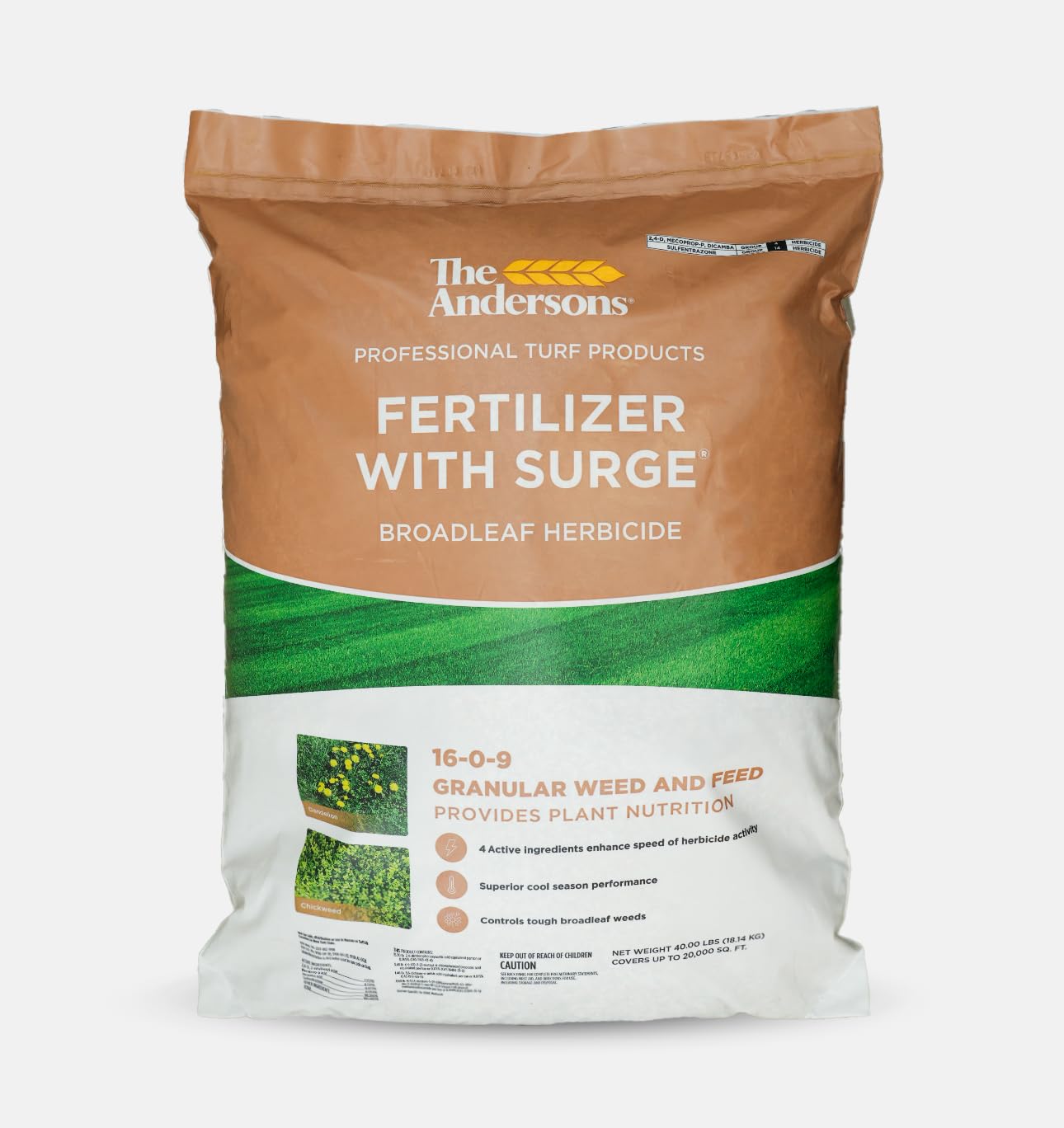
The Andersons Professional Surge is built for the homeowner who wants one product to do both jobs aggressively. The 16-0-9 NPK ratio is lower in nitrogen than the Yard Mastery, but the real draw is the four-way post-emergent herbicide blend that targets over 250 different broadleaf weeds, including creeping charlie (ground ivy), thistle, and wild onion — weeds that many consumer-grade formulas struggle with. The active ingredients are a mix of 2,4-D, Mecoprop-p, Dicamba, and Carfentrazone-ethyl, which gives it a broader spectrum than the standard two- or three-way mixes.
The bag weighs 40 lbs and covers up to 16,000 sq ft, which makes it the highest coverage option in this list. The granules are small and uniform, which helps with even distribution through a rotary spreader, and they dissolve quickly when watered in. Customers consistently report seeing results on stubborn creeping charlie and wild violet after a single application, which is rare for a granule — most post-emergent granules require a second pass for deep-rooted perennials.
There are two important restrictions. First, this product is not safe for Floratam St. Augustine grass, dichondra, or carpetgrass, so check your grass type before buying. Second, it is not sold in New Hampshire or Washington due to state regulations on the herbicide blend. If you have a cool-season lawn or a warm-season lawn with Bermuda or Zoysia, this is the most effective post-emergent granular option available.
Why it’s great
- Four-way herbicide kills 250+ weed types, including creeping charlie and thistle
- Covers 16,000 sq ft, ideal for large or irregularly shaped lawns
- Small granule size spreads evenly and dissolves quickly
Good to know
- Not safe for St. Augustine (Floratam), dichondra, or carpetgrass
- Not available for purchase in NH or WA
3. Scotts Turf Builder Weed and Feed 3, 15,000 sq. ft.
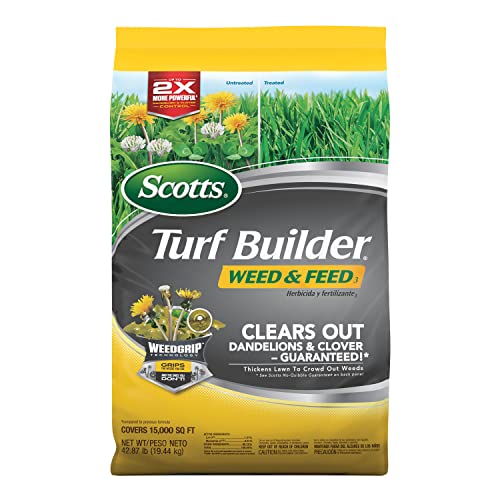
Scotts has been the default choice in the granular weed and feed category for decades, and the 15,000 sq ft bag is the most economical large-area option in their lineup. The formulation uses Weedgrip Technology, which means the granule has a slightly tacky coating that helps it stick to weed leaves rather than falling straight to the soil. This is important because post-emergent herbicides need to sit on the leaf surface to be absorbed, and a rain shower too soon after application can wash them off. The active ingredients are 2,4-D and Mecoprop-p, which are effective on dandelion and clover but less so on crabgrass or mature clover patches.
The 43 lb bag is heavy, but it covers 15,000 sq ft at the standard spreader setting, making it ideal for half-acre lots or larger. Customers note that timing is critical — the granular version needs the weeds to be wet when you apply so the granules stick, and then you need to avoid watering for two to three days afterward to let the herbicide absorb. If you apply during a dry spell and skip the pre-wetting step, the granules will bounce off dry leaves and land in the soil, wasting the herbicide component.
The fertilizer side uses a mix of quick-release and slow-release nitrogen, which gives you a visible green-up within a week but also supports feeding for several weeks. Reviews consistently mention that it works very well on dandelions and henbit but performs inconsistently on clover and does not touch crabgrass at all. This is a solid choice for large lawns with mostly dandelion problems, but not a broad-spectrum solution.
Why it’s great
- Weedgrip Technology helps herbicide stick to leaf surfaces for better absorption
- Large bag covers 15,000 sq ft, good value for big lawns
- Trusted brand with consistent results on dandelion and clover
Good to know
- Does not control crabgrass or creeping charlie effectively
- Requires wetting the lawn before application for best results
4. Eco Solutions Slow Release Lawn Fertilizer 25-5-10
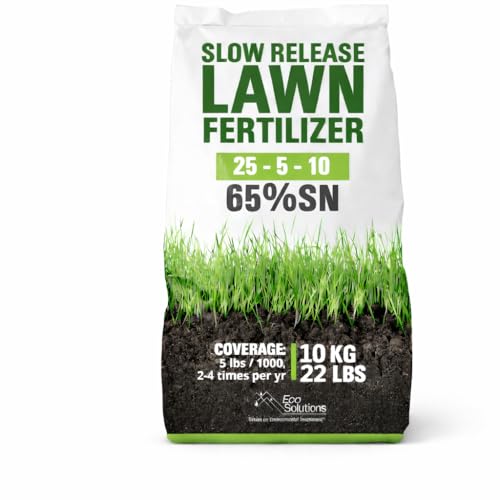
Eco Solutions takes a different approach by focusing on the fertilizer side only — there are no herbicides in this bag. The 25-5-10 NPK ratio is high in nitrogen, and 65% of that nitrogen is in slow-release form, which feeds the lawn steadily for up to 110 days. This makes it the longest-feeding product in the list, and it is marketed as safe for kids and pets once the granules have been watered in and the lawn has dried. The bag weighs 22 lbs and covers 4,000 sq ft per application, which is smaller coverage than the premium options but appropriate for smaller to medium-sized properties.
The slow-release mechanism uses a coated granule that breaks down gradually with soil moisture and temperature, reducing the risk of nitrogen burn that often happens with cheap quick-release fertilizers. Customers report noticeable greening within 7 to 10 days, and the effect lasts into the second month without requiring a second application. The inclusion of sulfate of potash adds potassium and sulfur, which support root development and stress tolerance during hot or dry periods.
Because this product contains no weed killer, it is best suited for lawns that are already weed-free or where you are using a separate weed control program. If you are dealing with active broadleaf weeds, pair it with a liquid spray herbicide. But for a simple, safe, and effective feeding routine that keeps the lawn dense enough to resist weeds on its own, this is the best option in the mid-range tier.
Why it’s great
- 65% slow-release nitrogen feeds for up to 110 days from one application
- Formulated to be safe for children and pets after drying
- Contains sulfate of potash for root health and drought tolerance
Good to know
- No herbicide included, so it won’t kill existing weeds
- Coverage is only 4,000 sq ft per bag, smaller than most
5. Jonathan Green Green-Up Weed & Feed 21-0-3

Jonathan Green’s Green-Up Weed & Feed is a strong mid-range contender that combines a 21-0-3 NPK fertilizer with a post-emergent herbicide that controls over 250 broadleaf weeds. The herbicide blend includes 2,4-D and Dicamba, which gives it a solid reach against dandelions, chickweed, clover, wild onion, thistle, and even poison ivy. The fine particle size is a notable advantage — smaller granules mean better distribution through a rotary spreader and more particles per square inch, which translates to more even weed control across the lawn.
The 15 lb bag covers 5,000 sq ft, which is the standard coverage for the price range. The fertilizer is designed to feed for up to three months, though much of the nitrogen is quick-release, so the green-up is fast but may fade faster than products with a higher slow-release percentage. Best application timing is late spring or early fall, when weeds are actively growing and the grass is ready to absorb nutrients. Jonathan Green also advises not using this product at the same time as seeding, because the herbicide can inhibit germination of new grass seed.
Customer feedback is mixed on weed control — many get excellent results on dandelions and chickweed, but some report that clover and wild violet survive the application. The bag also tends to arrive with some clumping due to moisture exposure during shipping, so you may need to break up clumps before pouring it into the spreader. For the price and the weed count it covers, this is a decent value if your primary targets are soft broadleaf weeds rather than deep-rooted perennials.
Why it’s great
- Controls over 250 broadleaf weed species, including poison ivy and thistle
- Fine particle size ensures even distribution and good coverage
- Feeds for up to 3 months, reducing reapplication frequency
Good to know
- Cannot be used when seeding new grass due to herbicide harm
- Inconsistent results on clover and deep-rooted perennials in some lawns
6. The Andersons 18-0-4 Barricade Fertilizer with Pre Emergent Weed Control
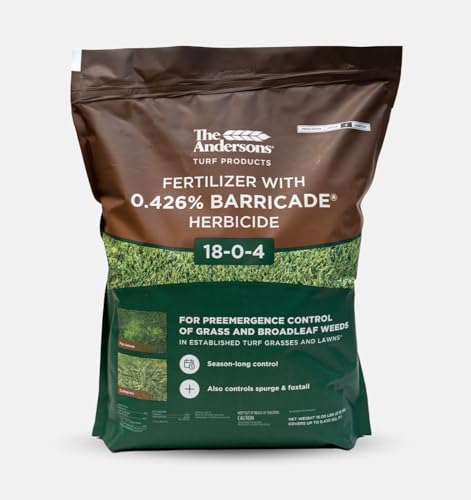
The Andersons Barricade is a pre-emergent weed control product that is fundamentally different from the post-emergent weed and feed products in this list. Instead of killing existing weeds, the active ingredient prodiamine prevents weed seeds from germinating. It targets 30 different grass and broadleaf weeds, including crabgrass, poa annua, goosegrass, and henbit. The 18-0-4 NPK ratio is modest in nitrogen but provides enough feeding to support early spring lawn green-up when applied before soil temperatures reach 55 degrees Fahrenheit.
The patented DG Technology (dispersible granule) is the standout feature here. Unlike standard granules that need to be watered in heavily, DG granules break down and disperse into the soil rapidly when they contact water, creating a uniform herbicide barrier in the top inch of soil. This reduces the risk of streaky coverage and missed spots that often happen with traditional pre-emergent granules. The bag weighs 18 lbs and covers 5,000 sq ft, which is on the smaller side for the price tier but justified by the professional-grade active ingredient.
Critical distinction: This product will not kill existing weeds. If you already have crabgrass or dandelions growing, you need a post-emergent product (like the Andersons Surge or Scotts Weed and Feed) to handle those first. Use Barricade in early spring as a preventive measure, then follow up with a post-emergent later in the season if needed. For homeowners who want to stop crabgrass before it starts, this is the top pre-emergent-and-fertilizer combo available.
Why it’s great
- Prodiamine stops crabgrass and 29 other weeds before they germinate
- DG Technology ensures rapid breakdown and uniform soil barrier
- Professional-grade active ingredient not found in most consumer bags
Good to know
- Will not kill existing weeds; must be applied before germination
- Coverage is only 5,000 sq ft, which feels small for the price tier
7. Scotts Turf Builder Weed and Feed 3, 5,000 sq. ft.

The smaller 5,000 sq ft version of Scotts Turf Builder Weed and Feed is the entry-level option that lets you try the formulation without committing to a 43 lb bag. The active ingredients and Weedgrip Technology are identical to the larger bag, using 2,4-D and Mecoprop-p to target dandelions, clover, and other common broadleaf weeds. The difference is purely in scale — 14.3 lbs instead of 43 lbs, which is easier to carry and store but means the cost per square foot is higher than buying the big bag.
For a small lawn (quarter acre or less), this size is actually more practical because you won’t have leftover granules degrading in the garage. The application instructions are the same: wet the weeds first, apply with a rotary spreader, and then avoid watering for two to three days. The fertilizer component will green up the lawn noticeably within a week, and the Weedgrip Technology improves herbicide adherence compared to standard Scotts granules from a decade ago.
The limitations are the same as its larger sibling: poor performance on crabgrass, inconsistent on mature clover, and no effect on creeping charlie. If your weed problem is mainly dandelions and you want a low-commitment first purchase to test the product, this is the cheapest entry point. But if you have a diverse weed population or a complex lawn, you will likely outgrow this product after one season.
Why it’s great
- Lowest entry price point to try Scotts Weed and Feed formulation
- Weedgrip Technology improves herbicide adhesion on wet weed leaves
- 14.3 lb bag is easy to carry and fits standard spreaders
Good to know
- Does not control crabgrass or creeping charlie effectively
- Weeds must be wet during application or granules will bounce off dry leaves
FAQ
Can I apply granular weed and feed on wet grass?
How long after applying granular weed and feed can I mow?
Will granular weed and feed kill crabgrass?
Final Thoughts: The Verdict
For most users, the best granular weed and feed winner is the Jonathan Green Green-Up because it balances a 21-0-3 fertilizer with excellent broad-spectrum weed control that covers over 250 species. If you want the deepest green with natural weed suppression through lawn density, grab the Yard Mastery Flagship. And for heavy weed infestations involving creeping charlie or thistle, nothing beats the The Andersons Professional Surge.