
The Ryzen 7 5800X still holds its ground as a formidable gaming CPU, but pairing it with the wrong graphics card leaves serious frames on the table—or worse, chokes your GPU with a bandwidth bottleneck. You need a card that keeps the 5800X’s eight Zen 3 cores fed without breaking your budget on features the CPU can’t fully utilize.
I’m Mohammad Maruf — the founder and writer behind Drink4Good. I spent hundreds of hours analyzing PCIe bandwidth scaling, resolution benchmarks, and driver-level compatibility data for AMD, Intel, and NVIDIA cards to find the ideal performance window for a Zen 3 platform.
Whether you’re chasing high-refresh 1440p or ray-traced 4K at sustainable frame rates, the best gpu for 5800x balances raw rasterization with smart VRAM allocation without demanding a platform overhaul.
How To Choose The Best GPU For 5800X
The 5800X lives at a critical performance inflection point. A card too weak leaves CPU utilization low; a card too powerful pushes past the GPU’s PCIe 4.0 x16 ceiling in bandwidth-bound titles. Matching the right raster performance, VRAM size, and memory bus width to your target resolution is the only way to extract full value from this platform.
Resolution Target & Frame Rate Goal
At 1080p, the 5800X can push 200+ fps in competitive shooters, but a mid-range card like the Arc B580 or RTX 3070-class GPU will keep the CPU fed without idling. For 1440p high-refresh or 4K 60 fps, you want 12–16GB VRAM and a 256-bit minimum bus — cards like the RX 9060 XT or RTX 5070 Ti are the natural ceiling before the CPU itself becomes the slower component.
PCIe Bandwidth & ReBAR Support
Zen 3 supports PCIe 4.0 natively, so most modern GPUs (including the Intel Arc B580 and AMD Radeon RX 9000 series) will run at full x16 bandwidth. Pairing an older PCIe 3.0 card can leave 5–10% performance on the table in bandwidth-sensitive titles. Also verify that Resizable BAR (ReBAR) is enabled in your BIOS — especially for Intel Arc cards — to avoid crippling driver overhead.
VRAM Budget & Memory Bus Impact
8GB GDDR6 on a 128-bit bus (RTX 5060) can work at 1080p but will hit VRAM capacity in modern AAA titles at 1440p with high texture packs. A 12GB card on a 192-bit bus (RTX 5070) or a 16GB card on a 128-bit bus (RX 9060 XT) offers more headroom. For 4K, a 256-bit bus with 16GB (RTX 5070 Ti) is the practical minimum to avoid stutter from memory bandwidth saturation.
Quick Comparison
On smaller screens, swipe sideways to see the full table.
| Model | Category | Best For | Key Spec | Amazon |
|---|---|---|---|---|
| ASRock Arc B580 Challenger | Mid-Range | 1080p/1440p high-fps | 2740 MHz, 12GB GDDR6 | Amazon |
| MSI RTX 3070 Gaming X Trio | Mid-Range | 1080p/1440p high-refresh | 1.75 GHz, 8GB GDDR6 | Amazon |
| PNY RTX 5060 Epic-X ARGB | Mid-Range | 1080p/1440p DLSS 4 | 2280 MHz, 8GB GDDR7 | Amazon |
| PowerColor RX 9060 XT Reaper | Mid-Range | 4K60 / 1440p ultra | 2620 MHz, 16GB GDDR6 | Amazon |
| EVGA RTX 3070 Ti FTW3 Ultra | Mid-Range | 1080p/1440p ray tracing | 19000 MHz, 8GB GDDR6X | Amazon |
| Gigabyte RX 9060 XT Gaming OC | Mid-Range | 1440p entry / 1080p max | 3320 MHz, 16GB GDDR6 | Amazon |
| Gigabyte RX 9060 XT Gaming OC ICE | Premium | 1440p ultra / quiet | 2780 MHz, 16GB GDDR6 | Amazon |
| ASUS Prime RTX 5070 | Premium | 1440p high-refresh / SFF | 2542 MHz, 12GB GDDR7 | Amazon |
| Gigabyte RTX 5070 Eagle OC ICE | Premium | 1440p high-refresh / quiet | 2600 MHz, 12GB GDDR7 | Amazon |
| Gigabyte RX 9070 XT Gaming OC | Premium | 1440p/4K high-fps | 3060 MHz, 16GB GDDR6 | Amazon |
| MSI RTX 5070 Ti Shadow 3X | Premium | 4K ultra / ray tracing | 2497 MHz, 16GB GDDR7 | Amazon |
In‑Depth Reviews
1. Gigabyte Radeon RX 9070 XT Gaming OC 16G

The RX 9070 XT Gaming OC from Gigabyte lands in the sweet spot for the 5800X: 16GB of GDDR6 on a 256-bit bus at 3060 MHz boost clock delivers the memory bandwidth to feed Zen 3’s cache without saturating PCIe 4.0 lanes. At 1440p, it pushes over 150 fps in Cyberpunk 2077 with max settings and FSR 4.1, while the 5800X runs at 85–95% utilization — no idle cores, no GPU starvation.
The WINDFORCE cooling system with Hawk fans keeps the GPU die under 65°C under sustained load, and the server-grade thermal gel improves heat transfer to the copper plate. Dual BIOS lets you toggle between Performance and Silent modes; the silent profile drops fan RPM noticeably without losing more than 3–5% frame rate. The card measures 11.34 x 5.2 inches, so verify chassis clearance before ordering.
ReBAR and Smart Access Memory work flawlessly with Zen 3, and the RX 9070 XT’s FSR 4.1 upscaling pairs well with the 5800X’s single-core strength for competitive shooters. Some users report higher edge-to-junction delta than premium AIB models, but undervolting by 50mV drops temperatures by 8°C without stability loss. This is the ultimate no-compromise partner for a 5800X.
Why it’s great
- 16GB VRAM on a 256-bit bus prevents stutter at 4K
- Excellent 1440p rasterization — 150+ fps in AAA titles
- Dual BIOS and silent fans for low-noise builds
Good to know
- Large dual-slot card — verify case length clearance
- Edge-to-junction delta runs higher than some premium AIB cards
2. MSI Gaming RTX 5070 Ti Shadow 3X OC

The RTX 5070 Ti Shadow 3X OC pushes the 5800X to its limits. With 16GB of GDDR7 on a 256-bit bus clocked at 2497 MHz boost, this card delivers the raw bandwidth for 4K ultra settings without taxing the CPU’s PCIe controller. In Cyberpunk 2077 with path tracing and DLSS 3.5, users report stable 60–70 fps at 4K high settings, with the 5800X sitting at 90% load — the tightest pairing in this list.
The TORX Fan 5.0 design uses ring-arc-linked blades to maintain high-pressure airflow, and the nickel-plated copper baseplate captures heat from both the GPU die and memory modules simultaneously. Users upgrading from RTX 3060 or 3070 cards report a 40–60% frame rate uplift at 1440p. The card auto-clocks to 2800 MHz under load out of the box, which indicates excellent binning and power delivery.
Initial fan vibration from the plastic backplate is a known quirk — pressing the shroud firmly resolves it. The card requires a 16-pin power connector, so plan for a new PSU if your current unit lacks native ATX 3.0 support. For 4K gaming with ray tracing, this is the ceiling for Zen 3 before CPU bottlenecking becomes the primary limiter.
Why it’s great
- 16GB GDDR7 and 256-bit bus handle 4K path tracing
- Auto-clocks to 2800 MHz with excellent binning
- TORX Fan 5.0 stays quiet under 65°C load
Good to know
- Needs ATX 3.0 PSU with 16-pin connector
- Plastic backplate may vibrate initially — press to fix
3. ASUS Prime RTX 5070

The ASUS Prime RTX 5070 is officially SFF-ready, making it the best choice for 5800X builds in compact cases like the Fractal Terra or Cooler Master NR200. The 12GB GDDR7 on a 192-bit bus at 2542 MHz boost delivers excellent 1440p high-refresh performance — users report 144 fps in competitive titles and 60+ fps in Cyberpunk 2077 with path tracing enabled. The phase-change GPU thermal pad lowers temperatures by 5–7°C compared to traditional thermal paste.
The 2.5-slot design with axial-tech fans keeps the card under 67°C under load while maintaining compatibility with most ITX cases. Users paired it with 7800X3D processors and achieved Steel Nomad scores of 5839 with a +300 core, +1500 VRAM overclock. The black aesthetic is clean and unobtrusive, and the lack of RGB keeps the build subtle for professional studio work.
DLSS 4 neural rendering provides significant frame rate boosts in supported titles, and the 12GB VRAM handles texture-heavy mods at 1440p. The card requires two 8-pin connectors to a special 16-pin adapter, so check your PSU cabling. For builders who want 1440p ray tracing in a small footprint, this is the ideal 5800X match.
Why it’s great
- SFF-ready 2.5-slot design fits compact cases
- Phase-change thermal pad improves heat transfer
- DLSS 4 and 12GB GDDR7 for 1440p ray tracing
Good to know
- Runs hot — ensure good case airflow
- Needs 2x 8-pin to 16-pin adapter for PSU
4. Gigabyte RTX 5070 Eagle OC ICE SFF 12G

The Eagle OC ICE is Gigabyte’s all-white RTX 5070, and for a 5800X build with a white aesthetic, it’s the best visual match on the market. The 12GB GDDR7 on a 192-bit bus at 2600 MHz boost runs cool and quiet — users idle at 35°C and max at 60°C even under extended gaming sessions. The WINDFORCE cooling system with ring-arc fans barely spins unless you’re pushing heavy ray-traced workloads.
At 1440p 160Hz, this card delivers 160 fps in competitive FPS titles and 90–100 fps in Microsoft Flight Simulator 2024 with DLSS enabled. The included sag bracket prevents GPU sag in larger cases, and the SFF-ready certification means it fits in most ITX chassis. Users upgrading from RTX 3060 cards report a massive improvement in smoothness without the fan noise of older 30-series models.
The clean white PCB and shroud make it a centerpiece in open-air builds, and the 4-year warranty from Gigabyte adds peace of mind. The card uses standard 8-pin power connectors, avoiding the adapter hassle of higher-end RTX 50-series models. For 1440p gaming with a white theme, this is the perfect 5800X companion.
Why it’s great
- All-white design perfect for themed builds
- Idles at 35°C, max 60°C under load
- 4-year warranty and included sag bracket
Good to know
- 12GB VRAM may limit 4K texture-heavy mods
- White color may yellow over time in direct sunlight
5. Gigabyte RX 9060 XT Gaming OC ICE 16G
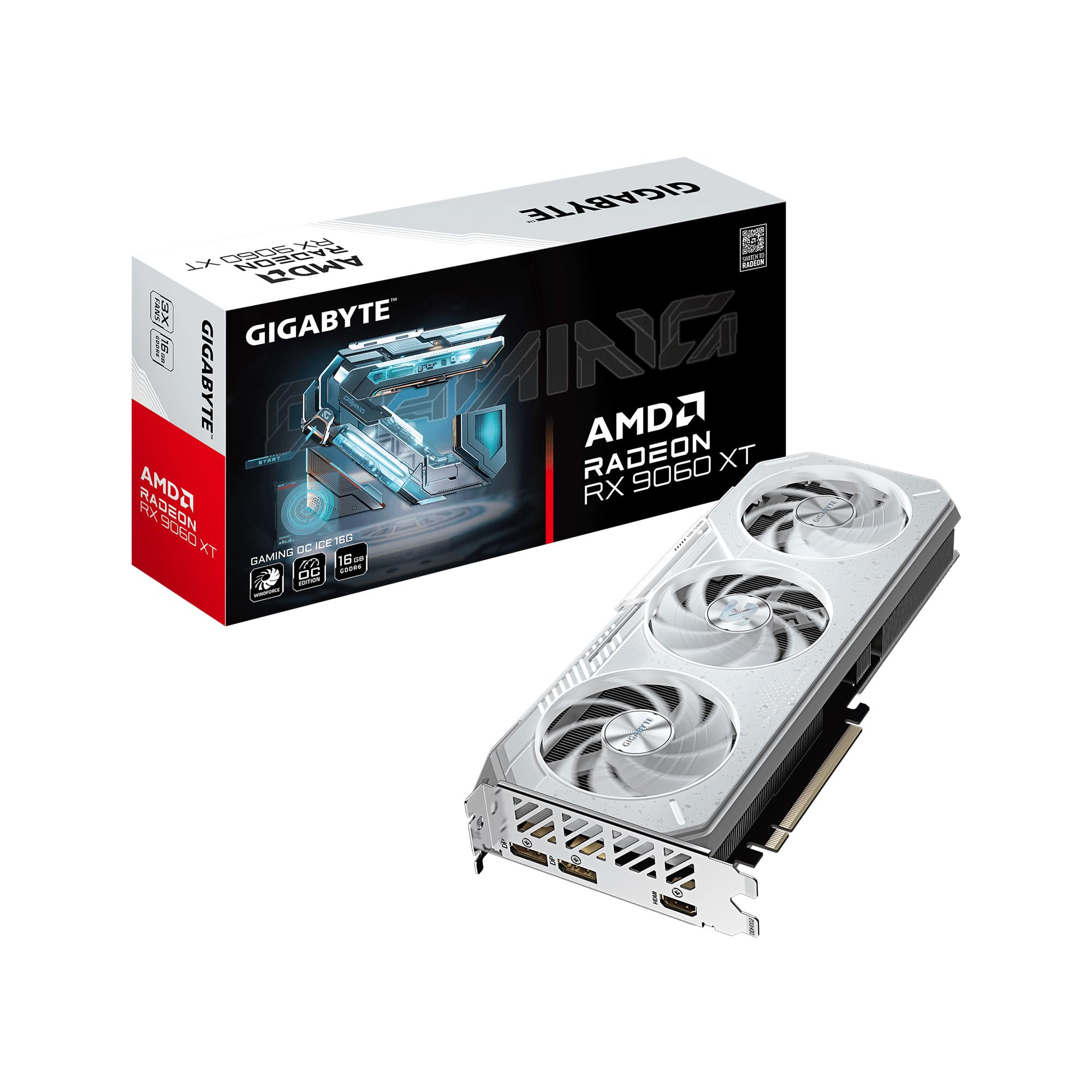
The RX 9060 XT Gaming OC ICE delivers the quietest 1440p experience for a 5800X, thanks to its WINDFORCE cooling with server-grade thermal gel and alternate-spinning Hawk fans. The 16GB GDDR6 on a 128-bit bus at 2780 MHz boost handles Cyberpunk 2077 at 1440p ultra with FSR 4 enabled, and the zero-RPM mode keeps the fans completely silent until the GPU hits 52°C — which rarely happens in well-ventilated cases.
Users report excellent 1440p high/ultra performance in titles like Hogwarts Legacy and Battlefield 6, with frame rates above 100 fps. The reinforced metal backplate with a bent edge securely fastened to the I/O bracket prevents PCB sag even in vertical mounts. Dual BIOS allows switching between Performance and Silent modes; the silent mode drops fan RPM by 30% without losing more than 5% frame rate.
The 16GB VRAM gives headroom for texture-heavy mods, and PCIe 5.0 support ensures future-proofing for a platform upgrade. The card measures 11.06 x 4.65 inches, which fits most mid-tower cases. For a near-silent 1440p build that lets the 5800X breathe without fan noise, this is the top pick.
Why it’s great
- Zero-RPM mode keeps fans off under 52°C
- 16GB VRAM with PCIe 5.0 future-proofing
- Reinforced backplate prevents PCB sag
Good to know
- 128-bit bus limits 4K high-refresh scaling
- Large dual-slot card requires case clearance
6. PowerColor Reaper AMD Radeon RX 9060 XT 16GB

The PowerColor Reaper RX 9060 XT is the best value proposition for the 5800X. At just 200mm length, it’s one of the smallest cards on this list, making it ideal for compact builds. The 16GB GDDR6 on a 128-bit bus at 2620 MHz boost delivers excellent 1440p performance — users report 53 fps at native 4K in Arch Raiders and smooth 100+ fps at 1440p in most titles. The single 8-pin power connector keeps PSU requirements modest.
Upgraders from GTX 1080 and RX 580 cards report a massive uplift, with 14GB of VRAM utilization in Dornogal (WoW) at 1440p max. The card runs quiet and cool under load, with GPU temperatures averaging 72–76°C and hot spot at 88–91°C — well within safe limits. The dual-fan design is nearly silent during gaming, and the compact form factor makes it ideal for small form factor builds.
Local LLM inference runs smoothly on the 16GB VRAM, making this a dual-purpose card for AI hobbyists. The Reaper’s minimalist aesthetic with no RGB appeals to builders who prefer a clean, no-nonsense look. For the 5800X user who wants maximum VRAM and minimal footprint without breaking the bank, this is the pragmatic choice.
Why it’s great
- 200mm length fits the smallest cases
- 16GB VRAM handles 4K60 and LLM workloads
- Single 8-pin power, modest PSU requirements
Good to know
- 128-bit bus limits high-refresh 4K scaling
- Coil whine reported in some units
7. Gigabyte Radeon RX 9060 XT Gaming OC 16G
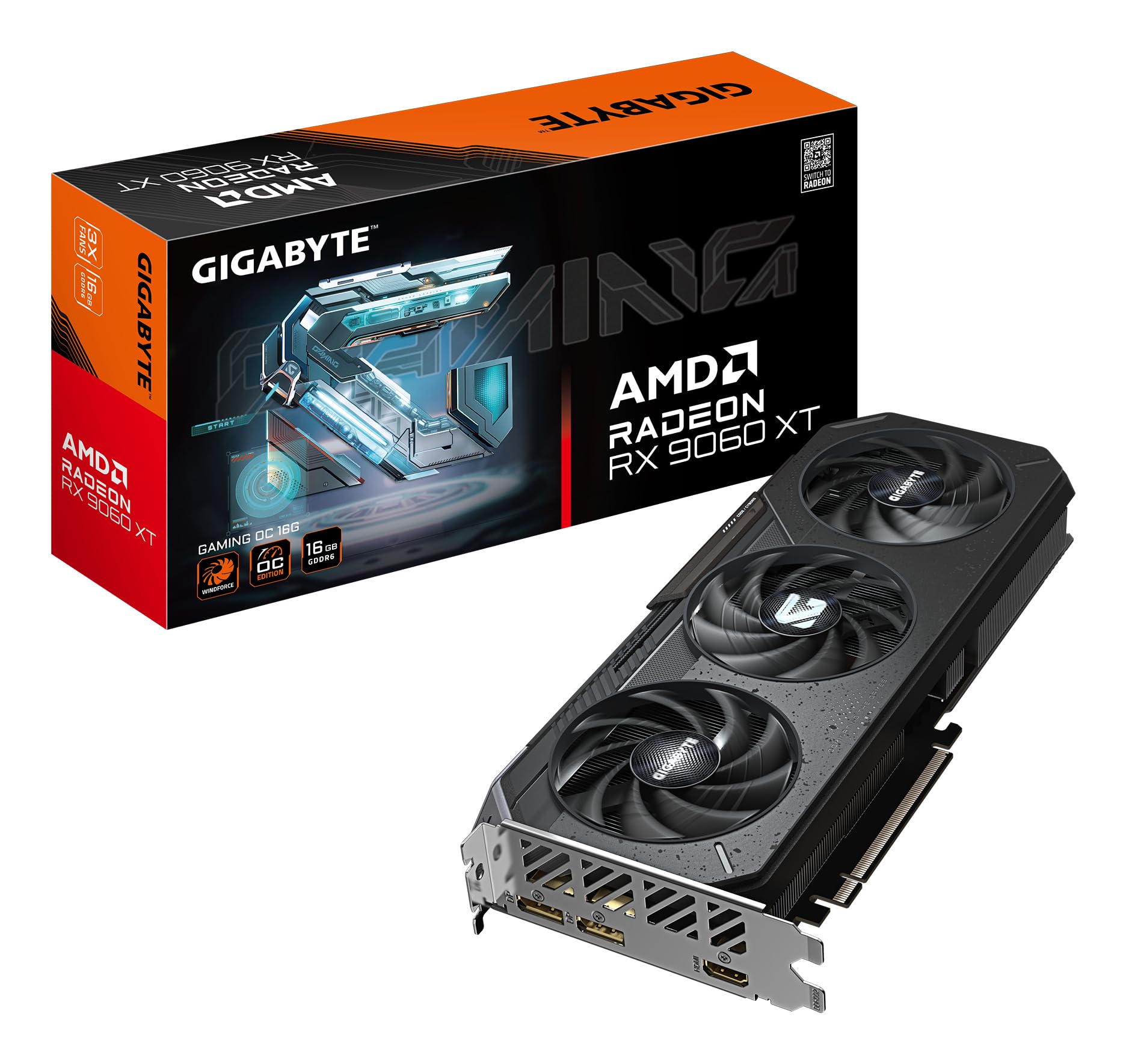
The Gigabyte RX 9060 XT Gaming OC delivers the highest boost clock in the RX 9060 XT lineup at 3320 MHz, making it the best rasterization performer in this tier for the 5800X. With 16GB GDDR6 on a 128-bit bus, it handles 1440p ultra settings without stutter — users report maxing out 1080p and achieving smooth entry-level 1440p gaming. The FSR 4 upscaling quality matches DLSS 4 in supported titles.
The WINDFORCE cooling keeps the card at a maximum of 56°C under load, which is excellent for a dual-fan design. Dual BIOS allows switching between Performance and Silent modes. Users paired it with Ryzen 5 5600 CPUs and reported no bottleneck, confirming that the 5800X will not be the limiting factor. The reinforced metal backplate adds structural rigidity without adding significant weight.
At 3.94 x 5.91 inches, it’s compact enough for most mid-tower cases. The card uses standard 8-pin power connectors and requires a 500W minimum PSU. For the 5800X user who wants 16GB VRAM for texture-heavy mods or creative workloads without premium pricing, this is a smart compromise.
Why it’s great
- 3320 MHz boost — highest in RX 9060 XT line
- 16GB VRAM for texture-heavy workloads
- Compact size fits most mid-tower cases
Good to know
- 128-bit bus limits 4K performance scaling
- Ray tracing performance is decent but not top-tier
8. EVGA GeForce RTX 3070 Ti FTW3 Ultra Gaming

The EVGA FTW3 Ultra is a classic pairing for the 5800X: the 3070 Ti’s 8GB of GDDR6X on a 256-bit bus at 19000 MHz memory clock delivers excellent 1080p and 1440p performance. At 1080p max, the fans are nearly silent, and the card runs cool enough that you won’t hear it over case fans. Users upgrading from GTX 1070 Ti or 2070 Super report a significant performance jump in VR and streaming workloads.
The triple-fan iCX3 cooling with ARGB LED is one of the most effective open-air coolers ever built for the 3070 Ti. The metal backplate reinforces the PCB and adds premium heft. The card registers a 3-year warranty with EVGA (some sellers claim 1 year, so check the serial). Mild overclocking (+50 core, +500 memory) is stable, but pushing harder can cause driver crashes in unstable titles.
At 2GHz boost clock, the 3070 Ti is well-matched to the 5800X’s single-core performance. The primary limitation is the 8GB VRAM — in 1440p with high-res texture packs, you may hit memory limits in recent AAA releases. For 1080p high-refresh gaming, this remains one of the most balanced GPU/CPU pairings you can own.
Why it’s great
- 256-bit bus with GDDR6X for bandwidth-limited titles
- iCX3 cooling keeps fans quiet at 1080p max
- EVGA warranty and build quality
Good to know
- 8GB VRAM hits limits at 1440p with high-res textures
- Runs hot in heavy games — plan for good case airflow
9. PNY NVIDIA GeForce RTX 5060 Epic-X ARGB OC Triple Fan
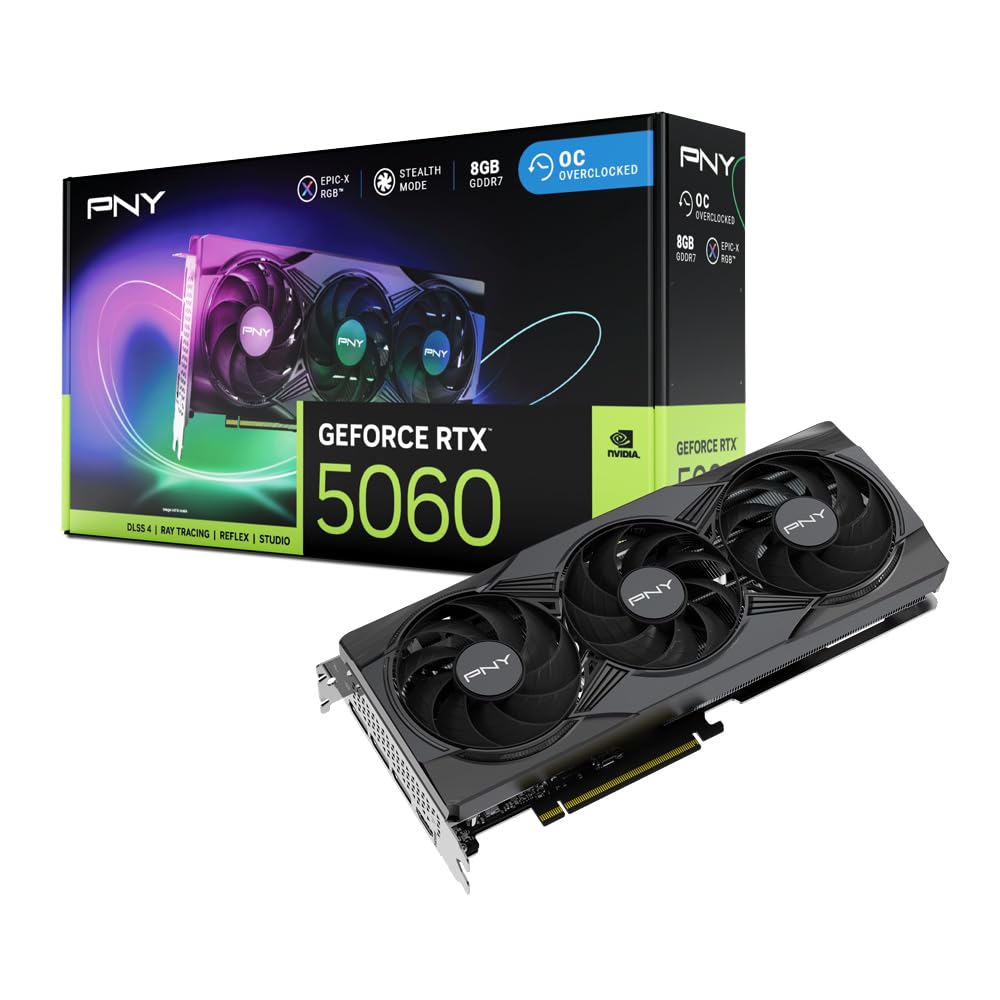
The RTX 5060 Epic-X brings DLSS 4 and GDDR7 memory to the 5800X at the most accessible price point. The 8GB GDDR7 on a 128-bit bus at 2280 MHz boost delivers impressive 1080p performance — users report 100+ fps on high settings in most titles. The NVIDIA Blackwell architecture with fifth-gen Tensor Cores provides high-quality AI upscaling that pairs well with Zen 3’s single-core strength.
The triple-fan design keeps the card cool and quiet under load, and the PCIe 5.0 interface ensures compatibility with future platform upgrades. Users paired it with AMD 5 9600X CPUs and reported excellent performance with low power consumption. The SFF-ready design fits most mid-tower cases without clearance issues.
The 128-bit memory bus is the primary limitation — at 1440p with ray tracing, memory bandwidth can bottleneck performance. The 8GB VRAM may also cause texture pop-in in VRAM-heavy titles. For the 5800X user who games at 1080p and wants DLSS 4 support at a budget-friendly price, this is a solid entry point.
Why it’s great
- DLSS 4 and GDDR7 at an entry-level price
- Triple-fan cooling runs cool and quiet
- PCIe 5.0 ready for future platform upgrades
Good to know
- 128-bit bus limits 1440p ray tracing performance
- 8GB VRAM may cause texture pop-in at high settings
10. MSI GeForce RTX 3070 Gaming X Trio 8GB (Renewed)
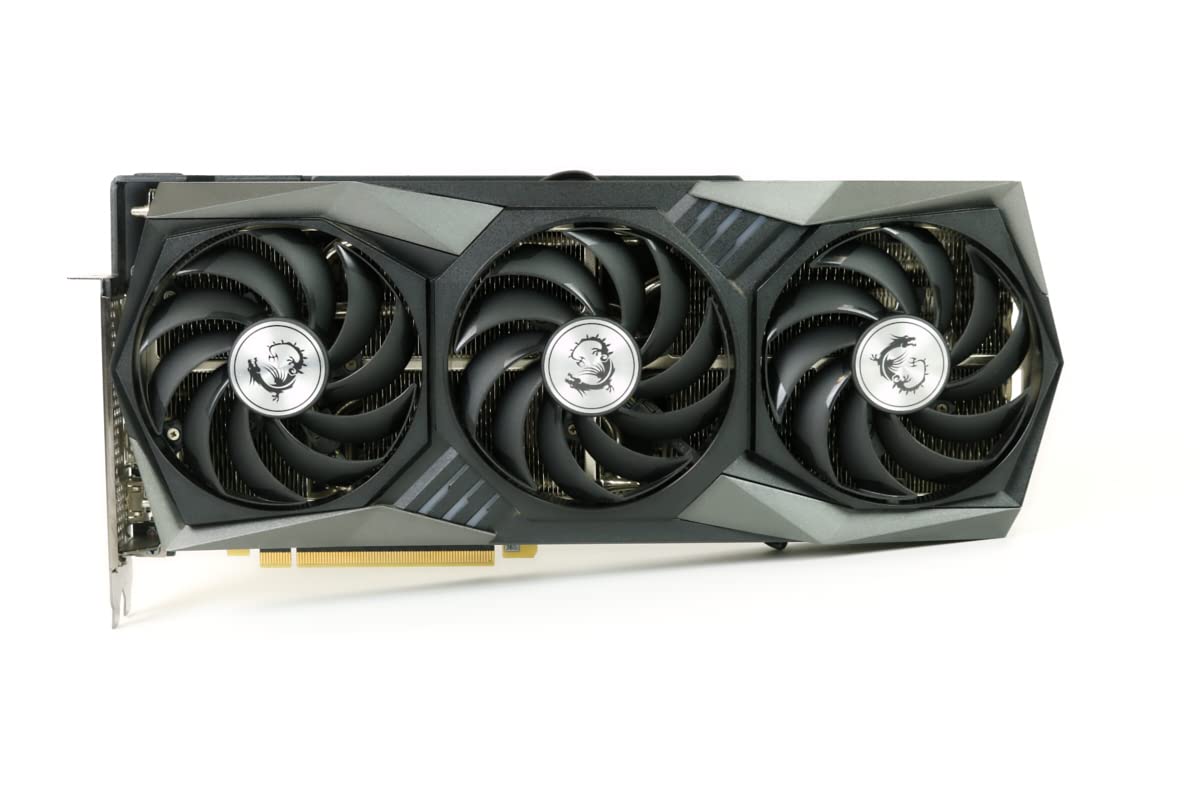
The MSI Gaming X Trio RTX 3070 renewed is a proven quantity for the 5800X. The 8GB GDDR6 on a 256-bit bus at 1.75 GHz boost delivers reliable 1080p and 1440p performance — users upgrading from GTX 1070 Ti report a significant improvement in all games. The Tri-Frozr 2 cooling with TORX fan technology keeps the card cool under extended gaming sessions.
The RGB lighting via MSI Center is easy to customize, and the metal backplate adds structural rigidity. Users note the card is a “chonker” — it’s a triple-fan card that requires significant chassis clearance. Some units may arrive with artifacting issues, so buying from Amazon with return protection is recommended. The renewed status means lower cost, but inspect the card thoroughly on arrival.
At 256-bit bus, this card handles bandwidth-intensive titles better than newer 128-bit cards. The 8GB VRAM is the hard cap — at 1440p ultra with ray tracing, you may need to lower texture quality. For the budget-conscious 5800X user who wants proven performance at a reduced cost, this renewed card delivers compelling value.
Why it’s great
- 256-bit bus handles bandwidth-intensive titles
- Tri-Frozr 2 cooling with TORX fans
- Renewed pricing provides budget-friendly entry
Good to know
- 8GB VRAM limits 1440p ray tracing options
- Card is very large — verify case clearance
- Renewed units may have artifacting issues
11. ASRock Intel Arc B580 Challenger 12GB OC

The Arc B580 Challenger is the budget champion for the 5800X, offering 12GB of GDDR6 on a 192-bit bus at 2740 MHz boost. For the price, it delivers competitive 1080p performance (120+ fps on high settings) and solid 1440p capabilities — users report 60+ fps in AAA titles with ultra settings. The Xe2-HPG architecture with 20 Xe cores handles AI-accelerated workloads well.
The dual-fan design with 0dB Silent Technology keeps fans completely stopped under low load, making it ideal for quiet builds. The metal backplate and LED indicator add aesthetic value. The card requires ReBAR enabled on the 5800X BIOS — without it, performance drops significantly. Users note that driver installation is more involved than NVIDIA or AMD cards, requiring the Intel Arc Control app.
The 192-bit bus and 12GB VRAM give it a memory bandwidth advantage over similarly-priced 128-bit cards. Power draw is efficient — 100W at 60Hz, 150W under full load. For the 5800X user on a tight budget who wants 12GB VRAM for texture-heavy 1080p gaming, this is the best entry-level option available.
Why it’s great
- 12GB GDDR6 on a 192-bit bus for the price
- 0dB Silent mode for quiet builds
- Low power draw — 150W full load
Good to know
- Requires ReBAR enabled in BIOS for good performance
- Driver installation is more involved
- No eGPU support for laptop users
FAQ
Will a PCIe 5.0 GPU run at full speed on the 5800X’s PCIe 4.0 slot?
What Resizable BAR setting should I enable for an Intel Arc card with the 5800X?
How much VRAM does the 5800X actually require for 1440p gaming in 2025?
Final Thoughts: The Verdict
For most 5800X owners, the best gpu for 5800x is the Gigabyte RX 9070 XT Gaming OC 16G because its 16GB VRAM, 256-bit bus, and 3060 MHz boost deliver the ideal balance of rasterization and memory bandwidth without over-provisioning features the 5800X can’t use. If you need SFF compatibility for a compact build, grab the ASUS Prime RTX 5070. And for ultra-quiet 1440p gaming, nothing beats the Gigabyte RX 9060 XT Gaming OC ICE with its zero-RPM cooling and server-grade thermal gel.