
The difference between a muddy, bitter cup and a clean, sweet one often comes down to the grind you can dial in before the water hits the beans. A grinder that delivers uniform particles in the right size unlocks flavors that pre-ground coffee simply cannot produce, whether you are pulling espresso or brewing a pour-over.
I’m Mohammad Maruf — the founder and writer behind Drink4Good. This guide is the product of many hours spent analyzing burr geometries, motor specifications, particle-size distributions, and real-world retention numbers across the most compelling options currently available.
The goal is to help you identify the best grinder for coffee based on your preferred brewing method, daily volume, and kitchen workflow rather than flashy packaging or inflated marketing claims.
How To Choose The Best Grinder For Coffee
Selecting a grinder is not about finding a machine that merely chops beans. The geometry of the burrs, the number of accessible grind settings, and the level of retention all directly affect how much flavor you extract from each gram of coffee. Focus on three critical areas to narrow your choices.
Burr Type and Material
Conical burrs excel at producing a wide particle distribution that suits medium to dark roasts and brew methods like pour-over and French press. Flat burrs, especially larger 64mm models, deliver a more uniform particle size with less fines, which translates to cleaner cups and easier espresso dial-in. Steel burrs with a hardness rating above HRC 55 resist wear over years of daily use.
Grind Adjustment Range and Step Size
For espresso, you need fine-grained control measured in microns per click — ideally 20 microns or less per step. Brew methods like drip and French press can tolerate coarser adjustment increments but still benefit from a wide range. The total number of settings matters less than the usable span between fine espresso and coarse cold brew.
Retention, Static, and Workflow
Retention, the grounds that stay inside the burr chamber after grinding, wastes coffee and introduces stale grinds into your next dose. Models below 0.5g of retention are preferred. Anti-static technology prevents clumping and flyaway powder, keeping your counter clean. Timed or single-dose operation, magnetic catch cups, and easy burr access for cleaning all make daily use smoother.
Quick Comparison
On smaller screens, swipe sideways to see the full table.
| Model | Category | Best For | Key Spec | Amazon |
|---|---|---|---|---|
| SHARDOR 64mm | Flat Burr | Espresso & brew versatility | 64mm flat burr; 100 settings | Amazon |
| KINGrinder K6 | Manual | Premium manual espresso | 16 microns/click; 60 clicks/rev | Amazon |
| AMZCHEF Single Dose | Electric Conical | Low-retention single dosing | 75 stepless settings; 40mm burr | Amazon |
| Aromaster | Electric Conical | Quiet family & office use | 48 grind settings; 3.9 oz capacity | Amazon |
| Timemore C2S | Manual | Portable daily manual grinding | 38mm conical burr; 700g weight | Amazon |
| OutIn Fino | Portable Electric | Travel & cordless brewing | 28 settings; USB-C rechargeable | Amazon |
In‑Depth Reviews
1. SHARDOR Professional 64mm Burr Coffee Grinder
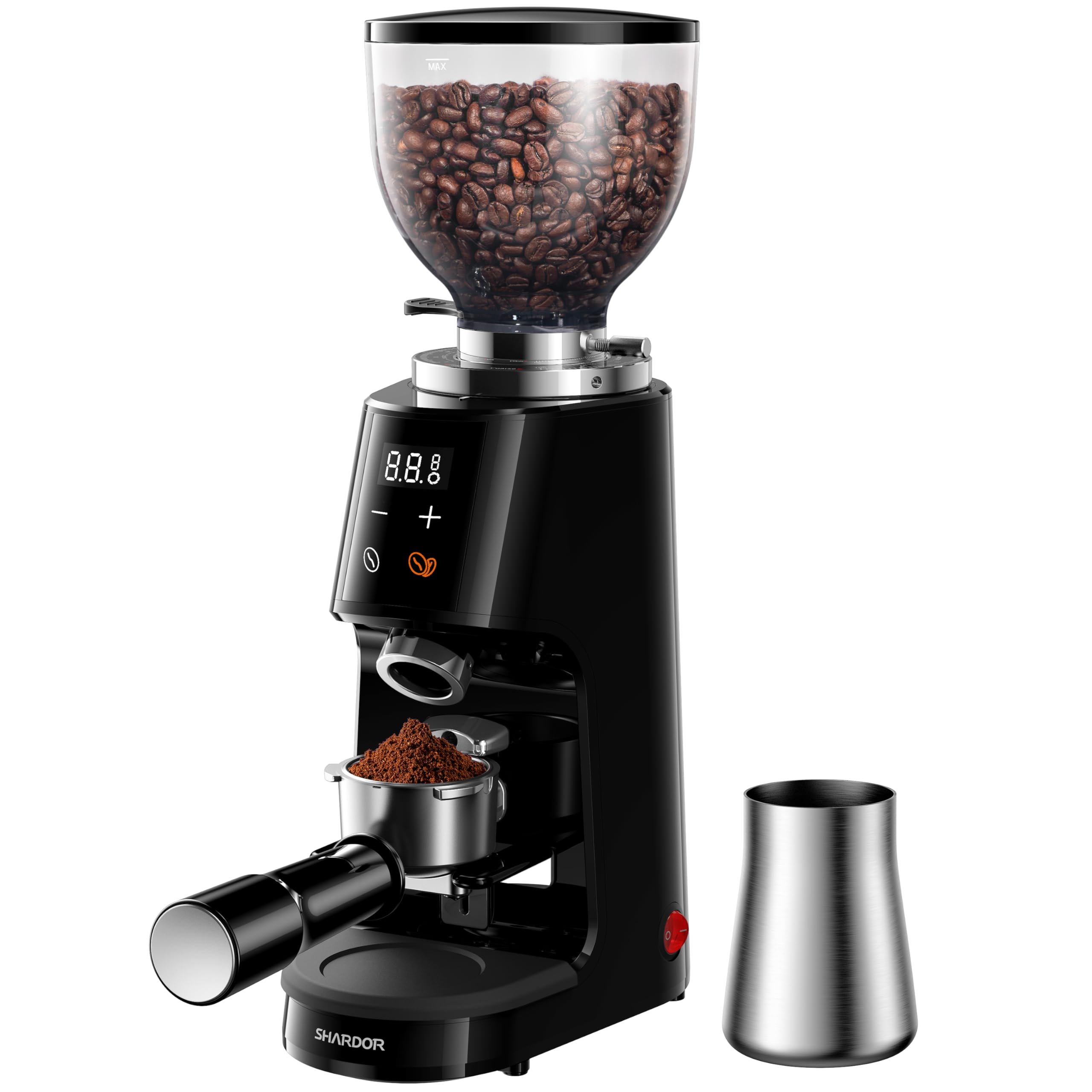
The SHARDOR uses a 64mm flat burr set inside an all-metal grinding chamber, a configuration typically found in machines costing two to three times as much. Flat burrs excel at producing a very uniform particle distribution with fewer fines, which makes dialing in for espresso significantly easier and yields a cleaner cup across all brew methods. The stepless adjustment ring, combined with 100 distinct grind settings, covers the full range from powdery fine to coarse cold brew with precision that rivals cafe-grade hardware.
Grind speed and noise are both noticeably better than competing 64mm options: users report that it finishes a full dose in roughly one-third the time of a Eureka Mignon Notte while operating at a lower decibel level. The built-in anti-static stainless steel catch cup keeps grounds from flying, and the magnetic discharge pipe makes disassembly for cleaning straightforward. The LED display allows timer control down to 0.1-second increments for single, double, or continuous doses, giving you exact repeatability shot after shot.
The main compromise is the plastic housing, though the burr chamber itself is metal. A few users note that the rubber base mat does not stay in place well and that the hopper gate can rattle when using a bellows. Overall, this grinder delivers professional-grade grind consistency and speed at a price point that undercuts most alternatives with similar burr size, making it the strongest all-around performer for anyone serious about espresso and pour-over alike.
Why it’s great
- 64mm flat burrs produce exceptional grind uniformity for espresso
- Stepless adjustment with 100 settings covers all brew methods
- Quiet and fast operation compared to rivals in the same class
Good to know
- Outer housing is plastic, not full metal
- Rubber base mat may need adhesive to stay in place
- Compatible single-dose hopper sold separately
2. KINGrinder K6 Manual Hand Coffee Grinder

The KINGrinder K6 is a full-metal manual grinder built around a stainless steel conical burr set with interior adjustment that delivers 16 microns of movement per click — fine enough to make meaningful adjustments for espresso without jumping past the ideal grind size. At 620 grams, the all-aluminum body feels dense and solid, and the dual-bearing central shaft ensures the burrs stay aligned throughout the grind cycle, producing consistent particle sizes even with light-roast beans that require more torque.
Users consistently report that the K6 grinds through 10 to 20 grams of coffee in about 45 seconds, which is competitive with many electric grinders in terms of throughput, and the zero-retention design means every gram of coffee ends up in the catch cup. The 30-gram hopper capacity limits you to single doses, but that is standard for manual grinders intended for precision. The screw-on catch cup doubles as a dosing cup that fits standard 58mm portafilters, streamlining the espresso workflow.
Reviewers frequently compare the grind quality to the DF64 electric grinder, noting that the conical burrs produce a slightly more rounded, balanced flavor profile that works especially well for medium roasts. The primary limitations are the physical effort required for light-roast espresso and the maximum 30-gram dose, which is not suitable for batch brewing. For anyone who values grind precision above convenience and prefers zero retention and a whisper-quiet workflow, the K6 is an exceptional choice.
Why it’s great
- 16 microns per click for precise espresso dial-in
- Full metal build with dual bearings feels indestructible
- Zero retention; catch cup fits 58mm portafilters
Good to know
- 30g max dose limits batch grinding
- Light-roast espresso requires noticeable arm effort
- Screw-on catch cup can jam if over-tightened
3. AMZCHEF Single Dose Coffee Grinder
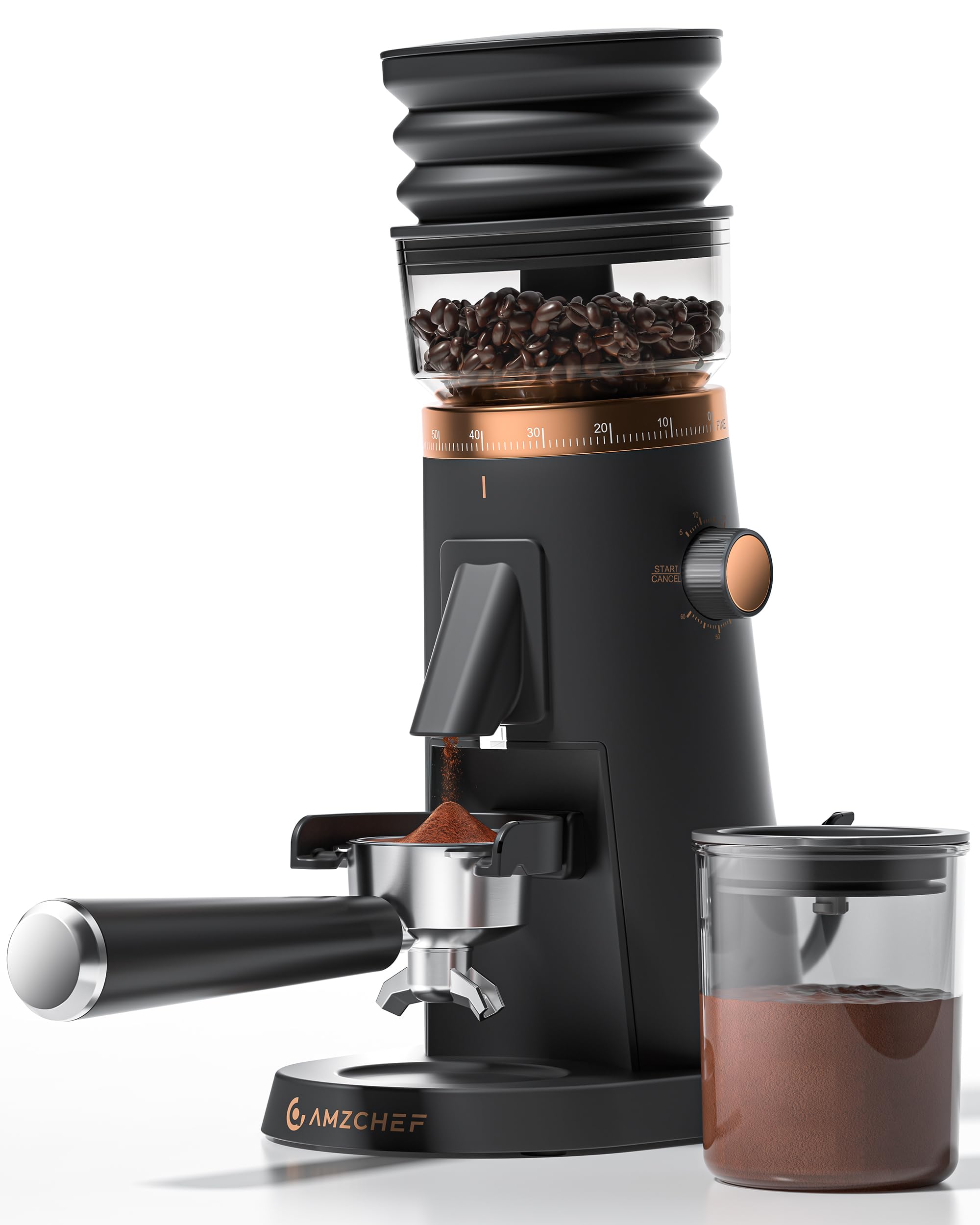
The AMZCHEF Single Dose grinder combines a 40mm six-star forged conical burr with 75 stepless grind settings, giving you enough granularity to fine-tune for espresso, pour-over, French press, and cold brew in a single compact machine. The stepless adjustment ring moves without audible clicks, allowing you to land on exact grind sizes between standard steps — a feature usually reserved for much more expensive units. The DC motor operates at 60 to 75 dB, which is significantly quieter than typical home electric grinders.
Retention is rated at 0.1 to 0.2 grams thanks to the magnetic detachable spout and included knock tool, meaning almost no stale grounds mix with your fresh dose. The anti-static design prevents clumping and powder spray, keeping the catch cup and counter clean. A 120-gram vacuum-sealed container preserves bean freshness, and the built-in LED illuminates the grinding chamber for visibility. The included dosing funnel stands accommodate 58mm, 54mm, and 51mm portafilters, making it compatible with most home espresso machines.
A small portion of users have reported that the grind adjustment mechanism can bind in the fine range on early units, though replacement units and persistent customer service resolved the issue. The timed grinding function, adjustable from 5 to 60 seconds, provides consistent dose control once dialed in. For home users who want low noise, near-zero waste, and versatile brewing capability in a single machine, this grinder delivers impressive value.
Why it’s great
- Near-zero retention at 0.1–0.2g
- Quiet DC motor at 60–75 dB
- 75 stepless settings for precise espresso tuning
Good to know
- Plastic housing may feel less premium than all-metal units
- Occasional binding in fine grind settings reported
- LED and vacuum container add convenience but not essential for all users
4. Aromaster Coffee Bean Grinder

The Aromaster electric grinder uses stainless steel conical burrs with 48 distinct grind settings, covering espresso through cold brew, and features a 40-second adjustable timer that controls the dose volume with repeatable accuracy. The large 3.9-ounce chamber holds enough beans for a full batch of drip coffee or multiple espresso shots, making it practical for families or shared offices. The beige finish and compact footprint fit neatly on a counter without dominating the space.
Upgraded anti-static technology is a standout feature here: users report that static cling and flying grounds are dramatically reduced compared to four prior grinders they tested. The tawny bin design also reduces UV impact on stored beans. The removable ring burr and built-in brush on the bean hopper lid make cleaning straightforward, and the overall noise level is lower than typical budget electric grinders — placing a hand on the lid during operation further dampens sound by an estimated 10 to 15 dB.
Some users note that certain nooks around the burr assembly are tricky to clean thoroughly without risking damage, and the plastic build quality does not match all-metal competitors. However, the consistent grind, quiet operation, and effective static control have earned it strong ratings from users who drink multiple brew methods daily. The 12-month repair service adds peace of mind. For anyone needing an affordable, low-mess electric grinder for varied brewing, this is a solid bet.
Why it’s great
- Effective anti-static design keeps counter clean
- Large 3.9 oz capacity for batch brewing
- Quieter than most budget electric grinders
Good to know
- Plastic housing may not satisfy users wanting full metal
- Removable burr has tricky cleaning spots
- 12-month repair service only covers limited defects
5. TIMEMORE Chestnut C2S Manual Coffee Grinder

The TIMEMORE C2S is an upgraded version of the widely popular C2, addressing the previous model’s main weakness by switching to a full metal unibody construction that eliminates the fragile top cover. The 38mm stainless steel conical burr is machined with CNC precision to a hardness of 55–58 HRC, and the double-bearing central shaft ensures the burrs stay aligned during rotation for uniform particle output. The 36-level grind adjustment uses an easy external nut that moves smoothly across the range.
At 700 grams and 52mm in body diameter, the C2S is compact enough for small hands to grip comfortably while still offering a substantial feel. The handle incorporates a bearing that allows it to keep spinning briefly after you release it, reducing wrist fatigue during longer grinding sessions. Users report consistent grind quality that significantly improves flavor compared to blade grinders, and the fully disassemblable design makes cleaning with the included brush simple.
The 25-gram capacity is adequate for a single espresso dose or a 12-ounce pour-over, but you will need to grind twice for a full pot of drip coffee. The steel burr set allows efficient grinding with minimal physical effort, though light-roast espresso still requires more torque than an electric alternative. For travelers, campers, or anyone wanting a quiet, durable manual grinder that removes the motor-failure risk, the C2S is a refined evolution of a proven design.
Why it’s great
- Full metal unibody fixes the C2 breakage issue
- 38mm CNC-machined burr with 55–58 HRC hardness
- Compact 52mm body and bearing-assisted handle reduce fatigue
Good to know
- 25g capacity requires multiple loads for batch brewing
- Light-roast espresso demands more physical effort
- External nut adjustment can be fiddly for frequent changes
6. OutIn Fino Portable Electric Coffee Grinder

The OutIn Fino redefines portable grinding with a rechargeable battery system that delivers up to 18 espresso shots per charge from dual 1000mAh cells, fully recharging in one hour via USB-C. The 38mm heptagonal conical burr is forged from 420 stainless steel at HRC 55–60 and is rated to handle over 100 kilograms of beans before replacement is needed. The 28-position precision dial covers the full spectrum from ultra-fine espresso to coarse French press with positive detents at each stop.
One-button operation includes auto-start, auto-stop when beans are fully ground, and an anti-clog reversal function that clears jams without user intervention. The noise level is rated below 60 dB, making it unobtrusive for early-morning brewing in shared spaces or hotel rooms. The collapsible bean hopper saves space during travel, and the dosing cup detaches for direct pouring. At 690 grams, it is light enough to carry in a backpack or carry-on.
Users note that 20 to 24 grams of beans often grind in a single pass, though very light roasts may require shaking to get the last few beans through. Some reviewers point out the lack of a pour spout on the dosing cup, which can cause minor mess when transferring grounds to an Aeropress. The battery longevity over several years is not yet proven. For anyone who wants a battery-powered electric grinder that travels as easily as a manual one but spares the wrist fatigue, the Fino is a unique and capable option.
Why it’s great
- USB-C rechargeable with up to 18 shots per charge
- Quiet operation below 60 dB
- Collapsible hopper and compact design for travel
Good to know
- Dosing cup lacks a pour spout for clean transfer
- Light roasts may need manual shake to finish grinding
- Long-term battery health is unverified over years of use
FAQ
Can I use a manual grinder for espresso every day?
Why does anti-static technology matter for coffee grinders?
What is the practical difference between conical and flat burrs?
Final Thoughts: The Verdict
For most users, the best grinder for coffee winner is the SHARDOR Professional 64mm because its flat burr uniformity, 100 grind settings, and quiet speed cover espresso and brew methods with professional-level precision at a mid-range cost. If you want the granularity of 16-micron manual adjustment and zero retention for serious espresso, grab the KINGrinder K6. And for battery-powered portability that spares your wrists, nothing beats the OutIn Fino for travel brewing.