
A garage floor with dips, slopes, and uneven seams turns every project into a balancing act — tool chests wobble, vehicle jacks sit unstable, and stored shelves lean. The right leveling compound turns that uneven mess into a smooth, monolithic surface ready for epoxy coating or daily use.
I’m Mohammad Maruf — the founder and writer behind Drink4Good. I’ve spent hundreds of hours analyzing chemical formulations, cure schedules, compressive strengths, and coverage rates to separate the compounds that truly self-level from those that just claim to.
After cross-referencing tensile data, application thickness ranges, real drying times, and hundreds of verified reviews, these are the top contenders for the best garage floor leveling compound money can buy today.
How To Choose The Best Garage Floor Leveling Compound
Not every concrete patcher is built for garage duty. The wrong compound cracks under vehicle weight, peels from moisture vapor, or simply doesn’t spread flat. Here are the key factors to evaluate before mixing your first batch.
Chemical Base: Epoxy vs. Polymer Cement
Epoxy-based compounds like the QuestMark 2105 deliver compressive strengths exceeding 6,700 PSI and bond chemically to old concrete. Polymer-modified cement compounds are cheaper per square foot but lack the structural integrity for heavy rolling loads. For a garage that sees cars, jacks, or toolboxes, epoxy mortar is the safer long-term bet.
Application Thickness and Layering
Some compounds, like the Henry pre-mixed patch, are limited to 1/4-inch per coat to avoid excessive drying times. Epoxy systems such as the Abatron Abocrete allow application in any thickness — critical when leveling dips deeper than half an inch. Check whether the product is designed for thin skim coats or true structural fills before starting.
Cure Speed and Foot Traffic Window
Premixed cement compounds often dry in 6-8 hours but remain fragile for days. Epoxy mortars like the QuestMark can handle light foot traffic in 12-14 hours, but full vehicle weight requires a 2-7 day cure. If your garage needs to be functional within 48 hours, look for fast-curing polyurea formulations like the OakSky 4-pack.
VOC Content and Indoor Suitability
Garages are semi-enclosed spaces, meaning low-VOC and zero-VOC compounds prevent lingering chemical odors. The QuestMark and Abatron formulas are both zero-VOC and solvent-free, making them safe for attached garage applications without overwhelming fumes.
Quick Comparison
On smaller screens, swipe sideways to see the full table.
| Model | Category | Best For | Key Spec | Amazon |
|---|---|---|---|---|
| QuestMark 2105 | Epoxy Mortar | Heavy traffic & structural repair | 6,700 PSI Tensile Strength | Amazon |
| Abatron Abocrete Kit | Epoxy Paste | Deep fills & chemical resistance | Shrink-Free, Any Thickness | Amazon |
| OakSky Concrete Crack Filler 4-Pack | Polyurea Sealant | Fast-curing crack sealing | Self-Flowing, 24-48h Cure | Amazon |
| Autosel 6-Pack Concrete Repair Filler | Silane Resin | Large crack & gap filling | Waterproof, 6.63 lb Total | Amazon |
| Henry W.W. Co. 12064 Pre-Mixed Floor Patch | Cement Patch | Small dips & subfloor repair | Pre-Mixed, 1 Gallon | Amazon |
In‑Depth Reviews
1. QuestMark 2105 Standard Epoxy Concrete Floor Patch and Resurfacer

QuestMark’s 2105 is a 100% solids epoxy mortar system engineered specifically for garage floors that need to handle daily vehicle loading and warehouse-style traffic. Its tensile strength of 6,700 PSI means this compound bonds aggressively to the existing slab and resists cracking even under heavy rolling loads. The three-component kit — resin, hardener, and aggregate — mixes into a thick, trowelable mortar that stays in place on vertical edges and forms a seamless transition across uneven seams.
Application thickness is limited to 1/8 to 1/4 inch per coat, which is standard for epoxy mortars, but the fast cure schedule is notable: recoating after 6-7 hours, light foot traffic by 12-14 hours, and full heavy traffic after 2-7 days. The zero-VOC formulation makes it safe for enclosed garages without lingering chemical odors. Customer feedback consistently highlights how quickly it hardens to a brick-like density.
Some users have reported inconsistent epoxy-to-hardener ratios between units, so weighing each component before mixing is recommended. The coverage is modest — approximately 19.15 square feet at 1/4-inch thickness per 5-gallon unit — so for large-area leveling, multiple kits will be required. Still, no other compound in this roundup matches its structural specs for true garage floor restoration.
Why it’s great
- Extreme 6,700 PSI tensile strength handles vehicle loads
- Zero-VOC, safe for attached garages
- Cures fast: light traffic in under 14 hours
Good to know
- Coverage is limited — larger projects need multiple kits
- Epoxy/hardener ratios may vary between batches
- Instructions are sparse for first-time users
2. Abatron Abocrete Kit – Self-Leveling Concrete Epoxy Patching Compound
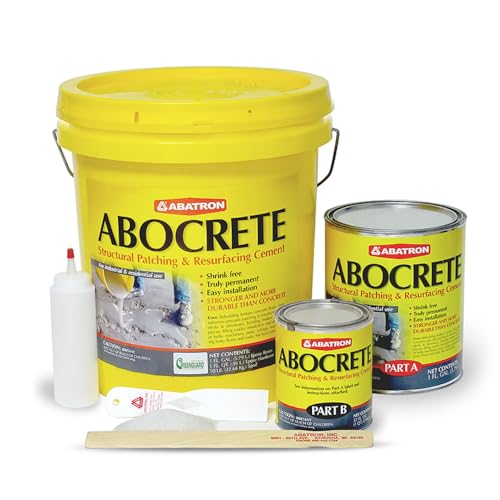
Abatron’s Abocrete Kit is the compound of choice when your garage floor has deep spalls, pitted surfaces, or salt-damaged concrete that needs structural rebuilding rather than cosmetic patching. Unlike cement-based fillers that must be applied in thin layers, this epoxy compound can be applied at any thickness without shrinking or cracking — a crucial capability for leveling dips deeper than half an inch. It bonds to concrete, plastic, and masonry, making it suitable for rebuilding concrete steps and countertops as well as floors.
The kit includes Part A resin, Part B hardener, and sand for consistency adjustment. The compound is self-leveling but requires manual troweling for thicker fills. It is unaffected by salt water, oils, and chemicals, so it holds up in garages where winter road salt gets tracked in or where oils drip from parked vehicles. Greenguard certification confirms extremely low VOCs, keeping the work environment safer than typical solvent-based epoxies.
Multiple users report that forklift traffic and heavy equipment have caused no degradation over months of use, confirming the compound’s structural claims. The main caveat is volume transparency — the kit lists a 1.25-quart size but the epoxy component is roughly 40 ounces before adding sand, yielding about half a gallon of finished material. Plan your square footage carefully if covering larger areas.
Why it’s great
- Apply at any thickness — no layer limit
- Resistant to salt water, oil, and chemicals
- Zero-VOC with Greenguard certification
Good to know
- Smaller usable material volume than container suggests
- Color and texture may not match existing concrete perfectly
- Requires mixing components precisely
3. Concrete Crack Filler 4-PACK – Self-Leveling Cement Crack Repair by OakSky
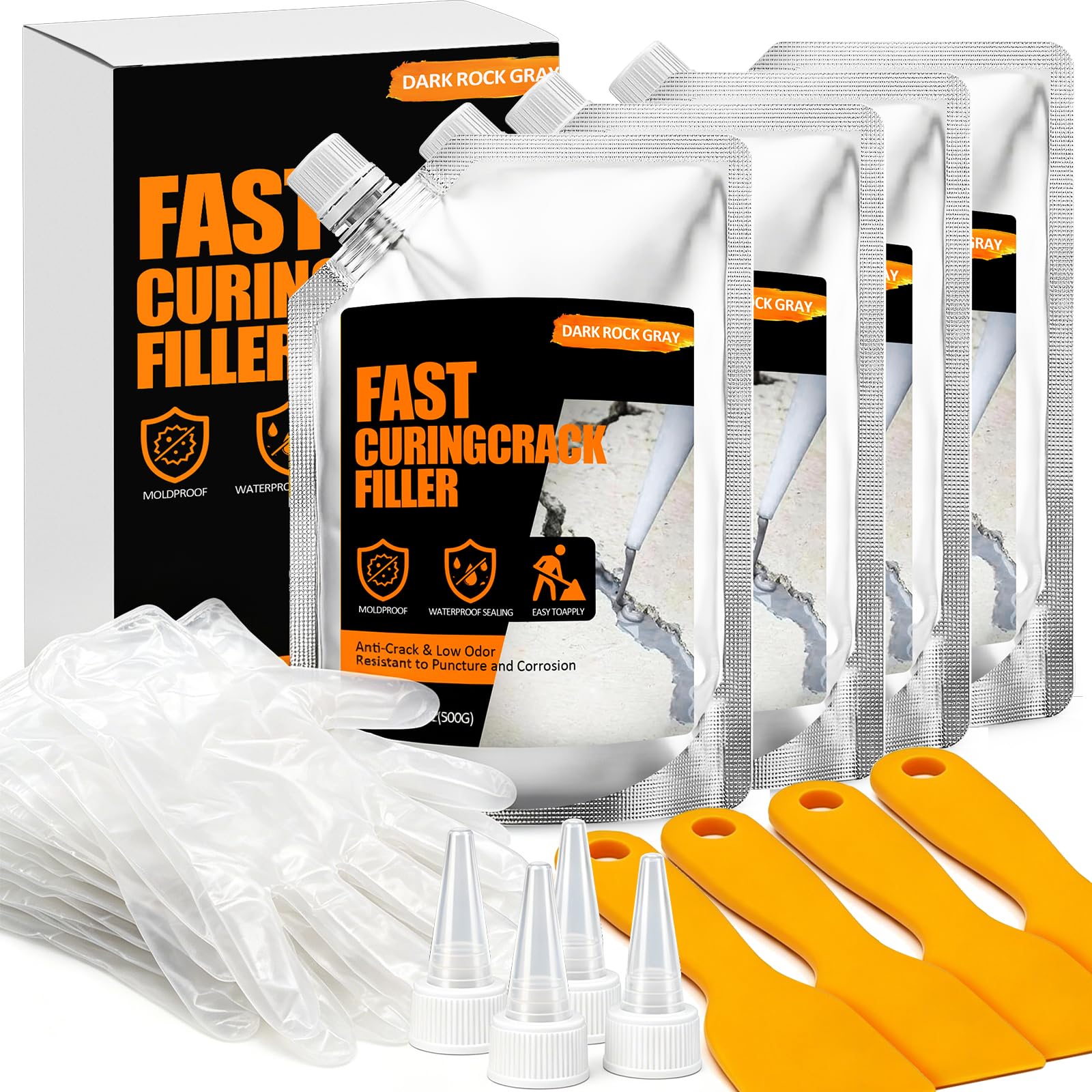
The OakSky 4-Pack brings a polyurea formulation to the garage floor repair market, and its standout feature is the self-flowing nozzle design that eliminates the need for manual troweling. Once the nozzle is attached, the compound spreads evenly across horizontal cracks and gaps, forming a smooth finish without tool marks. This makes it ideal for homeowners who want professional-looking results without the learning curve of epoxy mixing and spreading.
Cure speed is aggressive for a polyurea sealant: the surface becomes non-tacky in as little as 2 hours, with full cure achieved in 24-48 hours depending on temperature and humidity. The compound bonds to damp concrete without bubbling, which is rare in the category and saves time when working in humid garages or after pressure washing. Each tube seals cracks up to 2 inches wide and half an inch deep, and the 4-pack includes nozzles, scrapers, and gloves for immediate use.
The trade-off for this ease-of-use is a synthetic rubber-like texture once cured. Some users note the gray color doesn’t perfectly match weathered concrete, and the flexible finish feels different underfoot compared to rigid epoxy mortar. For purely cosmetic crack sealing and small gaps, this is the fastest and most user-friendly option, but it is not a structural leveling compound for large depressions.
Why it’s great
- Self-flowing nozzle — no troweling needed
- Fast 2-hour tack-free, 24-48 hour full cure
- Bonds to damp concrete without peeling
Good to know
- Rubbery finish may not match rigid concrete
- Color inconsistent with older slabs
- Not designed for structural leveling of deep dips
4. Autosel 6-Pack Concrete Repair Filler
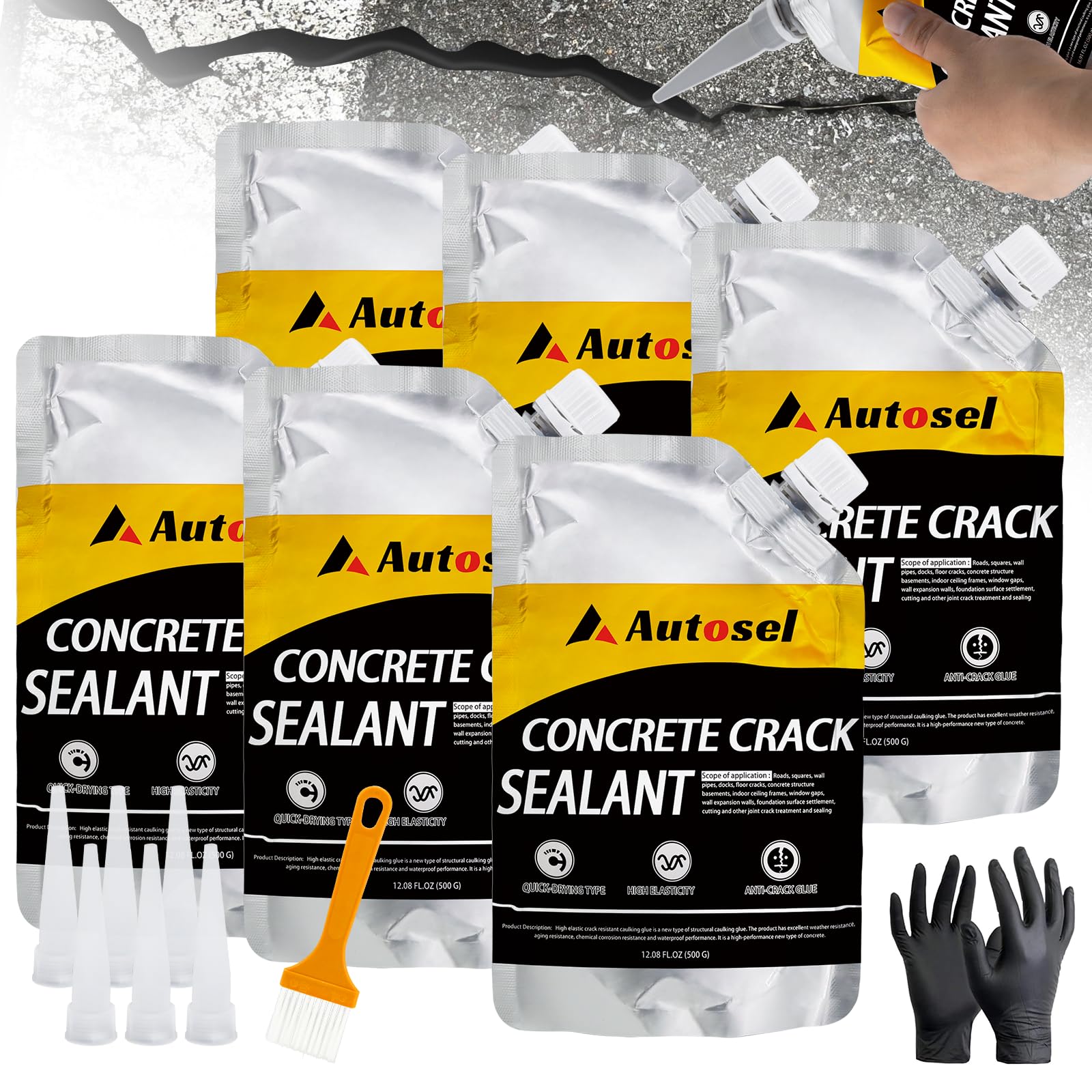
Autosel’s 6-Pack is a silane resin-based crack filler designed for large-scale crack sealing across concrete driveways, walkways, and garage floors. Each of the six tubes weighs roughly 1.1 pounds, giving a total of 6.63 pounds of material for covering multiple cracks in a single session. The formula self-levels in horizontal cracks and flows deeply into gaps, making it effective for both hairline fractures and wider breaks up to several inches across.
User feedback consistently highlights the ease of application — the included nozzles fit standard caulking guns and the compound spreads smoothly without mess. The black finish is durable under freeze-thaw cycles, with multiple users reporting successful performance through winter conditions. The waterproof rating ensures water doesn’t penetrate the seal during rain or car washing, which is critical for preventing sub-slab erosion.
The major drawback is application information: there are almost no instructions included with the kit, and the cure time is listed at 72 hours, though some users note 48 hours was sufficient before foot traffic. The provided nozzles have a tendency to leak at the base during application, so using a higher-quality caulking gun and wearing the included gloves is strongly advised. This is a solid budget-friendly option for preventing small cracks from becoming big problems, but not a structural leveling compound for large depressions.
Why it’s great
- Large total quantity — 6 tubes for multi-crack projects
- Waterproof and freeze-thaw durable
- Self-leveling flow into deep cracks
Good to know
- Almost no included instructions
- Cure time 48-72 hours may delay project
- Nozzle base can leak during application
5. Henry, W.W. Co. 12064 Pre-Mixed Floor Patch ARDEX LP 1 Gallon

The Henry 12064 is a pre-mixed, cement-based floor patch that requires zero mixing — open the pail and apply directly to the floor. This convenience makes it the most approachable option for DIYers fixing small dips or subfloor indentations, such as the footprint left by a removed kitchen island. The compound is trowelable and dries to a light concrete hardness within 6-8 hours, ready for light foot traffic the same day.
The critical limitation is application thickness: the manufacturer recommends applying no more than 1/8 to 1/4 inch per coat. Thicker applications result in dramatically extended drying times — a full 1/2-inch coat can stay soft for days. This makes the Henry patch unsuitable for leveling deep garage floor depressions. It is designed for cosmetic correction of small, shallow imperfections rather than structural floor restoration.
Customer reviews note that shipping damage is a recurring issue — the pail can arrive dented or leaking after transit, so inspect the packaging before opening. The compound is also not water-resistant, so it should not be used in areas exposed to standing water or constant moisture. For a quick, no-fuss patch on a small 2-foot by 4-foot area with shallow dips, the Henry pre-mix is serviceable, but serious garage floor leveling demands a higher-grade epoxy system.
Why it’s great
- Pre-mixed — open and apply instantly
- Dries in 6-8 hours for quick turnaround
- Good for small cosmetic patches
Good to know
- Limited to 1/4-inch max per coat
- Not water-resistant
- Shipping damage common for pails
FAQ
Can I apply a leveling compound over old epoxy or paint?
How long should a garage floor leveling compound cure before parking a car?
Final Thoughts: The Verdict
For most users, the garage floor leveling compound winner is the QuestMark 2105 because its 6,700 PSI tensile strength and zero-VOC formulation deliver true structural repair for garage floors that see daily vehicle weight. If you need to fill deep, uneven spalls with a compound that can be applied at any thickness, grab the Abatron Abocrete Kit. And for fast, tool-free crack sealing with a 24-hour cure time, nothing beats the OakSky 4-Pack.