
Every parent of a young gymnast knows the struggle: the dining table becomes a balance beam, the couch cushion turns into a crash mat, and the banister is constantly tested for handstand potential. A dedicated home beam solves the fear factor and saves your furniture from constant wear, but choosing the wrong one—too soft, too wobbly, or too short—can limit progress or even discourage practice. The real challenge is finding a beam that offers enough firmness for precise skills while feeling safe enough for a child to try a new cartwheel.
I’m Mohammad Maruf — the founder and writer behind Drink4Good. I’ve spent over 80 hours cross-referencing manufacturer specs, user experience patterns, and structural designs for home gymnastics beams to identify which models genuinely support skill development without compromising safety.
After comparing foam density, core materials, base stability, and adjustability across dozens of options, I’ve narrowed the field to the best models that deliver real training value. This guide breaks down the top contenders for a gymnastics beam for home so you can invest in the right one from the start.
How To Choose The Best Gymnastics Beam For Home
Selecting a beam for home use requires balancing your child’s current skill level, the space available, and the beam’s structural integrity. A beam that works for a beginner practicing walks will fail for an intermediate gymnast attempting cartwheels or handstands. Focus on these three factors before making a decision.
Core Material and Firmness
The beam’s core is the foundation of its performance. Floor beams typically use dense EPE foam or a wrapped foam block, while raised beams use solid wood or a wood core topped with foam and suede. Foam beams are forgiving for young beginners but can develop dents or lose shape over time, especially with heavier children. A solid wood core with a foam cushion layer offers the ideal balance—firm enough for precise foot placement and leaps, yet soft enough to absorb impact on landings. Always check the maximum weight rating and look for reviews mentioning whether the beam holds its shape after months of use.
Base Stability and Anti-Slip Design
A wobbly beam undermines confidence and can cause injury. Floor beams should have a wide, anti-slip bottom with a textured rubber or PVC surface that grips the floor without scratching it. Raised beams need a triangular or wide-leg support structure, preferably with rubber-wrapped feet to prevent sliding on tile, hardwood, or carpet. Some higher-end models feature dual U-shaped bases or rubber-coated steel legs that dramatically reduce side-to-side wobble. If your home has slick floors, prioritize beams with rubberized bases over bare plastic or metal.
Height Adjustability and Length
A beam that grows with your child eliminates the need for an upgrade within a year. Floor beams stay at ground level, which is safe for toddlers and absolute beginners learning to walk the beam. Once basic control is established, an adjustable raised beam becomes essential. Look for models with at least three height settings: a floor mode (around 7 inches), a medium height (14-18 inches), and a competition-adjacent setting (around 22 inches). The standard training length is 8 feet, which accommodates most skills from walkovers to split leaps without needing a full competition-sized 16-foot beam.
Quick Comparison
On smaller screens, swipe sideways to see the full table.
| Model | Category | Best For | Key Spec | Amazon |
|---|---|---|---|---|
| Sealoha 8ft Adjustable Beam | Adjustable Raised | Skill progression with wood core firmness | 300 lb weight limit, 8″ floor to 23″ high | Amazon |
| FC FUNCHEER Adjustable Beam | Adjustable Raised | Quick height changes without tools | 350 lb capacity, triple-layer foam+wood core | Amazon |
| defullion 8ft Adjustable Beam | Adjustable Raised | Intermediate gymnasts needing competition width | 4″ width, dual-layer cushion on wood core | Amazon |
| PreGymnastic 8ft Raised Beam | Adjustable Raised | Safety-focused design with rubberized steel bases | 5 height settings, rubber-wrapped U-bases | Amazon |
| FBSPORT 8ft PU Leather Beam | Floor Foam | Budget-friendly floor-level training | 500 lb limit, 4″ top, 6″ base, 5 lb weight | Amazon |
| ZENY 9ft Folding Beam | Floor Foam | Budget-friendly portable practice for all ages | 7.3″ wide base, tri-fold design, PVC cover | Amazon |
In‑Depth Reviews
1. Sealoha 8ft Adjustable & Foldable Balance Beam

This beam from Sealoha is the most versatile option in the lineup, combining a dense solid wood core with a suede-like cover that feels close to competition equipment. The steel legs use an inclined support structure that minimizes side-to-side wobble far better than standard straight-leg designs. At 8 feet long and 4 inches wide, it matches the width of an official beam, helping young gymnasts develop accurate foot placement and spatial awareness during skills like walkovers, leaps, and handsprings. The height range—from 7 inches floor mode up to 23 inches—covers every stage from first steps to advanced routines, making it a single-purchase solution for years of growth.
Assembly is tool-free thanks to a patented folding mechanism, and the beam collapses into a compact package for storage under a bed or leaning in a closet. Users consistently highlight the sturdy feel, even at the highest setting, and note that the suede surface provides excellent grip without being abrasive to bare feet. The 300-pound weight capacity means it can handle older children and even an adult spotter leaning on it during drills.
One trade-off is that the suede fabric can grab a little too much during spin skills like pirouettes, which advanced gymnasts may notice. Additionally, the beam requires some space (around 9 feet of floor length) when fully set up. For families with one aspiring gymnast who wants a beam that transitions from floor-level comfort to raised competition practice, this is the most well-rounded choice available.
Why it’s great
- Solid wood core provides firm, stable support for precise skills
- Wide height adjustability (7″ to 23″) without any tools
- Suede cover matches competition beam texture for muscle memory
Good to know
- Suede surface can be too grippy for spin and turn practice
- Requires dedicated floor space of about 9 feet when deployed
2. FC FUNCHEER 8ft Adjustable Balance Beam
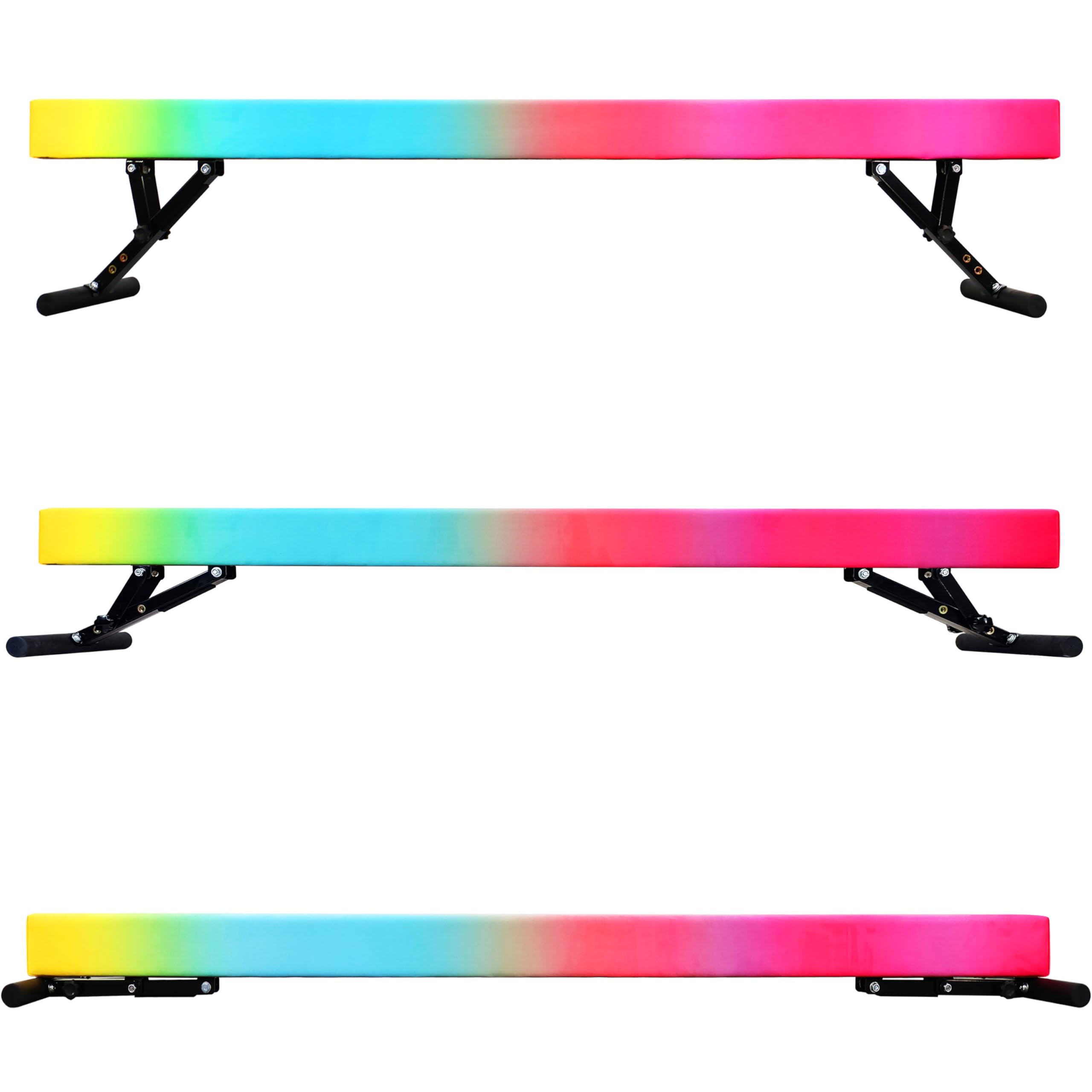
The FC FUNCHEER beam stands out for its patented 4-knob quick-adjust system that allows instant height changes without tools—perfect for a household with multiple children at different skill levels. The beam offers three preset heights (17 cm, 32 cm, and 42 cm) that correspond to foundation, challenge, and podium training. The core is a triple-layer construction: solid wood base for rigidity, shock-absorbing EVA foam for impact cushioning, and a 3mm soft foam wrap under a faux suede cover. This layered approach provides the firmness needed for leaps and handstands while reducing joint stress on landings compared to a bare wood beam.
Stability is handled by a Tri-Lock system featuring dynamic triangular support legs and 360-degree rubber-wrapped steel feet. The rubber wrapping extends across the entire base contact area, providing excellent grip on hardwood, tile, and low-pile carpet without sliding. With a 350-pound weight capacity, this beam is the most robust in the adjustable category, making it suitable for teenagers and even adult physical therapy use. The colorful gradient rainbow finish is a distinctive touch that appeals to younger children.
On the downsides, the beam is relatively heavy at around 34 pounds, making it less portable than foam-only options. Some users note that the highest setting (42 cm / 16.5 inches) is lower than a true competition beam (typically around 48 inches), so advanced gymnasts approaching level 7+ may find it less challenging. It also takes up a fair amount of floor space when assembled. For families valuing fast, tool-less height adjustments and a durable, comfortable practice surface, this beam delivers excellent value.
Why it’s great
- Tool-free 4-knob system allows instant height changes between three levels
- Triple-layer core (wood + EVA + soft foam) offers firm support with impact absorption
- 350 lb capacity and rubber-wrapped legs for exceptional stability on any floor
Good to know
- Heavier than foam beams at ~34 lbs, less portable for frequent moving
- Maximum height is lower than official competition beam height
3. defullion 8ft Adjustable Gymnastic Balance Beam
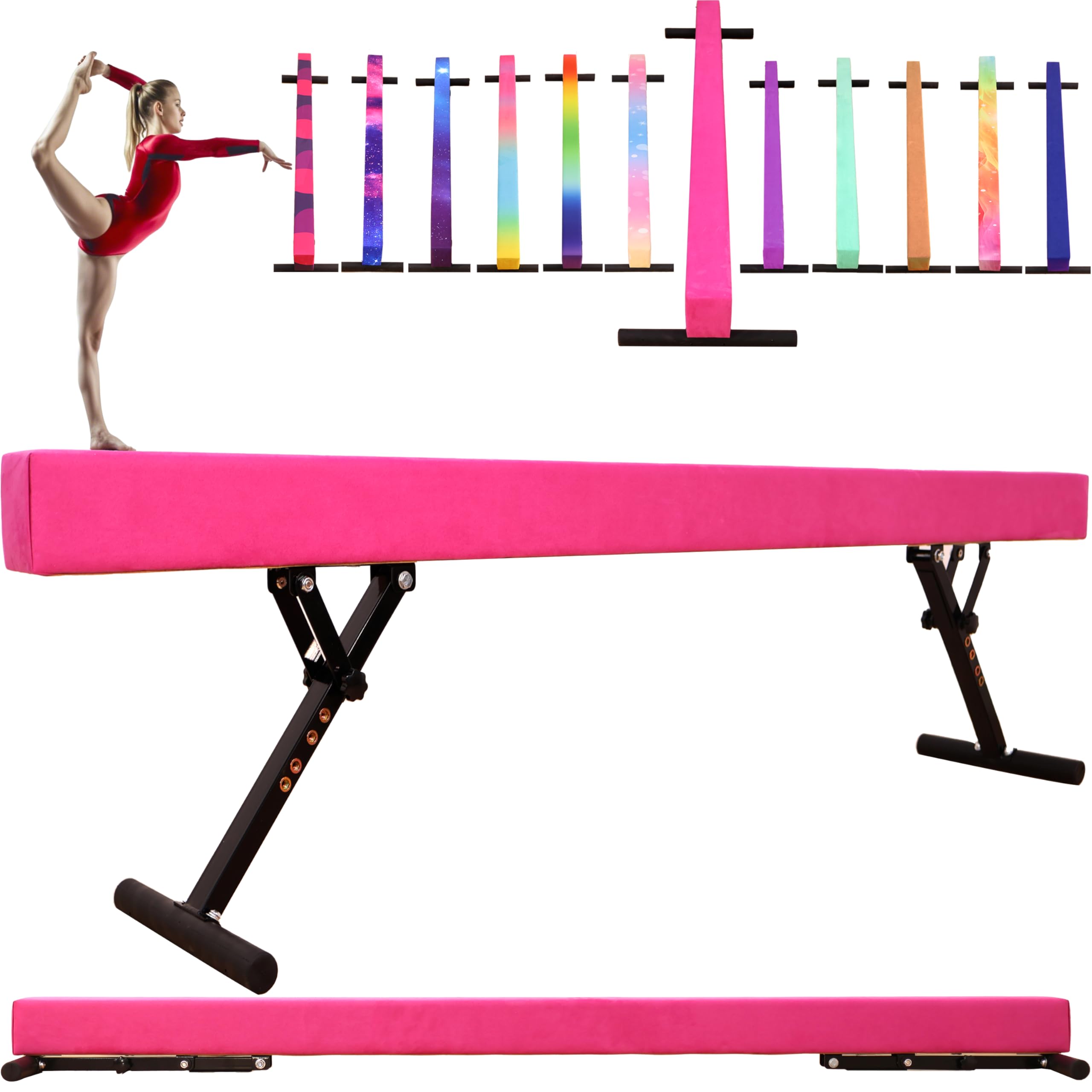
This defullion beam earns its premium positioning through a design that prioritizes competition-relevant specifications. The beam measures exactly 4 inches wide—matching official FIG competition width—and uses a solid wood core topped with a dual-layer cushion of foam and neoprene rubber, all wrapped in high-quality synthetic suede. The suede offers a balanced texture that is grippy enough for confident walkovers but permits cleaner spins than the Sealoha beam. The dual-mode design provides a floor height of 7 inches for beginner drills and an adjustable high mode from 7 to 22 inches, giving a longer adjustment range than most competitors at this price point.
Structural stability comes from a large triangle leg configuration that uses four support points instead of the standard two-leg design. This significantly reduces lateral wobble, a common complaint with less expensive adjustable beams. The steel legs are coated in thick rubber for 360-degree anti-slip performance and floor protection. The manufacturer offers a one-year free repair and lifetime maintenance guarantee, which suggests confidence in the build quality. Customer feedback consistently praises the beam for feeling “sturdy” and “professional,” with parents noting it holds up well to daily use by children ages 6 to 12.
The most notable limitation is the weight—around 33 pounds—which, combined with the assembly process, makes it less convenient for families who need to set up and break down frequently. Some users also note that the beam legs, while stable, require careful positioning on uneven carpets to avoid any rocking. It is also the most expensive model reviewed here, placing it firmly in the premium category. For serious young gymnasts who need a competition-width surface and a firm, stable base for high-intensity practice, this beam justifies the investment.
Why it’s great
- 4-inch wide suede top matches official competition beam dimensions
- Large triangle leg structure with 4 support points minimizes wobble
- Dual-layer cushion (foam + neoprene) offers firm support with controlled give
Good to know
- Heavy design (~33 lbs) makes frequent relocation a chore
- Assembly and height adjustment require more steps than knob-based systems
4. PreGymnastic 8ft Raised Balance Beam
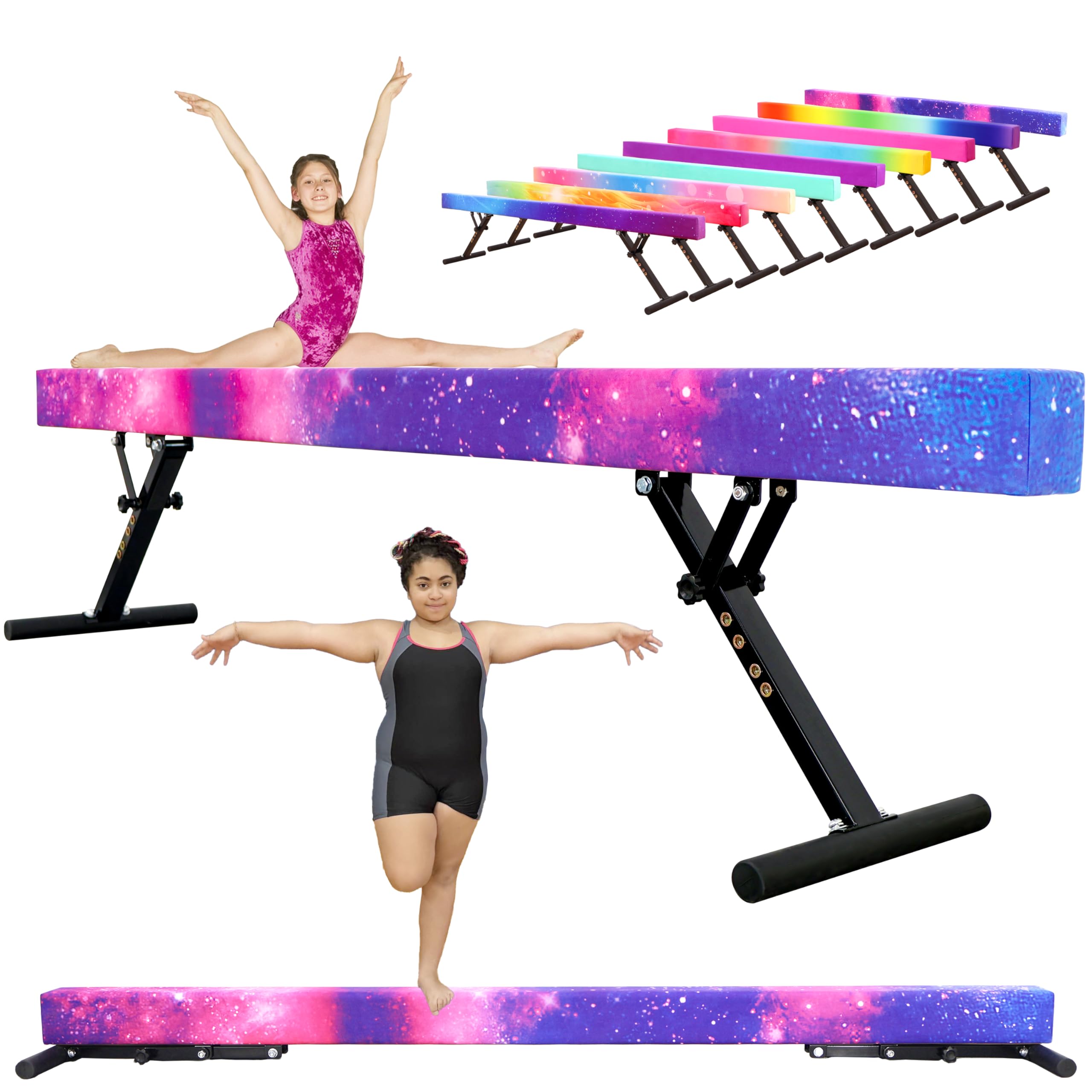
The PreGymnastic beam differentiates itself through a thoughtful safety-first design that addresses a common oversight in home gymnastics equipment. While many adjustable beams use bare metal U-bases, PreGymnastic wraps its steel base entirely in thick rubber. This rubberized coating serves two critical purposes: it dramatically increases floor grip to prevent sliding, and it creates a padded surface that reduces injury risk if a gymnast falls against the legs. The beam core is heavy beech wood, a dense hardwood that resists warping and provides a rock-solid foundation for precision skills.
The beam offers five distinct height settings—7 inches, 14 inches, 18 inches, 20 inches, and 22 inches—providing more granular progression than the 3-setting competitors. Height adjustment is handled by two dead-locking knobs that slide into pre-drilled holes, requiring minimal effort and no tools. The suede-like cover on the beam portion is durable and feels comfortable underfoot, offering a good balance between grip and slide for turns. Users report that the beam feels particularly sturdy when set at middle heights, with the star-pattern design on the legs adding a visual appeal that kids enjoy.
The primary trade-off is stability at maximum height. Several reviewers note that at the highest 22-inch setting, the beam experiences noticeable wobble during more dynamic movements like leaps and handsprings. PreGymnastic offers a one-year warranty and lifetime hardware maintenance, but the wobble at max height may limit its use for more advanced gymnasts who need absolute stability for complex skills. For parents prioritizing safety—especially for younger children ages 3 to 12—the rubber-wrapped bases and sturdy beech wood core make this a compelling choice for daily practice.
Why it’s great
- Rubber-wrapped steel U-bases provide superior grip and reduce leg-impact injury risk
- Five precise height settings (7″–22″) offer excellent progression granularity
- Heavy beech wood core resists warping for long-term durability
Good to know
- Some wobble at the highest 22-inch setting during dynamic skills
- Not suitable for advanced level 7+ gymnasts needing competition stability
5. FBSPORT 8ft PU Leather Folding Balance Beam

For families on a budget or those needing a highly portable floor-level training solution, the FBSPORT beam delivers impressive quality at an accessible price point. This folding floor beam features a contoured 4-inch top surface covered in PU leather, which is more durable and easier to clean than fabric alternatives. The 6-inch wide base provides a stable footprint for floor-level use, and the non-slip rubber bottom grips most flooring types effectively. At just 5 pounds, it is the lightest beam in this guide and folds into three sections for easy storage in a closet or car trunk.
The EPE foam core is notably denser than many budget beams, resisting compression and maintaining its shape even with frequent use by children and adults up to 500 pounds. This density makes it suitable for more than just balance walks—users report practicing handstands, cartwheels, and even leaps on this beam without the foam sinking or deforming. The PU leather surface offers a slight grip that prevents slipping without being sticky, and it wipes clean easily after sweaty practice sessions. The beam is available in 8-foot and 10-foot lengths, giving families flexibility based on available floor space.
The main limitation is that this is strictly a floor-level beam with no raised mode, so it cannot support the progression to higher skills. The foam core, while dense, is still softer than a wood or wood-foam hybrid, meaning advanced leaps and jumps may feel slightly less stable than on a raised competition beam. Some users also note that the Velcro strips connecting the folded sections can wear out over time. For absolute beginners, toddlers, or gymnasts who primarily need a safe, low-cost tool for balance drills and basic skills, the FBSPORT beam is an excellent entry point.
Why it’s great
- Lightweight 5-lb design folds into three compact sections for easy transport and storage
- Dense EPE foam core supports up to 500 lbs without flattening
- PU leather cover is durable, easy to clean, and provides good grip without abrasion
Good to know
- Floor-level only—no raised mode for intermediate/advanced skill progression
- Velcro joining strips may weaken over time with heavy folding and unfolding
6. ZENY 9ft Folding Gymnastics Balance Beam

The ZENY beam offers the most length (9 feet) of any option in this roundup at the lowest entry price, making it an attractive choice for families who need maximum practice surface without spending heavily. The beam is constructed from dense EPE foam that is firmer than generic puzzle mats but still softer than the wood-core beams. The PVC surface provides a comfortable, non-slip texture that is gentle on bare feet and easy to wipe clean after use. The 7.3-inch wide base is noticeably wider than the standard 6-inch base found on most floor beams, which adds an extra layer of stability for beginners who are still learning to center their weight.
The tri-fold design allows the beam to collapse into a short, manageable package that fits in a hall closet or under a bed. Users consistently highlight the portability and ease of deployment—open the three sections, and the beam is ready in under 10 seconds. The anti-slip bottom effectively grips hardwood and tile without leaving marks, and the beam holds up well to daily use by multiple children. With a 160-pound maximum weight recommendation, it is best suited for younger children up to around 12 years old, though some adult users have used it for balance exercises at lower weights.
The primary weakness is foam softness. Several reviewers note that the top surface sinks noticeably under concentrated weight—like during a one-foot leap or a handstand—which can undermine confidence in skills that require precise foot placement. The PVC cover, while easy to clean, does not offer the same premium tactile feedback as suede or PU leather. Additionally, being a floor-level-only beam, it cannot support progression to raised beam training. For toddlers and early beginner gymnasts (ages 2 to 7) who need a safe, wide, and forgiving surface to learn balance fundamentals, the ZENY beam provides a functional and affordable starting point.
Why it’s great
- Longest practice surface at 9 feet, providing ample room for walks and drills
- Wide 7.3-inch base adds beginner-friendly stability and anti-slip grip
- Tri-fold design packs down to a compact size for storage anywhere
Good to know
- Foam surface can sink under focused weight during leaps or handstands
- 160 lb weight limit is lower than most competitors, limiting older/heavier users
FAQ
At what age should my child start using a home gymnastics beam?
Can I use a foam floor beam on a carpeted surface?
How do I clean and maintain a suede or PU leather beam cover?
Final Thoughts: The Verdict
For most families, the gymnastics beam for home winner is the Sealoha 8ft Adjustable Beam because its solid wood core, wide height range, tool-free setup, and suede cover offer the best mix of progression support and durability. If you want instant, tool-free height changes and a cushioned triple-layer core, grab the FC FUNCHEER Adjustable Beam. And for a budget-friendly floor beam that packs away small, nothing beats the lightweight FBSPORT 8ft PU Leather Beam.