
The difference between a GMRS radio that keeps your group linked on a mountain trail and one that falls silent behind the first ridge comes down to three things: output power, antenna efficiency, and repeater compatibility. Ditch the toy-grade FRS units and step into a licensed service that offers real range—provided you choose a handheld built to use it.
I’m Mohammad Maruf — the founder and writer behind Drink4Good. I’ve spent dozens of hours cross-referencing FCC filings, user range reports, and battery drain curves to separate the radios that deliver on their specs from those that merely print them on the box.
Whether you are coordinating a backcountry overland trip, keeping in touch across a large property, or building an emergency comms kit, finding the right gmrs handheld radio requires weighing water resistance, channel capacity, and charging convenience against real-world power output.
How To Choose The Best GMRS Handheld Radio
GMRS handhelds sit in a specific regulatory slot between unlicensed FRS blister-pack radios and the wide-open world of amateur (HAM) gear. A proper GMRS unit must comply with Part 95E of the FCC rules, but within that framework you get 22 main channels, up to 8 repeater input pairs, and a legal power ceiling of 5 watts on most channels. The challenge is picking a radio that balances that power with a battery that lasts, a case that survives drops, and an antenna that actually radiates.
Waterproofing and Build Quality
IP67 means the radio can be submerged in one meter of water for 30 minutes—essential for river crossings, heavy rain, or accidental drops into a puddle. IP54 only protects against splashes and dust, so if you work or play in wet conditions, the higher rating saves your radio from an early death. Build quality also shows in the antenna connector: a sturdy SMA or BNC port survives repeated antenna swaps without stripping.
Channel Count vs. Usability
A radio that claims 250 channels is only useful if you can actually program and recall them. Look for models that support CHIRP (free programming software) or Bluetooth programming via a phone app, because scrolling through a bank of empty memories on a tiny keypad is a slow, frustrating process. Also check whether the radio uses zone-banking—groups of channels that you can switch between for different regions or trip types.
Battery Type and Charging
Lithium-ion packs with 1800–2800 mAh are standard, but the chemistry matters: pouch-type batteries degrade faster than radios that use two 18650 cells inside. USB-C charging is a massive convenience because you can top off from a power bank, vehicle charger, or laptop without carrying a dedicated cradle. Some radios still include a desktop charger for overnight bulk charging, which is a nice bonus if the unit sits in a base station role.
Quick Comparison
On smaller screens, swipe sideways to see the full table.
| Model | Category | Best For | Key Spec | Amazon |
|---|---|---|---|---|
| Retevis RB17P | Premium | Base station pairing & family use | 2200 mAh battery, 24h talk time | Amazon |
| Radioddity GM-30 Plus | Premium | Large group coordination with GPS | 1000 channels, GPS tracking | Amazon |
| BTECH GMRS-V2 | Mid-Range | Everyday carry & repeater work | 200 channels, IP54, USB-C | Amazon |
| Retevis Ailunce HA1G | Mid-Range | Rugged outdoor & emergency use | IP67, 2800 mAh, USB-C | Amazon |
| TIDRADIO TD-H3 | Mid-Range | Bluetooth programming & multi-band RX | Bluetooth prog., 2500 mAh | Amazon |
| BAOFENG UV-9G | Budget | Waterproof entry point for beginners | IP67, 128 channels, 2 batteries | Amazon |
| BAOFENG GM-15 Pro | Budget | Cost-effective 2-pack for groups | 8W (rated), 250 channels, 2-pack | Amazon |
In‑Depth Reviews
1. Retevis RB17P

The RB17P stands out because it includes 8 dedicated base station channels, letting you connect directly to a GMRS base station for coverage that far exceeds typical simplex handheld range. Its 2200 mAh battery delivers up to 24 hours of continuous talk time, and the desktop charger ensures the radios are ready after a full day of use. The Kenwood 2-pin accessory port also means you can swap in external speakers or lapel mics without adapters.
Audio clarity is excellent even at high volume, and the NOAA weather alert system scans automatically so you never miss a severe weather advisory. CHIRP compatibility simplifies programming, though users report that the stock antenna is mediocre; swapping to a 15-inch folding antenna unlocks the radio’s true repeater range—several verified reports show 10-mile repeater access after the change.
The main trade-off is that the firmware locks out certain non-standard FRS frequencies, and the USB-C port is not reinforced with a cover, so frequent flexing could lead to failure over time. Battery replacements are not sold separately, making built-in battery health a long-term concern. Still, for a well-built radio that pairs naturally with a home base station, the RB17P delivers the best balance of family-friendly usability and extended range.
Why it’s great
- Base station channels for dramatically extended coverage
- 24-hour battery life with fast desktop charging
- Loud, clear speaker and solid build quality
Good to know
- Stock antenna limits range; aftermarket upgrade recommended
- USB-C port lacks strain relief for rugged use
- Replacement batteries are not available separately
2. Radioddity GM-30 Plus

The GM-30 Plus packs 1,000 channels across 10 zones, making it the most future-proof radio on this list for multi-region travelers and serious group coordinators. The built-in GPS feature shares latitude, longitude, and straight-line distance between radios on the same frequency, which is a genuine safety advantage for large parties spread across a hiking trail or event venue.
CHIRP compatibility is fully supported, so you can bulk-load repeater frequencies for an entire trip in minutes. The USB-C charging port and 2500 mAh battery offer solid endurance—though real-world testers note the battery drains faster than expected when GPS is active. The high-gain 15.5-inch antenna included in the kit provides noticeably better simplex range than the stubby antennas bundled with most budget two-packs.
Be realistic about the advertised 15-mile range: on flat, unobstructed terrain you might get 3-4 miles of reliable simplex communication, and the long-distance claims require a repeater. The AM airband reception is weak compared to dedicated scanners, and the CPS software runs only on Windows. But for team operations where knowing everyone’s position matters, the GPS alone makes this a category stand-out.
Why it’s great
- GPS location sharing between radios for group safety
- 1,000 channel capacity in 10 zones for trip-specific programming
- USB-C charging and long 15.5-inch high-gain antenna included
Good to know
- Range is heavily dependent on terrain and repeaters
- GPS drains battery notably faster than standard operation
- Programming software is Windows-only
3. BTECH GMRS-V2

The GMRS-V2 is built for the person who wants a single handheld that handles daily use, repeater access, and occasional scanning without feeling oversized or toy-like. Its dual-watch and dual-PTT controls let you monitor two channels simultaneously, making it easy to keep an ear on a team channel while listening for a repeater response. The 200-channel capacity is split across memory banks so you can organize frequencies by region or function.
USB-C charging is a standout convenience at this price tier, and the included desktop charger gives you a second charging path so one can live in the vehicle. Owners consistently praise the transmit and receive audio quality, with several reports of hitting a repeater 41 miles away using only the stock antenna. The IP54 rating handles splashes and dust but does not allow submersion, so it is not a radio for river crossings.
The battery indicator is misleading—it shows a green light until the voltage drops to roughly 7.0V, then the radio shuts down abruptly. Use the voltage readout in the menu instead. The antenna nut can loosen from vibration; a dab of threadlocker solves it. These are minor quirks in an otherwise excellent mid-range radio that has proven reliable after a full year of use.
Why it’s great
- Dual-watch and dual-PTT for efficient channel management
- USB-C charging plus included desktop charger
- Proven long-range repeater performance with stock antenna
Good to know
- Battery indicator is not accurate; use voltage readout
- Antenna nut may loosen; threadlocker recommended
- IP54 rating is splash-proof only, not submersible
4. Retevis Ailunce HA1G
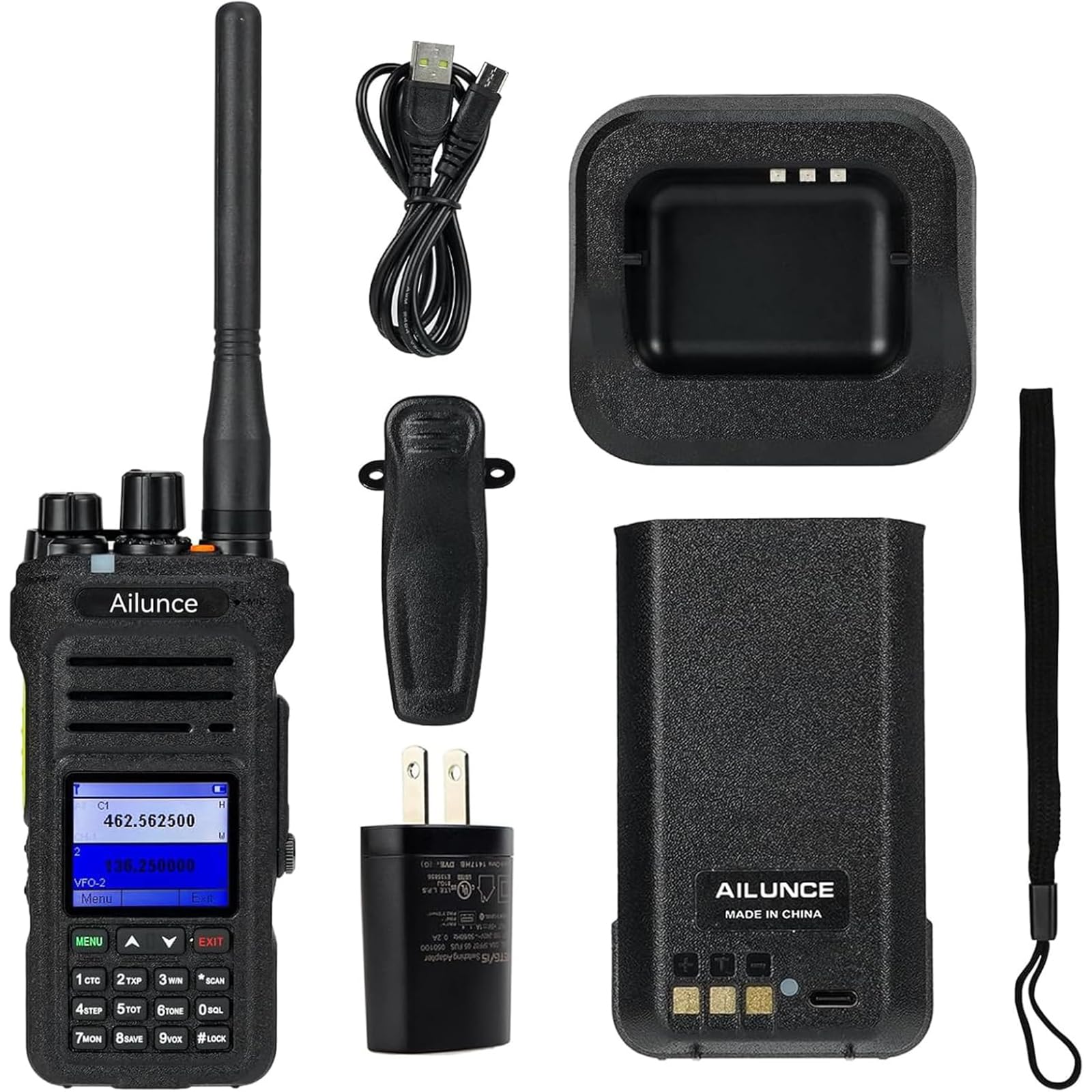
The HA1G earns its reputation as a tank among GMRS handhelds with a true IP67 waterproof rating—it survived a 30-minute submersion in three feet of water in verified tests. The 2800 mAh battery is one of the largest in this roundup, delivering roughly 60 hours of standby and 10-12 hours of active use, all recharged through a USB-C port that eliminates the need for a proprietary cradle.
Pre-programmed with 30 GMRS channels plus 226 customizable slots, the HA1G supports CHIRP and VFO mode for frequency agility. The 1.77-inch color screen is readable in direct sunlight at maximum brightness, and the side-mounted sub-PTT button allows quick transmission without shifting your grip. NOAA weather scanning is built in, and the emergency alarm sends a siren with flashing lights for rapid location in a crisis.
The display washes out in strong sunlight if you do not crank the brightness to full, and the NOAA scan function blocks primary receive while it cycles through weather channels, which can be annoying during active communication. The stock antenna is decent but not exceptional; pairing the radio with a longer aftermarket antenna noticeably boosts simplex reach. At this feature-per-dollar ratio, the HA1G is a formidable choice for anyone who expects their radio to take a beating.
Why it’s great
- IP67 waterproof rating for full submersion protection
- 2800 mAh battery with USB-C charging
- Large color screen and programmable sub-PTT button
Good to know
- NOAA scan blocks primary receive during alerts
- Display needs max brightness in direct sunlight
- Stock antenna benefits from an aftermarket upgrade
5. TIDRADIO TD-H3
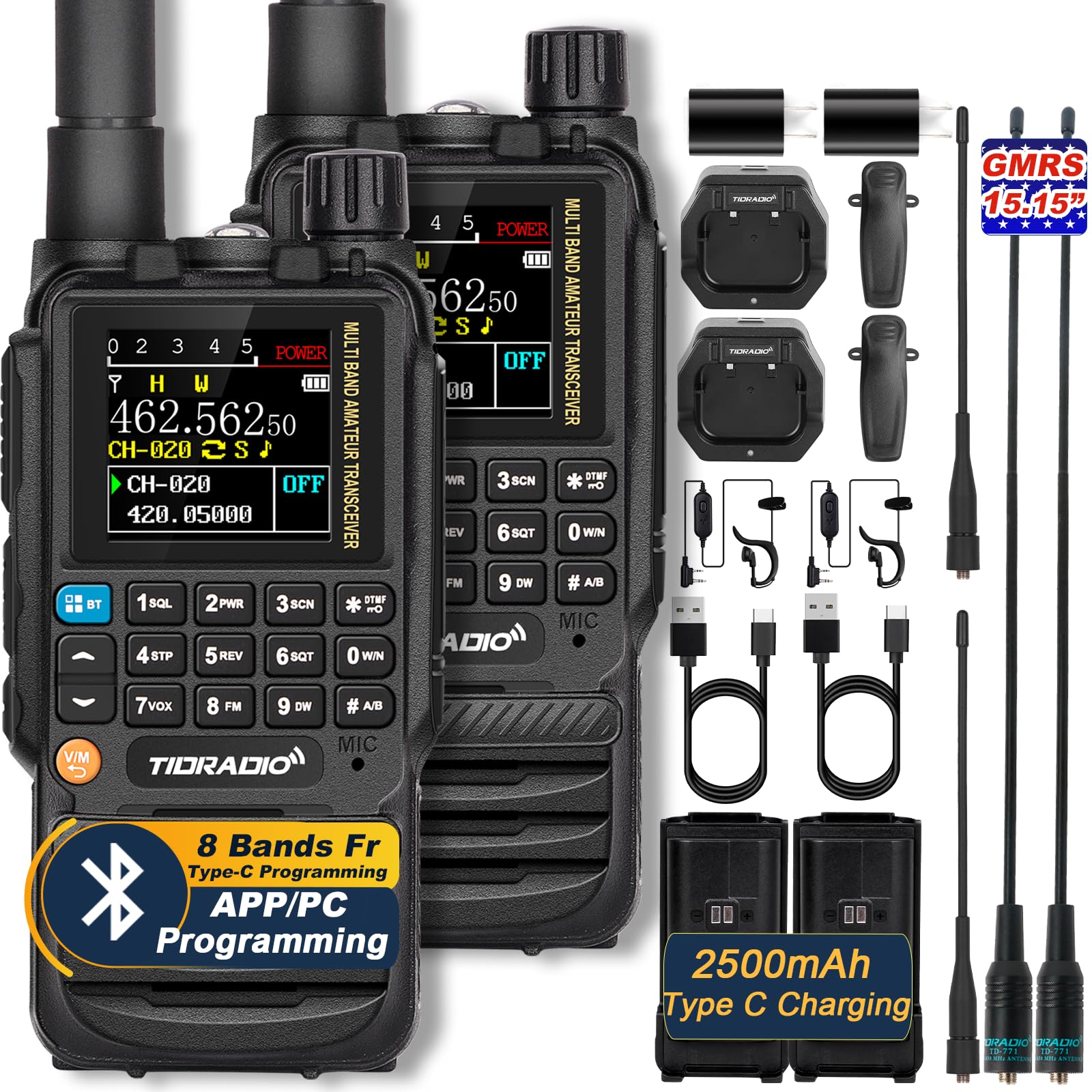
The TD-H3 redefines convenience for a GMRS radio by offering Bluetooth programming through the Odmaster phone app and a web-based PC tool, eliminating the need for a dedicated programming cable. It supports three modes—GMRS, Ham, and Unlocked (normal)—letting you legally switch between licensed operations without a separate device. The 8-band receiver picks up AM airband, VHF, UHF, and FM broadcast, making it a capable emergency scanner.
The 2500 mAh battery lasts roughly 48 hours of standby, and the USB-C port on the side also supports direct cable programming—a first in this class. The included 15.15-inch TD-771 long antenna provides noticeably better gain than the stubby alternatives, and the frequency copy feature allows you to clone a channel from another transmitting radio by holding the 1 key. This is a genuinely useful field tool when you encounter a new repeater without a programmed channel.
Belt clip durability is a recurring complaint; the clip can snag and break during active movement. The Air Band reception uses an incompatible squelch system, so aircraft audio tends to be quiet with static bursts. Some units may arrive with a bent antenna in the packaging. These are packaging and accessory issues rather than radio-core problems. For the user who values wireless convenience and multi-band scanning, the TD-H3 is the most technologically forward option here.
Why it’s great
- Bluetooth programming via phone app and web tool
- Mode-switching between GMRS, Ham, and Unlocked
- 8-band receiver with AM airband and long antenna included
Good to know
- Belt clip is fragile and can break during active use
- Air Band audio is quiet with poor squelch handling
- Antenna can arrive slightly bent in packaging
6. BAOFENG UV-9G

The UV-9G brings IP67 waterproofing to a budget-friendly price point, making it a solid choice for beginners who need a radio that can survive a dunk in a creek or a day in steady rain without breaking the bank. It ships with two batteries and a programming cable, and the 128-channel capacity covers 30 pre-programmed GMRS channels plus 8 repeater pairs and 11 NOAA weather channels with alert scanning.
CHIRP compatibility is intact, so you can load repeater frequencies easily, and the dual-band receiver (UHF/VHF) lets you monitor local HAM and public service traffic. Users report hitting repeaters from inside their living room with the stock antenna, and simplex range of about 3-5 miles is typical for open terrain. The included extended antenna and speaker mic add real value to the kit.
The programming port has a screw that is easy to strip, and the belt clip feels flimsy compared to aftermarket options. The channel display cannot show a custom name and the frequency simultaneously, which forces menu navigation when you want full information. The NOAA function is baked into the scan list rather than having a dedicated button, adding an extra step during severe weather. For the price, however, getting IP67 waterproofing with CHIRP support is a rare combination.
Why it’s great
- IP67 waterproof rating at a very accessible price
- Includes two batteries, programming cable, and speaker mic
- CHIRP compatible for easy frequency programming
Good to know
- Programming port screw is easy to strip
- Belt clip is weaker than aftermarket options
- No dedicated NOAA button; weather is in the scan list
7. BAOFENG GM-15 Pro

The GM-15 Pro is the volume-pick for groups that need multiple radios without spending heavily per unit. It ships as a two-pack with USB-C chargers, earphones, and two antennas per radio, making it ready for immediate family or team use. The 250-channel memory includes 30 default GMRS channels and 8 repeater channels out of the box, and the keypad menu allows on-the-fly programming without a computer.
USB-C charging from any power source—car, wall, power bank—is a genuine convenience, and the 1500 mAh battery is sufficient for a full day of intermittent use. The NOAA weather receiver includes 11 channels for emergency alerts, and the SOS alarm and flashlight are practical additions for camping or hiking. Simplex range of 2-5 miles is realistic depending on terrain, and the radio can hit repeaters when equipped with a better antenna.
The advertised 8W output is actually 5W; the radio is locked to 5W max on GMRS frequencies, so do not buy expecting higher legal power. It is not CHIRP-compatible, so you are stuck with the keypad or OEM software for programming. The included earphone is low quality. For the price of a single premium radio, you get two functional units that cover the basics—just know that the power spec is inflated and the software ecosystem is limited.
Why it’s great
- Two radios in a single purchase for group use
- USB-C charging from any power source
- NOAA weather alert scanning included
Good to know
- Advertised 8W power is actually 5W on GMRS
- Not CHIRP-compatible; limited programming options
- Included earphones are low quality
FAQ
Do I need an FCC license to operate a GMRS handheld radio?
What is the real-world simplex range of a 5W GMRS handheld?
Can I program a GMRS radio with a Mac?
What does the NOAA weather alert feature actually do?
How do I extend the range of my GMRS handheld?
Final Thoughts: The Verdict
For most users, the gmrs handheld radio winner is the Retevis RB17P because it pairs family-friendly operation with base station compatibility and long battery life. If you want GPS team tracking and massive channel capacity for multi-region travel, grab the Radioddity GM-30 Plus. And for a rugged, submersible radio that can survive off-road abuse and emergency deployment at a compelling price, nothing beats the Retevis Ailunce HA1G.