
The gap between a toy that gets tossed aside after ten minutes and one that pulls a five-year-old back again and again comes down to a single factor: how well it matches their developmental pulse. At this age, play is serious work—fine motor control is still being wired, cause-and-effect logic is just clicking into place, and the imagination runs hot enough to turn a cardboard box into a spaceship. The best gifts ride that wave rather than fight it.
I’m Mohammad Maruf — the founder and writer behind Drink4Good. I’ve spent hundreds of hours researching early childhood development toys, analyzing everything from material safety certifications to the real-world durability ratings buried in customer feedback.
Below, I break down five carefully vetted options that hit the sweet spot between skill-building and genuine fun so you can confidently choose one of the best gifts for five year olds that your child will actually use, not just unwrap.
How To Choose The Best Gifts For Five Year Olds
Five-year-olds sit at a unique crossroads: they’ve outgrown baby toys but lack the patience for complex board games or lengthy instructions. The smartest picks straddle the line between guided learning and open-ended play, letting the child lead without hitting a dead end. Below are the three factors that separate a shelf-dweller from a daily driver.
Fine Motor Demands vs. Frustration Threshold
A toy that demands too much dexterity will be abandoned; one that requires none won’t build any skill. Look for pieces that require a deliberate pinch, twist, or push—like snapping dinosaur halves together or screwing a plastic bolt with a toy drill—but avoid anything with tiny components that a five-year-old can’t manipulate independently. The sweet spot is pieces sized roughly one to three inches across with connectors that engage without jamming.
Open-Ended vs. Single-Outcome Play
Single-outcome toys (press a button, get a sound) lose their novelty fast. Multi-configuration toys—building kits with 100+ pieces, alphabet sets that can be sorted, matched, or used as standees—extend playtime exponentially. At five, a child’s prefrontal cortex is beginning to support imaginative planning, so a toy that offers multiple ways to succeed feeds that growing capacity rather than boring it.
Material Safety and Real-World Abrasion
“Durable” on the box doesn’t mean much when a toy hits a hardwood floor for the fifth time in an hour. Prioritize thick-walled plastics without sharp mold lines, non-toxic finishes that won’t flake off, and seams that are heat-bonded rather than glued. Also check that any electronic components are recessed or fully enclosed—five-year-olds test seals the way engineers test prototypes.
Quick Comparison
On smaller screens, swipe sideways to see the full table.
| Model | Category | Best For | Key Spec | Amazon |
|---|---|---|---|---|
| iPlay, iLearn Rocket Playset | Take-Apart STEM | Imaginative builders | Electric drill + 4 detachable stages | Amazon |
| National Geographic Junior Chemistry Set | Science Kit | Curious explorers | 50 experiments + 20+ lab tools | Amazon |
| Walenty Dinosaur Alphabet Set | Matching Game | Early letter learners | 26 double-sided Dino pieces | Amazon |
| Qirptey STEM Building Blocks | Building Kit | Creative construction | 125 pieces + idea booklet | Amazon |
| hahaland Unicorns Ballerina Set | Role-Play Plush | Dress-up & cuddle | 15.75-inch doll + 3 outfits + bag | Amazon |
In‑Depth Reviews
1. iPlay, iLearn Rocket Outer Space Playset

This spaceship playset nails the hardest task for any gift at this age: it lets the child do the work. The battery-powered toy drill turns each of the four main stages—cockpit, instrument cabin, turbine engine, tail engine—into a tangible disassembly challenge. A five-year-old gets to act out the role of engineer while internalizing spatial reasoning. The lights and sound effects are loud enough to thrill but not obnoxious enough to drive adults crazy, and the automatic shut-off on the sound module is a thoughtful touch for battery life.
At nearly 15 inches tall, the assembled rocket commands attention on a playroom floor. Customers consistently note that the 3-year-old demo can handle the drill independently after a brief demo, while the 5- to 7-year-old crowd enjoys reconfiguring the stages in different orders. The two included astronaut figures are cute but small—parents should keep an eye on them during play with younger siblings. The plastic feels dense and the edges are smoothly finished, no sharp mold lines anywhere.
What sets this apart from cheaper take-apart toys is the drill’s torque: it’s strong enough to actually drive the screws without being so fast that a kid loses control. That tactile cause-and-effect feedback loop—push a button, watch the part release—keeps the play session open-ended. For a five-year-old who asks “why?” about everything, this toy answers with physics instead of words.
Why it’s great
- Real working drill with kid-safe torque builds fine motor control
- Four detachable stages encourage logical sequencing and reconfiguration
- Lights and sound add immersion without overwhelming
Good to know
- Astronaut figures are small and easy to misplace
- Sound effects may feel limited after extended play sessions
2. National Geographic Junior Chemistry Set

The most common complaint about early science kits is that the “50 experiments” claim relies on a handful of variations of the same baking-soda-and-vinegar eruption. This Blue Marble kit, produced under the National Geographic license, avoids that trap by sequencing experiments that actually teach measurement, color mixing, and gas formation in distinct ways. The 20+ included tools—test tubes, goggles, a pipette, measuring cups—are made from thick-walled plastic and rubber that survive drops and spills.
Each experiment in the fully illustrated guide uses household staples (baking soda, vinegar, food coloring), so you won’t get stuck hunting for obscure chemicals. The three included food-color bottles (red, yellow, blue) let kids explore primary-color blending before moving to the volcano or the inflating-bag reaction. Parents report that the goggles actually fit a 4-year-old’s face without sliding off, which is rarer than it should be in this category. The kit weighs just 0.72 kilograms, making it easy to move from table to floor.
What earns this its spot in the middle of the lineup is the balance between structured learning and messy fun. A five-year-old isn’t ready for theoretical chemistry, but they are ready to watch a liquid change color and ask “how?” That moment of curiosity is what the National Geographic kit was designed to trigger—and it does it without requiring an adult to micromanage every step.
Why it’s great
- All experiments use common household items, no specialty chemicals
- Durable lab tools with child-safe materials and no sharp edges
- Illustrated guide makes instructions accessible for emerging readers
Good to know
- Some experiments require adult supervision for accurate measuring
- Food coloring may stain surfaces if spills aren’t wiped immediately
3. Walenty Dinosaur Alphabet Learning Toys

Five-year-olds who are just starting to connect letter shapes to sounds need a tactile bridge, and this dinosaur set provides exactly that. Each of the 26 dinosaurs splits into two halves: one carries an uppercase letter, the other the matching lowercase. The child snaps the two halves together to form a completed creature, turning abstract letter recognition into a physical matching puzzle. The double-sided printing means each dinosaur displays both forms on the visible surface, so a child always sees the uppercase/lowercase pair.
The plastic pieces are palm-sized, roughly 2.5 inches across when assembled, which is large enough to prevent choking hazards but small enough to require deliberate finger pressure to push together. Multiple customer reviews note that the snap connector requires a firm squeeze—some 3-year-olds struggle, but five-year-olds typically have the hand strength to do it independently. The included drawstring bag and storage box help with cleanup, but the real win is the color variety: each dinosaur sports a different bright hue, making color sorting a natural secondary game.
At this price point, the Walenty set holds up well against the wear and tear of daily play. The colors don’t rub off, the connector posts don’t shear off after repeated use, and the drawstring bag is durable enough for travel. For a gift that sneaks in phonics practice without feeling like homework, this is the smartest budget-friendly option on this list.
Why it’s great
- Double-sided dinosaurs make uppercase/lowercase matching physical and fun
- Durable plastic with no fading or loosening connectors over time
- Portable drawstring bag and box make storage and travel simple
Good to know
- Connectors can be stiff for children under 4 years old
- Pieces clatter loudly on hard floors when dropped
4. Qirptey Kids STEM Building Blocks (125 Pcs)

Building toys for this age often fall into two disappointing camps: blocks so small they frustrate, or blocks so large they limit creativity. This Qirptey set splits the difference with 125 pieces in varied shapes—gears, connectors, wheels, and standard bricks—that click together with a satisfyingly positive snap. The included idea booklet shows instructions for a race car, robot, truck, and dinosaur, but the real value is in the open-ended construction that happens after those four schematics are exhausted.
The rounded edge design is a meaningful safety feature: no sharp corners even when pieces are knocked over or stepped on. The plastic itself is non-toxic and odorless, and multiple customer reviews confirm that the material doesn’t develop stress cracks at the connection points—a common failure mode in budget building sets. The included sturdy toy box is large enough to hold the entire set without spilling, and the 0.92-kilogram weight means a child can carry the whole thing to the living room floor without assistance.
What elevates this above generic building blocks is the gear integration. Gears teach cause-and-effect in a way that static bricks can’t: when you attach a gear to a wheel and turn it, the wheel spins. That mechanical feedback loop keeps a five-year-old’s brain engaged longer than simple stacking ever could. For parents who want a gift that grows with the child’s ability to design increasingly complex structures, this set delivers the density needed to sustain interest well past the first month.
Why it’s great
- Gears and moving parts introduce mechanical cause-and-effect reasoning
- Rounded edges and non-toxic materials prioritize safety during aggressive play
- Storage box and idea booklet keep play organized and goal-oriented
Good to know
- Small pieces require supervision for children under 3 years
- Instructions are limited to 4 models; creativity is required beyond that
5. hahaland Unicorns Ballerina Doll Set
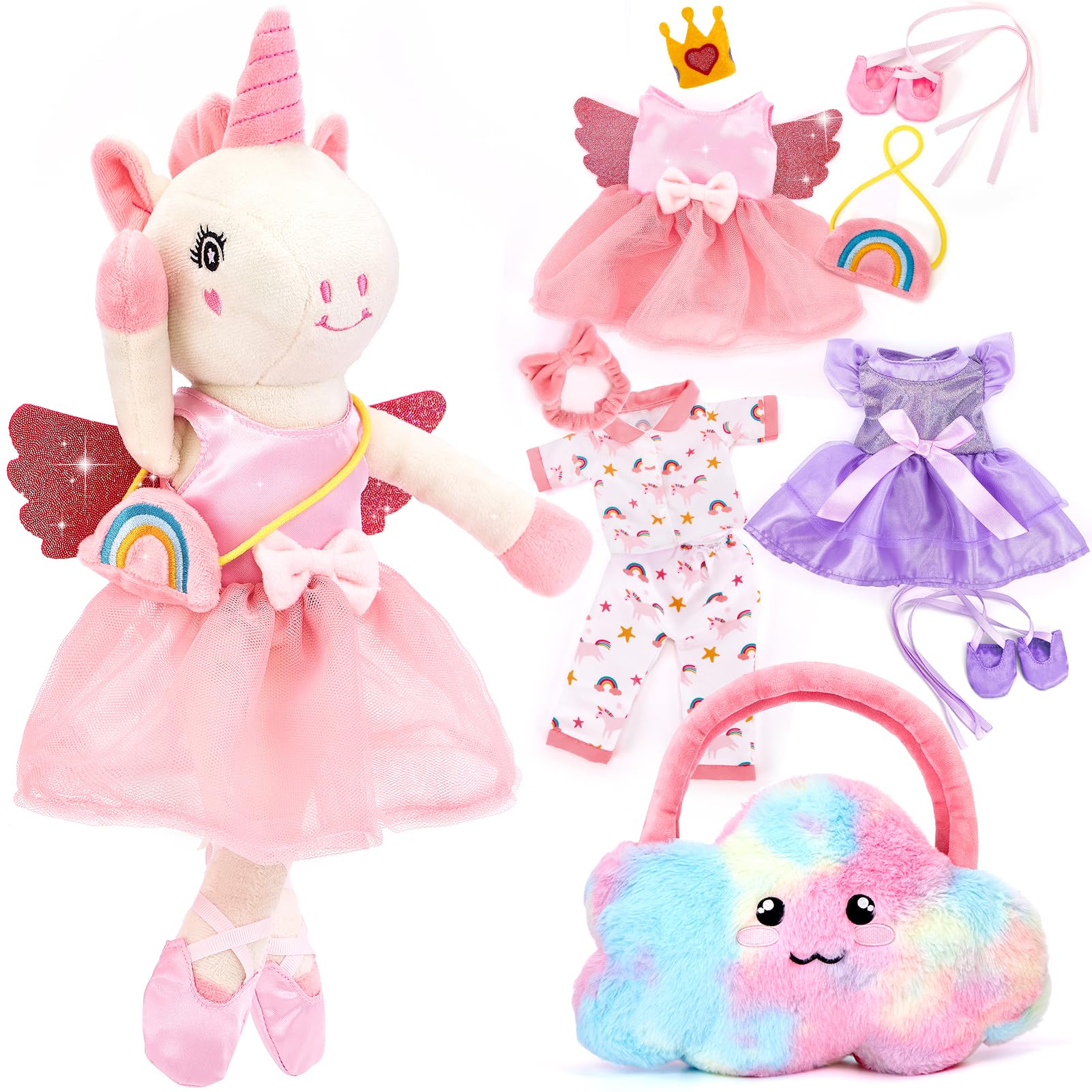
Role-play gifts for five-year-old girls often arrive as either a single dress with cheap accessories or a doll that’s too fragile for daily cuddling. The hahaland set sidesteps both traps with a 15.75-inch plush unicorn doll that comes with three interchangeable ballet outfits, each secured by hook-and-loop fasteners designed for small fingers. The doll itself is stuffed firmly enough to stand up when propped against a wall but soft enough to sleep with—a dual personality that matters more than most spec sheets acknowledge.
The included plush carry bag is the standout feature. It’s large enough to hold the doll and all three outfits, which means the entire play set consolidates into one portable package. For travel, overnights, or dance recital trips, that single-bag solution prevents the “I forgot the tutu” meltdown. Customers also praise the vibrant colors and the non-toxic certification, noting that the fabric doesn’t pill after repeated dressing and undressing sessions—a common failure point in this category.
Where this set delivers most is in the fine-motor practice hidden inside the play pattern. Each time a child fits the tiny ballet shoes onto the unicorn’s feet, or aligns the hook-and-loop back of a tutu, they’re building the same pincer-grip strength that later supports pencil control. The role-play element—pretending the unicorn is a dancer on stage—adds an emotional dimension that keeps the play session going well past the initial novelty. For a five-year-old drawn to imaginative storytelling and dressing up, this is the clear choice.
Why it’s great
- Three fully interchangeable outfits with child-friendly hook-and-loop fasteners
- Plush carry bag makes travel and storage effortless
- Soft yet supportive stuffing suitable for both active play and bedtime
Good to know
- Small accessory pieces (ballet shoes) need tracking during clean-up
- Primarily appeals to children with a strong interest in dress-up and unicorns
FAQ
How do I know if a toy has enough challenge for a five-year-old without being frustrating?
What material safety certifications should I check for plastic toys?
Is a 50-experiment science kit really usable for a five-year-old?
Final Thoughts: The Verdict
For most families, the best gifts for five year olds winner is the iPlay, iLearn Rocket Playset because it combines active take-apart construction with imaginative role-play and genuine STEM skill-building. If you want a gift that sparks collaborative discovery and messy fun, grab the National Geographic Junior Chemistry Set. And for a budget-friendly learning tool that makes phonics feel like a treasure hunt, nothing beats the Walenty Dinosaur Alphabet Set.