
The difference between a good gaming session and a great one often comes down to what you hear. From the distant rumble of an approaching siege engine to the faint footstep of an opponent rounding a corner, your desktop speakers are the portal to that world. Choosing the right pair means cutting through the marketing noise to find real clarity, punch, and connection latency that actually matters for your setup.
I’m Mohammad Maruf — the founder and writer behind Drink4Good. For this guide, I’ve spent many hours pulling apart technical specs, parsing hundreds of verified owner experiences, and cross-referencing driver materials, amplifier wattage, THX certifications, and frequency response curves to separate genuine performance from clever packaging.
Whether you need room-shaking bass for cinematic campaigns or pinpoint positional audio for competitive play, finding the right gaming computer speakers comes down to a few non-negotiable specs — driver size, connectivity, and power handling.
How To Choose The Best Gaming Computer Speakers
Gaming speakers sit at a unique intersection — they must handle explosive sound effects, subtle ambient cues, and often music playback without distortion. A consumer Bluetooth speaker designed for casual listening will simply not deliver the same transient response for in-game gunfire or directional footsteps. The right choice depends on your desk size, preferred game genre, and whether you need a subwoofer for deep bass extension.
Driver Configuration: 2.0 vs. 2.1 vs. Virtual Surround
A 2.0 setup uses two satellite speakers and relies on the drivers to produce bass. These typically save desk space and work well for competitive gamers who prioritize clarity over rumble. A 2.1 system adds a dedicated subwoofer (6.5-inch or larger) for sub-60Hz frequencies, enhancing immersion in cinematic single-player titles. Virtual 7.1 surround sound, available through USB connection and proprietary software like HECATE or Sonar, simulates positional audio through two speakers. This feature is especially useful for first-person shooters where hearing the exact location of an enemy matters.
Connectivity and Latency
Wired connections — USB, 3.5mm aux, and RCA — offer near-zero latency, making them the standard for competitive PC gaming. Bluetooth 5.3 and 5.4 have improved to under 100ms in most implementations, but only if the speaker and source support low-latency codecs. If you regularly switch between a PC, console, and phone, look for Bluetooth multipoint plus a dedicated aux input to avoid unplugging cables. A powerful amplifier onboard also reduces latency by handling signal processing independently from the PC’s sound card.
Power Handling: RMS vs. Peak Wattage
RMS (Root Mean Square) wattage indicates continuous, clean power output — the spec that matters for sustained gaming sessions. Peak wattage is a momentary burst figure and is less useful for real-world comparisons. A 2.1 system with 200W RMS will fill a large room with deep, distortion-free audio, while a compact 2.0 set with 20W RMS works well for near-field desktop listening. Match the speaker power to your room size and preferred listening level; overly powerful speakers in a small space can produce muddy bass.
Quick Comparison
On smaller screens, swipe sideways to see the full table.
| Model | Category | Best For | Key Spec | Amazon |
|---|---|---|---|---|
| Edifier MR3 | Monitor | Flat response mixing | 52Hz–40kHz + BT 5.4 | Amazon |
| SteelSeries Arena 7 | Premium 2.1 | Immersive cinematic gaming | 6.5″ sub + 10-band EQ | Amazon |
| Edifier G2000 Pro | Virtual 7.1 | Competitive FPS positional audio | 64W peak + 270° RGB | Amazon |
| Logitech Z623 | THX 2.1 | Large-room bass delivery | 400W peak / 200W RMS | Amazon |
| Ortizan C7 | Studio Monitor | Near-field music production | 3.5″ CF + 0.75″ silk dome | Amazon |
| OHAYO 60W | Bookshelf | Compact desktop versatility | 30Wx2 + MDF cabinet | Amazon |
| Bluedee 20W | Compact RGB | Small desk with aesthetics | 20W peak + BT 5.4 | Amazon |
In‑Depth Reviews
1. Edifier MR3 Powered Studio Monitor Speakers

The Edifier MR3 earns its spot at the top thanks to a frequency response that stretches from 52Hz to 40kHz, flat enough for critical monitoring yet lively enough for immersive gaming. The 3.5-inch mid-low drivers are paired with 1-inch tweeters, and the 18Wx2 RMS output delivers a peak SPL of 92.5dB — loud enough to fill a medium room without strain. The MDF cabinet construction reduces unwanted box resonance, keeping dialog and environmental audio clean during long sessions.
Connectivity is where the MR3 really pulls ahead for multi-device gamers. Balanced TRS inputs let you hook up a professional audio interface, while RCA and AUX handle a console or second PC simultaneously. Bluetooth 5.4 supports multipoint connection, so you can take a call or stream music from your phone without unpairing your desktop. The Edifier ConneX app adds a three-band EQ plus Music, Monitor, and Custom modes — useful for switching between competitive shooters and single-player RPGs.
The only real sacrifice is that the Bluetooth volume cannot be fully controlled from the source device when paired wirelessly — you will need to reach for the physical knob or open the app. Still, the sound signature is remarkably neutral for a speaker at this level, with zero audible hiss and a tight, controlled bass response that never bleeds into the mids.
Why it’s great
- Hi-Res Audio certified — flat response ideal for both gaming and production.
- Balanced TRS input for professional gear alongside standard RCA and AUX.
- App-based EQ with three sound modes for different content.
Good to know
- Bluetooth volume not fully controllable from paired phone or tablet.
- Pairing process can be finicky — button press sequence requires reading the manual.
2. SteelSeries Arena 7 RGB 2.1 Gaming Speakers

The Arena 7 takes the immersive route with a dedicated 6.5-inch downward-firing subwoofer that delivers deep, tactile bass for explosions and engine roars. The satellite speakers use separate silk dome tweeters and organic-fiber woofers — a 2-way design that keeps dialog crisp and directional cues from sounding boxy. With USB, optical, and aux inputs, plus Bluetooth connectivity, this system can serve as the audio hub for a PC, PlayStation, and phone simultaneously.
SteelSeries Sonar software unlocks a 10-band parametric EQ, spatial audio for surround simulation, and acoustic echo cancellation. The control puck on the desk gives instant access to volume, source switching, and headphone/speaker toggle — eliminating the need to blindly reach behind monitors. The PrismSync RGB lighting features four zones that react to in-game events, though the lighting width may not fully span ultrawide monitor setups.
Build quality is solid, but the missing speaker grilles are a genuine concern in households with children or pets — the exposed drivers can be damaged by curious fingers. Some users report that the front right satellite can develop a crackle after a few months, though firmware updates have addressed the issue for most. Still, the combination of a real subwoofer, advanced EQ, and multi-source handling makes it hard to beat for cinematic gaming.
Why it’s great
- Powerful 6.5″ subwoofer extends bass well below 60Hz for immersive soundscapes.
- Sonar software provides a 10-band parametric EQ and spatial audio.
- Convenient control puck and three active sources for multi-device setups.
Good to know
- No speaker grilles — drivers are exposed to dust and accidental impact.
- Some units exhibit a crackle in the right satellite; firmware updates help.
3. Edifier G2000 Pro 2.0 RGB Gaming Speakers
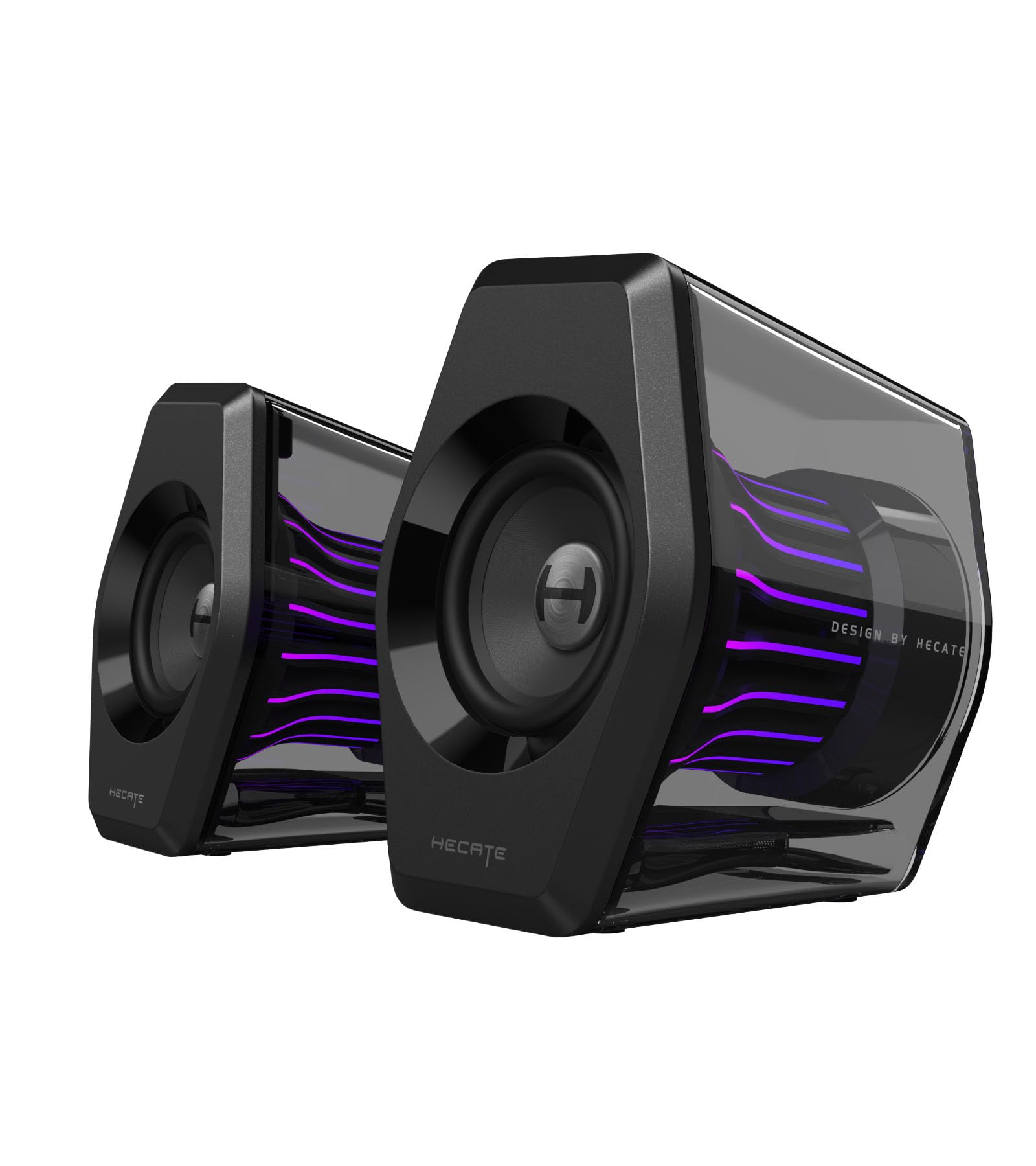
The G2000 Pro is designed specifically for competitive gaming. Its 64W peak power and virtual 7.1 surround sound are enabled via USB connection to a PC and the HECATE software, which processes audio to simulate rear and side channels through just two drivers. The 3-inch full-range drivers are paired with dual bass reflex ports to create a surprisingly wide soundstage for such a compact form factor. Footsteps and environmental cues in games like Call of Duty or Valorant become noticeably easier to localize compared to standard stereo.
The 270° TempoFlow RGB lighting uses 100 individual beads spread across 20 LED strips — more granular than most gaming speakers at this tier. You can cycle through seven lighting modes using the onboard buttons or the HECATE software, and the transparent enclosure amplifies the glow without looking cheap. The speaker also includes physical EQ presets for Game, Movie, and Music modes, which sharpen treble for footsteps, activate the 7.1 simulation for film, or boost vocal presence for streaming.
There is no line-out port for adding a subwoofer later, and the permanently attached inter-speaker cable is shorter than ideal for dual 24-inch monitor layouts. Some users also note that the speakers do not auto-power on with the PC, requiring a manual button press. Still, the clarity, power, and RGB integration make it a strong pick for the dedicated gamer who wants positional audio without a full 5.1 setup.
Why it’s great
- Virtual 7.1 surround via USB for competitive FPS positional awareness.
- 270° TempoFlow RGB with 100 LED beads — highly customizable lighting.
- Three dedicated EQ modes (Game, Movie, Music) switchable via buttons.
Good to know
- No subwoofer output — cannot expand to a 2.1 system later.
- Fixed inter-speaker cable is short; may not span large monitor arrays.
4. Logitech Z623 400W 2.1 Speaker System

The system delivers 200W RMS and 400W peak, with the subwoofer handling 130W of that power. The 7-inch sub driver produces deep, room-filling bass that shakes furniture when turned up, making it ideal for cinematic games and action movies in larger rooms. The two satellite speakers each pack 35W, providing enough headroom to fill a living room without distortion.
Connectivity is straightforward — RCA and 3.5mm inputs let you hook up three devices simultaneously, including a PC, console, and phone. A dedicated bass level knob on the right satellite gives quick tonal adjustment, and the headphone jack automatically mutes the speakers when plugged in. The system works with any device that has a headphone jack or RCA output, from a Blu-ray player to a Nintendo Switch.
The biggest trade-off is that the sound signature leans heavily toward bass, with recessed mids and highs that require EQ calibration to sound balanced. The satellite cables are 6 feet long each, but the right satellite uses a proprietary VGA-style connector — replacements are hard to find if damaged. A few owners report a static crackle from the power button after a year of use, which can be resolved with contact cleaner, but it is an extra maintenance step.
Why it’s great
- THX-certified 2.1 system with 200W RMS for large-room audio.
- Dedicated subwoofer with 7-inch driver delivers deep, impactful bass.
- Three simultaneous inputs (RCA + 3.5mm) for multi-device setups.
Good to know
- Bass-heavy tuning with recessed mids — requires EQ to sound balanced.
- Right satellite uses a proprietary cable; replacement is difficult.
5. Ortizan C7 Dual-Mode Studio Monitors

The Ortizan C7 bridges the gap between budget monitors and affordable gaming speakers. The 3.5-inch carbon fiber mid-bass driver paired with a 0.75-inch silk dome tweeter produces a near-flat frequency response that reveals more detail in game audio than typical consumer speakers. The built-in 24-bit DAC captures digital audio via USB-C with minimal signal loss, making it a solid choice for streamers or content creators who also edit video on the same setup.
Input versatility is the C7’s standout feature. You get balanced 6.35mm TRS inputs for professional mixing consoles or audio interfaces, plus RCA and 3.5mm aux for standard devices. Bluetooth 5.3 provides wireless streaming with an 18-meter range. A headphone output on the front panel lets you switch between speaker playback and private monitoring without fumbling behind the desk. The rear bass port extends low-end response without adding boominess — the 3.5-inch driver reaches down to around 45Hz, which is impressive for its size.
The volume knob feels slightly choppy with no smooth taper, and the low-end punch may be insufficient for bass-heavy electronic music or explosive game scenes without a subwoofer. The idle hiss is faint but audible in a completely silent room. Still, for its price, the C7 delivers a level of accuracy and connection flexibility that typically costs much more, making it a hidden gem for near-field desktop use.
Why it’s great
- Balanced TRS input and 24-bit DAC for professional audio monitoring.
- Near-flat response from carbon fiber drivers — excellent for mixing and gaming.
- Compact footprint with front-panel headphone output for easy switching.
Good to know
- Volume knob has an uneven taper — fine adjustments are tricky.
- Faint idle hiss present in quiet environments; no LDAC or AptX Bluetooth.
6. OHAYO 60W Computer Speakers

The OHAYO 60W speakers offer a genuinely musical sound signature that works well for both gaming and desktop music playback. The 0.75-inch carbon fiber silk dome tweeter and 3-inch carbon fiber mid-bass driver are housed in a MDF wooden cabinet that significantly reduces box resonance compared to plastic alternatives. The rear bass port amplifies low-end depth, giving the 2.0 system a surprising amount of body for game sound effects without needing a separate subwoofer.
Connectivity covers the essentials with Bluetooth 5.3, RCA, aux, and USB inputs — enough to handle a PC, phone, and gaming console at the same time. The front panel includes a physical volume knob plus separate treble and bass controls, allowing quick tonal adjustments between different game genres. Several reviewers with audio experience note the soundstage is surprisingly wide for a compact bookshelf design, with clear separation between foreground dialog and background environmental audio.
The inter-speaker cable is fixed, and the power supply is a wall wart rather than a detachable brick, which adds some clutter behind the desk. The 3.5mm aux input produces a slightly hollow sound compared to USB or Bluetooth, so the wired USB connection is recommended for desktop use. Still, for anyone wanting a clean, small-footprint 2.0 setup with genuine tweeters and natural musicality, this is a compelling mid-range option.
Why it’s great
- MDF wooden cabinet reduces resonance for clearer, studio-like sound.
- Separate treble and bass knobs for quick genre-specific EQ adjustments.
- Wide soundstage with good separation between dialog and effects.
Good to know
- Fixed inter-speaker cable — cannot be swapped for longer runs.
- 3.5mm input sounds slightly hollow compared to USB or Bluetooth.
7. Bluedee 20W Computer Speakers
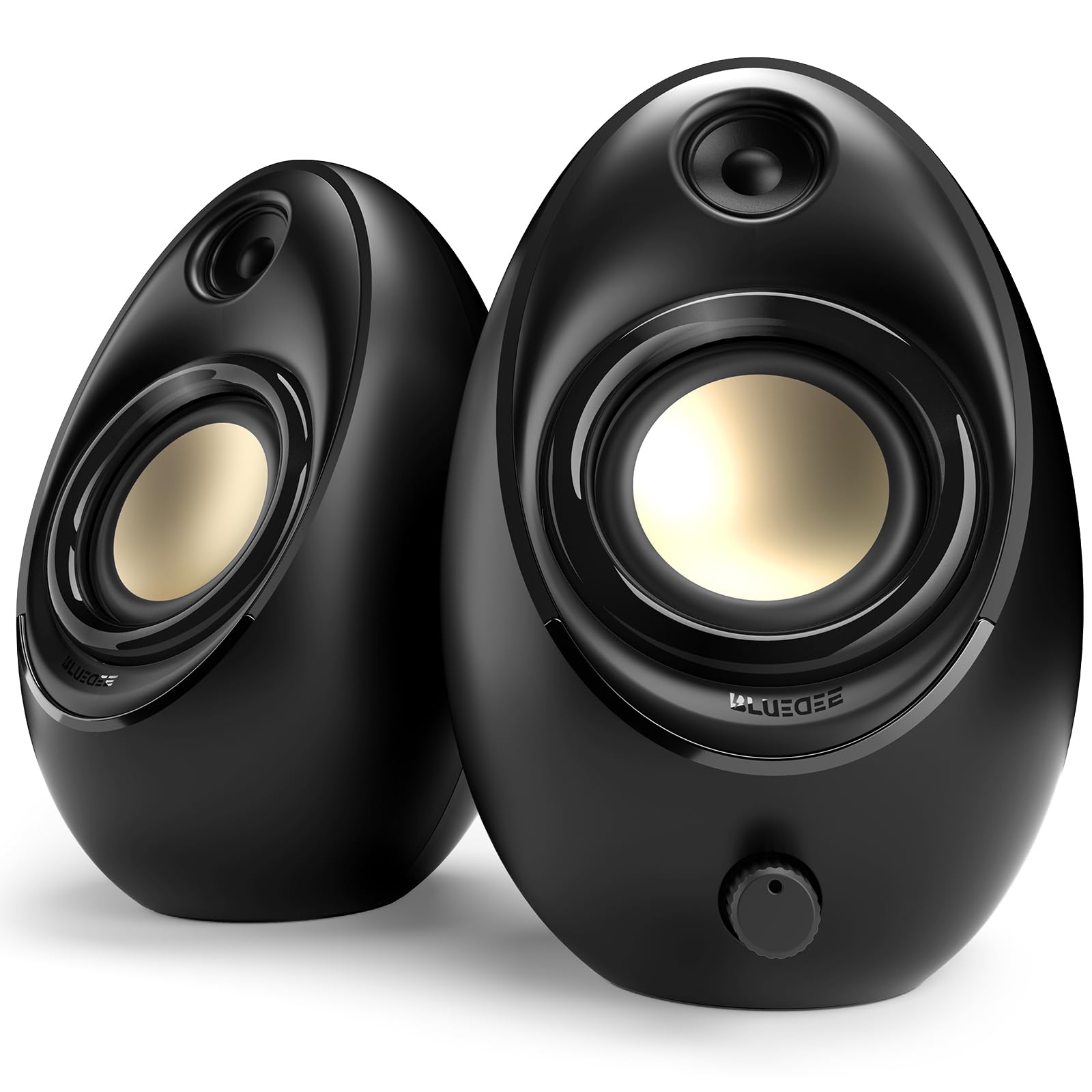
The Bluedee 20W speakers are an entry-level option that punches above its weight in terms of pure convenience. The 20W peak power is split between two tweeters, two full-range drivers, and two passive radiators, producing a surprisingly full sound for a compact enclosure. Built-in DSP tuning minimizes distortion even at higher volumes, so you can push them during intense gaming sessions without hearing harsh clipping. The all-in-one control knob handles volume, play/pause, lighting effects, and connection mode switching — reducing desk clutter significantly.
Bluetooth 5.4 provides stable wireless streaming with low latency, while the USB-C power input makes it easy to plug into a modern laptop or desktop without hunting for a wall outlet. The eight RGB lighting effects range from static colors to dynamic cycling, and there is an off option for a cleaner look during work hours. Setup is genuinely plug-and-play — no drivers, no software, no pairing hassles for USB operation.
The biggest limitation is the short inter-speaker cable — at about 50 inches, it may not comfortably span two 24-inch monitors on a wider desk. The sound also lacks the low-end authority of a system with a dedicated subwoofer, so bass-heavy titles may feel thin. Still, for a small desk or budget-conscious upgrade from built-in laptop speakers, the Bluedee delivers clean audio, robust wireless, and strong aesthetics at an accessible entry point.
Why it’s great
- True plug-and-play via USB-C — no drivers or software needed.
- Integrated control knob for volume, lighting, and connection mode.
- Eight RGB lighting effects plus an off mode for versatile aesthetics.
Good to know
- Short 50-inch inter-speaker cable — may not fit wide dual-monitor setups.
- Bass is limited by the small passive radiators; no subwoofer option.
FAQ
Do I need a subwoofer for competitive FPS gaming?
Is Bluetooth 5.4 good enough for gaming audio?
What does virtual 7.1 surround sound actually do?
Final Thoughts: The Verdict
For most users, the gaming computer speakers winner is the Edifier MR3 because it delivers Hi-Res Audio certification, balanced TRS inputs, and a flat response that works equally well for competitive gaming, music production, and everyday listening without breaking the bank. If you want room-shaking bass and immersive cinematic depth, grab the SteelSeries Arena 7 with its 6.5-inch subwoofer and advanced Sonar EQ. And for budget-conscious gamers who need a compact, RGB-lit setup with Bluetooth 5.4, nothing beats the Bluedee 20W for sheer value and ease of use.