
The moment your fiberglass repair cures, you’ll either feel rock-solid confidence or that sinking dread of a bond that won’t hold under stress. The wrong adhesive leaves you with delaminated hulls, cracked kayak seams, and loose hardware that fails right when you need it most. This guide cuts through the confusion to match your specific fiberglass job—whether it’s a marine seal below the waterline or a structural panel bond on an RV—to the one adhesive chemistry that actually works for it.
I’m Mohammad Maruf — the founder and writer behind Drink4Good. I’ve spent hundreds of hours analyzing chemical cure times, bond strength data, and substrate compatibility charts to find the adhesives that genuinely bond fiberglass without lifting, cracking, or softening under moisture.
Your search for a durable, waterproof glue for fiberglass ends here with five adhesives that have been rigorously tested against real-world conditions like salt spray, hull flex, and thermal expansion.
How To Choose The Best Glue For Fiberglass
Fiberglass is a composite of glass fibers suspended in a resin matrix, and its non-porous, smooth surface makes it notoriously difficult for ordinary adhesives to grip. The right glue for fiberglass must bond chemically with the existing resin or mechanically lock into a roughened surface—most standard white glues, super glues, and construction adhesives will peel away under stress or moisture. Success depends on matching the adhesive’s chemistry, cure speed, and flexibility to your specific repair scenario.
Chemical Compatibility: Epoxy vs. Polyurethane
Two-part epoxy adhesives form the strongest structural bonds to fiberglass because they share a similar resin chemistry—the epoxy cross-links with the fiberglass matrix for a near-welded hold. Polyurethane adhesives, like the 5200 formula, create a flexible, waterproof seal that excels where vibration and movement are constant—think boat hulls and deck fittings. Polyester resins, while related to fiberglass, are brittle and less reliable for bonding repairs. Stick with epoxy for structural fixes and polyurethane for sealing and bedding.
Cure Time and Working Time
Fast-cure formulas skin in under an hour and reach handling strength in 24 hours, making them ideal for projects that need quick turnaround—like a weekend boat repair. Standard-cure epoxies offer extended working times of 45-75 minutes, which gives you room to position parts, clamp them, and adjust alignment. Below the waterline, always choose a full-cure time of at least 24 hours to ensure the bond has reached maximum water resistance before exposure.
Flexibility and Modulus of Elasticity
Fiberglass structures flex under load, especially in marine and automotive applications. An adhesive that is too rigid—like a standard polyester resin—will crack under thermal expansion or hull flex. Thickened epoxies with a modulus around 150,000 PSI, such as the West System G/flex, balance stiffness with enough give to absorb shock. Polyurethane sealants are even more flexible, making them the right choice for bedding hardware that experiences constant vibration.
Water Resistance and UV Stability
Any glue used on fiberglass that touches water—boats, kayaks, RV roofs, or outdoor furniture—must be explicitly waterproof, not just water-resistant. Look for adhesives rated for continuous immersion, especially if the bond sits below the waterline. UV resistance matters for exposed repairs that see direct sunlight; polyurethane and specially formulated epoxies resist chalking and degradation better than standard epoxies, which can yellow and become brittle.
Quick Comparison
On smaller screens, swipe sideways to see the full table.
| Model | Category | Best For | Key Spec | Amazon |
|---|---|---|---|---|
| Berkland Marine Adhesive 5200 Fast Cure | Polyurethane | Watertight seals & hardware bedding | 24-hour fast cure, UV resistant | Amazon |
| TotalBoat Thixo Thickened Epoxy | Epoxy | Structural bonding & vertical repairs | 50-min working time, no sag | Amazon |
| 3M Panel Bonding Adhesive 38315 | Epoxy | Auto panel & SMC bonding | Glass bead technology, 47.5mL | Amazon |
| West System G/flex 655 Epoxy | Epoxy | Flexible structural bonds on dissimilar materials | 150,000 PSI modulus, bonds damp wood | Amazon |
| West System 105-K Fiberglass Boat Repair Kit | Epoxy | Complete DIY boat & RV hole repair | Includes fabric, fillers, & syringe | Amazon |
In‑Depth Reviews
1. Berkland Marine Adhesive Sealant 5200 Fast Cure
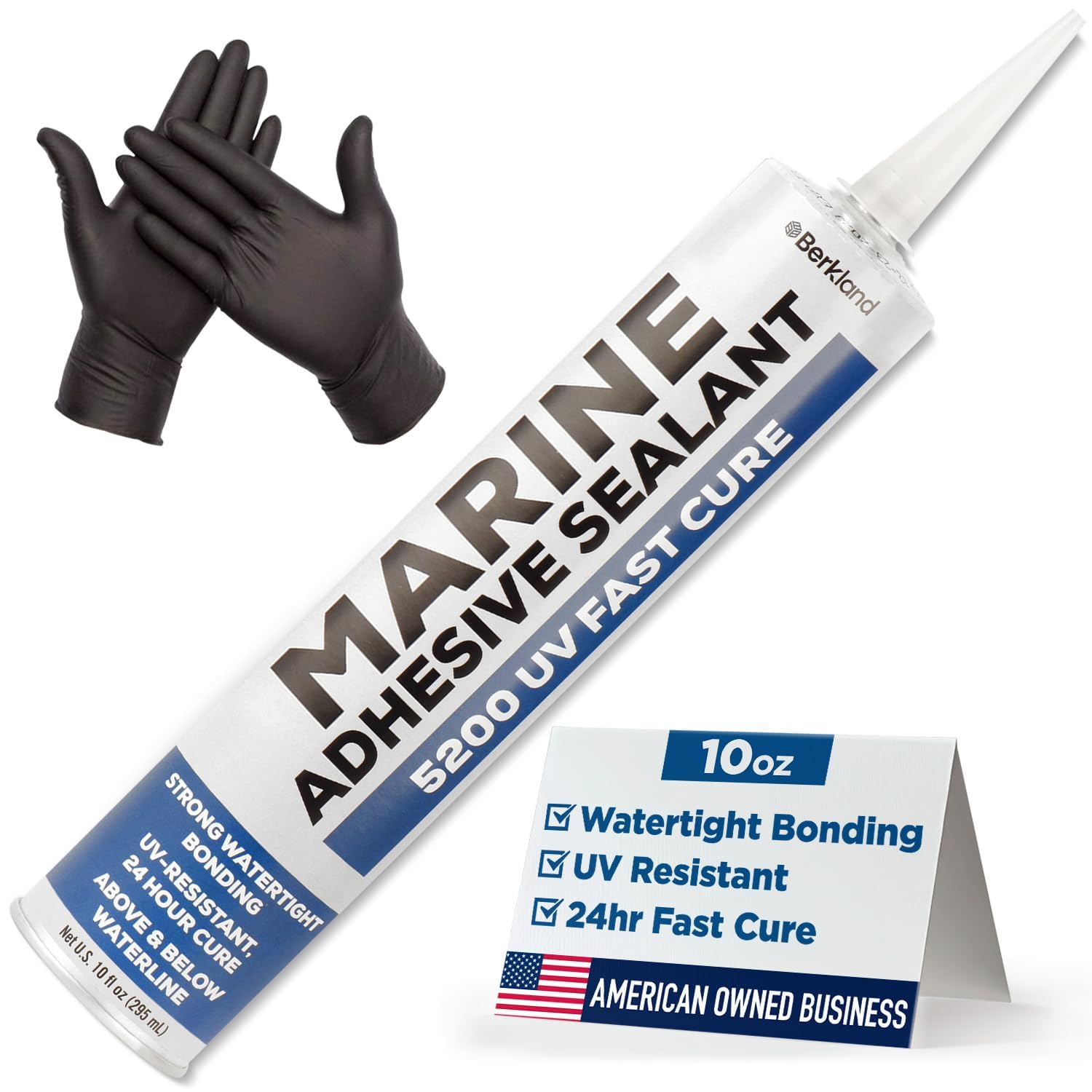
The Berkland 5200 Fast Cure is the gold standard for marine sealing and bedding—a polyurethane adhesive sealant that creates a permanent watertight bond above or below the waterline. Unlike standard 5200 that takes up to seven days to fully cure, this fast-cure version reaches handling strength in just 24 hours, getting your boat back on the water far sooner. It bonds tenaciously to fiberglass, gelcoat, wood, aluminum, and steel, making it a versatile solution for through-hulls, transducers, struts, and hull-to-deck joints.
The paste-like viscosity stays where you put it, even on vertical surfaces, and skins over within one hour to protect against washout. UV and weather resistance ensure the bond doesn’t crack, shrink, or chalk after long sun exposure—a common failure point with cheaper sealants. The 10 oz cartridge fits any standard caulk gun, and the included disposable gloves help keep cleanup manageable. Users consistently report that this holds as well as the 3M 05203 original, with the added convenience of a much shorter cure window.
One practical consideration: the tube lacks a resealing cap, so partial usage requires a roofing nail or screw driven into the tip to keep the remaining adhesive from curing inside the nozzle. Plan your application to use most of the cartridge in one session, or store it with a sealed tip. For boat owners who need a reliable, fast-setting bond that can handle wave impact and hull flex, this is the adhesive to keep in your marine toolkit.
Why it’s great
- 24-hour fast cure versus the traditional 7-day wait
- Certified waterproof below the waterline without softening
- UV and weather resistant for long-term exposed use
Good to know
- Tube does not include a resealing cap—plan to use in one session
- Polyurethane is less machinable than epoxy for shaping repairs
2. TotalBoat Thixo Thickened Epoxy Adhesive

TotalBoat Thixo solves the classic epoxy problem: sagging on vertical surfaces. This two-part thickened epoxy has a unique viscosity that stays exactly where you place it—ideal for overhead keel repairs, vertical transom work, and filling screw holes on the side of a hull. The 185ml cartridge delivers a perfect 2:1 mix ratio through the included static mixing tips, eliminating the guesswork of measuring resin and hardener by hand. With 50 minutes of working time and a 30-35 minute gel time at 77°F, you have ample room to position clamps and adjust alignment before the epoxy sets.
Once cured in 24 hours, Thixo can be drilled, sanded, and painted—making it suitable for both structural bonding and cosmetic finishing. It wets out fiberglass cloth well enough for small fabric repairs, yet stays thick enough to fill gaps without dripping. Users have successfully used it to fill below-waterline screw holes on boat transoms, glue plywood frames to RC barge hulls, and attach top caps with no sagging. The two included mixing tips add convenience for consecutive applications.
The main trade-off is value: at 185ml, the cartridge contains less volume than a standard 300ml tube, and the price per ounce runs higher than bulk epoxy alternatives. The thick consistency also requires a firm caulk gun—a standard lightweight gun may not provide enough leverage to fully mix the two parts through the static nozzle. For small, precision structural repairs where sagging is unacceptable, Thixo earns its spot despite the higher cost per application.
Why it’s great
- Thickened formula stays in place on vertical and overhead surfaces
- Accurate 2:1 mixing through static nozzle—no measuring needed
- Cured epoxy sands and paints like standard epoxy
Good to know
- 185ml cartridge is smaller and pricier per ounce than bulk options
- Requires a sturdy caulk gun to push the thick material through the mixing tip
3. 3M Panel Bonding Adhesive 38315

3M’s Panel Bonding Adhesive 38315 is a two-part epoxy engineered specifically for structural panel replacement in automotive and RV applications. It bonds steel, aluminum, SMC (sheet molded compound), and FRP (fiberglass-reinforced plastic), making it a favorite among body shop professionals for replacing doors, fenders, and quarter panels without welding. The glass bead technology built into the formula ensures a consistent bond gap—the beads keep the two mating surfaces a precise distance apart, preventing a starved joint that could fail under stress.
The epoxy is aggressively tacky from the moment the two parts meet, which means panel positioning must be exact before contact—you cannot slide panels into alignment after they touch. This grabby tack is a feature, not a flaw, because it mimics the rigidity of a welded joint once cured. Users report that it replaces welding entirely for non-structural panels, eliminating the rust issues caused by burned coatings near weld zones. It also creates a waterproof barrier that seals the seam against moisture intrusion.
The 50mL cartridge is small—users consistently note that it contains very little product—and is best suited for one repair job. You will need the 3M 08190 manual applicator and 38191 static mixing nozzle (sold separately) to dispense it correctly. The medium-to-high viscosity and 24-hour full cure time mean you’ll need clamps or sheet metal screws to hold the panel in place while the bond sets. For professional-grade panel adhesion on fiberglass, metal, or SMC, this is the most chemically precise choice available.
Why it’s great
- Glass bead technology maintains a consistent bond gap for maximum strength
- Replaces welding on panels, preventing rust from burnt coatings
- Creates a waterproof barrier that seals the entire seam
Good to know
- 50mL cartridge is small—best for single-panel repairs
- Requires separate applicator gun and mixing nozzles
- Extremely tacky—no sliding panels into position once contact is made
4. West System 655-8 G/flex Epoxy Adhesive
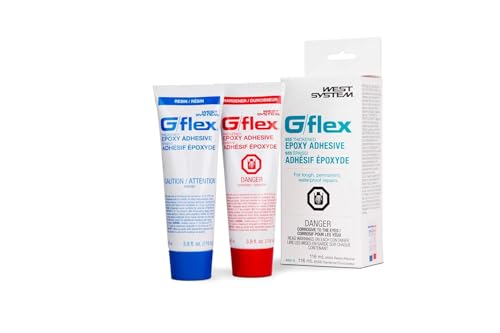
West System G/flex 655 is the epoxy for jobs where standard epoxies fail—bonding dissimilar materials like fiberglass to polyethylene, aluminum to wood, or metal to plastic. Its 150,000 PSI modulus of elasticity makes it significantly more flexible than traditional repair epoxies, allowing the bond to absorb expansion, contraction, shock, and vibration without cracking. This flexibility is exactly what you need for repairs on polyethylene kayaks, ABS canoes, and aluminum boats where the substrate expands differently than the fiberglass patch.
The 1:1 mix ratio is straightforward, delivering 46 minutes of pot life and 60-75 minutes of open working time at 72°F. It reaches initial cure in 3-4 hours and a full workable cure in 7-10 hours, with 24 hours for maximum strength. G/flex can even bond to damp or wet surfaces—a rare capability for any epoxy—and can be applied underwater with specific techniques. Users have successfully repaired polyethylene RV holding tanks, ABS canoe cracks, and fiberglass boat holes, noting that nothing else worked until they tried G/flex with proper flame treatment of the plastic substrate.
Surface preparation is critical: polyethylene and polypropylene require flame treatment (briefly passing a propane torch over the surface) plus 60-80 grit sanding and acetone wiping before the epoxy will grip. The two 4.5 fl oz tubes provide enough material for several small repairs, but the cost per ounce runs higher than standard epoxy. If you need to bond fiberglass to a hard-to-stick plastic or metal, G/flex is the only reliable choice on this list.
Why it’s great
- Flexible enough to bond dissimilar materials with different expansion rates
- Bonds to damp wood and non-porous plastics like polyethylene
- Clear cured finish sands and paints easily for cosmetic repairs
Good to know
- Polyethylene adhesion requires flame treatment—not a direct-out-of-the-box bond
- Premium price per ounce compared to standard epoxy
5. West System 105-K Fiberglass Boat Repair Kit

The West System 105-K is the all-in-one starter kit for anyone new to fiberglass repair—or for boat owners who want a grab-and-go solution stored aboard. It includes eight premeasured packets of 105 Epoxy Resin and 205 Fast Hardener, a sheet of fiberglass fabric, adhesive and fairing fillers, mixing pots, glue brushes, a reusable mixing stick, an application syringe, protective gloves, and illustrated instructions. This kit covers everything needed to repair cracks, scrapes, gelcoat blisters, loose hardware, delaminated panels, and holes up to 1 inch in diameter.
The premeasured packs eliminate the most common beginner mistake: incorrect resin-to-hardener ratio. The 105/205 combination creates a strong, waterproof epoxy bond that cures in about 24 hours, with a fast working time that suits small repairs. The included fiberglass fabric can be cut to size and wet out with the epoxy for structural patches, while the fillers (adhesive and fairing) let you build up low spots or create a smooth surface for painting. Users have successfully repaired 9mm holes in RV skins, keel damage on small sailboats, and transom cracks on fishing boats—all without prior fiberglass experience.
The kit is compact and resealable for onboard storage, but the total epoxy volume is small—best for one or two small-to-medium repair jobs. Several users noted that the kit contains far more fiberglass fabric than epoxy resin, so if you need a larger repair, you will need to buy additional resin separately. The price point puts it in the budget-friendly tier relative to buying individual components, and the step-by-step instructions make it accessible for first-time DIY repairs.
Why it’s great
- Complete kit with all materials for a single small repair—no separate purchases needed
- Premeasured epoxy packs eliminate mixing errors
- Compact case fits easily in boat storage for emergency repairs
Good to know
- Small epoxy volume—might need extra resin for larger projects
- Instructions are included but best supplemented with online video guides
FAQ
Can I use super glue or construction adhesive on fiberglass?
Do I need to sand fiberglass before applying adhesive?
What is the difference between epoxy and polyester resin for fiberglass repair?
How long should I wait before putting a fiberglass repair in water?
Final Thoughts: The Verdict
For most users, the glue for fiberglass winner is the Berkland Marine Adhesive 5200 Fast Cure because it combines permanent watertight sealing, 24-hour fast cure, and broad compatibility with fiberglass, wood, and metal. If you need a precision structural epoxy that won’t sag on vertical surfaces, grab the TotalBoat Thixo Thickened Epoxy. And for bonding fiberglass to tricky plastics like polyethylene or ABS, nothing beats the West System G/flex 655.