
Scratches on glass—whether on a car windshield, a shower door, or a beloved mirror—create a frustrating visual distortion that no amount of cleaning can fix. The wrong polishing compound can leave more haze than you started with, turning a simple repair into a costly replacement job.
I’m Mohammad Maruf — the founder and writer behind Drink4Good. I’ve spent hundreds of hours analyzing abrasive compounds, cerium oxide grades, and polymer technology to separate the true scratch removers from the marketing fluff in this narrow category.
Whether you’re removing light etching from hard water or a fingernail-catching gash in automotive glass, the best glass polishing compound for scratches balances particle size, application ease, and final clarity without leaving a residue.
How To Choose The Best Glass Polishing Compound For Scratches
Glass is a hard, brittle material, so removing scratches without creating new ones requires a compound with the right abrasive type, particle size, and carrier consistency. The wrong choice—like using a heavy automotive rubbing compound on a windshield—can frost the glass permanently. Here’s what matters.
Abrasive Type: Cerium Oxide vs. Aluminum Oxide
Cerium oxide is the gold standard for glass polishing because it chemically softens the glass surface during the mechanical abrasion, allowing finer scratches to be polished out without micro-fractures. Aluminum oxide compounds (like the Menzerna Heavy Cut 1000) work well on automotive clear coat but are too aggressive for bare glass unless specifically formulated for it. For optical clarity on windshields, mirrors, or crystal, a cerium oxide compound is the correct starting point.
Particle Size and Grit Grade
Compounds are graded by their abrasive particle size, measured in microns or grit number. A 3.5 μm cerium oxide powder (like the Teenyyou) is fine enough to polish out light scratches without hazing, while a 1000-grit aluminum oxide compound (Menzerna) is a medium cut best for deeper clear coat scratches before finishing with a finer polish. For glass, you generally want a fine-to-medium grit—too coarse, and you’ll need a second polishing step; too fine, and deep scratches won’t budge.
Application Method: Machine vs. Hand
Most effective glass polish compounds require a dual-action polisher or rotary buffer with a felt or foam pad to generate the heat and friction needed to activate the abrasive. Several products in this category—especially the CARPRO CeriGlass and the cerium oxide powders—explicitly require a machine for any meaningful scratch removal. A few can be used by hand for shallow marks, but expect to work much longer and with far less results. If you don’t own a polisher, focus on compounds that explicitly state hand-applicability.
Quick Comparison
On smaller screens, swipe sideways to see the full table.
| Model | Category | Best For | Key Spec | Amazon |
|---|---|---|---|---|
| CARPRO CeriGlass Glass Polish | Cerium Oxide Liquid | Automotive glass scratches | 5 oz kit with applicator | Amazon |
| Teenyyou 1.1 lb Cerium Oxide Powder | Optical Grade Powder | Versatile glass/crystal polishing | 3.5 μm particle size | Amazon |
| Premium Cerium Oxide 1lb | Optical Grade Powder | Shower doors, mirrors, headlights | 1 lb powder | Amazon |
| Menzerna Heavy Cut Compound 1000 | Aluminum Oxide Liquid | Automotive clear coat scratches | 1000 grit / 8 oz | Amazon |
| Finish First Auto Polish | Synthetic Polymer | Swirl fill & long-term protection | 16 oz polymer formula | Amazon |
In‑Depth Reviews
1. CARPRO CeriGlass Glass Polish

The CARPRO CeriGlass is the most well-rounded glass polishing compound in this list, combining a cerium oxide suspension with a dedicated microfiber applicator pad in a single kit. This ready-to-use liquid eliminates the mixing step required by powder compounds, making it the most accessible choice for automotive glass owners who want results without measuring ratios. At 5 ounces, it provides enough material to tackle a full windshield with heavy scratches, but users consistently report that deep fingernail-catching scratches require a dual-action polisher and multiple 5-minute sessions to fully remove.
The compound is fine enough to leave a hydrophobic surface that resists water spotting, which is a meaningful long-term benefit for daily drivers. However, the included felt pad is widely considered insufficient for scratch-level abrasion—most experienced users pair it with a rayon or wool pad on a DA polisher. The formula requires heat buildup through sustained pressure, and you’ll need to spritz water periodically to prevent the compound from drying out and caking onto the glass.
Customer feedback is overwhelmingly positive for light-to-moderate defects, with a 4.1-star rating across nearly 500 reviews. The main complaints come from users who expected hand-applied results or who lacked a machine polisher—this product is not a hand-rub solution for deep glass scratches. If you’re serious about restoring clarity to a scratched windshield or side window and own a polisher, this is the most targeted, fuss-free option.
Why it’s great
- Ready-to-use liquid, no mixing required
- Leaves a hydrophobic finish that resists water spots
- Proven to remove deep scratches with a DA polisher
Good to know
- Ineffective by hand for anything beyond light haze
- Included felt pad is not useful for scratch removal
- Requires sustained machine polishing for deep defects
2. Teenyyou 1.1 Pound Cerium Oxide Polishing Powder

The Teenyyou cerium oxide powder offers the finest particle size in this roundup at a consistent 3.5 μm, which is the sweet spot for glass polishing—aggressive enough to remove light scratches from windshields, mirrors, and shower doors, yet fine enough to leave an optically clear finish without secondary haze. The 1.1-pound container provides massive value for users who plan to polish multiple surfaces or who need a bulk supply for ongoing restoration work. The wide-mouth plastic bottle with lid makes dispensing and storage straightforward, and several users confirmed the actual weight exceeded 1.1 pounds.
This is a true optical-grade powder, meaning it creates a chemical-mechanical reaction with the glass surface during polishing. One 25-year machinist reviewer noted that the efficiency of this CeO₂ is remarkably high, requiring much less effort than other abrasives for the same clarity result. The powder must be mixed with water into a slurry and applied with a felt polishing wheel or foam pad on a buffer—it will not work dry. Users report that it successfully removed stubborn windshield residue and restored 20-year-old headlights to clear condition, though it did not remove very light scratches in one instance.
The biggest practical downside is the mess. This is a fine, airborne powder that requires protective gloves and a mask according to the manufacturer’s safety notice, and the slurry can splatter during high-speed buffing. Keep a spray bottle of water nearby to re-wet the pad as you work. For the price per pound and the particle consistency, this is the top choice for heavy-volume or professional-level glass restoration.
Why it’s great
- Very fine 3.5 μm particles for optical-grade finish
- Bulk 1.1 lb container offers excellent per-use value
- Proven effective on windshields, headlights, and crystal
Good to know
- Requires mixing with water into a slurry
- Creates significant mess; needs gloves and mask
- Does not remove very light surface scratches in some cases
3. Premium Cerium Oxide Optical Grade Compound 1lb
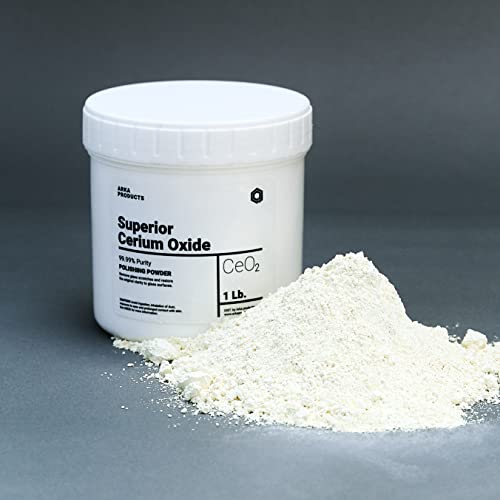
This generic-brand cerium oxide powder is a straightforward, no-frills option for any glass polishing project—from lead crystal glasses to shower door hard water stains to car windshields. It arrived in a heat-sealed package, which users appreciated for freshness, and the 1-pound quantity is enough for multiple full-size applications. The powder is mixed with water to form a paste and applied with a felt polishing wheel or microfiber cloth, making it equally suitable for small DIY projects or larger automotive jobs.
Customer reviews highlight its versatility more than any other product in this category. One user restored vinegar-resistant cloudiness from lead crystal glasses using a drill with a sponge, while another removed etched hard water stains from a shower door that had resisted chemical cleaners. For car windshields, it handled minor scratches quickly with a cheap polisher, though one reviewer noted that tiny chips trapped the polish and left white spots that required additional effort to clean. The powder is an optical-grade rare earth compound, so it delivers the same chemical-mechanical polishing action as the premium brands at a lower cost per ounce.
The primary limitation is the lack of any included applicator or instructions. The powder comes in a plain bag, so you must source your own felt pads, buffing wheels, and mixing container. Additionally, the fineness means it works best on light-to-medium scratches—deep gouges that catch a fingernail will require extended machine polishing with significant pressure. For the price, this is a capable entry-level cerium oxide powder that covers most home and auto glass needs.
Why it’s great
- Highly versatile on crystal, shower doors, and auto glass
- Good value for a full pound of optical-grade powder
- Effective on hard water stains that chemicals cannot remove
Good to know
- No applicator or instructions included
- May leave white residue in pits if not cleaned thoroughly
- Deep scratches require extended machine polishing
4. Menzerna Heavy Cut Compound 1000
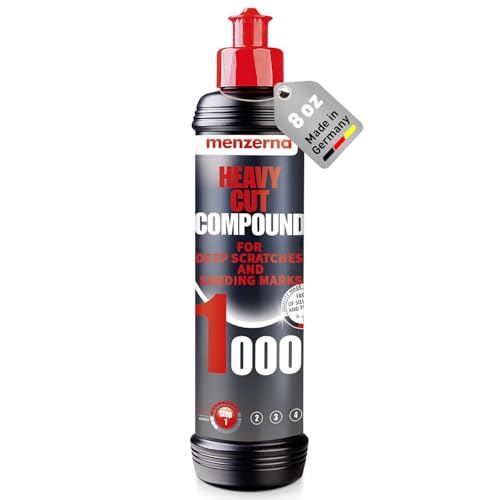
The Menzerna Heavy Cut Compound 1000 is not a glass-specific polish—it is a 1000-grit aluminum oxide compound designed for automotive clear coat and paint correction. That distinction matters because this product will damage bare glass by creating a frosted, etched surface. It belongs in this roundup because many buyers searching for a scratch-removing compound for their car’s painted surfaces or headlight lenses will consider it, and it excels in that role. For painted surfaces with clear coat scratches from parking lot scrapes or key marks, this compound removes them aggressively and quickly.
Customer reviews confirm the speed: one user removed nearly all visible scratches from a side panel scrape in under 10 minutes by hand, without a machine. The 8-ounce bottle is compact and easy to handle, and the compound is silicone-free, which prevents fisheye problems during repainting. It works best with a foam pad on a dual-action polisher, but the manufacturer explicitly states it can be applied by hand for minor details—a flexibility that the glass-only powders lack.
The trade-off is that it has no glass-specific application. If your scratch is on a windshield or mirror, skip this and choose a cerium oxide product. But if you’re dealing with a deep scratch in the clear coat of your car’s body panels, the Menzerna Heavy Cut 1000 is the most effective and beginner-friendly option in this list for that specific use case, backed by 130 years of German abrasive manufacturing experience.
Why it’s great
- Removes deep clear coat scratches quickly by hand or machine
- Silicone-free formulation avoids repainting issues
- Trusted German brand with long abrasive expertise
Good to know
- Not for bare glass—will cause frosting
- 8 oz bottle is small for large-area work
- Medium 1000 grit may require a finishing polish step
5. Finish First Auto Polish

Finish First Auto Polish is not an abrasive compound. It is a synthetic polymer sealant that chemically bonds to painted surfaces to fill in fine swirl marks and provide durable weather protection lasting 6 to 9 months. It should not be confused with a scratch-removing compound for glass or deep paint defects. It is included here because many buyers searching for a general polish may encounter it as a Liquid Glass alternative, and understanding its role is critical to avoiding an ineffective purchase for scratch removal.
The formula contains no wax, silicone, or Teflon, relying instead on a polymer layer that enhances gloss and resists environmental contaminants. The polish is thicker than the Liquid Glass formula it replaced, and application requires a bit more rubbing to remove tar and bug residue. On dark-colored vehicles, it produces a noticeable depth of shine that outperforms most consumer-grade waxes.
For scratch removal specifically, this product will only mask very shallow swirl marks—it will not remove a scratch that you can feel with your fingernail. It is best used as the final protective layer after a heavy-cut compound like the Menzerna has done the actual abrasive correction. If your primary need is restoring scratched glass, look to the cerium oxide options above. If you want a finish that makes an old paint job look showroom-new for months, this is a solid choice.
Why it’s great
- Long-lasting polymer protection (6-9 month durability)
- Fills fine swirl marks for a deep, wet-look shine
- Silicone-free and wax-free formula
Good to know
- Not an abrasive; will not remove deep scratches
- Thicker formula requires more effort to apply evenly
- Focused on paint protection, not glass polishing
FAQ
Can any of these glass polishing compounds be used by hand?
Will a glass polishing compound remove a scratch I can feel with my fingernail?
Is cerium oxide powder dangerous to inhale?
Final Thoughts: The Verdict
For most users, the best glass polishing compound for scratches winner is the CARPRO CeriGlass Glass Polish because it combines a ready-to-use cerium oxide formula with proven scratch-removal capability for automotive glass, provided you own a dual-action polisher. If you want bulk flexibility for multiple surfaces and don’t mind mixing your own slurry, grab the Teenyyou 1.1 lb Cerium Oxide Powder for the finest particle consistency and best per-use value. And for a dedicated heavy-cut compound on painted surfaces (not glass), nothing beats the Menzerna Heavy Cut Compound 1000 for speed and ease of use by hand or machine.