
Bonding wood to plastic presents a unique chemical challenge: the porous cellulose structure of wood craves absorption, while the slick non-porous surface of plastic repels adhesion. Most general-purpose glues fail this specific interface, leaving you with a joint that pops apart under light stress. The right adhesive formulation bridges this gap by using a carrier that etches the plastic surface while penetrating the wood grain for a mechanical lock.
I’m Mohammad Maruf — the founder and writer behind Drink4Good. This guide is built on hundreds of hours of cross-referencing material compatibility data, peel-strength tests, and real-world application reports to isolate the adhesives that genuinely solve the wood-to-plastic bonding problem.
We analyzed viscosity, cure time, gap-filling ability, and substrate compatibility to find the most reliable options available today, which led us to compile this definitive list of the best glue for wood to plastic for your next project.
How To Choose The Best Glue For Wood To Plastic
The base principle is simple: match the adhesive’s chemistry to the least-porous surface in the joint. For wood-to-plastic, that means a formula that can either mechanically etch or chemically soften the plastic surface long enough to form a bond before solvent evaporation. Not every cyanoacrylate does this equally well.
Viscosity: Thin vs. Medium vs. Thick
Thin CA glue wicks into hairline cracks and porous wood grain but runs off slick plastic surfaces before it grabs. Medium viscosity is the sweet spot for most wood-to-plastic joints — it stays put on the plastic and still penetrates the wood. Thick formulas act like gap-fillers, useful when the two materials don’t mate flush.
Accelerator vs. Natural Cure
Accelerator spray forces a cure in seconds, which is essential when you cannot clamp the joint or when the plastic surface is prone to creeping. But the chemical kick can embrittle some plastics, so test on an inconspicuous spot first. Without accelerator, look for formulas that cure within 60 to 90 seconds at room temperature.
Solvent Resistance & Temperature Range
If your bond will face moisture, heat, or cleaning solvents, pick a glue with listed resistance ratings. Standard CA glues soften around 82°C, while specialized high-temp versions tolerate up to 110°C. For outdoor use or kitchen repairs, the spray-adhesive route (like a high-strength contact cement) can outperform bottled CA.
Quick Comparison
On smaller screens, swipe sideways to see the full table.
| Model | Category | Best For | Key Spec | Amazon |
|---|---|---|---|---|
| Titebond Instant Bond Thick | Gel CA | No-clamp vertical repairs | Full cure in 18 seconds | Amazon |
| CA Glue + Activator Kit (ixirpro) | Multi-viscosity Kit | Hobby & 3D print assembly | 16.9 fl oz accelerator spray | Amazon |
| Starbond Thick CA + Activator | Thick CA + Aerosol | Woodworking & mitre joints | 2-minute full cure with spray | Amazon |
| 3M Hi-Strength 90 Spray | Contact Spray | Large surface-area bonding | Low VOC, bonds PE & PP | Amazon |
| Glue Masters Industrial Grade CA | Medium CA Bulk | High-volume workshop use | 8 oz bottle, 24-hour full cure | Amazon |
In‑Depth Reviews
1. Titebond Instant Bond Wood Adhesive Thick, 2 oz

The Titebond Instant Bond is a thick, gel-form cyanoacrylate that stays exactly where you put it — critical when bonding a vertical wood trim piece to a plastic window frame or PVC molding. Its 18-second full-cure time eliminates the need for clamps, which is a game-changer for quick household repairs where you can’t hold pressure for minutes. The gel consistency prevents drips onto surrounding surfaces.
Despite the “wood adhesive” branding, the manufacturer lists acrylic, PVC, and natural rubber as compatible substrates. Multiple users report successful bonds on foam board to wood and oak to unknown plastics without the glue running off the slick surface. The thick formula also swells slightly as it cures, filling micro-gaps that thin glues would leave empty.
The 2 oz bottle is modest, but the gel’s efficiency means a single drop covers a significant joint area. One user noted that it is not an “instant” bond for small repositionable parts — the thick gel holds firm immediately, so alignment must be perfect before contact. The trade-off is a bond that outlasts the surrounding wood in many cases.
Why it’s great
- Gel stays on plastic without running off
- 18-second cure eliminates clamping
- Bonds stronger than the wood itself
Good to know
- No repositioning once parts touch
- Small bottle for the price
2. CA Glue with Activator Kit – 3 x 1.75 oz (Thin, Medium, Thick)
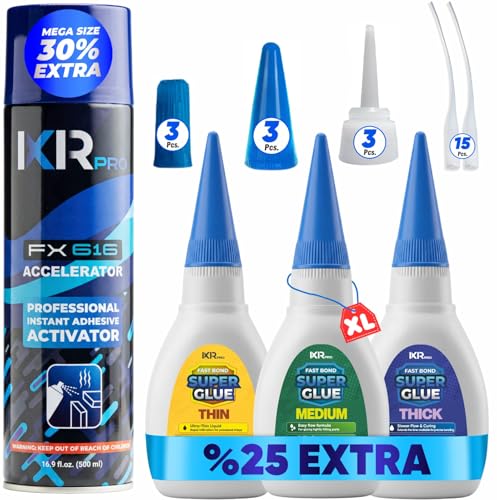
The ixirpro CA Glue Kit gives you three viscosity grades in one package — thin for wicking into wood pores, medium for general wood-to-plastic joints, and thick for gap-filling when the surfaces don’t mate flush. The included 16.9 fl oz accelerator spray forces a full cure in seconds, which is invaluable when bonding a 3D-printed PLA bracket to a wooden base where clamping geometry is awkward.
Users report success gluing 3D prints (PLA, ABS, PETG) to wood, repairing loose freezer handles where plastic meets wood, and fixing eyeglass frames. The thin viscosity does double duty as a wood stabilizer, while the medium and thick options handle the actual structural joint. The 15 precision microtips and replacement lids help prevent the nozzle clogging that plagues standard CA bottles.
One reviewer noted the medium bottle seemed thicker than the thick bottle, suggesting a possible labeling inconsistency, so test each viscosity before committing to a large bond. The accelerator spray has a strong odor, so use it in a ventilated area. For the price, this kit offers the most versatility for mixed-material projects.
Why it’s great
- Three viscosities cover every joint scenario
- Large activator spray for instant curing
- Includes precision tips and spare caps
Good to know
- Medium and thick bottles may be swapped
- Accelerator has strong fumes
3. Starbond Thick CA Glue with Activator Bundle (2 oz + 6 oz)
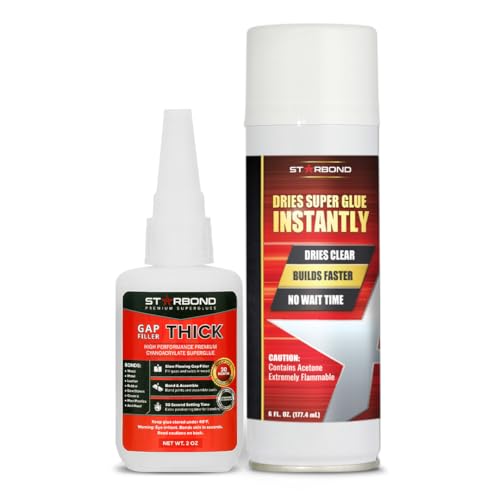
Starbond’s thick CA glue has a honey-like viscosity that gives you deliberate positioning time — about two minutes before full cure — while still delivering a bond that sands clean. This is ideal when you need to align a wooden mitre joint to a plastic laminate surface and want to slide the parts into perfect registration before the glue locks. The included aerosol accelerator reduces blooming (white residue) and strengthens the joint.
The formulation is made in small batches for freshness, with a claimed shelf life of up to 30 months when stored properly. Users specifically praise it for woodworking and crafts where the thick glue fills minor gaps between wood and plastic without running. The accelerator’s ergonomic nozzle delivers a fine, even mist that does not blow the glue out of the joint.
The 2 oz bottle plus 6 oz refill provides a generous total volume for the price point, and the accelerator is large enough to last many sessions. One user noted that while the thick formula is forgiving, it still bonds skin almost instantly — wear nitrile gloves. The accelerator has a noticeably lower odor than other brands, which makes indoor work more tolerable.
Why it’s great
- Honey consistency gives repositioning time
- Low-odor accelerator reduces blooming
- Small-batch formula with long shelf life
Good to know
- Still bonds skin aggressively
- Thick formula not for wicking cracks
4. 3M Hi-Strength 90 CA Spray Adhesive, Low VOC, 19 oz

The 3M Hi-Strength 90 is a contact spray adhesive, not a bottled CA, and it solves the wood-to-plastic problem in a completely different way: you spray both surfaces, let the solvent flash off for a minute, then press them together for an immediate permanent bond. This is the right approach for large-area bonding — think laminating a plastic sheet to a plywood panel or attaching plastic trim to a wooden cabinet door.
Unlike standard CA glues, the 3M 90 formulation is designed to bond low-surface-energy plastics like polyethylene and polypropylene, which are notoriously difficult to glue. The adjustable nozzle lets you control the spray pattern from a narrow stream to a wide fan, reducing overspray. The low-VOC formula meets CARB, SCAQMD, and GREENGUARD standards, making it one of the more environmentally friendly options on this list.
One reviewer found the spray texture “lumpy like silly string” which was problematic for thin vinyl but acceptable for wood-to-wood adhesion. The bond is contact-type, meaning no repositioning once the two surfaces meet — alignment must be exact.
Why it’s great
- Bonds difficult plastics like PE and PP
- Adjustable spray pattern for large areas
- Low-VOC and certified for indoor use
Good to know
- No repositioning after contact
- Spray texture can be uneven
5. Glue Masters Industrial Grade Cyanoacrylate, Medium Viscosity, 8 oz
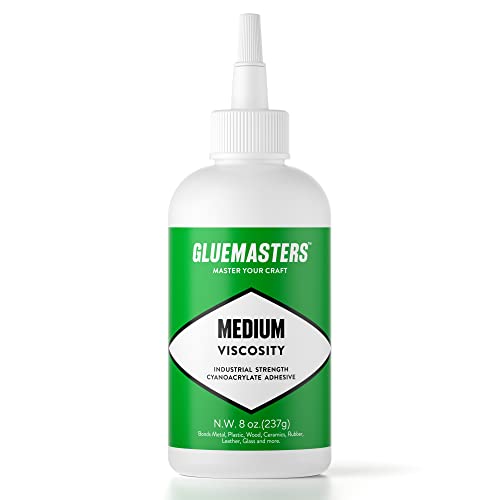
The Glue Masters 8 oz bottle provides the most adhesive per dollar in this lineup, making it a smart choice for workshops that go through CA glue quickly. The medium viscosity flows smoothly for controlled application — it stays on a plastic surface long enough to bring a wooden mating piece into contact, yet still penetrates the wood grain for a mechanical lock. The waterproof bond stands up to daily wear on shoe soles, ceramics, and household fixtures.
Users report success in finish carpentry, where a drop on a mitre joint sets in 20 seconds with an accelerator spray, replacing the need for clamps. The large bottle is noted for high value, with one reviewer calling the consistency “dangerously sticky” — a thin, watery feel that requires a steady hand. The adhesive bonds skin and can cause eye injury if splashed, so safety glasses and gloves are mandatory.
The 24-hour full cure time is longer than other options here, but the initial handling bond forms within a minute. Several reviewers warn that the tip clogs easily and the lid can glue shut if not cleaned after each use. One user reported that the container bottom dissolved after 18 months with about 6 oz left, so shelf-life and container integrity are considerations for infrequent users.
Why it’s great
- Lowest cost per ounce in the review
- Waterproof bond resists daily wear
- Sets in 20 seconds with accelerator
Good to know
- Thin consistency can be messy
- Container may degrade over long storage
FAQ
Will standard cyanoacrylate glue bond polyethylene or polypropylene to wood?
Should I use activator spray every time I bond wood to plastic?
Why does my wood-to-plastic glue joint keep failing?
Final Thoughts: The Verdict
For most users, the glue for wood to plastic winner is the Titebond Instant Bond Thick because its gel formula eliminates run-off on plastic surfaces while curing clamp-free in 18 seconds. If you want the versatility of three viscosities plus an accelerator for hobby work, grab the ixirpro CA Glue Kit. And for large-surface bonding where standard CA glues fail on polyethylene or polypropylene, nothing beats the 3M Hi-Strength 90 Spray.