
A garage is the most expensive parking spot you own, yet the average driver spends thousands of dollars over a lifetime fixing cracked bumpers, dented fenders, and scraped side mirrors from a single miscalculation. The standard tennis ball on a string feels like a medieval solution in an age of sensor fusion, and most homeowners discover that the concrete wall is surprisingly hard to judge from a driver’s seat that sits three feet to the left. A dedicated guide sensor changes that dynamic entirely by feeding you real-time spatial data instead of requiring you to eyeball a six-inch clearance.
I’m Mohammad Maruf — the founder and writer behind Drink4Good. I spend my time analyzing hardware specifications, comparing sensor technologies, and filtering through thousands of user test reports to separate the devices that genuinely protect your vehicle from the ones that just blink a light.
This guide covers ultrasonic, infrared, and laser-based solutions designed to end parking anxiety in tight garages, and it walks through the exact specs and mounting trade-offs that determine whether a garage parking sensor actually prevents a collision or simply adds another gadget to your wall.
How To Choose The Best Garage Parking Sensor
Every garage parking sensor boils down to a single question: how does it detect the vehicle and what does it tell you when you are close enough? The answer determines whether you get precise distance feedback, a simple stop signal, or a laser line you have to track while steering. Three factors dominate the buying decision: the detection technology, the installation footprint and power requirement, and the alert method you can actually process without taking your eyes off the road.
Detection Technology — Laser, Ultrasonic, or Infrared Beam
Laser units project a visible red dot onto your dashboard to mark the perfect stopping location, giving you the simplest possible interface: stop when the dot lands on the target. These devices work best when the laser itself is bright enough to cut through a south-facing garage in daylight. Ultrasonic sensors measure real-time distance from the wall and send a digital readout, which means you get exact inch-by-inch feedback rather than a single target spot — useful if multiple drivers use the same garage. Infrared beam sensors create an invisible tripwire that triggers an audio or visual alert the moment the car breaks the beam, making them excellent for protecting a specific depth zone but less helpful for gradual approach guidance.
Mounting Compatibility and Power Source
Wireless or battery-powered units offer the easiest retrofit — stick them to the wall or clamp them to the garage door track and you are done within ten minutes. AC-powered sensors provide continuous operation without battery swaps, but they require proximity to an outlet and a clean cable run. Sensors that draw power directly from the garage door opener eliminate cord clutter entirely, though they lock you into that specific opener brand. The mounting location matters just as much: ceiling-mounted units cover the entire vehicle footprint, wall-mounted sensors work best for forward-stop positioning, and track-mounted units focus specifically on side-mirror clearance for tighter garages.
Quick Comparison
On smaller screens, swipe sideways to see the full table.
| Model | Category | Best For | Key Spec | Amazon |
|---|---|---|---|---|
| CHAMBERLAIN myQ-G0401-ES | Smart Hub | Remote monitoring and smart home integration | WiFi 2.4 GHz with Bluetooth setup | Amazon |
| Maxsa 37314 Park Right | Dual Laser | Multi-car laser alignment with motion light | Class IIIA red lasers, AC + battery backup | Amazon |
| EKYLIN 8-Sensor Reverse Radar | Ultrasonic | Full bumper coverage with LED distance display | 8 ultrasonic sensors, 12V DC power | Amazon |
| LogicXYZ GP5-2540 | Ultrasonic | Real-time distance readout without lasers | Dual ultrasonic sensors, AC powered | Amazon |
| STKR Side Parking Sensor | Ultrasonic | Side-mirror protection on narrow tracks | Range 4 to 24 inches, battery or USB-C | Amazon |
| Seco-Larm E-931-S35RRQ | Photoelectric | Long-range beam tripwire for gates and garages | 35 ft range, 21 mA standby draw | Amazon |
| LiftMaster 975LM | Laser | OEM integration with LiftMaster openers | Class 2 laser, 90-second runtime | Amazon |
In‑Depth Reviews
1. CHAMBERLAIN myQ-G0401-ES
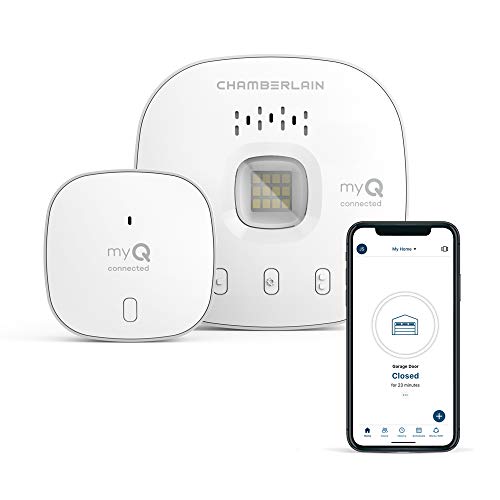
The CHAMBERLAIN myQ-G0401-ES redefines the parking sensor category by replacing a simple stop signal with full remote awareness: you open or close the garage from anywhere, set a nighttime close schedule, and receive push notifications every time the door operates. The sensing distance hits 7 feet, and the included door sensor communicates every open-close cycle to the myQ app, which means you never have to wonder whether the door actually shut after you left. It works with most openers manufactured after 1993 that use photoelectric sensors, though it specifically excludes Chamberlain units with a yellow learn button from 2010 to 2021 and any Linear opener.
The installation requires a 2.4 GHz Wi-Fi router within 50 feet of the hub, and the Bluetooth-assisted pairing simplifies the initial connection significantly compared to older myQ models. The hub mounts to the ceiling near the opener, and the wireless door sensor attaches to the door panel with included adhesive — no wiring, no drilling. Users report that the app learns the door travel pattern after a few cycles and reliably tracks open duration, rotation count, and even minor delays in closing.
The most commonly reported friction point is the door sensor’s battery life: several owners note that the coin-cell battery requires replacement every two to three months, which feels frequent for a sensor that only transmits status changes. Additionally, the Amazon Key in-garage delivery feature has drawn sharp criticism — some users experienced delivery drivers entering improperly, with one incident involving a dog escaping. The device itself earns consistent high marks for reliability, but the Key service requires careful consideration of your household’s safety boundaries.
Why it’s great
- Smartphone alerts provide peace of mind for open-door incidents
- Bluetooth pairing makes initial setup far simpler than previous myQ generations
- No subscription fees for basic open/close and notification features
Good to know
- Door sensor battery drains in 2-3 months and requires frequent replacement
- Incompatible with Chamberlain yellow-learn-button openers and Linear models
- Amazon Key service has documented safety concerns per user reports
2. Maxsa 37314 Park Right

The Maxsa 37314 Park Right addresses the exact pain point of multi-car garages where two vehicles need independent alignment references. It mounts centrally on the ceiling and projects two fully adjustable red lasers — one for each parking spot — that strike the dashboard at the perfect stopping point. Each laser rotates 360 degrees, so you can fine-tune the left-right position and the forward-stop depth independently for compact cars, SUVs, or trucks. The motion sensor detects a vehicle or person entering and activates the lasers along with a built-in LED safety light that stays on for roughly 15 seconds after motion stops.
The unit runs on the included AC adapter with a 9-foot cord, and it offers optional AA battery backup that keeps the lasers and LED active during a power outage. The detection range reaches 15 feet with a 130-degree field of view, which covers the full entry path of most standard two-car garages. Installation uses screws and anchors or the included adhesive tape, and the housing itself weighs only 5 ounces, so it stays secure on a drywall ceiling without heavy reinforcement.
A significant design quirk emerged in user testing: the AC adapter delivers 6 volts, but the laser and LED circuits apparently run optimally at 4.5 volts, causing some units to remain continuously active rather than entering standby mode. Several owners resolved this by swapping in a third-party 4.5-volt adapter, after which the motion activation worked as intended. The motion sensor also faces only toward the garage door, which means entering from the interior side – coming in from the house – will not trigger the light. For parking assistance alone these issues are manageable, but buyers should budget a few extra dollars for the correct power adapter if the always-on behavior bothers them.
Why it’s great
- Dual independently adjustable lasers cover two parking spots from one ceiling unit
- Motion-activated LED light adds safety when walking to and from the vehicle
- Battery backup keeps the system operational during power failures
Good to know
- Supplied 6V AC adapter may cause constant-on behavior; 4.5V adapter recommended instead
- Motion light faces garage door only, not the interior entry path from the house
- Adhesive tape mounting may weaken over time in hot garages; screws are more reliable
3. EKYLIN 8-Sensor Reverse Radar

The EKYLIN 8-Sensor Reverse Radar brings a full aftermarket parking-assist system into the garage sensor conversation. It includes eight ultrasonic sensors — four for the front bumper and four for the rear — plus a digital control box and an LED distance display that shows exact proximity data. The beep frequency increases as the car approaches an obstacle, and the LED readout gives numeric distance feedback for precise inch-by-inch judgment. The sensor cables measure 20 feet for the front set and 7.5 feet for the rear set, which means the kit works best on small to mid-sized vehicles where cable routing distances stay manageable.
Installation requires drilling 22mm holes into the bumper using the included universal hole saw, and the control box needs a 12-volt power connection from the vehicle’s reverse light circuit. The system supports multiple bumper colors — black, red, grey, white, Fiat red, champagne gold, blue, and silver — so the sensors blend reasonably well with most factory paint jobs. The EKYLIN carries a 3-year warranty, which is notably longer than the standard 1-year coverage found on most aftermarket automotive electronics in this tier.
The most critical installation caveat involves the wiring logic: the reverse sensors will not function when the front sensor wire (blue) is connected simultaneously on certain vehicle models. Several owners found that disconnecting the blue wire restored full reverse functionality but disabled the front sensors entirely, creating a workable reverse-only system that defeats the front coverage purpose. The wire lengths themselves limit placement — the 7.5-foot rear cables barely reach the back of a full-size sedan, and a Mercedes CLK350 installation reportedly took 1.5 days due to routing constraints. The LED display also runs loud at full volume, and some units triggered random beeps during normal driving, suggesting sensitivity tuning could be tighter.
Why it’s great
- Eight sensors provide full front and rear bumper coverage for six zones of detection
- Digital LED readout shows exact distance numbers rather than vague beep-only feedback
- Three-year warranty far exceeds typical coverage on aftermarket parking systems
Good to know
- Wiring conflict between front and rear sensor circuits may disable reverse function on some cars
- Cable lengths are too short for large sedans, wagons, or SUVs
- LED display is very loud at maximum volume with no easy volume control option
4. LogicXYZ GP5-2540 Garage Parking Assistant
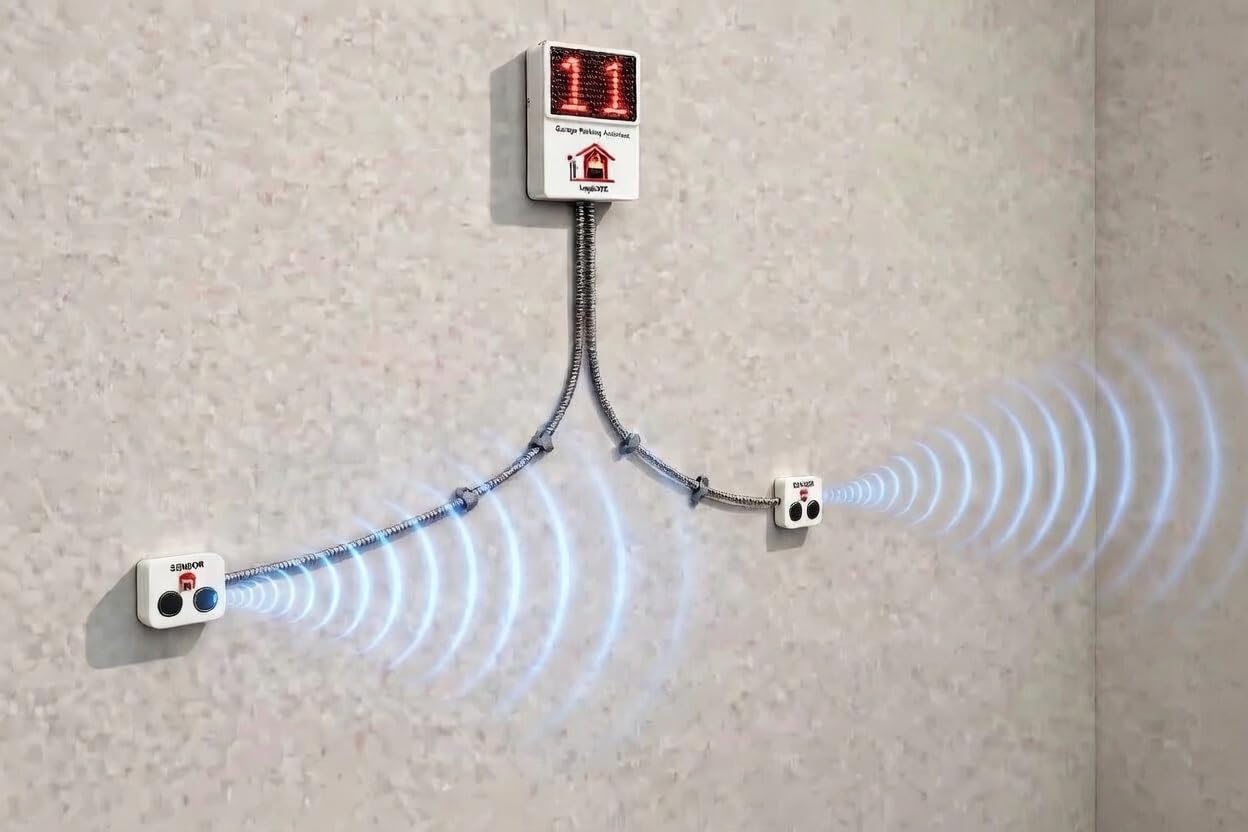
The LogicXYZ GP5-2540 strips away lasers and smart-home connectivity in favor of one function done well: showing the exact distance between your front bumper and the garage wall. A digital LED screen reads from 99 inches down to zero with a resolution you can actually trust for tight parking, and dual ultrasonic sensors behind the display detect the approaching vehicle with solid accuracy. The unit is AC powered — no batteries to swap, no periodic failures from low voltage — and the display automatically shuts off after 10 seconds of no movement to save energy, waking periodically to recalibrate its reference.
Mounting uses included Velcro pads on a clean wall surface, requiring no tools or drilling. The compact housing measures 3.25 by 2.75 by 1 inches and weighs 13 ounces, so it sits unobtrusively at eye level on the back wall of the garage. Because the system is wall-mounted rather than ceiling-mounted, you can reposition it easily if you switch vehicles or rearrange the garage layout. Several users built portable floor stands for deep garages where the wall sits too far back for accurate sensing, which effectively turns the unit into a movable parking assistant.
Durability emerges as a mixed picture here. Some units have operated reliably since 2020 with only an occasional unplug-reboot cycle to clear a frozen display. Other owners reported the screen locking up with scrolling logos or erratic distance readings after about eight months, with no accessible customer support to resolve the issue. The Velcro pads also degrade over time — one user reported that the sensor fell off the wall in 2026 after the tape failed, requiring replacement with heavy-duty double-sided tape. For the price, the GP5-2540 offers a clean no-nonsense distance readout that outperforms laser dots and hanging tennis balls, but the long-term reliability variance makes it a calculated bet rather than a sure thing.
Why it’s great
- Exact numeric distance readout eliminates guesswork better than any laser dot system
- AC power means zero battery replacement and consistent operation in cold garages
- Compact wall-mount design installs in minutes with no wiring required
Good to know
- Some units experience display freezing or erratic readings after several months of use
- Velcro mounting tape degrades over time and may require replacement
- Objects placed in front of the sensors (bikes, tools) cause false distance readings
5. STKR Side Parking Sensor
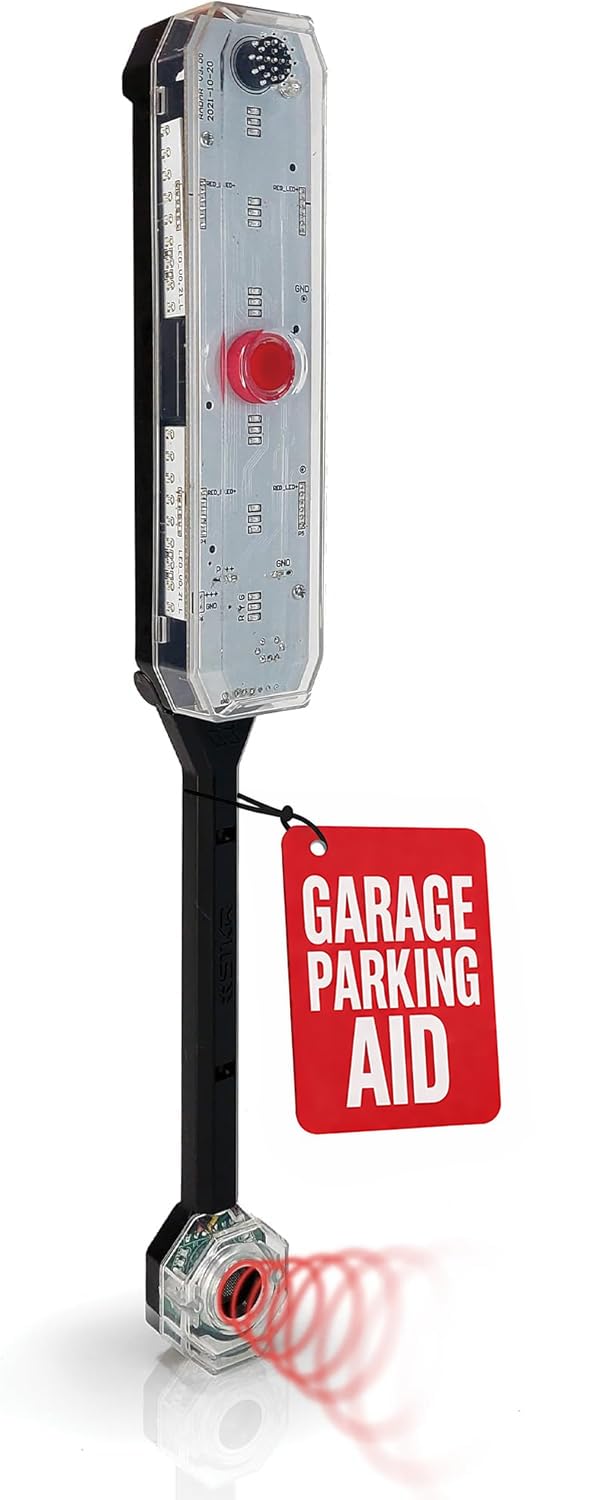
The STKR Side Parking Sensor tackles a specific blind spot that most garage guides ignore entirely: the side mirror and door panel as you enter a narrow garage. Rather than measuring forward distance to the wall, this device clamps directly to the garage door track and uses ultrasonic detection to monitor the gap between your mirror and the track itself. The alert system uses a three-stage LED indicator — green for clear, yellow for close, red with an audible siren for stop — and the warning distance is fully adjustable from 4 inches to 24 inches using a single button. The tool-free track clamp installs in seconds, requires no drilling, and removes just as quickly if you need to reposition it.
Power comes from either 4 AA batteries or USB-C, though the cable runs only about 1 foot and the USB-C jack sits on a fragile arm extension rather than the main body. Battery life is a real concern: one user reported the unit stopped working after 34 days on fresh batteries, and multiple reviews recommend hardwiring via USB-C to a nearby outlet to avoid constant battery swaps. The response speed is tuned for slow parking — the ultrasonic reading updates quickly enough for a gentle roll forward but not for a fast entry, which matches how most drivers approach a tight space anyway.
The track clamp itself has a compatibility limitation: it clips onto standard garage door tracks but does not fit rails on certain brands where the counterbalance spring sits directly in the clamp zone. One owner mounted the sensor on a wooden block using #6 screws after discovering the track clip was unusable.
Why it’s great
- Tool-free track clamp installs in under two minutes with no permanent modification
- Three-stage visual alerts (green/yellow/red) provide intuitive distance feedback
- Adjustable warning range from 4 to 24 inches suits different garage widths
Good to know
- Battery-only operation drains quickly; USB-C power is strongly recommended
- Track clamp may not fit rails with counterbalance springs in the mounting zone
- USB-C jack on the sensor arm is fragile and at risk of damage if cord is snagged
6. Seco-Larm E-931-S35RRQ Enforcer

The Seco-Larm E-931-S35RRQ operates on an entirely different principle from the laser and ultrasonic options — it creates an invisible infrared beam between a transmitter and a reflector, and the moment that beam is broken, the relay triggers an alert. The maximum sensing distance reaches 35 feet, which covers the full depth of most residential garages and extends well into driveways and gates for outdoor applications. The housing is weatherproof, making this one of the few garage parking sensors that can survive direct rain exposure if you need to monitor an outdoor parking lane or a gate entry. Power comes from a standard wall outlet, and the LED indicator shows power and alignment status at a glance.
Alignment is the critical installation step: the reflector needs to be positioned so the infrared beam bounces back to the receiver accurately. The beam spreads roughly 1 square foot at 20 feet, which provides a generous enough target that precise aiming is achievable with the included adjustment brackets. Users report that the device draws only 21 mA on standby and 63 mA when the beam is obstructed, making it exceptionally efficient for battery-backed systems — you can wire it into a gate or garage opener backup without draining reserves. The relay output supports normally-open and normally-closed configurations, so it integrates cleanly with security systems, industrial automation panels, and aftermarket sirens.
The major limitation for pure garage parking use is the binary nature of the feedback: the beam is either intact or broken, so you get a stop-or-go signal rather than gradual distance feedback. This makes the Seco-Larm better suited for protecting a defined boundary — stop the car before the beam breaks — than for fine-tuning parking depth to within an inch. The mounting system also lacks compound-angle adjustments; users who needed precise multi-axis alignment added ball heads or custom brackets. For a garage parking sensor buyer who wants a rugged, hardwired, weatherproof tripwire with sub-100mA current draw, this unit stands alone in its class, but it serves a very different use case than consumer-friendly laser or ultrasonic guides.
Why it’s great
- Weatherproof housing allows use in exposed parking areas and driveways beyond the garage
- Draws only 21 mA on standby — ideal for battery-backed security and gate systems
- Relay output with NO/NC configuration integrates into custom automation setups
Good to know
- On/off beam detection provides binary stop signal only — no gradual distance feedback
- Mounting lacks compound angle adjustment; ball head bracket may be needed for precision
- Reflector alignment requires careful setup to avoid false triggers from misalignment
7. LiftMaster 975LM Laser Parking Assist
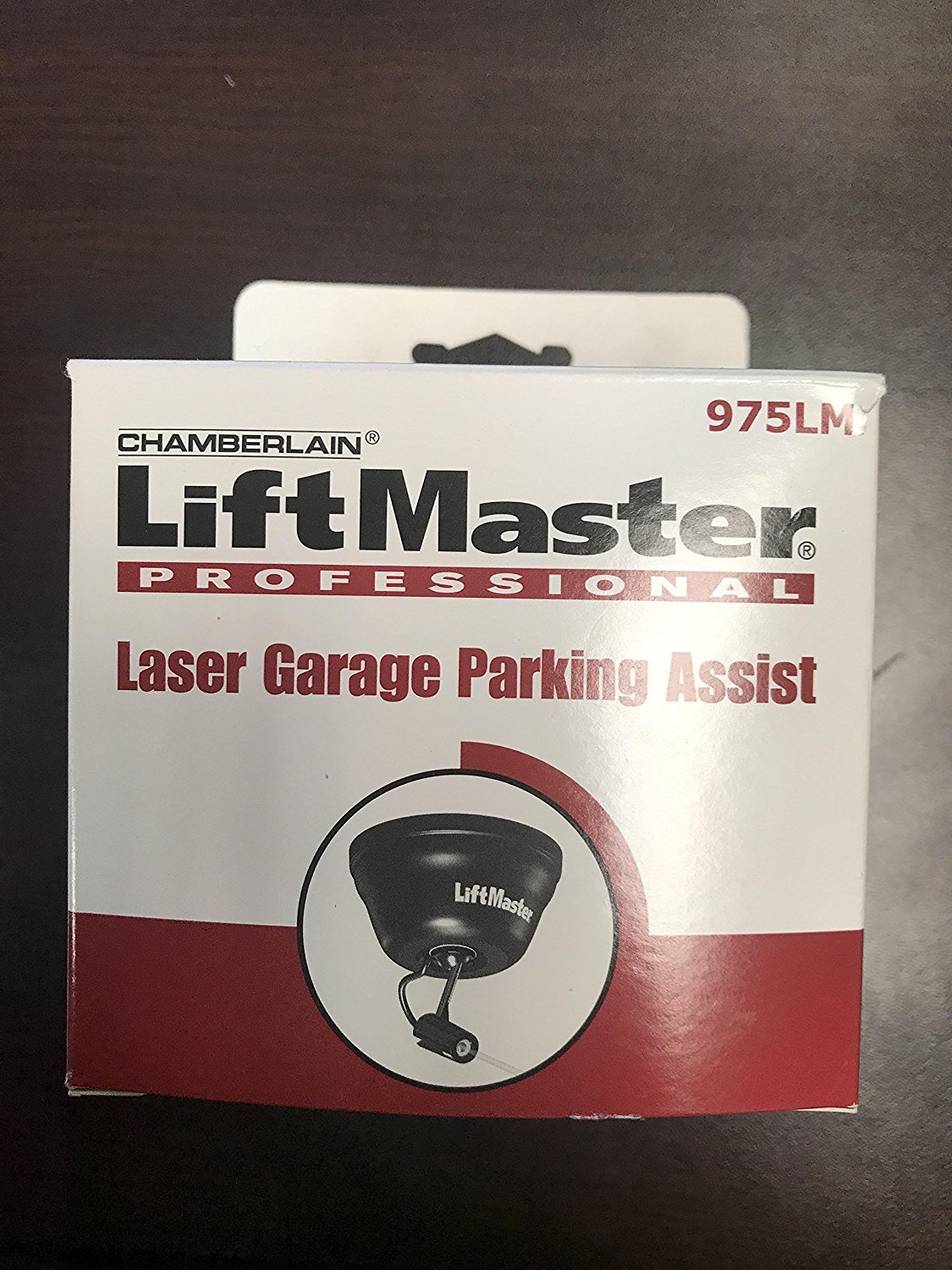
The LiftMaster 975LM Laser Parking Assist is the factory-designed solution for LiftMaster and Chamberlain garage door openers, integrating directly into the opener’s safety beam circuit to trigger a red laser dot whenever the IR beam is interrupted. The laser stays on for 90 seconds, giving you ample time to pull in slowly until the dot lands on your dashboard target. The laser itself is a Class 2 device — safe for incidental eye exposure but clearly visible on most dashboard surfaces, even in a south-facing garage with the lights on. The unit connects directly to the photo-eye terminals on the opener, which means zero wall-wart adapters, zero battery swaps, and zero Wi-Fi pairing.
Installation requires accessing the opener’s terminal block and wiring the 975LM into the existing safety beam circuit — a straightforward procedure for anyone comfortable with basic low-voltage wiring. The laser housing attaches via a single screw into the ceiling drywall or a stud, and the laser module sits in a ball socket that allows for coarse angle adjustment. Once aligned, the system is essentially maintenance-free: no batteries to change, no firmware updates, and no motion sensor that might miss your arrival. The laser unit itself weighs only 0.11 pounds and measures small enough that it disappears into the ceiling line.
The laser dot is small — about the size of a pencil eraser — and it is not visible in the air, only when it strikes a surface. This makes the initial aiming process tricky: you must climb a ladder, activate the laser by interrupting the safety beam, then adjust the angle while looking at the dashboard from the driver seat, climbing down to check, climbing back up to adjust. The wiring is short enough that mounting the unit directly to the ceiling near the opener is the only practical option, which may place the laser outside the optimal angle range for some vehicles. The 90-second timer also does not retrigger while the door remains open — once the laser turns off, you need to step out and walk back through the safety beam to restart it, which breaks the parking process if you need a second adjustment.
Why it’s great
- Opener-powered operation eliminates batteries and external power adapters completely
- Class 2 laser is safe for incidental eye contact and visible on most dashboard surfaces
- Integrates directly with LiftMaster and Chamberlain safety beam circuits for tidy installation
Good to know
- Laser dot is not visible in the air — aiming requires multiple ladder climbs to fine-tune
- 90-second timer does not retrigger with the door open; must step back through beam to reactivate
- Wiring is short; unit must mount on ceiling near opener, limiting placement flexibility
FAQ
Will a laser parking sensor work if my garage has bright overhead LED lights?
Can I use an ultrasonic garage parking sensor for a vehicle with a front bull bar or winch?
Do garage parking sensors interfere with each other when installed in adjacent spots?
Final Thoughts: The Verdict
For most users, the garage parking sensor winner is the CHAMBERLAIN myQ-G0401-ES because it transforms parking from a purely stop-distance game into a full smart-home awareness system — you can check the door status from anywhere, and the free myQ app delivers genuine peace of mind for anyone who has ever driven away wondering whether the garage door actually closed behind them. If you want dual-vehicle laser alignment with a motion-activated safety light, grab the Maxsa 37314 Park Right. And for protecting side mirrors in a tight single-car track, nothing beats the STKR Side Parking Sensor.