
An invisible fence that actually follows your dog to the cabin, the ranch, or the back forty—that’s the promise of a modern GPS shock collar. The old underground wire system locks you into a fixed perimeter and demands a backhoe. A GPS-based collar reads satellite coordinates and builds a virtual boundary you can reshape in minutes from your phone. Whether you need to contain a wandering hound on 10 acres or keep a curious terrier out of the flower bed, the core question is always the same: does the receiver lock onto satellites fast enough to correct before the dog learns the boundary is a suggestion?
I’m Mohammad Maruf — the founder and writer behind Drink4Good. I’ve spent hundreds of hours combing through user reports, comparing GPS acquisition speeds, correction latency, and waterproofing standards across every major collar system on the market to separate reliable containment from frustrating drift.
Whether you need no-subscription simplicity or a full tracking suite for backcountry hunts, this guide breaks down the critical specs—satellite accuracy, correction modes, and battery endurance—behind the best gps shock collar for your specific terrain and dog size.
How To Choose The Best GPS Shock Collar
Buying a GPS shock collar is a multi-year investment in your dog’s safety. Skimp on GPS accuracy or correction reliability and you’ll spend weekends re‑training. Focus on the wrong spec and you might lock yourself into a subscription you don’t need. Here are the three filters every serious buyer should apply before clicking “add to cart.”
GPS Accuracy & Correction Latency
Not all GPS modules are equal. Budget collars often use single‑frequency chips that drift 10–20 ft, causing false corrections or missed boundaries. Mid‑range and premium systems (Garmin, Dogtra, PetSafe Guardian) employ multi‑frequency or AI‑assisted GPS that locks position within 3–5 ft. Correction latency—the delay between crossing the boundary and receiving the tone/vibration/shock—is equally critical. A lag longer than one second teaches your dog that the line is blurry. Look for systems advertising sub‑second response.
Correction Modes & Training Flexibility
A one‑size‑fits‑all shock level frustrates sensitive dogs and fails with stubborn breeds. The best collars offer at least 5–10 static levels plus separate tone and vibration modes. Premium models add “Nick” (brief pulse) and “Constant” (sustained correction) so you can match intensity to the situation. Combined systems that include a BarkLimiter or a pager vibration give you layered training tools without buying a second device.
Battery Life & Build Quality
GPS radios drain power faster than standard e‑collars. A collar that dies after 8 hours is useless for a full day hike or a multi‑acre property. Look for 24‑hour minimum runtime; premium units exceed 60 hours with dynamic tracking. Waterproofing matters equally—IPX6 handles rain, IPX7 handles submersion. IPX9K (found on the Dogtra Pathfinder 2 Mini) survives high‑pressure spray, essential for hunting dogs that cross creeks daily. Avoid non‑replaceable batteries if you plan to keep the collar beyond two seasons.
Quick Comparison
On smaller screens, swipe sideways to see the full table.
| Model | Category | Best For | Key Spec | Amazon |
|---|---|---|---|---|
| Dogtra Pathfinder 2 | Premium Handheld | Multi-dog tracking & e-fence | 9‑mile range, 21‑dog capacity | Amazon |
| Dogtra Pathfinder 2 Mini | Premium Handheld Compass | Off-grid hunting & hiking | 2‑sec GPS updates, 4‑mile range | Amazon |
| PetSafe Guardian GPS 2.0 | Subscription Tracking | Real‑time tracking & virtual fence | 70‑hr battery, dual‑frequency GPS | Amazon |
| Garmin Alpha TT 25 | High‑End Tracking | Professional training & long hunts | 9‑mile track/train, 136‑hr battery | Amazon |
| PetSafe Guardian GPS | Premium No-Subscription | Large‑property containment | 5‑day battery, AI motion detection | Amazon |
| DJNFGQ 2‑Pack GPS Fence | Mid‑Range 2‑Collar | Free‑form polygonal boundaries | 6561‑ft radius, 24‑hr battery | Amazon |
| TTPet GPS Fence | Mid‑Range Single Collar | Budget for medium‑sized yards | 3‑yd accuracy, 5‑level correction | Amazon |
| WIEZ GPS Wireless Fence | Entry‑Level GPS Fence | Open‑field circular containment | 3281‑ft radius, 3‑trip correction | Amazon |
| Garmin PT10 | Accessory Collar | Garmin remote compatibility | 1‑mile range, BarkLimiter built‑in | Amazon |
In‑Depth Reviews
1. Dogtra Pathfinder 2

Dogtra’s Pathfinder 2 is a complete GPS tracking and training ecosystem that runs entirely on a free app plus a handheld GPS connector—no monthly subscription required. The system uses a dual‑frequency antenna that delivers real‑time position updates every 2‑3 seconds, even under heavy tree canopy. During field testing, hunters report the geofencing feature triggers a smartphone alert the instant a dog crosses the virtual boundary, and the e‑collar response (Nick, Constant, Tone, Pager, LED light) arrives without measurable delay. The collar itself is IPX9K‑rated, meaning it survives high‑pressure spray and full submersion in saltwater, and the 9‑mile range comfortably covers rolling hills and dense brush.
The companion app is the real standout. Offline maps powered by Map Box let you navigate without cellular signal—critical for backcountry trips—and the “lost collar locator” helps you find a dropped unit by sound and light. You can track up to 21 dogs simultaneously, with each dog’s speed, direction, and distance displayed on a single smartphone screen. Owners consistently praise the rugged build and the fact that the GPS connector acts as a physical teaching button for quick corrections without fumbling for a phone app. The main frustration is the power‑on sequence: you must hold the button for several seconds, and some users accidentally toggle the unit off mid‑walk. Battery life averages 24–30 hours with continuous tracking, which is good but not class‑leading.
For anyone who regularly hunts, hikes, or works multiple dogs off‑leash, the Pathfinder 2 delivers a professional‑grade experience without recurring fees. The e‑fence feature is accurate enough for suburban use, though the minimum zone size may frustrate owners with postage‑stamp yards. If your priority is raw tracking range with zero subscription burden, this is the system to beat.
Why it’s great
- No subscription for full tracking and e-fence
- 9‑mile range with reliable multi-dog support
- IPX9K waterproofing for all‑weather use
Good to know
- Power‑on button sequence can be confusing
- E-fence minimum zone size is too large for small yards
- Relies on smartphone for full map interface
2. Dogtra Pathfinder 2 Mini Compass
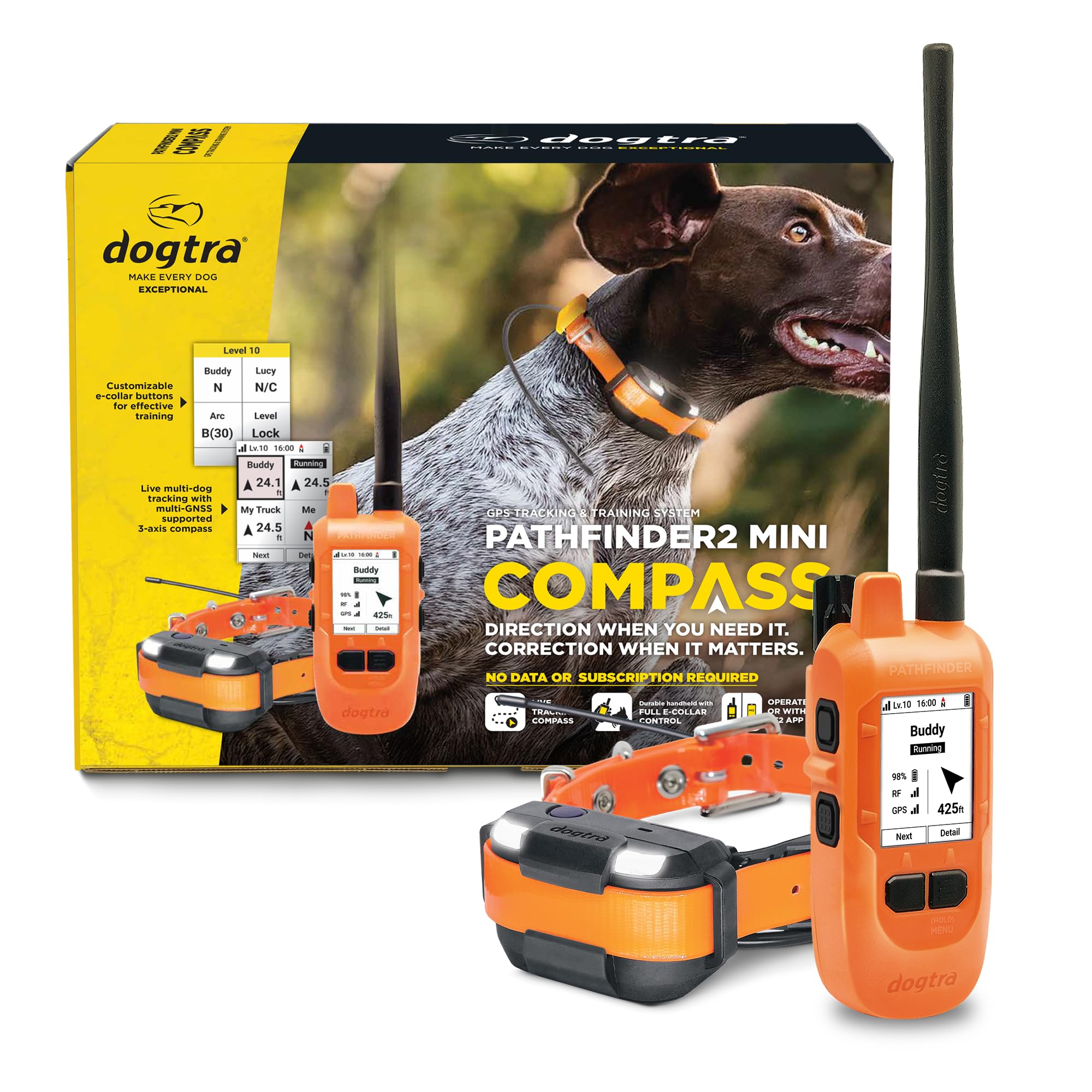
The Pathfinder 2 Mini Compass takes everything that works in the standard Pathfinder 2 and adds a dedicated 2‑inch LCD handheld with a live compass bearing. That means you can leave your phone safely tucked away—the handheld shows your dog’s direction, distance, speed, and motion status with 2‑second GPS refresh intervals. The 4‑mile range is shorter than the standard Pathfinder 2’s 9‑mile, but for most day hikes, farm patrols, and hunting on dense terrain, 4 miles is ample. The handheld also gives you full e‑collar control with tactile buttons for Nick, Constant, Tone, Pager, and LED light, so corrections happen instantly without unlocking a screen.
The collar receiver is IPX9K‑rated and fits dogs 15 lbs and up. Owners who tested the system in the Appalachian backcountry praised the offline map capability—you download satellite or terrain maps ahead of time via the free app, then navigate entirely without cellular signal. The rugged handheld survived drops onto rocks and full submersion during creek crossings. The included belt clip and lanyard make one‑handed access easy. On the downside, the handheld’s screen is small; hunters with aging eyes sometimes need reading glasses to read the compass numbers in low light. Battery life on the collar is solid at around 24 hours, but the handheld requires a separate charge that lasts about 15 hours of continuous use.
If you want a dedicated handheld that works independent of your phone, the Mini Compass is the cleanest solution on the market. The e‑fence and geofencing alerts still require the app for initial setup, but once configured, the handheld handles 99% of day‑to‑day tracking and correction. It’s ideal for the hunter or hiker who dislikes juggling a smartphone in wet or rugged conditions.
Why it’s great
- Handheld with built-in compass works without smartphone
- 2‑second GPS updates for accurate real-time tracking
- IPX9K waterproof collar for harsh environments
Good to know
- 4‑mile range may be too short for open plains
- Handheld screen is small and hard to read in dim light
- Battery life on handheld is shorter than the collar
3. PetSafe Guardian GPS 2.0

PetSafe’s Guardian GPS 2.0 is the most technologically refined subscription‑based fence on the market. The collar is 50% smaller than the previous generation, fitting dogs as small as 10 lbs with neck circumferences down to 8 inches. Inside that slim package sits a dual‑frequency GPS antenna that delivers pinpoint location accuracy—typically within 3–5 feet—plus AI‑driven motion detection that filters out false boundary crossings caused by GPS drift. The real‑time tracking feed updates every few seconds through the MyPetSafe app, and you can create up to 50 custom virtual fences with push notifications the instant your dog crosses. Battery life is a strong 70 hours on a single charge, and the collar is waterproof for rain, puddles, and swims.
The three‑mode training system (tone, vibration, 10 levels of static) gives you enough granularity to find the exact correction level your dog respects without over‑correcting. Setup requires a 2.4 GHz Wi‑Fi connection, which is a one‑time process. Owners of smaller breeds especially appreciate the lightweight collar that doesn’t interfere with their dog’s movement. The main trade‑off is the subscription—monthly or annual plans start after a free trial month, and each additional dog requires its own collar and subscription. Some users report that the GPS can lag 5–20 feet behind the dog’s actual position, leading to corrections that occur after the dog has already re‑entered the safe zone, which can confuse training.
For owners with medium‑to‑large properties who want the smallest possible collar with real‑time tracking and smartphone alerts, the Guardian GPS 2.0 is an excellent choice. The subscription cost is the primary sticking point, but the convenience of no base station, no buried wire, and instant fence‑boundary alerts may justify it for peace‑of‑mind. If your property is smaller than half an acre or has dense tree cover, PetSafe recommends their in‑ground or wireless alternatives instead.
Why it’s great
- Ultra‑lightweight collar fits dogs as small as 10 lbs
- 70‑hour battery life with dual‑frequency GPS accuracy
- Up to 50 custom virtual fences with push alerts
Good to know
- Subscription required after free trial month
- GPS lag can cause delayed corrections
- Requires 2.4 GHz Wi‑Fi for initial setup
4. Garmin Alpha TT 25

The Garmin Alpha TT 25 is a dedicated tracking and training collar designed to pair with Garmin handhelds like the Alpha 10 or Pro 550 Plus. It tracks your dog up to 9 miles away with position updates as frequent as every 2.5 seconds, and it delivers 18 levels of continuous or momentary stimulation plus tone and vibration. The rugged, slim receiver is universally sized and uses a user‑replaceable flex band—a major advantage if the original band wears out after a couple of seasons. The dynamic tracking feature extends battery life significantly: a standard Li‑ion pack lasts up to 68 hours, and the upgraded expanded pack pushes to 136 hours, easily covering a week‑long hunting trip.
The collar’s multicolor LED (7 colors, user‑selectable) makes it easy to identify which dog is which at night or in thick cover. Owners who use the collar with the Pro 550 Plus report that the GPS accuracy is “down to the foot,” and the stimulation is responsive enough for both basic boundary training and correcting behavior at a distance. The Wi‑Fi connectivity ensures automatic firmware updates when the collar is charging. The biggest limitation is that the Alpha TT 25 is a collar only—you must already own or purchase a compatible Garmin handheld to see tracking data and send commands. The collar is also on the pricier side, but the build quality and Garmin’s ecosystem are hard to beat for serious hunting and field work.
If you are already invested in the Garmin ecosystem or need a collar that can handle extreme battery demands for multi‑day trips, the Alpha TT 25 is a no‑compromise choice. The stimulation range is wide enough for the most stubborn breeds, and the replaceable battery pack means you aren’t throwing away the whole unit when the battery degrades. Just factor in the cost of the handheld if you are starting from scratch.
Why it’s great
- Up to 136‑hour battery life with expanded pack
- 9‑mile tracking and 18‑level stimulation
- User‑replaceable flex band and battery pack
Good to know
- Requires a separately sold Garmin handheld
- Premium price point for collar only
- Battery pack upgrade adds extra cost
5. PetSafe Guardian GPS Fence
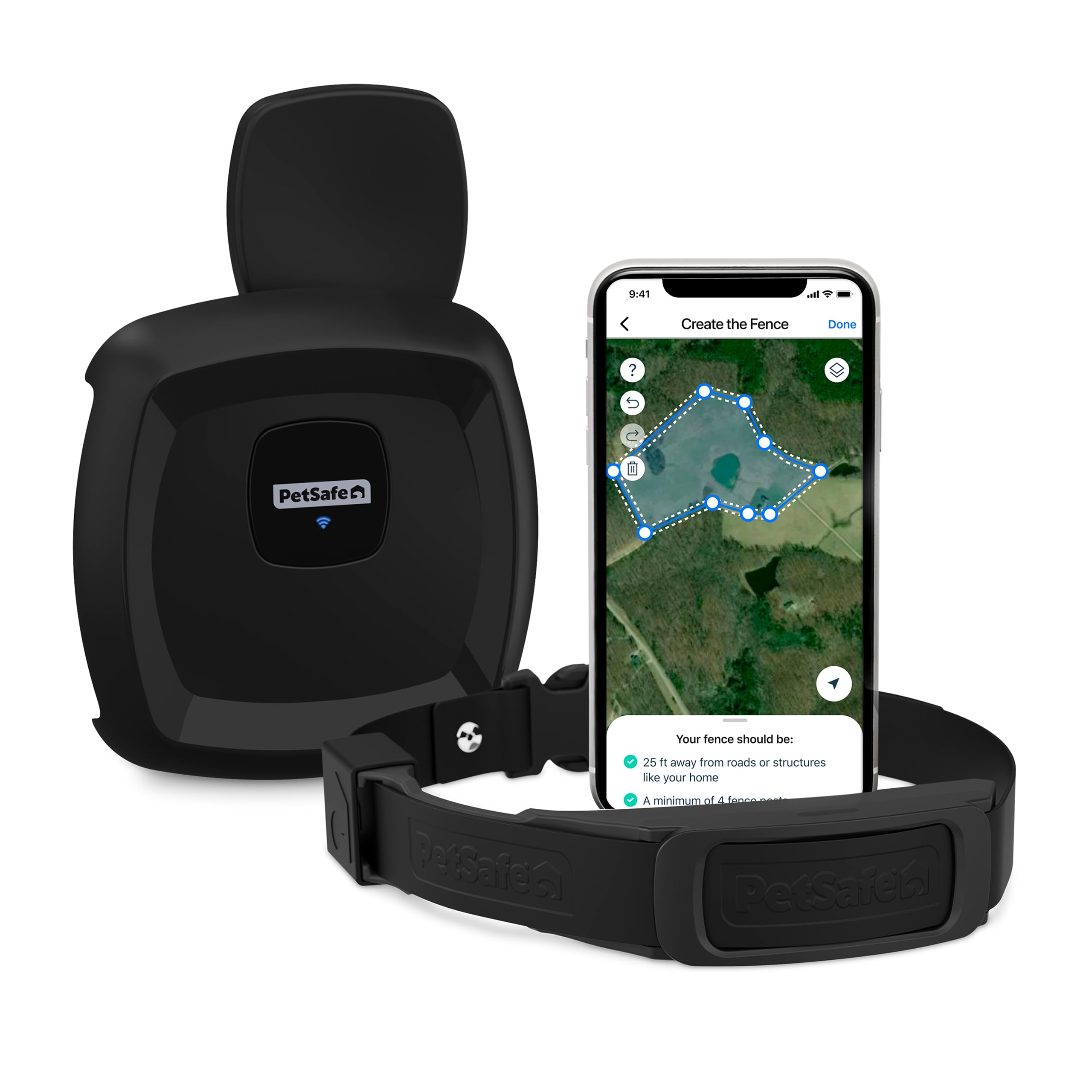
The PetSafe Guardian GPS Fence (first generation) combines no‑subscription operation with AccuGuard technology that fuses GPS satellite data, real‑time motion detection, and AI to reduce false alerts. The redesigned collar is slim and lightweight, boasting up to five days of battery life on a single charge—enough for long weekends without worry. Installation takes about an hour via the My PetSafe app: you draw your property boundaries on a satellite map, and the collar learns the perimeter. The system supports properties of ¾ acre or larger, and you can choose between tone, vibration, or 10 levels of static correction. Owners appreciate the portability—move to a new house, redraw the boundary in the app, and you’re done. No base station, no buried wire.
The collar is waterproof and fits dogs over 25 lbs. Additional add‑a‑dog collars are available for multi‑pet households. Customer reviews consistently highlight that the AI motion detection dramatically cuts down on the false boundary alerts that plague cheaper GPS fences. However, the system requires a stable Wi‑Fi connection for setup and occasional sync; if your internet goes down, the fence still holds the last known boundary, but you lose the ability to adjust settings or receive notifications. A few owners report that after several months the collar begins to fall offline intermittently, requiring a reboot of the base unit. Battery life in real‑world use is closer to 3 days than the advertised 5, especially with frequent corrections.
For owners who want a true wireless, subscription‑free fence with reliable AI‑assisted boundary detection, the Guardian GPS Fence is a top contender. The five‑day battery claim is optimistic, but even three days is plenty for most households. The no‑subscription model is a clear advantage over PetSafe’s own Guardian 2.0. If you have a large, open property and don’t need real‑time tracking, this is a smart buy.
Why it’s great
- No recurring subscription fees
- AI motion detection reduces false alarms
- Portable fence—no base station or buried wire
Good to know
- Requires stable Wi‑Fi for setup and adjustments
- Battery life averages 3 days in real use
- Falls offline intermittently for some users
6. DJNFGQ 2‑Pack GPS Fence
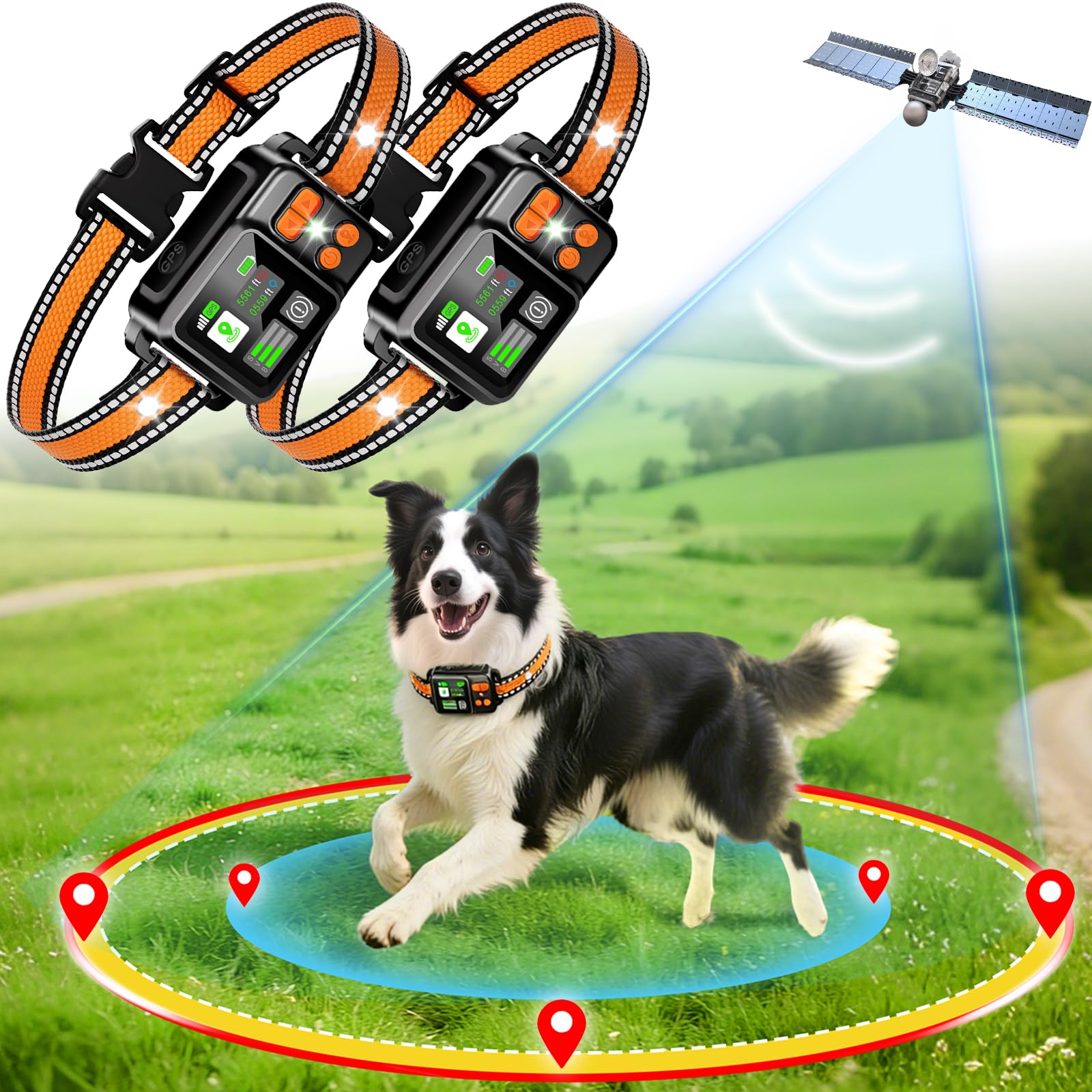
The DJNFGQ 2‑Pack GPS Fence system is a solid mid‑range option that includes two fully functional collar receivers, making it immediately cost‑effective for multi‑dog households. The standout feature is the “free‑form fence” mode—instead of being locked into a perfect circle, you can set multiple GPS vertices to trace the exact shape of your yard, garden, or farm boundary. This matters if your property has an irregular shape, a pond, or a garden bed you want your dogs to avoid. The circular fence mode works as a quick 3‑second setup for open fields, with a radius adjustable from 49 ft up to 6561 ft (roughly 1.4 miles). IPX7 waterproofing means the collars survive submersion up to 1 meter for 30 minutes, good for dogs that splash through creeks and puddles.
The collars charge in about 3 hours and run for approximately 24 hours on a single charge—adequate for a full day of outdoor freedom, but you’ll need to charge nightly if the dogs are out from sunrise to sunset. Correction modes include tone, vibration, and adjustable static levels, though the static adjustment is less granular than Garmin or Dogtra offerings. Owners report that the GPS drift is noticeable—roughly 10 ft in open sky—which can cause the occasional false alert near property lines. The built‑in screen on the collar is bright but scratches easily, so a screen protector is advisable. Customer support is responsive; the seller has proactively upgraded chips for better connectivity based on user feedback.
If you need to contain two dogs on a large, irregularly shaped property without breaking the bank on a premium system, the DJNFGQ 2‑Pack is a practical choice. The free‑form fence mode is a genuine differentiator at this price tier, though the GPS drift means you should set the boundary a few feet inside your actual property line for safety. The 24‑hour battery is acceptable but not class‑leading.
Why it’s great
- Two collar receivers included at a mid‑range price
- Free‑form polygonal fence for irregular property shapes
- IPX7 waterproof for splashes and submersion
Good to know
- GPS drift of ~10 ft requires buffer zone
- Screen scratches easily; protector needed
- Battery life is 24 hours—charge nightly for all‑day use
7. TTPet GPS Wireless Dog Fence

The TTPet GPS Wireless Fence uses a 2025‑era AI GPS chip that claims “intelligent scene recognition” to reduce false triggers from tree cover and building interference. In practice, owners report that the collar maintains roughly 3‑yard accuracy under clear skies, which is competitive with collars costing twice as much. The play area radius adjusts from 25 to 999 yards (up to 647 acres), making it suitable for everything from a small suburban back yard to a large rural property. The collar fits dogs over 18 lbs with neck sizes from 9 to 29 inches, and the IPX6 waterproofing handles rain and splashes but not full submersion. The 5‑level correction sequence—increasing tone, vibration, and shock—repeats with a 1‑minute pause between cycles to prevent over‑stimulation.
Setup is straightforward: charge the collar, turn it on, walk to the center point, and set the radius. The automatic memory feature saves your settings so you don’t have to reconfigure after power cycling. Owners who purchased the TTPet as their first GPS fence appreciated the low learning curve and the fact that the collar worked as intended out of the box. However, the collar is not designed for indoor use—you must turn it off before the dog enters the house to avoid accidental corrections. A small number of users reported that the collar stopped functioning after a few months, suggesting the build quality may not match the premium competition. The 1‑year warranty is standard but may not cover wear and tear on the contacts.
The TTPet GPS Fence is the best entry‑level option for owners who want to try GPS containment without a significant financial commitment. The AI chip delivers respectable accuracy for the price, and the automatic memory feature reduces daily friction. If you are unsure whether GPS fencing will work for your dog or your property, this is a safe, low‑cost introduction. Expect to upgrade to a more durable system if you plan to use it daily for multiple dogs over several years.
Why it’s great
- AI GPS chip reduces false triggers
- Automatic memory saves settings after power cycle
- Large radius range up to 999 yards
Good to know
- Not suitable for indoor use; must turn off before entering
- Some units fail after a few months of use
- IPX6 is splash‑proof, not fully submersible
8. WIEZ GPS Wireless Dog Fence

The WIEZ GPS Wireless Fence is the most affordable dedicated GPS fence on this list, targeting owners with simple, open‑field containment needs. It uses a circular boundary model with a radius adjustable from 65 to 3281 feet (covering up to 776 acres). No base station or buried wire is required—the collar itself contains the GPS module and the correction logic. The safety design is notable: when the dog crosses the boundary, the collar delivers a continuous warning (tone/vibration/shock) for 16 seconds, pauses for 30 seconds, then repeats the cycle up to three times. After three failed attempts to return, the collar stops correction until the dog re‑enters the safe zone, preventing over‑correction from a confused pet that cannot find its way back. The collar is lightweight at 8.4 ounces and comes with a 2‑year warranty after registration.
Owners praise the battery life, with some reporting that a single charge lasts from sunup to sundown for about two years of regular use. The reflective collar strip improves night visibility, a nice safety touch. Setup requires reading the instructions carefully—the circular boundary may not align perfectly with property lines, so you need to place the center point strategically. The WIEZ is explicitly designed for open fields and farms; owners with tree‑covered lots or irregular boundaries report frequent false alerts because GPS signals bounce off foliage. The collar’s belt‑type closure is less secure than a traditional buckle; some owners wish it used a snap closure instead.
The WIEZ GPS Fence is a competent, no‑frills solution for owners with large, open properties who want to give their dog freedom to roam without digging a trench. The three‑strike correction system is a humane touch, and the 2‑year warranty is generous at this price point. But it is not a multi‑purpose collar—skip it if you have dense trees, a complex yard shape, or need training modes beyond basic containment.
Why it’s great
- Most affordable GPS fence with no ongoing fees
- Three‑strike correction cycle prevents over‑correction
- Excellent battery life—lasts all day for years
Good to know
- Circular boundary only; no free‑form shape
- Prone to false alerts under dense tree cover
- Belt‑type closure is less secure than a buckle
9. Garmin PT10

The Garmin PT10 is not a standalone GPS fence; it is a dedicated training collar designed to pair with Garmin handheld remotes like the Pro 70, Pro 550, or Sport Pro. It operates on 27 MHz radio frequency with a 1‑mile range, making it a reliable companion for owners who already use Garmin’s training ecosystem. The collar includes a built‑in BarkLimiter with Advanced Bark Correction Technology, which automatically detects barking and delivers a correction without needing the remote. It comes with two lengths of stainless steel, insulated contact points to accommodate different coat lengths, and the collar strap is ¾ inch wide—thin enough to fit smaller dogs without twisting but stout enough for daily use.
Owner feedback is overwhelmingly positive regarding durability: the collar survives rain, sun, cold, and the occasional drop or chew. Battery life is rated at 60 hours, and owners report it works for about 4 days of moderate use before needing a recharge. The training modes (vibration, tone, static) are responsive, and the collar works effectively as a bark deterrent for nuisance barking at delivery drivers or neighbors. The main limitation is that the PT10 does not include GPS tracking or boundary containment—it is a training collar with a bark control feature, not a full GPS fence system. The collar strap is thin and can twist on some dogs; several owners replace it with a wider third‑party strap for a better fit.
The PT10 is the right choice if you already own a Garmin handheld and need a high‑quality training collar with bark control for a dog that does not require GPS containment. It is not a replacement for a full GPS fence, but as a complement to an existing Garmin setup, it delivers reliable performance at a sensible price. Skip it if you need GPS positioning or virtual fence functionality.
Why it’s great
- Built‑in BarkLimiter for automatic bark correction
- Durable construction survives rough play and weather
- Interchangeable contact points for different coat lengths
Good to know
- No GPS tracking or fence capability
- Requires a separate Garmin handheld for training
- Thin collar strap may twist on active dogs
FAQ
Can a GPS shock collar work in a heavily wooded area?
What is the difference between a GPS fence and an in‑ground wire fence?
How long does a GPS shock collar battery typically last?
Final Thoughts: The Verdict
For most owners, the best gps shock collar winner is the Dogtra Pathfinder 2 because it offers professional‑grade 9‑mile tracking, multi‑dog support, and a responsive e‑collar system—all without a monthly subscription. If you want a dedicated handheld that works independently of your phone for off‑grid adventures, grab the Dogtra Pathfinder 2 Mini Compass. And for owners with small‑to‑medium dogs who need the smallest possible collar with real‑time tracking, nothing beats the PetSafe Guardian GPS 2.0, subscription notwithstanding.