
That sagging headliner, the peeling armrest, the cushion seam that let go after one too many movie marathons — upholstery failure isn’t just an eyesore, it’s a direct challenge to your car’s cabin comfort or your furniture’s lifespan. The fix isn’t always a trip to the professional shop, but the wrong adhesive will fail under the heat, humidity, and constant flexing that upholstery endures. You need a formula that grabs fast, stays flexible, and won’t let go when the sun bakes the interior to over 140°F.
I’m Mohammad Maruf — the founder and writer behind Drink4Good. I’ve spent countless hours analyzing the chemistry behind contact cements and spray adhesives, comparing bond strength data, heat resistance ratings, and open times to separate the products that genuinely perform from those that simply promise a strong hold.
This guide cuts through the aerosol confusion, showing you exactly which formulas are built for fabric, leather, and foam, and which ones will leave you with a sticky mess and a failed project. Whether you need to reattach a car headliner or repair a favorite club chair, this comprehensive analysis of the best glue for upholstery will help you choose the right adhesive for a durable, long-lasting repair.
How To Choose The Best Glue For Upholstery
Selecting the right adhesive for an upholstery project is about matching the glue’s chemistry to the specific material and the environmental stress it will face. A formula that works perfectly for attaching felt to wood will fail spectacularly when asked to hold a foam-backed headliner to a hot metal roof panel. Focus on these three criteria to ensure your repair lasts.
Understand the Chemistry: Contact vs. Spray
The majority of professional-grade upholstery adhesives are contact cements, which require you to apply a thin layer to both surfaces, let it dry to a tack-free state, and then press them together. This creates an instant, high-strength bond that doesn’t require clamping. Spray adhesives offer a similar technology but in a more controlled application, ideal for large panels or curved surfaces where a brush would leave marks. Avoid simple white glues or hobby glues; they lack the flexibility and heat resistance needed for upholstery.
Prioritize Heat and Moisture Resistance
In a vehicle, interior temperatures can soar above 160°F on a sunny day. A glue that softens or loses its grip at these temperatures will cause your headliner or door panel fabric to droop or detach. For furniture, consider exposure to body oils, spills, and humidity. Always look for adhesives explicitly rated for high heat and moisture resistance. The technical data should mention temperature ratings or successful use in automotive or marine environments.
Evaluate Open Time and Initial Tack
Open time is the window you have to position your material before the glue sets. For a simple, small patch, a fast-setting glue with a 10-minute open time is ideal. For a complex headliner installation covering a large area, you will need a longer open time to allow for precise positioning without the fabric sticking prematurely. The initial tack — how aggressively the glue grabs upon contact — is equally crucial. High initial tack is essential for vertical applications where gravity is working against you.
Quick Comparison
On smaller screens, swipe sideways to see the full table.
| Model | Category | Best For | Key Spec | Amazon |
|---|---|---|---|---|
| 3M Headliner & Fabric Adhesive | Premium | Automotive headliners & heavy fabric | Dries in 30–60 minutes | Amazon |
| 3M Max Strength 90 | Premium | High-heat & marine applications | Max bond in 10 minutes | Amazon |
| Duall-88 Leather Adhesive | Mid-Range | Leather & shoe repair | Dries clear, sets in 10–30 min | Amazon |
| Beacon Fabri-Tac | Value | Fabric crafts & small repairs | Washable, waterproof, flexible | Amazon |
| Gorilla Heavy Duty Spray | Budget | General DIY & temporary holds | Repositionable up to 10 min | Amazon |
In‑Depth Reviews
1. 3M Headliner & Fabric Adhesive (Pack of 2)

This is the benchmark for interior trim work. The 3M Headliner & Fabric Adhesive is specifically engineered for the demanding environment of an automotive interior, providing exceptional strength for bonding heavyweight headliners, carpets, and sound-deadening materials to metal and plastic. Its formula dries clear and resists the deteriorating effects of extreme heat, cold, and humidity, ensuring your work stays done even in a parked car during a summer heatwave.
The aerosol can delivers a controlled, even layer with an adjustable nozzle that helps direct the spray precisely where it’s needed, minimizing messy overspray. With a dry time of 30 to 60 minutes, it offers a generous working window for positioning large panels before the bond sets fast for a professional finish. Users consistently report success on complex projects like Jeep hardtop liners and convertible tops, where other adhesives have failed.
While the price tag is higher than multi-purpose spray adhesives, this two-pack offers enough coverage for multiple headliners or one large project like an RV interior. The strength is exceptional — one user noted it can be almost too effective, requiring careful handling to avoid wrinkles. For any repair where a failed bond would mean redoing the entire job, this adhesive is the most reliable investment you can make.
Why it’s great
- Superior heat and moisture resistance for automotive use
- Controlled spray pattern with adjustable nozzle reduces waste
- Two-pack provides excellent value for large projects
Good to know
- Very high initial tack — not forgiving for beginners on large panels
- Requires careful surface prep for optimal bond strength
2. 3M Max Strength 90 Multi-Surface Contact Adhesive
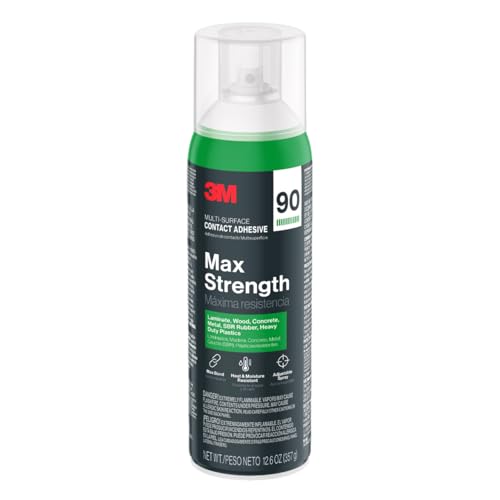
When the job goes beyond fabric to wood, metal, laminate, or concrete, the 3M Max Strength 90 is the contact adhesive that handles it all. Its “max bond” formula develops full strength in just 10 minutes, making it ideal for time-sensitive repairs. This is not just a fabric glue; it is a high-performance contact cement perfect for bonding upholstery foam to plywood seat bases, attaching rubber or leather panels, or even installing acoustic soundproofing in a vehicle or home theater.
The heat and moisture resistance of this adhesive is outstanding, with numerous user reports confirming its reliability in demanding marine environments and extreme interior heat in RVs and cars. The adjustable nozzle allows you to switch from a wide fan spray for covering large, flat surfaces to a narrower stream for precise application on edges and trim pieces, offering a level of control that is rare in aerosol adhesives.
As a premium-priced, Low VOC formula that meets CARB requirements, it is a responsible choice for indoor work. A common note in user feedback is that the adhesive is incredibly sticky and requires precise placement, as repositioning is difficult once the two surfaces meet. It’s the best choice for structural upholstery repairs where the bond must be stronger than the material itself, but it demands careful planning and execution.
Why it’s great
- Extremely strong bond that develops in 10 minutes
- Excellent heat and water resistance for marine and automotive use
- Adjustable nozzle for precision or wide coverage
Good to know
- Not repositionable after initial contact — requires a steady hand
- Strong fumes require excellent ventilation
3. Duall-88 Leather Adhesive
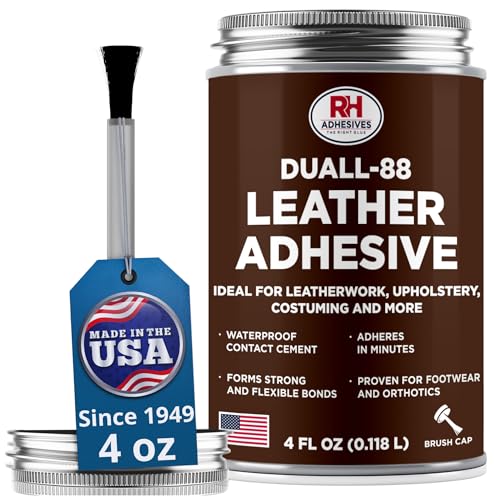
If your upholstery project involves leather, the Duall-88 Leather Adhesive from RH Adhesives is a purpose-built solution. This neoprene-based contact cement provides a flexible yet incredibly strong bond that is specifically formulated to handle the unique stretch and movement of leather, making it ideal for car door panels, furniture repairs, shoe refinishing, and leathercraft. It dries to an amber-clear finish that won’t frost or crack as the leather flexes, preserving the look of your project.
The standout feature here is the working time; the adhesive sets within ten to thirty minutes, giving you a solid window to position and adjust the leather before the bond becomes permanent. This is a critical advantage for upholstery work where perfect alignment is everything. The formula is waterproof and heat-resistant, and user feedback confirms it holds strong in demanding applications like repairing kayaking sandals and car door upholstery where other glues have failed.
At a moderate price point for a specialized product, this 4-ounce can provides enough glue for several smaller repairs or a single, precise installation. The main trade-off is the strong solvent smell, which is a characteristic of high-strength neoprene adhesives. Users consistently recommend working in a well-ventilated area, but note that the fumes dissipate quickly after the glue cures, leaving behind a repair that outperforms cheaper, general-purpose alternatives.
Why it’s great
- Formulated specifically for leather — handles flex and movement
- Good working time (10–30 minutes) for repositioning
- Waterproof and heat resistant for tough environments
Good to know
- Strong solvent smell requires good ventilation during use
- Small 4-ounce can is not cost-effective for large projects
4. Beacon Fabri-Tac Premium Fabric Glue
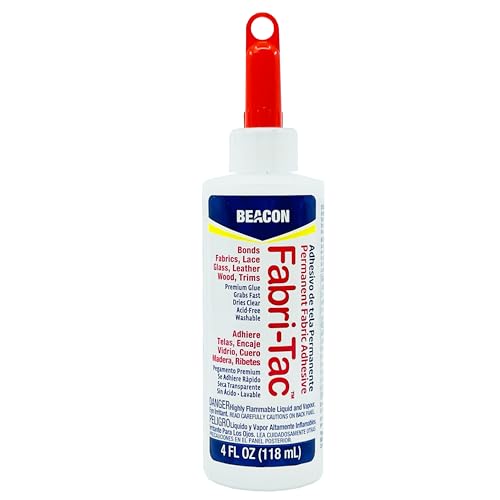
For small-scale upholstery repairs and fabric crafting, the Beacon Fabri-Tac is a reliable, budget-friendly workhorse. Marketed as “the glue gun in a bottle,” this liquid adhesive delivers a permanent, flexible bond that is washable and waterproof, making it perfect for re-attaching trim on pillows, repairing soft-soled shoes, or fixing seams on cushions that will see regular use. It dries crystal clear, leaving no yellowed residue on your fabric.
The formula is incredibly versatile and bonds a wide array of materials including lace, denim, canvas, and even some plastics and wood, providing a strong hold that endures many launderings. Users have reported excellent results on challenging repairs like tent tears and shoe separation, where the flexible bond outperforms stiffer glues that would crack under load. The bottle’s nozzle allows for precise application, making it ideal for detail work and small repair areas where an aerosol would be too messy.
This mid-range option is best suited for furniture accents and craft projects rather than heavy-duty structural repairs like automotive headliners. Its gel-like consistency can sometimes produce “glue webs” on narrow surfaces, requiring careful handling, and it is not designed for large panel applications. For the price, it offers outstanding performance for the majority of household upholstery fixes, making it the smart choice for the casual DIYer.
Why it’s great
- Washable and waterproof for durable fabric repairs
- Dries crystal clear — no yellowing over time
- Excellent precision nozzle for small-area application
Good to know
- Not strong enough for heavy automotive headliners
- Thick gel can create stringy webs on narrow surfaces
5. Gorilla Heavy Duty Spray Adhesive
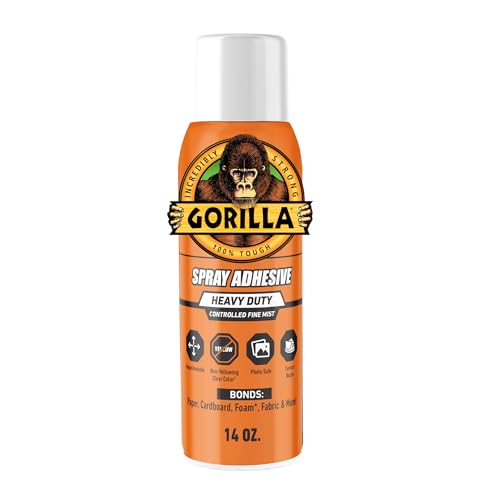
For general-purpose bonding and light upholstery tasks, the Gorilla Heavy Duty Spray Adhesive is a versatile and affordable entry-level option. Its key feature is the ability to remain repositionable for up to 10 minutes before forming a permanent bond, which is a huge advantage for beginners or for projects where aligning intricate patterns is necessary. The wide pad nozzle delivers a controlled, fine mist that reduces overspray, making it a good choice for craft projects like re-covering foam board or attaching fabric to cardboard.
The formula dries clear and non-yellowing, is moisture resistant, and bonds a broad range of surfaces including fabric, paper, cardboard, and foam. Users praise its strong hold and value for money, often noting that the large 14-ounce can lasts much longer than the tube-style glues from big-box stores. It has been successfully used for tasks like attaching fabric to walls for accent panels and fixing car mats where extreme heat resistance is not a primary concern.
This is a budget-friendly product, and its limitations reflect that. It is not designed for high-heat or high-humidity environments, and its bond strength, while good for crafts, is not in the same league as the neoprene-based contact cements needed for professional upholstery. For simple, indoor fabric projects where you need a quick, clean bond and the ability to reposition your material, this spray adhesive is an excellent value — but it’s not the tool for a sagging car headliner or a heavy leather seat repair.
Why it’s great
- Repositionable for 10 minutes — great for precise alignment
- Large can size offers excellent value for small projects
- Dries clear and non-yellowing for clean finishes
Good to know
- Not heat or moisture resistant enough for automotive use
- Bond strength is not adequate for heavy structural repairs
FAQ
Can I use super glue for upholstery fabric?
How do I remove old upholstery glue before applying new adhesive?
Is spray adhesive or liquid glue better for a car headliner?
Final Thoughts: The Verdict
For most users, the best glue for upholstery winner is the 3M Headliner & Fabric Adhesive (Pack of 2) because its automotive-grade formulation provides the perfect balance of heat resistance, open time, and bond strength for the most demanding repairs. If you want a versatile contact adhesive that can handle leather, wood, and laminates with extreme durability, grab the 3M Max Strength 90. And for a budget-friendly, washable solution for smaller fabric crafts and furniture touch-ups, nothing beats the Beacon Fabri-Tac.