
When the grid goes dark, the difference between a minor inconvenience and a full-blown crisis often comes down to a single decision made weeks before: which machine will keep your refrigerator cold, your sump pump running, and your family safe. A power outage doesn’t ask your permission, and it won’t wait for you to research specs by candlelight. The right backup power system bridges the gap between helplessness and self-sufficiency, but the wrong choice can leave you with a dead battery in a storm or a fuel you cannot source.
I’m Mohammad Maruf — the founder and writer behind Drink4Good. I’ve spent hundreds of hours comparing wattage curves, fuel consumption rates, inverter THD measurements, and real-world reliability data across dozens of generator platforms to build this guide around the hard numbers that actually matter during an extended blackout.
Whether you are preparing for hurricane season, winter ice storms, or planned rolling blackouts, finding the right generator for power outage means matching your specific appliance load to the correct fuel type, runtime profile, and output architecture — and this guide breaks down every critical spec across eleven top contenders.
How To Choose The Best Generator For Power Outage
Selecting a generator is not about picking the biggest number on the box. It is about matching three variables — starting wattage, fuel availability, and runtime — to the specific appliances you refuse to lose during an outage. Overestimate one factor and you waste money on capacity you’ll never use; underestimate starting surge and your motor won’t even spin up.
Wattage: Running vs. Starting Surge
Every motor-driven appliance — a refrigerator compressor, a well pump, a window AC unit — draws two to three times its rated running wattage for the first few seconds. A fridge rated at 700 running watts may spike to 2,100 watts on startup. When you add a furnace blower, lights, and a modem, the total starting surge can exceed 4,000 watts even in a modest setup. Always size your generator’s peak wattage to the sum of all starting surges you might run simultaneously — not just the steady-state numbers.
Fuel Type and Runtime
Gasoline is energy-dense and widely available, but it degrades in storage and requires carburetor maintenance if not run regularly. Propane stores indefinitely without degrading and burns cleaner, but it delivers slightly lower peak wattage and requires a separate tank. Natural gas offers unlimited runtime via a home gas line, but the generator must be connected by a professional and output is capped at the gas line’s BTU delivery rate. Battery power stations produce zero emissions and run silently, but their runtime is limited to the kWh capacity of the internal battery — typically 2 to 4 kWh — which may power a fridge for 12 to 24 hours before needing a grid or solar recharge.
Inverter vs. Conventional Alternator
Conventional open-frame generators produce electricity with higher total harmonic distortion (THD), often above 5%, which can damage sensitive electronics like modern refrigerators with inverter boards, CPAP machines, and laptop power supplies. Inverter generators electronically condition the output to under 3% THD — clean enough for any modern appliance. Inverter units also run at variable engine speeds under lighter loads, cutting fuel consumption and noise by a significant margin. For home backup that powers any sensitive device, an inverter generator is the safer choice.
Noise and Neighborhood Considerations
An open-frame generator at full load can produce 75 to 85 dBA — loud enough to disturb neighbors and violate local noise ordinances in many residential areas. Inverter generators typically operate between 55 and 65 dBA, roughly the volume of a normal conversation. If you live in a dense suburban or urban setting, the quieter inverter models are not just a courtesy — they are often a requirement. Even in rural areas, lower noise allows you to run the generator overnight without disrupting sleep.
Safety Systems: CO Shutdown and GFCI
Carbon monoxide poisoning is the leading cause of generator-related deaths. Every modern generator should include an automatic CO shutdown sensor that kills the engine if CO levels rise near the unit. This is not a luxury — it is a baseline safety requirement, especially when using the generator in partially enclosed spaces like a garage with the door cracked. GFCI protection on the outlets adds another layer of electrical safety in wet conditions.
Quick Comparison
On smaller screens, swipe sideways to see the full table.
| Model | Category | Best For | Key Spec | Amazon |
|---|---|---|---|---|
| Champion 4000-Watt Dual Fuel | Inverter | Dual fuel mid-range home backup | 3000W rated / 64 dBA | Amazon |
| DuroMax XP13000HXT Tri Fuel | Open Frame | Whole-home tri fuel | 13,000W peak / 500cc engine | Amazon |
| Westinghouse 12500 Watt Dual Fuel | Open Frame | Large home with remote start | 12,500W peak / 457cc engine | Amazon |
| DuroStar DS13000MX Dual Fuel | Open Frame | Heavy-duty whole-home backup | 13,000W peak / 500cc engine | Amazon |
| Anker SOLIX C2000 Gen 2 | Power Station | Zero-emission home backup | 2,048Wh / 2,400W rated | Amazon |
| Jackery Explorer 2000 v2 | Power Station | Solar recharging + silent backup | 2,042Wh / 2,200W rated | Amazon |
| PowerSmart 4800-Watt Inverter | Inverter | Quiet RV and home with wheels | 4,800W peak / 3600W rated | Amazon |
| WEN DF360iX Dual Fuel | Inverter | Lightweight dual fuel RV backup | 3,600W peak / 49 lbs | Amazon |
| ERAYAK 4500W Inverter | Inverter | Compact job site + backup | 4,500W peak / 0.2-1.2% THD | Amazon |
| Pulsar PGD40ISCO Inverter | Inverter | Ultra-light camping and backup | 4,000W peak / 47.3 lbs | Amazon |
| WEN 56360i Inverter | Inverter | Budget-friendly quiet backup | 3,600W peak / 46 lbs | Amazon |
In‑Depth Reviews
1. Champion Power Equipment 4000-Watt Dual Fuel Inverter Generator

The Champion 4000-watt dual fuel inverter hits the sweet spot between portable convenience and real home backup capability. It delivers 4,000 starting watts and 3,000 running watts on gasoline, with propane output rated at 2,700 running watts. The 64 dBA noise rating at 23 feet puts it firmly in conversation-level territory — quiet enough for suburban overnight use without disturbing the neighbors. The 149cc engine is parallel ready, letting you double output with a second unit.
What sets this Champion apart is the integrated CO Shield carbon monoxide auto-shutoff system. Combined with cold start technology that fires up reliably in low temperatures, this generator is built for the exact conditions — winter ice storms — when an outage is most dangerous. Runtime reaches up to 10 hours on gasoline and a remarkable 25 hours on propane at quarter load, meaning fewer middle-of-the-night refueling runs.
Real-world owners report running two refrigerators plus a freezer for six to twelve hours on a single 20-pound propane tank, with no carburetor maintenance needed thanks to the clean-burning gas. The TT-30R RV outlet and 5-20R duplex household receptacle cover the typical home transfer switch connection without additional adapters. At roughly 53 pounds, it is hand-carryable but benefits from the optional wheel kit for longer moves.
Why it’s great
- Genuine dual fuel with propane runtime up to 25 hours
- CO Shield auto-shutoff for safety during storms
- Quiet 64 dBA inverter output suitable for residential areas
Good to know
- No included wheel kit — must purchase separately for easy yard mobility
- Some users report inconsistent warranty support response times
2. DuroMax XP13000HXT 13,000-Watt Tri Fuel Generator
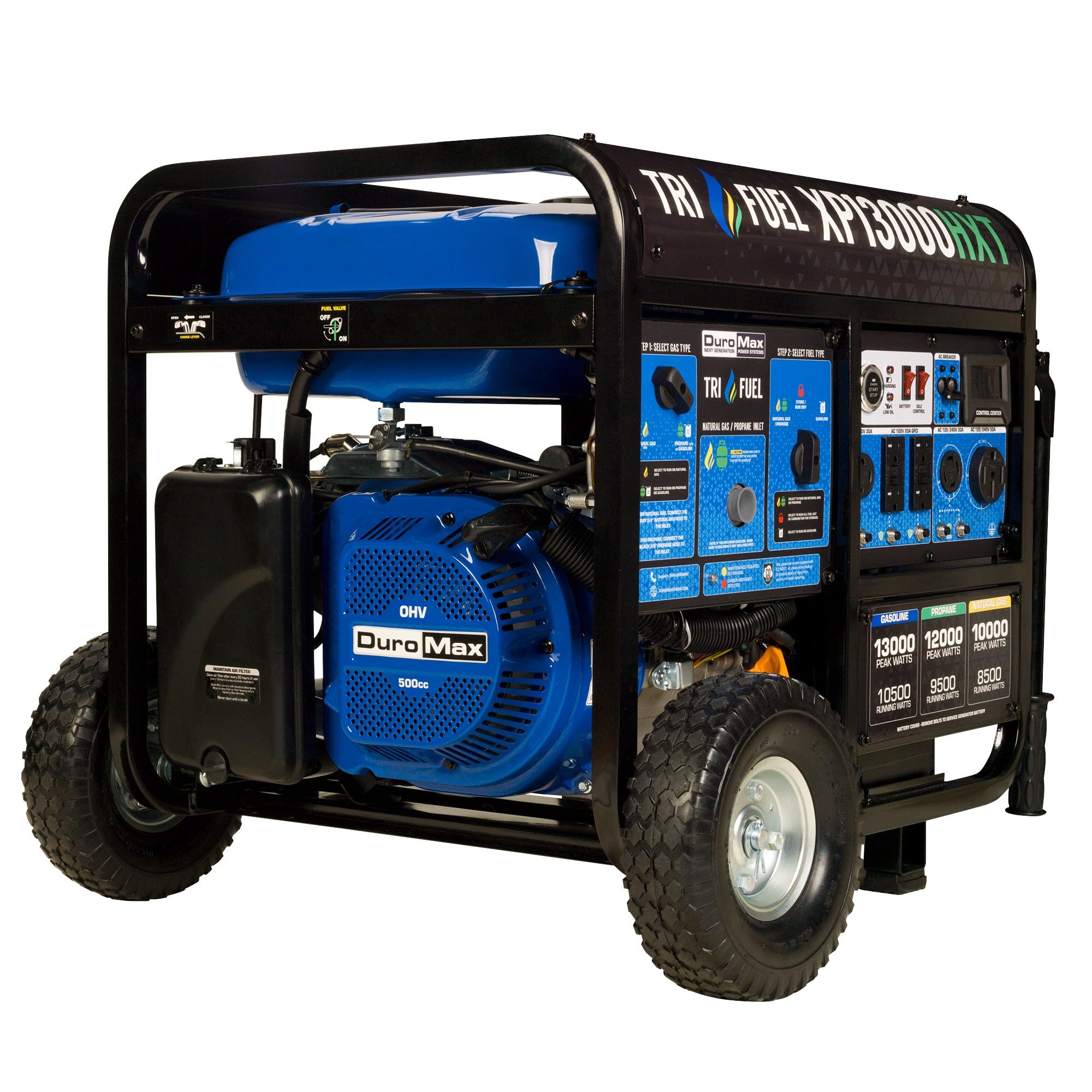
The DuroMax XP13000HXT is the only unit in this lineup that runs on gasoline, propane, and natural gas — a tri-fuel architecture that gives you the ultimate fuel flexibility during extended outages. The 500cc OHV engine pushes 13,000 peak watts and 10,500 running watts on gasoline, enough to power an entire home including a 4-ton central AC, well pump, and electric range simultaneously. The 50-amp outlet is transfer switch ready for whole-home connection.
Push-button electric start plus a remote key fob means you can fire up the generator from inside the house during a storm. The front-facing fuel selector switches between fuels in seconds, and the included 15-foot natural gas hose lets you connect directly to a home gas line for unlimited runtime. The CO Alert system monitors carbon monoxide levels and shuts the engine down automatically if dangerous concentrations build up — essential for a machine this large that may be run near a house.
Owners report running an entire home — four refrigerators, furnace, security cameras, and lights — at only 25 to 30 percent load for six hours on 2.2 gallons of gasoline. Natural gas operation requires a minimum 225,000 BTU/hour supply from the home line, which most residential meters can handle but should be verified by a plumber or electrician. At 240 pounds, this is a stationary unit meant for a dedicated outdoor pad, not for tailgating.
Why it’s great
- Tri-fuel capability with natural gas for indefinite blackout runtime
- 50-amp outlet ready for whole-home transfer switch connection
- Remote start key fob for safe indoor startup from shelter
Good to know
- Heavy 240-pound build requires a hand truck or permanent placement
- Open-frame design is loud — not suitable for overnight residential use
3. Westinghouse 12500 Watt Dual Fuel Generator

The Westinghouse 12500 delivers 12,500 peak watts on gasoline and 11,200 on propane, powered by a 457cc four-stroke engine with a cast iron sleeve — a durable design meant for many hundreds of hours of operation. The remote start key fob, electric push-button start, and backup recoil starter give three layers of ignition redundancy, crucial when you need power fast in a deteriorating storm situation. The 6.6-gallon fuel tank provides up to 12 hours of runtime at half load.
Outlet configuration is comprehensive: two GFCI 120V 20A household receptacles, one L14-30R 30A transfer switch outlet, and one 14-50R 50A RV outlet — all with rubber covers for weather protection. The built-in CO sensor and automatic low-oil shutdown protect both the user and the engine. Westinghouse functionally tests every unit at the factory, so minor residual oil or fuel odor on first run is normal behavior, not a defect.
Real-world owners note that the assembly process — attaching wheels and feet — takes under five minutes. The unit is heavy at 212 pounds, so the included wheel kit and fold-down handles are essential for positioning. The engine loses efficiency above 2,000 feet elevation, but a reasonably priced high-altitude carburetor kit resolves that for mountain homes. This generator has earned top ratings from Consumer Reports and Popular Mechanics for reliability and power delivery.
Why it’s great
- Remote start key fob allows safe operation from inside the home
- Cast iron sleeve engine provides long-term durability for frequent use
- Three outlet types including 50A RV and L14-30R transfer switch
Good to know
- 212-pound weight makes this a semi-permanent installation rather than portable
- Open-frame design produces typical generator noise — ear protection recommended
4. DuroStar DS13000MX 13,000-Watt Dual Fuel Generator

The DuroStar DS13000MX is built around a 500cc engine generating 13,000 peak watts on gasoline and 11,000 on propane, routed through a rugged all-metal frame and reinforced power panel that can survive harsh outdoor storage. The push-button electric start simplifies ignition, and the front-facing fuel selector lets you switch between gasoline and propane instantly without tools. The 50-amp outlet is ready for direct home transfer switch connection.
The CO Alert system continuously monitors ambient carbon monoxide and shuts the engine down automatically if levels become unsafe. The engine features low-oil shutdown and a digital hour meter that tracks runtime for maintenance scheduling. The included wheel and handle kit makes the 220-pound unit movable across firm ground, though it is clearly designed for semi-permanent placement near a home or workshop.
Owners report this generator powers an entire house including two AC units, a refrigerator, stove, microwave, TVs, and a water heater simultaneously without noticeable strain. On propane, storage is maintenance-free since the fuel never degrades, and the unit starts instantly even after months in storage. The remote control key fob adds convenience, allowing you to start the generator from inside the house during heavy rain or snow.
Why it’s great
- 500cc engine delivers genuine whole-home power including multiple AC units
- CO Alert auto-shutdown for critical safety during storms
- All-metal construction withstands outdoor exposure and rough handling
Good to know
- 220-pound unit requires a hand truck or wheel kit for any movement
- Open-frame noise level limits use to daytime or remote locations
5. Anker SOLIX C2000 Gen 2 Portable Power Station
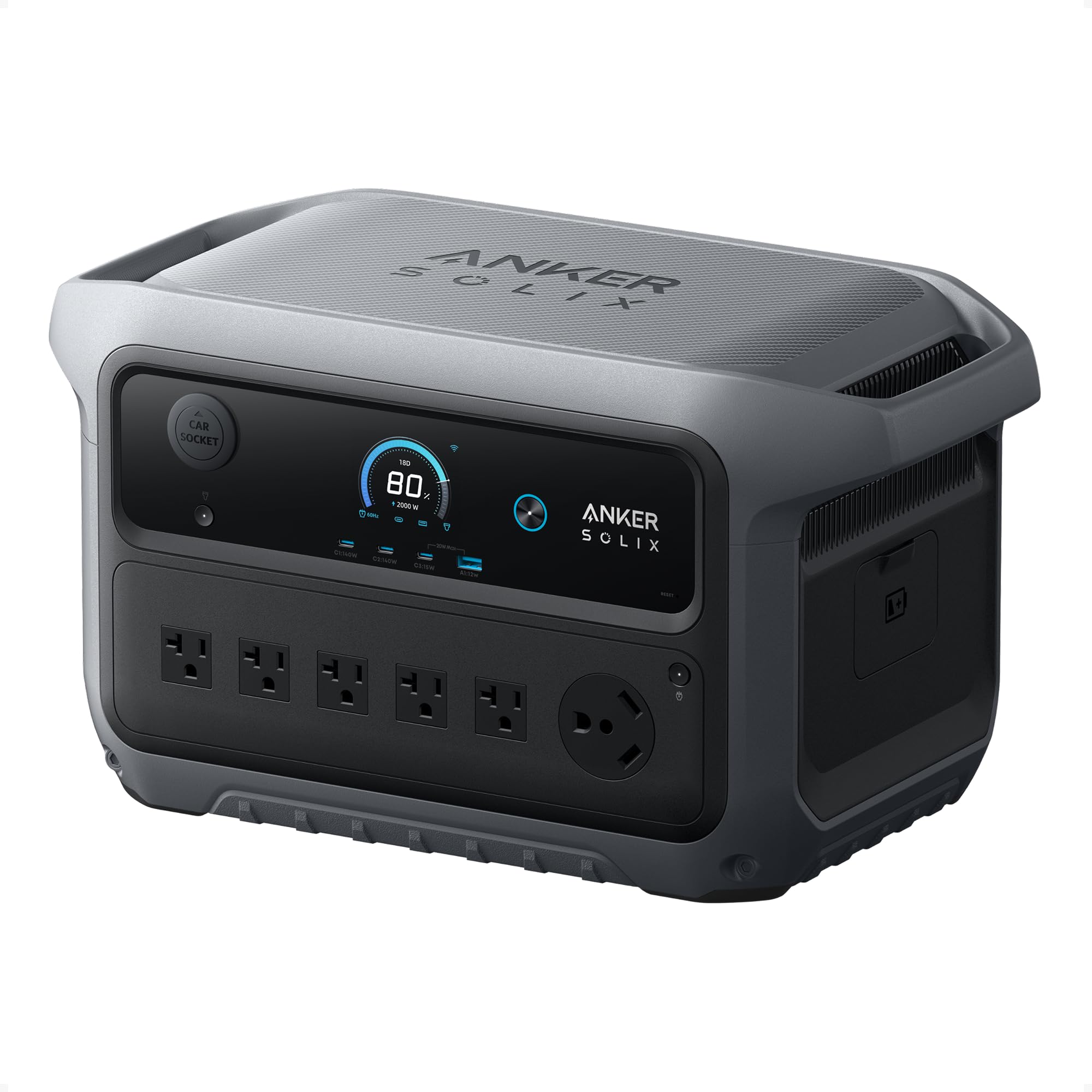
The Anker SOLIX C2000 Gen 2 represents a fundamentally different approach to outage backup: a 2,048Wh LiFePO4 battery with a 2,400W rated inverter and 4,000W peak surge — enough to run a full-size refrigerator for up to 32 hours, or a window AC unit for several hours, with zero emissions and near-silent operation. The 41.7-pound unit is 25 percent lighter and 29 percent smaller than comparable 2kWh stations, making it genuinely portable around the home.
Charging speed is the standout feature here: AC input recharges the battery from zero to 100 percent in 58 minutes — faster than any other station in this capacity class. Solar input up to 800W provides full recharge in under two hours in good sun. The 20ms UPS-style switchover means connected devices never experience a dropout during a grid flicker, protecting sensitive electronics and medical equipment. The expansion battery capability doubles capacity to 4kWh for up to 64 hours of fridge runtime.
The app-based monitoring system tracks real-time consumption and predicts remaining runtime based on actual load — a practical tool for rationing power during extended outages. Output ports include three AC outlets, USB-C PD 100W, USB-A, and a 12V car port. Standby consumption is remarkably low at 9 watts, so the battery holds its charge for months between uses. This is the quiet, fume-free solution for apartment dwellers and those who prioritize safety over unlimited runtime.
Why it’s great
- Full recharge in 58 minutes via AC — fastest in class by a wide margin
- 4,000W peak surge starts motor-driven appliances without tripping
- Zero emissions and silent operation for indoor and apartment use
Good to know
- 2kWh capacity limits runtime to roughly one day for essential appliances
- Solar panels sold separately; expansion battery required for whole-home backup
6. Jackery Explorer 2000 v2 with Solar Panels
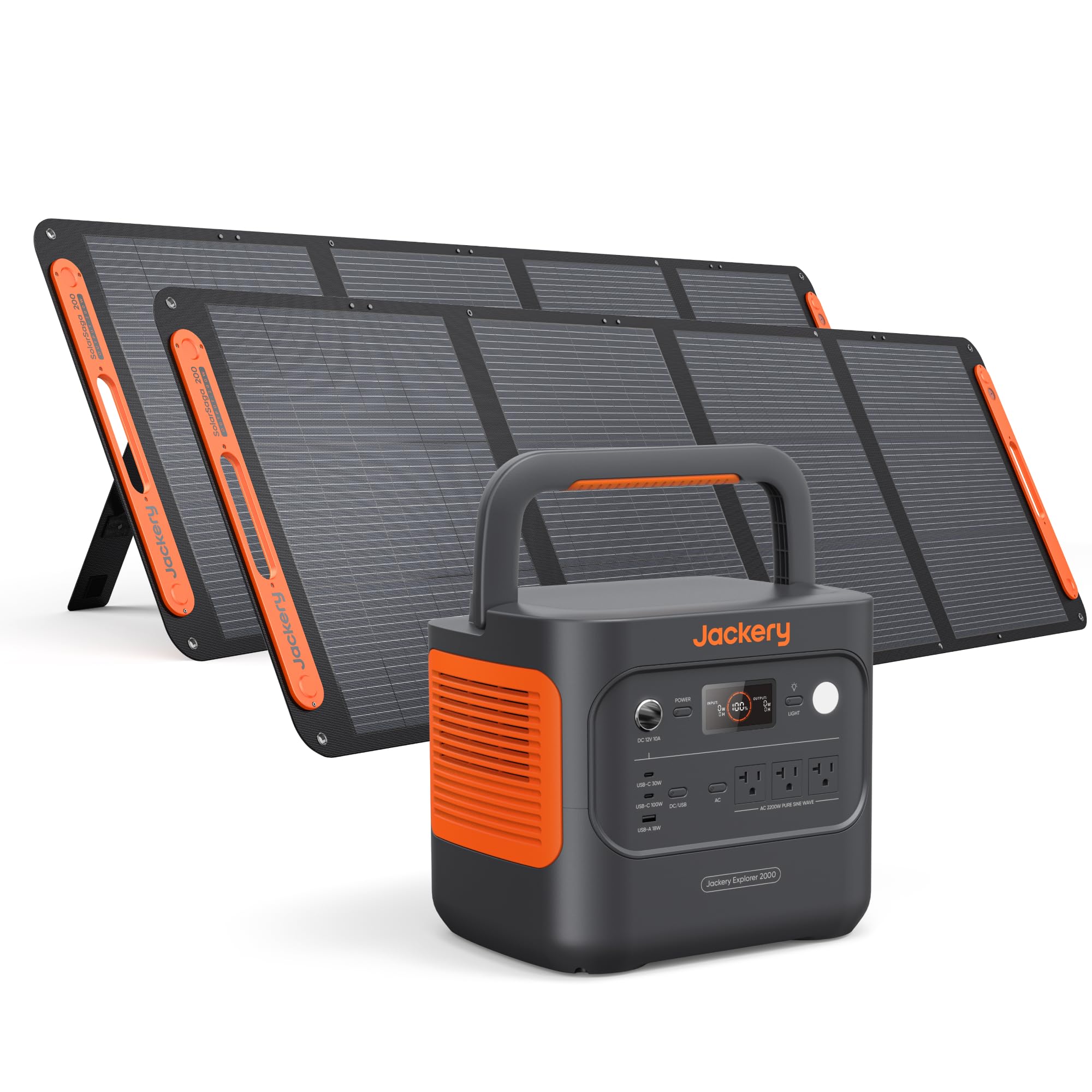
The Jackery Explorer 2000 v2 bundles a 2,042Wh LiFePO4 power station with two 200W solar panels, creating a complete off-grid power system that recharges entirely from sunlight — a critical advantage during multi-day outages when fuel supplies run dry. The 2,200W pure sine wave inverter handles fridge compressors, sump pumps, and CPAP machines with 20ms UPS switchover that keeps devices running through grid blips without interruption.
Weighing 39.5 pounds, this is the lightest 2kWh class power station available, thanks to Jackery’s CTB (Cell-to-Body) architecture borrowed from electric vehicle battery design. AC charging reaches 80 percent in 66 minutes, while the app-activated Emergency Super Charging mode completes a full charge in 102 minutes. Solar charging from the included panels delivers up to 400W input, fully recharging the battery in about six hours of direct sunlight — essentially free energy that scales with daylight hours.
Owners confirm the unit powers a window AC for 3.5 hours, a refrigerator and two freezers indefinitely with daily solar top-ups, and runs a coffee maker without issues. The silent charging mode operates at 30 dB — barely audible — allowing the generator to recharge overnight without disturbing sleep. The LiFePO4 chemistry provides up to 10 years of daily-cycle life, making this a genuine long-term investment rather than a disposable emergency device.
Why it’s great
- Dual 200W solar panels included for unlimited fuel-free recharging
- 39.5-pound weight is the lightest in its capacity range
- 20ms UPS switchover protects devices during grid flicker
Good to know
- 2kWh capacity limits heavy appliance runtime to a few hours
- Solar panels require clear outdoor placement and take 6+ hours for full charge
7. PowerSmart 4800-Watt Portable Inverter Generator

The PowerSmart 4800-watt inverter generator combines a 223cc OHV engine with built-in wheels and a folding handle, eliminating the need for a separate mobility kit. With 4,800 starting watts and 3,600 running watts, it occupies the sweet spot between lightweight inverter convenience and real home backup power. The inverter technology delivers clean power under 3% THD, safe for refrigerator control boards, sump pumps with electronic sensors, and home network equipment.
Noise output is rated at 69 dBA at quarter load from 23 feet — slightly louder than the quietest inverter generators but still in the conversation-level range and far quieter than any open-frame unit. Runtime reaches 10 hours at 50 percent load on a single tank of gasoline. The outlet panel includes four 120V three-prong receptacles, one 12V DC outlet, and two 5V USB ports — enough connectivity for a typical home backup setup without needing power strips.
Real-world owners report that the generator starts on the first pull with no choke needed — a detail that matters when you are in a hurry during a blackout. The wheel kit makes it easy to roll from storage shed to outdoor operation point. Users in remote off-grid homes report running their entire DC lighting system and varied AC loads including window AC units and workshop tools without any stalling. The integrated LED indicators and ECO mode help manage fuel consumption under lighter loads.
Why it’s great
- Wheel and handle kit built-in — no separate purchase or assembly required
- 10-hour runtime at half load covers a full night of sleep
- Clean inverter power under 3% THD protects electronics
Good to know
- No fuel shutoff valve — carburetor must drain through normal shutdown
- 89-pound weight is heavier than other inverter units in this class
8. WEN DF360iX Dual Fuel Inverter Generator

The WEN DF360iX brings dual fuel capability to a 49-pound inverter platform — one of the lightest propane-capable generators on the market. On gasoline it delivers 3,600 surge watts and 2,900 rated watts; on propane the numbers are 3,500 surge and 2,600 rated. The 149cc four-stroke engine is remarkably quiet, operating at a volume comparable to normal conversation according to the US Department of Health and Human Services standards.
The WEN Watchdog CO Shutdown Sensor adds automatic carbon monoxide detection, turning off the engine if dangerous levels are detected near the unit. The fuel shutoff feature drains the carburetor before shutdown, preventing gum buildup that plagues generators left unused for months between storms. The tool-free LPG quick-connector makes switching between fuels a 10-second operation — no wrenches or threading required.
The control panel includes a digital display showing voltage, frequency, runtime, load percentage, and remaining fuel — information that helps you manage your power budget during a long outage. Two USB ports and a TT-30R RV receptacle make this generator equally suited for home backup and RV power. Owners confirm it starts on the first or second pull on both fuels, with the propane mode running a 20-pound tank for many hours of continuous operation.
Why it’s great
- 49-pound weight makes it genuinely portable — one hand to carry
- Propane mode eliminates fuel degradation storage concerns
- CO Watchdog sensor and fuel shutoff protect both user and engine
Good to know
- Some units ship with loose propane regulator connections — check before first use
- 20A household outlets reported to hold plugs loosely on certain units
9. ERAYAK 4500W Portable Inverter Generator

The ERAYAK 4500W inverter generator delivers 4,500 peak watts and 3,500 running watts from a 208cc engine, but the headline spec is the total harmonic distortion: between 0.2 percent and 1.2 percent — cleaner than most home wall outlets. This level of power quality is critical for sensitive medical devices like CPAP machines, modern refrigerator inverter boards, and home network UPS systems that can malfunction or shut down with dirtier power.
Noise is rated at 60.5 dBA — among the quietest inverter generators available at this wattage. The ECO mode adjusts engine speed dynamically based on load, dropping fuel consumption to just 0.21 gallons per hour at 25 percent load. The parallel-ready design allows connecting two units for 7,000 running watts and 9,000 peak watts with a 50-amp combined output. The outlet panel includes a TT-30R RV outlet, two 120V AC household outlets, a 12V cigarette lighter port, and both USB-A and USB-C ports.
At 55 pounds, the ERAYAK is light enough for one person to lift into a truck bed or carry up a set of stairs. The electric start ignition makes operation simple for all family members. Real-world users report the generator powers large demolition hammers on job sites, runs a food truck’s lighting and small appliances without disturbing the customer atmosphere, and provides reliable home backup that starts quickly every time.
Why it’s great
- THD as low as 0.2% — safe for the most sensitive electronics
- 60.5 dBA operation is barely louder than a normal conversation
- ECO mode uses only 0.21 GPH at low loads for extended runtime
Good to know
- Some early units had reliability issues with automatic shutdown under load
- Customer support responsiveness varies — warranty claims may require persistence
10. Pulsar PGD40ISCO 4000W Inverter Generator

The Pulsar PGD40ISCO packs 4,000 peak watts and 3,200 rated watts into a 47.3-pound frame — one of the best power-to-weight ratios in the inverter generator category. The 145cc four-stroke engine runs at 59 dBA, making it genuinely quiet enough for camping, tailgating, and residential use where noise ordinances apply. The single-gallon fuel tank provides 4 hours of runtime at half load, which translates to roughly a full evening of essential appliance coverage.
Despite the compact size, this generator is parallel ready, allowing it to pair with another Pulsar inverter for double the output. Automatic voltage regulation and inverter technology keep the power clean enough for sensitive electronics, including CPAP machines and laptop chargers. The recoil start ignition system uses a magneto rather than a conventional spark system, which tends to start more reliably in cold weather conditions typical of winter storm outages.
Owners report this generator as a reliable secondary or light-duty backup unit, capable of powering a filtered pellet stove, a few lights, a refrigerator, and communication devices during an outage. Users who paired it with a 13,500 BTU RV air conditioner and a soft start kit confirm it handles the startup surge without issue. The white chassis stays cooler in direct sun compared to black generators, a practical detail for outdoor operation in summer storms.
Why it’s great
- 47.3 pounds is exceptionally light for a 4,000W peak generator
- 59 dBA noise rating keeps operation discreet in residential zones
- Parallel capability allows future expansion to 6,400W total
Good to know
- No wheel kit or handle included — must carry or purchase separately
- Fuel tank may vapor lock in high heat — cracking the cap relieves pressure
11. WEN 56360i 3600-Watt Inverter Generator

The WEN 56360i is the entry-level inverter generator that gets the fundamentals right: 3,600 surge watts and 2,900 rated watts from a 149cc engine that weighs just 46 pounds. At this weight, it is genuinely portable — you can carry it with one hand from storage to the patio in a single trip. The fully enclosed design keeps noise levels low while protecting the engine components from rain splash and debris during outdoor operation.
The fuel shutoff feature is critical for a generator that may sit unused for months between outages. By running the carburetor dry before shutdown, it prevents ethanol-related gumming and starting failures — the single most common cause of generator failure during an emergency. The outlet panel includes two 120V three-prong receptacles, a TT-30R RV receptacle, a 12V DC outlet, and two 5V USB ports, covering the typical backup load of a refrigerator, lights, phone charging, and a modem.
Owners consistently praise the ease of starting — typically one or two pulls even in 14°F winter conditions — and the quiet operation that makes it comfortable to use near a camper or home. The compact dimensions (17.9 by 11.6 by 19.7 inches) allow it to fit under a camper bunk for storage. Real-world fuel consumption runs about one gallon for five hours of mixed load, and the 46-pound dry weight means no wheels are needed for basic positioning around a property.
Why it’s great
- 46 pounds is genuinely carriable by one person without a dolly
- Fuel shutoff prevents carburetor gumming during long storage
- Clean inverter power protects sensitive electronics at an affordable price
Good to know
- 2,900 running watts will not power a large home’s well pump or central AC
- Regular oil changes every 25 hours are required with no oil filter
FAQ
Can I run a generator in my garage with the door open during an outage?
What size generator do I need to run a refrigerator, furnace, and a few lights?
How long can I store gasoline before it goes bad in a generator tank?
Is a dual fuel generator worth the extra cost over a gasoline-only model?
How do I calculate the right extension cord gauge for my generator?
Final Thoughts: The Verdict
For most users, the generator for power outage winner is the Champion 4000-Watt Dual Fuel Inverter Generator because it balances clean inverter power with genuine dual fuel capability and a CO safety system in a portable, residential-friendly package. If you want whole-home power with tri-fuel flexibility and unlimited natural gas runtime, grab the DuroMax XP13000HXT. And for zero-emission, silent indoor backup with fast solar recharging, nothing beats the Anker SOLIX C2000 Gen 2.