
A garage heater that plugs into a standard wall outlet can make a cold workspace tolerable, but the real trick is finding one that delivers enough warmth without requiring a 240-volt circuit and a professional electrician. Most 120-volt models push 1,500 watts, which equates to roughly 5,120 BTUs — enough to take the edge off a 200- to 300-square-foot space, but not enough to heat a three-car shop. The difference between a unit that merely blows air and one that actually changes the room temperature comes down to the heating element type, the thermostat accuracy, and the build quality of the fan motor.
I’m Mohammad Maruf — the founder and writer behind Drink4Good. I’ve spent countless hours digging into the engineering specs of these units, comparing PTC ceramic elements against infrared and radiant coils, and cross-referencing real customer feedback to separate marketing claims from measurable performance.
Below I’ve assembled a lineup of the best 120v garage heater options currently available, ranging from wall-mounted smart units to portable drum fans, each chosen for how well they match the realities of a cold, dusty, uninsulated garage.
How To Choose The Best 120V Garage Heater
Selecting a heater for a garage is different from picking one for a bedroom or living room. Garages have higher ceilings, more drafts, less insulation, and often hold moisture or dust. You need a unit that is built to handle those conditions without tripping a breaker or becoming a fire hazard.
Heating Element Type
Three technologies dominate this category: PTC ceramic, radiant infrared, and standard forced-air coils. PTC ceramic elements are self-regulating — they increase resistance as they get hotter, which prevents overheating and makes them safer for unattended use. Infrared heaters warm objects and surfaces directly rather than the air, which is useful in a drafty garage where heated air escapes quickly. Standard forced-air units rely on a metal coil that glows red; they are the least expensive but also the most prone to cycling issues and dust ignition if not cleaned regularly.
Thermostat Accuracy and Control
A heater that only has a fan switch is essentially an on/off device — it blasts heat until you physically unplug it. Models with a built-in thermostat that holds within 1 to 2 degrees are worth the premium because they prevent the space from swinging between freezing and roasting. For a garage, look for a thermostat range that starts around 40 degrees Fahrenheit so you can set the unit to keep pipes from freezing without heating the entire space to a comfortable temperature all day.
Safety Certifications and Build Quality
ETL or UL listing is non-negotiable in a garage setting where dust, vibration, and moisture are present. Flame-retardant housings (V-0 rated), automatic overheat shutoff, and tip-over protection are baseline features. For a 1,500-watt heater drawing 12.5 amps, you must also confirm that the circuit breaker and wiring can handle a continuous load — many garage circuits share outlets with lights or other tools, which can lead to nuisance trips.
Quick Comparison
On smaller screens, swipe sideways to see the full table.
| Model | Category | Best For | Key Spec | Amazon |
|---|---|---|---|---|
| Stiebel Eltron CK Trend | Wall-Mounted Fan | Precision temp control | 49 dB noise level | Amazon |
| Cadet Com-Pak CSC151TW | Wall-Mounted Fan | Small-room permanence | 5120 BTU | Amazon |
| Brightown Smart Wall Heater | Smart Wall-Mount | Smart-home integration | PTC ceramic element | Amazon |
| GiveBest Smart Wall Heater | Smart Wall-Mount | Floor or wall flexibility | 1°F thermostat accuracy | Amazon |
| DR. INFRARED HEATER DR218 | Infrared Radiant | Greenhouse frost protection | IPX4 splash-proof | Amazon |
| Mysa Smart Thermostat LITE | Thermostat Controller | Upgrading existing heaters | 120V/240V compatible | Amazon |
| BILT HARD 30in Drum Fan | High-Velocity Fan | Air circulation only | 13,000 CFM | Amazon |
In‑Depth Reviews
1. Stiebel Eltron CK Trend Wall-Mounted Electric Fan Heater
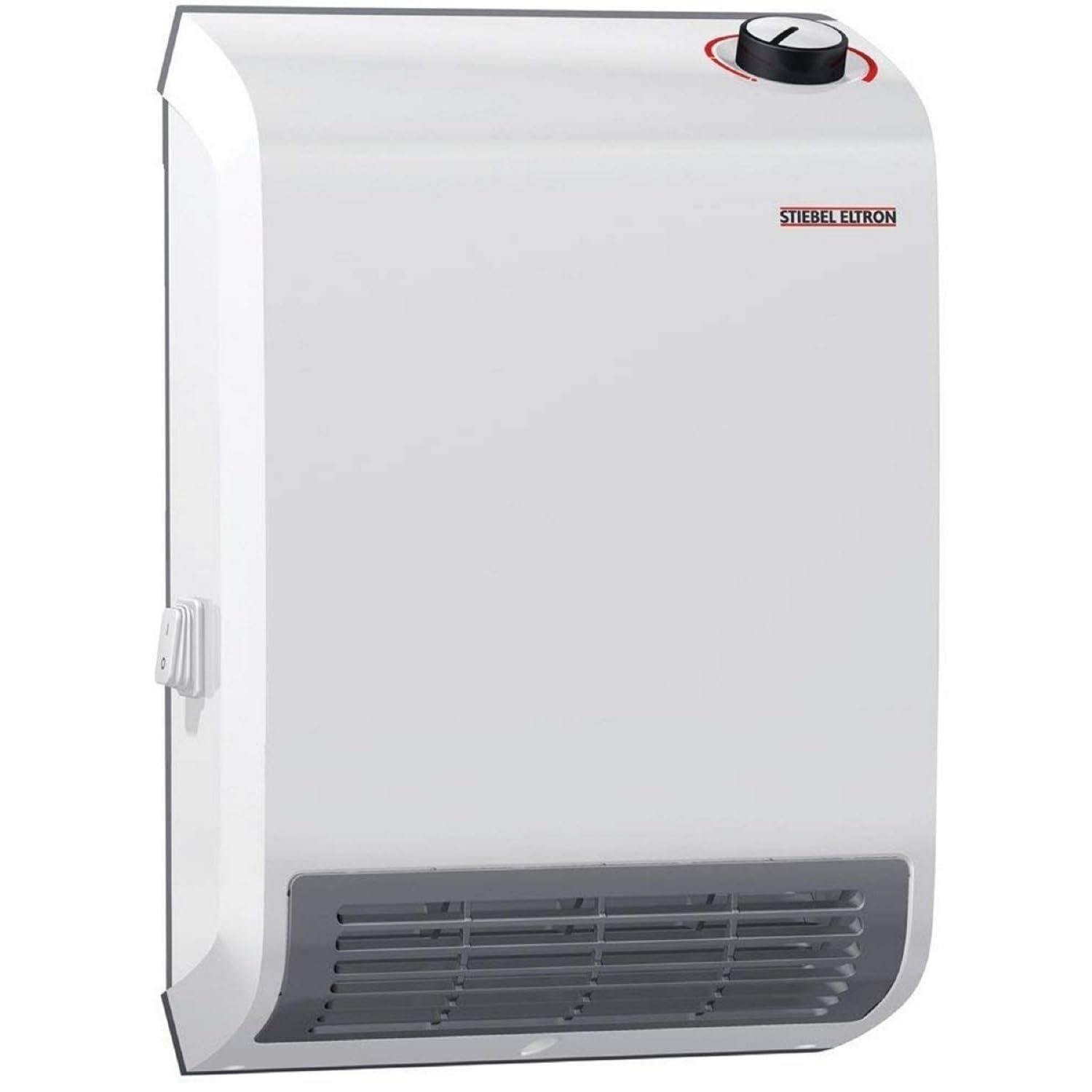
The Stiebel Eltron CK Trend is built around a glass-reinforced polycarbonate radial fan that produces only 49 dB(A) of noise — quieter than most mini-split indoor units. The PTC ceramic heating element modulates its resistance as it warms, so the unit never runs at full power longer than necessary, which translates into consistent heat without the metallic ping and click of expanding coils. With a 5,118 BTU output at 1,500 watts on a 120-volt circuit, it’s well-suited for a finished basement, three-season porch, or an insulated single-car garage up to about 200 square feet.
The mechanical thermostat knob gives you direct control without waiting for a digital screen to wake up, and the unit can be wired for a remote line-voltage thermostat if you want to integrate it into a larger system. The build quality is immediately apparent — the housing is rigid, the grille attaches without wobble, and the included 71-inch cord gives you placement flexibility. Owners report that it can raise the temperature of a finished basement from 58°F to 67°F in roughly two hours and then cycle on for only 15 minutes out of every hour to maintain that level.
The only real drawback is installation: the CK Trend is designed to be hardwired or mounted through the backplate, and there is no exterior knockout for conduit, which means if you need to run BX cable from the side, you will have to drill your own hole — an act that voids the warranty. For buyers who want a permanent, low-noise heater with German engineering and a three-year warranty, this is the gold standard in this category.
Why it’s great
- Exceptionally quiet radial fan at 49 dB(A) makes it suitable for sleep or work spaces
- PTC ceramic element self-regulates for safer, more consistent heat
- Mechanical thermostat provides reliable control without digital failure points
Good to know
- No side knockout for conduit; drilling your own hole voids the warranty
- Onboard thermostat may short-cycle if the unit is mounted in a very small enclosure
- Designed for hardwiring or through-back mounting, which may require an electrician
2. Cadet Com-Pak Electric Wall Heater CSC151TW

The Cadet Com-Pak has been a staple in bathrooms and small rooms for decades because the design is exceptionally simple — a 1,500-watt radiant coil behind a metal grille with a rotary thermostat on the front. There are no digital components to fail, no Wi-Fi modules to reset, and no app to update. The 5,120 BTU output at 120 volts is identical to the Stiebel in raw heating power, but the radiant element heats the coil directly rather than using a PTC ceramic block, which means the initial warm-up is slightly slower, and the unit stays hot for a few minutes after it cycles off.
The compact dimensions — just 9 inches wide by 12 inches tall — let it fit between 16-inch-on-center studs without cutting, and the included wiring box matches standard residential electrical boxes. Owners report installing this in uninsulated crawl-space bathrooms to prevent frozen pipes, and the mechanical thermostat holds within a degree or two of the set point. It is also one of the few models on this list that comes with the thermostat integrated into the unit body rather than as an add-on.
The downsides are real. The fan noise is noticeable — louder than the Stiebel and not what anyone would call quiet. The unit requires a dedicated 15-amp circuit if used at full power, and the metal grille gets hot enough to cause burns if touched. Several reviewers note that the installation cost, especially in older homes, can run or more if an electrician needs to run new wiring and add a breaker. For a permanent solution in a small garage or workshop where you plan to leave the heater in place for years, the Cadet Com-Pak is a durable workhorse.
Why it’s great
- Simple mechanical controls with no digital board to fail over time
- Compact 9-inch width fits between standard stud bays without cutting
- Proven track record for frost protection in small, uninsulated spaces
Good to know
- Fan noise is significantly higher than PTC ceramic competitors
- Requires a dedicated 15-amp circuit; installation often exceeds product cost
- Metal grille becomes hot to the touch during operation
3. Brightown Smart Wall Heater
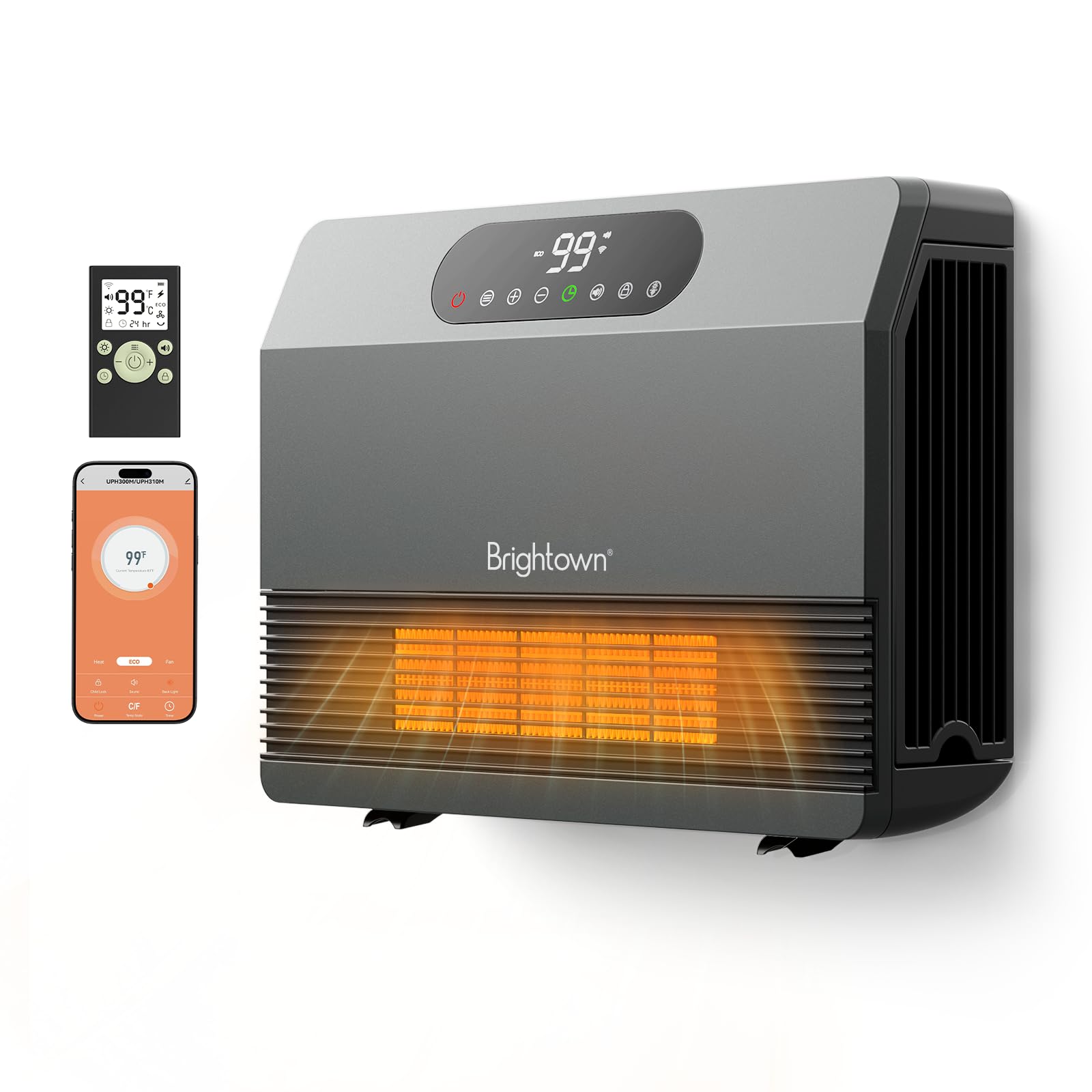
The Brightown Smart Wall Heater packs a PTC ceramic element, 1,500 watts of output, and five operating modes into a wall-mounted housing that is only 4.3 inches deep. What sets it apart from the GiveBest (which looks nearly identical) is the thermostat range — the Brightown lets you dial from 40 to 99 degrees Fahrenheit in 1-degree increments, which is an unusually wide span for a plug-and-play unit. The ECO mode automatically adjusts the power level between 600, 1,000, and 1,500 watts to maintain the set temperature, so it does not simply blast full power until it overheats.
Owners consistently mention the quiet operation — the fan noise is described as comparable to a ceiling fan on low. The unit also supports the Smart Life and Tuya app ecosystem, which means it integrates with Home Assistant if you want to trigger it based on a temperature sensor on your garage wall. The V-0 flame-retardant housing and ETL listing provide solid safety coverage for a garage environment where dust and vibration are present.
The biggest limitation is the physical size: the 16.1-inch width does not span standard 16-inch stud spacing cleanly, so you may need to mount it on a plywood backer or cut a custom opening. The included remote control is small and easy to lose, and while the app works reliably, the initial Wi-Fi pairing can be finicky if your garage router signal is weak. For anyone who wants to preheat a garage on the drive home using voice commands through Alexa or Google, this is the most feature-rich option under the premium price point.
Why it’s great
- 40°F to 99°F thermostat range with 1-degree accuracy for frost prevention
- ECO mode modulates power levels to avoid constant full-wattage cycling
- Quiet fan and Alexa/Google voice control for remote preheating
Good to know
- Width is too long to mount flush between two studs on 16-inch centers
- Wi-Fi setup can be challenging if the garage signal is weak
- Remote control is small and easily misplaced
4. GiveBest Smart Wall Heater

The GiveBest Smart Wall Heater shares the same basic DNA as the Brightown — PTC ceramic element, 1,500 watts, 200-square-foot coverage, and app control — but it differentiates itself with a dual-mount design that includes retractable feet and a carry handle. This matters in a garage where you might want the heater on the workbench during the day and mounted out of the way at night. The five heating modes (ECO, P3 at 1,500W, P2 at 1,000W, P1 at 600W, and fan-only) give you precise control over how much current you draw, which can prevent a 15-amp garage circuit from tripping when the compressor also kicks on.
The thermostat range spans 41 to 95 degrees Fahrenheit with 1-degree accuracy, and the ECO mode works the same as the Brightown — it adjusts power output to maintain the set temperature rather than cycling fully on and off. Owners praise the quiet operation and the ease of wall-mounting, noting that the integrated handle makes it simple to move between rooms. The LED display can be turned off completely for dark environments, and the child lock adds a layer of protection if the heater is within reach of pets or children.
The downside is that the mounting bracket uses plastic clips that feel less robust than the Cadet’s metal frame, and the power cord is only about 5 feet long, which may require an extension cord in a large garage. The unit also has a slight delay when starting from cold — the PTC element needs about 15 seconds to reach full temperature before the fan kicks on. For someone who wants a portable-yet-mountable heater that works with Alexa and the Smart Life app for around a mid-range price, the GiveBest delivers better flexibility than the fixed-mount Brightown.
Why it’s great
- Retractable feet and carry handle allow both floor and wall use
- ECO mode with three power levels prevents circuit overload
- Quiet fan with dimmable or off LED screen for dark garages
Good to know
- Plastic mounting clips feel less durable than metal alternatives
- Short 5-foot power cord may require an extension cord
- PTC element takes 15 seconds to heat before the fan activates
5. DR. INFRARED HEATER DR218 Greenhouse Garage Heater

The DR. INFRARED HEATER DR218 is unique in this lineup because it uses a radiant infrared element rather than a forced-air fan or PTC ceramic block. Instead of heating the air, the infrared element warms surfaces, tools, and people directly — which makes it ideal for a drafty greenhouse or a poorly insulated garage where heated air escapes within minutes. The 1,500-watt output covers roughly 150 square feet, and the IPX4 splash-proof rating means it can handle the condensation and occasional spray that comes with greenhouse environments.
Owners confirm that it maintained temperatures in the low 40s inside a 6-by-8-foot greenhouse during a 22-degree freeze in Texas, which is exactly the right use case for this unit. The cabinet-style housing is compact at 10 inches deep by 15 inches tall, and the low maintenance requirement — no filter to clean, no fins to dust — is a genuine advantage in a dirty garage. The fan moves air across the infrared element to help distribute the warm objects slightly, but it is not a high-velocity unit, so placement matters: the effective heat reach is about 8 feet in front of the unit.
The unit only has one power setting — 1,500 watts — so there is no low-power mode for milder days. Several owners reported that the thermostat did not reliably shut the heater off at the set temperature, which is a common complaint with budget infrared units. There is also at least one documented case of the internal wiring burning up due to undersized gauge wire in a 220-volt installation, though the 120-volt version for garages should not experience the same issue if used on a dedicated circuit. For targeted frost protection in a small greenhouse or workshop, the DR. INFRARED is an affordable specialist.
Why it’s great
- Infrared heating warms objects directly, effective in drafty or uninsulated spaces
- IPX4 splash-proof rating handles greenhouse condensation
- Compact, low-maintenance cabinet with no filter to clean
Good to know
- Only one power setting — no low-power mode for milder weather
- Thermostat may not accurately cycle off at the set temperature
- Effective heat reach is limited to about 8 feet from the unit
6. Mysa Smart Thermostat LITE for Electric Baseboard Heaters
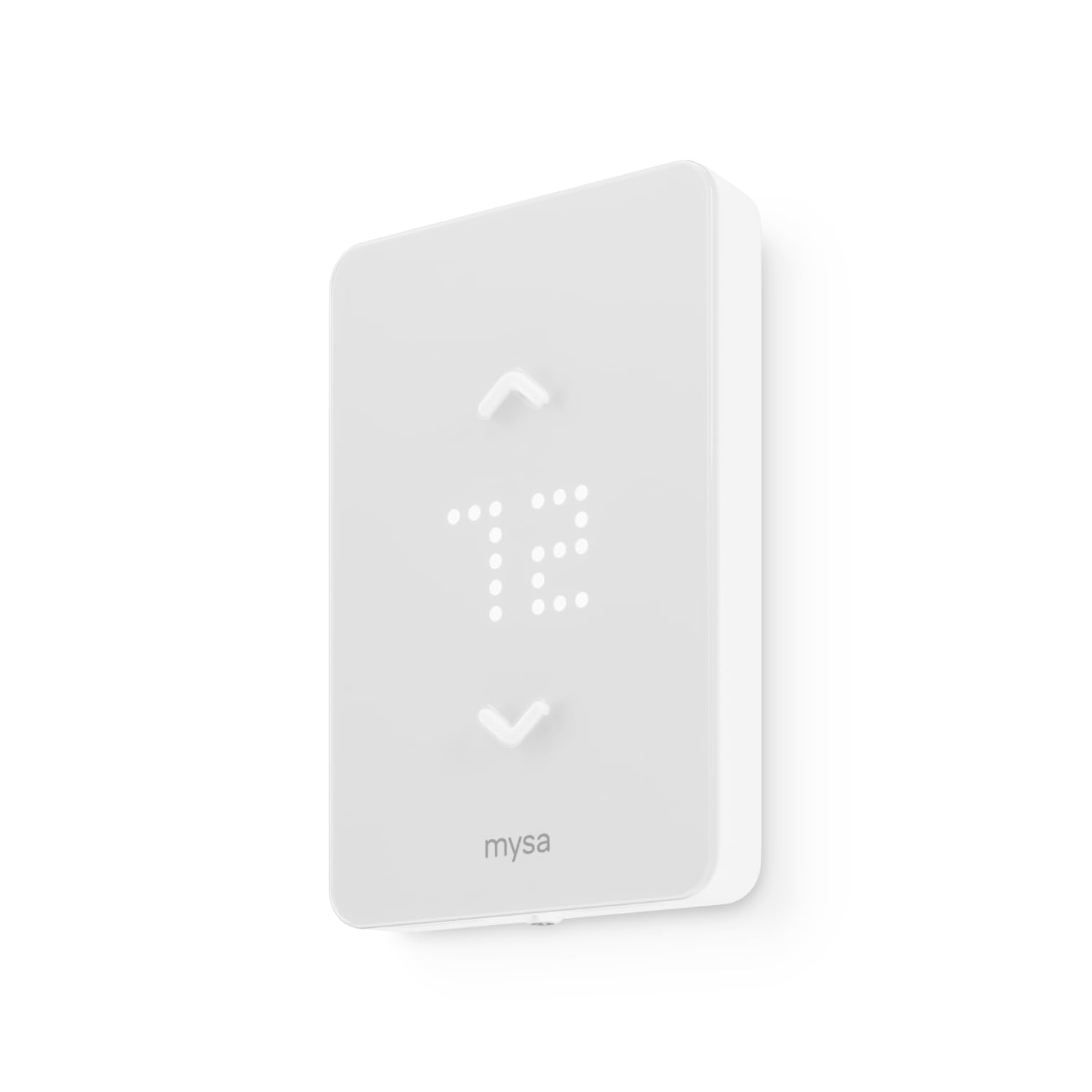
The Mysa Smart Thermostat LITE is not a heater — it is a smart controller for your existing 120-volt or 240-volt baseboard heater, wall heater, or fan-forced unit. If you already have a Cadet Com-Pak or an older forced-air heater in your garage and want to add scheduling, remote control, and per-room energy tracking, this is the product that transforms a dumb heater into a smart one. It supports single-pole and double-pole configurations and works with 120V, 208V, and 240V systems, which covers virtually all residential electric baseboard heaters.
The installation is designed for a 15-minute DIY job: the app provides step-by-step wiring guidance based on your existing configuration, and the unit connects directly to your home Wi-Fi without a separate hub. Once installed, you can create 7-day schedules that drop the temperature to 45°F overnight to save energy and then bring the garage back to 55°F before you arrive in the morning. The Mysa app is free with no subscription, and it delivers monthly runtime reports that show exactly how many hours each room used heating.
The catch is compatibility: Mysa requires four wires (two power wires plus either a neutral or a second live wire), and some older garage heaters only have two wires at the thermostat location. If you have a line-voltage thermostat with only two wires (one black, one red), you will need to run a neutral or use a different product. The LITE version also lacks the adaptive display, humidity sensor, and usage tracking of the premium Mysa model. For owners of compatible heaters who want to cut heating bills by up to 26 percent through scheduling, this is the most effective upgrade available.
Why it’s great
- Converts any 120V or 240V line-voltage heater into a smart programmable unit
- No monthly subscription — all scheduling and tracking features included
- 15-minute DIY installation with app-guided wiring instructions
Good to know
- Requires four wires at the thermostat; not compatible with two-wire setups
- LITE version lacks humidity sensor and advanced usage tracking
- Designed for baseboard and wall heaters, not standalone portable units
7. BILT HARD 30-inch High Velocity Drum Fan
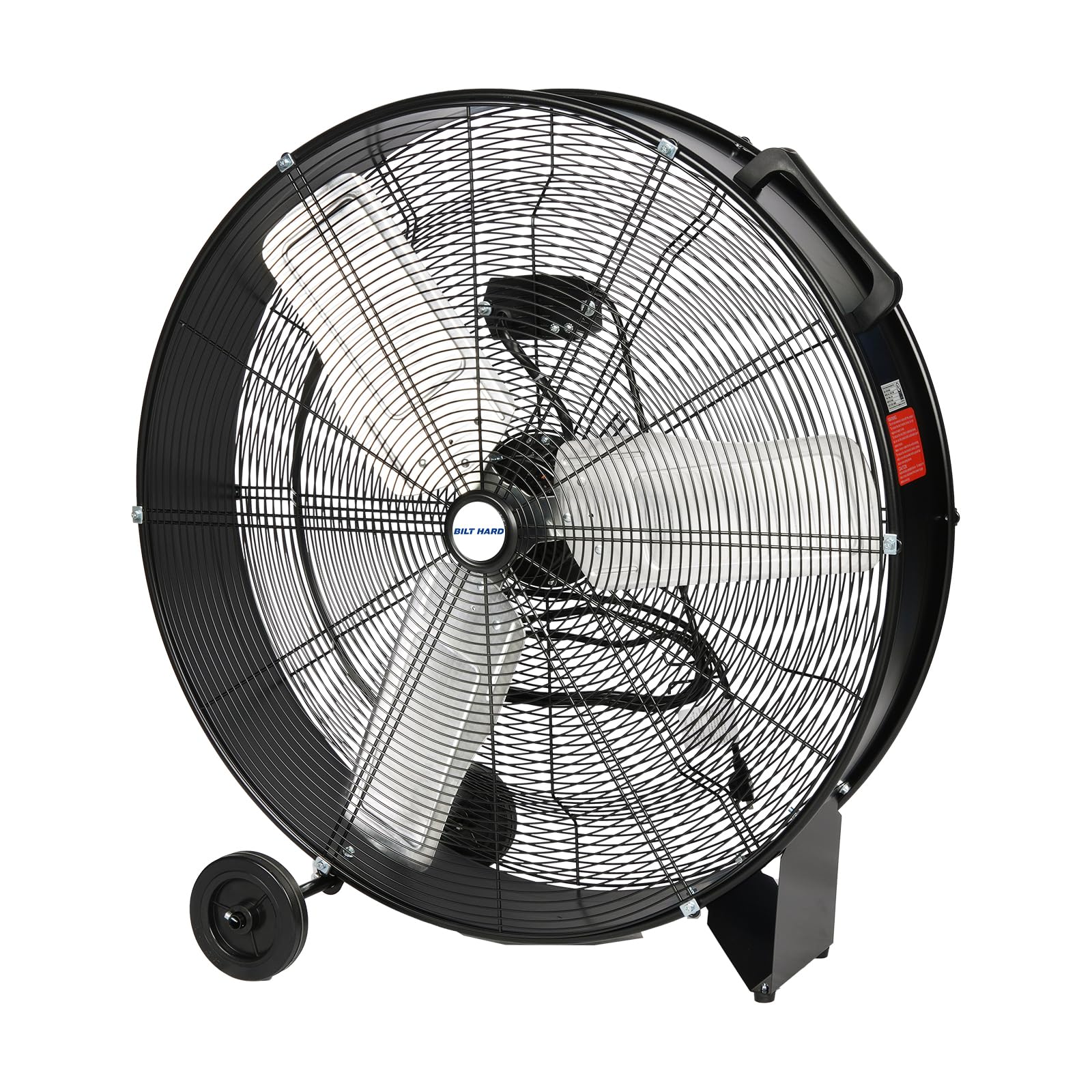
The BILT HARD 30-inch Drum Fan is not a heater, but it plays a critical role in a garage heating strategy: without air movement, a 1,500-watt heater will stratify hot air at the ceiling while your feet stay cold. This fan moves 13,000 CFM on high speed and 9,000 CFM on low, which is enough to destratify a two-car garage in minutes and push warm air down to floor level where it actually benefits you. The heavy-duty steel housing, aluminum blades, and OSHA-compliant grilles are built for industrial environments, and the rubber wheels let you reposition it wherever the cold spot develops.
Owners report that the fan is quieter than expected for a 30-inch industrial unit — the axial design and rubber feet dampen vibration compared to cheaper box fans. The two-speed push-button control is simple, and the tilting head lets you direct airflow horizontally or slightly upward to break up ceiling heat pockets. Assembly requires bolting the wheels and handles on, which one reviewer noted is slightly awkward solo but takes under 10 minutes with a second person.
The obvious catch is that this fan does not produce heat — it only moves air. If you use it in a garage that has no separate heat source, it will circulate cold air just as effectively. It also tilts upward under its own weight when the stand is set at certain angles, which can misdirect airflow. But when paired with any of the heaters on this list, the drum fan doubles the effective coverage by preventing temperature stratification. For anyone with high ceilings or a long workshop layout, this is the missing piece that makes the whole system work.
Why it’s great
- 13,000 CFM prevents hot air stratification at the ceiling
- Industrial-grade steel and aluminum construction for long-life in dirty environments
- Quieter than comparable 30-inch models due to dampened vibration
Good to know
- Does not generate heat — only circulates existing air
- Fan tilts upward under its own weight at certain angles
- Assembly requires two people for bolt alignment
FAQ
Can I run a 1,500-watt heater on a standard 15-amp garage circuit?
What size garage can a 120-volt heater effectively warm?
Is a wall-mounted heater safer than a portable space heater in a garage?
Can I use an extension cord with a 120-volt garage heater?
Final Thoughts: The Verdict
For most users, the best 120v garage heater winner is the Stiebel Eltron CK Trend because it combines a whisper-quiet radial fan with a PTC ceramic element that self-regulates and a proven German build quality that should outlast five winters. If you want app control and voice activation to preheat the garage before you even open the door, grab the Brightown Smart Wall Heater or the GiveBest Smart Wall Heater with its flexible floor-or-wall design. And for a larger space or high ceilings where hot air stratifies near the rafters, nothing beats pairing any of these heaters with the BILT HARD 30-inch Drum Fan to push that warmth down where you actually feel it.