
Competitive gaming at 240Hz offers the fastest mainstream refresh rate, reducing motion blur and input lag to a level where every frame counts. Choosing the right panel involves more than just the hertz number—response time, panel type, and resolution all define the actual experience.
I’m Mohammad Maruf — the founder and writer behind Drink4Good. I analyze gaming monitor specifications and real-world performance data to pinpoint which 240Hz models deliver on their speed promises across different budgets and use cases.
Whether you’re chasing pixels in fast-paced shooters or immersing in detailed open worlds, finding the right 240hz gaming monitor means balancing refresh rate with color accuracy and resolution for your specific setup.
How To Choose The Best 240Hz Gaming Monitor
Picking a 240Hz monitor requires weighing panel technology, resolution, and adaptive sync support against your GPU’s power and your preferred game genres. The wrong combination can leave you with a monitor that your hardware can’t drive to its potential.
Panel Type: IPS vs. OLED vs. QD-OLED
IPS panels offer consistent color and wide viewing angles at lower cost, making them ideal for fast-paced FPS gaming where motion clarity matters most. OLED and QD-OLED panels deliver infinite contrast and true blacks but come at a premium. For competitive gaming, an IPS panel’s price-to-performance ratio often wins. For single-player immersion, OLED’s deeper blacks and richer colors transform the experience.
Resolution: 1080p, 1440p, or 4K at 240Hz
240Hz at 1080p is easier for mid-range GPUs to drive and offers the lowest input lag, but the image is softer on larger screens. QHD (1440p) hits the sweet spot for most mid-to-high-end GPUs—detailed enough for immersion while keeping frames high. 4K 240Hz demands a top-tier GPU but delivers the ultimate clarity and fluidity for those who can afford both the monitor and the graphics hardware.
Quick Comparison
On smaller screens, swipe sideways to see the full table.
| Model | Category | Best For | Key Spec | Amazon |
|---|---|---|---|---|
| LG 27GR83Q-B | Mid-Range | Competitive FPS | QHD 240Hz IPS 1ms | Amazon |
| Alienware AW2723DF | Premium | Competitive FPS | QHD 280Hz IPS 1ms | Amazon |
| ASUS ROG Strix XG27AQDMG | Premium | Immersive Gaming | QHD 240Hz OLED 0.03ms | Amazon |
| MSI MPG 321URX | Premium | High-End Gaming | 4K 240Hz QD-OLED 0.03ms | Amazon |
| LG 32GX850A-B | Premium | Dual-Mode Use | 4K 165Hz/FHD 330Hz OLED | Amazon |
| ASUS ROG Strix XG32UCG | Premium | Multi-Use Gaming | 4K 160Hz/FHD 320Hz IPS | Amazon |
| AOC Q27GAZD | Premium | Vivid Colors | QHD 240Hz QD-OLED 0.03ms | Amazon |
| Acer Predator X27U | Premium | Color Accuracy | WQHD 240Hz QD-OLED 0.03ms | Amazon |
| Samsung Odyssey OLED G5 | Mid-Range | OLED Entry Point | QHD 180Hz OLED 0.03ms | Amazon |
| Samsung Odyssey G4 25″ | Budget | Affordable Speed | FHD 240Hz IPS 1ms | Amazon |
| KTC H32S25E | Budget | Large Curved Display | QHD 240Hz VA 1ms | Amazon |
In‑Depth Reviews
1. LG 27GR83Q-B
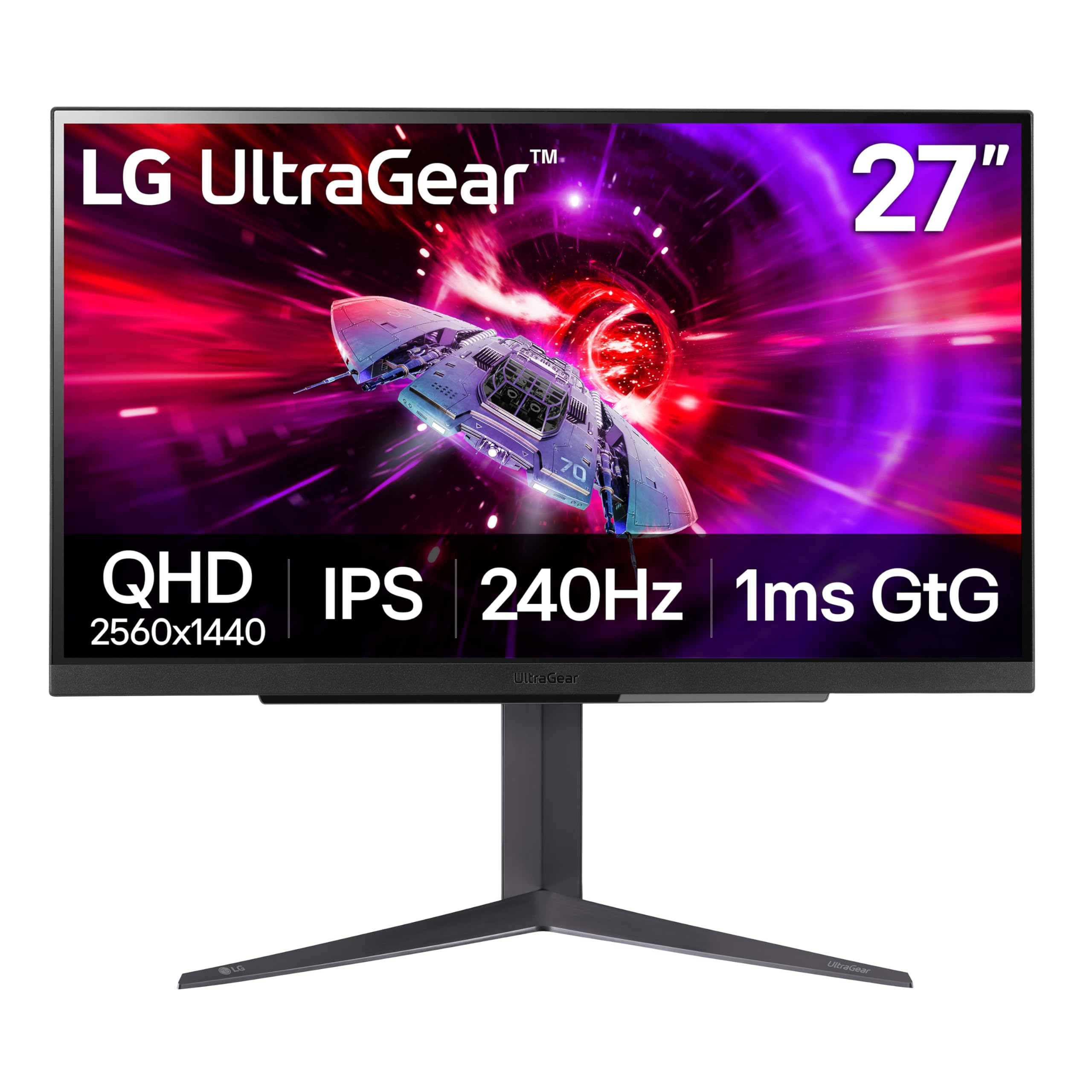
The LG 27GR83Q-B strikes an exceptional balance between price and performance. Its 27-inch QHD IPS panel delivers a 240Hz refresh rate with a 1ms GtG response time, making it ideal for competitive shooters where every frame of motion clarity matters. Both HDMI 2.1 and DisplayPort 1.4 support the full 240Hz bandwidth, so you get the full speed from your console or PC.
Color accuracy is a strong point here, covering 95% DCI-P3 with DisplayHDR 400 certification. This means vibrant, saturated imagery without the washed-out look you might get from budget high-refresh monitors. The fully adjustable stand with tilt, height, swivel, and pivot options adds ergonomic flexibility that’s rare in this price tier.
Some users report a stuck pixel issue out of the box, so inspect yours immediately upon arrival. The built-in 4-pole headphone jack with DTS Headphone:X is a nice bonus for immersive audio without extra gear. LG’s OnScreen Control software makes adjusting Brightness and mode settings quick once installed.
Why it’s great
- Full 240Hz over HDMI 2.1 and DP 1.4
- Excellent color gamut and HDR 400
- Fully adjustable ergonomic stand
Good to know
- Potential stuck pixels on arrival
- LG warranty process can be slow
2. Alienware AW2723DF

The Alienware AW2723DF pushes the envelope with a native 240Hz that overclocks to 280Hz without stuttering. Its Fast IPS panel with Nano Color technology covers 95% DCI-P3 and hits DisplayHDR 600 brightness, producing vivid highlights and deep shadows that give single-player games a cinematic feel. G-Sync certification ensures tearing remains absent even when frame rates fluctuate.
The build quality is solid, with a heavy base and clean cable management routed through the stand. The 27-inch QHD resolution is sharp enough for immersive gaming while still being easy to drive at high frame rates with a mid-range GPU. AlienFX lighting and the Lunar Light color finish give the monitor a distinctive look that stands out on any desk.
Backlight bleed is noticeable on some units in dark scenes, which may bother users who play horror games or watch movies in a dim room. The on-screen display menu is also less intuitive than competitors. Compared to OLEDs, the HDR performance is decent but not transformative. Alienware’s 3-year warranty covers the panel for peace of mind.
Why it’s great
- Overclockable to 280Hz without ghosting
- Excellent build and cable management
- Very low input lag for competitive play
Good to know
- Backlight bleed varies by unit
- No HDMI 2.1 or built-in speakers
3. ASUS ROG Strix XG27AQDMG

ASUS’s ROG Strix XG27AQDMG brings a glossy WOLED panel to the 27-inch QHD format. At 240Hz with a 0.03ms GtG response time, motion clarity is superb and colors pop without the greyish bloom of matte IPS screens. The custom heatsink and ASUS OLED Care reduce burn-in risk during long sessions, a key concern for OLED adopters.
Dialing in color takes minimal effort thanks to 99% DCI-P3 coverage and excellent out-of-box accuracy. The monitor’s anti-flicker technology minimizes eye strain when refresh rates fluctuate, a feature that shooters grinding for hours will appreciate. G-Sync Compatible certification ensures smooth frame delivery with Nvidia GPUs.
Text clarity is slightly less sharp than IPS panels due to the OLED subpixel layout, which may bother users who read a lot. The glossy screen looks stunning in controlled lighting but reflects bright windows or overhead lights. The 3-year warranty includes burn-in coverage, offering extra confidence for your investment.
Why it’s great
- Glossy OLED delivers unmatched vibrancy
- Custom heatsink reduces burn-in risk
- Excellent motion clarity at 240Hz
Good to know
- Text crispness not on par with IPS
- Reflective in bright rooms
4. MSI MPG 321URX

The MSI MPG 321URX delivers 4K resolution at 240Hz on a 32-inch QD-OLED panel. The combination offers stunning clarity and fluidity, whether you’re exploring detailed open worlds or racing in competitive sims. Its 0.03ms GtG response time is beyond what the human eye can perceive, eliminating all ghosting in fast motion.
Color coverage reaches 99% DCI-P3 with Delta E ≤2 accuracy, making this monitor suitable for creative work alongside gaming. VESA DisplayHDR True Black 400 certification means deep blacks with bright highlights that make scenes pop. OLED Care 2.0, KVM support, and a 90W USB-C port add practical value for multi-device setups.
Some Mac users report a handshake issue when connecting dual 4K monitors, requiring a disable of DSC and manual input locking. Amazon’s shipping packaging has been criticized for insufficient padding, so inspect the box carefully upon delivery. The 4-way adjustable stand offers excellent ergonomics, though the monitor is heavy.
Why it’s great
- 4K 240Hz QD-OLED delivers unbeatable clarity
- True Black HDR 400 with wide color gamut
- 90W USB-C and KVM for productivity
Good to know
- Mac dual-monitor setup requires manual configuration
- Packaging from Amazon may be insufficient
5. LG 32GX850A-B
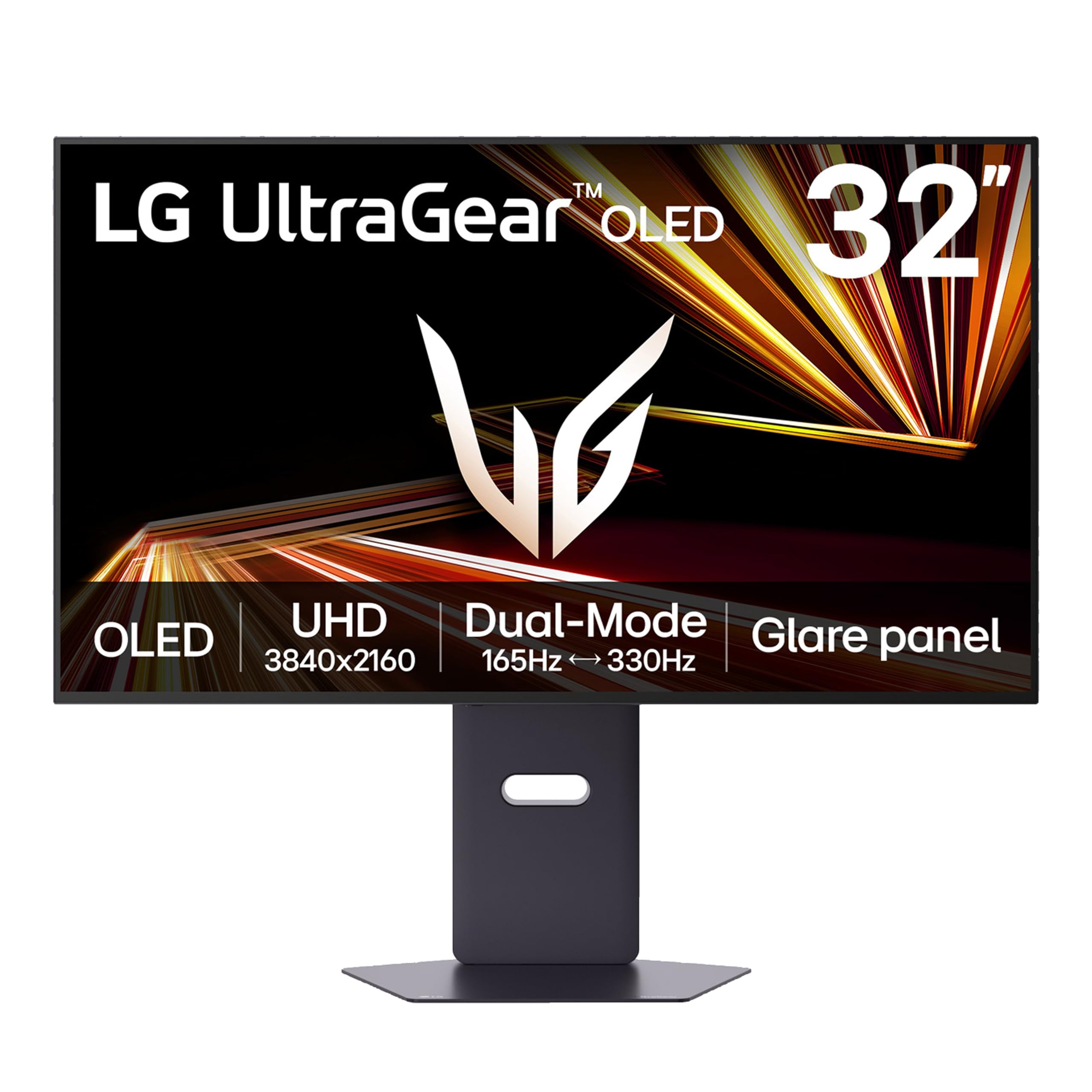
The LG 32GX850A-B introduces a glossy OLED panel at 32 inches with a dual-mode capability, letting you switch between 4K at 165Hz for story-driven titles and Full HD at 330Hz for competitive play. The Micro Lens Array+ technology boosts typical brightness to 275 nits, retaining detail and contrast even in bright scenes.
Color reproduction covers 98.5% DCI-P3 with a 1.5M:1 contrast ratio, rendering blacks that are truly black. VESA DisplayHDR True Black 400 certification ensures HDR content looks rich without blooming. The fully adjustable stand includes tilt, height, swivel, and pivot options, fitting seamlessly into any immersive setup.
Brightness is lower than high-end LCD panels, peaking at around 275 nits in typical use, which may not satisfy users who prefer very bright HDR highlights. The glossy coating reflects ambient light more than matte screens, so room lighting should be controlled. The dual-mode switch via hotkey is a standout feature for players who enjoy both single-player and competitive games.
Why it’s great
- Dual-mode switches between 4K and high-refresh FHD
- True black levels with excellent color gamut
- Fully adjustable stand with ergonomic range
Good to know
- Lower peak brightness than LCD competitors
- Glossy finish shows reflections in bright rooms
6. ASUS ROG Strix XG32UCG
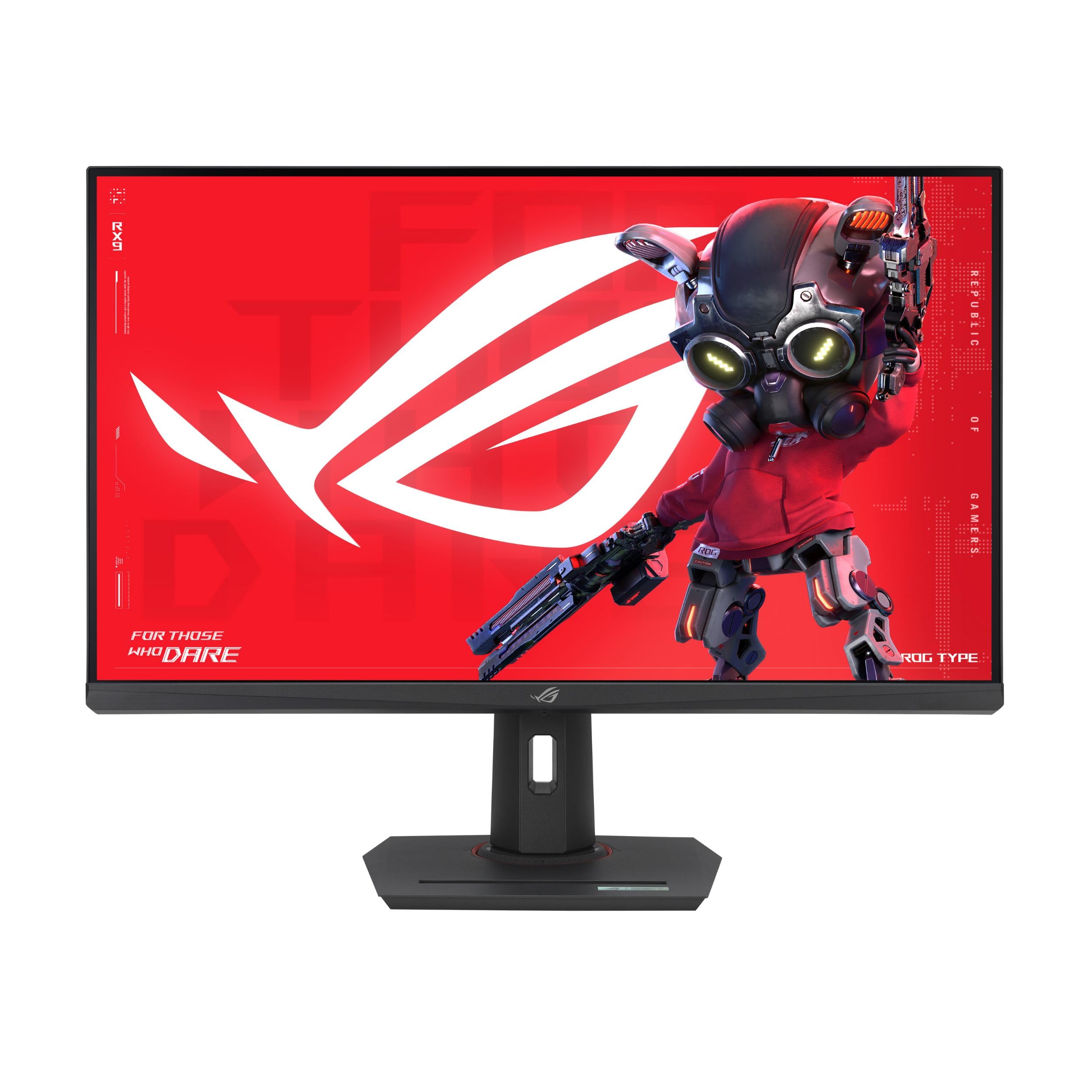
The ASUS ROG Strix XG32UCG brings a dual-mode Fast IPS display that runs 4K at 160Hz or FHD at 320Hz. Its 0.3ms minimum response time is incredibly low for a non-OLED panel, making it a strong pick for competitive gamers who want high resolution during normal play and extreme refresh rates during tournaments.
Covering 95% DCI-P3 with a 1000:1 static contrast ratio, colors are rich and accurate. The Extreme Low Motion Blur Sync (ELMB SYNC) technology allows ghosting-free motion while VRR is active, a rare combo that eliminates both tearing and blur. USB-C with DP Alt mode simplifies laptop connections without extra adapters.
HDR performance is adequate for an LCD panel, but it doesn’t match the depth of OLEDs. The semi-gloss coating balances reflections and image sharpness well. Built-in DisplayWidget Center software lets you adjust settings with a mouse, streamlining the experience. The 3-year warranty adds confidence.
Why it’s great
- Dual-mode with 4K 160Hz and FHD 320Hz
- ELMB SYNC eliminates blur with VRR
- USB-C with DP Alt mode and good ergonomics
Good to know
- HDR depth not on par with OLED
- Semi-gloss screen still shows reflections
7. AOC Q27GAZD
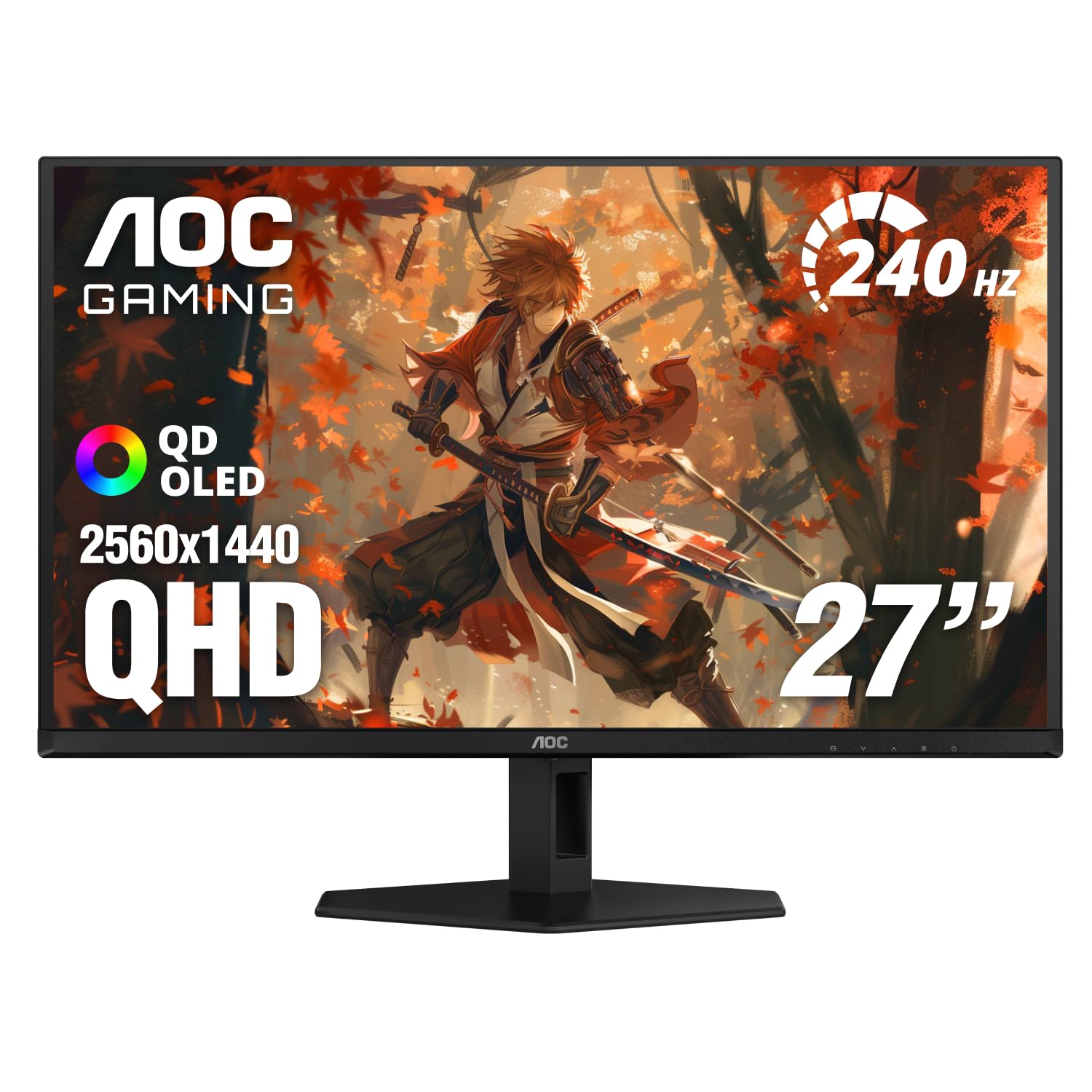
The AOC Q27GAZD brings QD-OLED technology to a 27-inch QHD format at a price that undercuts most OLED competitors. With 147.6% sRGB and 110.2% DCI-P3 coverage, colors are incredibly vivid and the 0.03ms response time eliminates any perceivable ghosting. HDR400 True Black certification adds deep, inky blacks that make games feel more immersive.
Adaptive-Sync includes G-Sync Compatible support, keeping gameplay smooth and tear-free. The monitor is VESA mountable, though the included stand is basic and lacks height adjustment. The thin top panel design can tilt if not handled carefully on a monitor arm, so a snug VESA mount is recommended.
Text clarity suffers slightly from the QD-OLED subpixel layout, though it’s not as pronounced as on some earlier OLEDs. HDMI input is limited to 165Hz, so you must use DisplayPort to reach the full 240Hz. The glossy display shows reflections in bright rooms but maintains excellent contrast in controlled lighting.
Why it’s great
- Best price-to-performance for QD-OLED
- Wide color gamut and true black levels
- Ultra-low 0.03ms response time
Good to know
- Basic stand lacks height adjustment
- Limited to 165Hz over HDMI
8. Acer Predator X27U
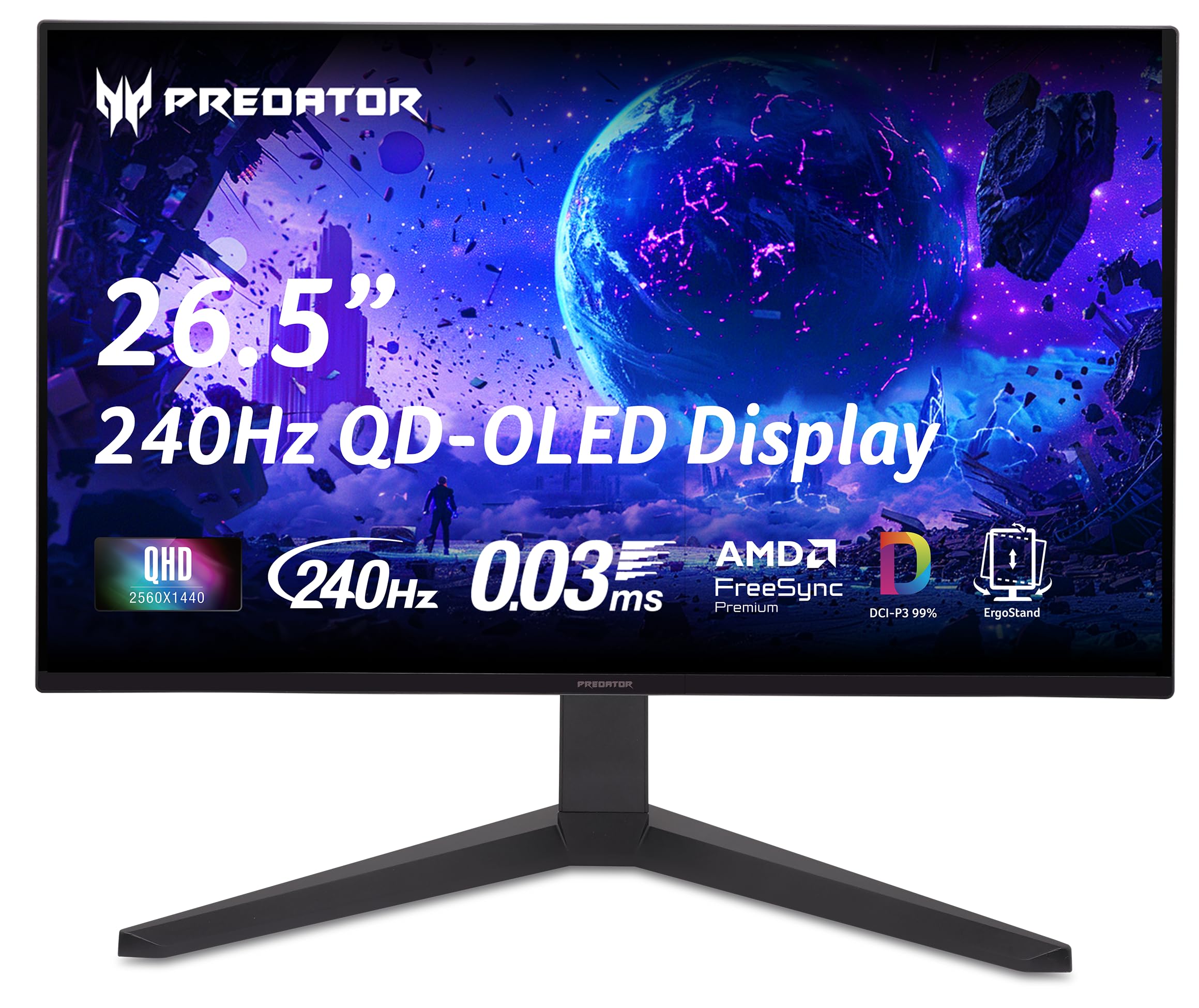
The Acer Predator X27U leverages a 26.5-inch WQHD QD-OLED panel with 99% DCI-P3 and Delta E<2 color accuracy. At 240Hz and 0.03ms response time, motion is buttery smooth and colors are vibrant without oversaturation. AMD FreeSync Premium support eliminates tearing across a wide frame rate window.
Image retention-refresh cycles run automatically to prevent burn-in without interrupting gameplay. The ZeroFrame design makes the bezel virtually invisible, while the fully adjustable stand includes tilt, height, swivel, and pivot. Dual HDMI 2.1 ports make it a strong choice for console gamers who want high refresh rates on PS5 or Xbox Series X.
Peak brightness is on the dimmer side compared to premium LCD options, maxing out at around 250 nits SDR. Some users find the on-screen menu complex and lacking a sharpness slider. The plastic build feels less premium than metal alternatives, but the panel performance overshadows these cosmetic compromises.
Why it’s great
- Excellent color accuracy with wide gamut
- Dual HDMI 2.1 for console gaming
- Full ergonomic stand included
Good to know
- Lower brightness than LCD competitors
- Menu system is complex and limited
9. Samsung Odyssey OLED G5

The Samsung Odyssey OLED G5 offers an entry point into QD-OLED gaming with a 27-inch QHD panel. Its 180Hz refresh rate and 0.03ms response time deliver fast, fluid motion with minimal input lag. Samsung’s Glare Free technology reduces reflections, making the glossy screen usable in rooms with ambient light.
Pantone Validation ensures accurate colors across a wide gamut, and HDR10 support adds depth to highlights and shadows. The OLED Safeguard system uses a Thermal Modulation feature to cool the screen and prevent burn-in during extended sessions. Auto Source Switch+ seamlessly toggles between connected devices, a convenience for multi-platform gamers.
The refresh rate is capped at 180Hz, not reaching the 240Hz that some high-end competitors offer. The stand is non-adjustable in height and tilt, which limits ergonomic setup flexibility. The plastic build feels lightweight compared to metal rivals, and the limited connectivity includes only one HDMI and one DisplayPort.
Why it’s great
- Excellent OLED visuals at an accessible price
- Glare Free technology works in bright rooms
- Pantone Validated for color accuracy
Good to know
- Only 180Hz, not 240Hz
- Non-adjustable stand limits ergonomics
10. Samsung Odyssey G4 25″

The 25-inch Samsung Odyssey G4 provides the core 240Hz speed on an IPS panel at a price that’s hard to beat. With a 1ms GtG response time and compatibility with both G-Sync and FreeSync Premium, it handles fast-paced shooters without tearing or stuttering. The smaller 25-inch FHD screen makes it a natural fit for dual-monitor setups or tighter desks.
Color reproduction is solid for the category, covering 99% sRGB with a 400 cd/m² peak brightness. The IPS viewing angles are wide, keeping the picture consistent even when you’re not dead center. The fully adjustable stand supports tilt, swivel, and height adjustments, rare in this price range. Ultrawide Game View lets you switch to a 21:9 aspect ratio for cinematic gaming.
1080p resolution on a 25-inch screen shows visible pixels when sitting close, which may bother users accustomed to higher pixel densities. The 240Hz bandwidth requires DisplayPort usage, as HDMI is limited to lower refresh rates. The wide stand base takes up significant desk space compared to modern thin designs.
Why it’s great
- Lowest price for a reliable 240Hz IPS panel
- Fully adjustable stand with good range
- Dual sync compatibility (G-Sync & FreeSync)
Good to know
- FHD resolution shows visible pixels up close
- HDMI input limited to lower refresh rates
11. KTC H32S25E

The KTC H32S25E is a 32-inch curved gaming monitor with a 1000R curvature that wraps around your peripheral vision. Its VA panel delivers a 4000:1 contrast ratio, producing deeper blacks than IPS panels, and the QHD 2560×1440 resolution balances sharpness with GPU demands at 240Hz. Adaptive Sync keeps tearing at bay during fast action.
Connectivity includes two HDMI inputs and two DisplayPort ports, with DP supporting the full 240Hz. The frameless design and tilt adjustment make it easy to integrate into a multi-monitor or single-screen setup. For the price, this is one of the few large-format monitors that offer both QHD and 240Hz without breaking the bank.
VA panel viewing angles are narrower than IPS, so off-axis color shifts are noticeable. The 1ms response time is a marketing claim; real-world motion blur may be slightly higher than IPS competitors. Customer reviews mention occasional dead pixels and inconsistent backlight uniformity, so inspect your unit upon arrival.
Why it’s great
- Large 32-inch curved design with 1000R
- Deep contrast ratio for a VA panel
- Two DisplayPorts for multi-device setups
Good to know
- VA viewing angles narrower than IPS
- Quality control issues reported occasionally
FAQ
Can my GPU run 240Hz at 1440p or 4K?
Is 240Hz noticeably better than 144Hz?
Final Thoughts: The Verdict
For most users, the 240hz gaming monitor winner is the LG 27GR83Q-B because it offers the best balance of speed, color, and price in a 27-inch QHD IPS format. If you want true black levels and vivid OLED colors, grab the ASUS ROG Strix XG27AQDMG. And for 4K 240Hz immersion, nothing beats the MSI MPG 321URX.