
Shaky footage is the fastest way to kill a story. Whether you’re chasing a subject low to the ground, orbiting for a dramatic reveal, or simply walking backward through a crowded venue, a camera gimbal is the only piece of gear that transforms chaotic motion into fluid cinema. The market now spans from sub- entry-level stabilizers to pro rigs over , and the deciding factor is no longer just payload—it’s the intelligent tracking, automation, and ergonomic features baked into the motors.
I’m Mohammad Maruf — the founder and writer behind Drink4Good. After spending dozens of hours cross-referencing manufacturer specs, analyzing customer feedback patterns, and mapping payload-to-price ratios across nine distinct gimbal models, this guide isolates the hardware details that actually determine whether a gimbal serves you or fights you.
A poorly chosen stabilizer introduces micro-jitter, limits your lens choices, and complicates setup. Make an informed decision with this analysis of the best camera gimbal options for mirrorless and DSLR shooters in 2025.
How To Choose The Best Camera Gimbal
Choosing a gimbal without understanding payload, motor torque, and battery architecture leads to frustration. The following framework separates the models that deliver smooth, reliable performance from those that introduce unnecessary setup friction.
Payload Capacity vs. Real-World Gear Weight
A gimbal’s rated payload is the maximum weight it can stabilize, but not all gimbals handle that limit gracefully. A mirrorless body with a 24-70mm f/2.8 lens lands around 1.2 kg. Add a cage, an external microphone, or a small monitor, and you easily exceed 2 kg. The rule: choose a gimbal whose payload exceeds your heaviest planned setup by at least 400 g. The DJI RS 4 Mini tests at 2 kg, while the FeiyuTech SCORP 3 handles 3.5 kg—a huge difference when rigging a fully kitted Sony FX3 or Panasonic GH6.
Native Vertical Shooting vs. Third-Party Plates
Social media content demands vertical video. Some gimbals require you to physically reorient the camera by loosening screws and attaching an L-bracket (a 30-second to two-minute process). Others, like the DJI RS 4 and the ZHIYUN Weebill 3E, feature dedicated quick-release plates that allow a 10-second switch to native vertical orientation. If your workflow produces as much vertical as horizontal footage, a fast-switching gimbal directly pays for itself in saved setup time across dozens of clips.
AI Tracking and Subject Framing
AI tracking modules, such as the one built into the FeiyuTech SCORP 3 and the external module of the DJI RS 4 Mini, lock onto a subject and keep them centered without you touching the joystick. This is critical for solo creators who need to film themselves walking, dancing, or moving through a scene. The accuracy depends on the module’s detection width and refresh rate; the newer FeiyuTech units support gesture control up to 59 feet. Models without this feature (like the base DJI RS 3 Mini) rely entirely on manual pan and tilt.
Quick Comparison
On smaller screens, swipe sideways to see the full table.
| Model | Category | Best For | Key Spec | Amazon |
|---|---|---|---|---|
| FeiyuTech SCORP 3 | Premium | AI tracking and detachable handle | 3.5 kg payload | Amazon |
| DJI RS 4 | Premium | Pro mirrorless with extended tilt axis | 3 kg payload | Amazon |
| FeiyuTech SCORP 3 KIT | Premium | All-in-one kit with travel case | 3.5 kg payload | Amazon |
| DJI RS 5 Combo | Premium | High-end pro with auto axis locks | Enhanced intelligent tracking | Amazon |
| DJI RS 4 Mini | Mid-Range | Lightweight travel and vlogging | 2 kg payload | Amazon |
| ZHIYUN Weebill 3E | Mid-Range | Budget-friendly with high payload | 3 kg payload | Amazon |
| FeiyuTech SCORP-C | Mid-Range | Ergonomic hanging handle design | 2.5 kg payload | Amazon |
| DJI RS 3 Mini (Renewed) | Budget | Entry-level mirrorless stabilization | 2 kg payload | Amazon |
| Xtra Muse Pocket Camera | Mid-Range | All-in-one vlogging solution | 1-inch CMOS sensor | Amazon |
In‑Depth Reviews
1. FeiyuTech SCORP 3
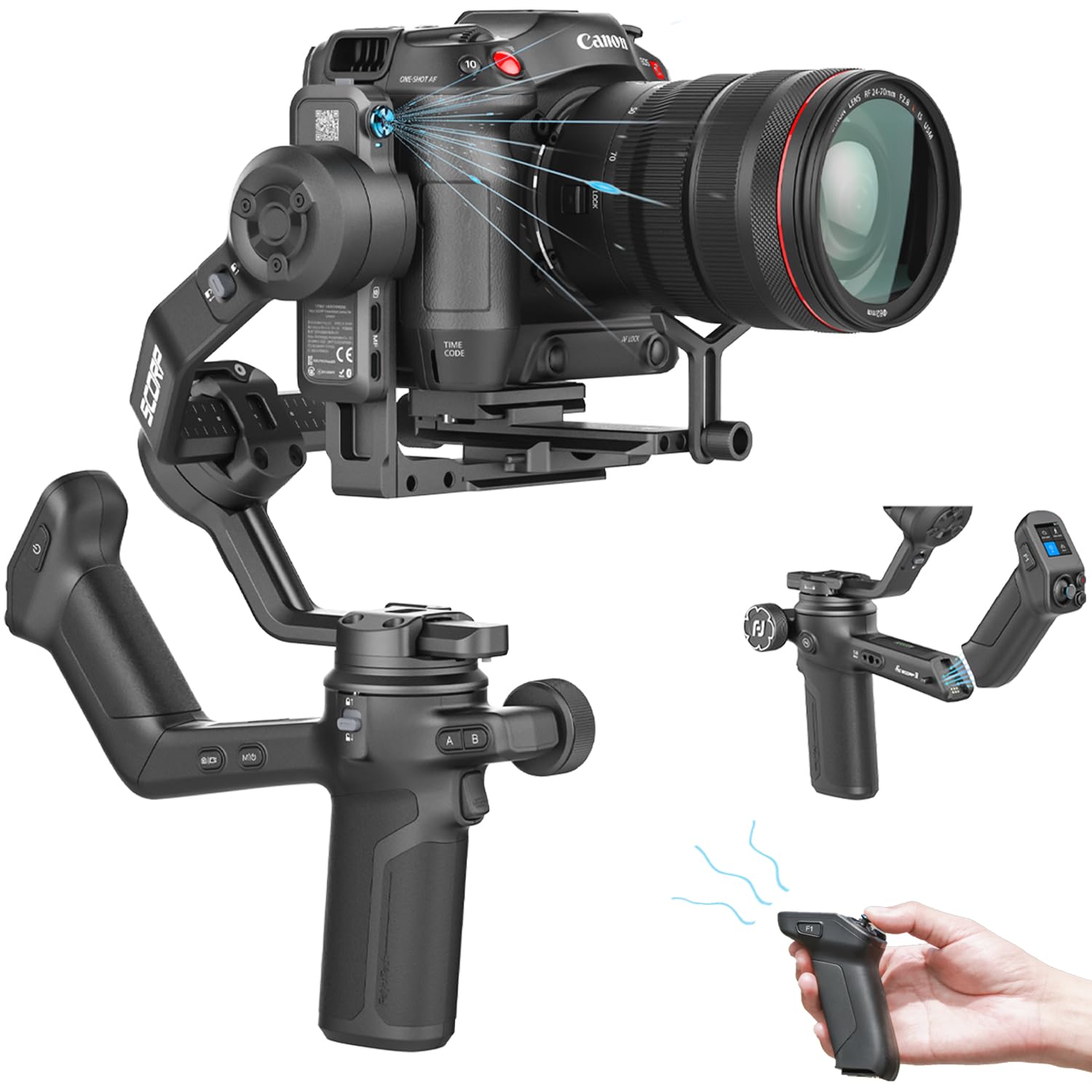
The SCORP 3 redefines solo operation by embedding the AI tracking sensor directly into the body, eliminating the need for a separate accessory module. Its detachable teapot-style handle transforms into a wireless remote with full parameter control, a feature that turns a one-person shoot into a two-crew workflow. The 3.5 kg payload comfortably supports heavy rigs like a Panasonic GH6 with a cage and a 12-60mm Leica lens, leaving headroom for an external mic or small monitor.
The 1.3-inch HD touchscreen provides intuitive access to mode switching, gyro settings, and A-B trajectory memory. Bluetooth shutter control pairs seamlessly with most mirrorless cameras, enabling tap-to-start recording without a cable. Battery runtime reaches up to 14 hours, which covers nearly any all-day event without a recharge, and fast 18W charging restores 30 minutes of use in just five minutes when you do top it up.
The 2025 quaternion stabilization algorithm handles running, low-angle flashlight mode, and fast panning with minimal micro-jitter. Some users report that the middle bracket requires careful initial adjustment, but once balanced, the SCORP 3 delivers cinema-grade smoothness that rivals setups costing twice as much. For creators who prioritize AI tracking, ergonomic control, and a high payload ceiling, this is the defining choice of the year.
Why it’s great
- Built-in AI tracking with gesture control up to 59 feet
- Detachable remote handle adds solo-crew flexibility
- 3.5 kg payload handles fully rigged pro cameras
Good to know
- Middle bracket is stiff during initial balancing
- Not the most compact form for travel
2. DJI RS 4

The DJI RS 4 is the professional standard for mirrorless stabilization, and its Teflon-coated axis arms make balancing noticeably smoother than the previous generation. The tilt axis extends by 8.5 mm, offering more room to center heavier lens combinations like a Sony A7S III with a 24-70mm f/2.8 GM. The 3 kg (6.6 lbs) payload accommodates most pro hybrid setups without dropping into the overload zone.
The 2nd-generation native vertical shooting plate is a standout for social-media-first creators. Simply release the horizontal plate, rotate it 90°, and secure it in the vertical slot—no extra L-bracket, no tools. The joystick mode switch lets you toggle between PF, PTF, FPV, and 3D Roll 360 modes quickly, making it easy to adapt mid-shot without diving into the app. The RSA communication port opens the gimbal to third-party accessories like remote-control ring handles, which professional steadicam operators appreciate.
Battery life sits at 12 hours from the included BG21 grip, and the optional BG70 upgrade extends that to 29.5 hours while providing 18W USB-C power delivery to your camera. User feedback consistently highlights the solid build, intuitive controls, and reliable stabilization that handles long wedding days. The only recurring caveat is that the BG70 battery grip is expensive, but for full-time pros who shoot 10+ hours, the investment pays off in uninterrupted run time.
Why it’s great
- Teflon axis arms for ultra-smooth balancing
- Second-gen vertical switching in under 10 seconds
- RSA port supports extensive accessory ecosystem
Good to know
- Optional high-capacity battery grip is pricey
- No built-in AI tracking module
3. FeiyuTech SCORP 3 KIT
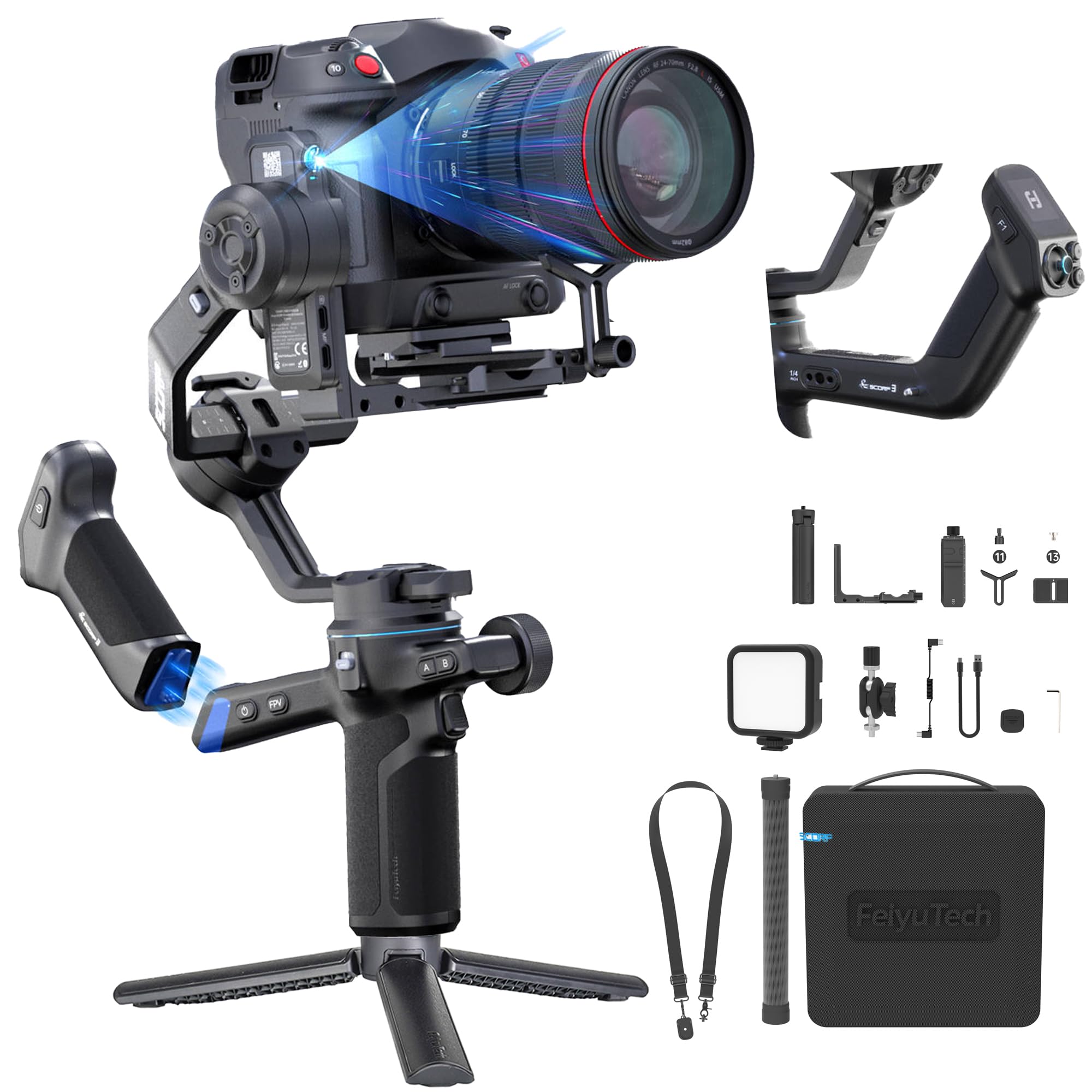
The SCORP 3 KIT is effectively the base SCORP 3 bundled with a carrying case and dedicated slots for all accessories, making it the best option for creators who travel frequently. The core hardware is identical: a 3.5 kg payload, AI tracking built into the body, and a detachable handle that serves as a wireless remote. The case keeps the gimbal, handle, tripod, cables, and lens support organized, so you never scramble for the right cable before a shoot.
The 10th-generation quaternion stabilization algorithm delivers the same buttery-smooth footage as the standard SCORP 3, including effective cancellation of footstep vibration during fast walking. The 1.3-inch touchscreen UI is responsive, and Bluetooth shutter control pairs directly to the camera for tap-to-start recording. The middle bracket, while sturdy, requires some patience during initial leveling—a minor setup hurdle that becomes faster with practice.
Bluetooth connectivity pairs reliably with Sony, Canon, Panasonic, and Nikon bodies, but the Panasonic Lumix S1R II has been reported as incompatible via Bluetooth, requiring a wired connection instead. For most modern mirrorless cameras, the SCORP 3 KIT represents a complete, ready-to-go package at a price that undercuts equivalent DJI bundles by a noticeable margin. If you want a full production kit without buying accessories separately, this is the clear pick.
Why it’s great
- Includes travel case with dedicated storage slots
- Same high payload and AI tracking as base model
- Detachable handle doubles as wireless remote
Good to know
- Some Panasonic Lumix bodies lack Bluetooth pairing
- Middle bracket leveling is initially stiff
4. DJI RS 5 Combo
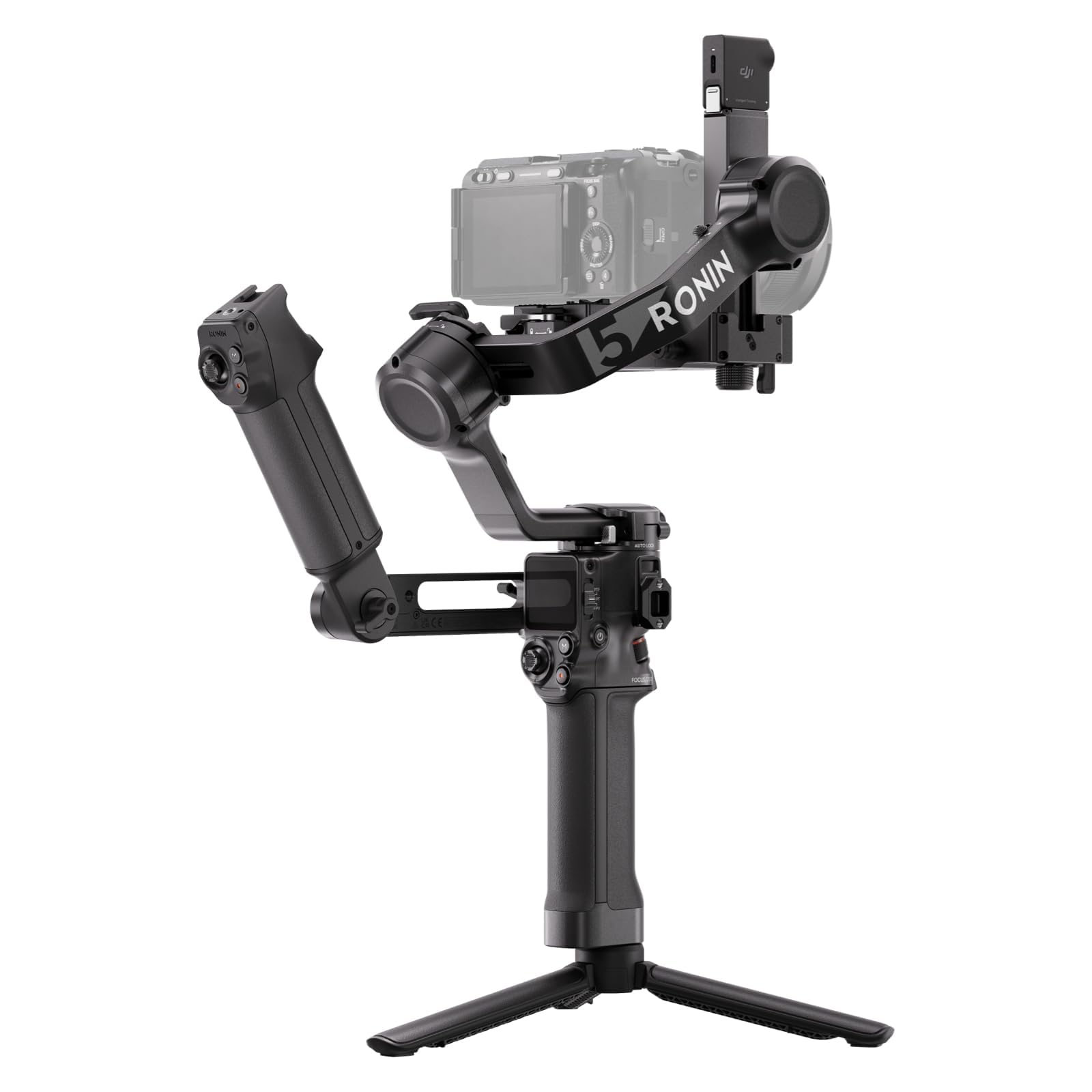
The DJI RS 5 Combo is DJI’s most advanced gimbal to date, featuring 2nd-generation automated axis locks that fold the gimbal for storage or unlock for shooting with a single button press. This cuts setup time from 30 seconds to under three, which matters intensely when you’re chasing a moving subject or switching shots quickly. The Electronic Briefcase Handle provides intuitive single-handed control with a joystick and buttons, allowing low-angle shots without bending over awkwardly.
The Enhanced Intelligent Tracking Module is a separate unit that attaches to the side of the gimbal, enabling subject tracking—people, vehicles, or pets—directly from the touchscreen. The fine-tuning knobs on each axis arm allow micro-adjustments in balancing, making it easier to center heavy lenses without guessing. The new Z-Axis Indicator provides real-time visual feedback on footstep vibration, helping you refine your walking technique for the smoothest possible footage.
Battery life reaches 14 hours from the BG33 grip, and a full charge takes just one hour via USB-C fast charging. The combo includes a carrying case, the tracking module, and the briefcase handle, making it a true all-in-one pro solution. Testers note that the base kit (non-Combo) does not include the tracking module, which is a + add-on, so the Combo is the only smart buy for tracking-centric shooters. For full-time videographers handling corporate, wedding, and commercial work, the RS 5 Combo is the ultimate tool.
Why it’s great
- 2nd-gen automated axis locks for instant setup
- Electronic briefcase handle for low-angle stability
- Z-Axis indicator improves walking technique
Good to know
- Base kit lacks the tracking module
- Premium pricing reflects professional-grade features
5. DJI RS 4 Mini

The DJI RS 4 Mini is the sweet spot for hybrid shooters who need a lightweight gimbal that doesn’t sacrifice the core features of the full-size RS 4. It weighs just over 1 kg, making it comfortable to hold for extended periods, yet its 2 kg (4.4 lbs) payload handles mirrorless bodies like the Sony A7 IV or Fujifilm X-T5 with a standard zoom lens. The auto axis locks fold the gimbal for storage and unlock it for shooting in under two seconds, a feature previously reserved for the pro RS 4.
Intelligent tracking works via the optional RS Intelligent Tracking Module, which attaches to the cold shoe and frames subjects automatically. The Teflon-enhanced balancing surfaces make the sliding adjustments smoother than the RS 3 Mini, so swapping lenses or changing camera bodies mid-shoot is less tedious. Fast vertical switching takes about 10 seconds—release the plate, rotate, and re-secure—which is fast enough for social media creators moving between formats multiple times in a single shoot.
Battery life is rated at 13 hours, and real-world tests with a full-frame camera and continuous recording show 8+ hours, enough for an all-day wedding or event. The non-detachable battery is the only compromise—you can’t swap a dead pack for a fresh one mid-shoot—but a 10-minute charge from a power bank restores about an hour of runtime. For vloggers, travel content creators, and event shooters who prioritize portability without losing stabilization quality, the RS 4 Mini is the top mid-range option.
Why it’s great
- Ultra-fast auto axis locks rival full-size models
- Lightweight 1 kg form for extended handheld use
- Smooth Teflon-enhanced balancing adjustment
Good to know
- Non-detachable battery limits hot-swap options
- Cannot balance heavy telephoto or full-cage setups
6. ZHIYUN CINEPEER Weebill 3E

The ZHIYUN Weebill 3E delivers a 3 kg (6.6 lbs) payload at a price that typically lands in the 2 kg category, making it the payload-to-price leader in the mid-range segment. It weighs only 1.05 kg, lighter than many competitors with half its capacity, and its A4-sized folded form slips into most camera bags. The native vertical shooting plate works exactly like the DJI system—release, rotate, and lock—allowing quick format transitions without additional accessories.
Battery life reaches 16 hours on a full charge, the highest in this comparison, and the 14W PD fast charging refills the pack in under three hours. Bluetooth shutter control pairs automatically after initial setup, letting you start/stop recording via the gimbal’s record button. One notable limitation: the Weebill 3E only includes a Panasonic control cable in the box, meaning Canon, Sony, and Nikon shooters must purchase additional cables separately for wired shutter control.
The 2.5 Sling Mode uses a separately purchased sling grip and wrist rest to offload weight from your arm to a shoulder strap, reducing fatigue by over 50% during extended low-angle shooting. User feedback praises the stabilization smoothness and the intuitive interface, though the yaw axis cannot do 360-degree rotations. For budget-conscious shooters who need a high payload for a mix of mirrorless and DSLR bodies, the Weebill 3E offers the best value for the payload.
Why it’s great
- 3 kg payload in a sub-1.1 kg body
- 16-hour battery life covers full-day shoots
- Native vertical shooting without extra plates
Good to know
- Only includes Panasonic control cable
- Sling accessories purchased separately
7. FeiyuTech SCORP-C

The FeiyuTech SCORP-C distinguishes itself with an integrated hanging handle that allows comfortable upright and underslung shooting without changing your grip. The handle’s beveled edges fit the palm naturally, and the folding aileron bracket lets you set the gimbal down on any flat surface without needing a tripod. The payload capacity reaches 2.5 kg (5.5 lbs), enough for mainstream mirrorless and DSLR combinations like the Sony A7 III with a Tamron 28-75mm f/2.8.
The five-way center-of-gravity adjustment system uses a memory slider that returns the plate to your last balanced position, speeding up rebalancing when you swap lenses. The AB Trajectory Memory mode records a movement path and repeats it with one button press—useful for consistent panning or crane-like shots. The 2,500 mAh battery provides 10 to 13 hours of runtime, and 18W fast charging adds 30 minutes of use from just five minutes on a charger.
User feedback is overwhelmingly positive regarding the smooth stabilization and the ergonomic scorpion tail grip, which enables two-handed stabilization naturally. Some beginners find the initial setup instructions unclear, and a few users note that the thumb stick control can feel jerky at low speeds until you customize the response curve. The SCORP-C comes with all essential camera control cables in the box, including Sony, Canon, Panasonic, and Nikon formats, so you don’t need additional purchases.
Why it’s great
- Unique integrated hanging handle for versatile grips
- Five-axis gravity memory slider speeds rebalancing
- Includes cables for all major camera brands
Good to know
- Thumb stick can feel jerky without curve tuning
- Setup instructions not beginner-friendly
8. DJI RS 3 Mini (Renewed)

The DJI RS 3 Mini, available as a renewed unit, brings DJI’s third-generation RS stabilization algorithm to an entry-level price. Weighing only 795 g (1.75 lbs), it is the lightest camera gimbal in this comparison by a wide margin, making it ideal for travel, hiking, and all-day handheld use. The 2 kg (4.4 lbs) payload supports compact mirrorless bodies like the Sony A6400, Fujifilm X-S10, or Panasonic GH6 with lightweight primes.
Bluetooth shutter control pairs automatically after initial setup, and native vertical shooting is supported by mounting the quick-release plate to the vertical arm—no extra bracket required. The 3rd-generation stabilization algorithm handles low-angle shots and flashlight mode effectively, though the motors lack the torque of the RS 4 series when confronted with heavier lenses like a 24-70mm f/2.8. The battery life is sufficient for several hours of intermittent shooting, but the non-removable battery is a limitation for all-day events without access to a power outlet.
As a renewed product, the unit comes with a 90-day warranty rather than the standard one-year coverage, which is the main trade-off for the discounted price. User reviews are almost universally positive, praising the smooth stabilization and portability, but the limited warranty means you should test the gimbal thoroughly within the first few weeks. For beginners or casual shooters who want DJI quality on a tight budget, the RS 3 Mini renewed is a solid entry point that still delivers professional-grade smooth footage.
Why it’s great
- Ultra-light 795 g body reduces shooting fatigue
- DJI 3rd-gen stabilization for smooth footage
- Native vertical shooting with quick-release plate
Good to know
- Renewed unit comes with only 90-day warranty
- Limited torque struggles with heavy telephoto lenses
9. Xtra Muse Pocket Camera with 3-Axis Gimbal

The Xtra Muse is not a traditional gimbal for your existing camera—it is a complete pocket camera with a permanently integrated 3-axis gimbal stabilizer. This distinction makes it the best choice for creators who want an all-in-one solution without the complexity of mounting, balancing, and cabling a separate camera. The 1-inch CMOS sensor records 4K video at up to 120fps, producing the same cinematic slow-motion and detail as the DJI Pocket 3, but at a lower price.
The built-in face and object tracking keeps subjects centered in the frame during walking, running, or dynamic movement, eliminating the need for an external tracking module or smartphone app. The 2-inch touchscreen interface is responsive and allows switching between horizontal and vertical shooting with a single tap. The standard bundle includes a carrying bag, a wrist strap, and a handle with a 1/4-inch thread for mounting to tripods or monopods.
Battery life is slightly over two hours, which is passable for short vlogs but not enough for an all-day shoot without a power bank connected via USB-C. The micro-SD card slot supports UHS Speed Class 3 cards for reliable 4K/120fps writing. User feedback highlights the surprising quality of the stabilization for its size and the reliable autofocus, though some users note that lens attachments are not supported. For creators who want to press record and get smooth footage without any setup, the Xtra Muse offers a fully integrated solution in a pocket-sized package.
Why it’s great
- Complete pocket cam with built-in 3-axis stabilization
- 4K/120fps recording with 1-inch CMOS sensor
- Face and object tracking works without external gear
Good to know
- Battery lasts just over 2 hours
- No lens attachment support for focal flexibility
FAQ
Does a higher payload rating always mean better stabilization?
How does native vertical shooting affect balance?
Can I use any smartphone app to control a camera gimbal?
What is the real-world battery life difference between a 12-hour and 16-hour rated gimbal?
Does the Xtra Muse pocket camera replace a separate camera and gimbal?
Final Thoughts: The Verdict
For most users, the best camera gimbal winner is the FeiyuTech SCORP 3 because it combines a 3.5 kg payload, built-in AI tracking, and a detachable remote handle into a single package that outperforms options costing double a few years ago. If you want the fastest setup and auto axis locks for professional mirrorless work, grab the DJI RS 4. And for a lightweight travel gimbal that still gives you auto locks and intelligent tracking, nothing beats the DJI RS 4 Mini.