
A “K‑Cup combo” coffee maker looks simple on paper: one machine that can brew a quick single cup and a full carafe when the house needs more than one caffeine mood. In real life, these machines live (or die) on tiny daily moments: the first cup you make half‑awake, the carafe you pour while someone’s talking to you, the pod you forget to remove, the reservoir you refill too quickly and seat slightly off… and the cleanup you’ll either do every day or you’ll avoid until it becomes a problem.
If you’re shopping for the best coffee maker with k-cup combo, you’re not just buying a brewer. You’re buying a smoother morning, fewer counter gadgets, and a “this actually fits our household” solution. The reason most buying guides feel useless is that they talk like spec sheets—when the truth is that two combo brewers with similar features can feel totally different to own. One will quietly become part of your routine. The other will annoy you in three specific ways… every single day.
So this guide is built around the real friction points that show up again and again in owner feedback: whether the pod side produces a full, satisfying cup or a thin one; whether the carafe side tastes fresh after an hour; how easy it is to avoid drips and splashes; whether the “bold” button is actually meaningful; and how maintenance works when life gets busy. I’ll also call out the hidden make‑or‑break details that rarely show up on product pages—things like mug clearance, needle care, condensation behavior, reservoir logic, and the kinds of mistakes that cause overflow or “error” messages.
Below you’ll find 17 carefully ordered picks—starting with higher‑end “buy once, love it” machines and stepping down toward budget workhorses and newer entrants. Every model is here because it solves a specific household problem, not because it has a longer bullet list.
How to Choose the Best Coffee Maker With K-Cup Combo for Your Routine
A great combo brewer does two jobs well: it delivers a satisfying single cup quickly and it makes a carafe that doesn’t taste tired after the first pour. The trick is that the “combo” category includes very different internal designs. If you pick the right architecture for your household, the rest becomes easy.
1. Start with the one question that predicts happiness
Ask: Which side will you use more—single cups or carafes? Not what you hope, but what your life actually does.
- Mostly single cups: Prioritize pod performance, quick heat‑up, mug clearance, and easy needle cleaning.
- Mostly carafes: Prioritize showerhead saturation, carafe design (thermal vs hotplate), and a brew basket that’s easy to rinse.
- Truly 50/50 households: Look for models where neither side feels like an afterthought (this is where better brands stand out).
2. Understand the two architectures: shared‑reservoir vs split‑system
This is the most important technical difference, because it changes your daily workflow.
- Shared‑reservoir combo: One big tank feeds both the pod side and the carafe side. These feel “easy” because you fill once and forget. But they can also confuse people because carafe sizing may be based on smaller “coffee cups” than your mug.
- Split‑system combo: The pod side has its own reservoir and the carafe side is filled separately (often by pouring water into a well). These feel more intentional for households that want separation (regular vs decaf, different water habits), but you do a bit more hands‑on filling.
If your household argues about who emptied the reservoir, or you hate refilling tanks, shared‑reservoir designs can feel like a gift. If your household has two totally different coffee identities, split‑systems often feel cleaner and more “adult.”
3. Pick your carafe personality: thermal vs hotplate
Carafe design has a bigger impact on flavor than most people realize—because it controls what happens after brewing.
- Thermal carafe: Keeps coffee hot without continuing to cook it. Often better for people who sip slowly, host brunch, or hate burnt notes. The tradeoff is that some thermal carafes are fussier to pour (a common real‑life complaint).
- Glass carafe + hotplate: Simple, familiar, easy to see the level. Better for households that finish a pot quickly. The tradeoff is taste drift if the plate is aggressive or if it keeps running for hours.
4. Don’t treat “bold” as a marketing word—test what it really does
On a combo brewer, “bold” can mean different things: a slower water flow, slightly higher brewing temperature, a pulse pattern, or simply a longer contact time. Here’s how to know if bold will matter to you:
- If you drink pods black: Bold matters more. Weak extraction is obvious when there’s nothing to hide behind.
- If you add milk/sweetener: Bold still helps, but your biggest win is choosing a smaller cup size or using a stronger pod/roast.
- If you brew grounds on the single‑serve side: Bold can help compensate for baskets that drain quickly.
5. Decide how you want to make iced coffee
Some machines offer a true “brew over ice” mode that adjusts brewing behavior to reduce watery flavor. Others simply brew hot coffee, which you then pour over ice (totally fine if you brew stronger or use a smaller cup size).
- If you want iced daily: Choose a model with an explicit iced mode or easy strength control.
- If iced is occasional: Any machine can do it well if you use a smaller brew size and build the drink around ice intentionally.
6. Watch the hidden convenience factors
These are the details you’ll feel every day—and they’re why people either love their combo machine or rage‑replace it.
- Mug clearance: Can your favorite travel mug fit without removing parts? If not, will you actually bother removing them?
- Drip tray behavior: Adjustable trays help prevent splatter and keep your counter clean.
- Pour design: A carafe that drips every time becomes a daily annoyance. Some designs practically force you to pour over the sink.
- Water fill access: Tall machines under cabinets can be a pain if you must lift lids to refill.
7. Maintenance is not optional—so pick a machine that makes it easy
Combo brewers have more pathways for buildup: pod needles, water lines, showerheads, valves, baskets, and sometimes milk/steam components. You want a machine that encourages you to clean it.
- Needle care: If the pod needle clogs, you’ll get weak brews, partial brews, or messy blow‑outs.
- Descaling: If your water is mineral‑heavy, scale will affect temperature, flow, and taste faster than most people expect.
- Removable parts: A basket you can lift out and rinse beats a tight corner you have to wipe with paper towels.
8. Choose based on your “coffee household” profile
Most homes fit one of these patterns. Pick the profile that sounds like you, then choose a brewer designed for that life.
- “Two‑drinker house, two different coffees”: You’ll love split‑system designs or machines that make switching modes obvious.
- “Pods during the week, carafes on weekends”: Look for strong programming and a carafe that stays enjoyable through a slow morning.
- “Entertainers”: Prioritize carafe taste stability and easy batch brewing. Thermal is often the move.
- “Small counter / RV / tight kitchen”: Slim footprints and movable reservoirs matter more than you think.
- “Iced coffee regulars”: Look for iced modes or strong extraction controls that hold up over ice.
9. Don’t get trapped by a feature you won’t use
Milk frothers, espresso capsules, and touchscreen panels can be amazing—or they can be a distraction if you’re mainly a “coffee, now” person. If you’ve never once thought, “I wish I could steam milk,” skip the wand. If you love lattes, choose a machine that makes that ritual feel easy and clean, not messy and awkward.
10. Your final decision framework (simple and effective)
Before you pick, answer these four questions:
- Do I want a thermal carafe or a hotplate carafe?
- Do I want one shared reservoir or separate fill logic?
- Will I use pods, grounds, or both on the single‑serve side?
- What’s the one annoyance I refuse to live with? (drips, weak cups, complicated cleaning, noisy grinding, tall profile, etc.)
Now you’re choosing like an owner—not like a shopper staring at a feature list.
Quick Comparison: 17 Best Coffee Maker With K-Cup Combo Picks
Use this table to spot the machines that fit your routine, then jump to the full reviews for the real‑life details— like which ones stay clean easily, which ones keep carafe coffee tasting fresh, and which designs are most forgiving when you’re half awake.
On smaller screens, swipe or scroll sideways to see the full table.
| Model | Combo style | Carafe feel | Best match | Amazon |
|---|---|---|---|---|
| Cuisinart Coffee Center SS-21NAS (Thermal) | Pod + carafe | Thermal “sip slow” stability | Most homes wanting one premium, everyday‑easy combo brewer | Amazon |
| Keurig K-Duo Hot & Iced (Gen 2, MultiStream, 72oz) | Keurig duo | Glass + hotplate “serve now” | Pod lovers who still want real carafe flexibility with fewer refills | Amazon |
| Cuisinart SS-15P1 (Single Serve + 12-Cup) | Split system | Glass + adjustable hotplate control | Two‑drinker homes that want separation and stronger “hot cup” energy | Amazon |
| Cuisinart Barista Bar SS-4N1NAS (4-in-1) | Coffee bar | Glass + café‑style variety | Households wanting drip + pods + capsule espresso + steaming in one footprint | Amazon |
| Cuisinart Grind & Brew Plus SS-GB1NAS | Beans + pods | Glass carafe with fresh‑ground aroma | People who want whole‑bean freshness without buying a separate grinder | Amazon |
| Cuisinart SS-16 (Hot & Iced) | Pod + carafe | Glass “fast pot” with iced option | Families who want Cuisinart flexibility without going full premium | Amazon |
| Keurig K-Duo Single Serve & Carafe (MultiStream) | Keurig duo | Glass + hotplate with iced mode | People who want Keurig simplicity, iced coffee, and a compact counter footprint | Amazon |
| Keurig K-Duo Essentials (Gen 2) | Keurig duo | Simple “no fuss” carafe brewing | Shoppers who want the duo idea with fewer bells and a more basic interface | Amazon |
| Keurig K-Duo (Classic, 60oz) | Keurig duo | Classic “easy to live with” workflow | Anyone who wants a widely used model with lots of accessories and familiarity | Amazon |
| Hamilton Beach FlexBrew Advanced 5-in-1 (49924) | Pods + grounds | Hidden carafe, slim footprint | Small counters that still want real flexibility (and fast single cups) | Amazon |
| Hamilton Beach FlexBrew TRIO Thermal (Stainless) | Pods + grounds | Thermal “no hotplate” taste | People who want a thermal carafe without switching to a premium price tier | Amazon |
| Hamilton Beach FlexBrew TRIO (49902, Glass) | Pods + grounds | Fast single cups + classic pot | Homes wanting quick pod coffee but still able to make a full pot easily | Amazon |
| Dual Brew Coffee Maker (Pantrymade, Touchscreen) | Pod + carafe | Simple, modern, space‑saving | Value shoppers who want the combo idea in a straightforward, easy-to-use layout | Amazon |
| AIRMSEN Dual Coffee Maker (Touchscreen) | Pods + grounds | Fast brew with “coffee bar” look | Homes/offices wanting touchscreen scheduling and flexible brewing methods | Amazon |
| Hamilton Beach 2-Way Hot & Iced (47500J) | Ground-only | Glass pot + bold/iced modes | Pod‑free homes who still want single‑cup convenience and less waste | Amazon |
| Hamilton Beach 2-Way (49933, White) | Ground-only | Simple, programmable classic | People who want the “two ways” idea and don’t want to buy pods | Amazon |
| Hamilton Beach 2-Way (49980RG, Black) | Ground-only | Same concept, different finish | Anyone who wants pod‑free single cups with a full carafe option in one unit | Amazon |
In‑Depth Reviews: 17 Combo Coffee Makers Real Homes Actually Keep Using
Now we’ll go model by model. I’ll talk like an owner, not a brochure: what feels easy, what feels fiddly, where taste shines, where cleanup gets annoying, and what kind of household each machine fits best.
1. Cuisinart Coffee Center SS-21NAS – The “Premium Everyday” Combo That Feels Calm to Own

This is the kind of combo brewer people buy when they want to stop thinking about coffee hardware and start enjoying coffee again. The SS-21NAS nails the “two different mornings” reality: one person wants a fast single cup, another wants a full pot, and nobody wants extra machines taking over the counter. The reason it feels premium isn’t a gimmick—it’s the way the workflow stays predictable when you’re moving fast.
Real owners consistently praise two things: speed and heat stability. The thermal carafe is a big part of that story because it keeps the pot pleasant without relying on an aggressive hotplate that can push coffee toward “cooked.” That matters in homes where the pot gets poured over a long breakfast window instead of disappearing in 10 minutes. And on the single‑serve side, the multiple brew sizes and the “over ice” function make it easier to dial in a cup that tastes intentional instead of diluted.
The most useful design upgrade people notice in daily life is the single‑serve cup area. Splatter happens when the drop distance is too big, especially on taller brews. This unit’s cup support approach helps you control that distance so the counter stays cleaner. There are also repeated notes about the machine producing coffee quickly—an underrated quality when your morning is already behind schedule.
Why you’ll like it
- Thermal carafe that protects flavor – Better for slow sippers and weekend pot drinkers who hate “burnt” drift.
- Low‑stress versatility – Single cup, travel mug, iced coffee, and full pot feel like one coherent system.
- Predictable day-to-day behavior – Owners tend to describe it as fast, consistent, and “easy to live with.”
- Countertop confidence – Looks like a real kitchen appliance, not a plastic gadget, and it holds up visually.
Good to know
- Some users report leaking when the reservoir isn’t seated perfectly—this is a “push it fully into place” kind of machine.
- Like most combo units, it rewards basic maintenance: rinse the pod area, empty the drip tray, and keep the brew path clean.
- It’s not the smallest footprint; if you have tight overhead cabinets, plan how you’ll refill comfortably.
Ideal for: households that want a premium combo brewer that feels stable, predictable, and easy—especially if you value thermal carafe flavor over hotplate cooking.
2. Keurig K-Duo Hot & Iced (Gen 2, MultiStream, 72oz) – The “Fill Once, Brew Everything” Household Workhorse

If your house is already a Keurig house—or you simply want the most familiar, no‑drama path to pod convenience—this Gen 2 K‑Duo is the most “plug into your routine” option on the list. The shared reservoir is the headline feature because it removes friction: you’re not refilling two separate tanks, and you’re not playing “which side needs water?” every morning.
MultiStream matters more than people think. A common complaint with pod brewing is thinness—especially in larger cup sizes. MultiStream-style brewing aims to saturate more evenly, which tends to make the cup taste fuller and more aromatic. Add the Strong and Extra Hot options and you get something closer to a confident, café-ish cup rather than a watery “office pod” vibe. On the carafe side, the programmable auto brew is the feature that quietly improves life: set it up at night, wake up to a ready pot, and you’ve reduced your morning decisions to one: pour.
The honest reality of Keurig-style combo machines is that they’re loved for convenience and sometimes criticized for longevity. Some owners describe long stretches of great performance, and others describe random “add water” behavior or error messages that feel like the machine forgetting it has a full tank. The best way to think about this model is: it’s excellent when you want a modern Keurig workflow—and you want it as a single, counter-friendly station.
Why you’ll like it
- One large reservoir – Fewer refills, less thinking, easier “busy household” mornings.
- Better pod extraction feel – MultiStream + Strong/Extra Hot can deliver a more satisfying single cup.
- Iced coffee compatibility – Brew over ice makes iced drinks easier to get right without tasting diluted.
- Programmable carafe brewing – The “wake up to coffee” lifestyle is a real quality-of-life upgrade.
Good to know
- Shared reservoirs can confuse expectations around “carafe size” versus how much water the machine actually holds.
- If you ignore descaling/cleaning, pod performance often declines first (weaker cups, slower flow, louder brewing).
- Some owner feedback mentions inconsistent reliability; this is a convenience-first machine, not a “buy it for life” tool.
Ideal for: Keurig lovers who want a modern, all-in-one station with a big shared reservoir, strong pod options, and true carafe flexibility for family mornings.
3. Cuisinart SS-15P1 – The Split‑System Combo That Feels Like Two Real Machines

The SS‑15P1 is one of the most “adult” combo designs because it behaves like two separate brewers sharing one footprint. That matters when your household has two different coffee identities: one person wants decaf pods occasionally, another wants a strong carafe every morning, and nobody wants cross‑contamination of workflow. The separate single‑serve reservoir is the quiet win here—you’re not constantly draining the same tank for two different purposes.
Owners who care about a truly hot cup often gravitate toward this model because the carafe side feels like a real 12‑cup drip machine rather than a side feature. The adjustable hotplate temperature is the kind of feature you don’t appreciate until you’ve lived with a too‑hot plate that cooks coffee into bitterness. Meanwhile, the pod side tends to earn praise for being surprisingly competent even though it’s not a Keurig-branded brewer—a nice reminder that “K‑Cup compatible” doesn’t mean “second‑rate.”
The tradeoff is that split‑system machines demand you understand the logic: carafe side is filled differently than the pod side, and the physical act of pouring water into the carafe well can be awkward in tight spaces. Some owners also mention that carafe pouring design is not the smoothest—this is one of those machines where slow, deliberate pouring is part of the ritual if you want a clean counter.
Why you’ll like it
- Feels like “two real brewers” – The split logic reduces compromise and keeps routines clean.
- Hotplate temperature control – Better for people who hate cooked taste or want gentler warming.
- Strong morning flexibility – Single cup when you’re solo, full pot when the household needs it.
- Great for regular + decaf households – The workflow supports different drinkers without drama.
Good to know
- Filling can be a little fiddly under low cabinets; you may pull the unit forward to pour water comfortably.
- Some owners mention drips/spills when pouring—pouring over the sink becomes the natural habit.
- Replacement parts and customer service experiences can vary; this is a “treat it well and it treats you well” machine.
Ideal for: two‑drinker homes that want separation, stronger drip performance, and a combo machine that feels intentional rather than “two compromises in one shell.”
4. Cuisinart Barista Bar SS-4N1NAS – The Countertop “Coffee Menu” Without Extra Gadgets

If your household doesn’t just want coffee—if it wants options—this is the “one machine instead of three” answer. The Barista Bar is built for people who bounce between a pot of coffee, a quick pod, and the occasional espresso‑style moment with steamed milk. That’s exactly why it can feel like a kitchen lifestyle upgrade: you’re not constantly moving between appliances, and you’re not storing extra gear just to get variety.
The most important expectation to set is this: it’s a capsule‑espresso experience, not a full‑manual espresso machine. That’s a feature, not a flaw, if your goal is speed and simplicity. Owners who love it talk about the convenience of having hot water, steaming, pods, and drip coffee in one station—especially for mixed households where one person wants regular drip and another wants the “fun drinks.”
The complaints are also consistent: the steam wand’s positioning can feel awkward in tight spaces, and descaling/cleaning instructions can feel less intuitive than people expect. Another real-life tip from owner patterns: pod handling matters. If you remove pods too quickly after brewing, you can invite splatter or mess. The machine rewards a slightly slower, calmer workflow—brew, wait a beat, then open.
Why it’s special
- True variety in one footprint – Drip, pods, capsule espresso, steaming, hot water: it’s a real menu.
- Great for mixed households – One person can keep it simple; another can make lattes/cappuccinos.
- Space-saving “upgrade” – Replaces multiple appliances, which is often the real value in a small kitchen.
- Entertaining-friendly – A pot for guests, specialty drinks for fun, and less countertop chaos.
Good to know
- The wand placement can feel low/long; you’ll find the “right cup” that fits your steaming routine.
- Cleaning/descaling steps can feel confusing for first-time owners; it’s easier once you learn the knob logic.
- It’s tall—if you have overhead cabinets, you may pull it forward for filling and steaming.
Ideal for: households who want drip coffee and pod convenience, but also want espresso-style drinks and steamed milk without committing to a full espresso machine setup.
5. Cuisinart Grind & Brew Plus SS-GB1NAS – Fresh Beans + Pods, With a “Ritual Required” Tradeoff

This machine appeals to a very specific kind of coffee person: you want the smell and flavor of freshly ground beans, but you also want the convenience of pods on chaotic days. In other words: you want freshness without giving up speed. When it’s working with you, it can feel magical—grind, brew, fill the kitchen with aroma, and start the day like you meant it.
The important part is the tradeoff: a built‑in grinder inside a steamy drip machine is a maintenance relationship. Owners frequently describe the grinder as loud (not subtle “morning gentle” loud—more like “yes, coffee is happening” loud), and they also describe moisture building up in the grinder area during brewing. That moisture is the hidden reason some people find this machine “high effort”: if you don’t clean and dry key parts, old coffee paste can build up and affect performance.
So think of it like this: the SS‑GB1NAS gives you fresher coffee than typical drip + pod combos, but it expects you to be the kind of person who rinses and wipes things as part of the ritual. If you’re a “set it and ignore it” household, you may get annoyed. If you’re a “coffee is my morning craft” household, you may love it.
Why you’ll like it
- Fresh ground flavor on demand – Whole beans brewed immediately can taste noticeably better.
- Pods when you need speed – You’re not trapped in one brewing identity.
- Grind-off flexibility – Use pre‑ground when you want less noise or less cleaning.
- Strong “coffee ritual” vibe – For the right owner, it feels like a morning companion, not a gadget.
Good to know
- The grinder area can require frequent cleaning/drying because brewing creates steam and moisture.
- It’s loud when grinding—great if you like a “wake up” machine, not great if someone’s sleeping nearby.
- Pouring and parts ergonomics aren’t universally loved; if you’re sensitive to drips, you may prefer a different carafe design.
Ideal for: people who value bean freshness but still want pod convenience—especially if you don’t mind a little daily cleanup as part of the payoff.
6. Cuisinart SS-16 – The “Flexible Without Feeling Fussy” Hot & Iced Combo

The SS‑16 is for people who want Cuisinart flexibility but don’t necessarily need the more premium thermal-carafe experience. It gives you the practical things that matter: multiple single‑serve sizes, a full 12‑cup carafe, brew strength control, and the ability to do hot or iced without turning coffee into a watery afterthought.
Where this model shines is in “daily driver” behavior. It’s the kind of machine you can use in two different modes without feeling like you’re solving a puzzle: want one cup right now, fine. Want a pot for the morning, also fine. Owners who keep it running smoothly tend to do one thing consistently: they maintain it. When people report slow dripping or incomplete brewing, it often shows up after long stretches without descaling or filter attention. With basic maintenance, the machine tends to bounce back and behave.
The pod side is the one to pay attention to. Some users report messy overflow or grounds making their way into the cup in certain situations. In real life, that usually points to one of a few patterns: a clogged needle, a pod puncture that didn’t open cleanly, or coffee grounds in the brew chamber that weren’t wiped out from the previous use. If you want a “clean counter” relationship with this machine, the habit is: brew, remove pod, wipe any loose grounds, and keep the drip area clean. It takes seconds, and it keeps the machine happy.
Why you’ll like it
- Strong feature-to-hassle ratio – Flexible modes without a complicated learning curve.
- Hot + iced capability – Easy to get a decent iced coffee workflow without buying extra gadgets.
- Carafe temperature control – Helps you avoid the “burnt on the plate” taste drift.
- Multiple single‑serve sizes – Makes it easier to tune strength by choosing smaller cups when needed.
Good to know
- Pod-side mess is possible if you don’t keep the chamber/needle clean; quick wipe-down prevents most issues.
- Like any combo brewer, it performs best when you descale on a consistent rhythm.
- Glass carafe + plate is best for homes that finish the pot fairly quickly.
Ideal for: households who want a capable hot-and-iced combo from a familiar brand, with good everyday usability and enough control to dial in taste.
7. Keurig K-Duo (MultiStream) – The Modern Duo for Hot, Iced, and “Just Push a Button” Days

This version of the K‑Duo is designed to be the “every moment” machine: single cups when you’re rushing, carafes when you’re hosting, and iced coffee when you want something lighter. The draw is that Keurig makes the workflow familiar—pods are what they do—and the front panel style controls keep the machine approachable for anyone in the household.
Owners who love it talk about convenience and flexibility. Brewing a single cup while thinking about the rest of your morning is the Keurig superpower: you don’t need a coffee ritual to get coffee. They also like the larger reservoir concept, because it reduces the “refill tax.” If you’ve ever lived with a small tank that needs constant attention, you know how quickly that annoyance adds up.
The negative feedback tends to come from two areas: bulk/footprint and expectations around carafe output. Some people find it more cumbersome than expected, especially on tight counters, and some dislike the taste compared to their preferred drip setup. If your priority is “best possible drip coffee taste,” you might prefer a Cuisinart-style drip-focused combo. If your priority is “push button, get coffee, move on,” this fits the Keurig identity well.
Why you’ll like it
- Keurig simplicity – Low learning curve for a whole household.
- Hot + iced flexibility – Brew Over Ice supports iced coffee routines without extra steps.
- Multiple sizes – Helps you tune strength by choosing the right cup size and brew mode.
- Made for mixed use – Cup today, carafe tomorrow, and it’s all built in.
Good to know
- Footprint can feel larger than expected; measure if your counter is tight.
- Taste expectations vary; if you’re picky about drip flavor, prioritize drip-focused designs.
- Like most pod systems, regular cleaning/descaling keeps performance stable and reduces weird errors.
Ideal for: people who want a modern Keurig experience that handles both cups and carafes, with iced capability and a straightforward push-button routine.
8. Keurig K-Duo Essentials (Gen 2) – The “Basic, Gets It Done” Dual Brewer

“K‑Duo Essentials” is exactly what it sounds like: the duo idea without the feeling that you’re paying for a dozen features you’ll never touch. For some households, that’s perfect. You want pods, you want a carafe sometimes, and you want the machine to be intuitive enough that nobody in the house makes a mess trying to use it.
A common “happy owner” theme is practicality: it fits better than older bulky brewers, it’s easier to load, and it delivers quick single cups. People also appreciate being able to brew a cup while a carafe is brewing, because it supports real household timing (one person is leaving now, another is sipping slowly).
The complaints tend to be about build feel and expectations. Some owners describe the unit as more plastic and less “premium” than expected. Others critique reservoir math around carafe brewing—this is less about deception and more about misunderstanding how these machines measure “cups” for carafes. If you buy this model with the mindset “I want a simple duo,” it tends to satisfy. If you expect premium materials and luxury engineering, you may want to step up.
Why it works
- Simple dual-brew routine – A good fit for households who don’t want a complicated interface.
- Quick single cups – Delivers that “coffee now” feeling with minimal fuss.
- Carafe flexibility – Great for weekends, guests, or filling a travel mug before work.
- Compact enough for many counters – Often easier to place than older, bulkier systems.
Good to know
- Some owners dislike the build feel; it’s a function-first machine rather than a luxury one.
- Shared reservoir logic can surprise people who expect a full “big pot” from one fill every time.
- Like all pod systems, needle care and descaling keep it from brewing weak or acting glitchy.
Ideal for: shoppers who want a straightforward Keurig-style combo brewer that’s easy to operate, easy to understand, and built around daily convenience.
9. Keurig K-Duo (Classic, 60oz) – The Widely‑Owned Duo With Tons of Real‑World History

This is the “classic duo” that many people have lived with, which means it has something most newer models don’t: a huge body of real household experience. That matters because combo brewers are all about routine. You’re not buying a weekend toy—you’re buying the thing you’ll use on autopilot. And this model has been used in enough kitchens that you can learn the patterns quickly.
The strongest argument for this model is familiarity + compatibility. Keurig’s ecosystem is enormous, and that includes everything from pods to accessories to replacement parts and third‑party add‑ons. If you like the idea of being able to tweak your setup—different K‑Cup drawers, reusable options, specialty pod adapters—this is a friendly platform. Owners who love it often describe it as consistent and intuitive: it does what it says, and it becomes part of the kitchen.
The downside is also well-known: carafe pouring can be messy for some users, and there are reports of repeated replacements for leaking carafes or machines that stop brewing correctly over time. It’s the classic Keurig tradeoff: unbeatable convenience and familiarity, with mixed long‑term reliability experiences depending on use and maintenance.
Why people keep buying it
- Familiar Keurig experience – If you already understand Keurig, you’ll feel at home instantly.
- Accessories everywhere – Easy to customize your coffee station.
- Programmable carafe brewing – A real quality-of-life feature for weekday mornings.
- Solid “two needs, one machine” logic – Pods for speed, carafe for household volume.
Good to know
- Carafe pouring/drips are a common complaint; many owners adapt by pouring over the sink.
- Some long-term feedback includes shutdowns or incomplete brews; descaling and basic care matter.
- If you want premium materials and thermal carafe flavor stability, look at higher-end designs.
Ideal for: people who want the most familiar Keurig duo setup with lots of user history, lots of accessories, and a straightforward daily routine.
10. Hamilton Beach FlexBrew Advanced 5‑in‑1 (49924) – The Slim Combo That Tries to Do Everything

This machine exists for one reason: space. At first glance it looks like a single‑serve brewer, then you realize the carafe is tucked into the design like a hidden feature. That’s clever because many combo machines sprawl across the counter. The FlexBrew Advanced aims to give you options without making your kitchen feel like an appliance showroom.
In real homes, the best part is speed + flexibility. You can brew pods or grounds as a single cup, you can brew hot or iced styles, and you can still make a full carafe for the household. The movable reservoir is also one of those “only matters if you have a weird space” features— but if you do have a weird space, it matters a lot. Being able to position the tank for your layout reduces the daily annoyance of refilling.
The flip side is that multi‑mode machines are more complex internally, and owner experiences can be mixed. Some people describe it as sleek, fast, and perfect; others describe loud steaming, inconsistent brewing, or a machine that becomes stubborn about cleaning cycles. The key to enjoying this model is treating it like a system: keep the needle area clean, don’t overfill the grounds basket, and maintain it so the machine doesn’t drift into error behavior.
Why you’ll like it
- Space-saving design – Great for small kitchens, dorms, or tight coffee corners.
- Multiple brewing paths – Pods or grounds, single cup or carafe, hot or iced.
- Fast single cups – Built for mornings when you want coffee now.
- Movable reservoir – Helps you fit the machine to your space instead of rearranging your kitchen.
Good to know
- Some owner feedback mentions noise/steam and occasional stubborn “clean me” behavior—maintenance matters here.
- Multi-mode machines require you to pay attention to which mode is selected to avoid mistakes.
- If you want the most “premium feeling” build, this is more practical than luxurious.
Ideal for: small-counter households who want maximum flexibility in a slim footprint—especially if you like the idea of pods and grounds without owning two machines.
11. Hamilton Beach FlexBrew TRIO (Thermal) – The “No Hotplate Taste” Option Without Premium Pricing

If you know you prefer thermal carafe coffee—because you hate the way hotplates can cook flavor over time—this FlexBrew TRIO thermal model is a strong “practical upgrade” choice. The design gives you three paths: pods for speed, grounds for a single cup, and grounds for a full carafe. That’s a real household-friendly toolkit, especially for homes where one person wants convenience and another wants a pot.
Owners who love it tend to rave about the thermal carafe behavior: coffee stays hot and enjoyable for long stretches, and the last cup still tastes like coffee rather than reheated bitterness. The speed of single-cup brewing is another recurring highlight—fast brewing is often the difference between “I use it every day” and “I bought it, but I still stop for coffee sometimes.”
The caution is reliability variability. Some user feedback describes repeated failures and internal leaking behavior over time. That’s not universal, but it’s frequent enough that you should view this model as a “high value when it behaves” machine rather than a guaranteed decade-long tank. The reward is thermal-carafe flavor protection at a more accessible tier than the premium category.
Why it stands out
- Thermal carafe flavor stability – Better for slow mornings and people sensitive to “cooked” taste.
- Three brewing options – Pods, single-serve grounds, or a full pot.
- Fast single-cup performance – A real-life win on busy mornings.
- Value-focused versatility – You’re getting a lot of brewing flexibility in one station.
Good to know
- Some long-term feedback raises reliability concerns; ongoing maintenance and careful use matter.
- Thermal carafes can be fussier to pour depending on lid/spout design—develop a slow, steady pour habit.
- If you want premium build feel, the higher-end Cuisinart options feel more refined.
Ideal for: people who want thermal-carafe flavor protection and flexible brewing methods, especially if you’re trying to avoid the “hotplate cooked” taste.
12. Hamilton Beach FlexBrew TRIO (49902, Glass) – Quick Single Cups With a Full Pot Backup

This FlexBrew TRIO version is built for speed and daily convenience. The headline is fast single-cup brewing plus a large reservoir, which means less waiting and less refilling. For households where one person wants a travel mug immediately and another wants a pot later, that’s the sweet spot: you can cover both use cases without owning separate machines.
Owner praise often centers on “it actually fits my mugs” and “it’s quicker than my previous machine.” That’s not a small thing. If a brewer forces you to run two cycles to fill a travel mug, you lose the whole point of single-serve convenience. The ability to choose larger single-cup sizes helps, and the bold setting gives you a simple way to compensate if a larger cup tastes a bit lighter.
The weak point in owner feedback is needle/steam behavior after months of use for some users. The pattern looks like this: the machine works great, then it starts throwing needle-related errors or producing hiss/steam and messy partial brews. That usually ties back to fine coffee grounds and mineral buildup. If you keep the needle area clean, avoid overfilling reusable baskets, and descale consistently, you’re far more likely to get the “easy daily” experience people love.
Why you’ll like it
- Fast single cups – Built for “I need coffee now” mornings.
- Large reservoir convenience – Less refilling, more brewing.
- Pods or grounds – Flexible for different drinkers and different coffee moods.
- Travel-mug friendly – Larger cup settings can reduce “brew twice” frustration.
Good to know
- Needle-related issues show up in some long-term experiences; cleaning and descaling reduce the risk.
- As with many machines, overfilling reusable baskets can cause messy overflow—use strength settings instead of “too much coffee.”
- Glass carafe + hotplate works best for homes that finish the pot reasonably quickly.
Ideal for: households that want fast single cups, flexible brewing inputs, and a full pot option—especially if you value speed over “premium build feel.”
13. Pantrymade Dual Brew – The Straightforward Touchscreen Combo That Surprises People
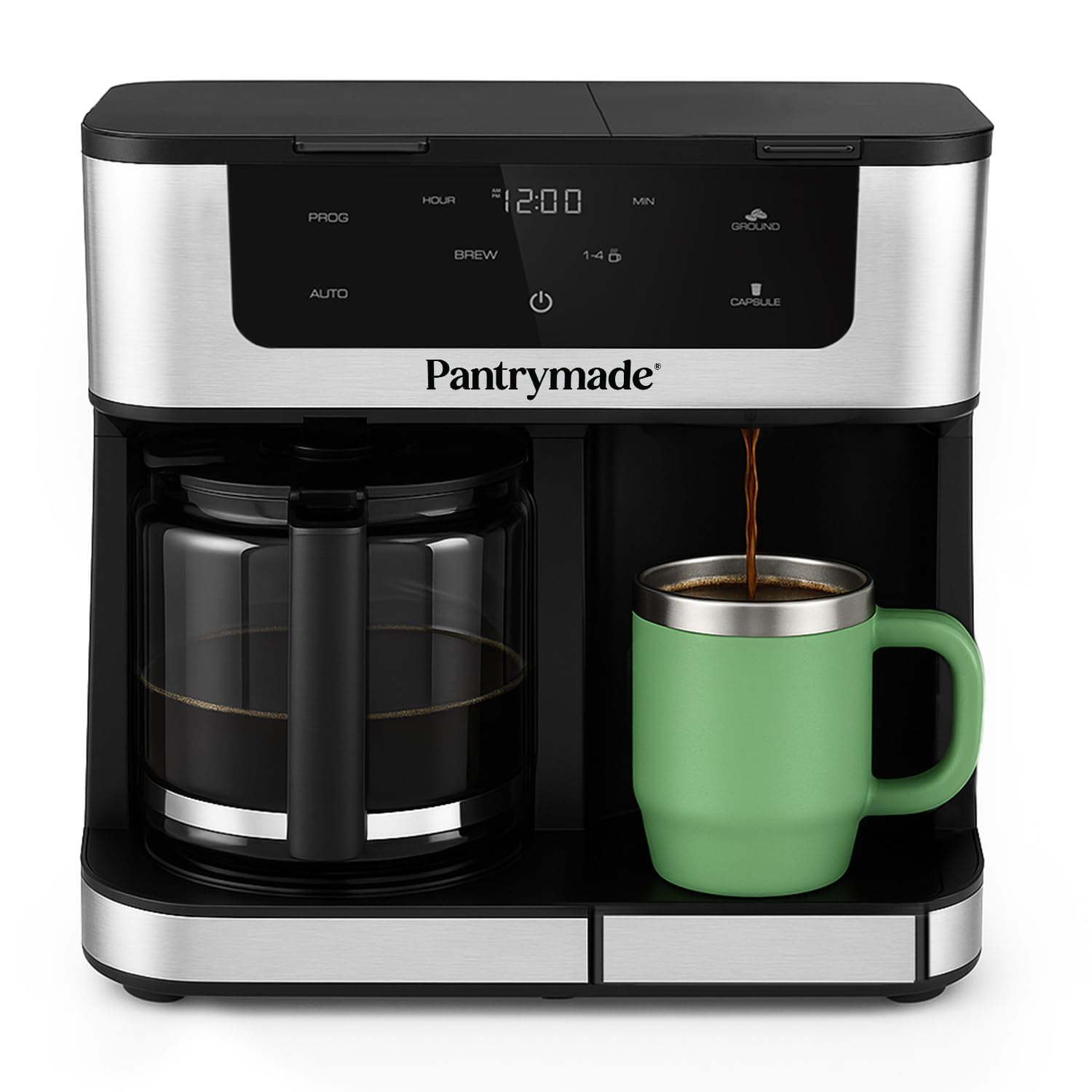
Pantrymade is the kind of “newer name” that people often buy with mild skepticism—then keep because the machine does what it promised. The appeal is simplicity: one side for a full carafe, one side for a single serve pod, and a touchscreen interface that makes programming feel modern instead of button-cluttered. For many homes, that’s the whole goal: a clean coffee station that handles both solo mornings and guest mornings.
Owner feedback tends to emphasize three things: it makes good coffee, it’s easy to operate, and it looks nice on a coffee bar. That’s a strong “value satisfaction” combo. A surprisingly important real-life note from users is the physical build feel—some describe it as heavier and more substantial than expected, which matters when you’re trying to avoid the flimsy vibe some budget machines have.
The tradeoff is workflow on the single‑serve side. Some users mention needing to add water more often (or even per cup), which makes it feel less “fill once, brew all day” than shared-reservoir designs. If you don’t mind that—and many people don’t—this becomes a very practical “all-in-one” machine that keeps the counter clean and supports two brewing styles without drama.
Why it’s a smart buy
- Simple, modern interface – Touchscreen scheduling without a confusing learning curve.
- Two clear brewing zones – Easy to understand: carafe side vs single-serve side.
- Good everyday coffee – Owners often describe it as consistent and satisfying.
- Adjustable drip tray – Helps prevent splatter and fits travel mugs more comfortably.
Good to know
- Some workflows require more frequent water adding on the single-serve side than big shared-reservoir machines.
- It can be tall for some cabinet setups—plan refill space if your counter is under low shelves.
- It’s a newer name compared to legacy brands; long-term reputation is still being built.
Ideal for: value-focused shoppers who want an easy touchscreen combo brewer that looks good on the counter and covers both single cups and full pots.
14. AIRMSEN Dual Coffee Maker – The Feature‑Packed Budget Combo With Mixed Real‑World Consistency
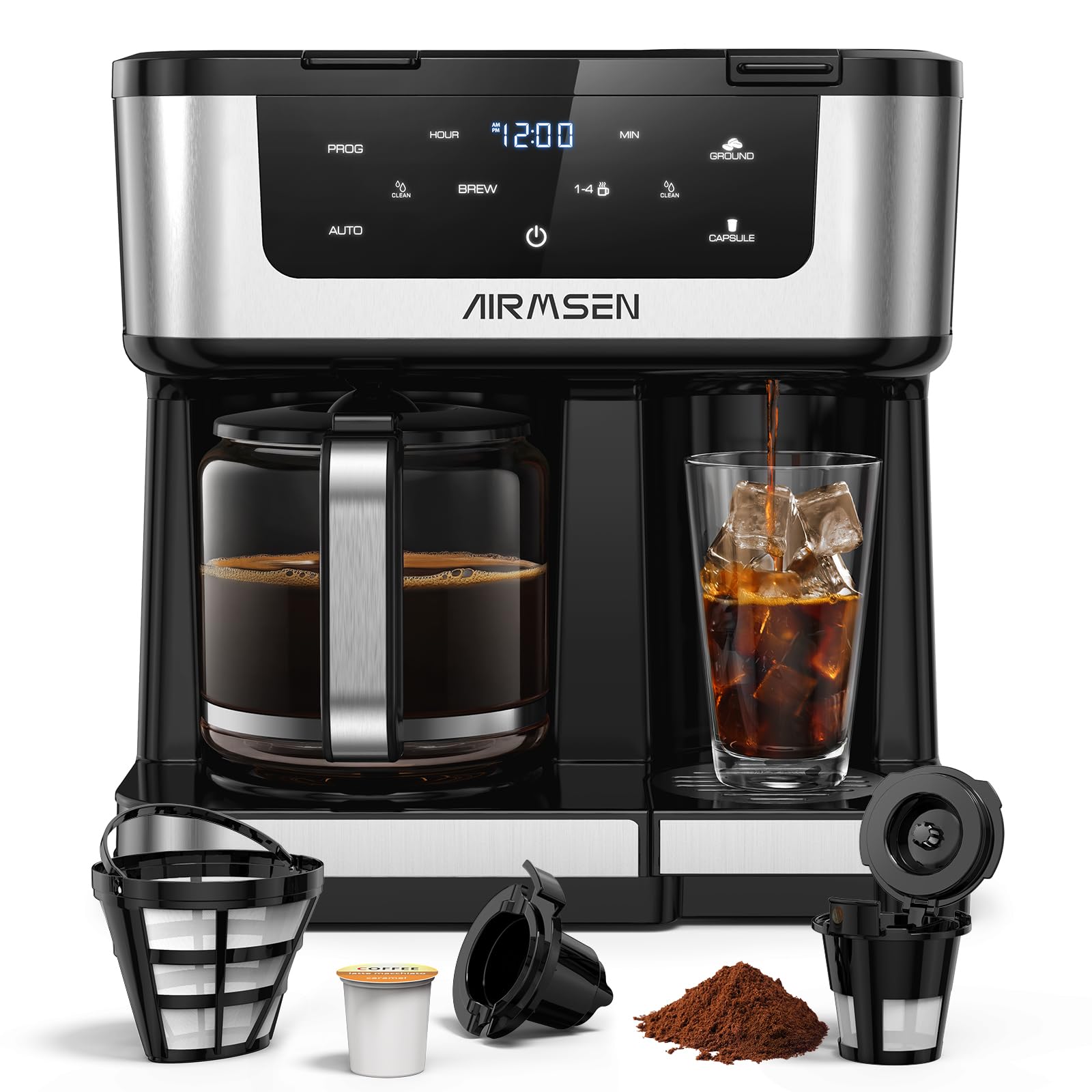
AIRMSEN’s combo brewer is the kind of machine that wins people over with features: touchscreen controls, scheduling, dual brewing methods, and a “coffee bar” look that feels more expensive than it is. In homes and offices, that’s attractive because it creates a clean, modern coffee station without jumping into premium-brand pricing.
When owners are happy, they describe it as easy to set up, quick to brew, and consistent enough for daily use. That’s the best-case scenario: you get a sleek combo brewer that behaves. Some also highlight that the coffee temperature is “drinkable” rather than scalding, which can be a plus if you hate burning your mouth first sip.
The caution is consistency. There are also reviews describing frustrating performance on the pod side (incomplete cups) and weaker heat on the pot side. That kind of split experience is common with budget combo machines: you can get a great unit, or you can get a unit that feels like it needs more refinement. If you’re comfortable with a value machine that may not feel as bulletproof as a legacy brand, it can be a strong “feature-per-dollar” choice. If you want maximum predictability, the premium picks above are safer bets.
Why you’ll like it
- Touchscreen convenience – Easy scheduling and simple settings for a modern workflow.
- Pods + grounds flexibility – Works for mixed households and offices with different preferences.
- Quick everyday brewing – When it performs well, it’s a smooth daily driver.
- Looks good on a coffee bar – Design matters when the machine lives on the counter.
Good to know
- Mixed owner feedback on pod-side consistency and carafe-side heat; performance can vary by unit and maintenance.
- Keep-warm behavior may feel short for slow sippers; this is better for “brew and drink” households.
- Budget machines reward careful cleaning and sensible fill habits to avoid clogs and weak output.
Ideal for: budget-focused buyers who want touchscreen programming and dual brewing flexibility—especially for home offices or shared spaces.
15. Hamilton Beach 2‑Way Hot & Iced (47500J) – Single Cups Without Pods (Less Waste, More Control)

This model is important in a “K‑Cup combo” conversation because it solves the same household problem—single cup vs full pot—without using pods. If you’re tired of the cost and waste of pods, or you simply prefer the taste of ground coffee, this is the kind of two‑way machine that makes single cups feel practical again. You scoop grounds, brew a cup, and you’re done.
Owners who like this machine tend to love it for one reason: it feels like it gives them control back. You decide how much coffee you use, you can brew a full pot quickly, and the single cup option helps you avoid brewing a whole carafe just to waste it. There’s also enthusiasm around the iced feature—especially for people who want cold coffee without needing a separate “cold brew” setup.
The most common annoyance is carafe pouring behavior. Drips can be a thing, and for some people that’s a dealbreaker because it becomes a daily cleanup task. Another real-life note is heat: the hotplate can run very hot, which some people love and others find too aggressive. If you prefer gentler warming, you may want a thermal carafe machine instead.
Why you’ll like it
- Pod-free single cups – Less waste and more control over flavor strength.
- Hot + iced modes – Easy iced coffee workflow without buying another appliance.
- Quick carafe brewing – Owners often describe it as fast and convenient for daily pots.
- Simple “scoop and brew” single serve – The included scoop approach keeps it easy.
Good to know
- Carafe pouring can drip for some users; many pour over the sink to keep counters clean.
- Hotplate heat may feel intense if you’re a slow sipper; it’s better for “brew and drink” households.
- Not K‑Cup compatible—this is for people intentionally choosing ground coffee instead of pods.
Ideal for: pod-free households who want the convenience of single cups and the usefulness of a full pot, plus an easy path to iced coffee.
16. Hamilton Beach 2‑Way (49933, White) – The “Daily Driver” Two‑Way Brewer That Avoids Pods
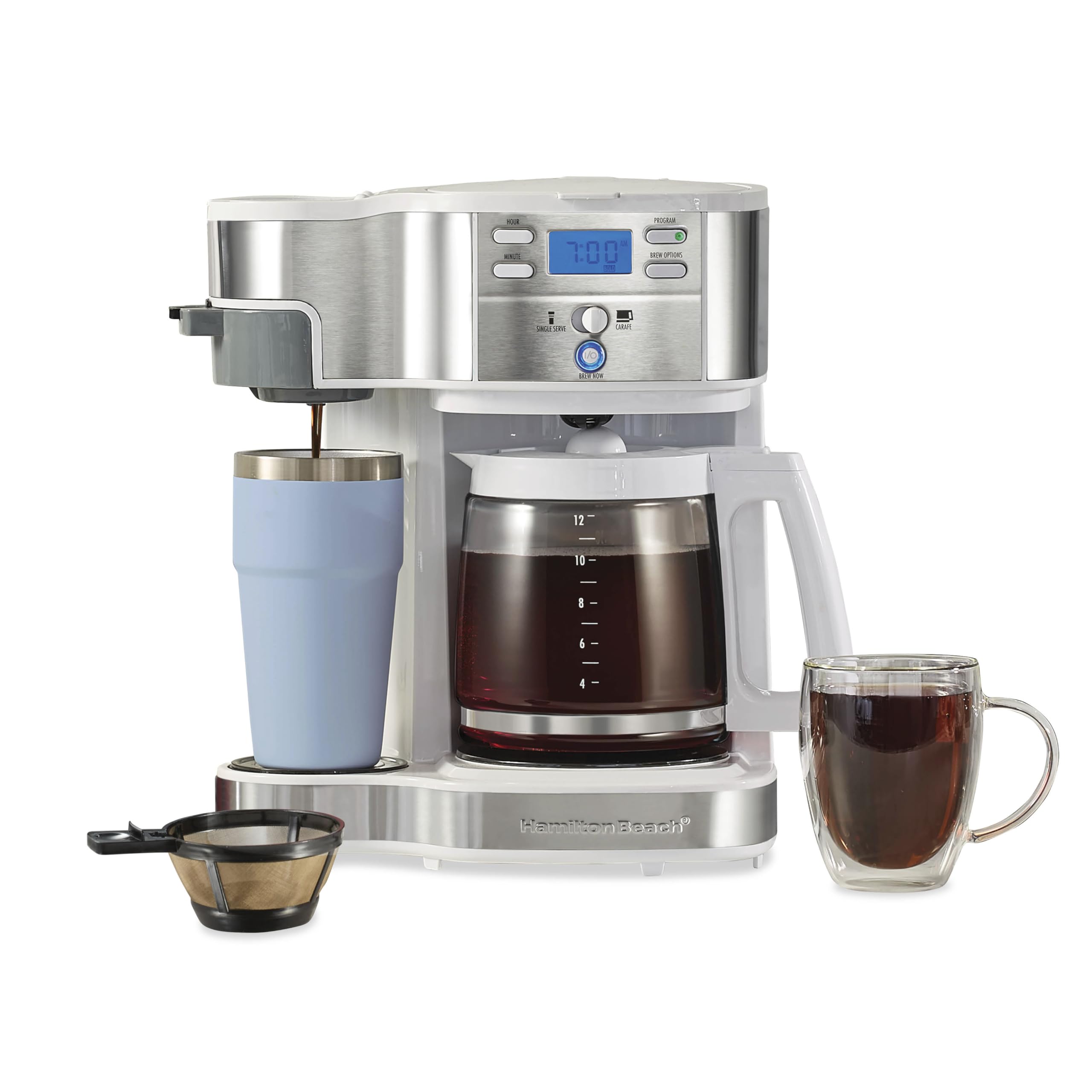
This is one of those machines that people buy because it’s practical… then keep because it’s quietly good at being a coffee maker. The “two-way” concept is simple: one side makes a full pot, one side makes a single cup, and you can do it all with ground coffee. If you love good beans and hate the idea of pods, this kind of design can feel like the most sensible coffee station you’ve ever owned.
Owners who love it tend to describe it with the kind of praise that actually matters: it’s easy to use, the coffee is hot, it brews quickly, and the timer feature makes mornings smoother. There’s also appreciation for the single-serve grounds basket concept because it reduces waste and lets you tune strength naturally—more grounds for stronger coffee, less for lighter.
The main complaint is single‑serve speed. Compared to pod systems, a ground-basket single cup can feel slower, and some users call the setup awkward if the basket shifts or gets bumped. In practice, once you learn your routine—scoop, set, brew—it becomes second nature. If you want the fastest possible single cup, choose a pod machine. If you want pod-free control, this is a very satisfying daily driver.
Why people love it
- Pod-free single cups – Control flavor and reduce waste without losing convenience.
- Hot, satisfying drip coffee – Many owners describe the coffee as especially hot and flavorful.
- Timer-friendly routine – Set it up, wake up, pour—classic and effective.
- Versatile cup fit – The platform system helps accommodate different mug sizes.
Good to know
- Single-serve brewing can feel slower than pod systems; it’s the tradeoff for using grounds.
- Basket handling can feel fiddly until you develop your routine.
- Not compatible with K‑Cup pods—this is intentionally built for ground coffee.
Ideal for: pod-free households who want a reliable two‑way setup and enjoy controlling coffee strength with grounds instead of pods.
17. Hamilton Beach 2‑Way (49980RG, Black) – The Same Pod‑Free Concept in a Classic Black Finish

This model is essentially the same lifestyle solution as the 49933: pod‑free single cups and a full pot option in one unit, built around ground coffee. The reason it belongs in this guide separately is simple: many people care what lives on the counter. The black finish fits more kitchens, especially modern or stainless setups, and for some households that visual fit is part of “will we keep using it?”
The real‑life owner experience is familiar: people love the concept because it saves money on pods, reduces waste, and still gives the flexibility of a quick single cup or a full carafe. The machine shines when your routine is “one travel mug now, maybe a pot later.” It’s also popular with people who buy good beans and want the machine to get out of the way and let the coffee taste like coffee.
The most common “watch this” points are the same: the single-serve side may feel slower than pod machines, and the basket system requires a gentle, repeatable routine so nothing shifts or spills. If you treat it as a simple, reliable drip machine with two modes, it tends to deliver a very satisfying daily experience—especially for people who never wanted pods in the first place.
Why you’ll like it
- Pod-free savings and control – Brew single cups with your favorite grounds.
- Simple, familiar drip taste – Great for people who prefer classic coffee flavor.
- Countertop-friendly finish – The black + stainless look fits many kitchens.
- Two modes, one station – Full pot for guests, single cup for daily life.
Good to know
- Single-serve speed is slower than pod brewers; that’s the cost of avoiding pods.
- Some users mention awkwardness with the single-serve basket until they get used to it.
- If you want true K‑Cup compatibility, choose one of the pod-capable models above.
Ideal for: anyone who wants the two‑way “cup or carafe” lifestyle without pods, especially if you prefer the black finish and classic drip simplicity.
How Combo Brewers Actually Work (and Why Some Cups Taste Weak)
Here’s the truth: most “weak coffee” complaints are not about the coffee itself. They’re about extraction—how water moves through coffee (pods or grounds), how long it stays in contact, and whether the brew path is clean enough to maintain consistent flow. Combo brewers have more moving parts than single-purpose machines, so small issues show up faster.
1. Pod brewing is a tiny extraction window
A pod is a small dose of coffee. If you ask a small dose to produce a very large cup, the machine has to either: (a) push more water through quickly (watery), or (b) slow the flow and extract more (stronger, but can taste harsh if pushed too far). That’s why “smaller cup size + bold” is often the fastest path to a better cup.
- If your pod coffee tastes thin: choose a smaller cup size first, then use bold/strong mode.
- If it tastes bitter: choose a slightly larger cup size or use regular mode with a medium roast pod.
- If it tastes inconsistent: clean the needle area and descale—flow restrictions create weird extraction behavior.
2. Single-serve grounds baskets can be excellent… if the basket design is stable
Ground-basket single cups can taste great because you control dose and grind. But baskets that drain too quickly can produce light coffee unless you increase grounds or use a “bold” mode that changes water behavior. If your machine’s basket can shift or tip easily, your “single cup” experience will feel messy and slow. That’s why some households love ground-only two-way machines and others get annoyed by them.
3. Carafe taste is mostly about “what happens after brewing”
If your carafe coffee tastes great at pour one and tired at pour four, it’s usually the warming method, not the brewing method. Thermal carafes protect the coffee from continued heat. Hotplates keep coffee hot but can push taste toward cooked if the plate is aggressive or if the coffee sits too long. If you’re a slow sipper, thermal tends to feel like a taste upgrade.
4. Why “needle errors” and steam blowouts happen
Pod systems pierce and inject water through small channels. Fine coffee dust, mineral buildup, and puncture debris can clog these channels. When flow is blocked, pressure builds, and you can get partial brews, sputtering, steam release, or grounds mess. This is why the best long-term pod experiences come from machines that make needle cleaning easy—and owners who actually do it.
5. The simplest “stronger coffee” playbook (works on almost every machine)
- Use a smaller brew size (especially for pods).
- Use bold/strong mode if your machine offers it.
- Preheat your mug with hot water if you want coffee to stay hot longer without relying on the machine’s heat.
- Keep the brew path clean (needle area, drip tray, brew basket, and water reservoir).
- Use fresh coffee—old grounds and stale pods taste thin no matter what machine you buy.
If you follow that playbook, you’ll make better coffee on a “good” machine and you’ll also diagnose faster when a machine is drifting into maintenance issues.
FAQ: K‑Cup Combo Coffee Makers (Without the Confusion)
What’s the real advantage of a combo coffee maker?
Shared reservoir or split system—what should I pick?
How do I get stronger pod coffee without buying new pods?
Thermal carafe or hotplate—what tastes better?
Why do some machines drip all over the counter when pouring?
Is “brew over ice” worth it, or can I just brew hot coffee onto ice?
What causes pod-side mess or “grounds in the cup”?
Do ground-only “two-way” machines make sense in a K-Cup combo guide?
Which model should I buy if I want “one machine that makes everyone happy”?
Final Thoughts: The Best Coffee Maker With K-Cup Combo Is the One You’ll Actually Use
A combo coffee maker is supposed to reduce friction—not add new frustrations. The right one makes mornings feel smoother because it matches your household’s real rhythm: who drinks what, when, and how much effort you’re willing to spend to get there.
Here’s the fastest way to turn this guide into the right buy:
- Want the premium “most homes will love it” pick with thermal flavor stability? Start with the Cuisinart Coffee Center SS-21NAS. It’s the best balance of ease, versatility, and a carafe that stays enjoyable over time.
- Want the easiest Keurig-style workflow with a big shared reservoir? Choose the Keurig K-Duo Hot & Iced (Gen 2, MultiStream, 72oz). It’s built for “push a button” convenience with real carafe flexibility.
- Have two different coffee personalities at home (regular + decaf, pod + pot) and want separation? Pick the Cuisinart SS-15P1. The split-system feel can be a genuine household peacekeeper.
- Want lattes/cappuccinos and “coffee bar” variety without multiple appliances? Go for the Cuisinart Barista Bar SS-4N1NAS. It’s the “more fun drinks, less clutter” choice.
- Want fresh-bean aroma on drip days but still want pods sometimes? The Cuisinart Grind & Brew Plus SS-GB1NAS is the right kind of indulgence if you don’t mind maintenance.
- Need a slim footprint combo for tight counters? The Hamilton Beach FlexBrew Advanced 5-in-1 (49924) is the “small space, lots of options” answer.
- Want pod-free single cups and still want a full pot option? Choose the Hamilton Beach 2‑Way Hot & Iced (47500J) or the classic Hamilton Beach 2‑Way (49933) for “grounds only” control and less waste.
If you choose based on your actual routine—single cups first, carafes second, or truly both—you’ll end up with the best coffee maker with k-cup combo for your life, not just the one with the longest feature list. And that’s the difference between a machine you tolerate… and a machine you genuinely enjoy using.