
A running back’s success lives or dies by the first two steps after the handoff. Bulky, restrictive shoulder pads that lock up the shoulders or limit neck rotation create a split-second hesitation that a linebacker will exploit every time. The right set of pads for this position must deliver targeted impact protection for the deltoids, sternum, and clavicle while leaving the shoulder girdle free to swing, stiff-arm, and absorb contact from any angle.
I’m Mohammad Maruf — the founder and writer behind Drink4Good. Over the past several seasons, I’ve evaluated youth and high school shoulder pad designs across every major manufacturer, analyzing shell geometry, foam density, cantilever arch height, and articulation systems to identify which models genuinely support a running back’s unique movement patterns.
The market is flooded with one-size-fits-all lineman pads, so finding genuine football shoulder pads for running backs requires understanding how cantilever arch height, closure systems, and side-impact wings affect both protection and mobility during cuts, spins, and tackle absorption.
How To Choose The Best Football Shoulder Pads For Running Backs
Running backs absorb hits from every quadrant — head-on tackles, blindside blitzes, low ankle wraps, and high collar punches. A pad built for a lineman or linebacker will lock up the shoulders and restrict the arm carriage needed for ball security and stiff-arms. Here are the three specs that separate a true RB pad from a generalist shell.
Cantilever Arch Height and Profile
The cantilever arch sits over the trapezius and clavicle. Lineman pads use a tall, flared arch to spread impact across the upper back. Running backs need a low-profile or flat cantilever that sits flush against the shoulder contour. This design eliminates the shelf that catches on helmet rims during head-up tackles and allows the neck to rotate freely when scanning the field after a cut.
Side-Impact Wings and Deltoid Integration
Stingers and AC joint injuries happen when the shoulder is driven upward and inward. Running backs need pads with extended side wings or integrated deltoid pads that wrap around the lateral shoulder. Look for models where the deltoid padding is sewn into the arch plate or uses a hook-and-loop system that stays put during violent contact — loose deltoid pads that shift on contact provide a false sense of protection.
Closure and Belt System Security
A running back’s pad will shift laterally more than any other position due to rotational cuts and spin moves. The closure system — whether nylon clips, biothane straps, or PVC belts — must lock the body of the pad against the torso without pinching or digging in. Models with a Z-fit or articulating belt system hold the chest plate centered over the sternum even after a fifteen-yard scramble, preventing the pad from drifting into the armpit and exposing the ribcage.
Quick Comparison
On smaller screens, swipe sideways to see the full table.
| Model | Category | Best For | Key Spec | Amazon |
|---|---|---|---|---|
| Battle Sports Defender | Premium | Varsity / High School RB | Aerospace-grade plastic / articulating chassis | Amazon |
| Battle Sports Phantom | Mid-Range | Youth / 8U Skilled Position | Leaf spring shock absorption / 16 x 12 x 4 in | Amazon |
| Riddell Surge Youth | Mid-Range | Youth RB with Back Protection | Built-in back plate / flat pad design | Amazon |
| Riddell Pursuit Youth | Mid-Range | Small / Lightweight Youth RB | Z-fit nylon clip belt system | Amazon |
| Schutt Y-Flex Youth | Budget | Youth All-Position Entry | Sleeker arch design / 3 lb weight | Amazon |
| Schutt Y-Flex 4.0 | Budget | Youth League / Travel Ball | Varsity-level protection / extended pad length | Amazon |
| Champro Gauntlet II | Budget | JV / Home Practice | Low-profile cantilever / impact diffusion | Amazon |
In‑Depth Reviews
1. Battle Sports Defender Football Shoulder Pads
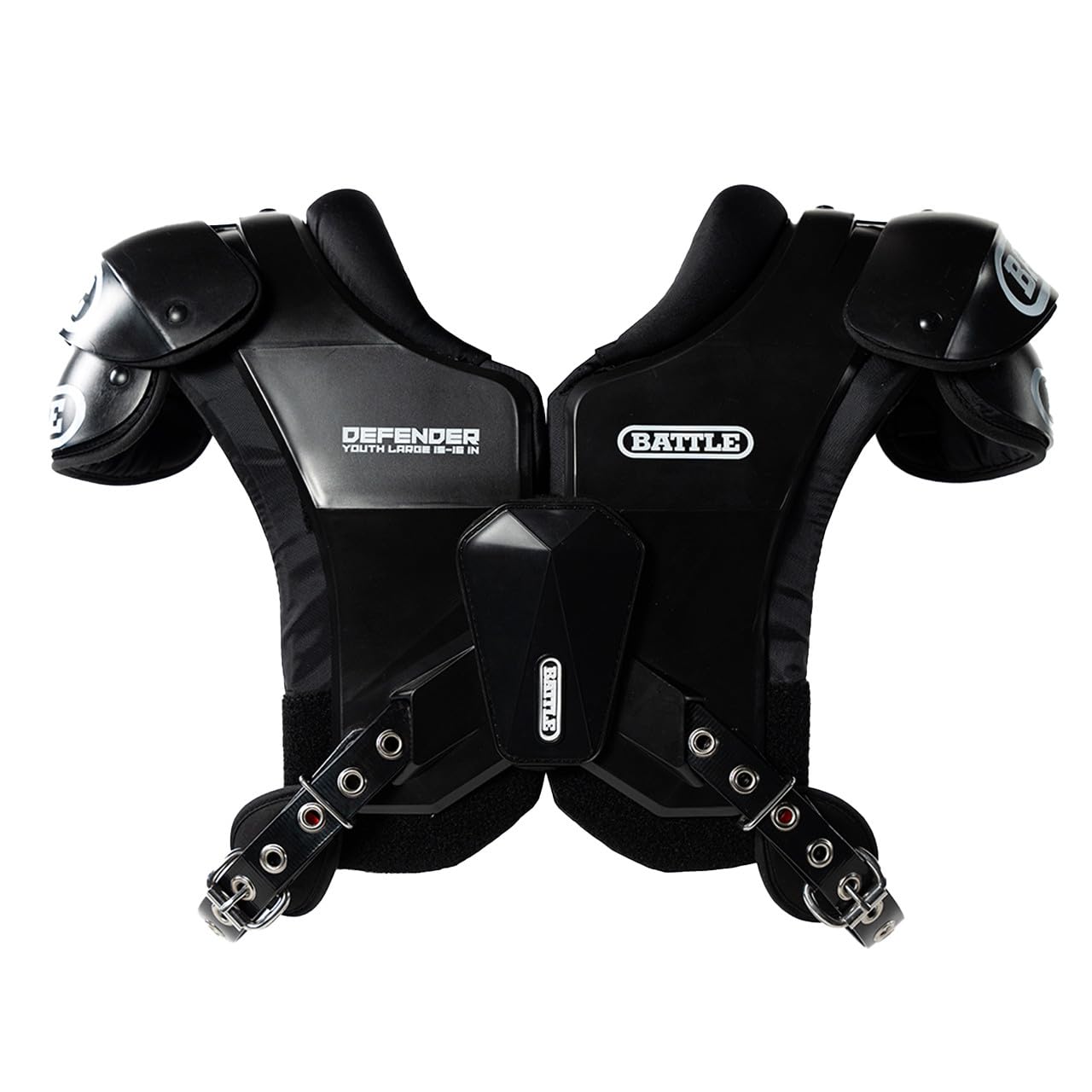
The Defender uses aerospace-grade materials to shave weight without sacrificing impact dispersion — the shell is noticeably stiffer than standard polypropylene youth pads, yet the articulating chassis moves with the scapula during overhead arm swings. The foam neck roll and removable sternum protector provide coverage where running backs absorb the most punishment: the upper chest and clavicle area during head-up collisions.
High school and varsity-level backs will appreciate the ventilation channels that reduce heat buildup during two-a-days. The biothane straps don’t stretch or loosen after repeated contact, and the buckle closure locks the pad body in place even during spin moves. At 1.23 kilograms, this is one of the lightest fully-featured pads on the market, which directly translates to less fatigue in the fourth quarter when yards are hardest to earn.
Some users noted the plastic shell cracked after weeks of intense practice, though this appears isolated to specific size runs. For most programs, the Defender’s balance of flexibility, weight, and sternum coverage makes it the premium pick for a starting varsity running back.
Why it’s great
- Articulating chassis allows full shoulder rotation for ball security
- Ventilated airflow system keeps core temperature down during long drives
Good to know
- Premium price point may be overkill for recreational leagues
- Limited colorway options for team-matching requirements
2. Battle Sports Phantom Football Shoulder Pads

The Phantom employs leaf spring technology inside the arch, a mechanical shock absorber that compresses on impact and rebounds without transferring the full force to the AC joint. For a youth running back who takes repetitive hits while learning to lower the shoulder, this energy dispersion reduces the stinger sensation that makes kids flinch before contact. The raised molded chest plate adds a permanent sternum protector without adding the bulk of a separate insert.
At just 16 x 12 x 4 inches, the Phantom’s footprint is compact enough for 8U players but still offers extra-wide internal cushioning for side impact protection. The adjustable belt system includes a strap management slot that prevents loose webbing from flapping during sprints. Youth coaches report that the wide-coverage foam neck roll protects the cervical spine without limiting the pre-snap head turns required for reading defenses out of the backfield.
The shell’s low profile means it layers well under a jersey without puffing out, making it harder for tacklers to grab pad fabric on a breakaway run. This is the best option for a youth program transitioning from flag to tackle, where the running back needs a confidence boost from reliable protection.
Why it’s great
- Leaf spring system absorbs shock without transferring energy to the shoulder joint
- Adjustable belt system with slot management prevents strap drift during cuts
Good to know
- Chest plate may feel bulky for very slender frames
- Neck roll is fixed — not removable for players who prefer less cervical coverage
3. Riddell Surge Youth Shoulder Pad

The Surge is the only mid-range pad in this group that ships with a built-in back plate, a critical feature for running backs who take hits while falling forward or getting driven from behind. The flat pad design sits low across the shoulder, minimizing the interference with helmet rotation that taller cantilevers create — a common complaint among backs who wear the Surge and a Riddell helmet combo. The PVC adjustable belts lock the pad in place without the slippage that side-mounted nylon clips sometimes develop.
The velvet collar lining prevents the abrasive chafing that develops on the trapezius after repetitive contact, and the removable/adjustable bodies let coaches fine-tune the torso fit without swapping the entire unit. Multiple parents report that the Surge dramatically improved their child’s confidence attacking the line of scrimmage after switching from a generic all-position pad. The chest plate covers the sternum without protruding, so the player can still secure the football across the chest without the pad pushing the ball loose.
At this price point, the inclusion of a back plate and flat cantilever design represents exceptional value for a youth back who needs both cervical freedom and lower-spine protection.
Why it’s great
- Built-in back plate provides lower spine protection at a mid-range price
- Flat pad design keeps helmet rotation unhindered for better field vision
Good to know
- PVC belts may feel stiff before break-in in cold weather
- Size M may not accommodate very thin players under 65 pounds
4. Riddell Pursuit Youth Shoulder Pad

The Pursuit was designed specifically for smaller youth athletes, and its Z-fit belt system is the standout feature for running backs who struggle to don pads independently. High-strength nylon clips replace traditional screw-in straps, letting a 9-year-old snap the pads closed without adult help — a convenience that matters during practice rotations. The flat pad profile sits low enough to avoid the “pad-helmet collision” that bothers backs who take direct hits while lowering the shoulder.
Integrated deltoid pads are sewn directly into the arch plate, eliminating the shifting that happens with strap-on deltoids. This is especially important for running backs who carry the ball in the outside arm — the padding stays positioned over the AC joint even when the arm is raised for a stiff-arm. The hook-and-loop closure allows fine adjustment of the side bodies, accommodating growth between seasons without needing a completely new pad.
At a size small, the Pursuit fits a 50-pound 9-year-old cleanly while still providing varsity-grade protection in the chest and shoulder zones. It’s the lightest option in the Riddell lineup, which matters for young backs still developing the neck and shoulder strength to carry a full-sized pad.
Why it’s great
- Z-fit nylon clips enable independent on/off for young players
- Integrated deltoid pads stay in place during stiff-arm and carry motions
Good to know
- Limited to smaller frames — may not fit youth above 90 pounds
- No back plate included for lower spine protection
5. Schutt Y-Flex Youth

The Y-Flex Youth streamlines Schutt’s traditional arch design into a sleeker profile that sits closer to the shoulder, reducing the lever arm that takes impact force up into the neck. The wider neck opening allows a running back to drop into a three-point stance and still make pre-snap line calls without the pad edge digging into the jaw. Weighing only 3 pounds, it’s light enough for a 10-year-old back to wear without fatigue during a full game.
The T-hook strap system provides a secure, snug fit that doesn’t loosen after repeated tackling drills. Parents report the pads lasted two full seasons for a grandson playing travel football — the plastic shell showed minimal stress marks, and the foam retained its shape without collapsing. The all-purpose design accommodates any position, but the sleeker arch specifically benefits running backs who need to swing their arms wide for stiff-arms without the epaulet catching on a defender’s face mask.
The black/neon green colorway provides high visibility under stadium lights, but players on strict uniform codes may prefer a single-color shell. This is a solid entry-level pad for a youth back moving up from flag football who needs reliable protection without the complexity of multi-piece adjustment systems.
Why it’s great
- Wider neck opening improves pre-snap head rotation for reading defenses
- T-hook strap holds secure through full games without re-tightening
Good to know
- Limited color options may not match all team uniforms
- Not designed for varsity-level impact frequency
6. Schutt Y-Flex 4.0 Shoulder Pads
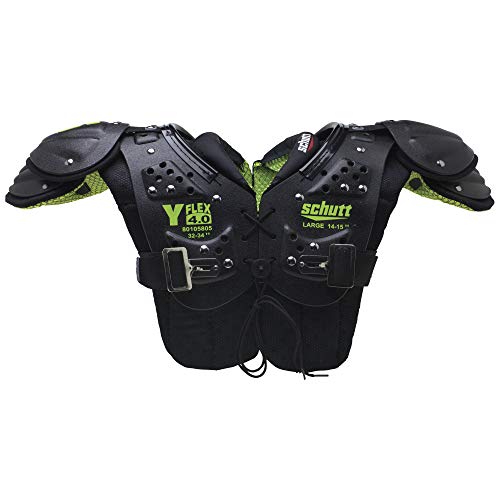
The Y-Flex 4.0 sits in the sweet spot between entry-level cost and varsity-grade protection. The extended pad length covers more of the upper ribcage — a vulnerable zone for running backs who take hits while falling forward. Despite the longer coverage, the all-purpose design keeps the weight manageable for a youth player, though at 0.01 ounces the listed spec appears to be a typo; actual handling weight is comparable to other youth Schutt models around 2.5-3 pounds.
Multiple customer reviews note that the Y-Flex 4.0 matched or exceeded the protection quality of pads from major sporting goods retailers at roughly half the cost. The pull-on closure and hook-and-loop adjustment make fitting straightforward for parents who aren’t familiar with football pad sizing. For a youth back playing both league and travel football, this pad provides the durability to survive multiple seasons without visible degradation of the foam or plastic components.
The pad’s bulky appearance can be a downside for backs who prefer a streamlined silhouette under the jersey, but the trade-off is genuine rib protection that many budget pads omit entirely.
Why it’s great
- Extended pad length covers upper ribs without adding significant weight
- Durable shell and foam rated for multiple seasons of travel ball
Good to know
- Bulkier profile may not create the streamlined look some players prefer
- Size chart may run slightly small — consider sizing up for growing players
7. Champro Gauntlet II Football Shoulder Pads

The Gauntlet II brings a low-profile cantilever design that reduces weight and increases freedom of movement — the exact geometry advantage running backs need. The impact diffusion system spreads the force of direct hits across a wider surface, which reduces the pinpoint sting of a shoulder-down tackle. Built-in deltoid pads and padded epaulets maximize cushioning in the zones where backs absorb contact most frequently.
Swivel front and back connectors allow the pads to move with the player’s torso twist during spin moves and jump cuts, creating a more natural feel than rigid-body pads. The hook-and-loop attachment system makes the deltoid pads and epaulets removable for cleaning — a practical feature for a position that generates significant sweat and field dirt. At 5 pounds, it’s slightly heavier than premium options, but the weight is distributed evenly across the shoulders and chest.
This is a genuine entry-level pad. One reviewer noted that the plastic arch and foam feel less dense than more expensive alternatives, making it suitable for JV or home practice rather than competitive varsity play. The Gauntlet II is a smart choice for a growing back who needs functional protection on a budget before investing in a higher-tier pad.
Why it’s great
- Low-profile cantilever design favors RB-specific mobility requirements
- Removable components simplify cleaning after sweaty practices
Good to know
- Foam density is lower than competitive varsity-grade pads
- Swivel connectors may loosen over extended use
FAQ
What makes running back shoulder pads different from lineman pads?
Should I buy shoulder pads with a built-in back plate?
How should running back shoulder pads fit?
Final Thoughts: The Verdict
For most users, the football shoulder pads for running backs winner is the Battle Sports Defender because its articulating chassis and aerospace-grade shell provide varsity-level protection without sacrificing the range of motion needed for ball security and stiff-arms. If you want integrated back protection at a mid-range price, grab the Riddell Surge. And for a youth player transitioning from flag to tackle who needs uncompromised mobility, nothing beats the Battle Sports Phantom with its leaf spring shock system.